
Construction Robot Market Share, Growth & Forecast by 2034
Coverage: By Automation (Fully Autonomous, Semi-Autonomous); Function (Demolition, Bricklaying, 3D Printing, Concrete Structural Erection, Finishing Work, Doors and Windows Installation); Application (Public Infrastructure, Commercial and Residential Buildings, Nuclear Dismantling and Demolition, Others) , and Geography (North America, Europe, Asia Pacific, and South and Central America)
- Status : Data Released
- Report Code : TIPEL00002504
- Category : Electronics and Semiconductor
- No. of Pages : 150
- Available Report Formats :


- Last update date : September 28, 2026


2025 Market Size
US$ 1.62 Bn
Base year value
2034 Forecast
US$ 7.24 Bn
Projected by 2034
CAGR 2026-2034
18.10 %
Growth rate
Addressable Market
US$ 36.67 Bn
(2026-2034)
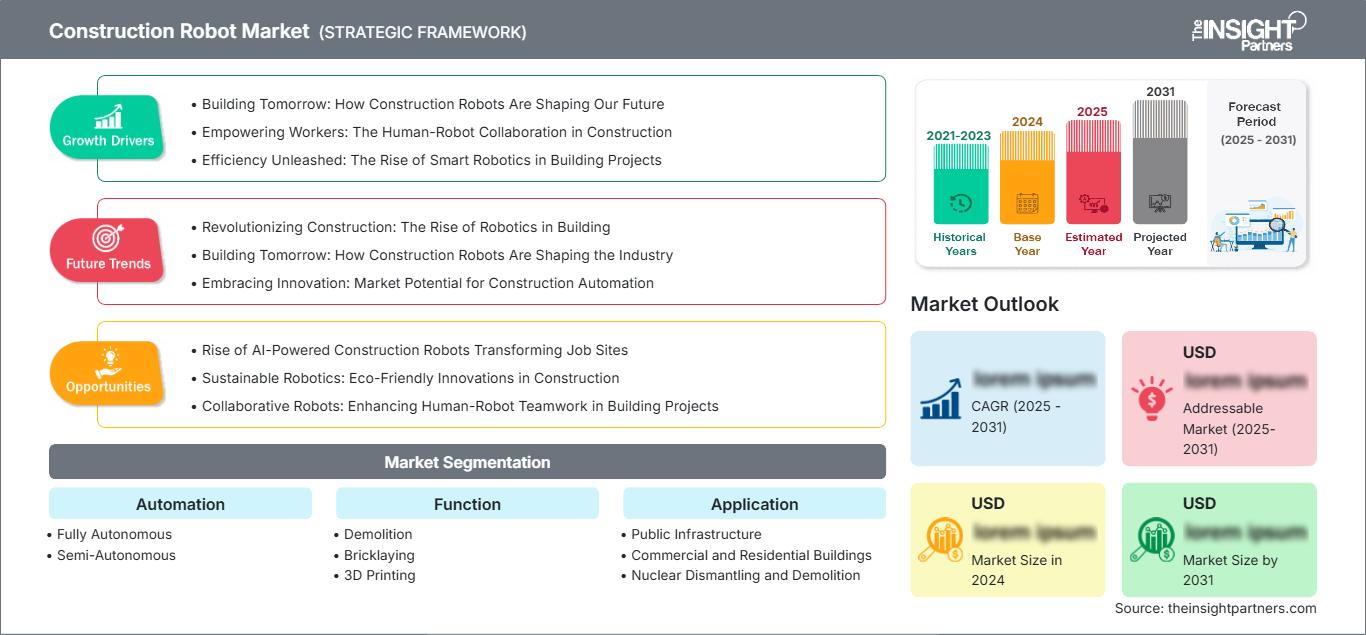
The Construction Robot market size reached a valuation of US$ 1.62 Billion in 2025 and will grow to a value of US$ 7.24 Billion by 2034, growing at a CAGR of 18.10% between 2026 and 2034. This growth in demand is influenced by a shortage of skilled labor, stringent on-site safety concerns, digitization of construction processes, and reduced time taken by projects due to infrastructure, commercial, residential, and hazardous demolition applications.
The North American region will continue to be one of the key regions for adoption, owing to infrastructure development, the construction of data centers, and the increasing likelihood of contractors testing out robotic systems such as rebar tying, layout, demolition, and drilling. The North American region is expected to grow at a CAGR of 17.2–18.6% over 2034.
Construction Robot Market Assessment and Insights
- North America accounted for 34–37% share in 2025 and is projected to grow at 17.2–18.6% CAGR between 2026–2034, driven by highway, bridge, data center, and industrial construction automation.
- US represented 78–82% of North America in 2025 and is expected to grow at 17.5–18.8% CAGR as contractors deploy robotics for labor-intensive field tasks.
- Europe held 24–27% share in 2025 and is likely to grow at 16.4–17.8% CAGR, led by Germany, the UK, France, Italy, and Spain.
- Asia Pacific captured 25–28% share in 2025 and is forecast to grow at 19.4–20.8% CAGR, supported by China, Japan, South Korea, India, and Australia.
- Largest Segment Semi-Autonomous systems held 55–58% market share in 2025 and are projected to grow at 17.0–18.3% CAGR due to practical human-machine workflows.
- High Growth Segment Fully Autonomous systems held 42–45% market share in 2025 and are expected to grow at 19.0–20.6% CAGR as AI navigation improves.
- Key companies analyzed in detail: Advanced Construction Robotics, Inc.; Autonomous Solutions, Inc.; Construction Robotics, LLC; Conjet AB; CYBERDYNE Inc.; Giant Hydraulic Tech Co., Ltd.; Husqvarna AB; Komatsu Ltd.; RoboTerra Inc.; RobotWorx.
Source: The Insight Partners' analysis based on proprietary research, government publications, company annual reports, investor presentations, industry databases, and expert interviews.
While commercial applications have shifted from single task tests to more repeatable deployments in rebar tying, demolition, concrete printing, layout, and façade installation, the dynamics of production have undergone changes through the combination of robust machines with cloud monitoring, fleet management, and job site data collection. Thus, the Construction Robot Market is changing from equipment sale to service-led automation where uptime, training, integration, and schedule compression drive purchase decisions.
In terms of future growth drivers, the market is anticipated to expand to cover Asia, the Middle East, and some renovation projects in Europe due to the need for safe execution of infrastructure projects, nuclear decommissioning, and high-rise building constructions. Investment has been made in robotics as a service offering, AI-perception technology, and modular building interface systems. Worker safety and emission regulations will also boost the market.
Construction Robot Market Report Scope
| Report Attribute | Details |
|---|---|
| Market size in 2025 | US$ 1.62 Billion |
| Market Size by 2034 | US$ 7.24 Billion |
| Global CAGR (2026 - 2034) | 18.10% |
| Historical Data | 2021-2024 |
| Forecast period | 2026-2034 |
Construction Robot Market Analysis
Factors driving Construction Robot Market expansion include consistent scarcity of skilled labor, increasing cost of wages, and a need to maintain distance between the worker and dust, vibration, heights, and confined space risks. Automation can be effective where the work is repetitive, quantifiable, and physically demanding, such as rebar tying, demolition, drilling, bricklaying, and heavy construction of structures.
The environment consists of robot original equipment manufacturers (OEM), construction equipment manufacturers, software vendors, contractors, rental companies, and regulatory authorities for safety compliance. The supply chain is specialized because robots have to withstand dust, vibration, rough terrains, and changes in the site landscape. Vendors with hardware and BIM integration solutions perform better than those selling standalone machines.
Construction Robot Market Analysis highlights a competitive industry that is characterized by specialized robotics suppliers and diversified machinery manufacturers. Advanced Construction Robotics, Inc. specializes in automated rebar solutions, Conjet AB and Husqvarna AB concentrate on demolition and concrete cutting, whereas Komatsu Ltd. is responsible for automation of heavy equipment and site digitalization.
The focus of investment is moving towards technologies capable of supporting fleet operations, autonomy upgrades, and services that reduce contractor financial exposure. The leading competitors in the market are Autonomous Solutions, Inc., Construction Robotics, LLC, CYBERDYNE Inc., Giant Hydraulic Tech Co., Ltd., RoboTerra Inc., and RobotWorx.
● REPORT CUSTOMIZATION
Tailor This Report To Align With Your Specific Business Requirements
This report can be customized to align precisely with your business objectives, scope, and target markets. Customization options include tailored segmentation, geography, competitive analysis, and strategic insights to support informed decision-making.
Customize This Report →WHAT YOU CAN ADJUST
- ● Segmentations
- ● Geography
- ● Competitive Analysis
- ● Language Preferences
Construction Robot Market: Strategic Insights
Regional Insights
North America Construction Robot Market
North America contributed to 34–37% of total revenue in 2025 and will experience growth at 17.2–18.6% CAGR. Growth of the Construction Robot Market share in North America is fueled by infrastructure development expenditure, data center expansion, bridges renovation, and increased use of robotics for demolition works due to safety concerns.
Construction robot demand is highest in application where efficiency of production can be calculated in terms of time saved or reduced labor hours spent. Robotic as a Service model contributes to better access to robots among contractors who prefer to spend money on operation rather than capital costs.
U.S. Construction Robot Market
The United States accounted for 78%-82% of North America’s market share in 2025 and is anticipated to expand at a compound annual growth rate of 17.5%-18.8%.
Advanced Construction Robotics, Inc., Autonomous Solutions, Inc., Construction Robotics, LLC, RoboTerra Inc., and RobotWorx are companies offering domestic relevance through field automation, robotic integration, robotics in education, and industrial robotics reselling. The applications are likely to be rebar tying, drilling, layout, demolition assistance, and automation of existing equipment.
Europe Construction Robot Market
In 2025, the Europe segment represented 24-27% market share and expected to grow at 16.4-17.8% CAGR. The German market dominates due to advanced industrial automation and precise engineering. In the United Kingdom, acceptance is driven by infrastructure modernization and limited urban construction, in which safety and efficiency are essential procurement criteria.
The French, Italian, and Spanish markets develop through renovation activities, infrastructure construction, and the use of demolition or finishing robots. The European regulations focused on worker safety, dust control, and low-emissions technologies benefit electric demolition robots and remote concrete removal machines made by specialized manufacturers.
APAC Construction Robot Market
APAC captured 25–28% share in 2025 and is forecast to grow at 19.4–20.8% CAGR, making it the fastest-expanding region. China leads by construction scale, while Japan and South Korea emphasize automation to offset aging workforces and high safety expectations.
India and Australia add momentum through infrastructure pipelines, mining-linked civil works, and urban development. Komatsu Ltd., CYBERDYNE Inc., and regional integrators support adoption through equipment intelligence, assistive robotics, and industrial automation capabilities. Policy focus on smart cities and resilient infrastructure strengthens long-term demand.
Middle East & Africa Construction Robot Market
Middle East and Africa is projected to grow at 17.0–18.4% CAGR, led by Saudi Arabia and the UAE. Large infrastructure, energy, tourism, and industrial city programs create demand for robotic concrete, demolition, and finishing solutions on projects with tight delivery schedules.
South Africa and the rest of MEA show selective adoption where mining, industrial maintenance, and hazardous demolition require remote or compact machines. The Construction Robot Market remains early-stage in the region, but rental models and imported specialist systems can accelerate uptake.
Segmentation Analysis
Automation
The automation segment is expected to grow at 18.0–19.2% CAGR during 2026–2034. Construction Robot Market scope within automation is shaped by contractors’ need to balance autonomy with site supervision, safety rules, and variable field conditions. Semi-autonomous systems dominate today because they complement crews, while fully autonomous systems gain traction in controlled or repetitive environments.
- Fully Autonomous platforms are strategically important for repetitive, digitally mapped, or remote tasks where navigation, perception, and machine control can reduce direct labor dependency.
- Semi-Autonomous systems retain operator oversight while automating high-frequency motions, making them attractive for contractors seeking measurable productivity gains without completely redesigning jobsite workflows.
Function
The function segment is projected to grow at 17.6–18.9% CAGR, reflecting wider use cases across demolition, masonry, additive construction, concrete assembly, finishing, and installation. Demand is strongest where robots improve safety or create direct schedule savings. Vendors increasingly design modular tool heads so one platform can support multiple construction tasks.
- Demolition robots hold strong market position because compact, remote-controlled systems work in hazardous, confined, or dust-intensive areas while keeping operators at safer distances.
- Bricklaying systems address productivity and consistency in masonry, particularly where labor shortages and repetitive wall construction create a clear return on automation.
- 3D Printing supports faster shell construction, design flexibility, and lower material waste, although adoption depends on codes, material certification, and project-specific engineering.
- Concrete Structural Erection robots assist with reinforcement, placement, and heavy repetitive work, making them strategically relevant in bridges, industrial buildings, and infrastructure projects.
- Finishing Work robots improve repeatability in sanding, spraying, surface preparation, and interior tasks where quality consistency and labor availability affect project schedules.
- Doors and Windows Installation remains emerging but important as façade precision, lifting assistance, and installation safety become priorities in high-rise and modular building workflows.
Application
The application segment is expected to grow at 18.2–19.6% CAGR as robotics penetrates public infrastructure, buildings, and nuclear dismantling. Public infrastructure provides the largest addressable base because bridges, roads, tunnels, and utilities involve repetitive structural work. Nuclear dismantling and demolition offer high-value demand where remote operation reduces exposure to hazardous environments.
- Public Infrastructure generates strong demand for rebar tying, concrete work, demolition, and inspection robots because agencies prioritize safety, repeatability, and schedule assurance.
- Commercial and Residential Buildings use robots for layout, bricklaying, finishing, and installation where standardized plans and labor constraints support scalable deployment.
- Nuclear Dismantling and Demolition is strategically important because remote-controlled robots reduce worker exposure and support precise material removal in regulated environments.
Opportunity Snapshot
| Application | Revenue Contribution | Trend Tag | Adoption Stage |
| Public Infrastructure | High | Bridge Automation | Scaling |
| Commercial and Residential Buildings | Medium | Layout Robotics | Scaling |
| Nuclear Dismantling and Demolition | Low | Remote Removal | Emerging |
Construction Robot Market Growth Drivers and Impact Analysis
Labor Shortages Push Contractors Toward Task Automation
Constraints on skilled labor for construction are some of the most direct forces due to the fact that robots have the ability to normalize the output in repetitive and physically tough operations. Operations such as tying rebar, drilling, laying bricks, and finishing work usually require crews that cannot be scaled up very fast. Through automating certain processes, the contractors are protected from any kind of absenteeism, tiredness, and inefficiency. The most significant effect on the market comes from projects with large areas or surfaces.
Safety Requirements Accelerate Remote and Robotic Operations
Construction robotics minimizes the risk associated with exposing workers to hazardous environments that include areas for demolition, confined spaces, height works, and hazardous disassembly work. Demolition robots and automated concrete disassembling equipment are particularly useful in environments where there is a need to control dust, vibrations, falling objects, and radiations. The commercial benefit of construction robotics goes beyond the need to comply with occupational safety regulations since it leads to lesser incidences that may cause interruptions to work.
Digital Construction Workflows Improve Robot Deployability
The effectiveness of robots increases with the ability to connect the design data with field implementation. The usage of BIM, digital layout documents, LiDAR scanning, and cloud technology in monitoring the progress makes it possible for robots to understand the requirements of the job site without much intervention by people. This enhances the efficiency of drilling, laying out, inspecting, and installing tasks. This effect builds up because contractors who automate their project controls can apply these procedures on several projects.
Construction Robot Market Future Trends
AI-Native Jobsite Robotics Platforms
Construction Robot Market trends include AI-nativism and learning from conditions at the site, commands from the operator, and documents associated with the project. In the future, robots will depend more on sensing and avoidance rather than following predetermined routes and planning tasks. The trend will open up new areas for application including renovation sites, repair of infrastructure, and multi-trades. Manufacturers who can create robust hardware with software that adapts will have an edge.
Robotics-as-a-Service Becomes a Procurement Model
Robotics-as-a-Service is set to be a future trend where robotics are made available to contractors without investing a lot of money upfront in the purchase of dedicated robotics for particular projects. This includes services such as training, maintenance, updating software, and providing reports on performance. This will fit well with the nature of the industry since it operates on a project basis and will help small contractors adopt automation technology.
Construction Robot Market Opportunities
Infrastructure Automation for Bridges and Transport Corridors
Public infrastructure offers the clearest near-term opportunity because bridges, tunnels, roads, and utilities involve repeatable structural activities and measurable schedule targets. Construction Robot Market Forecasts indicate strong potential for rebar tying, concrete removal, drilling, inspection, and material handling systems. Vendors can target transport agencies, large contractors, and specialty subcontractors with proof-of-productivity data. The most attractive deployments will combine robotics with digital documentation so owners receive both completed work and verified progress records. Growing investments in smart infrastructure and public modernization programs will further accelerate adoption of robotic systems capable of operating with minimal disruption to traffic and surrounding communities. Integration with BIM platforms, AI-driven project monitoring, and cloud-based reporting will enable stakeholders to improve transparency, optimize maintenance planning, and deliver infrastructure projects with greater efficiency and accountability.
Hazardous Dismantling and Nuclear Decommissioning
Nuclear dismantling, chemical facilities, and high-risk industrial demolition create specialized opportunities for compact, remote-controlled, and sensor-equipped robots. These environments prioritize exposure reduction, precision removal, and compliance documentation over pure speed. Suppliers can differentiate through radiation-tolerant components, tool versatility, remote diagnostics, and operator training. Although volumes are lower than mainstream building applications, project values are higher and buying criteria are less price-sensitive when robots reduce human exposure and improve controlled dismantling outcomes. Advancements in autonomous navigation, real-time environmental sensing, and modular robotic attachments are expected to expand operational capabilities in hazardous locations. Increasing regulatory oversight and stricter worker safety standards will encourage organizations to adopt robotic solutions that enhance risk management, improve documentation accuracy, and support safer execution of complex dismantling and decommissioning activities.
Recent Developments
- February 2026: XTEND and JFB Construction Holdings announced a definitive US$1.5 billion all-stock merger to create XTEND AI Robotics, a Nasdaq-listed company focused on AI-powered autonomous drones and robotics. The combined company aims to accelerate U.S. manufacturing, expand defense and public safety solutions, and leverage JFB’s public market platform to scale XTEND’s technology globally.
- July 2026: SoftBank Group is reportedly considering the acquisition of Swiss construction automation startup Gravis Robotics in a deal valued at up to US$500 million (¥82 billion). The company develops AI-powered autonomous construction machinery, including excavators and bulldozers, aimed at improving productivity and addressing labour shortages. If completed, the acquisition would strengthen SoftBank’s physical AI strategy by expanding its robotics portfolio in construction and industrial automation.
- March 2026: ASI Robots acquired Scythe Robotics to expand its autonomous equipment portfolio across landscaping, construction, and agriculture. The acquisition integrates Scythe’s Sight AI vision system and M.52 autonomous mower with ASI’s Mobius® autonomy platform, strengthening its off-road robotics capabilities. The combined company aims to accelerate the deployment of AI-powered autonomous vehicles for industrial applications while addressing labour shortages and improving operational efficiency.
Frequently Asked Questions

- Comprehensive Market Sizing and Forecast Analysis
- Detailed Segmentation Analysis
- In-Depth Market Dynamics Assessment
- Regional and Country-Level Insights
- Competitive Landscape and Company Benchmarking
- Strategic Business Intelligence
Recent Reports
Testimonials

The Insight Partners' SCADA System Market report is comprehensive, with valuable insights on current trends and future forecasts. The team was highly professional, responsive, and supportive throughout. We are very satisfied and highly recommend their services.
RAN KEDEM Partner, Reali Technologies LTDs
I requested a report on a very specific software market and the team produced the report in a few days. The information was very relevant and well presented. I then requested some changes and additions to the report. The team was again very responsive and I got the final report in less than a week.
JEAN-HERVE JENN Chairman, Future Analytica
We worked with The Insight Partners for an important market study and forecast. They gave us clear insights into opportunities and risks, which helped shape our plans. Their research was easy to use and based on solid data. It helped us make smart, confident decisions. We highly recommend them.
PIYUSH NAGPAL Sr. Vice President, High Beam Global
The Insight Partners delivered insightful, well-structured market research with strong domain expertise. Their team was professional and responsive throughout. The user-friendly website made accessing industry reports seamless. We highly recommend them for reliable, high-quality research services
YUKIHIKO ADACHI CEO, Deep Blue, LLC.
This is the first time I have purchased a market report from The Insight Partners.While I was unsure at first, I visited their web site and felt more comfortable to take the risk and purchase a market report.I am completely satisfied with the quality of the report and customer service. I had several questions and comments with the initial report, but after a couple of dialogs over email with their analyst I believe I have a report that I can use as input to our strategic planning process.Thank you so much for taking the extra time and making this a positive experience.I will definitely recommend your service to others and you will be my first call when we need further market data.
JOHN SUZUKI President and Chief Executive Officer, Board Director, BK Technologies
I wish to appreciate your support and the professionalism you displayed in the course of attending to my request for information regarding to infectious disease IVD market in Nigeria. I appreciate your patience, your guidance, and the fact that you were willing to offer a discount, which eventually made it possible for us to close a deal. I look forward to engaging The Insight Partners in the future, all thanks to the impression you have created in me as a result of this first encounter.
DR CHIJIOKE ONYIA MANAGING DIRECTOR, PineCrest Healthcare Ltd.Reason to Buy
- Informed Decision-Making
- Understanding Market Dynamics
- Competitive Analysis
- Identifying Emerging Markets
- Customer Insights
- Market Forecasts
- Risk Mitigation
- Boosting Operational Efficiency
- Strategic Planning
- Investment Justification
- Tracking Industry Innovations
- Aligning with Regulatory Trends





 Get Free Sample for