
Cooled Thermal Infrared Detector Market Size, Share & Trends by 2034
Coverage: By Type (Vanadium Oxide (VOx), Amorphous Silicon (A-Si)); Application (Military and Defense, Commercial Use) , and Geography (North America, Europe, Asia Pacific, and South and Central America)
- Status : Data Released
- Report Code : TIPRE00023772
- Category : Electronics and Semiconductor
- No. of Pages : 150
- Available Report Formats :


- Last update date : September 28, 2026


2025 Market Size
US$ 469.20 Mn
Base year value
2034 Forecast
US$ 872.20 Mn
Projected by 2034
CAGR 2026-2034
7.13 %
Growth rate
Addressable Market
US$ 6,053.42 Mn
(2026-2034)
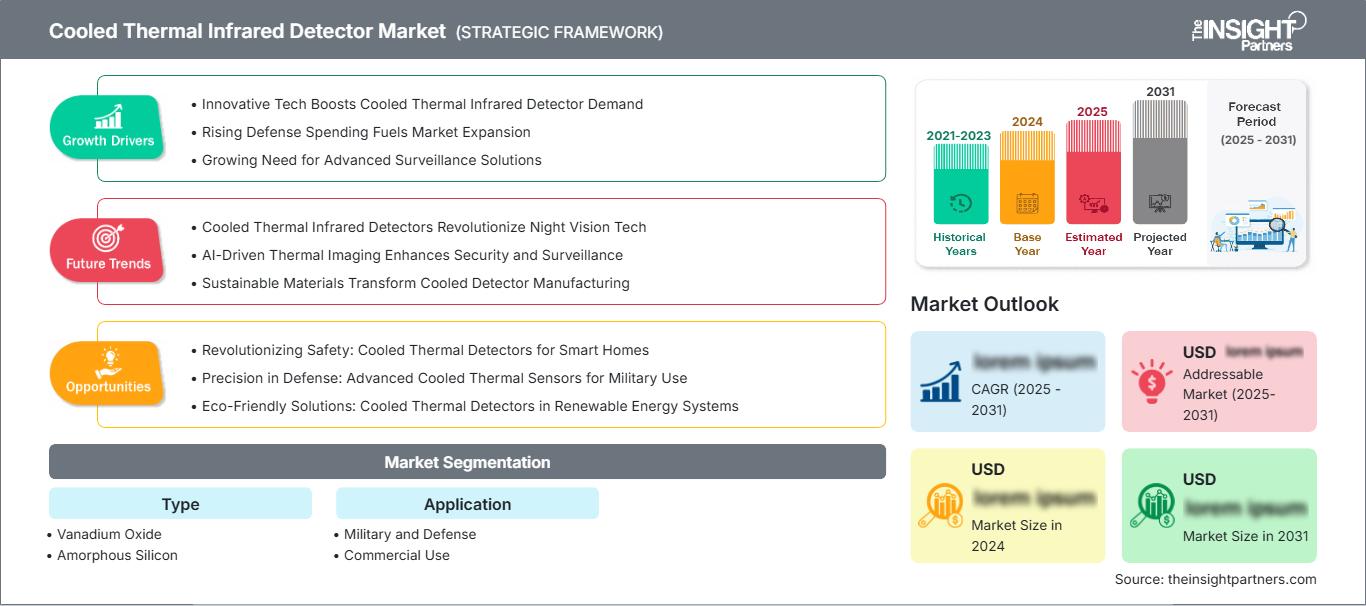
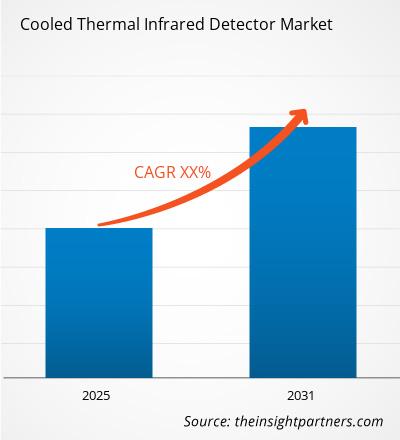
The Cooled Thermal Infrared Detector Market size has been evaluated at US$ 469.20 Million in 2025 and is expected to be worth US$ 872.20 Million by 2034, growing with a CAGR of 7.13% between 2026 and 2034. Drivers include the need for high sensitivity imaging in applications ranging from long distance surveillance and target detection to industrial testing, where cooling provides more robust signal detection compared to room temperature detectors.
North America will be exhibiting a CAGR of 6.8%-7.4% driven by continued modernization efforts within the defense sector, improved surveillance along its borders, upgrades to aerospace payloads, and the need to secure its critical infrastructure. The Cooled Thermal Infrared Detector Market value within North America is bolstered by US initiatives for EO/IR, local manufacture of sensors, and commercial use of thermal inspection systems.
Cooled Thermal Infrared Detector Market Assessment and Insights
- North America: The region holds 34–37% share in 2025 and grows at a CAGR range of 6.8–7.4% during 2026–2034, supported by defense EO/IR modernization, aerospace payload integration, and critical infrastructure surveillance.
- US: The country represents 79–83% of North America in 2025 and grows at a CAGR range of 6.9–7.5% during 2026–2034, led by military imaging programs.
- Europe: The region accounts for 24–27% share in 2025 and grows at a CAGR range of 6.4–7.0% during 2026–2034, with the UK, Germany, France, Italy, and Spain leading procurement.
- Asia Pacific: The region holds 26–29% share in 2025 and grows at a CAGR range of 7.8–8.6% during 2026–2034, led by China, Japan, South Korea, India, and Australia.
- Largest Segment: Military and Defense holds 66–70% market share in 2025 and grows at a CAGR range of 6.9–7.5% during 2026–2034 through ISR, targeting, and border surveillance programs.
- High Growth Segment: Commercial Use holds 30–34% market share in 2025 and grows at a CAGR range of 7.6–8.3% during 2026–2034 as precision inspection, gas imaging, and R&D adoption expand.
- Key companies analyzed in detail: Axis Communications AB; Bosch Security Systems, LLC; Leonardo DRS, Inc.; Teledyne FLIR LLC; Fluke Corporation; General Dynamics Mission Systems, Inc.; L3Harris Technologies, Inc.; Opgal Optronics Industries Ltd.; Lynred USA; Zhejiang Dali Technology Co., Ltd.
Source: The Insight Partners' analysis based on proprietary research, government publications, company annual reports, investor presentations, industry databases, and expert interviews.
Evolution in detector development is moving away from large, cooled camera-based sensors towards miniaturized and more lightweight devices which can be incorporated into aircraft, automobiles, ships, hand-held systems, and ground-based surveillance networks. Manufacturing trends are increasingly being driven by FPA production rates, cooler longevity, dewar assembly, export regulation, and calibration capabilities. Manufacturers who have the ability to design detectors, cooler design and installation, signal processing, and rugged packaging are better suited as purchasers look for longevity and stability under challenging conditions.
Future market growth is expected in Indo-Pacific defense systems, European border monitoring, Middle Eastern energy security programs, and commercial manufacturing with fast thermal imaging systems. The investments are expected to go into developing HOT MWIR detectors, smaller Stirling coolers, multispectral imaging, and advanced artificial intelligence image analysis. Favorable regulations are expected from defense readiness programs, aviation safety regulations, infrastructure hardening programs, and methane emission monitoring standards.
Cooled Thermal Infrared Detector Market Report Scope
| Report Attribute | Details |
|---|---|
| Market size in 2025 | US$ 469.20 Million |
| Market Size by 2034 | US$ 872.20 Million |
| Global CAGR (2026 - 2034) | 7.13% |
| Historical Data | 2021-2024 |
| Forecast period | 2026-2034 |
Cooled Thermal Infrared Detector Market Analysis
The cooled thermal infrared detector market growth factors include the need for long-range imaging due to low thermal contrast, fog, smoke, dark conditions, and long distances that hamper the use of visible imaging or uncooled detectors. The military favors cooled infrared detectors for use in ISR, target acquisition, missile warning, and naval observation, whereas the commercial industry favors cooled detectors for higher frame rates and sensitivity in applications such as non-destructive testing, semiconductor inspection, optical gas imaging, and scientific measurements.
The supply chain includes compound semiconductors, read out integrated circuits, focal plane arrays, cryogenic coolers, dewar cooler assemblies, optics, and image processing electronics. Supply is limited because of the complex nature of cooling technology and need for vacuum packaging, temperature control, calibration, and long certification process for cooled thermal infrared detectors.
Positioning in Cooled Thermal Infrared Detector Market analysis entails control over detector materials, cooler efficiency, military certifications, and camera assembly downstream. Leonardo DRS, Inc. and L3Harris Technologies, Inc. help develop defense solutions, whereas Teledyne FLIR LLC and Fluke Corporation focus on industrial and scientific imaging solutions. Axis Communications AB, Bosch Security Systems, LLC, Opgal Optronics Industries Ltd., Lynred USA, General Dynamics Mission Systems, Inc., and Zhejiang Dali Technology Co., Ltd. target surveillance, security, and specific thermal imaging needs.
Key investments will be made in coolers longevity, smaller pixel sizes, processor integration, shorter cooldown time, and payload capacity for multiple types of signals. Strategic positioning is gradually changing from a components supplier to an integrator that delivers imaging systems ready for customer use to minimize their integration efforts. Firms that have defense program presence, regional service capability, and proven performance record are capable of maintaining their margins despite procurement processes and growing supply chain resilience requirements.
● REPORT CUSTOMIZATION
Tailor This Report To Align With Your Specific Business Requirements
This report can be customized to align precisely with your business objectives, scope, and target markets. Customization options include tailored segmentation, geography, competitive analysis, and strategic insights to support informed decision-making.
Customize This Report →WHAT YOU CAN ADJUST
- ● Segmentations
- ● Geography
- ● Competitive Analysis
- ● Language Preferences
Cooled Thermal Infrared Detector Market: Strategic Insights
Regional Insights
North America Cooled Thermal Infrared Detector Market
North America holds 34–37% share in 2025 and is projected to grow at a CAGR range of 6.8–7.4% during 2026–2034. Cooled Thermal Infrared Detector Market share is supported by US defense procurement, Canadian border and maritime surveillance, and demand for EO/IR payloads in airborne, ground, and naval platforms. The region benefits from established prime contractors, domestic detector manufacturing, and strong test-range infrastructure.
Commercial demand is smaller but technically important, especially in aerospace testing, semiconductor process control, gas leak visualization, and high-speed laboratory thermography. Teledyne FLIR LLC, Leonardo DRS, Inc., L3Harris Technologies, Inc., General Dynamics Mission Systems, Inc., and Fluke Corporation provide North American depth across cooled cores, EO/IR systems, rugged electronics, and industrial cameras. Buyers emphasize reliability, export compliance, cybersecurity, and lifecycle support.
U.S. Cooled Thermal Infrared Detector Market
The U.S. accounts for 79-83% share of North America and registers a CAGR of 6.9-7.5% in 2026-2034. The demand driver comprises military and defense initiatives such as target designators, situational awareness of vehicles, missile warnings, border surveillance, and airborne ISR. There is extensive vendor representation from Leonardo DRS, Inc., Teledyne FLIR LLC, L3Harris Technologies, Inc., and General Dynamics Mission Systems, Inc. offering sensor and platform capability.
Trends among applications are third-generation FLIR upgrades, MWIR miniaturized payloads for unmanned systems, maritime surveillance, and commercial cameras used in automated operations and test laboratories. The U.S. customers require vendors to enhance the lifespan of coolers, minimize sustainment costs and continue manufacturing within the country when the program involves any sensitive defense operations. Commercial market will grow where fast thermal data can reduce scrap and improve safety.
Europe Cooled Thermal Infrared Detector Market
Europe represents a market share of 24-27% in 2025 and is set to witness a CAGR of 6.4-7.0% during 2026-2034. In Europe, the UK dominates due to its defense electronics, maritime surveillance, and airborne EO/IR. In Germany, industrial inspection, border security, and vehicle mounted systems play a vital role. France reaps the advantage due to detector experience, aerospace programs, and infrared supply chain presence.
Italy and Spain are contributing through their naval updates, infrastructure monitoring, and airport security applications. Increasing preference among European customers for sovereign or allied source, maintainability, and data/defense export compliance norms is evident. The parent company technology of Lynred USA, European associations of Leonardo DRS, Inc., Axis Communications AB, Bosch Security Systems, LLC, and Opgal Optronics Industries Ltd. help in accessing surveillance and imaging channels.
APAC Cooled Thermal Infrared Detector Market
APAC market shares are 26% to 29% in 2025 and have a forecasted CAGR of 7.8% to 8.6% from 2026 to 2034. China dominates due to large volumes of defense electronics, border surveillance, and national production of infrared systems. Japan and South Korea increase the demand due to industrial inspection and aerospace industries. India grows owing to defense modernization and procurement of surveillance systems.
Australia contributes to maritime domain awareness, mining security, and critical infrastructure protection. The drivers of industrial demand include electronics manufacturing, semiconductor inspection, shipbuilding, and energy infrastructure monitoring. Government policy on supporting defense manufacturing in the region drives regionalization. Zhejiang Dali Technology Co., Ltd. reinforces the market share of China, and the global vendors compete by performance and export compliance.
Middle East & Africa Cooled Thermal Infrared Detector Market
Middle East & Africa is projected to grow at a CAGR range of 6.2–6.9% during 2026–2034. Saudi Arabia is a leading country, supported by border security, energy infrastructure, smart city surveillance, and defense localization. The UAE adds aviation security, ports, and premium infrastructure monitoring, while South Africa supports mining, perimeter protection, and industrial maintenance.
Rest of MEA demand remains project-led and depends on defense budgets, energy investment, and integrator support. Thermal imaging is relevant for pipelines, refineries, airports, coastlines, and remote installations where visible-light monitoring is limited. Suppliers with training, maintenance, and ruggedized systems are better positioned than companies offering detector modules without regional service capability.
Segmentation Analysis
Type
Type is projected to grow at a CAGR range of 6.9–7.6% during 2026–2034. Cooled Thermal Infrared Detector Market scope is defined by material performance, pixel stability, cooling compatibility, and integration into high-sensitivity imaging systems. Type selection depends on sensitivity targets, operating wavelength, cost, yield, and suitability for military or commercial imaging modules.
- Vanadium Oxide: Vanadium oxide supports thermal detector designs where stability, manufacturability, and established processing matter. Demand is linked to surveillance, monitoring, and imaging systems requiring dependable thermal response.
- Amorphous Silicon: Amorphous silicon is strategically relevant for scalable detector fabrication and cost-sensitive imaging pathways. Adoption benefits from semiconductor process compatibility and use in compact thermal sensing architectures.
Application
Application is expected to grow at a CAGR range of 7.1–7.9% during 2026–2034. Military and defense remains the primary demand base because cooled detectors deliver high sensitivity for long-range observation and target recognition. Commercial use is expanding as factories, laboratories, energy operators, and aerospace companies adopt precise thermal imaging for quality, safety, and compliance.
- Military and Defense: Military and defense demand is anchored in ISR, target acquisition, missile warning, naval observation, vehicle sights, and border surveillance where performance at distance outweighs higher system cost.
- Commercial Use: Commercial use is gaining strategic importance in process control, non-destructive testing, gas imaging, semiconductor inspection, and advanced research where cooled sensitivity improves decision quality.
Opportunity Snapshot
| Application | Revenue Contribution | Trend Tag | Adoption Stage |
| Military and Defense | High | ISR Payloads | Mature |
| Commercial Use | Medium | Process Imaging | Scaling |
Cooled Thermal Infrared Detector Market Growth Drivers and Impact Analysis
Defense Modernization Requiring Long-Range Thermal Superiority
Defense modernization is the strongest driver because cooled detectors enable detection, recognition, and identification at ranges that uncooled systems cannot consistently match. Military users need thermal superiority for night operations, smoke-obscured environments, border control, naval surveillance, and airborne targeting. The market impact is visible in demand for MWIR and LWIR payloads, dewar cooler benches, stabilized turrets, and integrated EO/IR systems. Procurement programs increasingly evaluate lifecycle cost, cooldown speed, cooler reliability, and sensor fusion compatibility. This favors suppliers with qualified defense products, secure manufacturing, and proven field performance in harsh operating conditions.
Industrial Automation Expanding Demand for High-Speed Thermography
Industrial automation is expanding the addressable base for cooled thermal imaging because factories increasingly monitor fast processes, subtle heat signatures, and defects that visible systems miss. Cooled detectors support high frame rates, strong thermal sensitivity, and stable measurements for electronics manufacturing, composites curing, additive manufacturing, battery testing, and non-destructive inspection. The impact is a shift from occasional laboratory use to continuous inline monitoring where downtime reduction and scrap prevention justify higher camera costs. Automation-ready interfaces, calibration storage, and long-life coolers make cooled systems more practical for production environments.
Energy and Infrastructure Monitoring Creating Specialized Use Cases
Energy and infrastructure monitoring creates specialized demand for cooled detectors where sensitivity and spectral performance improve operational decisions. Optical gas imaging, flare monitoring, refinery inspection, pipeline surveillance, airport perimeter security, and port monitoring all benefit from thermal detection that works in low light and difficult weather. Methane monitoring rules and safety programs encourage operators to identify leaks, overheating equipment, and unauthorized activity earlier. The market impact is stronger demand for rugged cameras, fixed thermal networks, and analytics-enabled systems that convert detector data into alarms, maintenance actions, and compliance evidence.
Cooled Thermal Infrared Detector Market Future Trends
HOT MWIR Designs Reducing Cooling Burden
Cooled Thermal Infrared Detector Market trends will increasingly center on HOT MWIR designs that operate at higher detector temperatures while preserving sensitivity. This reduces cooler workload, power draw, maintenance exposure, and package complexity, making cooled systems more attractive for drones, mobile vehicles, industrial cells, and remote towers. Suppliers will compete on cooler lifetime, vibration control, cooldown time, and thermal stability rather than sensitivity alone. The trend supports broader deployment in applications where conventional cryogenic systems were previously considered too costly or maintenance-intensive.
Multispectral Payloads Combining Detection and Identification
Multispectral payloads will become more common as defense and commercial users seek detection, classification, and identification from one sensor package. Combining MWIR, LWIR, visible, shortwave infrared, and laser range data can improve target discrimination, reduce false alarms, and support autonomous decision aids. This trend favors detector suppliers able to integrate calibrated thermal channels with onboard processing and platform interfaces. Future systems will be judged by actionable image quality, not only detector specifications, creating opportunities for software-rich imaging modules.
Cooled Thermal Infrared Detector Market Opportunities
Commercial Retrofit Programs for Precision Inspection Lines
Cooled Thermal Infrared Detector Market Forecasts point to an opportunity in retrofitting inspection lines that already use visible cameras, pyrometers, or lower-sensitivity thermal tools. Manufacturers can deploy cooled cameras for seal inspection, composite curing, electronics heat mapping, battery abuse testing, and high-speed process validation. Vendors should package detectors with optics, software, calibration services, and automation protocols to reduce integration risk. The most attractive customers are facilities where defect prevention, uptime, and traceable thermal data directly affect yield, warranty cost, or regulatory compliance.
Regional Defense Localization and Allied Supply Chains
Defense localization offers an actionable opportunity as governments seek secure access to infrared sensors, coolers, and EO/IR payloads. Suppliers can form manufacturing partnerships, technology-transfer agreements, and service hubs in Europe, India, the Middle East, and Asia Pacific while protecting critical intellectual property. Local assembly and repair capability can shorten lead times, improve bid competitiveness, and meet offset requirements. Companies that combine proven detector performance with compliant regional delivery models can access long-duration programs tied to vehicles, aircraft, naval systems, and border security networks.
Recent Developments
- March 2026: VIGO Photonics acquired the assets of InfraRed Associates, Inc., a U.S.-based manufacturer of infrared detectors, to expand its global presence and strengthen its footprint in the North American photonics and defense markets. The acquisition adds local manufacturing capabilities in Florida, enhances support for U.S. government and industrial customers, and combines the companies' R&D, engineering, and production expertise to accelerate innovation and drive long-term growth in infrared detection technologies.
- February 2026: FLIR launched the A6450 Long-Life Cooled MWIR Cameras, a new thermal imaging solution for continuous industrial automation, process control, and non-destructive testing (NDT). The cameras feature a high-operating-temperature (HOT) MWIR detector, a long-life linear cooler with up to 27,000 hours of operation, 125 Hz high-speed imaging, and automation-ready interfaces, enabling reliable 24/7 thermal inspection, improved defect detection, and reduced maintenance in high-throughput manufacturing environments.
- May 2026: Exosens announced plans to double its production capacity for cooled infrared (IR) cameras to meet accelerating global demand for long-range surveillance and counter-drone applications. The expansion strengthens the company's industrial manufacturing capabilities, supports increased adoption of its ITAR-free cooled IR imaging solutions by defense contractors and OEMs, and enhances its ability to deliver high-performance thermal imaging systems for defense, homeland security, and autonomous platforms.
Frequently Asked Questions

- Comprehensive Market Sizing and Forecast Analysis
- Detailed Segmentation Analysis
- In-Depth Market Dynamics Assessment
- Regional and Country-Level Insights
- Competitive Landscape and Company Benchmarking
- Strategic Business Intelligence
Recent Reports
Testimonials

The Insight Partners provided valuable market intelligence that supported our global go-to-market strategy. Their team was professional, responsive, and attentive to our feedback, providing thoughtful analysis and helpful methodological clarifications throughout the project.
Junmo Kim Chief Financial Officer (CFO), Enertech Co., Ltd.
The Insight Partners' SCADA System Market report is comprehensive, with valuable insights on current trends and future forecasts. The team was highly professional, responsive, and supportive throughout. We are very satisfied and highly recommend their services.
RAN KEDEM Partner, Reali Technologies LTDs
I requested a report on a very specific software market and the team produced the report in a few days. The information was very relevant and well presented. I then requested some changes and additions to the report. The team was again very responsive and I got the final report in less than a week.
JEAN-HERVE JENN Chairman, Future Analytica
We worked with The Insight Partners for an important market study and forecast. They gave us clear insights into opportunities and risks, which helped shape our plans. Their research was easy to use and based on solid data. It helped us make smart, confident decisions. We highly recommend them.
PIYUSH NAGPAL Sr. Vice President, High Beam Global
The Insight Partners delivered insightful, well-structured market research with strong domain expertise. Their team was professional and responsive throughout. The user-friendly website made accessing industry reports seamless. We highly recommend them for reliable, high-quality research services
YUKIHIKO ADACHI CEO, Deep Blue, LLC.
This is the first time I have purchased a market report from The Insight Partners.While I was unsure at first, I visited their web site and felt more comfortable to take the risk and purchase a market report.I am completely satisfied with the quality of the report and customer service. I had several questions and comments with the initial report, but after a couple of dialogs over email with their analyst I believe I have a report that I can use as input to our strategic planning process.Thank you so much for taking the extra time and making this a positive experience.I will definitely recommend your service to others and you will be my first call when we need further market data.
JOHN SUZUKI President and Chief Executive Officer, Board Director, BK Technologies
I wish to appreciate your support and the professionalism you displayed in the course of attending to my request for information regarding to infectious disease IVD market in Nigeria. I appreciate your patience, your guidance, and the fact that you were willing to offer a discount, which eventually made it possible for us to close a deal. I look forward to engaging The Insight Partners in the future, all thanks to the impression you have created in me as a result of this first encounter.
DR CHIJIOKE ONYIA MANAGING DIRECTOR, PineCrest Healthcare Ltd.Reason to Buy
- Informed Decision-Making
- Understanding Market Dynamics
- Competitive Analysis
- Identifying Emerging Markets
- Customer Insights
- Market Forecasts
- Risk Mitigation
- Boosting Operational Efficiency
- Strategic Planning
- Investment Justification
- Tracking Industry Innovations
- Aligning with Regulatory Trends





 Get Free Sample for