
Critical Power and Cooling Market Size, Trends & Demand by 2034
Coverage: By Type (Critical Power, Cooling); Application (Industrial, Government and Defense, IT and Telecommunication, Transportation, Commercial, Others) , and Geography (North America, Europe, Asia Pacific, and South and Central America)
- Status : Data Released
- Report Code : TIPRE00005579
- Category : Electronics and Semiconductor
- No. of Pages : 150
- Available Report Formats :


- Last update date : July 29, 2026


2025 Market Size
US$ 37.14 Bn
Base year value
2034 Forecast
US$ 77.30 Bn
Projected by 2034
CAGR 2026-2034
8.49 %
Growth rate
Addressable Market
US$ 513.57 Bn
(2026-2034)
The Critical Power and Cooling Market stood at US$ 37.14 Billion in 2025 and will rise to US$ 77.30 Billion in 2034, growing at a CAGR of 8.49% from 2026 to 2034. The market is seeing growth driven by need for resilient electrical systems, precise cooling solutions, and system availability in the case of digital infrastructure, industrial automation, defense establishments, transport, and commercial buildings.
In North America, the demand is anticipated to grow at a CAGR of 7.8–8.6% driven by increasing needs for integrated power and cooling solutions in hyperscale data centers, grid limitations, government spending on resilience, and electrification of industrial processes. The Critical Power and Cooling Market size is supported by the trend towards building AI-ready facilities, deployment of modular UPS, use of liquid-based cooling, and replacement of aging critical infrastructure.
Critical Power and Cooling Market Assessment and Insights
- North America held 32–35% share in 2025 and is growing at a CAGR of 7.8–8.6% during 2026–2034, supported by data center densification, healthcare continuity, and defense modernization.
- US represented 78–82% of North America in 2025 and is growing at a CAGR of 8.0–8.8%, led by cloud, AI, semiconductor, and critical facility investments.
- Europe accounted for 24–27% share in 2025 and is advancing at a CAGR of 7.0–7.8%, with Germany, the UK, France, Italy, and Spain leading deployment.
- Asia Pacific captured 29–32% of the Critical Power and Cooling Market share in 2025 and is expanding at a CAGR of 9.0–9.8%, led by China, Japan, South Korea, India, and Australia.
- Largest Segment Critical Power held 56–60% market share in 2025 and is growing at a CAGR of 7.6–8.4%, supported by UPS, switchgear, batteries, and generator integration.
- High Growth Segment Cooling held 40–44% market share in 2025 and is growing at a CAGR of 9.2–10.0%, driven by AI racks, liquid cooling, and precision thermal management.
- Key companies analyzed in detail: ABB Ltd, Asetek, Inc., Daikin Industries, Ltd., Eaton Corporation plc, Johnson Controls International plc, Nortek Air Solutions, LLC, Rittal GmbH & Co. KG, Schneider Electric SE, STULZ GmbH, and Vertiv Holdings Co.
Source: The Insight Partners' analysis based on proprietary research, government publications, company annual reports, investor presentations, industry databases, and expert interviews.
The market structure is changing from point solutions of backup gear to the development of combined power and thermal systems. In today’s approach, UPS systems, switchgear, battery packs, power generators, chillers, cooling distribution units, and monitoring software form an integrated resilience solution for customers. The Critical Power and Cooling Market illustrates the change as new demands arise for AI applications, hospitals, automated factories, and telecom edge facilities with an increased focus on fast deployment and service maintenance.
Future demand will come from developing colocation areas, semiconductor fabrication plants, railway electrification, airports, and government continuity planning efforts. The focus of investment is expected to shift towards modular solutions, prefabricated electrical rooms, liquid cooling circuits, and remote monitoring. Regulations in terms of energy efficiency and stability of electricity supply will also benefit the vendors offering the combination of high availability and power savings.
Critical Power and Cooling Market Report Scope
| Report Attribute | Details |
|---|---|
| Market size in 2025 | US$ 37.14 Billion |
| Market Size by 2034 | US$ 77.30 Billion |
| Global CAGR (2026 - 2034) | 8.49% |
| Historical Data | 2021-2024 |
| Forecast period | 2026-2034 |
Critical Power and Cooling Market Analysis
The drivers of Growth in the Critical Power and Cooling Market include the expansion of the cloud environment, servers with AI, industrial automation, and robust public infrastructure. The data from the IEA indicates that in 2025, electricity consumption by the data centers increased by 17%, with AI data centers experiencing faster growth than the total electricity consumption.
The supply chain involves component manufacturers, electrical equipment providers, thermal specialists, construction contractors, facilities management firms, and maintenance companies. The supply dynamics depend on semiconductors for control, transformers, battery systems, compressors, heat exchangers, and skilled personnel for commissioning. The buyers' assessment criteria include lifecycle efficiency, redundant system design, service coverage, and integrated vendors because of potential disruptions caused by equipment malfunction.
The Critical Power and Cooling Market Report highlights rivalry between diversified electrical players and specialized thermal solutions providers. In terms of power, rivals include ABB Ltd, Eaton Corporation plc, Schneider Electric SE, and Vertiv Holdings Co., while differentiated cooling and enclosure solutions are provided by Daikin Industries, Ltd., Johnson Controls International plc, STULZ GmbH, Asetek, Inc., Nortek Air Solutions, LLC, and Rittal GmbH & Co. KG.
Trends in strategic positioning are moving towards modular designs, AI compatibility, and service-oriented solutions. Investments are being made in such areas as high-voltage distribution, lithium-ion UPS, direct-to-chip cooling, prefabricated skids, and predictive maintenance. Dell’Oro Group forecast for 2025 pointed out 14% compound annual growth rate for data center physical infrastructure up to 2029, suggesting that power and thermal infrastructure solutions became a mainstay investment area instead of facility costs.
● REPORT CUSTOMIZATION
Tailor This Report To Align With Your Specific Business Requirements
This report can be customized to align precisely with your business objectives, scope, and target markets. Customization options include tailored segmentation, geography, competitive analysis, and strategic insights to support informed decision-making.
Customize This Report →WHAT YOU CAN ADJUST
- ● Segmentations
- ● Geography
- ● Competitive Analysis
- ● Language Preferences
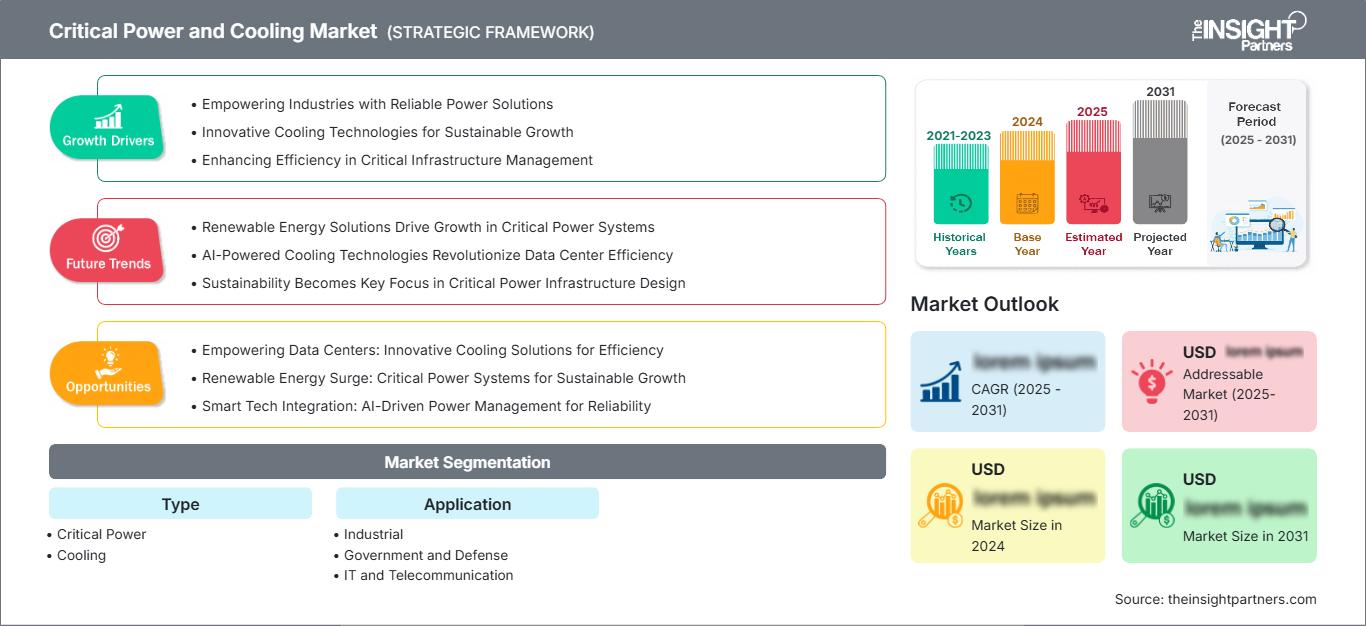
Critical Power and Cooling Market: Strategic Insights
Regional Insights
North America Critical Power and Cooling Market
North America held 32–35% share in 2025 and is forecast to grow at a CAGR of 7.8–8.6% through 2034. The market share is supported by hyperscale cloud regions, AI training clusters, hospital modernization, defense continuity, and aging electrical infrastructure. Grid connection delays are also pushing operators toward onsite generation, high-efficiency UPS, and advanced cooling control.
The demand is highest in data centers, semiconductor plants, laboratories, logistics centers, and commercial campuses. According to an analysis by the International Energy Agency (IEA), the capital investment by five big tech firms was higher than US$400 billion in 2025 and might go up even more in 2026, solidifying the North American focus on resilient power and cooling.
U.S. Critical Power and Cooling Market
The U.S. accounted for 78% to 82% share in North America in 2025 and is forecasted to have a CAGR of 8.0% to 8.8%. Key applications include artificial intelligence data centers, semiconductors production, governmental establishments, telecommunications edge data centers, healthcare and financial institutions. ABB Ltd, Eaton Corporation plc, Schneider Electric SE, Johnson Controls International plc and Vertiv Holdings Co. have prominent commercial presence.
Application trends indicate that IT and telecommunication exhibit the highest level of engineering intensity. Redundancy and secure operations are key factors in industrial and government applications. Power availability is becoming an important procurement criterion as developers consider on-site energy sources, battery-based UPS and efficient water-cooling technologies. Facility owners demand scalable infrastructure that will enable increased rack densities without total overhaul of electrical rooms.
Europe Critical Power and Cooling Market
The Europe region held 24-27% share in 2025 and will continue to grow at a CAGR of 7.0-7.8%. Germany holds leadership through automation in industry, vehicle electrification, and expansion of data centers. UK brings colocation facilities and resilience in financial services while France provides sovereign clouds and resilience in defense operations. Italy and Spain add through commercial retrofits, renewable energy usage, and transport infrastructure.
Buyers from Europe consider efficiency in energy use, non-GWP refrigerants, recovery of waste heat, and interaction with the grid. Schneider Electric SE, STULZ GmbH, Rittal GmbH & Co. KG, ABB Ltd., and Daikin Industries Ltd. benefit from their engineering expertise and compliance with regulations in the region. There is consistent growth when contrasted against APAC, but there are still opportunities due to replacement requirements and sustainability considerations.
APAC Critical Power and Cooling Market
Asia-Pacific commanded 29-32% of market share in 2025 and is projected to witness a CAGR of 9.0-9.8%. China dominates owing to cloud computing infrastructures, industrial parks, and telecom infrastructures, whereas Japan and South Korea have the need for reliable infrastructure due to electronics manufacturing needs. India and Australia bring in demands from colocation, transport, and public infrastructure.
Policy support in relation to digital infrastructure, manufacturing localization, and grid transformation adds to adoption momentum. The thermal load is rising due to deployment of AI servers in regional colocations and sovereign clouds. Users are cost-conscious and reliable for variations in power quality, ambient temperatures, and physical spaces within regional markets.
Middle East & Africa Critical Power and Cooling Market
Middle East & Africa is estimated to have a growth rate of 7.4% to 8.2%, owing to investments from Saudi Arabia, the UAE, South Africa, and MEA in general, for data centers, airports, healthcare facilities, industrial estates, and utilities. The UAE stands out in trade and colocation, whereas Saudi Arabia is investing in its sovereign digital infrastructure.
Due to high ambient temperatures, the region requires an energy efficient and redundant system to handle commercial, transport, and governmental facilities. Energy diversification, smart cities, and mining infrastructure drive the adoption of equipment. Broader adoption relies on technical service capability, financial models, efficient thermal design, and import channels of equipment parts.
Segmentation Analysis
Type
Type is expected to grow at a CAGR of 8.1–8.9% from 2026 to 2034 as the Critical Power and Cooling Market scope spans electrical resilience and thermal stability. Power systems remain the larger revenue base, while cooling accelerates as rack densities, process heat, and uptime requirements push buyers toward precision, liquid-assisted, and digitally controlled platforms.
- Critical Power remains the core procurement category because UPS, switchgear, batteries, generators, and power distribution equipment protect operations from outages, voltage events, and grid instability.
- Cooling is gaining strategic importance as high-density computing, industrial controls, and commercial facilities require precision air, chilled water, liquid cooling, and adaptive thermal monitoring.
Application
Application is projected to grow at a CAGR of 8.0–8.8% during 2026–2034 as uptime needs spread across digital, industrial, public, and commercial environments. IT and telecommunication lead technical intensity, while industrial and government facilities require hardened redundancy. Transportation and commercial buildings add steady replacement demand through safety, automation, and occupant-service continuity.
- Industrial users deploy resilient power and cooling for automation lines, process controls, robotics, cleanrooms, and energy systems where interruptions can halt production and damage equipment.
- Government and Defense facilities prioritize secure, redundant infrastructure for command centers, bases, laboratories, emergency response sites, and public services that require operational continuity during grid disturbances.
- IT and Telecommunication applications drive advanced architectures because cloud, AI, colocation, edge computing, and network nodes require scalable power, dense cooling, monitoring, and rapid commissioning.
- Transportation demand comes from airports, rail systems, ports, traffic control, and logistics facilities where digital signaling, security, and passenger systems depend on uninterrupted electrical and thermal performance.
- Commercial buildings adopt systems for hospitals, retail, offices, campuses, and mixed-use assets where downtime affects safety, revenue, compliance, and building service availability.
Opportunity Snapshot
| Application | Revenue Contribution | Trend Tag | Adoption Stage |
| Industrial | High | Plant Resilience | Scaling |
| Government and Defense | Medium | Secure Uptime | Mature |
| IT and Telecommunication | High | AI Density | Scaling |
| Transportation | Medium | Smart Mobility | Scaling |
| Commercial | Medium | Facility Continuity | Mature |
Critical Power and Cooling Market Growth Drivers and Impact Analysis
AI and Cloud Facilities Raise Power Density Requirements
AI infrastructure is putting higher demands on electrical and thermal loads than old-style facilities can deliver. As Dell’Oro Group pointed out, the increase in load by the use of AI will increase rack density by 4-8 times, reaching the range from 15 kW up to 60-120 kW. In terms of the effect on the market, it means moving from incremental refreshment to a redesign approach. This leads to the need to have the capability for integrated electrical infrastructure, liquid-ready cooling system, and commissioning skills capable of scaling along with accelerated compute.
Grid Constraints Increase Demand for Resilient Backup Systems
Availability of power has become a limiting factor for data centers, industrial parks, hospitals, and transportation hubs. According to the IEA study, the consumption of electricity by the data centers increased by 17% in 2025; grid interconnections and transformer supply have become bottlenecks in several markets. This situation results in greater demand for UPS systems, batteries, generators, switchgear, transfer equipment, and energy management software. In practice, it leads to higher investment in on-site resiliency and capacity rollout in phases. Facility owners plan to build backup infrastructure earlier in their projects, while manufacturers of modular products and fast installation enjoy shorter deadlines and risk-based procurement practices.
Thermal Efficiency Becomes a Compliance and Cost Priority
The cooling power system is now under more scrutiny because of the cost variability, sustainability goals, and restrictions on the use of water. The role of precision air conditioning systems cannot be overlooked; however, the rise of high-density hardware is making it increasingly important to optimize chilled-water systems, containment systems, liquid cooling systems, and digital thermal management solutions. According to IEA energy efficiency study, the potential gains from the digital optimization are significant in commercial buildings, which gives support to the implementation of sensors, analytics, and predictive controls in critical infrastructure. The implications are that there will be more demand for cost-effective cooling systems that do not affect uptime.
Critical Power and Cooling Market Future Trends
Liquid-Assisted Cooling Moves into Standard Facility Design
Critical Power and Cooling Market trends will increasingly reflect the move from optional liquid cooling pilots to planned thermal architectures in AI-ready facilities. Direct-to-chip loops, rear-door heat exchangers, coolant distribution units, and hybrid air-liquid systems will be specified earlier in design cycles. This trend will expand beyond hyperscale operators into colocation, telecom, defense, and research facilities as server densities rise. Suppliers that provide validated reference designs, controls integration, and serviceability will reduce adoption risk for owners. Air cooling will remain relevant, but the value pool will shift toward systems that manage mixed-density halls efficiently.
Digital Twins and Predictive Service Reshape Operations
Digital twins, remote monitoring, and predictive maintenance will become embedded in critical infrastructure operations. Facility owners need live visibility into UPS health, battery degradation, cooling efficiency, thermal hotspots, and redundancy margins. As equipment becomes more integrated, analytics will help operators test failure scenarios without disrupting production. This trend supports recurring service revenue and tighter supplier-customer relationships. It also changes procurement criteria because software usability, cybersecurity, and data quality become part of equipment selection. Vendors that combine installed-base knowledge with diagnostics can help customers extend asset life and reduce emergency service events.
Critical Power and Cooling Market Opportunities
AI-Ready Modular Infrastructure for Emerging Data Zones
Critical Power and Cooling Market Forecasts support investment in modular systems for emerging data center clusters where speed, grid uncertainty, and space constraints shape project economics. Prefabricated power rooms, containerized cooling, skid-mounted pumps, and integrated monitoring can shorten deployment and improve quality control. The opportunity is strongest in secondary cloud hubs, sovereign AI projects, telecom edge sites, and industrial campuses that need phased capacity. Suppliers can differentiate through tested designs, financing partnerships, and regional service teams. Modular offerings also help customers avoid overbuilding while preserving the ability to scale as IT load becomes clearer.
Resilience Retrofits for Industrial and Public Facilities
Retrofit programs offer a practical opportunity as factories, airports, hospitals, and government facilities modernize aging electrical and HVAC assets. Many sites cannot relocate operations, so suppliers that deliver staged upgrades, temporary redundancy, and low-disruption commissioning can capture service-led revenue. The opportunity includes replacing legacy UPS, adding lithium-ion batteries, improving switchgear coordination, upgrading chillers, and installing smarter thermal controls. Public-sector resilience funding and industrial automation investments will support demand. Vendors that can audit existing systems, quantify risk, and build multi-year modernization roadmaps will move beyond transactional equipment sales into advisory infrastructure partnerships.
Recent Developments
- July 2026: Vertiv (NYSE: VRT), a global leader in critical digital infrastructure, announced investments at its Tognana campus near Padua, Italy, to expand manufacturing and integrated testing capabilities for data center cooling systems. The company expects the investments to double chiller production capacity in the region by the end of 2026 and plans to complete a new large-scale testing laboratory in early 2027, supporting growing demand for AI and high-density computing infrastructure.
- October 2025: Schneider Electric SE continued expanding AI-ready data center infrastructure offerings, emphasizing modular power, cooling, and EcoStruxure-based monitoring for high-density environments. The strategy supports customers seeking integrated electrical and thermal architectures as AI workloads increase rack density and shorten deployment timelines across colocation and enterprise sites.
- March 2025: Eaton Corporation plc advanced its data center infrastructure positioning through integrated power management, UPS, switchgear, and thermal collaboration initiatives aimed at edge and AI workloads. The company’s portfolio emphasis supports customers requiring resilient power distribution, backup, and cooling coordination in compact, high-density facility environments.
Frequently Asked Questions

- Comprehensive Market Sizing and Forecast Analysis
- Detailed Segmentation Analysis
- In-Depth Market Dynamics Assessment
- Regional and Country-Level Insights
- Competitive Landscape and Company Benchmarking
- Strategic Business Intelligence
Recent Reports
Testimonials

The Insight Partners' SCADA System Market report is comprehensive, with valuable insights on current trends and future forecasts. The team was highly professional, responsive, and supportive throughout. We are very satisfied and highly recommend their services.
RAN KEDEM Partner, Reali Technologies LTDs
I requested a report on a very specific software market and the team produced the report in a few days. The information was very relevant and well presented. I then requested some changes and additions to the report. The team was again very responsive and I got the final report in less than a week.
JEAN-HERVE JENN Chairman, Future Analytica
We worked with The Insight Partners for an important market study and forecast. They gave us clear insights into opportunities and risks, which helped shape our plans. Their research was easy to use and based on solid data. It helped us make smart, confident decisions. We highly recommend them.
PIYUSH NAGPAL Sr. Vice President, High Beam Global
The Insight Partners delivered insightful, well-structured market research with strong domain expertise. Their team was professional and responsive throughout. The user-friendly website made accessing industry reports seamless. We highly recommend them for reliable, high-quality research services
YUKIHIKO ADACHI CEO, Deep Blue, LLC.
This is the first time I have purchased a market report from The Insight Partners.While I was unsure at first, I visited their web site and felt more comfortable to take the risk and purchase a market report.I am completely satisfied with the quality of the report and customer service. I had several questions and comments with the initial report, but after a couple of dialogs over email with their analyst I believe I have a report that I can use as input to our strategic planning process.Thank you so much for taking the extra time and making this a positive experience.I will definitely recommend your service to others and you will be my first call when we need further market data.
JOHN SUZUKI President and Chief Executive Officer, Board Director, BK Technologies
I wish to appreciate your support and the professionalism you displayed in the course of attending to my request for information regarding to infectious disease IVD market in Nigeria. I appreciate your patience, your guidance, and the fact that you were willing to offer a discount, which eventually made it possible for us to close a deal. I look forward to engaging The Insight Partners in the future, all thanks to the impression you have created in me as a result of this first encounter.
DR CHIJIOKE ONYIA MANAGING DIRECTOR, PineCrest Healthcare Ltd.Reason to Buy
- Informed Decision-Making
- Understanding Market Dynamics
- Competitive Analysis
- Identifying Emerging Markets
- Customer Insights
- Market Forecasts
- Risk Mitigation
- Boosting Operational Efficiency
- Strategic Planning
- Investment Justification
- Tracking Industry Innovations
- Aligning with Regulatory Trends





 Get Free Sample for