
Data Acquisition Card Market Demand, Size & Forecast by 2034
Coverage: By Product Type (PC Plug In Cards, Switch Boxes, Data Loggers); Application (Manufacturing, Retail, Telecom and IT, Education, Others) , and Geography (North America, Europe, Asia Pacific, and South and Central America)
- Status : Data Released
- Report Code : TIPRE00017129
- Category : Electronics and Semiconductor
- No. of Pages : 150
- Available Report Formats :


- Last update date : August 10, 2026


2025 Market Size
US$ 2.98 Bn
Base year value
2034 Forecast
US$ 7.6 Bn
Projected by 2034
CAGR 2026-2034
10.96 %
Growth rate
Addressable Market
US$ 46.76 Bn
(2026-2034)
The Data Acquisition Card Market was valued at US$ 2.98 Billion in 2025, which is expected to reach US$ 7.6 Billion by 2034, recording a CAGR of 10.96% from 2026 to 2034. The increasing utilization of plug-in cards, switch boxes, and data loggers for signal measurement within manufacturing, retail, telecom & IT, and educational settings is fueling the growth of the market.
In North America, the Data Acquisition Card Market size is driven by advances in manufacturing technologies, electronics testing applications, and industrial IoT deployments. The regional CAGR is estimated between 10.8% and 12.4% in the forecast period 2026–2034, primarily due to digitalization in factories and increased adoption of modular measuring systems. Investments in the semiconductors, automotive, energy sectors, and laboratories in the U.S. will continue to drive early adoption of high-speed acquisition systems.
Data Acquisition Card Market Assessment and Insights
- North America accounted for 34–37% share in 2025 and is growing at a CAGR range of 10.8–12.4% during 2026–2034, driven by industrial automation, aerospace testing, semiconductor fabs, and predictive maintenance programs.
- US represented 78–82% of North America in 2025 and is growing at a CAGR range of 10.6–12.1% during 2026–2034, supported by test labs and smart factories.
- Europe held 24–27% share in 2025 and is growing at a CAGR range of 9.4–10.8% during 2026–2034, led by Germany, the UK, France, Italy, and Spain.
- Asia Pacific captured 28–31% share in 2025 and is growing at a CAGR range of 12.6–14.8% during 2026–2034, led by China, Japan, South Korea, India, and Australia.
- Largest Segment PC Plug In Cards held 45–49% market share in 2025, with CAGR range of 9.8–11.4% during 2026–2034, due to high-speed testing and embedded measurement use.
- High Growth Segment Data Loggers held 26–30% market share in 2025, with CAGR range of 13.2–15.5% during 2026–2034, supported by remote monitoring and compliance recording.
- Key companies analyzed in detail: ABB Ltd, ADLINK Technology Inc., Advantech Co., Ltd., Campbell Scientific, Inc., Dataforth Corporation, Elsys AG, Honeywell International Inc., Measurement Computing Corporation, OMEGA Engineering Inc., and Scientech Technologies Pvt. Ltd.
Source: The Insight Partners' analysis based on proprietary research, government publications, company annual reports, investor presentations, industry databases, and expert interviews.
Technology adoption has shifted from being single-channel to being multi-channel and edge-compliant. The Market is affected by increasing sensor density in production, fast sampling rates, and better control software. There are also changes in dynamics in the form of tough, modular-chassis compatible, and signal-conditioning cards to decrease the integration time in industries.
Looking forward, the market is anticipated to grow due to increased adoption of data acquisition cards in Asia-Pacific factories, North American test systems, and Europe quality control systems. Government funding in electronic products, renewable energy, and digital manufacturing creates favorable tailwinds for the market. The market is also poised to gain traction from modernization of laboratories in educational institutions and telecom network testing.
Data Acquisition Card Market Report Scope
| Report Attribute | Details |
|---|---|
| Market size in 2025 | US$ 2.98 Billion |
| Market Size by 2034 | US$ 7.6 Billion |
| Global CAGR (2026 - 2034) | 10.96% |
| Historical Data | 2021-2024 |
| Forecast period | 2026-2034 |
Data Acquisition Card Market Analysis
The demand is based on plants requiring uninterrupted voltage, current, temperature, pressure, and vibration data. Growth of the Market comes from implementation of smart factory systems, predictive maintenance, and increased connection test benches. End users focus on acquiring the products with the ability to synchronize multiple inputs from sensors and reduce downtime and calibration.
Key participants in this market include the sensor producers, the providers of signal conditioning equipment, card manufacturers, software systems, integrators, and end users. Supply chain conditions benefit suppliers having reliable component supply, application engineering, and software for PCI, PXI, USB, and Ethernet-based systems. The Data Acquisition Card uses accuracy, response time, ruggedness, and software as key purchase factors.
Competition will be affected by automation and measurement providers who use the combination of hardware portfolios, software, and services. ABB Ltd and Honeywell International Inc. will gain from existing industrial automation connections, but ADLINK Technology Inc., Advantech Co., Ltd., and Measurement Computing Corporation will rely on specialized computing and measuring platforms. Data Acquisition Card Market report shows that specialization will remain relevant in laboratories, environment monitoring, and education.
The investments made in capital will go to the analytics at the edge, determinism control, and channel density. The competition between Campbell Scientific, Inc., Dataforth Corporation, Elsys AG, OMEGA Engineering Inc., and Scientech Technologies Pvt. Ltd. will be based on specialization within their domains, data logging, and technical support services. Increasingly, competitiveness will depend upon compatibility and life cycle availability.
● REPORT CUSTOMIZATION
Tailor This Report To Align With Your Specific Business Requirements
This report can be customized to align precisely with your business objectives, scope, and target markets. Customization options include tailored segmentation, geography, competitive analysis, and strategic insights to support informed decision-making.
Customize This Report →WHAT YOU CAN ADJUST
- ● Segmentations
- ● Geography
- ● Competitive Analysis
- ● Language Preferences
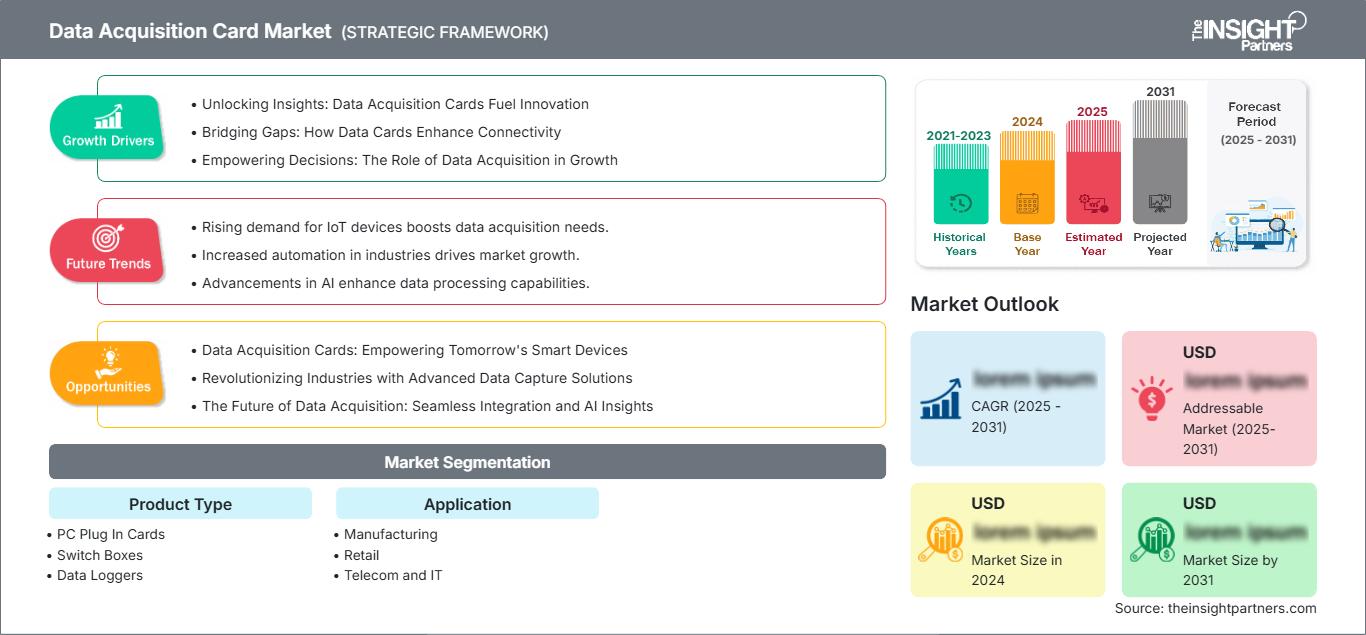
Data Acquisition Card Market: Strategic Insights
Regional Insights
North America Data Acquisition Card Market
North America occupied 34–37% of the Data Acquisition Card Market share in 2025 and is expected to grow at 10.8–12.4% CAGR from 2026 to 2034. Demand in the region is driven by manufacturing automation, aerospace validation, semiconductor testing, and energy monitoring where accurate sensor information ensures process control and safety regulation.
The development of the market in North America is bolstered by reshoring policies in the U.S., industrial transformation in Canada, and growth of the electronics and automotive supply chains in Mexico. Customers look for robust plug-in boards and expandable data loggers to work within supervisory systems.
U.S. Data Acquisition Card Market
In 2025, the U.S. constituted 78% - 82% share in North America, and it is projected to grow at a CAGR of 10.6% - 12.1% until 2034. Highest demands for applications exist in automated manufacturing, aerospace & defense testing, semiconductor process monitoring, telecommunications validation, and university labs that require repeatable and frequent testing.
Presence in the market is achieved through many companies such as Honeywell International Inc., Measurement Computing Corporation, Campbell Scientific Inc., Dataforth Corporation, and OMEGA Engineering Inc. The following are some of the purchasing considerations: sampling rate, channels available, documentation, and software compatibility especially in situations where validation is necessary.
Europe Data Acquisition Card Market
Europe held a share of 24-27% in 2025 and is expected to increase at a CAGR of 9.4-10.8% from 2026 to 2034. Germany dominates regional consumption via applications of automotive, machine, and industrial electronics testing. UK is next in line with its use in aerospace, telecommunications, and academia due to precision instruments.
France, Italy, and Spain are participating in regional demand through the use of applications in energy, transport, industry, and educational laboratories. European customers appreciate compliance, traceability, and long-term equipment durability. The suppliers that can offer local technical support and flexible business models will be ahead of their competitors.
APAC Data Acquisition Card Market
Share of Asia Pacific was 28–31% in 2025 and expected to increase at a CAGR of 12.6–14.8% between 2026 and 2034. China is the market leader owing to its massive volume in electronics, automotive, and industrial automation sectors, whereas Japan and South Korea need highly precise systems in semiconductors and robotics applications.
India and Australia are contributing via production increase, energy management, telecommunications network, and higher education laboratories. Favorable government policies regarding local electronics and industrial digitization are creating a need for affordable and scalable data acquisition cards.
Middle East & Africa Data Acquisition Card Market
Middle East and Africa is expected to grow at 8.7–10.2% CAGR during 2026–2034. Saudi Arabia and the UAE lead demand as energy, utilities, infrastructure, and smart building projects require monitoring systems that convert field signals into usable operational data.
The South Africa and Rest of MEA cluster exhibits selective adaptation in mining, education, telecommunications, and water infrastructure. The opportunities in this region are associated with tough environment logging, equipment diagnostics, and maintenance. The buyers in this region value durability, maintainability, and low cost of ownership.
Segmentation Analysis
Product Type
Product Type is projected to grow at 10.9–12.7% CAGR during 2026–2034. The market scope within product categories is shaped by the balance between fixed test benches, modular card-based systems, and portable data logging. Buyers select products based on channel count, sampling precision, environmental conditions, and compatibility with existing automation software.
- PC Plug In Cards remain the largest product type because they support high-speed measurement, compact installation, and direct integration with laboratory, manufacturing, and test automation software.
- Switch Boxes serve applications needing channel routing, repeatable switching, and controlled test sequencing, particularly in electronics validation, telecom checks, and production-line inspection environments.
- Data Loggers are gaining strategic importance in remote monitoring, compliance documentation, environmental measurement, and long-duration industrial diagnostics where standalone collection and storage are required.
Application
Application is expected to grow at 11.4–13.1% CAGR during 2026–2034. Manufacturing remains the dominant use case, while telecom and IT, retail, and education expand through equipment testing, operational monitoring, and training laboratories. Adoption depends on measurement reliability, ease of setup, data integrity, and the ability to connect physical signals with analytics workflows.
- Manufacturing uses acquisition cards for machine monitoring, quality control, process validation, and predictive maintenance, making it the most revenue-contributing application across automated plants.
- Retail adoption is narrower but relevant for equipment monitoring, energy measurement, cold-chain logging, and automated facility systems requiring dependable sensor capture.
- Telecom and IT users rely on cards and loggers for network equipment validation, power monitoring, thermal testing, and laboratory-based performance characterization.
- Education demand comes from engineering laboratories, vocational training, and research projects where affordable, reliable measurement platforms help students and researchers test physical systems.
Opportunity Snapshot
| Application | Revenue Contribution | Trend Tag | Adoption Stage |
| Manufacturing | High | Smart Factory | Scaling |
| Retail | Low | Facility Sensors | Emerging |
| Telecom and IT | Medium | Network Testing | Scaling |
| Education | Medium | Lab Training | Mature |
Data Acquisition Card Market Growth Drivers and Impact Analysis
Factory Digitization Raises Real-Time Measurement Demand
Manufacturers are connecting machines, sensors, and quality systems to reduce unplanned downtime and improve throughput. This shift increases the need for acquisition cards that capture reliable, synchronized signals from production equipment. The market benefits when factories replace manual readings with automated, traceable data streams. Impact is strongest in automotive, electronics, process industries, and packaging lines where vibration, temperature, torque, and pressure readings support maintenance decisions. As plants move toward closed-loop control and predictive analytics, card performance, software compatibility, and rugged design become central purchase factors.
Testing Complexity Expands Multi-Channel Card Adoption
Products in electronics, energy storage, telecom, and industrial machinery are becoming more sensor-rich and software-defined. Validation teams need measurement platforms that can acquire many signals simultaneously, maintain timing accuracy, and support repeatable test scripts. The Market gains from this complexity because plug-in cards and switch boxes can reduce test-bench footprint while improving throughput. Demand is reinforced by shorter product development cycles and the need to document performance under thermal, electrical, mechanical, and environmental stress conditions.
Remote Monitoring Strengthens Data Logger Use Cases
Utilities, infrastructure operators, laboratories, and field-service teams require continuous measurements in locations where permanent control systems are costly or impractical. Data loggers address this need by collecting environmental, electrical, and process readings over extended periods. The Market benefits as users combine standalone logging with cloud upload, alarms, and condition-based maintenance. Impact is visible in water systems, energy sites, telecom shelters, cold-chain assets, and educational field studies, where dependable recording supports compliance, diagnostics, and operational planning.
Data Acquisition Card Market Future Trends
Edge-Ready Acquisition Architectures
Future systems will increasingly combine signal capture, preprocessing, and local analytics before data reaches enterprise platforms. Data Acquisition Card Market trends point toward lower-latency architectures that filter noise, detect anomalies, and reduce network load at the machine level. This will matter in robotics, semiconductor tools, and energy assets where milliseconds affect quality and safety. Vendors able to integrate edge computing, secure firmware, and flexible software drivers are likely to gain preference among advanced users.
Hybrid Laboratory and Production Measurement Platforms
Testing environments are expected to converge as laboratories, pilot lines, and production cells share measurement workflows. Users will prefer acquisition cards that can move from development benches to scaled manufacturing with minimal reconfiguration. The market will therefore reward modular platforms, reusable software templates, and calibration continuity. This trend is particularly relevant for electric systems, telecom equipment, industrial sensors, and educational research programs that must translate experimental results into repeatable operating procedures.
Data Acquisition Card Market Opportunities
Modular Solutions for Mid-Sized Manufacturers
Mid-sized factories often need measurement upgrades but lack the budget and engineering resources for complex custom systems. Vendors can create Data Acquisition Card Market Forecasts around bundled cards, switch boxes, sensors, software templates, and remote support packages. This opportunity is strongest where plants are digitizing quality checks, energy use, and machine condition monitoring. Suppliers that simplify installation, documentation, and operator training can convert fragmented demand into repeatable deployments across industrial clusters.
Education and Training Lab Modernization
Engineering colleges, technical institutes, and corporate training centers require practical platforms that demonstrate sensing, control, data logging, and analytics. Affordable acquisition cards and loggers can support experiments in electronics, mechatronics, energy, telecommunications, and environmental monitoring. The market can capture this opportunity through curriculum-ready kits, multilingual documentation, and durable hardware designed for repeated student use. Education demand also creates long-term brand familiarity among future engineers and plant operators.
Recent Developments
- January 2026: Acqiris launched the SA6 12-bit data acquisition solution for Swept-Source Optical Coherence Tomography (SS-OCT), delivering up to 1 GS/s sampling in the industry's most compact PCIe form factor. The solution combines high-speed acquisition, real-time OCT processing, and low-latency streaming to improve imaging performance while reducing system size and integration complexity.
- August 2024: Emerson introduced new USB data acquisition (DAQ) devices through NI, offering improved measurement accuracy, faster setup, and simplified sensor connectivity for engineers. The compact USB DAQ portfolio is designed to accelerate testing and data collection across laboratory and industrial applications.
- September 2023: Yokogawa launched its fourth-generation high-speed data acquisition system, delivering faster sampling rates, enhanced scalability, and improved synchronization for complex measurement applications. The new platform is aimed at automotive, energy, aerospace, and industrial R&D environments requiring high-speed, multi-channel data acquisition.
Frequently Asked Questions

- Comprehensive Market Sizing and Forecast Analysis
- Detailed Segmentation Analysis
- In-Depth Market Dynamics Assessment
- Regional and Country-Level Insights
- Competitive Landscape and Company Benchmarking
- Strategic Business Intelligence
Recent Reports
Testimonials

The Insight Partners' SCADA System Market report is comprehensive, with valuable insights on current trends and future forecasts. The team was highly professional, responsive, and supportive throughout. We are very satisfied and highly recommend their services.
RAN KEDEM Partner, Reali Technologies LTDs
I requested a report on a very specific software market and the team produced the report in a few days. The information was very relevant and well presented. I then requested some changes and additions to the report. The team was again very responsive and I got the final report in less than a week.
JEAN-HERVE JENN Chairman, Future Analytica
We worked with The Insight Partners for an important market study and forecast. They gave us clear insights into opportunities and risks, which helped shape our plans. Their research was easy to use and based on solid data. It helped us make smart, confident decisions. We highly recommend them.
PIYUSH NAGPAL Sr. Vice President, High Beam Global
The Insight Partners delivered insightful, well-structured market research with strong domain expertise. Their team was professional and responsive throughout. The user-friendly website made accessing industry reports seamless. We highly recommend them for reliable, high-quality research services
YUKIHIKO ADACHI CEO, Deep Blue, LLC.
This is the first time I have purchased a market report from The Insight Partners.While I was unsure at first, I visited their web site and felt more comfortable to take the risk and purchase a market report.I am completely satisfied with the quality of the report and customer service. I had several questions and comments with the initial report, but after a couple of dialogs over email with their analyst I believe I have a report that I can use as input to our strategic planning process.Thank you so much for taking the extra time and making this a positive experience.I will definitely recommend your service to others and you will be my first call when we need further market data.
JOHN SUZUKI President and Chief Executive Officer, Board Director, BK Technologies
I wish to appreciate your support and the professionalism you displayed in the course of attending to my request for information regarding to infectious disease IVD market in Nigeria. I appreciate your patience, your guidance, and the fact that you were willing to offer a discount, which eventually made it possible for us to close a deal. I look forward to engaging The Insight Partners in the future, all thanks to the impression you have created in me as a result of this first encounter.
DR CHIJIOKE ONYIA MANAGING DIRECTOR, PineCrest Healthcare Ltd.Reason to Buy
- Informed Decision-Making
- Understanding Market Dynamics
- Competitive Analysis
- Identifying Emerging Markets
- Customer Insights
- Market Forecasts
- Risk Mitigation
- Boosting Operational Efficiency
- Strategic Planning
- Investment Justification
- Tracking Industry Innovations
- Aligning with Regulatory Trends





 Get Free Sample for