
Data Center Accelerator Market Size, Share & Growth by 2034
Coverage: by Type (FPGA, GPU, CPU, and Others); Application (Mid-Size Enterprise and Large Data Center); and End-user (BFSI, Telecom & IT, Government, Healthcare, and Energy), and Geography (North America, Europe, Asia Pacific, and South and Central America)
- Status : Data Released
- Report Code : TIPRE00002955
- Category : Electronics and Semiconductor
- No. of Pages : 150
- Available Report Formats :


- Last update date : July 31, 2026


2025 Market Size
US$ 16.76 Bn
Base year value
2034 Forecast
US$ 53.93 Bn
Projected by 2034
CAGR 2026-2034
13.87 %
Growth rate
Addressable Market
US$ 305.29 Bn
(2026-2034)
The Data Center Accelerator Market was estimated at US$ 16.76 Billion in 2025 and will reach US$ 53.93 Billion by 2034 with a CAGR of 13.87% during 2026-2034 owing to AI training, enterprise inference, HPC, and power efficiency in workload acceleration by using GPUs, FPGAs, CPUs, and specific accelerators within compute layer of data centers.
North America still holds structural importance due to hyperscale clouds investments, semiconductors eco-systems, and adoption of AI by enterprises. Data Center Accelerator Market size in North America is predicted to grow in the range of CAGR 12.8-14.2% during 2026-2034 owing to generative AI infrastructure, finance analytics workloads, federal modernization initiatives, and telecom cloud migrations.
Data Center Accelerator Market Assessment and Insights
- North America accounted for 38–41% share in 2025 and is expected to grow at a CAGR of 12.8–14.2% during 2026–2034, driven by hyperscale AI clusters, cloud modernization, and domestic semiconductor capacity.
- US represented 82–86% of North America in 2025 and is projected to grow at a CAGR of 12.6–14.0% during 2026–2034.
- Europe held 21–24% share in 2025 and is expected to grow at a CAGR of 11.6–13.0%, led by Germany, the UK, France, Italy, and Spain.
- Asia Pacific captured 25–29% share in 2025 and is forecast to grow at a CAGR of 14.5–16.3%, led by China, Japan, South Korea, India, and Australia.
- Largest Segment GPU held a 52–56% market share in 2025, with a CAGR of 13.2–14.8% during 2026–2034 as AI training and inference clusters scale.
- High Growth Segment FPGA held a 16–19% of the Data Center Accelerator market share in 2025, with a CAGR of 15.2–17.0% during 2026–2034 due to flexible, low-latency acceleration.
- Key companies analyzed in detail: Achronix Semiconductor Corporation, Advanced Micro Devices, Inc., Cisco Systems, Inc., Intel Corporation, Lattice Semiconductor Corporation, Lenovo Group Limited, Microchip Technology Inc., NVIDIA Corporation, Teledyne e2v Limited, Xilinx, Inc.
Source: The Insight Partners' analysis based on proprietary research, government publications, company annual reports, investor presentations, industry databases, and expert interviews.
AI accelerators have shifted from experimental AI clusters to data center architectures with consideration of parallel processing needs, cooling capacity, and power availability. GPUs are commonly used for intensive training, whereas FPGA and CPU-powered accelerators are used for inference, networking, analytics, and workload management purposes. The supply chain in this market has been influenced by advances in packaging, high-bandwidth memory, board-level integration, and tools that ease the process of deploying accelerators for enterprise and cloud consumers.
During the forecast period, developing regions will develop sovereign AI facilities, regional cloud zones, and energy-efficient data centers driven by policy incentives for domestic chip designing, AI safety, and secure government workloads. The market would gain from investments in telecom edge deployments, imaging processing in healthcare, fraud detection in BFSI, and energy simulation processes in the energy sector.
Data Center Accelerator Market Report Scope
| Report Attribute | Details |
|---|---|
| Market size in 2025 | US$ 16.76 Billion |
| Market Size by 2034 | US$ 53.93 Billion |
| Global CAGR (2026 - 2034) | 13.87% |
| Historical Data | 2021-2024 |
| Forecast period | 2026-2034 |
Data Center Accelerator Market Analysis
Demand for the Data Center Accelerator Market growth will be driven by demand in AI model training, AI inference, and real-time analytics in regulated industries. Businesses are moving applications out of general CPU compute environments and onto heterogeneous architectures since accelerators provide better performance per watt and lower model processing time.
There are several stakeholders in the ecosystem such as chip designers, foundries, memory manufacturers, system original equipment manufacturers, cloud providers, colocation companies, and software frameworks. Availability of advanced node capacity, HBM memory availability, and networking bandwidth will continue to affect the supply environment. Consumers prefer rack-scale solutions and consider them when buying rather than individual processors.
The Data Center Accelerator Market report highlights a highly competitive market with the focus on platform capabilities, software compatibility, and systems integration. In terms of the GPU accelerator, NVIDIA Corporation dominates and the competition is mainly provided by Advanced Micro Devices, Inc. and Intel Corporation with their GPU, CPU, and platform strategies.
The emphasis of investment will be made towards AI factories, sovereign compute, and compact enterprise setups. Networking and data center offerings are given by Cisco Systems, Inc., system integrations are offered by Lenovo Group Limited, and Teledyne e2v Limited provides offerings related to reliability use cases. The strategic positioning can be done by way of partnerships and reference architecture approach.
● REPORT CUSTOMIZATION
Tailor This Report To Align With Your Specific Business Requirements
This report can be customized to align precisely with your business objectives, scope, and target markets. Customization options include tailored segmentation, geography, competitive analysis, and strategic insights to support informed decision-making.
Customize This Report →WHAT YOU CAN ADJUST
- ● Segmentations
- ● Geography
- ● Competitive Analysis
- ● Language Preferences
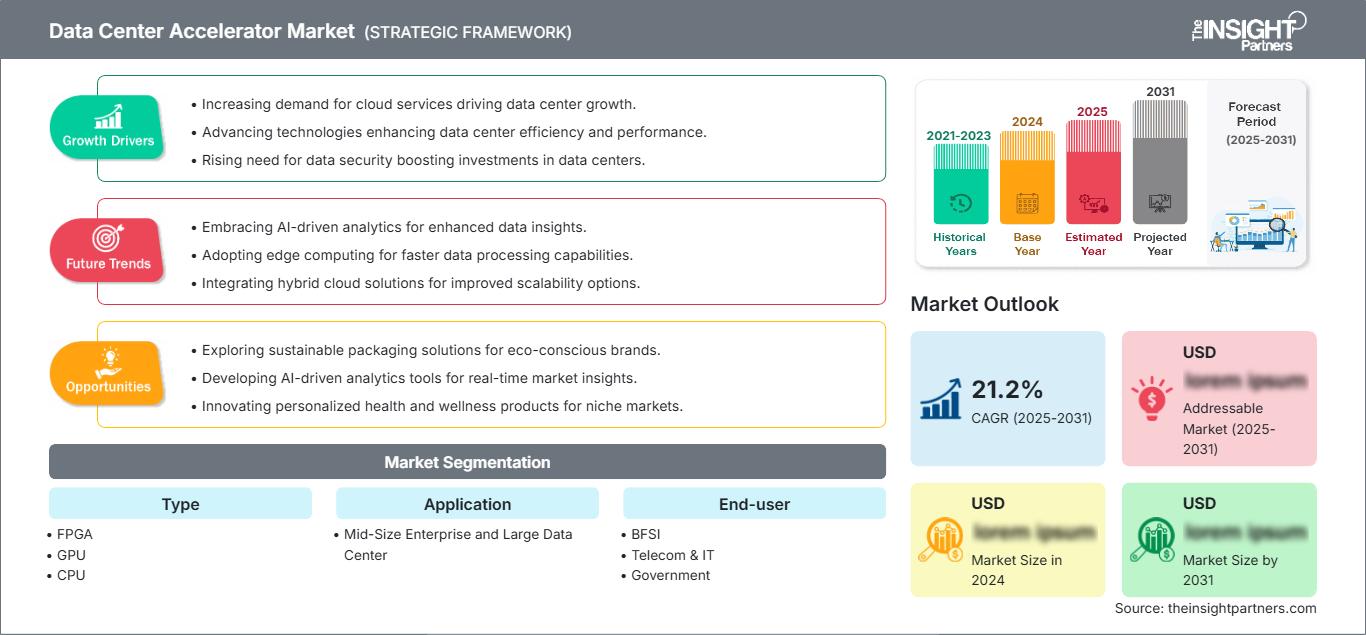
Data Center Accelerator Market: Strategic Insights
Regional Insights
North America Data Center Accelerator Market
North America was estimated to hold a market share of 38%-41% in 2025 due to cloud consolidation, high AI start-up presence, and rapid purchases made by the finance industry, healthcare organizations, and governments. The regional market share is backed by massive GPU clusters, AI model deployment, and enterprise adoption of hybrid cloud solutions.
CAGR growth for 2026-2034 is projected to be 12.8%-14.2%. Key drivers include expansion of hyperscale campuses, advanced semiconductor designs, and need for low-latency inferencing. Availability of power and interconnectivity are limiting factors, hence the adoption of accelerators that provide more compute per watt.
U.S. Data Center Accelerator Market
The US represented 82–86% of North America in 2025 and is projected to grow at a CAGR of 12.6–14.0% during 2026–2034. Demand is concentrated in hyperscale cloud, AI research, BFSI risk analytics, healthcare imaging, defense modernization, and telecom network automation.
There is an exceptional presence of companies associated with chips, platforms, networking, or programmable logic. These companies include NVIDIA Corporation, Advanced Micro Devices, Inc., Intel Corporation, Cisco Systems, Inc., Achronix Semiconductor Corporation, Lattice Semiconductor Corporation, Microchip Technology Inc., and Xilinx, Inc. Trends in applications include GPU-intensive AI and FPGA-enabled low-latency workloads.
Europe Data Center Accelerator Market
Europe had a market share of 21-24% in 2025 and was estimated to have a CAGR of 11.6-13.0% till 2034. Germany was the largest country in terms of market share on account of industrial automation, automotive simulation, and sovereign cloud requirements, whereas the UK has been able to create clusters for AI research and finance analytics.
France is working on its government and defense-specific compute applications, Italy is looking into upgrading the data centers of enterprises and telcos, and Spain is gaining cloud region presence owing to its green energy sources. The need to adhere to data localization, cybersecurity, and energy efficiency standards prompts the use of accelerators.
APAC Data Center Accelerator Market
The Asia Pacific region accounted for a share of 25-29% in 2025 and is projected to register a CAGR of 14.5-16.3% between 2026 and 2034. This region holds China at its helm due to cloud AI, localization of semiconductors, and large digital platforms. Japan and South Korea are contributing with their expertise in advanced electronics and memory ecosystem.
India is working toward increasing cloud regions, digital public infrastructure, and enterprise AI. Australia, on the other hand, has been working toward high-performance computing, mining analytics, and government modernization.
Middle East & Africa Data Center Accelerator Market
Growth of Middle East & Africa is expected to have a CAGR of 13.0% to 14.6% between 2026 and 2034. Saudi Arabia is leading the regional growth with initiatives like sovereign AI, smart city projects, and energy-driven data center investments. The UAE is backing initiatives like cloud zones, digitization of financial services, and AI centers of excellence.
South Africa continues to be the major market in the sub-Saharan region, driven by enterprise cloud investments and telecom infrastructure development. Demand from Rest of MEA is driven by initiatives like digital transformation in the public sector, energy analytics, and colocation.
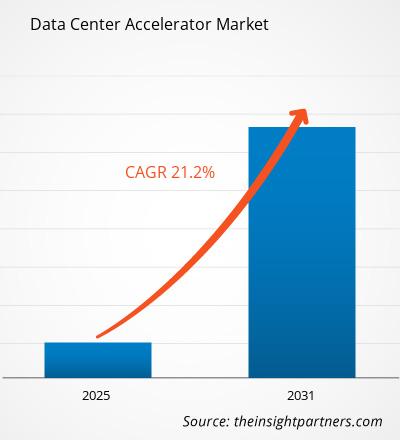
Segmentation Analysis
Type
The Type segment is expected to grow at a CAGR of 13.5–15.0% during 2026–2034. The Data Center Accelerator Market scope across processor architectures reflects workload specialization, as GPUs handle parallel AI, CPUs coordinate general workloads, and FPGAs support configurable low-latency acceleration.
- FPGA solutions are strategically important for adaptable inference, networking, encryption, and signal-processing workloads where reconfigurability, latency control, and lifecycle flexibility matter.
- GPU platforms hold the strongest position due to mature AI software ecosystems, parallel compute density, and proven deployment in training, inference, visualization, and analytics clusters.
- CPU acceleration remains essential for orchestration, preprocessing, memory management, and mixed workloads where general-purpose compute must coordinate with specialized accelerators.
Application
The Application segment is forecast to grow at a CAGR of 13.0–14.4% during 2026–2034. Demand differs by deployment scale, with mid-size enterprises prioritizing cost-effective AI inference and large data centers investing in dense accelerator clusters for training, analytics, and cloud services.
- Mid-Size Enterprise adoption is rising as packaged AI services, private inference, and analytics appliances reduce infrastructure complexity and improve accessibility for regulated business workloads.
- Large Data Center deployments represent the primary demand base because hyperscale and colocation facilities require high-density compute fabrics for AI training, inference, and cloud-native services.
End-user
The End-user segment is expected to grow at a CAGR of 13.2–14.9% during 2026–2034. Adoption is highest where data intensity, real-time decisioning, compliance, and latency-sensitive analytics converge, particularly across BFSI, Telecom & IT, Government, Healthcare, and Energy.
- BFSI users deploy accelerators for fraud detection, risk modeling, algorithmic analytics, and secure data processing where fast inference and auditability improve operational resilience.
- Telecom & IT remains a major demand center as cloud providers, carriers, and managed service firms scale AI, network automation, and edge computing platforms.
- Government demand is linked to sovereign cloud, cybersecurity, defense analytics, digital public services, and controlled AI infrastructure that meets data residency and security requirements.
- Healthcare adoption is expanding through medical imaging, genomics, hospital analytics, and clinical decision-support workloads where acceleration reduces processing time and improves workflow efficiency.
- Energy users apply accelerators in seismic interpretation, grid optimization, predictive maintenance, and renewable forecasting, where simulation speed directly affects operational planning.
Opportunity Snapshot
| End-user | Revenue Contribution | Trend Tag | Adoption Stage |
| BFSI | High | Fraud AI | Scaling |
| Telecom & IT | High | Edge Cloud | Mature |
| Government | Medium | Sovereign AI | Scaling |
| Healthcare | Medium | Imaging AI | Scaling |
| Energy | Medium | Grid Analytics | Emerging |
Data Center Accelerator Market Growth Drivers and Impact Analysis
AI Workload Scaling Across Enterprise Infrastructure
The adoption of AI technologies in enterprises is transitioning from pilot projects into production, thus leading to an ongoing demand for higher levels of training, inferencing, and analytics performance. Financial institutions require real-time fraud scoring, while healthcare organizations require accelerated imaging pipelines. Telecommunications providers also rely on AI in order to optimize traffic and manage service assurance. This drives up attach rates of accelerators within cloud and private infrastructure. The Data Center Accelerator Market sees an opportunity here since dedicated processors deliver improved performance and efficiency when compared to CPU-based solutions. With growing volumes of data in the workload, integrated platforms gain traction.
Power Efficiency Pressure in High-Density Data Centers
Availability of power is emerging as a key strategic challenge for the growth of the data centers, particularly with regards to large cloud regions with growing lineups in grid connection. With accelerators, there could be increases in the level of computing performance per rack with the use of efficient cooling and high bandwidth memory, along with scheduling optimization. This is especially true for operators with increasing needs for AI but no corresponding increase in energy consumption. This is evident in procurement preferences involving computing performance per watt, liquid cooling, and rackscale architecture.
Sovereign Cloud and Regulated Workload Modernization
Governments and industry bodies are focusing on creating secure and local compute infrastructures to handle sensitive data, AI algorithms, and mission-critical analytics. This results in demand for accelerators for national cloud, defense, healthcare, and government digitalization initiatives. Unlike other business workloads, these use cases are concerned about security, lifecycle, and supply chain. Suppliers of accelerators with well-defined roadmaps, tested software stacks, and regulatory-compliant platforms are the ones that are set to benefit from this demand for premium customers.
Data Center Accelerator Market Future Trends
Heterogeneous Compute Fabrics Become Standard
Future architectures will combine GPUs, CPUs, FPGAs, memory pooling, and high-speed interconnects into workload-specific compute fabrics. The Data Center Accelerator Market trends indicate that buyers will increasingly optimize at cluster level rather than processor level. This transition will favor vendors offering validated reference designs, orchestration software, and interconnect compatibility. Enterprises will gain flexibility to route training, inference, analytics, and networking functions to the most efficient compute resource. Over time, heterogeneous designs will also reduce dependency on a single accelerator type and improve infrastructure resilience.
Inference Infrastructure Moves Closer to Users
Inference workloads are expected to move closer to enterprise applications, telecom edges, hospitals, factories, and financial transaction systems. This shift will require compact accelerator platforms that balance latency, power, and manageability. Cloud regions will remain essential for large models, but distributed inference will support data privacy and faster response times. Vendors that deliver modular accelerator appliances, optimized software libraries, and remote lifecycle management will gain advantage. The trend also expands demand beyond hyperscale campuses into smaller data centers and edge facilities.
Data Center Accelerator Market Opportunities
Vertical AI Platforms for Regulated Industries
Vendors can create differentiated offerings by packaging accelerators with domain-specific software, compliance controls, and deployment services for BFSI, healthcare, government, and energy users. The Data Center Accelerator Market Forecasts point to growing demand for reliable, auditable, and secure AI infrastructure rather than generic compute capacity alone. Platform providers can capture value by aligning hardware with fraud analytics, medical imaging, public-sector data processing, and grid optimization. Partnerships with system integrators and cloud operators will be important because regulated customers often require implementation support, certification, and long-term service assurance.
Energy-Aware Accelerator Retrofits in Existing Facilities
Many enterprises cannot wait for new hyperscale facilities, creating opportunity for retrofit-ready accelerator systems that improve existing data center productivity. Products designed for constrained power envelopes, air-to-liquid transition paths, and simplified management can unlock demand in mid-size enterprise and colocation environments. Service models that include assessment, workload migration, and lifecycle support will help buyers reduce adoption risk. This opportunity is especially relevant where AI projects must scale quickly but real estate, grid access, or cooling capacity limits infrastructure expansion.
Recent Developments
- May 2026: NVIDIA introduced Vera, a high-performance data center CPU designed specifically for agentic AI, reinforcement learning, and large-scale data processing workloads. The processor powers standalone AI servers and accelerated computing platforms by improving task execution efficiency, energy performance, and data movement between CPUs and AI accelerators. Vera helps data centers support next-generation AI factories by enabling faster orchestration, code execution, analytics, and inference workloads while keeping accelerator systems operating at higher utilization.
- October 2025: Intel expanded its data center AI accelerator portfolio with Crescent Island, a new GPU designed for AI inference workloads. The accelerator is optimized for energy-efficient performance, high memory capacity, and cost-effective deployment in enterprise data centers, supporting applications such as real-time AI services and agentic AI workloads. Crescent Island features Intel’s Xe architecture, large memory bandwidth, and an open software ecosystem to help organizations scale AI inference infrastructure across diverse computing environments.
- May 2026: Intel expanded its data center AI platform with Xeon 6+ processors, enhanced Ethernet networking solutions, and updates to its AI accelerator roadmap for agentic AI workloads. The new infrastructure combines high-density CPU performance, advanced network connectivity, and AI acceleration capabilities to improve orchestration, data movement, and scalable AI deployment across data centers, cloud environments, and edge systems. The platform helps organizations build more efficient AI infrastructure by addressing performance, energy efficiency, and workload management challenges in next-generation computing environments.
Frequently Asked Questions

- Comprehensive Market Sizing and Forecast Analysis
- Detailed Segmentation Analysis
- In-Depth Market Dynamics Assessment
- Regional and Country-Level Insights
- Competitive Landscape and Company Benchmarking
- Strategic Business Intelligence
Recent Reports
Testimonials

The Insight Partners' SCADA System Market report is comprehensive, with valuable insights on current trends and future forecasts. The team was highly professional, responsive, and supportive throughout. We are very satisfied and highly recommend their services.
RAN KEDEM Partner, Reali Technologies LTDs
I requested a report on a very specific software market and the team produced the report in a few days. The information was very relevant and well presented. I then requested some changes and additions to the report. The team was again very responsive and I got the final report in less than a week.
JEAN-HERVE JENN Chairman, Future Analytica
We worked with The Insight Partners for an important market study and forecast. They gave us clear insights into opportunities and risks, which helped shape our plans. Their research was easy to use and based on solid data. It helped us make smart, confident decisions. We highly recommend them.
PIYUSH NAGPAL Sr. Vice President, High Beam Global
The Insight Partners delivered insightful, well-structured market research with strong domain expertise. Their team was professional and responsive throughout. The user-friendly website made accessing industry reports seamless. We highly recommend them for reliable, high-quality research services
YUKIHIKO ADACHI CEO, Deep Blue, LLC.
This is the first time I have purchased a market report from The Insight Partners.While I was unsure at first, I visited their web site and felt more comfortable to take the risk and purchase a market report.I am completely satisfied with the quality of the report and customer service. I had several questions and comments with the initial report, but after a couple of dialogs over email with their analyst I believe I have a report that I can use as input to our strategic planning process.Thank you so much for taking the extra time and making this a positive experience.I will definitely recommend your service to others and you will be my first call when we need further market data.
JOHN SUZUKI President and Chief Executive Officer, Board Director, BK Technologies
I wish to appreciate your support and the professionalism you displayed in the course of attending to my request for information regarding to infectious disease IVD market in Nigeria. I appreciate your patience, your guidance, and the fact that you were willing to offer a discount, which eventually made it possible for us to close a deal. I look forward to engaging The Insight Partners in the future, all thanks to the impression you have created in me as a result of this first encounter.
DR CHIJIOKE ONYIA MANAGING DIRECTOR, PineCrest Healthcare Ltd.Reason to Buy
- Informed Decision-Making
- Understanding Market Dynamics
- Competitive Analysis
- Identifying Emerging Markets
- Customer Insights
- Market Forecasts
- Risk Mitigation
- Boosting Operational Efficiency
- Strategic Planning
- Investment Justification
- Tracking Industry Innovations
- Aligning with Regulatory Trends





 Get Free Sample for