
DC Circuit Breaker Market Size, Share & Growth by 2034
Coverage: By Voltage (High Voltage, Medium Voltage, Low Voltage); Type (Hybrid, Solid-State); Insulation (Vacuum, Gas); End User (Renewables, Railways, Power Generation, Transmission and Distribution Utilities) , and Geography (North America, Europe, Asia Pacific, and South and Central America)
- Status : Data Released
- Report Code : TIPRE00006125
- Category : Electronics and Semiconductor
- No. of Pages : 150
- Available Report Formats :


- Last update date : July 31, 2026


2025 Market Size
US$ 4.12 Bn
Base year value
2034 Forecast
US$ 6.93 Bn
Projected by 2034
CAGR 2026-2034
6.71 %
Growth rate
Addressable Market
US$ 52.03 Bn
(2026-2034)
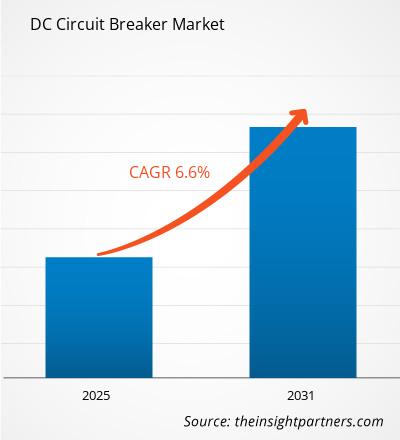
The DC Circuit Breaker Market in terms of revenue is estimated at US$ 4.12 Billion in 2025, expanding to US$ 6.93 Billion by 2034 at a CAGR of 6.71% between 2026 and 2034. Factors influencing demand include renewable integration, DC microgrids, energy storage batteries, electric vehicles, railway electrification, and HVDC Transmission lines which demand rapid interruption and fault isolation capability.
In North America, the DC Circuit Breaker Market size will be driven by utility network infrastructure upgrades, power architecture for hyperscale data centers, and rapid roll-out of EV fast-charging corridors. North America is forecasted to witness 6.2–6.8% CAGR from 2026 to 2034.
DC Circuit Breaker Market Assessment and Insights
- North America held 24–27% share in 2025 and is projected to grow at a CAGR of 6.2–6.8% during 2026–2034, led by grid hardening, data centers, and EV charging expansion.
- US accounted for 78–82% of North America in 2025 and is expected to grow at a CAGR of 6.3–6.9% through 2034.
- Europe represented 20–23% share in 2025 and is expected to expand at 5.7–6.3%, with Germany, the UK, France, Italy, and Spain leading utility and industrial adoption.
- Asia Pacific captured 38–42% share in 2025 and is forecast to grow at 7.1–7.8%, supported by China, Japan, South Korea, India, and Australia.
- Largest Segment Medium Voltage held 44–48% market share in 2025 and is expected to advance at 6.4–7.0% CAGR due to industrial and renewable interconnection demand.
- High Growth Segment High Voltage accounted for 22–26% market share in 2025 and is projected to grow at 8.0–8.8% CAGR on HVDC expansion.
- Key companies analyzed in detail: ABB Ltd, BRUSH Group, Eaton Corporation plc, Fuji Electric Co., Ltd., Larsen and Toubro Limited, Mitsubishi Electric Corporation, Rockwell Automation, Inc., Schneider Electric SE, Sécheron SA, Siemens AG.
Source: The Insight Partners' analysis based on proprietary research, government publications, company annual reports, investor presentations, industry databases, and expert interviews.
Technological development in the market has moved from the electromechanical interruption technology to hybrids and solid-state technologies that prevent arcing, reduce the fault clearance time, and coordinate converter operation. Production trends include modular breaker construction, vacuum interrupting, gas interrupting, and monitoring technologies. Manufacturers develop their products having in mind their suitability for incorporation into solar parks, battery energy storage system containers, DC rail systems, marine power systems, and data center busways where outages are not possible.
Demand for DC circuit breakers is expected to be driven during the forecast period by the rising economies of Asia, Gulf regions, and digital loads centers of North America. Policies for renewable energy generation, infrastructure developments, and strict safety regulations will help in certification and deployment of DC circuit breakers.
DC Circuit Breaker Market Report Scope
| Report Attribute | Details |
|---|---|
| Market size in 2025 | US$ 4.12 Billion |
| Market Size by 2034 | US$ 6.93 Billion |
| Global CAGR (2026 - 2034) | 6.71% |
| Historical Data | 2021-2024 |
| Forecast period | 2026-2034 |
DC Circuit Breaker Market Analysis
The DC Circuit Breaker Market share can be attributed to the increasing preference for DC native power generation environments such as solar PV systems, battery energy storage systems (BESS), electric vehicle chargers, rail traction, and converters for transmission. The value chain includes the use of semiconductor components, interrupter components, sensors, insulation fluids, integration into switchgears, certification, and post-sales testing.
Market dynamics continue to be affected by the availability of power electronics, copper, and specialty materials as well as qualification periods for critical applications. Utilities and industrial players have started to look beyond just replacements and adopt a lifecycle approach to protect their assets. The International Energy Agency reports higher electricity demand and investment requirements, emphasizing the need for efficient protection equipment.
The DC Circuit Breaker Market Report shows that there is moderate concentration in the industry where companies such as ABB Ltd., Siemens AG, Schneider Electric SE, Eaton Corporation plc, and Mitsubishi Electric Corporation compete with each other based on certifications, digital protection, and channel depth. The special players include Sécheron SA and BRUSH Group.
In terms of investments, solid state switching, reduction of SF6, predictive monitoring, and protection of converter stations are the areas receiving attention. Larsen & Toubro Limited, Fuji Electric Co., Ltd., and Rockwell Automation Inc. position themselves better by virtue of industrial automation and electrification interface solutions. Differentiation is based on test validation and installation base capabilities among others.
● REPORT CUSTOMIZATION
Tailor This Report To Align With Your Specific Business Requirements
This report can be customized to align precisely with your business objectives, scope, and target markets. Customization options include tailored segmentation, geography, competitive analysis, and strategic insights to support informed decision-making.
Customize This Report →WHAT YOU CAN ADJUST
- ● Segmentations
- ● Geography
- ● Competitive Analysis
- ● Language Preferences
DC Circuit Breaker Market: Strategic Insights
Regional Insights
North America DC Circuit Breaker Market
North America held 24–27% share in 2025 and is projected to grow at a 6.2–6.8% CAGR during 2026–2034. The DC Circuit Breaker Market share in the region is supported by utility grid reinforcement, growing DC distribution in data centers, and charging infrastructure that requires reliable protection against high-current faults.
There are also factors like reliability standards, renewable integration, and interest in medium voltage DC for commercial campuses. Companies that have facilities near to service networks are well placed due to the requirement of testing services, replacement parts, and coordination studies. There is high demand from the US, whereas Canada offers scope through storage-backed remote grids.
U.S. DC Circuit Breaker Market
USA constitutes 78-82% share of North America and is projected to witness CAGR of 6.3-6.9% till 2034. Usage is linked to hyperscale computing facilities, renewable & storage initiatives, electrified logistics fleet, and utility trials for quicker fault clearance with presence of converters in the network.
ABB Ltd, Eaton Corporation plc, Schneider Electric SE, Siemens AG, and Rockwell Automation, Inc. possess high market presence through their distribution network, engineering expertise, and switchgear installations. Applications are moving from low-voltage enclosures towards DC protection solutions in battery rooms, charging stations, rail sub-stations, and industrial control systems requiring selectivity.
Europe DC Circuit Breaker Market
Europe had 20–23% market share in 2025 and is expected to grow at a CAGR of 5.7–6.3%. Germany is the major contributor due to industrial automation, renewable energy, and power electronics manufacturing, while the UK is helped due to its offshore wind connections, data centers, and enhanced distribution network.
France, Italy, and Spain participate because of rail electrification, solar power plants, storage plants, and MV asset renovation. Compliance, environmental effectiveness, and SF6 reduction techniques are very important for European buyers, who are interested in vacuum and alternative gases insulation. The leading players are Siemens AG, Schneider Electric SE, ABB Ltd, and Sécheron SA.
APAC DC Circuit Breaker Market
The APAC region held the largest share of 38–42%, with a projected CAGR of 7.1–7.8% to lead regional demand. China is the biggest country market due to HVDC corridor, solar installations, manufacturing of energy storage systems, metro lines, and electrification of industries.
Japan and South Korea will experience increased demand due to manufacturing, railways, and data centers, while India and Australia will have growing demand due to evacuation of renewable energy and mining electrification. The regional demand for medium and high-voltage DC protection will be supported by manufacturing, grid projects through policy, and converters.
Middle East & Africa DC Circuit Breaker Market
The Middle East and Africa region will register CAGR of 5.9–6.6% in the forecast period 2026–2034. In the region, Saudi Arabia drives the market dynamics via the utility scale solar projects, grid development, electric vehicle charging networks, and industry cities where reliable DC fault protection is needed.
In the UAE, the demand comes via data centers, solar parks, and smart city infrastructure, whereas in South Africa and the Rest of MEA, there is a need for reliable DC fault protection in the distributed generation systems and weak-grid environment.
Segmentation Analysis
Voltage
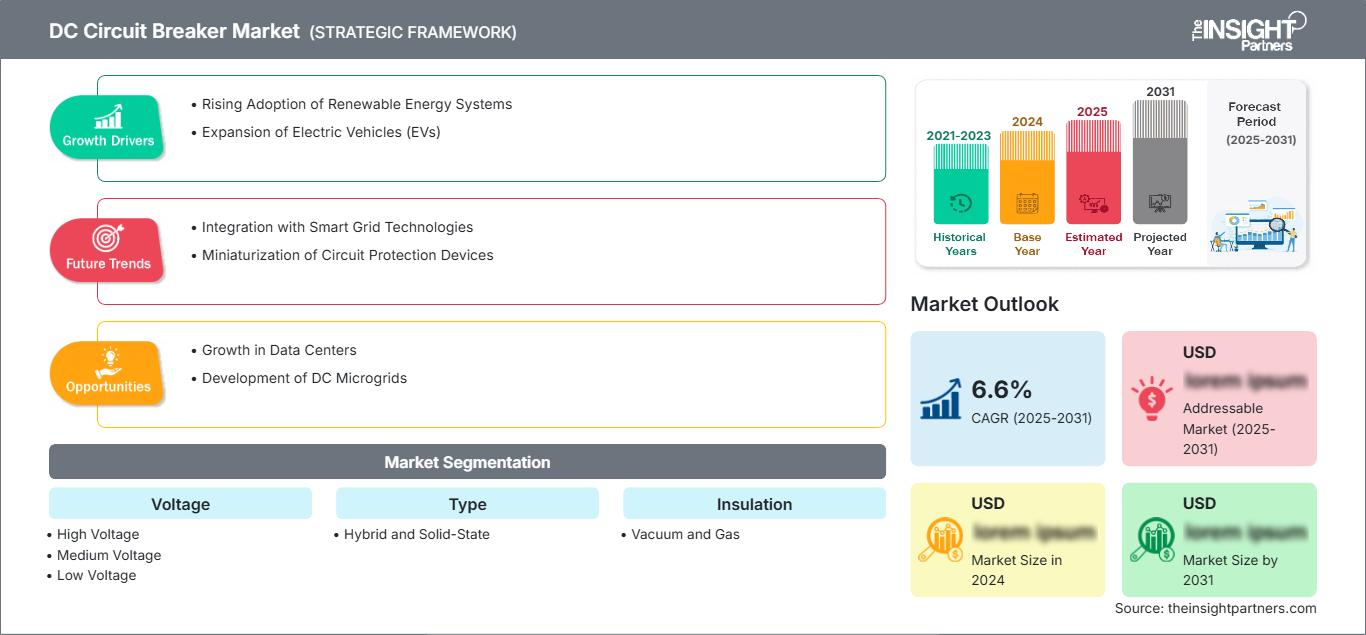
Voltage is expected to register a 6.6–7.2% CAGR during 2026–2034 as buyers specify protection by system voltage, arc energy, and selectivity needs. The DC Circuit Breaker Market scope across this segment spans transmission, distribution, charging, storage, and industrial automation where voltage level determines breaker topology, insulation, coordination, and testing requirements.
- High Voltage serves HVDC links, converter stations, offshore wind evacuation, and long-distance renewable transmission where rapid fault isolation and low interruption losses are strategically critical.
- Medium Voltage remains the largest voltage class, used in industrial feeders, rail substations, renewable plants, and campus microgrids needing reliable coordination and scalable switchgear integration.
- Low Voltage supports EV chargers, data centers, battery systems, machinery, and commercial DC panels where compactness, safety certification, and fast maintenance access shape purchasing.
Type
Type is projected to expand at a 6.8–7.5% CAGR during 2026–2034 as switching architecture becomes a key purchasing criterion. Hybrid designs balance losses and speed, while solid-state solutions target applications requiring microsecond interruption, remote diagnostics, and reduced mechanical wear in high-value assets.
- Hybrid breakers combine mechanical and semiconductor elements, offering faster interruption than conventional systems while managing conduction losses for utility, transport, and industrial applications.
- Solid-State breakers are gaining strategic importance in batteries, DC grids, and critical facilities because they enable arc-free switching, digital control, and rapid fault discrimination.
Insulation
Insulation is forecast to grow at a 6.1–6.8% CAGR during 2026–2034 as environmental rules and performance requirements reshape product design. Vacuum interrupters benefit from low-maintenance operation, while gas systems remain relevant where compactness, dielectric strength, and legacy substation practices influence specifications.
- Vacuum insulation is favored for medium-voltage applications requiring durability, reduced maintenance, and lower environmental exposure compared with legacy gas-dependent approaches.
- Gas insulation remains important in compact switchgear, high-voltage equipment, and retrofit environments where dielectric performance and established engineering standards support adoption.
Opportunity Snapshot
| Application | Revenue Contribution | Trend Tag | Adoption Stage |
| Transmission and Distribution | High | Grid Protection | Scaling |
| Commercial and Industrial | Medium | DC Facilities | Scaling |
| Renewables | High | Solar Storage | Mature |
| Railways | Medium | Traction Safety | Mature |
DC Circuit Breaker Market Growth Drivers and Impact Analysis
Grid Modernization and HVDC Expansion
The transmission grid companies are investing more in converter-based grids to transmit renewable energy over longer distances, as well as addressing the problem of network congestion. In HVDC grids, DC circuit breakers that are able to interrupt current flows without zero crossing of the current are necessary, hence making interruption speed and energy absorption crucial in the specifications of such DC breakers. This driver boosts the market demand for high voltage and hybrid equipment.
Battery Storage and Renewable Integration
DC cables, inverters, combiner boxes, and converters used in utility-scale battery storage and solar power plants have a high density. Circuit breakers that can interrupt strings, cabinets, and feeder circuits ensure the security of installations and minimize cascading events. With the increase in renewable generation capacity additions, the demand for DC circuit protection increases. This is clearly seen in the medium and low voltage demands, particularly for modular breakers that ensure fast installations and remote monitoring of the facilities.
Data Centers, EV Charging, and Industrial DC Loads
Digital infrastructure and electrified transport are creating higher-density DC loads that require faster and more selective protection. Data centers are evaluating DC distribution to reduce conversion stages, while fleet depots and public fast chargers need safe isolation for batteries, rectifiers, and high-power dispensers. Industrial automation adds steady demand through drives, robotics, and process equipment. These use cases expand the addressable base beyond utilities, encouraging manufacturers to offer compact devices with communication functions, thermal monitoring, and integration with energy management systems.
DC Circuit Breaker Market Future Trends
Solid-State Protection Moves Toward Mainstream Deployment
DC Circuit Breaker Market trends indicate that solid-state protection will move from niche pilots into broader commercial deployment as silicon carbide devices, thermal management, and control algorithms mature. The next phase will prioritize lower conduction losses, modular redundancy, and software-defined selectivity. Buyers will expect breakers to communicate fault signatures to supervisory systems and support predictive maintenance. Adoption will be strongest in critical loads, storage, marine electrification, and DC microgrids where arc-free interruption and millisecond-level recovery justify higher upfront cost.
Environmental Redesign of Insulation Platforms
Manufacturers are expected to accelerate vacuum and alternative gas designs as utilities reduce dependence on high-global-warming-potential insulation. Product roadmaps will increasingly combine environmental compliance with compact switchgear, digital monitoring, and standardized testing for DC applications. This trend will influence procurement language, especially in Europe and advanced Asian markets. Suppliers that prove dielectric reliability, lifecycle safety, and maintainability will gain advantage in substations, renewable interconnections, and industrial networks where owners face long asset lives and public scrutiny.
DC Circuit Breaker Market Opportunities
Packaged Protection for Storage and Charging Hubs
Developers of battery storage parks and EV charging hubs need repeatable protection packages that shorten engineering time and simplify commissioning. DC Circuit Breaker Market Forecasts point to attractive opportunities for pre-tested assemblies combining breakers, sensors, disconnects, and monitoring software. Suppliers can differentiate by offering coordination studies, thermal validation, and modular enclosures suited to containerized systems. This opportunity is action-oriented because project owners are scaling sites quickly and value solutions that reduce field wiring risk, inspection delays, and maintenance complexity.
Localized Manufacturing and Service Networks
Regional content rules, long equipment lead times, and the need for rapid service create openings for localized breaker assembly, testing, and repair capabilities. Companies that build regional application engineering teams can support utilities, rail operators, and industrial customers through qualification, failure analysis, and lifecycle upgrades. This opportunity is especially relevant in India, the Gulf, and North America, where infrastructure pipelines are expanding. Local presence can improve tender competitiveness while reducing downtime risk for operators managing critical DC assets.
Recent Developments
- April 2026: Siemens Smart Infrastructure has launched a new, comprehensive portfolio of direct current (DC) protection and switching solutions, solidifying its position as a pioneer in the DC era. The new offering, including the innovative SENTRON 3QD2 semiconductor circuit breaker and the SIRIUS 3RF5 solid-state switching device, is designed to meet the growing demand for sustainable, efficient, and reliable low-voltage power distribution and industrial switching technology. Integrated in power distribution systems such as SIVACON S8 low-voltage switchboard and SIVACON 8PS busbar trunking systems, these solutions are particularly crucial for high-performance applications such as data centers, especially AI Factories, production facilities and battery storage systems, as well as for the integration of renewable energies.
- July 2026: Diversified Technologies (DTI) introduced a hybrid medium-voltage DC circuit breaker designed for 5–20 kV applications in ships, data centers, and other critical power systems. The breaker combines mechanical contacts with solid-state switching technology to enable fast fault isolation, arc-free interruption, and reliable operation under full voltage and current conditions. The solution helps improve DC power system safety, reduce equipment damage during faults, and support more resilient high-power DC infrastructure.
- June 2026: Siemens and Infineon advanced semiconductor-based DC circuit breaker technology by integrating silicon carbide power modules into Siemens’ SENTRON 3QD2 protection system. The solution enables ultra-fast fault interruption, improved efficiency, higher power density, and enhanced reliability for applications such as data centers, industrial facilities, and battery storage systems. The technology supports more resilient DC power infrastructure by providing faster protection against short circuits and overloads compared with conventional electromechanical breakers.
Frequently Asked Questions

- Comprehensive Market Sizing and Forecast Analysis
- Detailed Segmentation Analysis
- In-Depth Market Dynamics Assessment
- Regional and Country-Level Insights
- Competitive Landscape and Company Benchmarking
- Strategic Business Intelligence
Recent Reports
Testimonials

The Insight Partners' SCADA System Market report is comprehensive, with valuable insights on current trends and future forecasts. The team was highly professional, responsive, and supportive throughout. We are very satisfied and highly recommend their services.
RAN KEDEM Partner, Reali Technologies LTDs
I requested a report on a very specific software market and the team produced the report in a few days. The information was very relevant and well presented. I then requested some changes and additions to the report. The team was again very responsive and I got the final report in less than a week.
JEAN-HERVE JENN Chairman, Future Analytica
We worked with The Insight Partners for an important market study and forecast. They gave us clear insights into opportunities and risks, which helped shape our plans. Their research was easy to use and based on solid data. It helped us make smart, confident decisions. We highly recommend them.
PIYUSH NAGPAL Sr. Vice President, High Beam Global
The Insight Partners delivered insightful, well-structured market research with strong domain expertise. Their team was professional and responsive throughout. The user-friendly website made accessing industry reports seamless. We highly recommend them for reliable, high-quality research services
YUKIHIKO ADACHI CEO, Deep Blue, LLC.
This is the first time I have purchased a market report from The Insight Partners.While I was unsure at first, I visited their web site and felt more comfortable to take the risk and purchase a market report.I am completely satisfied with the quality of the report and customer service. I had several questions and comments with the initial report, but after a couple of dialogs over email with their analyst I believe I have a report that I can use as input to our strategic planning process.Thank you so much for taking the extra time and making this a positive experience.I will definitely recommend your service to others and you will be my first call when we need further market data.
JOHN SUZUKI President and Chief Executive Officer, Board Director, BK Technologies
I wish to appreciate your support and the professionalism you displayed in the course of attending to my request for information regarding to infectious disease IVD market in Nigeria. I appreciate your patience, your guidance, and the fact that you were willing to offer a discount, which eventually made it possible for us to close a deal. I look forward to engaging The Insight Partners in the future, all thanks to the impression you have created in me as a result of this first encounter.
DR CHIJIOKE ONYIA MANAGING DIRECTOR, PineCrest Healthcare Ltd.Reason to Buy
- Informed Decision-Making
- Understanding Market Dynamics
- Competitive Analysis
- Identifying Emerging Markets
- Customer Insights
- Market Forecasts
- Risk Mitigation
- Boosting Operational Efficiency
- Strategic Planning
- Investment Justification
- Tracking Industry Innovations
- Aligning with Regulatory Trends





 Get Free Sample for