
DC Contactor Market Size, Share, and Growth Analysis by 2034
Coverage: By Product Type (General Purpose DC Contactors, Definite-Purpose DC Contactors); End User (Electric Vehicles, PV Solar, Aerospace and Defense, Rail Vehicles, Industrial Machineries, Others) , and Geography (North America, Europe, Asia Pacific, and South and Central America)
- Status : Data Released
- Report Code : TIPRE00019777
- Category : Electronics and Semiconductor
- No. of Pages : 150
- Available Report Formats :


- Last update date : October 26, 2026


2025 Market Size
US$ 525.71 Mn
Base year value
2034 Forecast
US$ 965.45 Mn
Projected by 2034
CAGR 2026-2034
7.07 %
Growth rate
Addressable Market
US$ 6,761.79 Mn
(2026-2034)
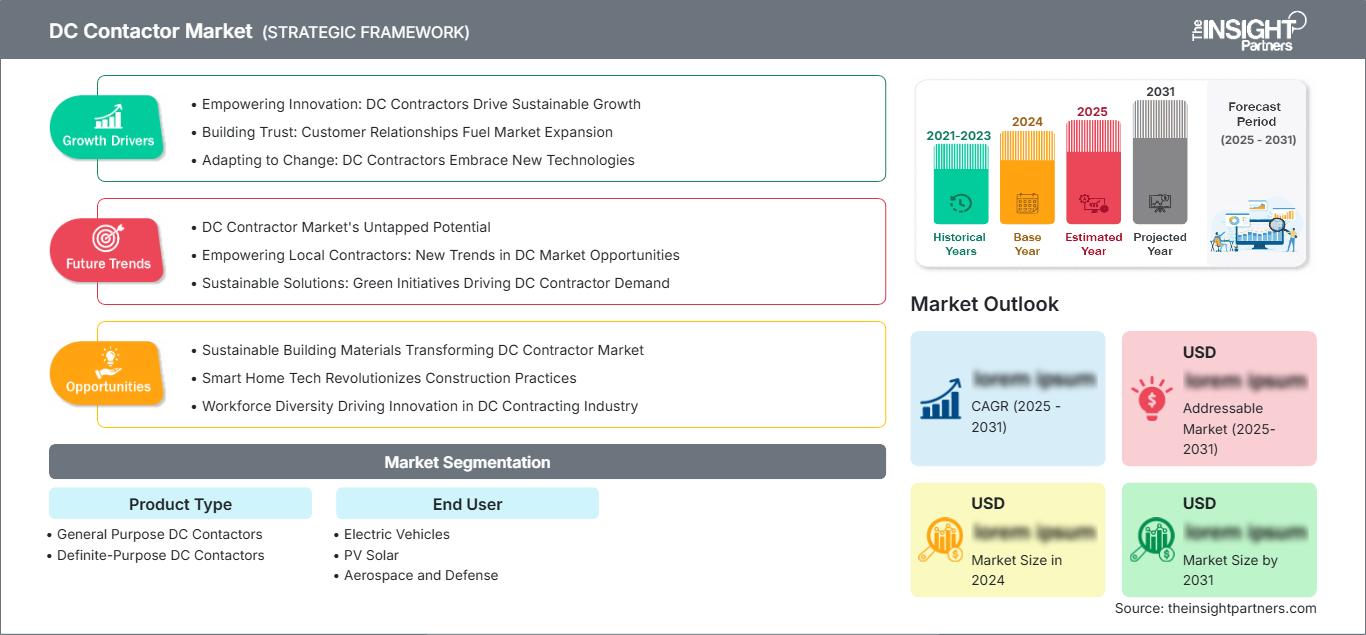
The DC Contactor Market size was estimated at US$ 525.71 million in 2025, and is projected to be US$ 965.45 million by 2034, with a CAGR of 7.07% during 2026-2034. The market includes electromechanical switches employed to switch on, disconnect, and safeguard the direct current in electric vehicles, photovoltaic (PV) solar plants, aerospace & defense systems, rail vehicles, and industrial machineries.
The North American market is expected to grow at a CAGR between 6.7-7.6% through 2034 due to the rising demand for DC Contactors due to the presence of battery packs in EVs, powerful chargers, and solar storage systems. North America is also benefitted by its domestic electrification spending, utility interconnection, and increased reliability in industrial power systems.
DC Contactor Market Assessment and Insights
- North America: The region accounts for 27–31% DC Contactor Market share in 2025 and grows at a CAGR range of 6.7–7.6% during 2026–2034, supported by EV charging, energy storage, and industrial automation.
- US: The country represents 78–82% of North America in 2025 and grows at a CAGR range of 6.8–7.7% during 2026–2034, led by EV manufacturing and charging networks.
- Europe: Europe holds 24–28% share in 2025 and grows at a CAGR range of 6.3–7.2% during 2026–2034, with Germany, France, the UK, Italy, and Spain leading demand.
- Asia Pacific: The region holds 32–36% share in 2025 and grows at a CAGR range of 7.6–8.8% during 2026–2034, led by China, Japan, South Korea, India, and Australia.
- Largest Segment: Electric Vehicles hold 48–52% market share in 2025 and grow at a CAGR range of 7.4–8.4% during 2026–2034 as high-voltage battery architectures scale.
- High Growth Segment: PV Solar holds 16–20% market share in 2025 and grows at a CAGR range of 8.0–9.2% during 2026–2034 due to solar-plus-storage deployments.
- Key companies analyzed in detail: Siemens AG; Schneider Electric SE; ABB Ltd.; Rockwell Automation, Inc.; Mitsubishi Electric Corporation; Hubbell Incorporated; Zhejiang Dongya Electronic Co., Ltd.; Eaton Corporation plc; AMETEK, Inc.; TE Connectivity plc.
Source: The Insight Partners' analysis based on proprietary research, government publications, company annual reports, investor presentations, industry databases, and expert interviews.
DC switching has evolved from low-voltage switching for industrial applications to sealed, high-voltage, application-specific contactors capable of withstanding multiple switching operations. Electric vehicle battery packs, 800V charging stations, photovoltaic strings, and battery energy storage applications are driving the design of products today. Thus, the market can be seen characterized by arc suppression capabilities, coil efficiency, heat resistance, size, and compliance with standards relevant to transportation, renewables, and mission critical electricity usage.
The market is forecast to grow in the future with increasing efforts by emerging economies to electrify their transportation fleets, rail systems, and distributed solar systems. Investment is likely to move towards contactors having higher voltage ratings, faster disconnect capabilities, low coil consumption, and diagnostics ready capabilities. It is expected that regulatory tailwinds related to vehicle safety, grid security, defense electrification, and renewables would benefit companies having mechanical reliability and application expertise.
DC Contactor Market Report Scope
| Report Attribute | Details |
|---|---|
| Market size in 2025 | US$ 525.71 Million |
| Market Size by 2034 | US$ 965.45 Million |
| Global CAGR (2026 - 2034) | 7.07% |
| Historical Data | 2021-2024 |
| Forecast period | 2026-2034 |
DC Contactor Market Analysis
Demand will be driven by electrified mobility, renewable energy generation, rail traction, and automatic machinery systems needing reliable DC isolation. Market growth will be supported by electric vehicle sales of more than 20 million units by 2025, solar + storage deployment, and high-voltage systems needing dependable switching under faults and loads.
The supply chain comprises of suppliers of contact material, coil, magnetics, enclosures, electronics, certification authorities, OEM buyers, and distributors. The supply chain is influenced by the availability of silver alloy, ceramic encapsulation, automation, testing capabilities, and qualification periods that are lengthy in transportation, military, and rail sectors compared to industrial controls.
The DC Contactor Market analysis highlights a competitive scenario with diversified electrical companies and application-specific component suppliers competing against each other. Siemens AG, Schneider Electric SE, ABB Ltd., Eaton Corporation plc, Mitsubishi Electric Corporation, and Rockwell Automation, Inc. make use of their global distribution networks and systems knowledge, whereas TE Connectivity plc, Hubbell Incorporated, AMETEK, Inc., and Zhejiang Dongya Electronic Co., Ltd. gain an edge with regard to their high-voltage, aerospace, industrial, and cost-effective strategies.
Key investment areas include hermetic sealing, gas-filled enclosures, position sensing, coil economizer, enhanced short circuit capability, and automated testing. Positioning strategy varies depending on end-users, as the electric vehicle (EV) segment looks for cycling capabilities and compactness, and PV solar users prefer voltage endurance.
● REPORT CUSTOMIZATION
Tailor This Report To Align With Your Specific Business Requirements
This report can be customized to align precisely with your business objectives, scope, and target markets. Customization options include tailored segmentation, geography, competitive analysis, and strategic insights to support informed decision-making.
Customize This Report →WHAT YOU CAN ADJUST
- ● Segmentations
- ● Geography
- ● Competitive Analysis
- ● Language Preferences
DC Contactor Market: Strategic Insights
Regional Insights
North America DC Contactor Market
The North American region accounted for 27-31% market share in 2025 and is expected to achieve a growth rate of 6.7-7.6% CAGR from 2026 to 2034. Factors driving the market include electric vehicle assembling facilities, charging stations, utility-scale solar power, energy storage systems, and industrial automation involving DC contactors.
Certified suppliers having good distribution and engineering capabilities will be preferred in regional purchases. The United States is leading due to automobile companies, charging station manufacturers, aerospace manufacturers, and other industrial manufacturers procuring DC switching technology for battery packs, pre-charge systems, DC fast charging stations, railway auxiliary systems, and industrial machines.
U.S. DC Contactor Market
The US accounts for 78-82% of North America in 2025 and has a CAGR of 6.8-7.7% in the period 2026 to 2034. The demand comes from electric vehicle platform, commercial charging stations, aerospace electrical system, and industrial equipment where reliability of switching can have an impact on safety and productivity.
Some of the companies involved include Eaton Corporation plc, Rockwell Automation, Inc., Hubbell Incorporated, TE Connectivity plc, and AMETEK, Inc., aided by local sales, engineering, and distribution channels. Some of the applications gaining popularity include battery disconnect systems, charger isolation systems, solar combiner systems, defense power distribution, and automated equipment.
Europe DC Contactor Market
Europe’s share ranges from 24% to 28% in 2025 and experiences a CAGR of 6.3% to 7.2% in the period of 2026-2034. Germany is the dominant nation in Europe due to the needs for reliability in DC switches for automotive electrical vehicles, rail transportation, industry automation and machinery exportation. Besides that, France and the UK require additional applications such as aerospace and defense products, EV charging solutions, and renewables.
Italy and Spain contribute to the market due to PV solar, transport, and machinery equipment development. The buyers of Europe pay attention to compliance, traceability and product lifecycle management, therefore Schneider Electric SE, Siemens AG, ABB Ltd., and Mitsubishi Electric Corporation are the key players in the market.
APAC DC Contactor Market
Asia Pacific accounts for 32-36% market share by 2025 and experiences a CAGR in the range of 7.6-8.8% between 2026-2034. China stands out on account of its initiatives relating to EVs, solar panel production, rail electrification, and battery storage, while Japan and South Korea focus on the quality of their components for use in automobile, industrial, and electronic related equipment.
India and Australia contribute to growth via their initiatives in charging stations, metro rail, industrial electrification, and renewable energy production. Policy preferences for local manufacture, energy security, and green transport encourage local sources, and cost-effectiveness contributes to the competitive position of companies such as Zhejiang Dongya Electronic Co., Ltd.
Middle East & Africa DC Contactor Market
Middle East & Africa is forecast to grow at a CAGR range of 5.8–6.8% during 2026–2034. Saudi Arabia and the UAE lead adoption through solar parks, mobility electrification pilots, data centers, and infrastructure modernization, while South Africa adds mining, rail, and industrial power demand.
Rest of MEA demand is shaped by grid reliability, distributed solar, water infrastructure, and transport upgrades. Harsh operating environments raise the importance of sealed enclosures, thermal resilience, and aftersales availability. Adoption improves when DC contactors are bundled with inverters, battery systems, charger cabinets, and industrial control panels.
Segmentation Analysis
Product Type
Product Type is projected to grow at a CAGR range of 6.8–7.7% during 2026–2034. The market scope by product type reflects a split between broad industrial switching and engineered duty cycles. General purpose devices serve standardized machinery and power panels, while definite-purpose designs gain importance where voltage, current, vibration, and arc behavior are tied to a specific application.
- General Purpose DC Contactors: These devices address industrial panels, battery systems, and machinery where standardized ratings, broad availability, and cost efficiency matter more than application-specific customization.
- Definite-Purpose DC Contactors: This category serves EVs, PV solar, rail, aerospace, and defense platforms requiring tailored current ratings, sealing, arc suppression, coil control, and validated duty cycles.
End User
End User is expected to grow at a CAGR range of 7.1–8.1% during 2026–2034. Adoption is strongest where DC power architectures are expanding and safety isolation is mission-critical. Electric vehicles lead current demand, PV solar accelerates with storage coupling, and rail, aerospace, defense, and industrial machinery provide resilient replacement and specification-driven demand.
- Electric Vehicles: Electric vehicles represent the largest use case because battery disconnects, pre-charge paths, traction systems, and fast-charging circuits require compact, high-cycle DC switching.
- PV Solar: PV solar demand is rising as higher-voltage arrays, combiner boxes, inverters, and storage-linked systems require safe isolation and dependable arc management.
- Aerospace and Defense: Aerospace and defense applications prioritize sealed, lightweight, vibration-resistant contactors for power distribution, ground vehicles, aircraft systems, and mission-critical electrical architectures.
- Rail Vehicles: Rail vehicles use DC contactors in traction, auxiliary power, battery systems, doors, HVAC, and signaling-linked circuits where reliability and service intervals matter.
- Industrial Machineries: Industrial machineries require DC contactors for motor drives, automation equipment, forklifts, cranes, backup power systems, and controlled switching in harsh operating environments.
Opportunity Snapshot
| End User | Revenue Contribution | Trend Tag | Adoption Stage |
| Electric Vehicles | High | Battery Safety | Scaling |
| PV Solar | Medium | Solar Storage | Scaling |
| Aerospace and Defense | Medium | Mission Power | Mature |
| Rail Vehicles | Medium | Traction Upgrade | Scaling |
| Industrial Machineries | Medium | Automation Power | Mature |
DC Contactor Market Growth Drivers and Impact Analysis
High-Voltage EV Architectures Require Safer DC Isolation
Electric vehicles need to have contactors which will be able to disconnect battery packs during charge, drive, maintenance, and fault events. With the platforms evolving to 400V and 800V design concepts, the switching technology needs to withstand more current flow, faster pre-charge operation, as well as multiple cycles without any welding or overheating. This translates into the need for sealed, smaller in size and able to be diagnosed devices. The effect of the market can be seen in the qualification process of contactors along with fuses, pyro switches, BMS, and charge technologies.
Solar-Plus-Storage Expands DC Switching Requirements
PV solar systems are becoming more integrated with battery energy storage systems, hybrid inverters, and DC coupled systems that require proper current interruptions. Contactors are installed in combiners boxes, battery boxes, inverter protection circuits, and maintenance isolation circuits. This becomes increasingly significant in view of higher voltage and longer duty cycle operation of utility scale and commercial applications. This is particularly relevant to areas that are installing solar capacity while increasing grid resiliency. Arc control, thermal stability, and compatibility with inverter and battery boxes become key differentiators for manufacturers.
Industrial and Rail Electrification Supports Replacement Demand
Industrial machinery, automated handling equipment, cranes, forklifts, and rail vehicles are adopting more DC drives, onboard batteries, and auxiliary power systems. This expands demand beyond new EV programs and creates a replacement base tied to maintenance cycles. Rail vehicles require contactors that withstand vibration, switching stress, and long service intervals, while industrial users prioritize uptime and spare-part availability. The commercial impact is steady order flow through OEMs, panel builders, and distributors. Suppliers that support both new-build and aftermarket channels can balance cyclical automotive exposure with resilient industrial revenue.
DC Contactor Market Future Trends
Diagnostics-Ready Contactors Become Standard in Critical Systems
DC Contactor Market trends will increasingly favor devices with position feedback, coil health monitoring, temperature awareness, and integration with battery or power management software. Future buyers will not evaluate contactors only by voltage and current ratings. They will also assess diagnostic visibility because predictive maintenance can reduce downtime in fleets, rail systems, storage plants, and industrial machinery. This shift will encourage suppliers to combine mechanical switching reliability with embedded sensing, standardized communication interfaces, and data that supports safety cases, warranty analytics, and remote service models.
Hybrid and Solid-State Switching Influences Design Roadmaps
Hybrid switching concepts will influence future product development as users seek faster interruption, lower contact wear, and improved arc control. Mechanical contactors will remain important because they provide low conduction loss and proven isolation, but electronics-assisted designs can reduce stress during switching events. This direction is relevant for megawatt charging, heavy-duty EVs, stationary storage, and rail power systems. Suppliers will need to balance cost, reliability, thermal design, and certification requirements as solid-state elements move from specialized uses toward broader commercial evaluation.
DC Contactor Market Opportunities
Localized Supply for EV and Charger Manufacturing
DC Contactor Market Forecasts support investment in localized production, testing, and engineering support near EV, charger, and battery-pack manufacturing hubs. OEMs increasingly prefer suppliers that can provide fast design iteration, traceable quality documentation, and regional logistics resilience. Opportunity exists in North America, Europe, India, and Southeast Asia as governments encourage domestic electrification supply chains. Companies that establish application labs, automated end-of-line testing, and flexible current-rating platforms can win programs that require both technical qualification and dependable delivery.
Application-Specific Platforms for Solar, Rail, and Defense
Beyond EVs, suppliers can create value by developing application-specific contactor families for PV solar, rail vehicles, aerospace, and defense. These markets reward documentation, environmental sealing, duty-cycle validation, and long-term availability more than low unit price alone. Solar integrators need high-voltage endurance, rail operators need vibration-resistant service parts, and defense programs need rugged, qualified components. Vendors that package contactors with auxiliary contacts, economizers, busbar compatibility, and certification support can deepen customer relationships and improve margins.
Recent Developments
- July 2026: HIITIO launched an expanded low-voltage DC contactor product lineup designed to address growing demand from electric vehicles, energy storage systems, charging infrastructure, solar applications, and industrial power systems. The new portfolio broadens HIITIO’s DC switching solutions with additional configurations focused on improving safety, reliability, and efficient power management in low-voltage DC applications, complementing the company’s existing range of high-voltage DC contactors, fuses, and electrical protection devices.
- June 2026: Schaltbau began series production of the Eddicy C330 megawatt charging contactor, a bidirectional DC contactor designed for next-generation high-power charging systems. The C330 supports switching voltages up to 1,500 V and continuous currents up to 3,000 A, enabling megawatt charging infrastructure for heavy-duty electric vehicles, energy storage systems, and renewable energy applications. Its compact design, low contact resistance, permanent-magnet arc extinguishing technology, and high short-circuit withstand capability improve efficiency, safety, and reliability for future high-power DC applications.
- March 2025: Schaltbau announced a strategic partnership with fortop Automation and Energy Control UK to serve as a distributor and systems integrator for Eddicy’s DC contactor portfolio in the UK market. The collaboration aims to accelerate adoption of advanced DC switching technology across industrial, renewable energy, electric vehicle charging, battery storage, and automation applications by providing customers with high-performance contactors designed for safer, more efficient, and reliable high-voltage DC systems.
Frequently Asked Questions

- Comprehensive Market Sizing and Forecast Analysis
- Detailed Segmentation Analysis
- In-Depth Market Dynamics Assessment
- Regional and Country-Level Insights
- Competitive Landscape and Company Benchmarking
- Strategic Business Intelligence
Recent Reports
Testimonials

The Insight Partners provided valuable market intelligence that supported our global go-to-market strategy. Their team was professional, responsive, and attentive to our feedback, providing thoughtful analysis and helpful methodological clarifications throughout the project.
Junmo Kim Chief Financial Officer (CFO), Enertech Co., Ltd.
The Insight Partners' SCADA System Market report is comprehensive, with valuable insights on current trends and future forecasts. The team was highly professional, responsive, and supportive throughout. We are very satisfied and highly recommend their services.
RAN KEDEM Partner, Reali Technologies LTDs
I requested a report on a very specific software market and the team produced the report in a few days. The information was very relevant and well presented. I then requested some changes and additions to the report. The team was again very responsive and I got the final report in less than a week.
JEAN-HERVE JENN Chairman, Future Analytica
We worked with The Insight Partners for an important market study and forecast. They gave us clear insights into opportunities and risks, which helped shape our plans. Their research was easy to use and based on solid data. It helped us make smart, confident decisions. We highly recommend them.
PIYUSH NAGPAL Sr. Vice President, High Beam Global
The Insight Partners delivered insightful, well-structured market research with strong domain expertise. Their team was professional and responsive throughout. The user-friendly website made accessing industry reports seamless. We highly recommend them for reliable, high-quality research services
YUKIHIKO ADACHI CEO, Deep Blue, LLC.
This is the first time I have purchased a market report from The Insight Partners.While I was unsure at first, I visited their web site and felt more comfortable to take the risk and purchase a market report.I am completely satisfied with the quality of the report and customer service. I had several questions and comments with the initial report, but after a couple of dialogs over email with their analyst I believe I have a report that I can use as input to our strategic planning process.Thank you so much for taking the extra time and making this a positive experience.I will definitely recommend your service to others and you will be my first call when we need further market data.
JOHN SUZUKI President and Chief Executive Officer, Board Director, BK Technologies
I wish to appreciate your support and the professionalism you displayed in the course of attending to my request for information regarding to infectious disease IVD market in Nigeria. I appreciate your patience, your guidance, and the fact that you were willing to offer a discount, which eventually made it possible for us to close a deal. I look forward to engaging The Insight Partners in the future, all thanks to the impression you have created in me as a result of this first encounter.
DR CHIJIOKE ONYIA MANAGING DIRECTOR, PineCrest Healthcare Ltd.Reason to Buy
- Informed Decision-Making
- Understanding Market Dynamics
- Competitive Analysis
- Identifying Emerging Markets
- Customer Insights
- Market Forecasts
- Risk Mitigation
- Boosting Operational Efficiency
- Strategic Planning
- Investment Justification
- Tracking Industry Innovations
- Aligning with Regulatory Trends





 Get Free Sample for