
Digital Inks Market Share, Size & Demand by 2034
Coverage: By Formulation (Solvent-Based, Water-Based, UV-Cured, Others); Application (Advertising and Promotion, Ceramic Tiles Printing, Packaging, Clothing and Household Textiles, Glass Printing, Publication, Others); Substrate (Plastics, Ceramics and Glass, Textiles, Paper) , and Geography (North America, Europe, Asia Pacific, and South and Central America)
- Status : Data Released
- Report Code : TIPRE00005486
- Category : Chemicals and Materials
- No. of Pages : 150
- Available Report Formats :


- Last update date : July 22, 2026


2025 Market Size
US$ 3.96 Bn
Base year value
2034 Forecast
US$ 7.17 Bn
Projected by 2034
CAGR 2026-2034
6.83 %
Growth rate
Addressable Market
US$ 50.32 Bn
(2026-2034)
The Digital Inks Market was valued at US$ 3.96 Billion in 2025 and is projected to reach US$ 7.17 Billion by 2034, registering a CAGR of 6.83% during 2026–2034. Expanding due to increasing usage of digital printing technologies in packaging, textiles, ceramic tiles, printing for advertisements, glass decoration, and publishing industries, where shorter print runs, the ability to use variable data, speed, and reduced waste are transforming the focus of the ink manufacturing industry.
In North America, converter investments in labels, flexible packaging, wide-format graphics, and industrial inkjet systems support an estimated 5.7–6.7% CAGR. The Digital Inks Market size outlook is reinforced by demand for low-VOC chemistries, UV-curable productivity gains, and brand requirements for customized packaging. Regulatory attention to emissions and food-contact materials is also shifting procurement toward water-based and energy-curable formulations.
Digital Inks Market Assessment and Insights
- North America: Share in 2025 of 29–33% and CAGR between 5.7–6.7%. Packaging conversion, wide-format graphics, and low-VOC compliance sustain demand, while mature distribution networks support adoption of UV-cured and water-based products.
- US: Share in 2025 of 76–80% of North America and CAGR between 5.8–6.8%. Strong label, packaging, signage, and industrial print demand keep the country central to regional ink consumption.
- Europe: Share in 2025 of 24–28% and CAGR between 5.3–6.3%. Germany, the UK, France, Italy, and Spain lead through packaging modernization, ceramic decoration, textile printing, and sustainability-led formulation shifts.
- Asia Pacific: Share in 2025 of 34–38% and CAGR between 7.5–8.5%. China, Japan, South Korea, India, and Australia benefit from electronics, textiles, ceramics, labels, and expanding consumer goods manufacturing.
- Largest Segment: Water-Based formulation with market share of 36–40% in 2025 and CAGR of 6.4–7.4% during 2026–2034, supported by lower emissions and packaging compatibility.
- High Growth Segment: UV-Cured formulation with market share of 27–31% in 2025 and CAGR of 7.8–8.8% during 2026–2034, driven by instant curing and productivity gains.
- Key companies analyzed in detail: Bordeaux Digital PrintInk Ltd., FUJIFILM Holdings Corporation, INX International Ink Co., JK Group S.p.A., Marabu GmbH & Co. KG, Nazdar Company, Inc., Nutec Digital Ink (Pty) Ltd., Sensient Imaging Technologies S.A., Sun Chemical Corporation, artience Co., Ltd.
Source: The Insight Partners' analysis based on proprietary research, government publications, company annual reports, investor presentations, industry databases, and expert interviews.
Production technology is shifting away from analog substitution and toward engineered inks that are tailored to particular printhead, substrate, curing technology, and compliance needs. The factors of pigment stability, viscosity, droplet formation, bonding, and drying are key in defining business success. Digital presses in packaging and textiles production are becoming more efficient at minimizing setup times and inventory waste, thus compelling ink producers to strive for optimal performance based on color density, food-safe compliance, durability, and equipment compatibility.
Demand is forecasted to grow in Asia-Pacific countries, some Middle-Eastern packaging centers, and North American label converters adopting fast inkjet lines. The need to minimize VOCs, shorter product development periods, and rising production of customized textiles will be driving factors in future investments. The Digital Inks Market will increasingly reward suppliers that combine formulation science, application testing, printhead partnerships, and reliable global service capability.
Digital Inks Market Report Scope
| Report Attribute | Details |
|---|---|
| Market size in 2025 | US$ 3.96 Billion |
| Market Size by 2034 | US$ 7.17 Billion |
| Global CAGR (2026 - 2034) | 6.83% |
| Historical Data | 2021-2024 |
| Forecast period | 2026-2034 |
Digital Inks Market Analysis
The Digital Inks Market growth trajectory is tied to the conversion of packaging, advertising, textile, and ceramic decoration from long-run analog production to shorter, data-driven digital output. Brand owners require faster artwork changes, local-language labeling, and seasonal customization, while printers seek lower setup waste and flexible batch economics. These requirements support steady demand for solvent-based, water-based, and UV-cured formulations across multiple substrates.
Supply dynamics depend on pigments, dyes, resins, monomers, photoinitiators, solvents, additives, and printhead qualification cycles. Ink suppliers must manage raw material volatility while meeting strict viscosity, particle-size, migration, and durability tolerances. The ecosystem includes printer OEMs, converters, textile mills, ceramic tile producers, packaging suppliers, and distributors, making technical service and application testing as important as price competitiveness.
Current Digital Inks Market analysis shows competition centered on application-specific chemistry, regulatory support, and OEM-aligned performance. Sun Chemical Corporation, INX International Ink Co., FUJIFILM Holdings Corporation, Nazdar Company, Inc., and Marabu GmbH & Co. KG continue strengthening portfolios for packaging, signage, industrial, and specialty printing. This strategy is based on the requirement for color uniformity, substrate adhesion, equipment operation, and local technical service support.
The specialists in this field include Bordeaux Digital PrintInk Ltd., JK Group S.p.A., Nutec Digital Ink (Pty) Ltd., Sensient Imaging Technologies S.A., and artience Co., Ltd., which target the niches of wide format printing, textile sublimation, inkjet industrial, and coloring technologies. Funding will shift towards products with lower odor levels, energy-curable technology, and digital textile systems.
● REPORT CUSTOMIZATION
Tailor This Report To Align With Your Specific Business Requirements
This report can be customized to align precisely with your business objectives, scope, and target markets. Customization options include tailored segmentation, geography, competitive analysis, and strategic insights to support informed decision-making.
Customize This Report →WHAT YOU CAN ADJUST
- ● Segmentations
- ● Geography
- ● Competitive Analysis
- ● Language Preferences
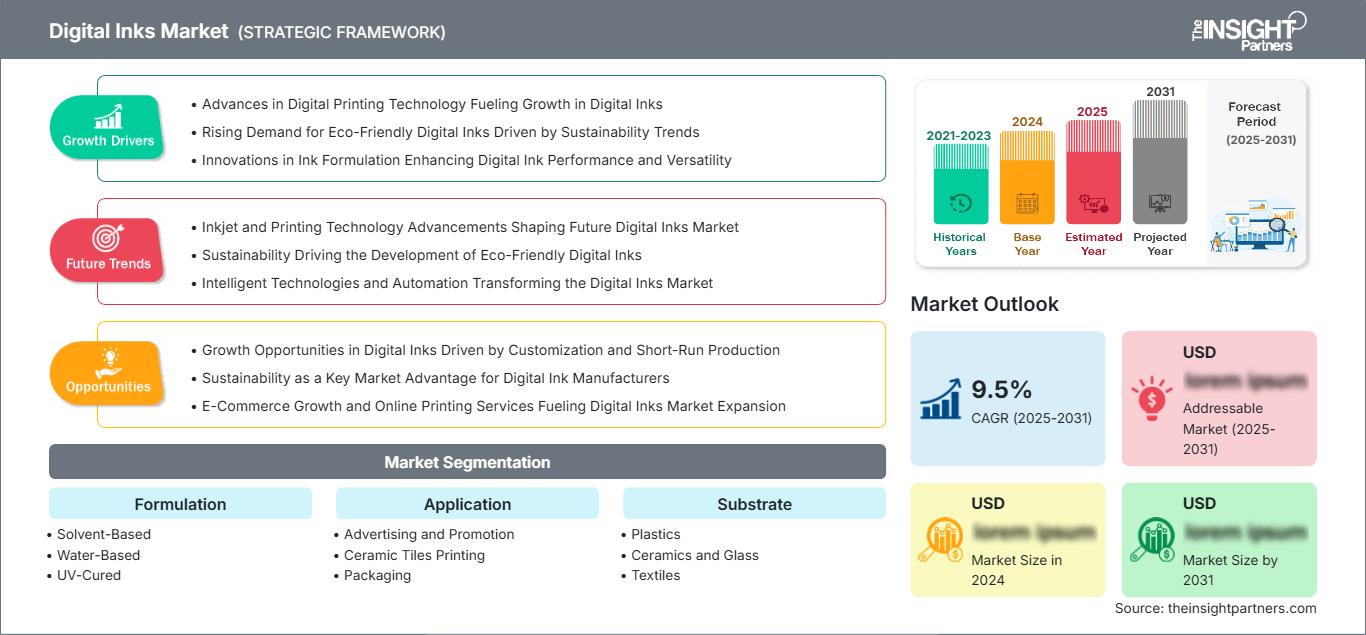
Digital Inks Market: Strategic Insights
Regional Insights
North America Digital Inks Market
North America represented 29–33% of global revenue in 2025 and is expected to expand at a 5.7–6.7% CAGR through 2034. The regional Digital Inks Market share reflects established label printing, corrugated packaging, wide-format signage, and industrial marking demand. Converters are upgrading equipment to support shorter runs, variable data, and faster design cycles across consumer goods and logistics applications.
Low-VOC procurement policies and brand-owner sustainability goals are accelerating the move toward water-based and UV-cured systems. Packaging, commercial graphics, and textile decoration remain the main demand centers. Supplier proximity, OEM collaboration, and technical service networks support the qualification of new inks for plastic films, paper labels, textiles, and rigid substrates in high-value production environments.
U.S. Digital Inks Market Market
The U.S. accounted for 76–80% of North American revenue in 2025 and is forecast to grow at a 5.8–6.8% CAGR. The demand has been directed toward labeling, flexible packaging, point of sale graphics, promotional printing, and industrial marking. Adoption of inkjet printing technology by the converting industry of this country has been driven by the need to reduce material wastage during the setup process and address the problem of SKU explosion among brands.
The presence of the business facilitates the technology transfer and qualification process. INX International Ink Co., Nazdar Company, Inc., FUJIFILM Holdings Corporation, and Sun Chemical Corporation offer their products in the packaging, graphics, and industrial markets through formulation, distribution, and service networks. Applications of the technology include UV-curing ink for increased productivity and water-based ink for labeling and corrugated packaging.
Europe Digital Inks Market Market
Europe held 24–28% of global revenue in 2025 and is projected to grow at a 5.3–6.3% CAGR. Germany continues to be the leader due to the presence of good packaging machinery, industrial printing, ceramic decoration, and chemical formulation. The UK is aided by label conversion and retail packaging needs driven by frequent artwork changes and private-label product development.
The contribution made by France, Italy, and Spain comes via cosmetics packaging, fashion textiles, ceramic tiles, and food labeling. The focus of the EU on emissions, migration, and circular packaging drives waterborne and energy-curing inks. Marabu GmbH & Co. KG, JK Group S.p.A., Bordeaux Digital PrintInk Ltd., and Sensient Imaging Technologies S.A. cater to special needs in signage, textiles, and industrial decoration.
APAC Digital Inks Market Market
Asia Pacific accounted for 34–38% of global revenue in 2025 and is expected to grow at a 7.5–8.5% CAGR. China dominates regional demand via packaging, ceramics, electronics marking, and textile printing. Japan and South Korea bring in industrial precision printing and advanced materials technology knowledge.
The market has huge growth potential in India as the apparel, labeling, and packaging for consumer products are adopting digital workflow technology solutions. At the same time, Australia opts for wide-format graphics and unique packaging solutions. Manufacturing, export of textiles, and advanced packaging technologies receive policy support in the region. Leading players in technology include Artience Co., Ltd. and FUJIFILM Holdings Corporation.
Middle East & Africa Digital Inks Market Market
The Middle East & Africa market is projected to register a 6.1–7.1% CAGR through 2034. Saudi Arabia leads regional momentum as infrastructure, retail packaging, and tourism projects create demand for signage, décor, and packaged goods printing. UAE demand is supported by logistics, events, and brand communication activity.
South Africa contributes through labels, promotional graphics, and packaging conversion, while the rest of MEA remains project-led. Energy-linked industrial diversification and food processing investments increase the need for durable coding, labeling, and packaging inks. Suppliers that provide technical training and climate-appropriate formulations can improve adoption across harsh operating conditions.
Segmentation Analysis
Formulation
The Formulation segment is projected to grow at a 6.6–7.6% CAGR during 2026–2034. The Digital Inks Market scope is widening as printers choose chemistries based on drying speed, substrate adhesion, emissions profile, odor, migration risk, and equipment compatibility. Regulatory pressure and productivity requirements are shifting demand toward water-based and UV-cured platforms while solvent-based products retain relevance in durable graphics.
- Solvent-Based: Solvent-based inks remain important for outdoor graphics, plastics, and applications requiring strong adhesion, durability, and weather resistance, although regulatory and odor concerns limit growth in sensitive environments.
- Water-Based: Water-based inks lead adoption in packaging, paper, textiles, and labels, where lower emissions, print quality, and compatibility with sustainability programs support broader commercial acceptance.
- UV-Cured: UV-cured inks are gaining share because instant curing, sharp image quality, and strong adhesion improve productivity on plastics, glass, labels, and industrial substrates.
Application
The Application segment is anticipated to grow at a CAGR of 6.7% to 7.7% till 2034. Digital printing that decreases set-up time, allows for customization and design flexibility, sees more demand. The segments of packaging and advertisement make up for the bulk of the demand, but ceramic tiles, textiles, glass, and print publications are all benefiting.
- Advertising and Promotion: Advertising uses rely on fast turnaround, outdoor durability, and high color impact for banners, signage, displays, and retail graphics, making digital inks essential for localized campaigns.
- Ceramic Tiles Printing: Ceramic tile printing benefits from non-contact decoration, design variety, and high-resolution surface effects, supporting adoption among tile manufacturers serving residential and commercial interiors.
- Packaging: Packaging is a strategic application as brands require variable data, shorter runs, seasonal designs, and faster SKU changes across labels, cartons, flexible packs, and corrugated formats.
- Clothing and Household Textiles: Textile applications use digital inks for customization, reduced water use, fast sampling, and design flexibility across apparel, curtains, home décor, and promotional fabrics.
- Glass Printing: Glass printing demand is supported by architectural décor, appliances, containers, and interior design applications requiring adhesion, opacity, durability, and consistent color performance.
- Publication: Publication printing uses digital inks for short-run books, personalized materials, academic content, and localized print jobs where inventory reduction and rapid turnaround improve economics.
Substrate
The substrate segment will experience a growth rate of 6.5% – 7.5% CAGR during 2026 – 2034. Ink formulation is dependent upon substrate choice and its properties. Plastics and paper account for packaging and labeling applications, while textiles promote design flexibility, whereas ceramic and glass generate specific demand.
- Plastics: Plastic substrates are central to labels, flexible packaging, rigid containers, and displays, requiring inks with adhesion, flexibility, scratch resistance, and compatibility with food-contact requirements.
- Ceramics and Glass: Ceramics and glass require specialized inks that tolerate firing, curing, abrasion, and cleaning exposure, supporting decorative tiles, architectural panels, appliances, and container printing.
- Textiles: Textile substrates need color vibrancy, wash durability, hand-feel control, and fabric compatibility, making ink selection critical for apparel, décor, soft signage, and household fabrics.
- Paper: Paper remains important for labels, cartons, publications, and commercial print, where absorption control, drying speed, dot gain, and recyclability influence ink qualification decisions.
Opportunity Snapshot
| Application | Revenue Contribution | Trend Tag | Adoption Stage |
| Advertising and Promotion | Medium | Retail Graphics | Mature |
| Ceramic Tiles Printing | Medium | Decor Tiles | Scaling |
| Packaging | High | Variable Data | Scaling |
| Clothing and Household Textiles | High | Custom Textiles | Scaling |
| Glass Printing | Low | Decor Glass | Emerging |
| Publication | Medium | Short Runs | Mature |
Digital Inks Market Growth Drivers and Impact Analysis
Packaging Customization and Short-Run Economics
Digital printing is being considered by packaging converters since there are requirements for fast turnaround of products, frequent design changes, and variable content to cater to regional campaigns, e-commerce, and track-and-trace. With digital inks, the label, flexible packaging, corrugate, and carton can be printed without the need for a long plate-making process. This trend affects food, beverages, personal care, pharmaceutical, and consumer products industries. In addition, this will help address changes in regulations as well as retailers’ demands for timely seasonal changes. The ink supplier will stand to gain if it can offer its ink systems for food-safe, low odor, and migration control, among others.
Shift Toward Low-VOC and Energy-Curable Formulations
Lower emissions, safer handling and more favorable work environments have become increasingly important to regulators, converters and brand owners. This has created more demand for waterborne, UV-curable, and LED-curable ink technologies when appropriate for performance. This trend is most apparent in packaging, interior graphics, textile printing and food-related printing, where the odor and migration characteristics affect qualifying suppliers. Energy-curable inks increase productivity through immediate cure capability and reduced drying issues. Compliance documents, low migration properties and good curing ability create an advantage when negotiating with converters.
Expansion of Textile and Ceramic Digital Printing
Producers of textiles and ceramics are utilizing digital printing technologies to enhance design versatility, decrease sample time, and satisfy the needs of niche customers. In the case of textile applications, digital inkjet enables quick fashion trends and customizations while eliminating the need for a great deal of screen inventory. In the manufacturing of ceramic tiles, digital decoration allows for the reproduction of such materials as stone, wood, and textures at industrial speed and increases product variation. Such uses demand ink that has fabric suitability, washing endurance, heat stability, or abrasion endurance.
Digital Inks Market Future Trends
Bio-Based and Low-Migration Ink Platforms
Emerging Digital Inks Market trends point toward bio-based resins, safer solvents, and low-migration systems that satisfy packaging and regulatory expectations without sacrificing print quality. Food, personal care, and healthcare packaging will require stronger documentation on raw materials, curing completeness, odor, and migration behavior. Future ink development will therefore involve closer collaboration among chemical suppliers, printer OEMs, converters, and brand compliance teams. The practical outcome will be longer qualification cycles but higher switching barriers once approved. Companies able to combine sustainability claims with measurable press performance and regulatory evidence are likely to gain preference in sensitive applications.
Industrial Inkjet Integration with Automated Production
The industrial printing manufacturers will be required to integrate the inkjet heads directly within the production line itself for printing and other surface applications. The market will increase its scope from traditional print rooms to packaging lines, building products, consumer electronics, and engineered parts. The demand for inks will increase due to the fact that the fluids need to work effectively while running in the production environment and will need to work on surfaces that are uneven, coated, hot, and chemical-treated.
Digital Inks Market Opportunities
Packaging Lines for E-Commerce and SKU Proliferation
E-commerce growth and expanding SKU portfolios create a clear opportunity for ink suppliers serving labels, corrugated packaging, and flexible formats. Converters need inks that support rapid job changes, barcode readability, durable transport performance, and consistent color across smaller batches. Investment aligned with Digital Inks Market Forecasts should prioritize packaging qualification, low-migration validation, and partnerships with digital press OEMs. Suppliers can also differentiate through color management tools, on-site troubleshooting, and application laboratories that shorten approval timelines. The opportunity is strongest where brand owners seek localized packaging, promotional personalization, and waste reduction without sacrificing shelf impact or regulatory compliance.
Textile Printing for On-Demand Fashion and Home Décor
Demand for on-demand textile printing provides suppliers with the chance to cater to producers of clothing, banners, curtains, upholstery, and household decorations who require flexibility in design. Digital ink decreases the requirement for huge minimum orders and helps in quicker sampling and customization of the design. The best options available are pigment ink, reactive ink, disperse ink, and sublimation ink because they help in improving the color intensity, washfastness, and texture of the cloth. They must concentrate on setting up textile centers, pretreatment, and compatibility tests on the most frequently used fabrics.
Recent Developments
- June 2026: Siegwerk has completed its acquisition of Hi-Tech Inks, a leading Indian manufacturer of flexographic and gravure printing inks. This acquisition enhances Siegwerk's growth strategy and solidifies its commitment to India, a key strategic market. The merger positions the combined entity as the largest player in India's flexible packaging inks market, with over 20 percent market share.
- May 2026: NUtec Digital Ink has launched Ruby R10-DTF, a high-performance UV-curable Direct-to-Film ink designed for LED-UV printers. This ink solution enables quick decal production, eliminating the manual weeding process required by traditional vinyl applications, thereby significantly reducing production time and labor costs for print providers.
- April 2025: INX International is set to unveil its new Beverage Can Digital Ink at the Cannex Fillex World Canmaking Congress, taking place from April 29 to May 1 in Denver. This event marks INX's return to North America since 2019, showcasing cutting-edge canmaking technologies. INX, a leader in metal decorating, will present the INXJet MDLM UV Curable Inkjet ink, a regulatory-compliant solution aimed at enhancing digital can decoration.
Frequently Asked Questions

- Comprehensive Market Sizing and Forecast Analysis
- Detailed Segmentation Analysis
- In-Depth Market Dynamics Assessment
- Regional and Country-Level Insights
- Competitive Landscape and Company Benchmarking
- Strategic Business Intelligence
Recent Reports
Testimonials

The Insight Partners' SCADA System Market report is comprehensive, with valuable insights on current trends and future forecasts. The team was highly professional, responsive, and supportive throughout. We are very satisfied and highly recommend their services.
RAN KEDEM Partner, Reali Technologies LTDs
I requested a report on a very specific software market and the team produced the report in a few days. The information was very relevant and well presented. I then requested some changes and additions to the report. The team was again very responsive and I got the final report in less than a week.
JEAN-HERVE JENN Chairman, Future Analytica
We worked with The Insight Partners for an important market study and forecast. They gave us clear insights into opportunities and risks, which helped shape our plans. Their research was easy to use and based on solid data. It helped us make smart, confident decisions. We highly recommend them.
PIYUSH NAGPAL Sr. Vice President, High Beam Global
The Insight Partners delivered insightful, well-structured market research with strong domain expertise. Their team was professional and responsive throughout. The user-friendly website made accessing industry reports seamless. We highly recommend them for reliable, high-quality research services
YUKIHIKO ADACHI CEO, Deep Blue, LLC.
This is the first time I have purchased a market report from The Insight Partners.While I was unsure at first, I visited their web site and felt more comfortable to take the risk and purchase a market report.I am completely satisfied with the quality of the report and customer service. I had several questions and comments with the initial report, but after a couple of dialogs over email with their analyst I believe I have a report that I can use as input to our strategic planning process.Thank you so much for taking the extra time and making this a positive experience.I will definitely recommend your service to others and you will be my first call when we need further market data.
JOHN SUZUKI President and Chief Executive Officer, Board Director, BK Technologies
I wish to appreciate your support and the professionalism you displayed in the course of attending to my request for information regarding to infectious disease IVD market in Nigeria. I appreciate your patience, your guidance, and the fact that you were willing to offer a discount, which eventually made it possible for us to close a deal. I look forward to engaging The Insight Partners in the future, all thanks to the impression you have created in me as a result of this first encounter.
DR CHIJIOKE ONYIA MANAGING DIRECTOR, PineCrest Healthcare Ltd.Reason to Buy
- Informed Decision-Making
- Understanding Market Dynamics
- Competitive Analysis
- Identifying Emerging Markets
- Customer Insights
- Market Forecasts
- Risk Mitigation
- Boosting Operational Efficiency
- Strategic Planning
- Investment Justification
- Tracking Industry Innovations
- Aligning with Regulatory Trends





 Get Free Sample for