
Digital Inspection Market Size, Share & Forecast by 2034
Coverage: by Component (Hardware, Software, Services); Technology (Machine Vision, Metrology, NDT); Dimension (2D, 3D); Industry Vertical (Manufacturing, Electronics, Oil and Gas, Aerospace and Defense, Automotive, Power, Food and Pharmaceuticals, Others) , and Geography (North America, Europe, Asia Pacific, and South and Central America)
- Status : Data Released
- Report Code : TIPRE00011484
- Category : Electronics and Semiconductor
- No. of Pages : 150
- Available Report Formats :


- Last update date : August 06, 2026


2025 Market Size
US$ 24.86 Bn
Base year value
2034 Forecast
US$ 46.47 Bn
Projected by 2034
CAGR 2026-2034
7.2 %
Growth rate
Addressable Market
US$ 321.88 Bn
(2026-2034)
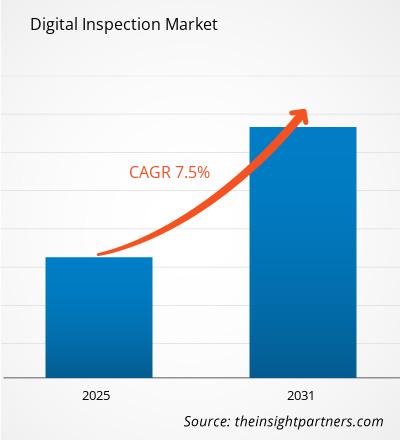
The global Digital Inspection market was valued at US$ 24.86 billion in 2025 and is expected to reach US$ 46.47 billion by 2034; it is estimated to record a CAGR of 7.2% during 2026-2034.
Digital Inspection Market Assessment and Insights
- North America held 32–34% share in 2025 and is projected to grow at a 7.4–8.0% CAGR between 2026–2034, supported by aerospace, automotive, electronics, and regulated energy inspection demand.
- US represented 78–82% of North America in 2025 and is expected to grow at a 7.3–7.9% CAGR between 2026–2034, driven by advanced manufacturing and defense quality systems.
- Europe accounted for 25–27% share in 2025 and is projected to grow at a 7.0–7.6% CAGR between 2026–2034, led by Germany, the UK, France, Italy, and Spain.
- Asia Pacific captured 28–30% share in 2025 and is forecast to grow at an 8.7–9.4% CAGR between 2026–2034, led by China, Japan, South Korea, India, and Australia.
- Largest Segment Hardware held 45–48% market share in 2025 and is projected to expand at a 7.1–7.8% CAGR between 2026–2034 as sensors, scanners, cameras, and probes remain deployment-critical.
- High Growth Segment Software held 27–30% market share in 2025 and is expected to grow at a 9.0–9.8% CAGR between 2026–2034 as analytics, AI, and cloud workflows scale.
- Key companies analyzed in detail: Basler AG, Carl Zeiss AG, FARO Technologies, Inc., General Electric Company, Hexagon AB, MISTRAS Group, Inc., Nikon Metrology NV, Evident Corporation, OMRON Corporation, Zetec, Inc.
Source: The Insight Partners' analysis based on proprietary research, government publications, company annual reports, investor presentations, industry databases, and expert interviews.
From offline sampling processes, quality control has shifted towards networked inspection stations equipped with sensors. Camera technology, structured-light scanning, computerized tomography, phased-array ultrasound, and automated coordinate measuring machines have become the norm in factories as they ensure tolerance verification. The Digital Inspection market will also continue to gain from shorter life cycles, stricter supplier qualification and requirements for inspection data that can be used in process optimization and not simply for compliance purposes.
According to the Digital Inspection Market forecast, the next five years will see capital expenditure moving towards inspection solutions that incorporate hardware, software and specialized services. Emerging regions are developing capacities in the electronics, automotive and energy sectors, while developed countries are looking into automating inspection due to skilled labor shortage. Expectations for traceability, safety and reliability of products will help sustain adoption regardless of fluctuations in capital expenditure cycles.
Digital Inspection Market Report Scope
| Report Attribute | Details |
|---|---|
| Market size in 2025 | US$ 24.86 Billion |
| Market Size by 2034 | US$ 46.47 Billion |
| Global CAGR (2026 - 2034) | 7.2% |
| Historical Data | 2021-2024 |
| Forecast period | 2026-2034 |
Digital Inspection Market Analysis
The drivers of the Digital Inspection Market growth include automation of manufacturing process, smaller-sized electronics, electric cars, turbines, and safety critical infrastructure. Consumers are interested in digital inspection solutions that can reduce scrap and first-pass yield and also help create digital records. These ecosystems consist of optics, sensors, scanning technologies, robotics, inspection software, calibration, and domain experts that can interpret measurement results into quality decisions.
The supply chain is still uncertain due to the fact that precision optics, cameras, probes, as well as computing equipment requires specialized supply chains. The vendors address it with modular platforms, software-as-a-service solutions, and support contracts. It would be beneficial for the market if the inspection data could be integrated with the manufacturing execution system to correct errors on time.
The competition is intensifying as Hexagon AB, Carl Zeiss AG, FARO Technologies, Inc., Nikon Metrology NV, Basler AG, OMRON Corporation, General Electric Company, MISTRAS Group, Inc., Evident Corporation, and Zetec, Inc. develop their offerings in machine vision, dimensional metrology, and non-destructive testing. The market indicates that the ability to differentiate revolves around accuracy, workflow integration, field serviceability, and ease of use of software.
Investments are flowing into AI-enabled defect classification, automatic programming of measurements, portable scanning capabilities, and cloud reporting solutions. Strategic positioning involves vendors that are capable of delivering in both factory automation and asset integrity markets. The larger players like scalable inspection systems, whereas smaller players are interested in faster return on investment through adaptable systems for multiple product lines.
● REPORT CUSTOMIZATION
Tailor This Report To Align With Your Specific Business Requirements
This report can be customized to align precisely with your business objectives, scope, and target markets. Customization options include tailored segmentation, geography, competitive analysis, and strategic insights to support informed decision-making.
Customize This Report →WHAT YOU CAN ADJUST
- ● Segmentations
- ● Geography
- ● Competitive Analysis
- ● Language Preferences
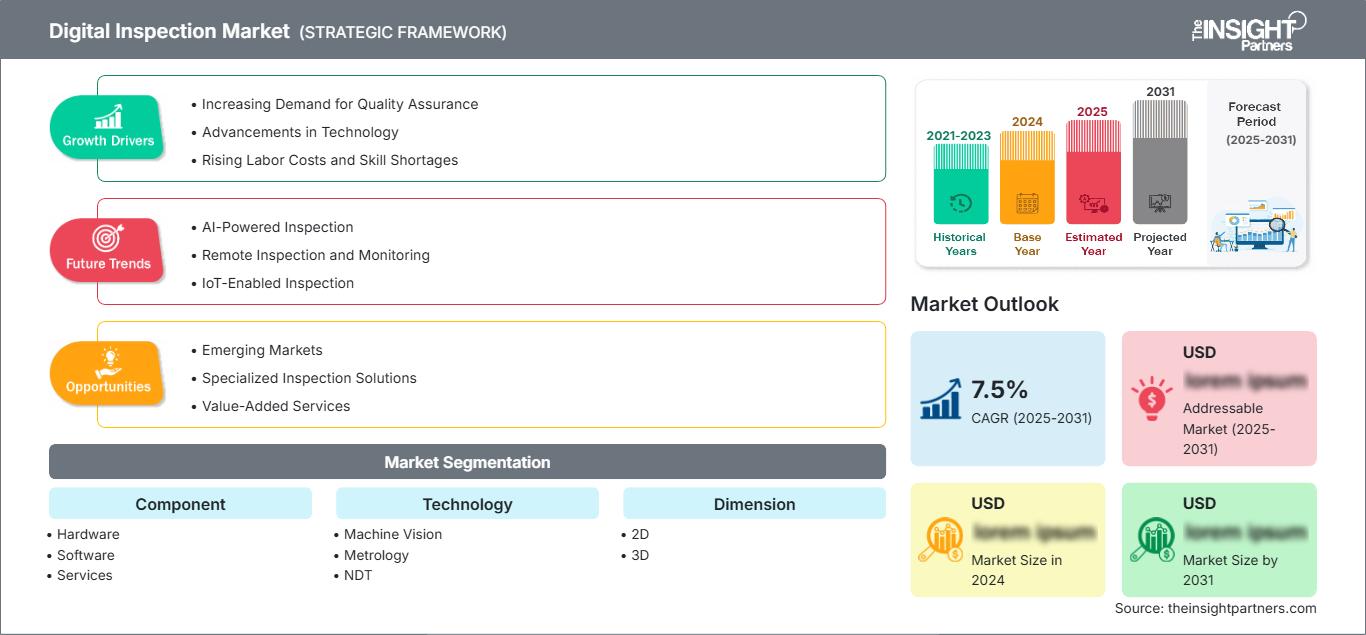
Digital Inspection Market: Strategic Insights
Regional Insights
North America Digital Inspection Market
North America held 32–34% share in 2025 and is expected to expand at a 7.4–8.0% CAGR through 2034. The Digital Inspection Market share in the region is anchored by aerospace qualification, automotive quality automation, electronics inspection, pipeline integrity, and semiconductor process-control requirements, supported by strong supplier ecosystems and high automation readiness.
Manufacturers are investing in inline machine vision, automated metrology, and digital NDT to reduce rework and improve auditability. The US leads adoption, while Canada supports growth through energy, aerospace, and advanced manufacturing applications. Regional demand is also strengthened by reshoring initiatives and the need to document quality performance across distributed supplier networks.
U.S. Digital Inspection Market
United States comprised 78–82% share of North America in 2025 and estimated to witness a 7.3–7.9% CAGR between 2026 and 2034. Deployment is seen across aerospace, defense, medical devices, electronics, automotive, and energy segments where defect tracing, non-contact measurements, and repeatable inspection evidences are critical purchase requirements.
Market penetration is high with companies such as General Electric Company, FARO Technologies, Inc., MISTRAS Group, Inc., Zetec, Inc., and OMRON Corporation catering to varying inspection requirements. United States market is becoming application-driven, where demand for inspections is expected to move from individual inspection stations towards integrated quality cells and predictive maintenance solutions.
Europe Digital Inspection Market
Europe was valued at 25–27% share in 2025 and is expected to register CAGR of 7.0–7.6% through 2034. Germany is a leader in this region due to its precision engineering, automotive manufacture, industrial machines, and metrology expertise, whereas the UK has advantages in aerospace, energy inspections, and quality programs in regulated infrastructures.
Other contributors in Europe include France, Italy, and Spain due to their aerospace value chains, transport equipment, medical technology, and advanced manufacturing upgrades. The market is influenced by high quality standards, safety requirements of employees, and sustainability efforts in extending the life of assets. Localized solutions, calibration services, and software integrators have an advantageous position in European industrial hubs.
APAC Digital Inspection Market
APAC accounted for 28-30% in 2025 and will register a CAGR of 8.7-9.4% in 2026-2034. In China, the growth is led by electronics, EVs, machinery, and infrastructure, while in Japan and South Korea it is dominated by precision metrology, semiconductor inspection, robotics, and manufacturing reliability.
In India and Australia, there is growing adoption in the automotive, rail, energy, mining, and public infrastructure inspections. Policies for supporting domestic manufacturing and safety regulations are encouraging adoption. In the case of the market in APAC, the transition to 3D inspection and AI-driven visual inspection is rapidly taking place.
Middle East & Africa Digital Inspection Market
The Middle East & Africa region is expected to experience a CAGR of 7.8%-8.5% in the period of 2026-2034. The main driver for this market segment is Saudi Arabia. Energy infrastructures, petrochemical plants, refineries, power plants, aircraft inspection, and major construction activities necessitate NDT and documentation.
The United Arab Emirates has been implementing platforms in aviation, infrastructure, and manufacturing segments, whereas the South Africa brings the demand for mining, power and industrial maintenance services. The rest of MEA is a service-driven market segment, offering chances to companies that provide hardware and cloud solutions.
Segmentation Analysis
Component
Component demand is projected to grow at a 7.8–8.6% CAGR during 2026–2034. Hardware remains essential for image capture and measurement, software is becoming the intelligence layer, and services support integration, calibration, validation, and operator enablement. The Digital Inspection Market scope is widening as buyers combine all three to create repeatable inspection workflows.
- Hardware includes cameras, scanners, probes, sensors, X-ray systems, and measurement devices. It holds strategic importance because inspection accuracy depends on calibrated data capture and rugged industrial performance.
- Software enables defect recognition, measurement analytics, digital twin comparison, reporting, and workflow automation. Demand is rising as manufacturers seek scalable intelligence rather than isolated inspection results.
- Services cover installation, training, calibration, validation, and outsourced inspection. They are critical for regulated industries and facilities lacking specialized metrology or NDT expertise.
Technology
Technology is expected to grow at a 7.9–8.7% CAGR during 2026–2034. Machine vision supports high-speed visual checks, metrology verifies dimensional conformance, and NDT detects internal or structural defects without damaging assets. The market is strongest where these technologies are integrated into one quality architecture.
- Machine Vision supports automated surface inspection, assembly verification, barcode checks, and defect classification. Its position is strongest in high-throughput electronics, packaging, automotive, and general manufacturing lines.
- Metrology covers dimensional measurement using CMMs, scanners, lasers, and optical systems. It is strategically important for aerospace, automotive, medical devices, and precision-engineered components.
- NDT includes ultrasonic, radiographic, eddy-current, and visual testing methods. Demand is resilient in energy, infrastructure, aerospace, and heavy industries where asset integrity is safety-critical.
Dimension
Dimension solutions are forecast to grow at a 7.6–8.4% CAGR during 2026–2034. 2D inspection remains efficient for surface checks and pattern recognition, while 3D inspection is gaining importance as complex assemblies, additive manufacturing, and precision machining require depth, geometry, and volumetric verification.
- 2D inspection is widely used for visual defects, label verification, alignment, and surface conditions. It remains cost-effective where speed and repeatability outweigh full geometric reconstruction.
- 3D inspection captures geometry, depth, shape, and volumetric characteristics. It is increasingly strategic for aerospace, automotive, electronics, implants, additive manufacturing, and advanced packaging applications.
Dimension
Dimension is repeated in the input segmentation and is retained without renaming. The repeated category reinforces the strategic distinction between 2D and 3D inspection requirements, particularly where buyers evaluate speed, accuracy, data volume, system cost, and compatibility with existing quality infrastructure.
- 2D systems support rapid inspection for flat surfaces, printed features, dimensional outlines, and visual defects. They are commonly deployed where production speed is the primary constraint.
- 3D systems support high-value inspection where depth and shape matter. They are preferred for complex parts, reverse engineering, digital twins, and non-contact dimensional validation.
Opportunity Snapshot
| Technology | Revenue Contribution | Trend Tag | Adoption Stage |
| Machine Vision | High | AI Vision | Scaling |
| Metrology | High | 3D Scanning | Mature |
| NDT | Medium | Asset Integrity | Scaling |
Digital Inspection Market Growth Drivers and Impact Analysis
Automation Pressure in High-Precision Manufacturing
Inspection in factories assembling components of electric vehicles, semiconductor products, medical products, and aerospace products requires a speed beyond what manual processes can offer. Automation helps control variability through the application of uniform measuring standards regardless of shifts, factories, and suppliers. The business impact is most pronounced in cases where there are significant scrapping costs as well as when defects lead to liabilities under warranty, safety issues, and factory shutdowns. Inspection automation can contribute to labor efficiency through freeing up technicians to concentrate on exception handling.
Regulated Asset Integrity and Traceability Requirements
Energy, aviation, transportation, healthcare, and industrial infrastructure operators must document inspections, prove compliance, and identify defects before failures occur. Digital NDT, connected reporting, and standardized inspection records improve audit readiness and lifecycle asset management. This driver increases recurring demand because pipelines, turbines, aircraft structures, pressure systems, bridges, and critical machinery require repeated inspection over long service lives. Vendors that provide validated workflows, secure data retention, and technician support are positioned to benefit from compliance-led procurement cycles.
Shift Toward Data-Driven Quality Management
Inspection data is increasingly treated as a strategic manufacturing asset rather than a pass-fail record. When measurement outputs connect to statistical process control, digital twins, and production analytics, quality teams can identify drift earlier and reduce corrective-action costs. This creates demand for software platforms, analytics engines, and integration services. The commercial effect is a shift from one-time equipment purchases toward lifecycle solutions that generate value through continuous process intelligence, supplier comparison, and predictive quality management.
Digital Inspection Market Future Trends
AI-Assisted Inspection Programming and Defect Classification
Digital Inspection Market trends will increasingly center on AI tools that simplify inspection programming and classify defects with contextual confidence scores. These systems will not replace certified quality judgment, but they will shorten setup time, reduce dependence on scarce specialists, and improve consistency across plants. As training datasets mature, algorithms should become more reliable for surface flaws, dimensional deviations, weld anomalies, and assembly errors. Adoption will be highest where repeated product families create enough inspection history for model refinement.
Cloud-Native Quality Records Across Supplier Networks
Quality records are moving from local files to governed cloud environments that connect OEMs, tier suppliers, inspectors, and maintenance teams. This trend will improve visibility into supplier performance, enable remote review, and support faster corrective actions. Security, data ownership, and validation requirements will remain important adoption filters. Over time, cloud-native inspection platforms should make it easier to compare performance across facilities and preserve inspection evidence for warranty, certification, and asset-lifecycle decisions.
Digital Inspection Market Opportunities
Inspection-as-a-Service for Mid-Sized Manufacturers
Mid-sized manufacturers often need advanced inspection capability but lack capital budgets, metrology specialists, or validation teams. Service-led models can convert high upfront investment into predictable operating spending while providing access to calibrated equipment and trained personnel. This opportunity is attractive for suppliers in automotive, industrial machinery, medical devices, and electronics that must satisfy customer audits. Providers can differentiate through rapid deployment, transparent reporting, and flexible contracts that scale with production volumes.
Integrated Inspection for Energy Transition Assets
Wind turbines, grid equipment, hydrogen systems, batteries, and carbon-management infrastructure create inspection requirements across manufacturing, installation, and operations. These assets operate under demanding safety and reliability expectations, making digital NDT, robotics, drones, and analytics valuable investment areas. The opportunity is not limited to new projects because installed assets require lifecycle inspection and maintenance. Vendors that package hardware, inspection procedures, and data platforms for energy transition applications can build durable recurring revenue streams.
Recent Developments
- July 2026: Omron advanced semiconductor inspection technology by integrating its VT-X board inspection system with NVIDIA Omniverse and Metropolis libraries. The solution enables real-time visualization of printed circuit board warpage, AI-driven defect diagnosis, and combined optical and X-ray inspection data, helping manufacturers improve inspection accuracy, production quality, and operational efficiency in semiconductor manufacturing.
- June 2026: KITOV.ai enhanced robotic inspection capabilities by integrating metrology software into its Core+ platform, creating a 360-degree vision system for automated inspection of complex components. The solution combines AI-driven defect detection, robotic path planning, and dimensional analysis to inspect all sides of parts in a single cycle, improving quality control across aerospace, automotive, electronics, and medical manufacturing sectors.
- May 2026: Cognex launched the Insight 3900 embedded AI vision system powered by Qualcomm technology, delivering high-speed, high-accuracy inspection without requiring an external computer. The system combines edge AI processing, advanced imaging capabilities, and industrial connectivity to support demanding manufacturing applications across packaging, automotive, electronics, and consumer goods industries, improving inspection efficiency and production performance.
Frequently Asked Questions

- Comprehensive Market Sizing and Forecast Analysis
- Detailed Segmentation Analysis
- In-Depth Market Dynamics Assessment
- Regional and Country-Level Insights
- Competitive Landscape and Company Benchmarking
- Strategic Business Intelligence
Recent Reports
Testimonials

The Insight Partners provided valuable market intelligence that supported our global go-to-market strategy. Their team was professional, responsive, and attentive to our feedback, providing thoughtful analysis and helpful methodological clarifications throughout the project.
Junmo Kim Chief Financial Officer (CFO), Enertech Co., Ltd.
The Insight Partners' SCADA System Market report is comprehensive, with valuable insights on current trends and future forecasts. The team was highly professional, responsive, and supportive throughout. We are very satisfied and highly recommend their services.
RAN KEDEM Partner, Reali Technologies LTDs
I requested a report on a very specific software market and the team produced the report in a few days. The information was very relevant and well presented. I then requested some changes and additions to the report. The team was again very responsive and I got the final report in less than a week.
JEAN-HERVE JENN Chairman, Future Analytica
We worked with The Insight Partners for an important market study and forecast. They gave us clear insights into opportunities and risks, which helped shape our plans. Their research was easy to use and based on solid data. It helped us make smart, confident decisions. We highly recommend them.
PIYUSH NAGPAL Sr. Vice President, High Beam Global
The Insight Partners delivered insightful, well-structured market research with strong domain expertise. Their team was professional and responsive throughout. The user-friendly website made accessing industry reports seamless. We highly recommend them for reliable, high-quality research services
YUKIHIKO ADACHI CEO, Deep Blue, LLC.
This is the first time I have purchased a market report from The Insight Partners.While I was unsure at first, I visited their web site and felt more comfortable to take the risk and purchase a market report.I am completely satisfied with the quality of the report and customer service. I had several questions and comments with the initial report, but after a couple of dialogs over email with their analyst I believe I have a report that I can use as input to our strategic planning process.Thank you so much for taking the extra time and making this a positive experience.I will definitely recommend your service to others and you will be my first call when we need further market data.
JOHN SUZUKI President and Chief Executive Officer, Board Director, BK Technologies
I wish to appreciate your support and the professionalism you displayed in the course of attending to my request for information regarding to infectious disease IVD market in Nigeria. I appreciate your patience, your guidance, and the fact that you were willing to offer a discount, which eventually made it possible for us to close a deal. I look forward to engaging The Insight Partners in the future, all thanks to the impression you have created in me as a result of this first encounter.
DR CHIJIOKE ONYIA MANAGING DIRECTOR, PineCrest Healthcare Ltd.Reason to Buy
- Informed Decision-Making
- Understanding Market Dynamics
- Competitive Analysis
- Identifying Emerging Markets
- Customer Insights
- Market Forecasts
- Risk Mitigation
- Boosting Operational Efficiency
- Strategic Planning
- Investment Justification
- Tracking Industry Innovations
- Aligning with Regulatory Trends





 Get Free Sample for