
Digital Substation Market Demand, Size & Forecast by 2034
Coverage: by Type (Transmission Substation, Distribution Substation); Voltage (Up to 220 kV, 220-550 kV, Above 500 kV); End-User Industry (Utility, Metal, Mining, Oil and Gas, Transportation), and Geography (North America, Europe, Asia Pacific, and South and Central America)
- Status : Data Released
- Report Code : TIPRE00003608
- Category : Electronics and Semiconductor
- No. of Pages : 150
- Available Report Formats :


- Last update date : August 05, 2026


2025 Market Size
US$ 8.31 Bn
Base year value
2034 Forecast
US$ 13.33 Bn
Projected by 2034
CAGR 2026-2034
6.09 %
Growth rate
Addressable Market
US$ 101.69 Bn
(2026-2034)
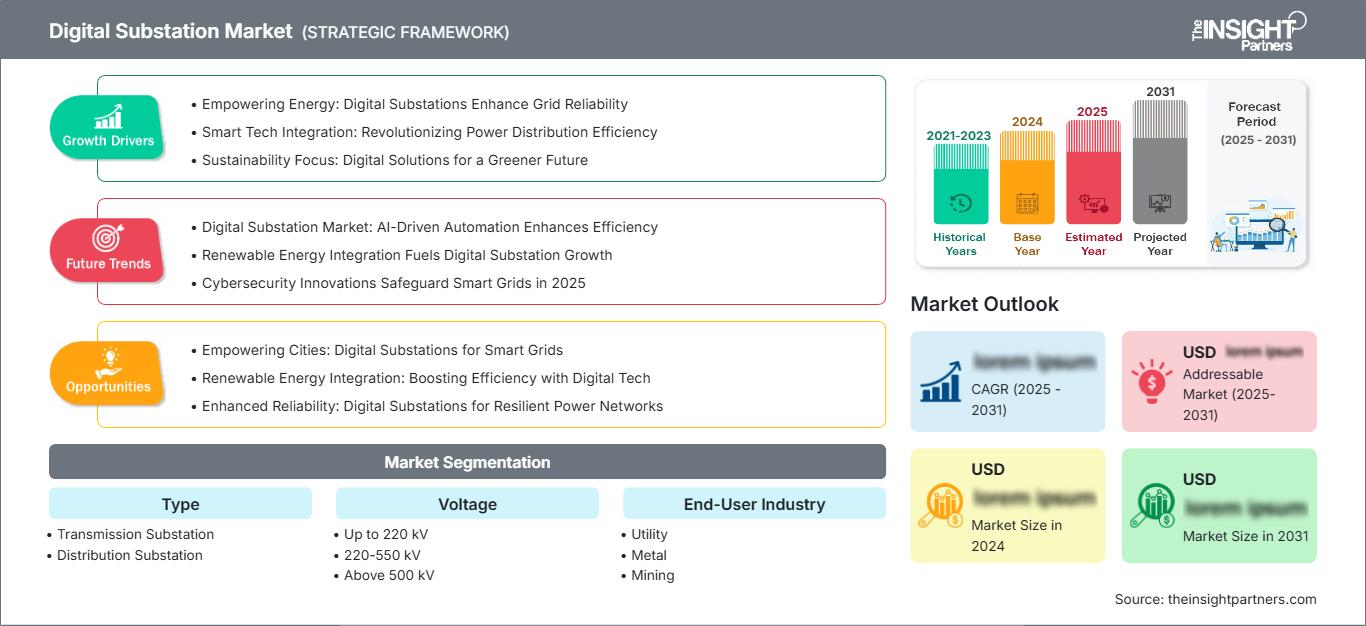
The Digital Substation Market stood at US$ 8.31 Billion in 2025 and is forecasted to be valued at US$ 13.33 Billion by 2034, recording a CAGR of 6.09% from 2026 to 2034. The market is gaining traction with utilities, heavy industries, and transportation companies substituting the copper-based protection system with data-driven automation infrastructure.
In North America, the Digital Substation Market size is estimated to grow with a CAGR of 5.6% - 6.4% owing to increased grid resiliency initiatives, renewables queue for interconnection and aging transmission infrastructure, leading to increased investments in automation. The utilities are focusing on IEC 61850-based protection system, fiber-optic process bus networks and remote diagnostics in order to minimize outage time, increase safety and engineer substations.
Digital Substation Market Assessment and Insights
- North America held 28–32% Digital Substation Market share in 2025 and is growing at a CAGR range of 5.6–6.4% during 2026–2034, supported by grid resilience funding, renewable integration, and brownfield automation programs.
- US represented 78–82% of North America in 2025 and is growing at a CAGR range of 5.7–6.5%, led by utility modernization and transmission upgrades.
- Europe accounted for 24–27% share in 2025 and is advancing at a CAGR range of 5.3–6.1%, with Germany, the UK, France, Italy, and Spain leading digital grid adoption.
- Asia Pacific captured 33–37% share in 2025 and is expanding at a CAGR range of 6.6–7.4%, led by China, India, Japan, South Korea, and Australia.
- Largest Segment Transmission Substation held 57–61% market share in 2025 and is growing at a CAGR range of 5.8–6.6%, supported by high-voltage grid expansion.
- High Growth Segment Distribution Substation held 39–43% market share in 2025 and is growing at a CAGR range of 6.4–7.2%, driven by feeder automation and DER visibility.
- Key companies analyzed in detail: ABB Ltd., Cisco Systems, Inc., Eaton Corporation plc, Emerson Electric Co., GE Vernova Inc., Honeywell International Inc., Larsen & Toubro Limited, NR Electric Co., Ltd., Schneider Electric SE, and Siemens Energy AG.
Source: The Insight Partners' analysis based on proprietary research, government publications, company annual reports, investor presentations, industry databases, and expert interviews.
Architecture of digital substations has evolved from analog protection that uses many panels to intelligent electronic devices, unit merge, process bus technology, and centralized protection systems. In manufacturing, dynamics now depend on software configuration, hardening of cybersecurity, pretested panels in the factory, and interoperability testing rather than just assembling electromechanical devices. This is where the Digital Substation Market comes in, reflecting utilities’ demand for standardized engineering, fast commissioning, reduced copper usage, and continuous asset visibility in transmission and distribution grids.
Future demand will be enhanced in renewable-rich power grids, distribution networks in urban areas, electrified corridors in rail transport, and energy-intensive industries. Developing regions are emphasizing robust electrical power grids due to growing demand for electricity, whereas established economies are upgrading substations to address aging infrastructures and stringent reliability criteria. Stringent regulation requiring cyber security, grid observability, and decarbonization will drive vendors providing lifecycle services and automation platforms.
Digital Substation Market Report Scope
| Report Attribute | Details |
|---|---|
| Market size in 2025 | US$ 8.31 Billion |
| Market Size by 2034 | US$ 13.33 Billion |
| Global CAGR (2026 - 2034) | 6.09% |
| Historical Data | 2021-2024 |
| Forecast period | 2026-2034 |
Digital Substation Market Analysis
Drivers for Digital Substation Market Growth include increasing complexity in grids, due to solar energy, wind energy, battery storage, data centers, electrified transportation, and distributed loads. Digital substations use sampled values, generic object-oriented substation events, SCADA interface, and condition monitoring in place of wired signaling. This helps to achieve better fault isolation, faster commissioning, and faster situational awareness for the operator.
The value chain includes grid operators, EPC companies, automation software, protection relay, communication network, and systems integration. Companies that provide digital protection solutions include ABB Ltd. and Siemens Energy AG, distribution automation solutions include Schneider Electric SE and Eaton Corporation plc, Cisco Systems, Inc. provides network security solutions, and GE Vernova Inc., NR Electric Co., Ltd. and Larsen & Toubro Limited provide transmission automation solutions.
Competitive Dynamics for Digital Substation Market are characterized by movement towards interoperable systems, cybersecurity certification, lifecycle services, and retrofitting capability. Emerson Electric Co. and Honeywell International Inc. match substation automation with industrial controls and energy management solutions; at the same time, utilities analyze ecosystems offered by vendors rather than their products. Increasingly, procurement recognizes value in validated architecture, education, and compatibility with existing grid infrastructure.
The focus of investments is placed on brownfield upgrade, modular substations, digital twins, and centralized protection systems that decrease need for visits. The strategic positioning hinges upon local service capabilities, IEC 61850 know-how, compliance with cyber regulations, and capability to combine communication, protection, and control software. Vendors that minimize downtime and engineering risks can protect their margins amid competitive tenders.
● REPORT CUSTOMIZATION
Tailor This Report To Align With Your Specific Business Requirements
This report can be customized to align precisely with your business objectives, scope, and target markets. Customization options include tailored segmentation, geography, competitive analysis, and strategic insights to support informed decision-making.
Customize This Report →WHAT YOU CAN ADJUST
- ● Segmentations
- ● Geography
- ● Competitive Analysis
- ● Language Preferences
Digital Substation Market: Strategic Insights
Regional Insights
North America Digital Substation Market
In 2025, North America will occupy 28–32% market share and continue to record growth over a CAGR between 5.6% to 6.4%. This market is supported by hardening of the power grid, mitigating wildfires, renewable interconnection, and federal infrastructure funds. Process bus technology, remote management, and secure communication are becoming essential to increase reliability in this environment.
Hydro transmission upgrades and renewable energy sources drive the Canadian market. The USA continues to be the major hub of projects. Buyers value accountability from vendors, interoperability tests, and retrofit technology which reduces power outage time. Growth of this market faces challenges of permitting processes and utility budgeting but resilience requirements and increased electricity demands keep the automation funding flowing.
U.S. Digital Substation Market Market
The US represented 78–82% of North America in 2025 and is forecast to grow at a CAGR range of 5.7–6.5%. ABB Ltd., Eaton Corporation plc, Cisco Systems, Inc., GE Vernova Inc., Schneider Electric SE, and Siemens Energy AG support protection, networking, automation, and grid software needs. Applications include transmission corridors, utility distribution feeders, renewable substations, and industrial power systems.
Demand is strengthened by ageing grid assets, extreme-weather resilience needs, and expansion of data centers and electric vehicle charging infrastructure. US utilities value cyber-secure remote access, standardized designs, and reduced copper wiring. Adoption is strongest where outage costs are high, skilled labor is limited, and digital monitoring can improve maintenance prioritization.
Europe Digital Substation Market Market
Europe has 24-27% market share in 2025 and is forecast to have CAGR of 5.3-6.1%. Germany excels in renewable integration, industrial grid reliability, and transmission upgrades. UK focuses on offshore wind links and network digitization, while France concentrates on nuclear energy, renewables and transmission control. Italy and Spain increase demand through implementation of smart grids, rail electrification, and solar-rich power distribution networks.
Procurement in Europe prioritizes interoperability, reduced carbon emissions, worker safety, and lifecycle efficiency. Utilities tend to integrate their digital substations projects with SF6 reduction, asset analysis and resilience strategy. The growth is more steady than that of Asia Pacific due to strict grid renewal cycle, but still reliable due to engineering standards, regulatory pressure and cross-border electricity trade.
APAC Digital Substation Market Market
Asia Pacific accounted for 33–37% of the market in 2025 and is estimated to expand with a CAGR range of 6.6–7.4%. Leading in this region are China, which implements ultra-high voltage corridors and renewable energy sources as well as smart grids; India, which increases transmission capacity and distribution automation; and Japan, South Korea, and Australia, which emphasize reliability, renewables, and energy security.
Supporting policies aimed at electrification and energy security and manufacturing of devices in the region drive market growth. The Digital Substations market in APAC receives boost due to significant projects and fast construction cycles.
Middle East & Africa Digital Substation Market Market
Middle East & Africa is projected to grow at a CAGR range of 5.1–5.9% as Saudi Arabia, the UAE, South Africa, and the rest of MEA invest in transmission expansion, renewable zones, industrial cities, and utility reliability. Saudi Arabia leads through large grid and energy transition projects, while the UAE emphasizes smart infrastructure.
Regional adoption is linked to oil and gas power networks, mining loads, urban growth, and desalination-linked electricity demand. Projects often require harsh-environment equipment, remote diagnostics, and turnkey integration. Growth remains project-driven, but high-value infrastructure programs create steady opportunities.
Segmentation Analysis
Type
Type is expected to grow at a CAGR range of 6.0–6.8% during 2026–2034 as the Digital Substation Market scope spans transmission and distribution assets. Transmission projects require advanced protection and wide-area monitoring, while distribution upgrades emphasize feeder automation, outage management, and distributed energy resource visibility. Utilities increasingly select scalable architectures that can be replicated across voltage classes.
- Transmission Substation remains the largest sub-segment because high-voltage networks need fast protection, synchronized measurements, and remote control for renewable corridors, interconnections, and bulk power reliability.
- Distribution Substation gains strategic importance as utilities add automation at feeder level to manage rooftop solar, storage, electric vehicle loads, and urban outage restoration requirements.
Voltage
Voltage is projected to grow at a CAGR range of 5.9–6.7% during 2026–2034 as utilities digitize assets from medium-voltage distribution nodes to extra-high-voltage transmission hubs. Higher-voltage projects carry larger automation budgets, but lower-voltage networks offer repeatable retrofit volume. Standardized protection, merging units, and secure communications help operators manage complexity across voltage tiers.
- Up to 220 kV addresses distribution and sub-transmission networks where feeder automation, renewable interconnection, and urban reliability programs create repeatable retrofit demand.
- 220-550 kV supports regional transmission, industrial corridors, and renewable evacuation projects requiring robust protection, SCADA integration, and fiber-optic communication networks.
- Above 500 kV serves bulk power corridors and strategic interconnections where reliability, synchronized measurements, and fast fault clearing are essential for system stability.
End-User Industry
End-User Industry is expected to grow at a CAGR range of 6.1–6.9% during 2026–2034 as utilities, metals producers, miners, oil and gas operators, and transport networks seek resilient power control. Utilities dominate spending, but industrial users adopt digital substations to reduce downtime, improve safety, and monitor mission-critical electrical assets across dispersed operating sites.
- Utility leads adoption because transmission and distribution operators need grid visibility, faster restoration, cyber-secure control, and standardized automation across new and existing substations.
- Metal facilities use digital substations to stabilize high-load furnaces, rolling mills, and captive power systems where power quality and outage avoidance affect production economics.
- Mining sites value remote monitoring, rugged protection, and automation for isolated operations that depend on reliable power for crushers, conveyors, ventilation, and processing plants.
- Oil and Gas operators deploy digital substations in refineries, LNG facilities, pipelines, and offshore assets where safety, redundancy, and remote diagnostics are critical.
- Transportation demand rises from rail electrification, metro systems, airports, and charging depots that require dependable substations, centralized monitoring, and rapid fault response.
Opportunity Snapshot
| End-User Industry | Revenue Contribution | Trend Tag | Adoption Stage |
| Utility | High | Grid Automation | Scaling |
| Metal | Medium | Power Quality | Mature |
| Mining | Medium | Remote Power | Scaling |
| Oil and Gas | Medium | Asset Safety | Mature |
| Transportation | Low | Rail Electrification | Emerging |
Digital Substation Market Growth Drivers and Impact Analysis
Grid Modernization and Renewable Integration Accelerate Deployment
Modernization of substations by utility companies is being driven by the need for bidirectional power flow due to increased generation and storage of renewable energy, e-mobility, and distributed loads. Advantages of digital substations include visibility through sampled values, intelligent electronic devices, and remote diagnostics, making it easier to detect problems and set protection parameters. The effect on the market is greatest on transmission routes and distribution circuits, where traditional hard-wired configurations create rigid restrictions. Vendors offering automation products with cyber-secure communication and retrofit capability of panels may assist utility companies in reducing outage times, reducing copper use, and standardizing engineering practices.
Industrial Electrification Raises Reliability Requirements
The metals industry, mining operations, oil and gas operations, and transport providers are all becoming more dependent on electricity due to the fact that production operations are becoming more automated and require greater energy use. Digital substations allow for condition monitoring, event logging, remote switching, and predictive maintenance, thus reducing the possibility of an unexpected downtime in expensive production processes. The Digital Substation Market gains an advantage if industrial customers tie electrical reliability to production output, safety, and compliance. The lifecycle cost of the project is becoming more important in the decision-making process compared to just equipment costs.
Cyber-Secure Remote Operations Become a Utility Priority
It becomes imperative to have remote operations as the utilities operate geographically dispersed substations while having limited field staff. While digitalization helps monitor, analyze, and configure the network remotely, it makes more imperative the need to implement secure networks, access control mechanisms, encryption services, and audit trails. The market trends include a shift from security performance to security governance, along with cybersecurity, in utilities. This requires more evidence from vendors regarding security in their development process, patching process, and compliance with standards. Cisco Systems, Inc., Siemens Energy AG, ABB Ltd., and Schneider Electric SE gain from the convergence of networking, automation, and grid software into an operational risk model.
Digital Substation Market Future Trends
Virtualized Protection and Centralized Automation Platforms
Digital Substation Market trends will increasingly include virtualized protection, centralized automation, and software-defined engineering environments. Instead of adding separate relays for every function, utilities will consolidate protection and control logic into tested platforms supported by merging units and process bus communications. This approach can reduce panel space, simplify upgrades, and improve configuration consistency across fleets. Adoption will depend on utility confidence in redundancy, cybersecurity, and fail-safe operation. Vendors offering simulation, digital twins, and lifecycle software support will be better positioned as asset owners seek faster commissioning and lower maintenance effort.
AI-Enabled Asset Diagnostics in Substation Operations
Future substations will generate larger datasets from transformers, breakers, protection relays, and communication devices. AI-enabled diagnostics will help operators prioritize maintenance by detecting abnormal switching patterns, thermal stress, communication failures, and protection mis operations before they become outages. This trend will not replace protection engineering, but it will improve asset management and workforce planning. The opportunity favors suppliers that combine domain models, cyber-secure data pipelines, and explainable analytics. Utilities will prefer tools that integrate with existing SCADA, enterprise asset management, and control center workflows rather than isolated dashboards.
Digital Substation Market Opportunities
Retrofit Programs for Ageing Transmission and Distribution Assets
Digital Substation Market Forecasts indicate strong opportunity in brownfield retrofit programs where utilities cannot rebuild every site but need better reliability and visibility. Vendors can target staged modernization packages that replace protection panels, add merging units, upgrade communications, and integrate remote monitoring without long outages. The investment case improves when utilities can reuse civil infrastructure while reducing copper, testing time, and maintenance visits. EPC partnerships, pre-engineered templates, and training services can accelerate adoption. Suppliers that demonstrate low-disruption migration from legacy schemes will gain advantage in regulated markets with cautious capital approval processes.
Digital Substations for Electrified Transport Networks
Railways, metro systems, airports, and charging corridors require substations that support high availability, fast fault isolation, and centralized supervision. Digital substation suppliers can pursue opportunities in transport electrification by offering compact designs, predictive diagnostics, and secure remote control tailored to public infrastructure. The investment appeal is linked to urban mobility expansion, rail decarbonization, and charging depot growth. Transport operators value solutions that reduce service disruption and simplify maintenance across multiple sites. Vendors with proven utility-grade automation and project execution capability can adapt those platforms for rail traction, airport power, and fleet charging networks.
Recent Developments
- May 2026: Hitachi Energy has partnered with the Turkish Electricity Transmission Corporation (TEİAŞ) to deploy Türkiye’s first digital substation pilot, marking a significant milestone in the country's power grid modernization. The initiative aims to demonstrate how digital substation technology can enhance the safety, reliability, and operational efficiency of electricity transmission infrastructure.
- February 2026: ABB Ltd. launched REX600, a compact protection and control device for digital substations that combines merging unit functionality, backup protection, and fault detection. The device supports IEC 61850-9-2LE, IEC 61869-9, and cybersecurity features including secure boot and encrypted communication.
- December 2024: Siemens Energy AG advanced its SIPROTEC 5 digital substation platform with firmware enhancements supporting process bus compatibility, modular I/O configurations, and embedded Ethernet switching. The upgrade strengthened digital protection architecture for high-voltage systems and supported more efficient commissioning and engineering workflows.
Frequently Asked Questions

- Comprehensive Market Sizing and Forecast Analysis
- Detailed Segmentation Analysis
- In-Depth Market Dynamics Assessment
- Regional and Country-Level Insights
- Competitive Landscape and Company Benchmarking
- Strategic Business Intelligence
Recent Reports
Testimonials

The Insight Partners' SCADA System Market report is comprehensive, with valuable insights on current trends and future forecasts. The team was highly professional, responsive, and supportive throughout. We are very satisfied and highly recommend their services.
RAN KEDEM Partner, Reali Technologies LTDs
I requested a report on a very specific software market and the team produced the report in a few days. The information was very relevant and well presented. I then requested some changes and additions to the report. The team was again very responsive and I got the final report in less than a week.
JEAN-HERVE JENN Chairman, Future Analytica
We worked with The Insight Partners for an important market study and forecast. They gave us clear insights into opportunities and risks, which helped shape our plans. Their research was easy to use and based on solid data. It helped us make smart, confident decisions. We highly recommend them.
PIYUSH NAGPAL Sr. Vice President, High Beam Global
The Insight Partners delivered insightful, well-structured market research with strong domain expertise. Their team was professional and responsive throughout. The user-friendly website made accessing industry reports seamless. We highly recommend them for reliable, high-quality research services
YUKIHIKO ADACHI CEO, Deep Blue, LLC.
This is the first time I have purchased a market report from The Insight Partners.While I was unsure at first, I visited their web site and felt more comfortable to take the risk and purchase a market report.I am completely satisfied with the quality of the report and customer service. I had several questions and comments with the initial report, but after a couple of dialogs over email with their analyst I believe I have a report that I can use as input to our strategic planning process.Thank you so much for taking the extra time and making this a positive experience.I will definitely recommend your service to others and you will be my first call when we need further market data.
JOHN SUZUKI President and Chief Executive Officer, Board Director, BK Technologies
I wish to appreciate your support and the professionalism you displayed in the course of attending to my request for information regarding to infectious disease IVD market in Nigeria. I appreciate your patience, your guidance, and the fact that you were willing to offer a discount, which eventually made it possible for us to close a deal. I look forward to engaging The Insight Partners in the future, all thanks to the impression you have created in me as a result of this first encounter.
DR CHIJIOKE ONYIA MANAGING DIRECTOR, PineCrest Healthcare Ltd.Reason to Buy
- Informed Decision-Making
- Understanding Market Dynamics
- Competitive Analysis
- Identifying Emerging Markets
- Customer Insights
- Market Forecasts
- Risk Mitigation
- Boosting Operational Efficiency
- Strategic Planning
- Investment Justification
- Tracking Industry Innovations
- Aligning with Regulatory Trends





 Get Free Sample for