
Distributed Acoustic Sensing Market Share, Size & Demand by 2034
Coverage: by Type (Single mode fiber, Multi-mode fiber); Industry Vertical (Military, Oil and Gas, Infrastructure, Telecommunication, Transportation, Others) , and Geography (North America, Europe, Asia Pacific, and South and Central America)
- Status : Data Released
- Report Code : TIPRE00009873
- Category : Electronics and Semiconductor
- No. of Pages : 150
- Available Report Formats :


- Last update date : September 28, 2026


2025 Market Size
US$ 754.60 Mn
Base year value
2034 Forecast
US$ 2,009.40 Mn
Projected by 2034
CAGR 2026-2034
11.50 %
Growth rate
Addressable Market
US$ 12,171.68 Mn
(2026-2034)
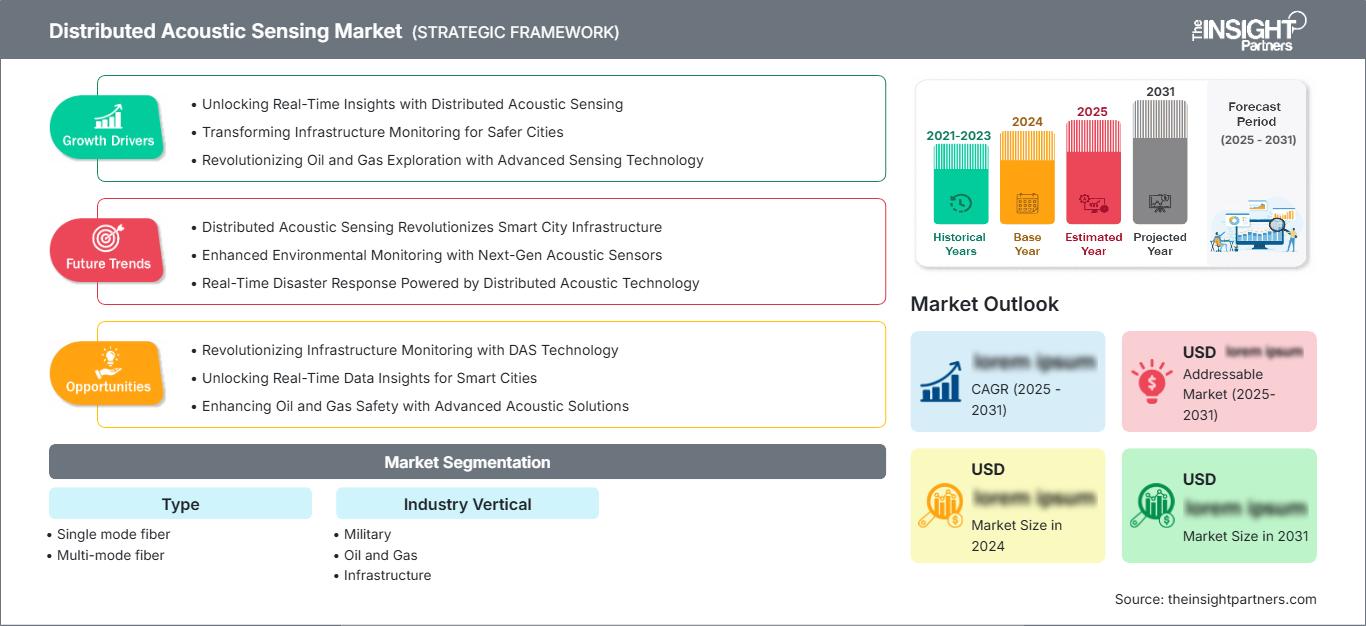
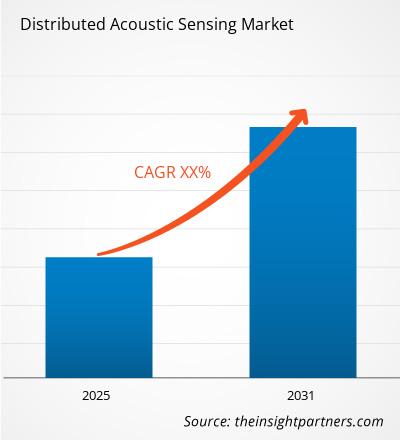
The Distributed Acoustic Sensing Market was valued at US$ 754.60 Million in 2025 and is projected to grow to US$ 2,009.40 Million by 2034, recording a CAGR of 11.50% in 2026-2034. The key drivers for this market include fiber optics-based monitoring systems in the oil and gas industry, infrastructure assets, defense sectors, telecommunication industries, and transportation where acoustic sensing plays an important role in detecting leaks, intrusions, vibration analysis, and underground incidents.
North America will record an estimated 10.8%-11.4% CAGR during 2026-2034, driven by aging pipelines infrastructure, shale field monitoring applications, railway safety initiatives, and increased border surveillance projects. The distributed acoustic sensing market size in North America is also driven by the presence of long haul fiber optic networks and early adoption in the oilfield service companies, utility firms, and government security agencies.
Distributed Acoustic Sensing Market Assessment and Insights
- North America accounted for 34–37% share in 2025 and is expected to expand at a CAGR of 10.8–11.4% during 2026–2034, supported by energy infrastructure surveillance and defense perimeter monitoring.
- US represented 78–82% of North America in 2025 and is projected to grow at a CAGR of 10.6–11.2% through 2034.
- Europe held 24–27% share in 2025 and is forecast to grow at a CAGR of 10.2–10.9%, led by the UK, Germany, France, Italy, and Spain.
- Asia Pacific captured 21–24% share in 2025 and is estimated to grow at a CAGR of 12.1–12.8%, led by China, Japan, South Korea, India, and Australia.
- Largest Segment Single mode fiber held 68–72% market share in 2025 and is expected to grow at a CAGR of 10.9–11.6% through 2034.
- High Growth Segment Transportation held 9–12% market share in 2025 and is projected to grow at a CAGR of 12.8–13.6% during 2026–2034.
- Key companies analyzed in detail: AP Sensing GmbH, Baker Hughes Company, Bandweaver Technology Limited, Fotech Solutions Ltd., Halliburton Company, Omnisens SA, OptaSense Holdings Limited, SLB, Silixa Ltd., Ziebel AS.
Source: The Insight Partners' analysis based on proprietary research, government publications, company annual reports, investor presentations, industry databases, and expert interviews.
The development of technology has helped transform DAS into a more intelligent infrastructure technology beyond the specific use in oilfield diagnostics. The interrogator equipment currently offers increased channel density, enhanced signal processing, and cloud-based event classification, with the costs of fiber installation helped by pre-existing telecommunications pathways. The production dynamics continue to be dominated by optical sensing and oilfield service companies, but software differentiation is gaining prominence as consumers seek reduced false alarm rate, automatic event libraries, and fast integration with control rooms.
During the forecasted period, new demands will arise from rail lines, offshore oil fields, smart utilities, and secure industrial facilities. With increasing regulatory focus on pipeline integrity and infrastructure security, continuous monitoring solutions will have an advantage. Asia-Pacific and Middle Eastern regions will increase installation numbers, while North America and Europe will see more upgrades in analytics and brownfield installations of fiber-optic sensing programs.
Distributed Acoustic Sensing Market Report Scope
| Report Attribute | Details |
|---|---|
| Market size in 2025 | US$ 754.60 Million |
| Market Size by 2034 | US$ 2,009.40 Million |
| Global CAGR (2026 - 2034) | 11.50% |
| Historical Data | 2021-2024 |
| Forecast period | 2026-2034 |
Distributed Acoustic Sensing Market Analysis
The market growth include the desire to make linear infrastructure assets monitorable. The Oil and Gas sector uses DAS technology to detect leaks in pipelines, hydraulic fracturing diagnosis, and well integrity, whereas the Rail and Road authorities use the technology for vibration and intrusion detection. Demand for DAS systems is boosted by the availability of fiber infrastructure.
The DAS supply chain includes suppliers of optical fibers, manufacturers of interrogators, providers of software analytics solutions, system integrators and field services providers. Favorable supply-side factors include the ability of vendors to provide ruggedized products and algorithms, as well as high spatial resolution. Demand for lifecycle management drives the importance of service capabilities alongside product performance.
Distributed Acoustic Sensing Market report reveals a highly competitive environment with AP Sensing GmbH, Fotech Solutions Ltd., Omnisens SA, OptaSense Holdings Limited, Silixa Ltd., and Ziebel AS competing on sensing capabilities, Baker Hughes Company, Halliburton Company, and SLB on the advantage of oilfield presence and scale of services, and Bandweaver Technology Limited on its involvement in pipeline and security projects.
Investments are being made in acoustic classification systems using AI, edge computing, and distributed fiber-optic sensing systems that measure acoustics, temperature, and strain together. Positioning depends more and more on the proof-of-concept demonstration within the specialized domains of subsea wells, critical pipeline infrastructure, railways, and perimeter security, where continuous monitoring can speed up the inspection process and reduce its cost.
● REPORT CUSTOMIZATION
Tailor This Report To Align With Your Specific Business Requirements
This report can be customized to align precisely with your business objectives, scope, and target markets. Customization options include tailored segmentation, geography, competitive analysis, and strategic insights to support informed decision-making.
Customize This Report →WHAT YOU CAN ADJUST
- ● Segmentations
- ● Geography
- ● Competitive Analysis
- ● Language Preferences
Distributed Acoustic Sensing Market: Strategic Insights
Regional Insights
North America Distributed Acoustic Sensing Market
The North American region accounted for 34-37% Distributed Acoustic Sensing Market share in 2025 and is expected to witness a CAGR of 10.8-11.4% between 2026-2034. Factors driving growth include shale basins, pipeline corridors, LNG facilities, border security, and utility asset management. DAS technology is preferred due to the ability to use optical fiber to monitor large stretches without using any devices in the field.
The region's high service offerings and extensive fiber optic network play an important role in adoption. The United States is the leader, whereas Canada's contribution lies in its oil sands, mining, and pipeline monitoring. Strict regulations related to leak detection make surveillance necessary.
U.S. Distributed Acoustic Sensing Market Market
The US constituted 78-82% of the North American market in 2025 and is projected to witness a CAGR growth rate of 10.6-11.2% during 2026-2034. The highest demand is forecasted for applications such as pipeline integrity, hydraulic fracturing diagnostics, distributed perimeter security, and transport corridor monitoring.
There are numerous midstream facilities, which provide a large retrofit market for acoustic fiber sensing solutions. There are many companies operating in the market and some of them include Baker Hughes Company, Halliburton Company, SLB, and OptaSense Holdings Limited, who help in project development by providing field services and sensing hardware as well as analytics.
Europe Distributed Acoustic Sensing Market Market
Europe held 24–27% market share in 2025 and expected to experience a CAGR of 10.2–10.9% from 2025 to 2034. The UK is leading in Europe due to its offshore energy monitoring, rail modernization, and specialized vendors. Germany participates in the market through industrial corridors, utilities, and transport safety programs.
France, Italy, and Spain have increased their share through power networks, tunnels, coastal projects, and critical facility protection. Buyers in Europe usually prioritize reliability, data management, and environmental risks. Existing fiber optic network in Europe facilitates brownfield installation, whereas energy security considerations drive continuous monitoring of cross-border pipelines.
APAC Distributed Acoustic Sensing Market Market
APAC's market share was 21–24% in 2025 and forecasted to rise at a CAGR of 12.1–12.8% till 2034. APAC will be led by China due to railway expansion, safety in industries, and pipeline surveillance in the energy sector. APAC will be driven by Japan, South Korea, India, and Australia via seismic monitoring, mining, use of telecom fibers, and transport security.
The policy focus of APAC on building resilient infrastructure and energy security drives procurement activities. APAC has a high-growth outlook not just because of retrofitting but from installation.
Middle East & Africa Distributed Acoustic Sensing Market Market
Middle East and Africa is projected to grow at a CAGR of 11.3–12.0% during 2026–2034. Saudi Arabia is the leading country due to oilfield surveillance, pipeline integrity, and industrial security programs. The UAE adds demand through energy terminals, smart infrastructure, and utility monitoring.
South Africa and the rest of MEA provide selective opportunities in mining, rail, border security, and power infrastructure. Regional customers prioritize harsh-environment reliability, remote asset visibility, and reduced patrol dependence across long-distance assets.
Segmentation Analysis
Type
The Type segment is projected to grow at a CAGR of 11.0–11.7% from 2026 to 2034. Distributed Acoustic Sensing Market scope within fiber selection is shaped by distance, signal fidelity, installation environment, and integration cost. Operators select fiber architecture based on whether assets require long-range surveillance, short-distance security monitoring, or high-sensitivity industrial diagnostics.
- Single mode fiber remains the dominant option for long-distance monitoring because it supports extended reach, stronger signal integrity, and deployment across pipelines, borders, subsea wells, and utility corridors.
- Multi-mode fiber is strategically useful in shorter routes, industrial facilities, and campus-style assets where lower installation complexity and localized vibration detection are more important than extreme distance.
Industry Vertical
The Industry Vertical segment is expected to grow at a CAGR of 11.4–12.2% during 2026–2034. Adoption is broadening as organizations treat acoustic fiber sensing as a risk-management platform rather than a single-use detector. Each vertical values continuous, distributed visibility, but procurement drivers differ across defense readiness, production optimization, asset integrity, communications resilience, and transport safety.
- Military uses DAS for perimeter surveillance, border monitoring, and underwater awareness, where rapid event localization and low-maintenance sensing networks support layered security architectures.
- Oil and Gas remains a core revenue contributor because wells, pipelines, and LNG assets require continuous acoustic monitoring for leaks, flow behavior, intrusion, and subsurface diagnostics.
- Infrastructure demand is rising across bridges, tunnels, power corridors, and industrial sites as owners seek early warning of vibration anomalies, encroachment, and structural stress patterns.
- Telecommunication benefits from installed fiber routes that can be converted into sensing assets, enabling network owners to support security, outage detection, and infrastructure monitoring services.
- Transportation is the high-growth vertical as rail, metro, road, and tunnel operators apply DAS for track condition awareness, trespass detection, landslide risk, and operational safety.
Opportunity Snapshot
| Industry Vertical | Revenue Contribution | Trend Tag | Adoption Stage |
| Military | Medium | Border Security | Scaling |
| Oil and Gas | High | Pipeline Integrity | Mature |
| Infrastructure | Medium | Asset Safety | Scaling |
| Telecommunication | Medium | Fiber Reuse | Emerging |
| Transportation | Medium | Rail Monitoring | Scaling |
Distributed Acoustic Sensing Market Growth Drivers and Impact Analysis
Rising Need for Continuous Pipeline Integrity Monitoring
Pipeline operators face higher scrutiny as aging networks, environmental risk, and theft or third-party interference increase operational exposure. DAS supports continuous surveillance across long corridors, helping identify acoustic signatures linked to leaks, digging, pigging, flow disturbance, and unauthorized access. The business impact is strongest where inspection intervals are costly or where incidents could trigger shutdowns, penalties, or reputational damage. This driver supports replacement of periodic patrols with real-time monitoring, especially in North America, Europe, and the Middle East.
Expansion of Fiber-Enabled Critical Infrastructure Programs
Governments and asset owners are increasing investment in resilient infrastructure, including railways, tunnels, power corridors, airports, borders, and industrial campuses. DAS benefits from this shift because installed or planned optical fiber can act as both communications infrastructure and sensing media. The market impact is a larger addressable base beyond oilfield applications, with procurement tied to safety, security, and uptime objectives. Transportation and infrastructure users are likely to adopt managed monitoring models when internal acoustic analytics capability is limited.
Improving Analytics Reduces False Alarms and Response Time
Earlier DAS deployments required specialist interpretation, but newer platforms apply event libraries, machine learning, and edge processing to classify acoustic patterns more reliably. Better analytics directly affect adoption because control rooms need actionable alerts rather than large volumes of raw vibration data. Vendors that demonstrate lower nuisance alarms and faster localization gain advantage in security, pipeline, and rail projects. The impact is a shift from hardware-led sales to solution-led contracts that include software updates, integration, and performance-based service commitments.
Distributed Acoustic Sensing Market Future Trends
Convergence of Acoustic, Temperature, and Strain Sensing
Distributed Acoustic Sensing Market trends will increasingly center on integrated distributed fiber-optic sensing, where acoustic, temperature, and strain measurements are combined into a single operating view. This convergence can improve asset diagnostics by linking vibration events with thermal anomalies and structural movement. Customers in subsea energy, carbon storage, rail, and utilities will prefer platforms that reduce separate instrumentation layers. Vendors able to package multi-parameter sensing with common analytics and cloud reporting will be better positioned for long-term enterprise contracts.
Use of Existing Telecom Fiber as a Sensing Network
Telecommunication infrastructure owners are expected to explore monetization of unused or shared fiber routes for sensing services. Existing long-haul and metro fiber can support monitoring of road corridors, utility routes, subsea cables, and urban infrastructure without large new civil works. This trend could change channel strategy by bringing telecom operators, tower companies, and network integrators into sensing partnerships. Adoption will depend on service-level agreements, data ownership, and the ability to separate communications traffic from sensing requirements.
Distributed Acoustic Sensing Market Opportunities
Managed Monitoring Services for Mid-Sized Asset Owners
Many mid-sized pipeline, utility, rail, and industrial operators need continuous monitoring but lack acoustic data science teams. Vendors can address this gap by offering managed services that combine interrogators, installation, analytics, alarm validation, and periodic performance reporting. Distributed Acoustic Sensing Market Forecasts indicate that recurring service revenue can expand as customers shift from capital purchases to outcome-based monitoring. The opportunity is strongest where risk is high, asset length is significant, and internal staffing is constrained.
Transportation Safety Programs in High-Growth Economies
High-growth economies are expanding rail, metro, highway, and tunnel infrastructure while facing safety, trespass, landslide, and maintenance challenges. DAS can support these programs by turning trackside or route fiber into real-time monitoring networks. Suppliers should prioritize partnerships with rail system integrators, telecom infrastructure companies, and public safety agencies. Commercial success will depend on localized analytics, rugged hardware, and proof that early warnings reduce service disruption, incident response time, and manual inspection frequency.
Recent Developments
- March 2026: VIAVI Solutions launched its next-generation True-Phase Distributed Acoustic Sensing (DAS) Fiber Sensing Interrogator, featuring integrated artificial intelligence (AI) and machine learning (ML) capabilities at the network edge to enable real-time infrastructure monitoring. The new FTH-DAS fiber test head enhances the company’s NITRO Fiber Sensing solution by delivering high-accuracy sensing, faster event detection, and improved infrastructure intelligence.
- June 2026: FEBUS Optics launched the FEBUS A1-NEO, a next-generation Distributed Acoustic Sensing (DAS) system designed to provide cost-effective, high-performance fiber-optic monitoring for critical infrastructure. The new solution introduces a “right-sized” approach to DAS, allowing organizations to deploy advanced sensing capabilities based on specific project requirements without investing in unnecessarily large systems.
- March 2026: Openreach announced a pioneering initiative to use its fibre-optic network as an acoustic sensing platform for detecting leaks in underground water pipes. In collaboration with Affinity Water and technology company Lightsonic, the project uses Distributed Acoustic Sensing (DAS) technology to transform existing fibre infrastructure into thousands of virtual sensors capable of identifying and locating water leaks.
Frequently Asked Questions

- Comprehensive Market Sizing and Forecast Analysis
- Detailed Segmentation Analysis
- In-Depth Market Dynamics Assessment
- Regional and Country-Level Insights
- Competitive Landscape and Company Benchmarking
- Strategic Business Intelligence
Recent Reports
Testimonials

The Insight Partners provided valuable market intelligence that supported our global go-to-market strategy. Their team was professional, responsive, and attentive to our feedback, providing thoughtful analysis and helpful methodological clarifications throughout the project.
Junmo Kim Chief Financial Officer (CFO), Enertech Co., Ltd.
The Insight Partners' SCADA System Market report is comprehensive, with valuable insights on current trends and future forecasts. The team was highly professional, responsive, and supportive throughout. We are very satisfied and highly recommend their services.
RAN KEDEM Partner, Reali Technologies LTDs
I requested a report on a very specific software market and the team produced the report in a few days. The information was very relevant and well presented. I then requested some changes and additions to the report. The team was again very responsive and I got the final report in less than a week.
JEAN-HERVE JENN Chairman, Future Analytica
We worked with The Insight Partners for an important market study and forecast. They gave us clear insights into opportunities and risks, which helped shape our plans. Their research was easy to use and based on solid data. It helped us make smart, confident decisions. We highly recommend them.
PIYUSH NAGPAL Sr. Vice President, High Beam Global
The Insight Partners delivered insightful, well-structured market research with strong domain expertise. Their team was professional and responsive throughout. The user-friendly website made accessing industry reports seamless. We highly recommend them for reliable, high-quality research services
YUKIHIKO ADACHI CEO, Deep Blue, LLC.
This is the first time I have purchased a market report from The Insight Partners.While I was unsure at first, I visited their web site and felt more comfortable to take the risk and purchase a market report.I am completely satisfied with the quality of the report and customer service. I had several questions and comments with the initial report, but after a couple of dialogs over email with their analyst I believe I have a report that I can use as input to our strategic planning process.Thank you so much for taking the extra time and making this a positive experience.I will definitely recommend your service to others and you will be my first call when we need further market data.
JOHN SUZUKI President and Chief Executive Officer, Board Director, BK Technologies
I wish to appreciate your support and the professionalism you displayed in the course of attending to my request for information regarding to infectious disease IVD market in Nigeria. I appreciate your patience, your guidance, and the fact that you were willing to offer a discount, which eventually made it possible for us to close a deal. I look forward to engaging The Insight Partners in the future, all thanks to the impression you have created in me as a result of this first encounter.
DR CHIJIOKE ONYIA MANAGING DIRECTOR, PineCrest Healthcare Ltd.Reason to Buy
- Informed Decision-Making
- Understanding Market Dynamics
- Competitive Analysis
- Identifying Emerging Markets
- Customer Insights
- Market Forecasts
- Risk Mitigation
- Boosting Operational Efficiency
- Strategic Planning
- Investment Justification
- Tracking Industry Innovations
- Aligning with Regulatory Trends





 Get Free Sample for