
Distributed Fiber Optic Sensing Market Share, Growth & Forecast by 2034
Coverage: by Operating Principle (OTDR, OFDR); Fiber Type (Single-Mode, Multimode); Application (Temperature Sensing, Acoustic Sensing, Other Sensing Applications); End-use Industry (Oil and Gas, Power and Utility, Safety and Security, Industrial, Civil Engineering) , and Geography (North America, Europe, Asia Pacific, and South and Central America)
- Status : Data Released
- Report Code : TIPRE00009691
- Category : Electronics and Semiconductor
- No. of Pages : 150
- Available Report Formats :


- Last update date : August 11, 2026


2025 Market Size
US$ 1.7 Bn
Base year value
2034 Forecast
US$ 4.13 Bn
Projected by 2034
CAGR 2026-2034
10.41 %
Growth rate
Addressable Market
US$ 25.93 Bn
(2026-2034)
The Distributed Fiber Optic Sensing Market size stood at US$ 1.7 Billion in 2025 and will further grow up to reach US$ 4.13 Billion by 2034, reflecting a compound annual growth rate of 10.41% over 2026–2034. Growth is being stimulated by constant measurement of temperature, acoustic, and strain in oil and gas, power and utilities, safety and security, industrial and civil engineering assets.
North America continues to be a valuable market for the industry, with the Market set to grow at a CAGR of 9.8%–10.6% until 2034. Regional requirements include shale infrastructure, pipeline integrity monitoring, power grid transformation, tunnel monitoring, and border security. Operators prefer fiber-optic sensing technology for its ability to convert any existing cable into measurement points.
Distributed Fiber Optic Sensing Market Assessment and Insights
- North America: The region holds 31–34% share in 2025 and is forecast to grow at a CAGR of 9.8–10.6% during 2026–2034, supported by oilfield monitoring, pipeline safety, power cable surveillance, and security deployments.
- US: The country represents 78–82% of North America in 2025 and is projected to grow at a CAGR of 9.9–10.7% during 2026–2034.
- Europe: Europe accounts for 25–28% share in 2025 and is expected to grow at a CAGR of 9.1–9.9% during 2026–2034, led by Germany, the UK, France, Italy, and Spain.
- Asia Pacific: Asia Pacific represents 29–32% share in 2025 and is forecast to grow at a CAGR of 11.5–12.4% during 2026–2034, with China, Japan, South Korea, India, and Australia driving adoption.
- Largest Segment: Temperature Sensing holds 43–47% market share in 2025 and is expected to grow at a CAGR of 9.6–10.3% during 2026–2034.
- High Growth Segment: Acoustic Sensing holds 24–28% market share in 2025 and is expected to grow at a CAGR of 11.8–12.7% during 2026–2034.
- Key companies analyzed in detail: AFL; AP Sensing GmbH; Bandweaver Technologies; Brugg Kabel AG; Halliburton Company; Luna Innovations Incorporated; OFS Fitel, LLC; Omnisens SA; SLB; Yokogawa Electric Corporation.
Source: The Insight Partners' analysis based on proprietary research, government publications, company annual reports, investor presentations, industry databases, and expert interviews.
The evolution of technology is shifting away from standalone sensors to an optical network that detects the change in temperature, vibration, and strain in kilometers of fiber. The Rayleigh, Raman, and Brillouin scattering systems continue to enhance spatial resolution, interrogator speed, and event classification. Business dynamics work in favor of manufacturers of robust cables, photonic interrogators, signal-processing software, and deployment services that can perform well in underwater, desert, industrial, and high-voltage environments.
Future demand will grow as utilities strengthen their grids, energy firms enhance their leak detections, and civil organizations monitor bridges, tunnels, dams, and rail corridors. Investments are also increasing in nations establishing renewable transmission, liquefied natural gas facilities, and critical infrastructure corridors. Pipeline integrity, worker safety, and environmental incidents will further intensify regulatory compliance to adopt continuous monitoring systems.
Distributed Fiber Optic Sensing Market Report Scope
| Report Attribute | Details |
|---|---|
| Market size in 2025 | US$ 1.7 Billion |
| Market Size by 2034 | US$ 4.13 Billion |
| Global CAGR (2026 - 2034) | 10.41% |
| Historical Data | 2021-2024 |
| Forecast period | 2026-2034 |
Distributed Fiber Optic Sensing Market Analysis
Demand drivers encompass asset integrity, safety requirements, reduced inspection cycles, and requirement for early detection systems of remote infrastructures. The Distributed Fiber Optic Sensing Market shows maximum growth when there is a requirement to monitor linear assets such as pipelines, wells, power lines, railways, and tunnels. Fiber sensing increases visibility as one single fiber cable is able to provide up to thousands of measurement points.
This market involves various stakeholders such as specialty fiber makers, cable makers, interrogator equipment makers, software analysis tool providers, system integrators, engineering companies, and end-users. There are incentives for vendors who have knowledge about the optical performance and installation capabilities of the product. The National Energy Technology Laboratory has pointed out multivariate fiber sensing technology over 25 kilometers for pipeline and power grids.
The competitive landscape comprises oilfield service providers, photonics technology companies, cable manufacturing companies, and application-oriented sensing companies. The key players in the Distributed Fiber Optic Sensing Market include Halliburton Company, SLB, Luna Innovations Incorporated, AP Sensing GmbH, Yokogawa Electric Corporation, Omnisens SA, Bandweaver Technologies, Brugg Kabel AG, AFL, and OFS Fitel, LLC.
Key investment areas include distributed acoustic sensing, combined DAS-DTS solutions, AI event classification, submarine cable monitoring, and power cable dynamic rating. Positioning strategies will become increasingly important in offering lifecycle services since buyers require survey, fiber path design, calibration, alarm tuning, and maintenance. Companies that are able to convert optical data to operation intelligence stand to benefit from valuable deals.
● REPORT CUSTOMIZATION
Tailor This Report To Align With Your Specific Business Requirements
This report can be customized to align precisely with your business objectives, scope, and target markets. Customization options include tailored segmentation, geography, competitive analysis, and strategic insights to support informed decision-making.
Customize This Report →WHAT YOU CAN ADJUST
- ● Segmentations
- ● Geography
- ● Competitive Analysis
- ● Language Preferences
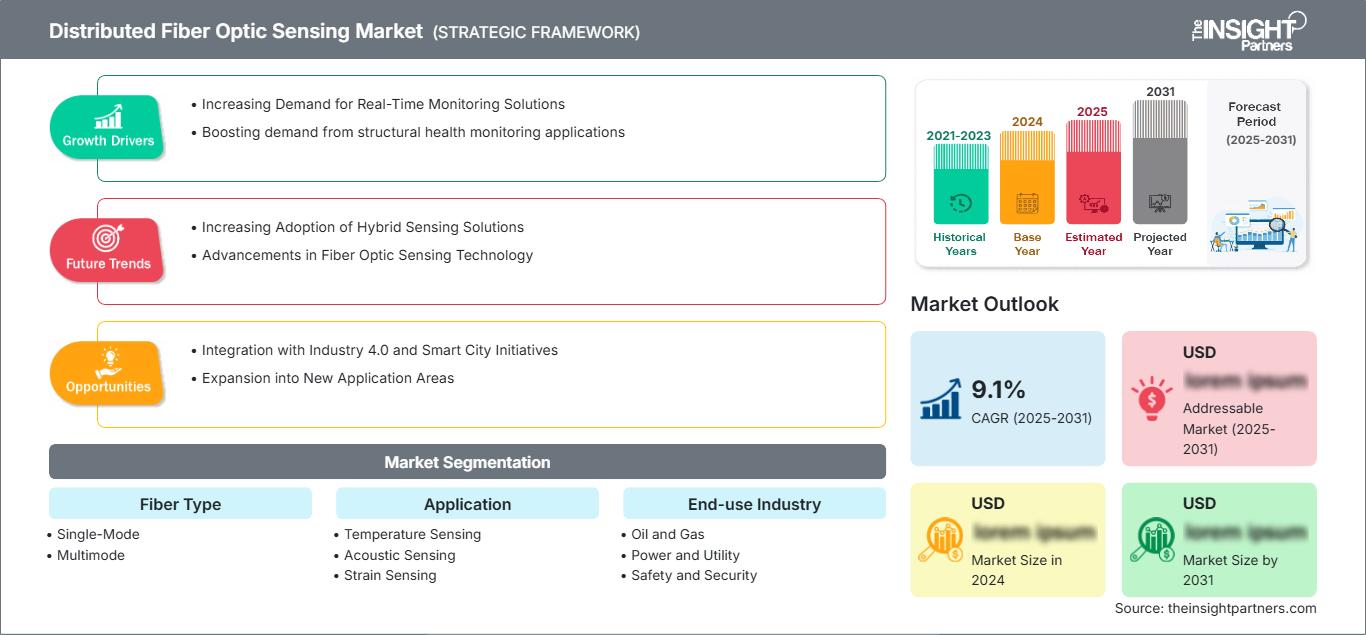
Distributed Fiber Optic Sensing Market: Strategic Insights
Regional Insights
North America Distributed Fiber Optic Sensing Market
North America holds 31–34% share in 2025 and is projected to grow at a CAGR of 9.8–10.6% during 2026–2034. Distributed Fiber Optic Sensing Market share is supported by pipeline integrity programs, unconventional oil and gas monitoring, grid reliability spending, and security installations around critical assets. The U.S. Department of Energy has noted fiber sensing value for leaks, ground movement, third-party intrusion, and power grid monitoring.
Regional buyers prioritize rugged interrogators, rapid localization, and software that separates real events from nuisance alarms. Oilfield wells, LNG terminals, refineries, transmission corridors, and utility substations create repeatable use cases. Supplier presence is strong through Halliburton Company, SLB, Luna Innovations Incorporated, AFL, OFS Fitel, LLC, and specialist integrators that support deployment, calibration, and long-term service.
U.S. Distributed Fiber Optic Sensing Market
The United States represents 78-82% of North America in 2025 and is projected to grow at a CAGR of 9.9-10.7% over 2026-2034. The application areas of interest include wellbore surveillance, pipeline leak detection, power cable temperature sensing, perimeter security, rail vibration detection, and structural health monitoring. Companies utilize distributed sensing technologies if conventional inspections cannot provide constant coverage.
There is representation from companies operating in the oilfield services, photonics, telecom cable, and infrastructure monitoring segments. Halliburton Company and SLB are players covering the subsurface and pipeline use cases, respectively, whereas Luna Innovations Incorporated and AFL offer solutions for sensing and testing along with fiber infrastructures.
Europe Distributed Fiber Optic Sensing Market
The European region holds 25-28% share in 2025 and is expected to witness growth at a CAGR of 9.1-9.9% from 2026-2034. Germany dominates on the basis of power cable monitoring, tunnel safety, industrial automation, and infrastructure modernization. The United Kingdom contributes to exports cables for offshore wind, railways, perimeter security, and North Sea energy assets that require real-time monitoring.
France, Italy, and Spain make their contribution on the basis of grid strengthening, transport tunnels, LNG assets, and civil engineering projects. The process of European procurement is influenced by factors such as safety, environment protection, and resilience planning of cross-border energy corridors. Companies such as AP Sensing GmbH, Brugg Kabel AG, Bandweaver Technologies, Omnisens SA, SLB, and Yokogawa Electric Corporation enjoy high visibility.
APAC Distributed Fiber Optic Sensing Market
APAC accounts for 29–32% share in 2025 and is expected to grow at a CAGR of 11.5–12.4% during 2026–2034. China is the leading country, supported by smart grid investment, metro expansion, pipeline networks, and large industrial sites requiring continuous monitoring.
Japan and South Korea add demand through power cable surveillance, tunnel safety, plant automation, and earthquake-aware infrastructure planning. India and Australia contribute through oil and gas pipelines, mining, renewable transmission, ports, and rail corridors. Policy support for resilient infrastructure and energy security strengthens deployment prospects for the Distributed Fiber Optic Sensing Market.
Middle East & Africa Distributed Fiber Optic Sensing Market
Middle East & Africa is projected to grow at a CAGR of 8.7–9.5% during 2026–2034. Saudi Arabia leads through oilfield digitalization, pipeline security, petrochemical sites, smart city infrastructure, and utility modernization. Harsh desert conditions increase the value of passive fiber sensing with low field electronics.
The UAE supports adoption in LNG, ports, data infrastructure, and high-value buildings, while South Africa and Rest of MEA use systems for mining, power networks, rail, and perimeter security. Buyers emphasize long-range coverage, high temperature tolerance, cyber-secure data transfer, and local maintenance capability.
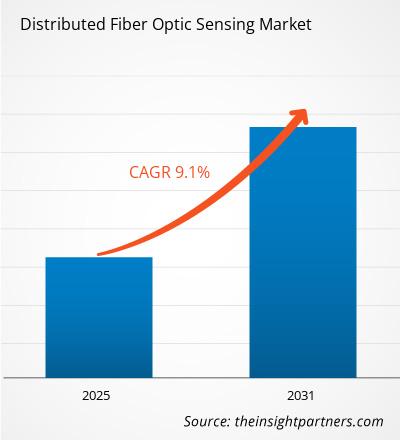
Segmentation Analysis
Fiber Type
The Fiber Type segment is projected to grow at a CAGR of 10.0–10.8% during 2026–2034. Distributed Fiber Optic Sensing Market scope covers the selection of optical fiber platforms that determine range, signal quality, bending tolerance, and deployment cost. Single-mode fiber dominates long-distance sensing, while multimode fiber supports shorter, plant-level monitoring where installation simplicity and equipment compatibility matter.
- Single-Mode fiber is strategically important for pipelines, power transmission, rail corridors, and subsea cables because it supports long reach, lower attenuation, and higher spatial performance.
- Multimode fiber serves industrial facilities, buildings, tunnels, and localized monitoring networks where shorter sensing distances, easier handling, and lower installation complexity can justify adoption.
Application
The Application segment is estimated to grow at a CAGR of 10.4–11.2% during 2026–2034. Temperature sensing remains the largest application because overheating, leaks, and thermal anomalies are common in power cables, pipelines, tanks, conveyors, and industrial assets. Acoustic and strain sensing are gaining traction as operators pursue intrusion detection, vibration analytics, and structural movement monitoring.
- Temperature Sensing leads adoption in power, oil and gas, tunnel safety, and industrial fire detection because continuous thermal profiles help operators identify overheating, leaks, and abnormal process conditions.
- Acoustic Sensing is increasingly used for pipeline leaks, third-party intrusion, rail monitoring, perimeter security, and subsea cable protection where vibration signatures support rapid event localization.
- Strain Sensing supports bridges, tunnels, dams, slopes, wells, and high-voltage cables by detecting deformation, ground movement, bending, and mechanical stress before failure risk escalates.
End-use Industry
The End-use Industry segment is projected to grow at a CAGR of 10.2–11.0% during 2026–2034. Oil and gas remains the largest demand base, while power and utility, civil engineering, safety and security, and industrial users broaden the market beyond upstream energy. Adoption depends on asset criticality, inspection difficulty, safety exposure, and the value of real-time alarms.
- Oil and Gas users apply systems to wells, flowlines, pipelines, LNG assets, and refineries where leak detection, thermal profiling, intrusion alerts, and reservoir surveillance reduce operational risk.
- Power and Utility buyers monitor transmission cables, substations, bus ducts, transformers, and renewable interconnections to prevent overheating, improve capacity planning, and support grid reliability.
- Safety and Security applications include borders, perimeters, subsea cables, tunnels, and high-value facilities where acoustic signatures help detect digging, intrusion, anchor drag, or abnormal activity.
- Industrial facilities use distributed sensing for conveyors, furnaces, chemical plants, storage tanks, and process lines where continuous monitoring improves safety and predictive maintenance.
- Civil Engineering adoption covers bridges, tunnels, dams, slopes, railways, and foundations, supporting structural health programs that detect strain, vibration, settlement, and temperature effects.
Opportunity Snapshot
| Application | Revenue Contribution | Trend Tag | Adoption Stage |
| Temperature Sensing | High | Thermal Alerts | Mature |
| Acoustic Sensing | High | Leak Detection | Scaling |
| Strain Sensing | Medium | Asset Deformation | Scaling |
Distributed Fiber Optic Sensing Market Growth Drivers and Impact Analysis
Real-Time Monitoring of Long Linear Infrastructure
For pipelines, railroads, electrical cables, tunnels, and sub-sea installations, constant visibility over long distances becomes increasingly costly when done through manual inspection. For this reason, the use of Distributed Fiber Optic Sensing Market increases because one installed optical fiber has the capability of acting as a sensing system by providing information about localized variations in temperature, acoustic disturbances, and strain. The importance of Distributed Fiber Optic Sensing Market increases significantly whenever there is a danger of having downtime, leaks, overheating, or excavations.
Digitalization of Oilfield and Utility Operations
The energy utilities providers are now incorporating their assets in the analytical platforms to allow predictive maintenance and control through remote operations. This is where fiber-optic sensors will come into play since it gives continuous monitoring of wells, flowlines, substations, bus ducts, and transmission lines without a lot of electrical sensor systems being deployed. The International Energy Agency has pointed out the need to have a growth in the electricity grids. The distributed sensing system will help address the reliability challenge by detecting overloads and temperature anomalies.
Rising Security Needs Around Critical Assets
Critical infrastructure owners are increasing investments in perimeter security, subsea cable protection, border monitoring, and pipeline intrusion detection. Distributed acoustic sensing converts fiber into a continuous vibration detector, helping identify digging, walking, vehicle movement, anchor drag, or abnormal equipment activity. The impact extends beyond security because early event classification can prevent accidental damage, service interruption, and environmental incidents. Demand is supported by higher geopolitical risk, growing dependence on data cables, and stricter resilience planning for energy and communications networks, making sensing part of broader infrastructure protection strategies.
Distributed Fiber Optic Sensing Market Future Trends
AI-Based Event Classification at the Edge
Distributed Fiber Optic Sensing Market trends are shifting toward edge analytics that process acoustic, thermal, and strain data closer to the asset. Future systems will filter nuisance alarms, classify events by probability, and recommend response actions before data reaches central control rooms. This will reduce operator fatigue and improve trust in continuous monitoring. Vendors will differentiate through training datasets, cyber-secure updates, and explainable alarm logic suited to pipelines, grids, railways, and security perimeters.
Hybrid DAS-DTS-DSS Platforms for Multi-Parameter Insight
Next-generation deployments will combine distributed acoustic, temperature, and strain sensing to provide richer asset context. A pipeline event, for example, can be assessed through vibration, thermal shift, and ground movement rather than one signal alone. This convergence will improve reliability in harsh terrain and complex industrial environments. Buyers will increasingly evaluate platforms on interoperability, fiber utilization, and integration with maintenance systems, not only on sensing distance or spatial resolution.
Distributed Fiber Optic Sensing Market Opportunities
Power Cable Monitoring for Grid Modernization
Distributed Fiber Optic Sensing Market Forecasts point to power and utility applications as a major investment opportunity because grids are carrying higher loads from electrification, renewables, and data centers. Suppliers can target underground cables, offshore wind export routes, substations, and HVDC corridors with temperature monitoring and dynamic rating solutions. Utilities benefit from improved capacity use, faster fault localization, and lower fire risk. The opportunity favors vendors offering rugged sensing cables, SCADA integration, and analytics that translate thermal profiles into operational decisions.
Subsea and Cross-Border Infrastructure Protection
Subsea cables, offshore pipelines, and interconnectors are becoming strategic assets for energy security, digital connectivity, and trade resilience. Fiber sensing can identify anchor drag, cable disturbance, seismic activity, leaks, and third-party interference across long routes. Vendors can pursue projects with offshore wind developers, telecom operators, national infrastructure agencies, and pipeline owners. The opportunity requires marine-grade engineering, event classification tuned for underwater noise, and service models that support continuous monitoring centers with clear escalation protocols.
Recent Developments
- November 2025: Knowit expanded its collaboration with Equinor through a new three-year agreement to further develop and operate Equinor’s Distributed Fiber Optic Sensing (DFOS) platform. Under the agreement, Knowit will provide software development, system integration, and technology advisory services to scale DFOS capabilities, enabling real-time monitoring and analysis of pipelines, cables, and wells. The technology is expected to improve operational safety, resource utilization, and emissions reduction across Equinor’s energy infrastructure portfolio.
- July 2024: VIAVI Solutions introduced NITRO® Fiber Sensing, a portfolio of distributed fiber optic sensing solutions for monitoring fiber optic cables and fiber-enabled critical infrastructure. The solution uses remote Fiber Test Heads (FTHs) to provide real-time monitoring of temperature, strain, and acoustic vibrations, enabling predictive maintenance, threat detection, and improved operational resilience for applications such as power cables, pipelines, data centers, transportation networks, and border security.
- July 2024: VIAVI Solutions launched NITRO® Fiber Sensing, an integrated real-time asset monitoring and analytics solution designed for fiber optic cables and critical infrastructure. The solution combines Distributed Temperature Sensing (DTS), Distributed Temperature and Strain Sensing (DTSS), and Distributed Acoustic Sensing (DAS) technologies to monitor temperature, strain, and acoustic events along fiber networks. NITRO Fiber Sensing enables predictive maintenance and threat detection for applications including oil, gas and water pipelines, electrical power transmission, border/perimeter security, and data center interconnects by providing precise location-based alerts for potential infrastructure issues.
Frequently Asked Questions

- Comprehensive Market Sizing and Forecast Analysis
- Detailed Segmentation Analysis
- In-Depth Market Dynamics Assessment
- Regional and Country-Level Insights
- Competitive Landscape and Company Benchmarking
- Strategic Business Intelligence
Recent Reports
Testimonials

The Insight Partners' SCADA System Market report is comprehensive, with valuable insights on current trends and future forecasts. The team was highly professional, responsive, and supportive throughout. We are very satisfied and highly recommend their services.
RAN KEDEM Partner, Reali Technologies LTDs
I requested a report on a very specific software market and the team produced the report in a few days. The information was very relevant and well presented. I then requested some changes and additions to the report. The team was again very responsive and I got the final report in less than a week.
JEAN-HERVE JENN Chairman, Future Analytica
We worked with The Insight Partners for an important market study and forecast. They gave us clear insights into opportunities and risks, which helped shape our plans. Their research was easy to use and based on solid data. It helped us make smart, confident decisions. We highly recommend them.
PIYUSH NAGPAL Sr. Vice President, High Beam Global
The Insight Partners delivered insightful, well-structured market research with strong domain expertise. Their team was professional and responsive throughout. The user-friendly website made accessing industry reports seamless. We highly recommend them for reliable, high-quality research services
YUKIHIKO ADACHI CEO, Deep Blue, LLC.
This is the first time I have purchased a market report from The Insight Partners.While I was unsure at first, I visited their web site and felt more comfortable to take the risk and purchase a market report.I am completely satisfied with the quality of the report and customer service. I had several questions and comments with the initial report, but after a couple of dialogs over email with their analyst I believe I have a report that I can use as input to our strategic planning process.Thank you so much for taking the extra time and making this a positive experience.I will definitely recommend your service to others and you will be my first call when we need further market data.
JOHN SUZUKI President and Chief Executive Officer, Board Director, BK Technologies
I wish to appreciate your support and the professionalism you displayed in the course of attending to my request for information regarding to infectious disease IVD market in Nigeria. I appreciate your patience, your guidance, and the fact that you were willing to offer a discount, which eventually made it possible for us to close a deal. I look forward to engaging The Insight Partners in the future, all thanks to the impression you have created in me as a result of this first encounter.
DR CHIJIOKE ONYIA MANAGING DIRECTOR, PineCrest Healthcare Ltd.Reason to Buy
- Informed Decision-Making
- Understanding Market Dynamics
- Competitive Analysis
- Identifying Emerging Markets
- Customer Insights
- Market Forecasts
- Risk Mitigation
- Boosting Operational Efficiency
- Strategic Planning
- Investment Justification
- Tracking Industry Innovations
- Aligning with Regulatory Trends





 Get Free Sample for