
Distribution Boards Market Share, Demand & Growth by 2034
Coverage: by Voltage Type (Low Voltage Distribution Boards, Medium Voltage Distribution Boards); End-Use (Transmission and Distribution Utilities, Manufacturing and Processing Industry, Commercial and Residential Sector, Others) , and Geography (North America, Europe, Asia Pacific, and South and Central America)
- Status : Data Released
- Report Code : TIPRE00005580
- Category : Electronics and Semiconductor
- No. of Pages : 150
- Available Report Formats :


- Last update date : September 28, 2026


2025 Market Size
US$ 14.15 Bn
Base year value
2034 Forecast
US$ 26.18 Bn
Projected by 2034
CAGR 2026-2034
7.08 %
Growth rate
Addressable Market
US$ 182.09 Bn
(2026-2034)
The Distribution Boards market on a global level is projected to grow from US$ 14.15 Billion in 2025 to US$ 26.18 Billion by 2034, registering a 7.08% CAGR from 2026 to 2034. The growth in the market is due to rising requirements of circuit protection, modular electric distribution system, and digital electrical installations.
The North America Distribution Boards market size growth can be attributed to grid hardening initiatives, higher power density in data centers, electrification of buildings, and upgrade of aging panel boards in the region. The market is forecasted to grow by 6.6-7.1% CAGR till 2034.
Distribution Boards Market Assessment and Insights
- North America accounted for 24–27% share in 2025 and is projected to grow at a 6.6–7.1% CAGR between 2026–2034, supported by utility modernization, data center expansion, and commercial retrofit demand.
- US represented 78–82% of North America in 2025 and is expected to expand at a 6.7–7.2% CAGR between 2026–2034, driven by grid upgrades and electrified buildings.
- Europe held 21–24% share in 2025 and is forecast to grow at a 6.2–6.8% CAGR between 2026–2034, led by Germany, the UK, France, Italy, and Spain.
- Asia Pacific represented 37–41% share in 2025 and is set to grow at a 7.6–8.3% CAGR between 2026–2034, with China, India, Japan, South Korea, and Australia leading demand.
- Largest Segment Low Voltage Distribution Boards held 62–66% market share in 2025 and is projected to grow at a 6.7–7.3% CAGR between 2026–2034.
- High Growth Segment Transmission and Distribution Utilities held 36–40% market share in 2025 and is expected to grow at a 7.5–8.2% CAGR between 2026–2034.
- Key companies analyzed in detail: ABB Ltd., Arabian Gulf Switchgear LLC, Eaton Corporation plc, ESL Power Systems, Inc., Hager SE, Larsen and Toubro Limited, Legrand SA, NHP Electrical Engineering Products Pty Ltd, Schneider Electric SE, Siemens AG.
Source: The Insight Partners' analysis based on proprietary research, government publications, company annual reports, investor presentations, industry databases, and expert interviews.
Migrating technology is changing the design of products in the form of distribution boards, which are shifting from being simple enclosures to becoming more modular and fitted with sensors. Manufacturers are changing their designs for busbar arrangement, protection, and load monitoring to facilitate faster installation and load monitoring. The dynamics of production are moving towards prefabrication, standardization on low-voltage platforms, and localized supply chains, thus avoiding project delays due to changes in copper, steel, and electronics prices.
Demand in the future is expected to rise due to the growth of infrastructure in emerging economies including urban distribution networks, industrial parks, transportation hubs, and renewable power systems. There will be continuous replacement of existing distribution boards in advanced countries due to the regulation of safer wiring, energy consumption, and reliable power systems. Investors will target distribution boards that offer compliance, compactness, maintainability, and diagnostics.
Distribution Boards Market Report Scope
| Report Attribute | Details |
|---|---|
| Market size in 2025 | US$ 14.15 Billion |
| Market Size by 2034 | US$ 26.18 Billion |
| Global CAGR (2026 - 2034) | 7.08% |
| Historical Data | 2021-2024 |
| Forecast period | 2026-2034 |
Distribution Boards Market Analysis
Growth of market is due to increasing electricity usage, upgrading of the grid and stricter building safety standards. Utilities need boards that will be capable of handling more feeder connections, renewable power generation, and outages isolation, while industries want reliability and easy maintenance. Consumers will use safe panels because of growing electrification of connected devices.
Value Chain includes manufacture of enclosures, manufacture of copper busbars, circuit breakers, relays, monitoring units, installation services, aftersales services. The supply dynamics continue to be influenced by the price of metals, time of certification and availability of skilled electrical workforce. With evolving requirements, the OEMs increasingly rely on their relationships with the breaker manufacturers and platforms and panel producers.
Distribution Boards market report for Distribution Boards reveals an area that is competitive in nature, dominated by integrated manufacturers of electrical equipment and regional players. The main competitors in the market include Schneider Electric SE, Siemens AG, ABB Ltd., Eaton Corporation plc, Legrand SA, and Hager SE, operating via digital marketing, portfolio of low voltage solutions, services, and specification through consultants, contractors, and utilities.
Investment patterns in the industry are inclined towards expansion of manufacturing capacity, launching smart panels, and setting up local factories near infrastructure projects. In this context, Larsen and Toubro Limited and Arabian Gulf Switchgear LLC can gain from demand created through infrastructure projects, and on the other hand, NHP Electrical Engineering Products Pty Ltd and ESL Power Systems Inc. operate in niche markets.
● REPORT CUSTOMIZATION
Tailor This Report To Align With Your Specific Business Requirements
This report can be customized to align precisely with your business objectives, scope, and target markets. Customization options include tailored segmentation, geography, competitive analysis, and strategic insights to support informed decision-making.
Customize This Report →WHAT YOU CAN ADJUST
- ● Segmentations
- ● Geography
- ● Competitive Analysis
- ● Language Preferences
Distribution Boards Market: Strategic Insights
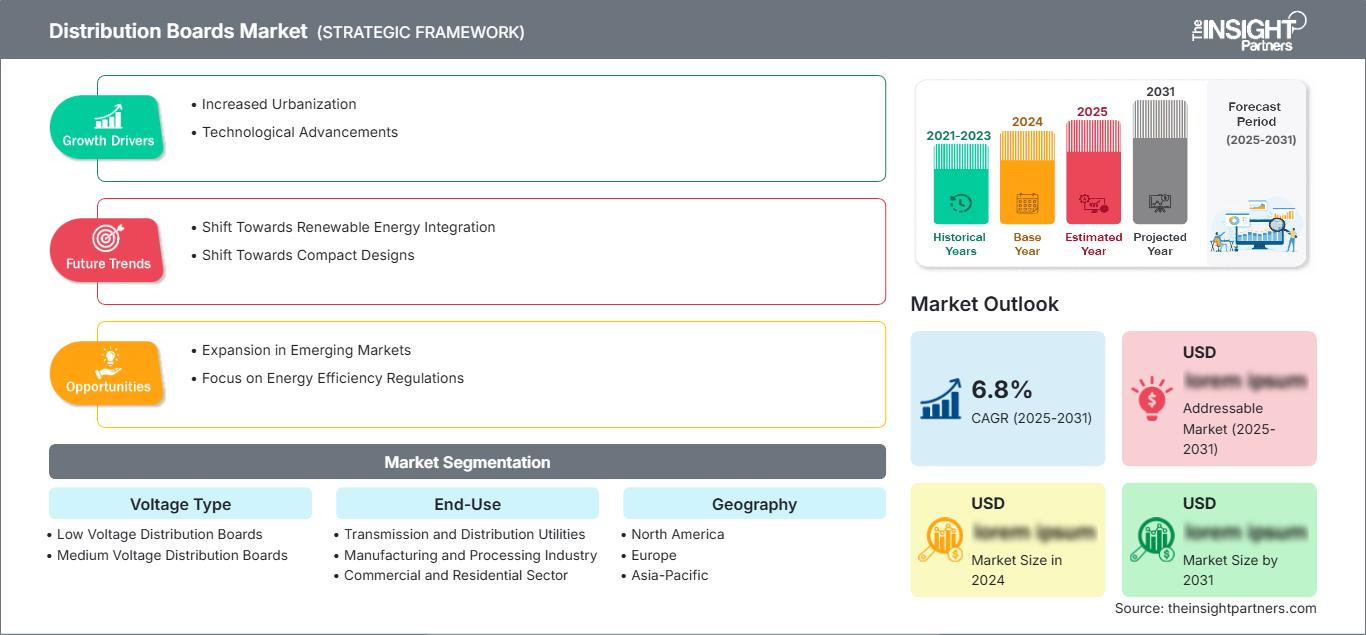
Regional Insights
North America Distribution Boards Market
The North American region held a revenue share of 24-27% of the worldwide market in 2025 and is expected to expand at a compound annual growth rate of 6.6-7.1% from 2026-2034. Drivers of Distribution Boards Market share include utility renewal projects, increased standards of electrical safety, and heavy loads of buildings that require selective coordination and digital monitoring.
There is demand for the product in the U.S. and Canada as grid resilience investment, construction of data centers, battery storage connection, and upgrades of commercial buildings require the modernization of distribution boards.
U.S. Distribution Boards Market
The U.S. holds 78–82% market share of North America revenues in 2025 and is expected to grow at a CAGR of 6.7–7.2% between 2026–2034. The country has an advantage due to large capex cycles for utilities, aging commercial panels, and rapidly growing electrified assets in warehouses, hospitals, universities, and data centers.
There is a widespread presence of companies operating in this industry including Eaton Corporation plc, Schneider Electric SE, Siemens AG, ABB Ltd., and ESL Power Systems, Inc. Applications of this company include utilities, industries, and critical power systems. Common adoption includes arc-flash protection, remote monitoring, prefabricated enclosures, and distribution boards.
Europe Distribution Boards Market
Share held by Europe was in range of 21% to 24% in 2025 and CAGR of 6.2% to 6.8% would be experienced up until 2034, due to Germany. Factors driving the market dynamics include building renovations, industrial energy efficiency, grid digitization, and stringent safety regulations. UK is focusing on commercial renovations, data centers and renewable energies, and hence demand for low voltage boards.
Germany leads in market due to manufacturing, automation and electricity upgrades, while France, Italy and Spain lead due to public infrastructure upgrades, solar integration and commercial renovation. Leading companies are Siemens AG, Schneider Electric SE, ABB Ltd., Legrand SA and Hager SE.
APAC Distribution Boards Market
AThe PAC accounted for the highest 37%-41% market share in 2025 and is projected to expand at a CAGR of 7.6%-8.3%, which will be the fastest regional contributor. The main driving factors behind the growth of China are industrial capacity, urban constructions, and grid investments. India also adds momentum to the growth owing to reforms in distribution and manufacturing corridors.
High-reliability systems are stressed upon by Japan and South Korea as they are used in electronics, transport and smart buildings. In Australia, the demand in the market driven by mining, renewables, and infrastructure improvements.
Middle East & Africa Distribution Boards Market
The Middle East & Africa market segment is expected to register a 6.4-7.0% CAGR until 2034. Saudi Arabia is the largest country within the region, driven by mega projects, utilities, industries, and renewable integration. UAE increases demand via commercial buildings, data centers, and other specialized installations.
South Africa and other MEA require dependable switches for mines, business complexes, and enhanced distribution network facilities. Customers within the region seek tough cases, thermal stability, quick delivery, and after-sales services. Arabian Gulf Switchgear LLC and foreign switchgear manufacturers benefit from projects-driven sales and localization.

Segmentation Analysis
Voltage Type
Voltage Type is expected to grow at a 6.9–7.5% CAGR during 2026–2034. Distribution Boards Market scope across voltage categories reflects the split between building-level circuit management and higher-capacity industrial or utility feeder needs. Adoption is influenced by installation voltage, safety compliance, load profile, and demand for monitoring.
- Low Voltage Distribution Boards dominate installations in commercial, residential, and light industrial settings because they manage final circuit distribution, protection, metering, and modular expansion with comparatively lower installation complexity.
- Medium Voltage Distribution Boards serve utilities, large plants, infrastructure, and renewable interconnections where higher feeder capacity, fault isolation, and equipment coordination are essential for operational continuity and safety.
End-Use
End-Use is projected to grow at a 7.1–7.8% CAGR during 2026–2034. Utilities, manufacturers, commercial owners, and residential developers specify boards according to load criticality, installation environment, and maintenance strategy. Growth is strongest where electrification, automation, and safety upgrades converge with asset replacement cycles.
- Transmission and Distribution Utilities are the most strategic buyers, using boards in substations, feeders, and distribution upgrades where reliability, protection coordination, and remote visibility support grid resilience.
- Manufacturing and Processing Industry requires robust boards for motors, process lines, automation cells, and maintenance isolation, making uptime, thermal performance, and serviceability decisive procurement factors.
- Commercial and Residential Sector depends on safe, modular boards for buildings, campuses, apartments, hospitals, and retail facilities, with demand rising as connected loads and energy monitoring requirements increase.
Opportunity Snapshot
| End-Use | Revenue Contribution | Trend Tag | Adoption Stage |
| Transmission and Distribution Utilities | High | Grid Resilience | Scaling |
| Manufacturing and Processing Industry | High | Plant Automation | Scaling |
| Commercial and Residential Sector | Medium | Smart Buildings | Mature |
| Others | Low | Special Loads | Emerging |
Distribution Boards Market Growth Drivers and Impact Analysis
Grid modernization and reliability investment
Utilities are upgrading their legacy distribution infrastructure for minimizing downtime, improving feeder visibility, and connecting distributed energy sources. Distribution boards play a crucial role here since they provide organization of circuits, fault isolation, and installation of protection devices in substations and downline distribution infrastructure. This effect can be observed by means of the increased emphasis on metering capabilities, communication preparedness, and pre-tested assembly. Manufacturers who are capable of integrating their certified components with technical documentation and service can secure repeat purchases.
Electrification of buildings and industrial loads
Electrification of buildings, upgrades of the heating and cooling system, electric vehicle charging, automation, and higher equipment densities are contributing to increased current loads within the building. It becomes necessary for the owners to have boards that can provide safe and effective power distribution to larger circuits and accommodate future increases in capacity. Impact on the market is that people are now switching from simple electrical boards to modular and monitored systems.
Safety compliance and digital maintenance requirements
Codes for electrical installation, insurer requirements, and risk mitigation in operations are encouraging purchases of more reliable, better protected, labeled, heat-managed, and easier-to-maintain boards. Digital maintenance is another requirement, since the operator wants alarms, metering, and diagnostics that will prevent unanticipated stops. This shifts purchase considerations from lowest installed cost to reliability of life cycle operation. Vendors with proven design, good documentation, and monitoring capability have an opportunity to boost their margins and help their customers meet their audits, safety, and up-time goals.
Distribution Boards Market Future Trends
Smart distribution boards becoming facility data nodes
Distribution Boards Market trends point to boards evolving into data nodes within building and industrial energy systems. Future products will combine circuit protection with embedded sensors, communication modules, and analytics-ready outputs. This will allow operators to monitor load imbalance, temperature rise, breaker status, and energy consumption at circuit level. The shift should support predictive maintenance, carbon reporting, and demand response participation, particularly in facilities where power quality and uptime directly affect operating performance.
Prefabricated and modular assemblies gaining preference
Prefabrication is expected to gain relevance as construction schedules tighten and skilled electrical labor remains constrained. Modular boards assembled under controlled factory conditions can reduce field wiring time, improve quality consistency, and simplify inspection. Contractors will increasingly prefer repeatable designs for campuses, data centers, warehouses, and residential towers. For manufacturers, this trend creates opportunities to standardize platforms while offering configurable options for metering, surge protection, communications, and spare capacity.
Distribution Boards Market Opportunities
Utility procurement programs for resilient distribution networks
Suppliers can target long-cycle utility procurement by aligning boards with resilience, monitoring, and standardized maintenance needs. Winning strategies include pre-approved designs, local service teams, documentation packages, and integration with protection relays or SCADA-ready devices. Utilities often buy through framework agreements, so qualification depth matters as much as product price. Companies that support engineering consultants early can influence specifications and secure recurring demand from substations, feeders, renewable interconnections, and urban capacity upgrades.
Digital retrofits for commercial and industrial facilities
Commercial and industrial retrofit programs create an attractive opportunity because many facilities need safer panels without complete electrical system replacement. Vendors can package boards with metering, thermal monitoring, surge protection, and maintenance services to reduce disruption. Priority verticals include hospitals, logistics hubs, food processing, semiconductor facilities, and office campuses. A solutions-led approach can convert compliance spending into broader energy management projects, improving account retention and aftermarket revenue.
Recent Developments
- March 2025: IPD launched its Evolution Core Distribution Board Range, a new generation of electrical distribution boards designed to deliver enhanced safety, reliability, and compliance with industry standards. Developed for residential and commercial applications, the range meets AS/NZS 3000 and AS/NZS 61439 requirements while offering a flexible solution for modern electrical installations.
- September 2025: APS Industrial launched its advanced Manufacturing Centre, highlighting its investment in local manufacturing capabilities and the future of distribution board production. The new facility is designed to improve delivery efficiency, strengthen product quality, and provide enhanced support to the electrical industry through locally manufactured solutions.
- January 2026: Proteus Switchgear introduced its upgraded ABX Compact Three Phase MCB Distribution Board range with factory-fitted surge protection devices (SPDs), providing enhanced electrical protection while maintaining a space-saving design. The new range includes integrated Type 1 and Type 1+2 SPDs, helping protect critical equipment from transient overvoltages caused by lightning strikes and switching surges.
Frequently Asked Questions

- Comprehensive Market Sizing and Forecast Analysis
- Detailed Segmentation Analysis
- In-Depth Market Dynamics Assessment
- Regional and Country-Level Insights
- Competitive Landscape and Company Benchmarking
- Strategic Business Intelligence
Recent Reports
Testimonials

The Insight Partners provided valuable market intelligence that supported our global go-to-market strategy. Their team was professional, responsive, and attentive to our feedback, providing thoughtful analysis and helpful methodological clarifications throughout the project.
Junmo Kim Chief Financial Officer (CFO), Enertech Co., Ltd.
The Insight Partners' SCADA System Market report is comprehensive, with valuable insights on current trends and future forecasts. The team was highly professional, responsive, and supportive throughout. We are very satisfied and highly recommend their services.
RAN KEDEM Partner, Reali Technologies LTDs
I requested a report on a very specific software market and the team produced the report in a few days. The information was very relevant and well presented. I then requested some changes and additions to the report. The team was again very responsive and I got the final report in less than a week.
JEAN-HERVE JENN Chairman, Future Analytica
We worked with The Insight Partners for an important market study and forecast. They gave us clear insights into opportunities and risks, which helped shape our plans. Their research was easy to use and based on solid data. It helped us make smart, confident decisions. We highly recommend them.
PIYUSH NAGPAL Sr. Vice President, High Beam Global
The Insight Partners delivered insightful, well-structured market research with strong domain expertise. Their team was professional and responsive throughout. The user-friendly website made accessing industry reports seamless. We highly recommend them for reliable, high-quality research services
YUKIHIKO ADACHI CEO, Deep Blue, LLC.
This is the first time I have purchased a market report from The Insight Partners.While I was unsure at first, I visited their web site and felt more comfortable to take the risk and purchase a market report.I am completely satisfied with the quality of the report and customer service. I had several questions and comments with the initial report, but after a couple of dialogs over email with their analyst I believe I have a report that I can use as input to our strategic planning process.Thank you so much for taking the extra time and making this a positive experience.I will definitely recommend your service to others and you will be my first call when we need further market data.
JOHN SUZUKI President and Chief Executive Officer, Board Director, BK Technologies
I wish to appreciate your support and the professionalism you displayed in the course of attending to my request for information regarding to infectious disease IVD market in Nigeria. I appreciate your patience, your guidance, and the fact that you were willing to offer a discount, which eventually made it possible for us to close a deal. I look forward to engaging The Insight Partners in the future, all thanks to the impression you have created in me as a result of this first encounter.
DR CHIJIOKE ONYIA MANAGING DIRECTOR, PineCrest Healthcare Ltd.Reason to Buy
- Informed Decision-Making
- Understanding Market Dynamics
- Competitive Analysis
- Identifying Emerging Markets
- Customer Insights
- Market Forecasts
- Risk Mitigation
- Boosting Operational Efficiency
- Strategic Planning
- Investment Justification
- Tracking Industry Innovations
- Aligning with Regulatory Trends





 Get Free Sample for