
Earphones and Headphones Market Share, Demand & Growth by 2034
Coverage: By Technology (Wired and Wireless); Price (Less Than 50 USD, Between 50 To 100 USD, and Above 100 USD); and Application (Media and Entertainment, Gaming, Corporate, Personal, and Fitness & Sports), and Geography (North America, Europe, Asia Pacific, and South and Central America)
- Status : Data Released
- Report Code : TIPTE100001018
- Category : Electronics and Semiconductor
- No. of Pages : 150
- Available Report Formats :


- Last update date : August 10, 2026


2025 Market Size
US$ 85.87 Bn
Base year value
2034 Forecast
US$ 277.50 Bn
Projected by 2034
CAGR 2026-2034
13.92 %
Growth rate
Addressable Market
US$ 1,568.17 Bn
(2026-2034)
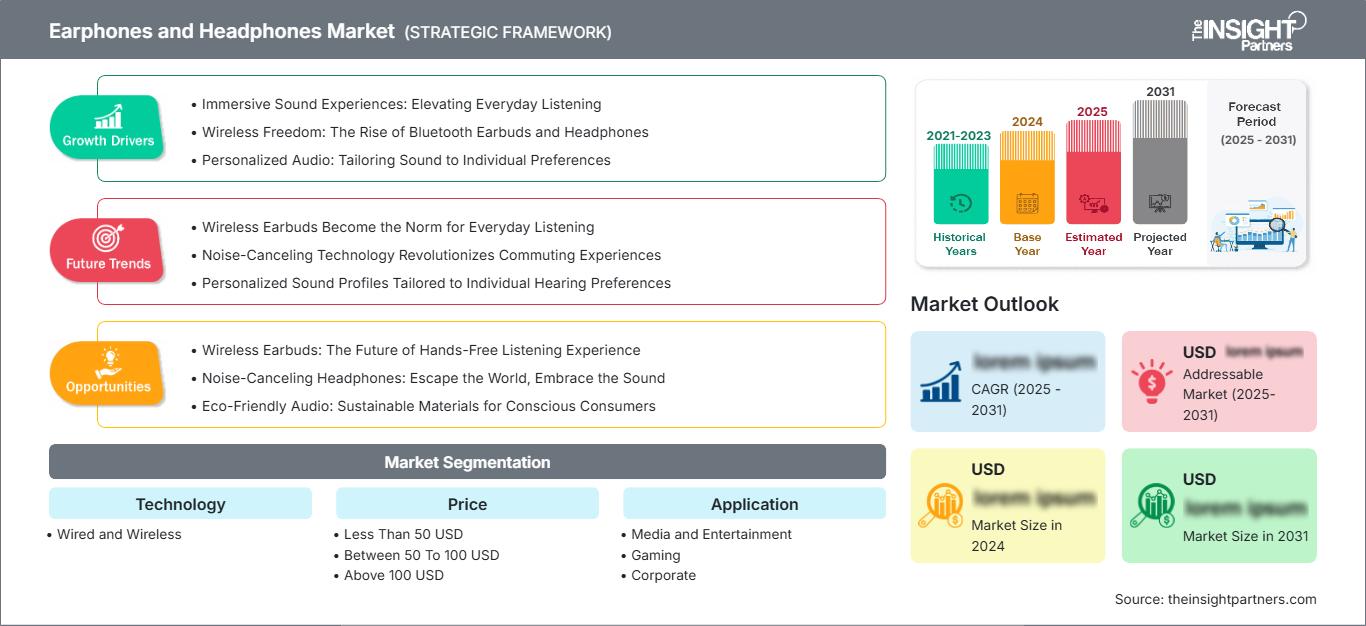
The Earphones and Headphones Market was US$ 85.87 Billion in 2025 and is anticipated to reach US$ 277.50 Billion by 2034, growing at a CAGR of 13.92% from 2026 to 2034. Growth is driven by the expanded usage of personal audio devices in various applications in entertainment, communications, gaming, fitness, and business environments with the wireless earphones driving replacement cycles and premiumization.
North America continues to be an important market segment for earphones and headphones, growing at a 12.8–13.6% CAGR over the forecast period until 2034. The growth of Earphones and Headphones Market share is driven by the presence of smartphones and media streaming subscriptions, hybrid working model, and premium sales channel. Gaming, fitness, accessibility are some other application areas boosting the regional demand.
.
Earphones and Headphones Market Assessment and Insights
- North America: Share in 2025 is estimated at 29–32%, with CAGR between 2026–2034 of 12.8–13.6%, supported by premium replacement, gaming, hybrid work, and strong direct-to-consumer distribution.
- US: The country represents 84–87% of North American revenue in 2025 and is growing at a 12.7–13.5% CAGR through 2034.
- Europe: Share in 2025 is estimated at 24–27%, with CAGR between 2026–2034 of 12.2–13.0%; the UK and Germany lead, followed by France, Italy, and Spain.
- Asia Pacific: Share in 2025 is estimated at 34–38%, expanding at a 15.0–16.0% CAGR through 2034, led by China, Japan, South Korea, and India.
- Largest Segment: Wireless technology holds 72–76% market share in 2025 and is projected to grow at a 15.0–15.8% CAGR during 2026–2034.
- High Growth Segment: Gaming application accounts for 10–13% market share in 2025 and is expected to expand at a 16.1–17.0% CAGR during 2026–2034.
- Key companies analyzed in detail: Bose Corporation, Sennheiser electronic SE & Co. KG, Skullcandy, Inc., Sony Group Corporation, Apple Inc., Audio-Technica Corporation, JVCKENWOOD Corporation, Harman International Industries, Incorporated, Pioneer Corporation, and Grado Labs, Inc.
Source: The Insight Partners' analysis based on proprietary research, government publications, company annual reports, investor presentations, industry databases, and expert interviews.
Personal audio has morphed from an accessory-driven market into one where software-enabled device platforms are driving market dynamics. The factors driving differentiation include Bluetooth reliability, active noise cancellation, spatial processing, beam-forming mics, and application-driven sound customization. Production has moved towards chip-based manufacturing, small batteries, accurate acoustics, and contract manufacturers in Asia. Brands need to strike a balance between frequent feature updates on one hand and component compatibility, firmware capability, serviceability, and supplier diversification on the other.
Between now and 2034, growth drivers will extend out of mature premium segments into branded wireless segments driven by mobile-first consumers in India, Southeast Asia, the Middle East, Africa, and Latin America. Investments will probably be made in low-power chips, hearing protection, biometric sensors, recyclables, and localized manufacturing. Tailwinds in regulations concerning USB-C compatibility, battery disclosure, data privacy, and hearing protection should benefit vendors with compliant hardware and firmware solutions.
Earphones and Headphones Market Report Scope
| Report Attribute | Details |
|---|---|
| Market size in 2025 | US$ 85.87 Billion |
| Market Size by 2034 | US$ 277.50 Billion |
| Global CAGR (2026 - 2034) | 13.92% |
| Historical Data | 2021-2024 |
| Forecast period | 2026-2034 |
Earphones and Headphones Market Analysis
The development of the market of earphones and headphones is linked to streaming, media consumption using mobile phones, teamwork, gaming, and fitness. Instead of simple replacement, a user requires a couple of devices because of his/her travelings, working, training, and other purposes. Addition of such features as wireless, voice recording, noise cancellation, and multipoint expands the usefulness of the product.
The ecosystem encompasses acoustics, semiconductor solutions, batteries, microphones, plastic injection molding, firmware, cloud applications, contract manufacturing, distribution and sales, and customer support. Supply chain robustness hinges on testing additional chips and batteries while not sacrificing tuning uniformity. Standardized parts contribute to cost-reduced products, whereas premium devices employ proprietary algorithms and drivers, as well as integration with operating systems.
The Earphones and Headphones Market report proves that competition is now moving towards ecosystems and use cases and not simply acoustics. Apple Inc. and Sony Group Corporation consider issues of hardware, software and content compatibility, while Bose Corporation and Sennheiser electronic SE & Co. KG pay their attention to acoustics; Skullcandy, Inc. and JBL to accessibility and lifestyle; Audio-Technica Corporation and Grado Labs, Inc. preserve their specialists' credibility.
There should be an investment in edge artificial intelligence, low power Bluetooth, hearing assistance, spatial audio and sensor fitness experiences. There is the benefit of JVCKENWOOD Corporation and Pioneer Corporation that is connected to the use of wider electronics distribution channels, while for Harman International Industries, Incorporated its brand architecture and automobile connections would be helpful. The right positioning depends upon portfolio ladders, quick firmware development, proper privacy control and channel-appropriate bundling so that there would be no discounts but differentiation of the products in entry, middle and premium tiers.
● REPORT CUSTOMIZATION
Tailor This Report To Align With Your Specific Business Requirements
This report can be customized to align precisely with your business objectives, scope, and target markets. Customization options include tailored segmentation, geography, competitive analysis, and strategic insights to support informed decision-making.
Customize This Report →WHAT YOU CAN ADJUST
- ● Segmentations
- ● Geography
- ● Competitive Analysis
- ● Language Preferences
Earphones and Headphones Market: Strategic Insights
Regional Insights
North America Earphones and Headphones Market
North America holds around 29–32% Earphones and Headphones Market share in 2025 and will witness a growth rate of 12.8–13.6% CAGR through 2026–2034. Affluence, 5G infrastructure, subscription services, air travels, and mature online commerce make for fast premium refresh. Hybrid working keeps multipoint connectivity, speech isolation, comfort, and long battery life in demand, and fitness and gaming fuel differentiable secondary device purchases.
This market segment exerts enormous power when it comes to planning the product development strategies because of the high representation of platform manufacturers, semiconductor manufacturers, gaming publishers, and audio manufacturers in the area. Safety and accessibility concerns encourage the use of exposure measurement and adaptive listening. The demand of Canadian cities is very high, whereas Mexico strengthens the manufacturing and value segments. Merchants try to differentiate through the release of new models, subscription programs, trading options, and warranties, which makes software and service more important than sound and price for selecting a brand.
U.S. Earphones and Headphones Market
The U.S. accounts for an estimated 84–87% of North America revenue in 2025, with forecasted CAGR of 12.7–13.5% for the period until 2034. The widespread use of smartphones coupled with extensive consumption of subscription video content, music, podcasts, and games leads to high replacement demand. Media and entertainment continues to be the main application, whereas gaming, business communication, fitness, and sports drive fast feature-oriented purchases based on low latency, directional microphones, sweat-resistance, and secure fit.
Brand density is very high with competitor brands like Apple Inc., Bose Corporation, Sony Group Corporation, Skullcandy, Inc., Harman International Industries, Incorporated and specialized brands selling their products through retailers, electronics stores, markets, operators and enterprises. The premium category makes use of pairing within the ecosystem and trade-in facilities while sub-US$50 categories act as mass market entry points. The enterprise category is becoming more and more concerned about certification for conferencing performance and fleet management. There must be public dialogue on hearing health to adopt exposure control, transparency mode, and parental protection.
Europe Earphones and Headphones Market
Europe accounts for 24-27% of the share in 2025 and will experience a CAGR of 12.2-13.0% in 2034. The leading country is the UK due to the streaming, gaming, commuter, and premium retail markets, whereas heavy engagement in remote work allows the use of headsets with beamforming, reliability, and multipoint pairing features. Nowadays, consumers consider repairability, battery life, protection against hearing damage, as well as environmental claims together with audio quality.
The German market is characterized by a significant number of premium and professional customers, which is caused by engineering tradition and specialty distribution. France is known for fashion-driven wireless technology adoption, as well as consumer culture. Italy and Spain add mobile entertainment and sport, as well as tourism demands. Generally, in Europe, there is an influence of the USB-C standard, ecodesign criteria, privacy requirements, and safe listening objectives on product design, packaging, and software.
APAC Earphones and Headphones Market
APAC accounts for 34%-38% market share in 2025 and is forecast to grow at a 15.0-16.0% CAGR up to 2034. China takes the lead through scale, manufacturing, e-commerce, and stiff domestic competition. Japan and South Korea maintain demand for premium, gaming, and high-resolution devices. India provides fast unit growth in the value and mid-tier wireless segments.
Advanced replacement demand is brought about by Australia. With industrial policy emphasizing electronics assembly, semiconductor technology, and digital technology, there is increased efficiency in supply. Entertainment via mobile phones, super apps, e-sports and health and fitness applications increase adoption, but pricing forces regionalization of the portfolio of products/services offered.
Middle East & Africa Earphones and Headphones Market
The Middle East and Africa region will register a compound annual growth rate (CAGR) of 13.6% to 14.6% up until 2034. Leading in the region are Saudi Arabia through youth spending, gaming, tourism, flights, and digital entertainment. The UAE boosts high-end shopping and tourism needs, whereas South Africa provides organized electronic distribution and use of mobile audio technology.
Other parts of MEA will see smartphone penetration increase together with improved connectivity for basic users. Availability of energy supply, cost of imports, and coverage influence the type of products available in the market – efficient batteries, durable devices and distributors in the region.
Segmentation Analysis
Technology
Technology is forecast to expand at a 13.7–14.5% CAGR during 2026–2034. The Earphones and Headphones Market scope spans mature, wired products and rapidly scaling wireless architectures. Adoption is governed by latency, battery performance, codec support, microphone quality, device interoperability, and serviceable firmware. Wireless drives premiumization and convenience, while wired products retain strategic relevance where reliability, zero charging, low latency, and predictable audio paths remain essential.
- Wired: Demand remains resilient among studios, audiophiles, schools, call centers, and budget buyers prioritizing dependable connections, low latency, long service life, and compatibility with dedicated audio equipment.
- Wireless: Wireless leads through portability, active noise cancellation, multipoint pairing, spatial processing, and ecosystem integration, making it the primary innovation arena across mass, gaming, fitness, and premium categories.
Price
Price segmentation is projected to grow at a 13.5–14.3% CAGR during 2026–2034. Entry products expand access, midrange devices concentrate mainstream features, and premium models monetize advanced acoustics, materials, sensors, and software. Competitive intensity is highest where active noise cancellation and multipoint connectivity migrate downward. Brands must maintain understandable feature ladders because aggressive promotions can compress differentiation and encourage consumers to defer upgrades.
- Less Than 50 USD: This tier supplies broad unit demand through online marketplaces, emerging markets, students, and replacement purchases, with reliability and battery life often outweighing advanced acoustic personalization.
- Between 50 To 100 USD: Midrange products balance affordability with active noise cancellation, stronger microphones, companion applications, and recognizable branding, making this band strategically important for upgrades from basic wireless models.
- Above 100 USD: Premium demand centers on acoustic tuning, adaptive cancellation, spatial audio, ecosystem integration, comfort, and durable materials, supporting higher margins but requiring sustained software and service investment.
Application
Application demand is expected to rise at a 13.8–14.6% CAGR during 2026–2034. Media and entertainment supply the broadest base, while gaming and fitness reward specialized latency, fit, and sensor capabilities. Corporate buyers prioritize speech intelligibility and manageability; personal use spans communication, travel, and study. Vendors increasingly design modular portfolios around context rather than universal specifications, improving attachment rates across multiple daily routines.
- Media and Entertainment: Streaming music, video, podcasts, and creator workflows sustain the largest demand pool, with immersive processing and noise control encouraging consumers to trade up across devices.
- Gaming: Low latency, positional sound, clear team communication, and long-session comfort underpin specialized demand across consoles, personal computers, and mobile platforms, including competitive esports audiences.
- Corporate: Hybrid meetings and contact-center operations favor dependable microphones, multipoint connectivity, certified collaboration compatibility, centralized device support, and comfort for prolonged professional use.
- Personal: Everyday communication, commuting, study, and travel create broad replacement frequency, with purchase decisions balancing portability, battery endurance, brand familiarity, privacy, and price.
- Fitness & Sports: Secure fit, sweat resistance, ambient awareness, biometric sensing, and light weight differentiate products for running, training, cycling, and outdoor activity.
Opportunity Snapshot
| Application | Revenue Contribution | Trend Tag | Adoption Stage |
| Media and Entertainment | High | Spatial Streaming | Mature |
| Gaming | High | Low Latency | Scaling |
| Corporate | Medium | Hybrid Meetings | Scaling |
| Personal | High | Daily Audio | Mature |
| Fitness & Sports | Medium | Biometric Audio | Emerging |
Earphones and Headphones Market Growth Drivers and Impact Analysis
Wireless Ecosystems Expand Everyday Audio Utility
Smartphones, tablets, televisions, consoles, watches, and laptops increasingly share audio through Bluetooth, multipoint switching, and account-based pairing. This interoperability converts a listening accessory into an everyday interface for calls, media, navigation, learning, and voice services. The commercial impact extends beyond unit growth because consumers buy secondary products optimized for commuting, work, sport, or home use. Manufacturers that control operating-system integration can reduce setup friction and reinforce retention, while independent brands compete through broad compatibility and differentiated acoustics. Annual Bluetooth audio-device shipments exceeded 1.3 billion units in 2023, indicating a large installed base for upgrades. Over the forecast period, low-energy audio, broadcast sharing, and improved codec efficiency should widen addressable use cases without proportionally increasing battery size.
Immersive Media and Gaming Raise Performance Requirements
Streaming platforms, competitive games, virtual worlds, and creator tools are increasing demand for spatial cues, low latency, wide dynamic range, and accurate microphones. Around 3 billion people play video games globally, creating a substantial audience for headsets that combine communication, positional awareness, and comfort. The impact reaches multiple price tiers: entry models emphasize reliable team chat, midrange products add wireless freedom and software equalization, and premium devices integrate planar drivers, head tracking, or personalized spatial profiles. Audio brands can improve monetization through platform certification, game partnerships, and cross-device compatibility. Safe-listening design is becoming commercially relevant as the WHO and ITU promote exposure monitoring and warnings for gameplay devices, encouraging makers to treat hearing protection as a product capability rather than a compliance afterthought.
Hybrid Work Sustains Professional-Grade Replacement Demand
Distributed work has made clear speech, background-noise suppression, and all-day comfort recurring procurement priorities for individuals and organizations. Unlike entertainment-only purchases, corporate deployments introduce certification, security, fleet management, warranty, and replacement requirements, supporting durable revenue across hardware and services. Contact centers, education, telehealth, and field operations further broaden professional use. Suppliers can differentiate through microphone arrays, on-device processing, replaceable wear parts, and compatibility with major collaboration platforms. The strongest commercial effect is a widening middle tier between consumer earbuds and specialist communications headsets. As employers standardize device policies, vendors with channel partners and measurable call-quality performance can win larger contracts, while consumer brands may capture bring-your-own-device demand through multipoint pairing and seamless switching between work and personal sources.
Earphones and Headphones Market Future Trends
Ear-Worn Devices Become Context-Aware Computing Platforms
Earphones and Headphones Market trends will increasingly converge with wearable computing. Future products will interpret motion, location, voice, acoustic surroundings, and selected health signals to adjust cancellation, transparency, translation, coaching, and notifications. Processing will shift toward the device to lower latency and reduce unnecessary data transmission. Competitive advantage will depend on trustworthy consent, accurate sensors, and useful experiences rather than feature accumulation. Open interfaces may let fitness, productivity, and accessibility applications use ear-worn inputs, generating service partnerships and longer engagement. Brands that explain data boundaries clearly and support features over several years should be better placed to justify premium pricing and reduce ecosystem switching.
Circular Design Moves from Packaging to Product Architecture
Sustainability strategies will move beyond recycled cartons toward replaceable batteries, modular cushions, repair documentation, recycled polymers, and longer firmware support. Product passports and durability disclosures may make lifetime value more visible to buyers and procurement teams. This transition will challenge highly sealed miniature earbuds, encouraging charging-case refurbishment, component recovery, and take-back programs. Manufacturers can lower warranty waste by designing diagnostic software and standardized service procedures into development cycles. Supplier selection will increasingly encompass traceability and material chemistry alongside cost and acoustic performance. Circularity will not eliminate rapid innovation, but it could separate credible long-term value propositions from superficial environmental messaging across premium and corporate offerings.
Earphones and Headphones Market Opportunities
Build Safe-Listening Features into Gaming and Youth Portfolios
Manufacturers can translate global safe-listening guidance into differentiated products rather than treating it solely as risk mitigation. Earphones and Headphones Market Forecasts favor suppliers able to combine calibrated exposure tracking, age-appropriate defaults, parental controls, intelligible warnings, and transparent dashboards with compelling gaming audio. The WHO and ITU’s first global safe-listening standard for video gameplay creates a practical design reference and procurement signal. Investment should prioritize validated dose calculation, cross-platform settings persistence, and partnerships with console, game, education, and hearing-health stakeholders. A credible implementation could unlock institutional channels, strengthen trust with families, and reduce reputational exposure. Success requires independent testing and user experiences that protect hearing without interrupting competitive play or entertainment.
Localize Midrange Wireless Portfolios for Emerging Cities
Rapid smartphone adoption and digital commerce in India, Southeast Asia, the Middle East, Africa, and Latin America create room between unbranded entry products and global flagships. Vendors should localize tuning, language support, payment plans, service coverage, and channel bundles while protecting core quality. Regional assembly or final configuration can improve responsiveness and mitigate duties where volumes justify investment. The strongest proposition combines dependable microphones, durable batteries, sweat resistance, and effective cancellation at accessible prices. Partnerships with operators, creators, fitness platforms, and marketplaces can reduce customer-acquisition costs. Investors should evaluate warranty economics and counterfeit exposure carefully, because sustainable share depends on after-sales execution, not simply aggressive launch pricing or celebrity campaigns.
Recent Developments
- March 2026: boAt has launched the Nirvana Eutopia 2 ANC premium over-ear headphones in India at a special introductory price of Rs. 4,999 (regular price: Rs. 5,999). The headphones feature 45dB Adaptive Hybrid ANC, dual drivers, Hi-Res Audio, 3D Spatial Audio, and up to 80 hours of battery life. They are available in Utopian White and Cosmic Black through boAt's website and leading e-commerce platforms.
- February 2026: Sony has unveiled the WF-1000XM6 truly wireless earbuds, featured its most advanced noise cancellation yet powered by the new HD Noise Cancelling Processor QN3e. The earbuds deliver premium sound with Hi-Res Audio, adaptive noise control, improved call quality, and a more ergonomic design. Available in Black and Platinum Silver, the WF-1000XM6 is priced at €300 and launches in select markets from February 2026.
- June 2026: CMF by Nothing has launched the CMF Headphone Pro in India, marking its first over-ear wireless headphones with Hybrid ANC. Priced at Rs. 7,999 (introductory price: Rs. 6,999), the headphones feature 40mm drivers, 40dB Hybrid ANC, LDAC and Hi-Res Audio support, customizable physical controls, and up to 100 hours of battery life. Sales begin via Flipkart and select retail stores.
Frequently Asked Questions

- Comprehensive Market Sizing and Forecast Analysis
- Detailed Segmentation Analysis
- In-Depth Market Dynamics Assessment
- Regional and Country-Level Insights
- Competitive Landscape and Company Benchmarking
- Strategic Business Intelligence
Recent Reports
Testimonials

The Insight Partners' SCADA System Market report is comprehensive, with valuable insights on current trends and future forecasts. The team was highly professional, responsive, and supportive throughout. We are very satisfied and highly recommend their services.
RAN KEDEM Partner, Reali Technologies LTDs
I requested a report on a very specific software market and the team produced the report in a few days. The information was very relevant and well presented. I then requested some changes and additions to the report. The team was again very responsive and I got the final report in less than a week.
JEAN-HERVE JENN Chairman, Future Analytica
We worked with The Insight Partners for an important market study and forecast. They gave us clear insights into opportunities and risks, which helped shape our plans. Their research was easy to use and based on solid data. It helped us make smart, confident decisions. We highly recommend them.
PIYUSH NAGPAL Sr. Vice President, High Beam Global
The Insight Partners delivered insightful, well-structured market research with strong domain expertise. Their team was professional and responsive throughout. The user-friendly website made accessing industry reports seamless. We highly recommend them for reliable, high-quality research services
YUKIHIKO ADACHI CEO, Deep Blue, LLC.
This is the first time I have purchased a market report from The Insight Partners.While I was unsure at first, I visited their web site and felt more comfortable to take the risk and purchase a market report.I am completely satisfied with the quality of the report and customer service. I had several questions and comments with the initial report, but after a couple of dialogs over email with their analyst I believe I have a report that I can use as input to our strategic planning process.Thank you so much for taking the extra time and making this a positive experience.I will definitely recommend your service to others and you will be my first call when we need further market data.
JOHN SUZUKI President and Chief Executive Officer, Board Director, BK Technologies
I wish to appreciate your support and the professionalism you displayed in the course of attending to my request for information regarding to infectious disease IVD market in Nigeria. I appreciate your patience, your guidance, and the fact that you were willing to offer a discount, which eventually made it possible for us to close a deal. I look forward to engaging The Insight Partners in the future, all thanks to the impression you have created in me as a result of this first encounter.
DR CHIJIOKE ONYIA MANAGING DIRECTOR, PineCrest Healthcare Ltd.Reason to Buy
- Informed Decision-Making
- Understanding Market Dynamics
- Competitive Analysis
- Identifying Emerging Markets
- Customer Insights
- Market Forecasts
- Risk Mitigation
- Boosting Operational Efficiency
- Strategic Planning
- Investment Justification
- Tracking Industry Innovations
- Aligning with Regulatory Trends





 Get Free Sample for