
EDM Cutting Wire Market Size, Share & Demand by 2034
Coverage: By Type (No Coated Wire, Coated Wire, Hybrid Wire); Application (Aerospace, Mechanic, Die and Mold, Others) , and Geography (North America, Europe, Asia Pacific, and South and Central America)
- Status : Data Released
- Report Code : TIPRE00026369
- Category : Electronics and Semiconductor
- No. of Pages : 150
- Available Report Formats :


- Last update date : August 11, 2026


2025 Market Size
US$ 1.08 Bn
Base year value
2034 Forecast
US$ 2.13 Bn
Projected by 2034
CAGR 2026-2034
7.84 %
Growth rate
Addressable Market
US$ 14.45 Bn
(2026-2034)
The EDM Cutting Wire market was valued at US$ 1.08 billion in 2025 and is expected to reach US$ 2.13 billion by 2034; it is estimated to record a CAGR of 7.84% during 2026-2034.
EDM Cutting Wire Market Assessment and Insights
- North America accounted for an estimated 23–25% share in 2025 and is projected to grow at 8.2–8.8% CAGR during 2026–2034, supported by aerospace reshoring, medical tooling, and automated precision machining.
- US represented 80–84% of North American revenue in 2025 and is forecast to expand at 8.3–8.9% CAGR through 2034.
- Europe held an estimated 39–41% share in 2025 and should grow at 7.8–8.4% CAGR through 2034, led by Germany, Italy, France, and the UK.
- Asia Pacific captured an estimated 30–32% share in 2025 and is expected to record 10.0–10.6% CAGR, with China, Japan, South Korea, and India leading incremental demand.
- Largest Segment No Coated Wire held 61–64% market share in 2025 and is projected to grow at 7.6–8.2% CAGR during 2026–2034.
- High Growth Segment Coated Wire represented 26–29% market share in 2025 and is forecast to expand at 10.7–11.3% CAGR during 2026–2034.
- Key companies analyzed in detail: Proterial, Ltd.; J.G. Dahmen & Co.; Oki Electric Cable Co., Ltd.; OPECMADE Inc.; Ningbo Powerway Alloy Material Co., Ltd.; Sumitomo Electric Industries, Ltd.; THERMOCOMPACT; Tamra Dhatu Udyog Pvt. Ltd.; Senor Metals Pvt. Ltd.; and Yuang Hsian Metal Industrial Corp.
Source: The Insight Partners' analysis based on proprietary research, government publications, company annual reports, investor presentations, industry databases, and expert interviews.
The use of EDM wire consumption has evolved from simple brass electrodes used by die shops to specially engineered products tailored for quick cuts, threading, tapering, and good surface finish. The coating of wires is not anymore popular as one of the bulk consumables because of existing equipment and economically-oriented mechanical producers requiring versatile usage of the wire. On the other hand, zinc-coated, diffusion coated, and composite wires, which produce stable discharge and save machining time, have become increasingly preferred due to the changing dynamics of production process.
From now until 2034, the potential market should expand into aerospace and precision tool manufacturing facilities that have been built in India, Southeast Asia, Mexico, and the Gulf. Government support of local manufacturing, localization of defense manufacturing, semiconductor capability, and electric vehicles could create demand for complex dies and conductive hard material parts. Manufacturers who can offer regional stock and application expertise will be able to convert machine sales into recurring wire purchases while fulfilling requirements for recycled alloys, traceability, and reduced energy per unit.
EDM Cutting Wire Market Report Scope
| Report Attribute | Details |
|---|---|
| Market size in 2025 | US$ 1.08 Billion |
| Market Size by 2034 | US$ 2.13 Billion |
| Global CAGR (2026 - 2034) | 7.84% |
| Historical Data | 2021-2024 |
| Forecast period | 2026-2034 |
EDM Cutting Wire Market Analysis
EDM Cutting Wire Market growth is conditioned by the growing complexity of the conductive materials that cannot be milled in an economically efficient way without any pressure or deformation. The products of the aerospace fasteners industry, turbines, stamping dies, and precision instruments require small kerf and precise tolerances. The market chain consists of the manufacturers of copper, zinc, brass, molybdenum, and special alloy; drawing, heat treatment, coating, testing, and spooling; machines and job shop distributors. Conductivity, tensile strength, straightness, purity, and spool uniformity influence cutting rate, wire breakage, and automatic threading.
Availability is affected by the price of copper and zinc, the price of energy resources, and drawing capacity. The suppliers ensure it by the proper combination of alloys, by recycling, by stocking in certain regions, and by special machine lines. The consumers begin to evaluate the cost per cavity rather than spool price, valuing the wires reducing rough cutting, trimming, electrode changes, and rejects.
EDM Cutting Wire Market report shows that there is a moderate level of concentration in the industry, whereby the scale players face competition from application-specific players. Proterial, Ltd., Oki Electric Cable Co., Ltd., Sumitomo Electric Industries, Ltd., and Ningbo Powerway Alloy Material Co., Ltd. benefit from expertise in metallurgy and fabrication processes. Meanwhile, THERMOCOMPACT, OPECMADE Inc., J.G. Dahmen & Co., Tamra Dhatu Udyog Pvt. Ltd., Senor Metals Pvt. Ltd., and Yuang Hsian Metal Industrial Corp. distinguish themselves through coatings, small diameter wire, flexible order volumes, and exports.
The industry investment is focusing on coated-wire production capabilities, in-line sizing, better winding quality, and local warehouses. The strategic positioning of players will depend on qualifying with machine-builders and distributors, application knowledge in generator applications, and capability to serve legacy machines as well as automatic cells. Volume can be safeguarded through long-term contracts, while margins can grow through premium products based on cycle time reductions.
● REPORT CUSTOMIZATION
Tailor This Report To Align With Your Specific Business Requirements
This report can be customized to align precisely with your business objectives, scope, and target markets. Customization options include tailored segmentation, geography, competitive analysis, and strategic insights to support informed decision-making.
Customize This Report →WHAT YOU CAN ADJUST
- ● Segmentations
- ● Geography
- ● Competitive Analysis
- ● Language Preferences
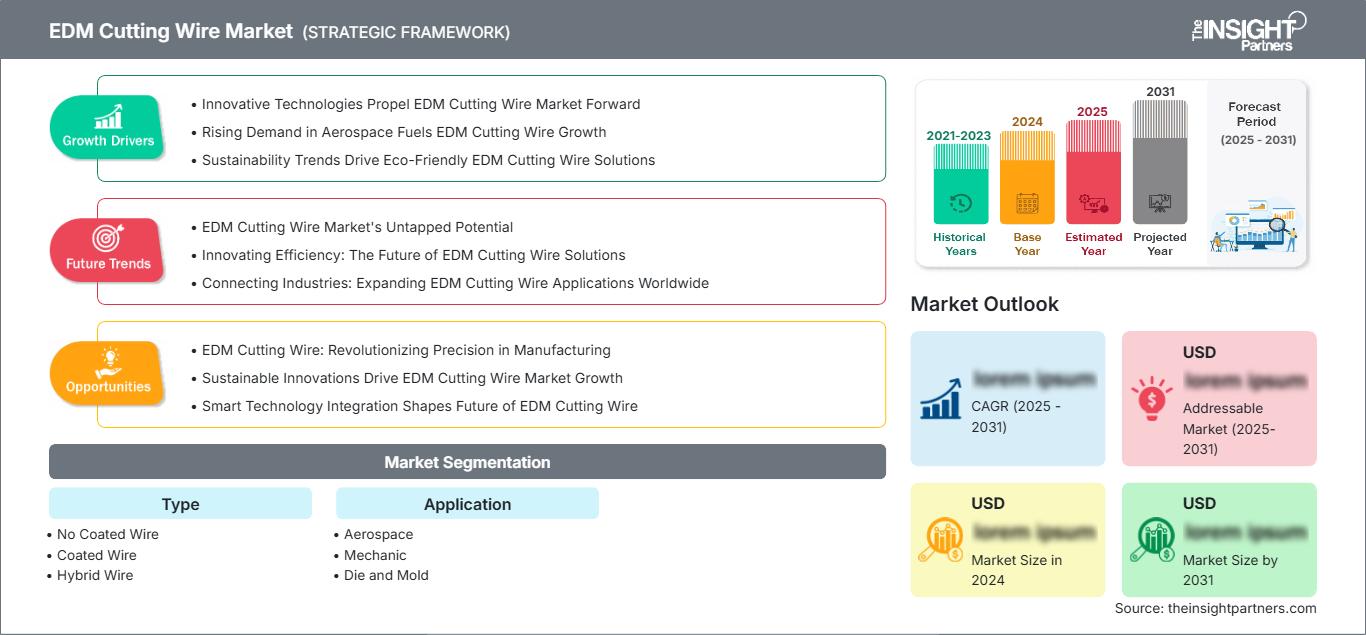
EDM Cutting Wire Market: Strategic Insights
Regional Insights
North America EDM Cutting Wire Market
North America occupied 23-25% of the EDM Cutting Wire Market share in 2025 and is projected to grow at a CAGR of 8.2%-8.8% in 2026-2034. The production of aerospace products, defense projects, medical equipment, and mold maintenance keeps the demand for accurate, low force machining alive. Consumers are willing to pay higher costs for coated wire due to increased speed, smooth threading, and minimal rework.
While the US dominates regional consumption, Mexico benefits from automotive and aerospace nearshoring, and Canada from aircraft, energy, and tooling needs. An extensive inventory of EDM machines from Japanese, Swiss, and domestic vendors creates possibilities for repeat business. The distribution inventory and technical support are essential since small businesses have certain needs related to spool size matching, fast delivery, and generator adjustment recommendations for hard alloys. Expansion in the region takes place through the use of automation technology to solve labor problems and increase unattended machining time.
U.S. EDM Cutting Wire Market
The USA was responsible for 80-84% of revenue from North America in 2025 and is expected to grow at an 8.3-8.9% CAGR until 2034. Aerospace engine, defense, orthopedic, and special mold applications drive the consumption of wires. Tight quality systems favor documentation regarding chemical composition and wire diameter, and reshoring initiatives foster domestic purchases of dies, punches, fixturing, and complicated conductive parts.
Oki Electric Cable Co., Ltd., Proterial, Ltd., THERMOCOMPACT, OPECMADE Inc., and regional distributors compete via compatibility with machinery, technical service, and stock of products. Applications are moving away from regular toolroom cutting towards automation cells cutting nickel alloys, titanium, carbides, and hard steels. Purchasing, in turn, prioritizes the threading performance, minimal breakage, surface condition, and price per finished part. Investments into the production capacities of aircraft and advanced manufacturing facilities will allow premium coated and hybrid wires to become more popular without reducing brass wire sales in general job shops.
Europe EDM Cutting Wire Market
Europe had an estimated market share of 39-41% in 2025 and will be expected to grow at a CAGR of 7.8-8.4% through 2034, keeping its leadership among regions. Germany takes the lead with machine tools, automotive tooling, and precision engineering. An extensive supplier base in the country allows for strict qualifications and frequent use of high-end wire based on the cycle time and finish, which define total manufacturing costs.
While the UK possesses aerospace and medical machining, France has aeronautics, energy, and wire manufacturing. The mold and packaging machinery, along with the industrial equipment in Italy, continues to have high demand. Automotive tooling and aerospace subcontracting in Spain become part of the cluster thanks to the focus of the EU on energy efficiency, material traceability, and circular manufacturing that drives the producers to disclose the composition of alloys and their recycling. J.G. Dahmen & Co. and THERMOCOMPACT are the companies with proximity advantage, but the Asian competitors outperform them through performance and pricing.
APAC EDM Cutting Wire Market
The Asia Pacific region accounted for a market share of 30–32% in 2025 and is expected to grow at a CAGR of 10.0–10.6% over the next decade. In the region, China is driven by electronics applications, automotive dies, general machinery, and alloy wire capacity, while Japan relies on precision machinery and experienced machine building.
Semiconductor and automotive tooling from South Korea, production-driven investments from India, and mining service applications from Australia contribute to the regional growth. Growth drivers include industrial automation, defense localization, electric mobility, and export-oriented machining applications.
Middle East & Africa EDM Cutting Wire Market
MEA & Africa are forecasted to experience a CAGR of 7.0-7.6% up to 2034. The UAE drives regional implementation via aviation maintenance, precision engineering, and free zone manufacturing, followed by Saudi Arabia in light of localization strategy growth in the defense, energy, and industrial value chains.
South Africa provides mature automotive tooling, mining repairs, and engineering capabilities, while Rest of MEA is distributor driven. Energy and infrastructure development, together with the emergence of new machining facilities, provide for continuous consumption needs despite a low level of existing equipment base and long qualifying process.
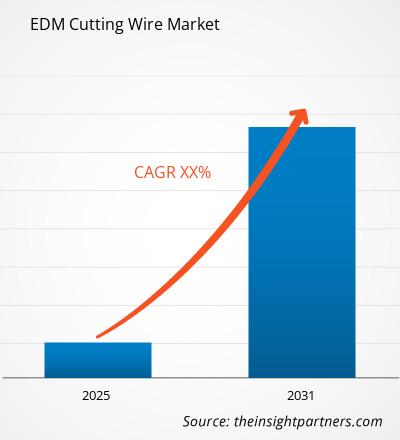
Segmentation Analysis
Type
The Type segment is expected to grow at 8.7–9.3% CAGR during 2026–2034. EDM Cutting Wire Market scope spans economical bare electrodes and performance-oriented coated or hybrid architectures. Selection depends on machine generator, workpiece height, taper, finish target, threading system, and acceptable cycle time. Premiumization is strongest where a faster first cut, fewer trims, or lower breakage produces measurable equipment-capacity gains.
- No Coated Wire remains the volume standard, favored by general toolrooms for broad machine compatibility, straightforward parameter setting, dependable brass performance, and lower acquisition cost in routine die and mechanical work.
- Coated Wire gains strategic importance in high-throughput cells because engineered surfaces improve discharge behavior, cutting speed, flushing, and finish, supporting productivity-led purchasing in aerospace and advanced mold operations.
- Hybrid Wire serves demanding jobs that balance core strength, conductivity, threading, taper performance, and surface control, positioning suppliers to address complex parts where conventional constructions create operational trade-offs.
Application
The Application segment is forecast to expand at 8.6–9.2% CAGR from 2026 to 2034. Demand is distributed across high-value aerospace components, general mechanical cutting, and recurring die and mold work. Application economics vary by material hardness, tolerance, part height, batch size, and downtime sensitivity. Suppliers therefore need performance data that links each wire construction to speed, finish, breakage, and machine settings.
- Aerospace is a premium-use application, requiring controlled machining of nickel alloys, titanium, hardened steels, and complex features where traceability, surface integrity, repeatability, and low mechanical force justify higher-performance consumables.
- Mechanic provides diversified recurring demand from job shops and equipment manufacturers, with purchasing divided between cost-efficient uncoated wire for routine work and coated grades for automated high-mix production.
- Die and Mold remains strategically central because punches, inserts, extrusion features, and precision cavities require narrow kerfs and repeatable geometry; refurbishment activity also stabilizes consumption across industrial cycles.
Opportunity Snapshot
| Application | Revenue Contribution | Trend Tag | Adoption Stage |
| Aerospace | High | Alloy Precision | Scaling |
| Mechanic | Medium | Cell Automation | Mature |
| Die and Mold | High | Fast Tooling | Mature |
EDM Cutting Wire Market Growth Drivers and Impact Analysis
Precision requirements in difficult conductive materials
Hardened steel, carbide, titanium, and nickel alloys with difficult-to-cut characteristics are being machined more and more in aerospace, medical, electronics, and tooling industries. Wire Electrical Discharge Machining (EDM) does not involve cutting, and therefore, it does not distort any material. Thus, wire EDM allows machining materials with narrow and complicated geometries, which cannot be done via contact cutting. It increases usage of electrodes repeatedly where accuracy and surface integrity is of importance instead of material price. The effect is most pronounced when working on production since the replacement of the wire can affect stability of the process and finishing result. Those suppliers who provide the information about the quality of electrodes based on their alloy, thickness and machine platform have an advantage.
Automation raises the value of reliable consumables
Manufacturers are extending unattended hours to address skilled-labor shortages and improve utilization of expensive EDM assets. Automatic threading, adaptive generators, remote monitoring, and palletized workflows make wire consistency more valuable because a break or failed rethread can interrupt an entire night shift. Roundness, straightness, tensile control, clean winding, and stable coatings therefore influence equipment availability as much as cutting speed. This shifts procurement from lowest spool price toward cost per completed component. Coated and hybrid wires benefit when they can demonstrate faster rough cuts, fewer interruptions, or reduced maintenance at current generator settings. Producers also gain opportunities to bundle parameter guidance, trial programs, and on-site optimization with local inventory and responsive distribution.
Expansion of die, mold, and localized manufacturing capacity
Industrial localization is increasing demand for dies, punches, extrusion tools, fixtures, and replacement components closer to final assembly plants. Electric vehicles, electronics, packaging, consumer products, and defense programs all require tooling that can be changed quickly as designs evolve. Wire EDM is deeply embedded in this workflow because it cuts hardened materials after heat treatment and enables economical modification or repair. Each new machining center creates recurring consumable requirements over its operating life, supporting aftermarket resilience beyond initial capital spending. Emerging manufacturing hubs also favor suppliers that can provide standard spool sizes, dependable customs handling, and application support. Regional warehouses can shorten lead times and reduce customer safety stocks, improving conversion from imported machine installations to sustained wire revenue.
EDM Cutting Wire Market Future Trends
Application-tuned coatings and digital parameter libraries
EDM Cutting Wire Market trends will increasingly connect metallurgical design with digital process knowledge. Suppliers are expected to develop coatings tuned for specific generator families, workpiece heights, alloys, taper angles, and finish targets rather than market one universal premium grade. Parameter libraries, validated test cuts, and machine-readable setup recommendations can shorten customer trials and reduce dependence on scarce operator experience. Inline inspection data may also support spool-level certificates covering diameter, tensile properties, and winding quality. This combination turns wire from a commodity into a documented process input. Competitive advantage will depend on translating laboratory gains into repeatable savings under production conditions, supported by distributors capable of technical implementation.
Circular alloys and lower energy per finished part
Sustainability requirements are likely to move beyond packaging and scrap collection toward lifecycle evidence for electrode alloys. Buyers will seek recycled-content disclosure, responsible sourcing, lower-emission drawing and heat treatment, and recovery routes for spent brass or specialty wire. Performance remains essential because a slower consumable can increase machine electricity and dielectric-system operation per part, offsetting material benefits. Producers that quantify energy, wire consumption, and rework per completed component can support customer carbon accounting while defending premium pricing. Over time, procurement specifications may combine conductivity, cutting speed, and surface finish with recycled content and product-level emissions, favoring manufacturers with integrated metallurgy, traceable feedstock, and efficient regional production.
EDM Cutting Wire Market Opportunities
Regional application centers in fast-industrializing markets
Suppliers can accelerate adoption in India, Mexico, Southeast Asia, and the Gulf by combining local inventory with application centers that benchmark wires on customers’ machines and materials. The investment case rests on converting new equipment installations into recurring consumable relationships before purchasing habits become fixed. Demonstrations should measure cutting time, trim passes, breakage, threading success, and finish against the customer’s incumbent wire. Small trial spools, machine-specific parameter sheets, and operator training reduce switching risk. Partnerships with EDM distributors can lower commercial cost while preserving technical reach. Local slitting, respooling, or final inspection may further improve responsiveness and support domestic-content goals where volumes justify capital expenditure.
Premium contracts based on verified productivity outcomes
A second opportunity is to sell coated and hybrid products through outcome-based agreements tied to validated machine productivity. Customers with stable part families can compare spool cost with saved machining hours, reduced rejects, and fewer maintenance events, creating a clearer return on premium consumables. This approach requires disciplined trials, baseline data, and jointly approved measurement protocols. Suppliers can prioritize aerospace, medical, carbide tooling, and tall-workpiece applications, where performance differences are most visible. Multi-year contracts that include safety stock, technical reviews, and batch traceability can improve revenue quality. Successful programs also create defensible application knowledge that competitors cannot replicate through price discounts alone.
Recent Developments
- June 2026: United Machining North America has launched a limited-edition lineup of advanced machining equipment, introduced special versions of its Agie Charmilles wire EDM machines and Mikron Mill 5-axis milling technology. The new models are designed to provide manufacturers with high-performance machining capabilities, improved efficiency, and competitive ownership value.
- August 2025: JSEDM is proud to introduce its Diamond Wire Saw Machine, engineered for high-speed, precision material slicing. This advanced system enables customers to rapidly validate material quality and make timely adjustments, significantly shortening the overall R&D cycle. The machine’s performance has already been validated, with sliced wafers confirmed as fully compatible with subsequent grinding and polishing processes. This ensures seamless integration into downstream manufacturing and strengthens customer confidence in quality and reliability.
- January 2026: Sodick Technologies India has introduced its latest wire-cut electrical discharge machining (EDM) machine equipped with the company’s patented i-Groove technology, bringing enhanced precision, improved surface quality, and reduced wire consumption to manufacturers in India. The new machine was unveiled at the TAGMA Die & Mold Exhibition in Mumbai.
Frequently Asked Questions

- Comprehensive Market Sizing and Forecast Analysis
- Detailed Segmentation Analysis
- In-Depth Market Dynamics Assessment
- Regional and Country-Level Insights
- Competitive Landscape and Company Benchmarking
- Strategic Business Intelligence
Recent Reports
Testimonials

The Insight Partners' SCADA System Market report is comprehensive, with valuable insights on current trends and future forecasts. The team was highly professional, responsive, and supportive throughout. We are very satisfied and highly recommend their services.
RAN KEDEM Partner, Reali Technologies LTDs
I requested a report on a very specific software market and the team produced the report in a few days. The information was very relevant and well presented. I then requested some changes and additions to the report. The team was again very responsive and I got the final report in less than a week.
JEAN-HERVE JENN Chairman, Future Analytica
We worked with The Insight Partners for an important market study and forecast. They gave us clear insights into opportunities and risks, which helped shape our plans. Their research was easy to use and based on solid data. It helped us make smart, confident decisions. We highly recommend them.
PIYUSH NAGPAL Sr. Vice President, High Beam Global
The Insight Partners delivered insightful, well-structured market research with strong domain expertise. Their team was professional and responsive throughout. The user-friendly website made accessing industry reports seamless. We highly recommend them for reliable, high-quality research services
YUKIHIKO ADACHI CEO, Deep Blue, LLC.
This is the first time I have purchased a market report from The Insight Partners.While I was unsure at first, I visited their web site and felt more comfortable to take the risk and purchase a market report.I am completely satisfied with the quality of the report and customer service. I had several questions and comments with the initial report, but after a couple of dialogs over email with their analyst I believe I have a report that I can use as input to our strategic planning process.Thank you so much for taking the extra time and making this a positive experience.I will definitely recommend your service to others and you will be my first call when we need further market data.
JOHN SUZUKI President and Chief Executive Officer, Board Director, BK Technologies
I wish to appreciate your support and the professionalism you displayed in the course of attending to my request for information regarding to infectious disease IVD market in Nigeria. I appreciate your patience, your guidance, and the fact that you were willing to offer a discount, which eventually made it possible for us to close a deal. I look forward to engaging The Insight Partners in the future, all thanks to the impression you have created in me as a result of this first encounter.
DR CHIJIOKE ONYIA MANAGING DIRECTOR, PineCrest Healthcare Ltd.Reason to Buy
- Informed Decision-Making
- Understanding Market Dynamics
- Competitive Analysis
- Identifying Emerging Markets
- Customer Insights
- Market Forecasts
- Risk Mitigation
- Boosting Operational Efficiency
- Strategic Planning
- Investment Justification
- Tracking Industry Innovations
- Aligning with Regulatory Trends





 Get Free Sample for