
Electric Scooty Battery Market Share, Size & Demand by 2034
Coverage: By Product Type (Lithium-Ion (Li-ion), Lithium Iron Phosphate (LFP), Lithium Polymer (LiPo), Sealed Lead Acid Battery (SLA), Nickel Metal Hydride (NiMH)); Capacity (100-500 Wh, 500-1000 Wh, 1000-1500 Wh, 1500-2000 Wh, 2000 Wh and Above) , and Geography (North America, Europe, Asia Pacific, and South and Central America)
- Status : Data Released
- Report Code : TIPRE00029308
- Category : Electronics and Semiconductor
- No. of Pages : 150
- Available Report Formats :


- Last update date : August 10, 2026


2025 Market Size
US$ 3.65 Bn
Base year value
2034 Forecast
US$ 23.9 Bn
Projected by 2034
CAGR 2026-2034
23.20 %
Growth rate
Addressable Market
US$ 107.36 Bn
(2026-2034)
The global Electric Scooty Battery Market size reached US$ 3.65 Billion in 2025 and will be worth US$ 23.9 Billion by 2034, growing at a CAGR of 23.20% during the forecast period. Expansion can be attributed to increased usage of electric scooters, localized batteries, diversified battery chemistry, and convenient charging solutions.
North America is estimated to grow at a CAGR between 17.5% and 19.5%, driven by micromobility fleets, delivery services, and state initiatives towards sustainable transport solutions. Growth drivers include safety of lithium batteries, advanced battery management systems, usage of shared scooters, and demand for smaller and cheaper vehicles.
Electric Scooty Battery Market Assessment and Insights
- North America held 11–13% Electric Scooty Battery Market share in 2025 and is growing at a CAGR range of 17.5–19.5% during 2026–2034, supported by shared mobility, campus fleets, and urban delivery electrification.
- US represented 76–79% of North America in 2025 and is growing at a CAGR range of 18.0–20.0%, led by micromobility operators and premium scooter brands.
- Europe accounted for 16–18% share in 2025 and is advancing at a CAGR range of 18.5–20.5%, with Germany, France, Italy, Spain, and the UK leading adoption.
- Asia Pacific captured 65–68% share in 2025 and is expanding at a CAGR range of 24.5–27.0%, led by China, India, Japan, South Korea, and Southeast Asia.
- Largest Segment Lithium-Ion held 52–56% market share in 2025 and is growing at a CAGR range of 22.0–24.0%, supported by energy density and declining pack costs.
- High Growth Segment Lithium Iron Phosphate held 15–18% market share in 2025 and is growing at a CAGR range of 26.0–29.0%, driven by safety, durability, and affordability.
- Key companies analyzed in detail: Contemporary Amperex Technology Co., Limited, Hunan CTS Technology Co., Ltd., LG Energy Solution, Ltd., Maxvolt Energy Industries Limited, Pastiche Energy Solutions Private Limited, Samsung SDI Co., Ltd., Shenzhen SmartPropel Energy System Co., Ltd., Wanxiang Import and Export Co., Ltd., Siam GS Sales Co., Ltd., and BYD Company Limited.
Source: The Insight Partners' analysis based on proprietary research, government publications, company annual reports, investor presentations, industry databases, and expert interviews.
In terms of technology evolution, the Electric Scooty Battery Market has seen an evolution from sealed lead acid batteries to lithium ion and LFP batteries which have more usable capacity and better BMS and thermal management. The production aspects have moved on to cell sourcing, pack manufacturing, casing design, certifications, warranty data analysis, and localization of modules.
Future demand would increase due to investments in sustainable two-wheeler transportation in India, China, South East Asia, Europe, and specific cities of the United States. Favorable policies, battery safety regulations, lower costs of cells will help to achieve economies of scale; battery providers who would be able to provide a proper combination of cost, energy density, cycle life and serviceability will get more preferential treatment.
Electric Scooty Battery Market Report Scope
| Report Attribute | Details |
|---|---|
| Market size in 2025 | US$ 3.65 Billion |
| Market Size by 2034 | US$ 23.9 Billion |
| Global CAGR (2026 - 2034) | 23.20% |
| Historical Data | 2021-2024 |
| Forecast period | 2026-2034 |
Electric Scooty Battery Market Analysis
Growth of Electric Scooty Batteries Market stems from consumers moving from petrol scooty, urban delivery electrification, and increasing charging infrastructure. Supply chain consists of lithium miners, cathode makers, cell makers, BMS suppliers, battery pack assembly companies, Original Equipment Manufacturers, distributors, recycling firms, and fleet management companies. Battery packs affect range, acceleration, charging time, safety, and total cost of ownership, thereby becoming the most crucial piece for electric scooty platform.
Supply trends continue to be impacted by lithium carbonate prices, cells availability, local content requirements, and battery pack certification. Lithium-ion continues to dominate high-end and mid-segment scooters, whereas LFP batteries make progress when thermal safety and cycle life are crucial factors. Sealed lead acid continues to be used for replacement purposes, but its heavy weight and low cycle life make it not suitable for new vehicles anymore.
Positioning is driven by cell technology, pack quality, relationship with OEMs, safety certifications, and extent of localization. Contemporary Amperex Technology Co., Limited and BYD Company Limited offer economies of scale, whereas LG Energy Solution, Ltd. and Samsung SDI Co., Ltd. offer high-quality cells. Hunan CTS Technology Co., Ltd., Shenzhen SmartPropel Energy System Co., Ltd., Maxvolt Energy Industries Limited, Pastiche Energy Solutions Private Limited, Wanxiang Import and Export Co., Ltd., and Siam GS Sales Co., Ltd. help in meeting requirements of pack customization and after market supply.
The investment trends indicate inclination towards LFP, good BMS software, modularity of casing, and recycling-related procurement process. The suppliers are positioning themselves based on their capabilities to give guarantees since now consumers who purchase scooters look at price of battery replacement against the cost saving on fuel consumption.
● REPORT CUSTOMIZATION
Tailor This Report To Align With Your Specific Business Requirements
This report can be customized to align precisely with your business objectives, scope, and target markets. Customization options include tailored segmentation, geography, competitive analysis, and strategic insights to support informed decision-making.
Customize This Report →WHAT YOU CAN ADJUST
- ● Segmentations
- ● Geography
- ● Competitive Analysis
- ● Language Preferences
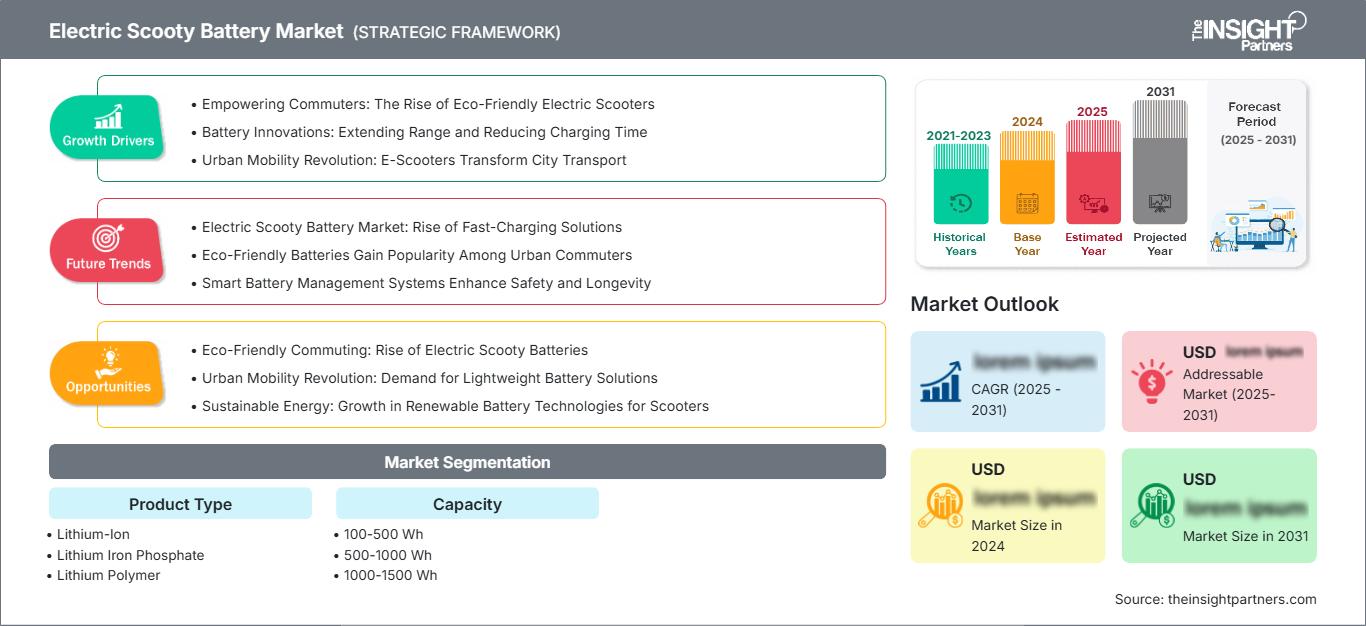
Electric Scooty Battery Market: Strategic Insights
Regional Insights
North America Electric Scooty Battery Market
North America was responsible for 11%–13% market share in 2025 and is expected to register CAGR at 17.5%–19.5% during the forecast period. The share of the Electric Scooty Battery Market is driven by shared micromobility service providers, university fleets, food delivery applications, and urban decarbonization initiatives. The majority of demand will be coming from replacement batteries, fleet-grade lithium-ion batteries, and high-end batteries with low safety risks.
Adoption of the product in North America is dominated by the USA, while Canada supports growth through city-based micromobility and commuter applications. Pack manufacturers focus on certification, safety against fire hazards, longevity, and compatibility with several scooter models. Growth rate is relatively slower compared to Asia-Pacific due to less vehicles and higher replacement frequency in the region.
U.S. Electric Scooty Battery Market
In 2025, the US was estimated to be 76-79% of North America and was projected to record a CAGR of 18.0-20.0%. The need for batteries in North America is linked to the use of fleet scooters, riders for last mile deliveries, campus mobility scooters, and premium scooters for leisure purposes. Companies in this market include LG Energy Solution, Ltd., Samsung SDI Co., Ltd., Contemporary Amperex Technology Co., Limited, and BYD Company Limited.
The Electric Scooty Battery Market trends include swappable or removable battery packs, safe charging solutions, fleet tracking through GPS connectivity, and monitoring of the condition of batteries. Cycle life, faster swapping, and fewer failures are key priorities for operators because of direct impact on earning capacity. Customers buying batteries appreciate certified chargers, thermal management systems, and warranties.
Europe Electric Scooty Battery Market
Europe had a market share of 16-18% in 2025 and will register CAGR growth of 18.5-20.5%. Germany leads due to the use of premium mobility, safety regulation, and efficient distribution. The UK and France favor fleet sharing and deliveries, whereas Italy and Spain increase demands due to urban commuting and scooter-friendly travel.
European consumers pay attention to compliance, recyclability, charger safety, and tracing the source of raw materials. City bans on internal combustion mobility help develop the Electric Scooty Battery Market due to the demand for short-distance commuters and commercial couriers. Battery suppliers who offer LFP batteries, swappable batteries, and battery management have good prospects since fleet operators of Europe need lifecycle costs and fire hazard mitigation.
APAC Electric Scooty Battery Market
The Asia Pacific region had a market share of 65-68% in 2025 and is anticipated to register a CAGR between 24.5%-27.0%. This is led by China with cell production, scooter proliferation and battery-swap systems. India is the fastest growing region while other countries include Japan, South Korea, Australia, and Southeast Asia, which drive up demand through commuting and deliveries.
Policies, localization requirements, and air pollution measures drive up demand within APAC. China produces significant cells and packs while India's electric two-wheelers programs drive domestic assembly. There is rising uptake of LFP batteries due to heat resistance, longevity and cost control, which suits urban scooter use. Local companies have advantages with proximity to suppliers.
Middle East & Africa Electric Scooty Battery Market
Middle East & Africa is projected to grow at a CAGR range of 16.0–18.5% as the UAE, Saudi Arabia, South Africa, and rest of MEA test electric micromobility for tourism, campuses, delivery, and first-mile connectivity. The UAE leads through smart-city mobility and charging infrastructure readiness.
Adoption depends on battery heat tolerance, charger safety, service access, and fleet maintenance capability. LFP packs are strategically relevant because high temperatures and long service life are important. Growth will remain selective, but resorts, logistics hubs, universities, and gated communities create early repeatable demand.

Segmentation Analysis
Product Type
Product Type is expected to grow at a CAGR range of 22.5–24.5% during 2026–2034 as Electric Scooty Battery Market scope covers Lithium-Ion, Lithium Iron Phosphate, Lithium Polymer, Sealed Lead Acid Battery, and Nickel Metal Hydride. Chemistry choice reflects energy density, safety, replacement cost, brand positioning, and duty cycle. Lithium systems dominate new models, while legacy chemistries persist mainly in low-cost replacement channels.
- Lithium-Ion remains the volume anchor because it combines high energy density, manageable weight, proven pack architecture, and broad OEM familiarity across consumer and fleet electric scooty models.
- Lithium Iron Phosphate gains strategic relevance where safety, cycle life, lower cobalt exposure, and heat tolerance outweigh the need for maximum energy density in compact scooter platforms.
- Lithium Polymer serves lighter and design-sensitive applications requiring flexible form factors, although higher cost and durability considerations limit adoption in rugged fleet operations.
- Sealed Lead Acid Battery remains present in low-cost replacements and older scooters, but heavy weight, slower charging, and shorter lifecycle reduce its suitability for new electric models.
- Nickel Metal Hydride occupies a limited niche where robustness and established recycling channels matter, yet lower energy density restricts its competitiveness against modern lithium chemistries.
Capacity
Capacity is projected to grow at a CAGR range of 23.0–25.0% during 2026–2034 as buyers balance range, charging convenience, vehicle price, and payload. Lower-capacity packs suit lightweight urban scooters, while 1000 Wh and above supports delivery riders, higher-speed models, and shared fleets. Pack suppliers differentiate through enclosure strength, BMS accuracy, thermal management, and warranty coverage.
- 100-500 Wh batteries serve compact commuter scooters, short-distance micromobility, and entry-level models where low weight, affordability, and easy removable charging are more important than long range.
- 500-1000 Wh packs support mainstream urban riding, balancing practical range, manageable vehicle weight, and acceptable charging time for personal commuting and light delivery use.
- 1000-1500 Wh batteries fit extended commuter needs, premium scooters, and moderate fleet applications where riders require better daily utilization without excessive cost escalation.
- 1500-2000 Wh packs address delivery, shared mobility, and performance scooters needing longer uptime, stronger acceleration support, and improved economics across high-mileage operating days.
- 2000 Wh batteries serve high-end or commercial-duty scooters where maximum range, payload support, and fewer charging interruptions justify higher upfront battery cost.
Opportunity Snapshot
| Capacity | Revenue Contribution | Trend Tag | Adoption Stage |
| 100-500 Wh | Low | Light Commute | Mature |
| 500-1000 Wh | High | Urban Range | Scaling |
| 1000-1500 Wh | High | Daily Utility | Scaling |
| 1500-2000 Wh | Medium | Fleet Duty | Emerging |
| 2000 Wh | Medium | Long Range | Emerging |
Electric Scooty Battery Market Growth Drivers and Impact Analysis
Urban Two-Wheeler Electrification Accelerates Battery Demand
Electric scooters are becoming viable alternatives to petrol scooters in congested cities as battery costs, convenient charging, and lower operational costs are all being addressed simultaneously. The consequence for battery providers is immediate: each sale provides an opportunity for both an initial battery requirement and a follow-up replacement requirement. The trends of electric two-wheelers in India, mass production in China, and the policy of low-emission mobility in Europe all contribute to increased packs. Providers of safe batteries, whether lithium-ion or LFP, will find an opportunity in this market via OEMs, fleets, and even the aftermarket.
Battery Safety Standards Reshape Technology Selection
Regulatory requirements are shifting from rudimentary electrical safety to pack-level thermal safety, charger safety, cell tracking, and abuse testing. The key driver affects purchasing practices in that manufacturers and fleet owners tend to favor batteries featuring an established BMS structure, robust casing, superior cells, and a warranty guarantee. LFP can capitalize on the trend due to its superior thermal stability chemistry whereas lithium-ion battery manufacturers need to prove their higher accuracy of control. The effects on the market will be reduced purchasing based on price alone, formation of certified partnerships, and higher obstacles for low-quality aftermarket packs.
Battery Swapping and Removable Packs Improve Utilization
One of the key barriers to scooter adoption is a lack of opportunities to charge scooters at home due to apartment living and dense urban areas. The operators of a fleet gain from quick recharge and reuse of their vehicles, while the customers do not lose time on lengthy charging. The effects of such driver include increased demands for standardized dimensions of the battery packs, reliable connectors, identity tracking, and state of health diagnostics. Companies that will be able to produce modular batteries for frequent handling will win in deliveries, shared mobility, and commuter segments.
Electric Scooty Battery Market Future Trends
LFP Becomes a Mainstream Urban Scooter Chemistry
The Electric Scooty Battery Market is expected to become more inclined towards LFP batteries because consumers are becoming more focused on safety, longevity, and reduced battery cost than high energy density. With increasing pack efficiency, LFP batteries can offer adequate range for shorter distance trips and minimize exposure to price fluctuation of nickel and cobalt. This would happen most in India, Southeast Asia, and fleet operations where heat tolerance and regular charging are important factors. LFP battery manufacturers who are able to perfect module design, state-of-health estimation through the BMS system, and faster qualification process with OEMs would stand out.
Connected Battery Health Analytics Enters Aftermarket Channels
Future deployments will increasingly use connected battery diagnostics to track cycles, temperature history, charging behavior, and degradation. This trend matters because used scooter values, warranty decisions, and fleet downtime all depend on reliable battery health information. Aftermarket suppliers can differentiate by offering packs with app-based status, service alerts, and verifiable state-of-health records. OEMs may also use analytics to tune warranty reserves and identify unsafe charging patterns. As battery packs become data-generating assets, suppliers with software capability will capture stronger margins than firms competing only on cells and casing cost.
Electric Scooty Battery Market Opportunities
Localized LFP Pack Assembly for India and Southeast Asia
Electric Scooty Battery Market Forecasts point to a strong opportunity in localized LFP pack assembly across India and Southeast Asia. Investors can target cell sourcing, BMS integration, rugged enclosures, certification labs, and OEM co-development. Local assembly reduces import exposure, improves response time for warranty issues, and aligns with regional industrial policies. The opportunity is commercially attractive because high temperatures, dense traffic, and daily charging cycles fit LFP strengths. Suppliers that combine cost discipline with tested safety performance can serve scooters, delivery fleets, and battery-swap networks while building defensible regional supply relationships.
Fleet Battery Lifecycle Services
Fleet battery lifecycle services create an opportunity to move beyond one-time pack sales. Delivery operators and shared mobility providers need predictable uptime, replacement planning, diagnostics, safe charging protocols, and end-of-life handling. Suppliers can offer service contracts that include battery monitoring, periodic health checks, refurbished pack programs, and recycling partnerships. This model improves customer retention and creates recurring revenue while reducing safety risk. The opportunity is strongest where scooters operate daily at high mileage, because even small improvements in battery availability, charging discipline, and replacement timing can materially improve fleet economics.
Recent Developments
- April 2025: Contemporary Amperex Technology Co., Limited unveiled Naxtra sodium-ion battery and second-generation Shenxing fast-charging battery at its Super Tech Day, highlighting 175 Wh/kg sodium-ion energy density, broad temperature operation, and long cycle capability. The development signals chemistry diversification that could influence future light electric mobility batteries where safety, cost stability, and resource availability matter.
- February 2025: Samsung SDI Co., Ltd. won InterBattery Awards 2025 for a 50-Ampere high-power cylindrical battery cell and LFP+ material and electrode technology. The company said the 50A cell supports fast charging and long lifespan, while LFP+ improves energy density by about 10% against conventional LFP, strengthening relevance for compact electric mobility applications.
- March 2025: LG Energy Solution, Ltd. showcased next-generation 46-series cylindrical batteries at InterBattery 2025, with battery technology reports noting higher capacity and density versus earlier cylindrical formats. The development supports broader cell-format innovation for electric mobility platforms, including compact vehicles that need improved energy density, manufacturability, and thermal management options.
Frequently Asked Questions

- Comprehensive Market Sizing and Forecast Analysis
- Detailed Segmentation Analysis
- In-Depth Market Dynamics Assessment
- Regional and Country-Level Insights
- Competitive Landscape and Company Benchmarking
- Strategic Business Intelligence
Recent Reports
Testimonials

The Insight Partners provided valuable market intelligence that supported our global go-to-market strategy. Their team was professional, responsive, and attentive to our feedback, providing thoughtful analysis and helpful methodological clarifications throughout the project.
Junmo Kim Chief Financial Officer (CFO), Enertech Co., Ltd.
The Insight Partners' SCADA System Market report is comprehensive, with valuable insights on current trends and future forecasts. The team was highly professional, responsive, and supportive throughout. We are very satisfied and highly recommend their services.
RAN KEDEM Partner, Reali Technologies LTDs
I requested a report on a very specific software market and the team produced the report in a few days. The information was very relevant and well presented. I then requested some changes and additions to the report. The team was again very responsive and I got the final report in less than a week.
JEAN-HERVE JENN Chairman, Future Analytica
We worked with The Insight Partners for an important market study and forecast. They gave us clear insights into opportunities and risks, which helped shape our plans. Their research was easy to use and based on solid data. It helped us make smart, confident decisions. We highly recommend them.
PIYUSH NAGPAL Sr. Vice President, High Beam Global
The Insight Partners delivered insightful, well-structured market research with strong domain expertise. Their team was professional and responsive throughout. The user-friendly website made accessing industry reports seamless. We highly recommend them for reliable, high-quality research services
YUKIHIKO ADACHI CEO, Deep Blue, LLC.
This is the first time I have purchased a market report from The Insight Partners.While I was unsure at first, I visited their web site and felt more comfortable to take the risk and purchase a market report.I am completely satisfied with the quality of the report and customer service. I had several questions and comments with the initial report, but after a couple of dialogs over email with their analyst I believe I have a report that I can use as input to our strategic planning process.Thank you so much for taking the extra time and making this a positive experience.I will definitely recommend your service to others and you will be my first call when we need further market data.
JOHN SUZUKI President and Chief Executive Officer, Board Director, BK Technologies
I wish to appreciate your support and the professionalism you displayed in the course of attending to my request for information regarding to infectious disease IVD market in Nigeria. I appreciate your patience, your guidance, and the fact that you were willing to offer a discount, which eventually made it possible for us to close a deal. I look forward to engaging The Insight Partners in the future, all thanks to the impression you have created in me as a result of this first encounter.
DR CHIJIOKE ONYIA MANAGING DIRECTOR, PineCrest Healthcare Ltd.Reason to Buy
- Informed Decision-Making
- Understanding Market Dynamics
- Competitive Analysis
- Identifying Emerging Markets
- Customer Insights
- Market Forecasts
- Risk Mitigation
- Boosting Operational Efficiency
- Strategic Planning
- Investment Justification
- Tracking Industry Innovations
- Aligning with Regulatory Trends





 Get Free Sample for