
Electric Traction Motor Market Share, Growth & Demand by 2034
Coverage: By Power Rating (<200 kW, 200 kW to 400 kW, and >400 kW); and Application (Railway, Electric Vehicles, Industrial Machinery, Conveyors, and Elevators), and Geography (North America, Europe, Asia Pacific, and South and Central America)
- Status : Data Released
- Report Code : TIPEL00002624
- Category : Electronics and Semiconductor
- No. of Pages : 150
- Available Report Formats :


- Last update date : August 26, 2026


2025 Market Size
US$ 17.19 Bn
Base year value
2034 Forecast
US$ 216.74 Bn
Projected by 2034
CAGR 2026-2034
32.52 %
Growth rate
Addressable Market
US$ 812.91 Bn
(2026-2034)
The Electric Traction Motor Market size stood at US$ 17.19 Billion in 2025 and is forecast to grow to US$ 216.74 Billion by 2034, marking a CAGR of 32.52% in 2026–2034. Growth can be attributed to rising electrification trends in passenger cars, commercial vehicles, rail transport, industrial machinery, conveyor systems, and elevators, as well as the continuous need for small-sized, energy-efficient, and controllable drive solutions that can handle an increasing range of duty cycles.
In North America, the Electric Traction Motor Market is set to grow at a modelled CAGR of 29.0–31.0% till 2034. Government incentives to promote zero-emission vehicles, manufacturing initiatives, and investments in rail infrastructure fuel procurement activities. Local production capacities of magnets, inverters, and motors contribute to supply chain resilience, and commercial vehicle platforms drive demand for high power density and temperature-resistant motors intended for prolonged operations.
Electric Traction Motor Market Assessment and Insights
- North America: Electric Traction Motor Market Share in 2025 is modeled at 21–23%, with CAGR between 2026–2034 of 29.0–31.0%, supported by fleet electrification, localized manufacturing, and rail renewal.
- US: The country represents 78–82% of North American demand in 2025 and grows at a 29.5–31.5% CAGR through 2034.
- Europe: Share in 2025 is estimated at 24–26%, with 28.0–30.0% CAGR during 2026–2034; Germany leads, followed by the UK, France, Italy, and Spain.
- Asia Pacific: Share in 2025 is modeled at 46–49%, expanding at 34.0–36.0% CAGR through 2034 as China, Japan, South Korea, and India scale production.
- Largest Segment: Electric vehicles hold 59–63% market share in 2025 and are expected to record 35.0–37.0% CAGR during 2026–2034.
- High Growth Segment: The 200 kW to 400 kW category holds 24–28% market share in 2025 and advances at 36.0–38.0% CAGR through 2034.
- Key companies analyzed in detail: ABB Ltd., Škoda Electric a.s., Toshiba Corporation, GE Vernova Inc., WEG S.A., Robert Bosch GmbH, CG Power and Industrial Solutions Limited, Traktionssysteme Austria GmbH, Alstom SA, and Nidec Corporation.
Source: The Insight Partners' analysis based on proprietary research, government publications, company annual reports, investor presentations, industry databases, and expert interviews.
The technology has evolved from traditional induction motors to permanent magnet synchronous motors, external excitation motors, and reluctance-assisted motors based on torque density and efficiency considerations. The Electric Traction Motor Market relies on integrated systems engineering across motor, inverter, gearing, cooling, and software capabilities, not just individual components’ performances. The use of automated winding, hairpins stator, advanced electrical steel, and digital inspection enhances the repeatability factor, whereas localized production limits logistical exposure. The manufacturers have to consider rare earth contents, heat resistance, noise performance, recyclability, and platform modularity in their automotive, rail, and industrial offerings.
In the future, capacity additions in India, Southeast Asia, Mexico, and Eastern Europe would add to existing centers of excellence in China, Japan, Germany, and the US. Public transportation electrification, stricter fleet emission regulations, and industrial energy efficiency measures could increase the pool of addressable demand. Investments will go towards scalable platforms, localized critical metals, and application-specific services networks; meanwhile, purchases will be made for lifecycle efficiencies, reparability, cybersecurity, and carbon-free supply chain.
Electric Traction Motor Market Report Scope
| Report Attribute | Details |
|---|---|
| Market size in 2025 | US$ 17.19 Billion |
| Market Size by 2034 | US$ 216.74 Billion |
| Global CAGR (2026 - 2034) | 32.52% |
| Historical Data | 2021-2024 |
| Forecast period | 2026-2034 |
Electric Traction Motor Market Analysis
The growth drivers of the market for Electric Traction Motors include the use of electric cars, decarbonization of rail, automation of warehouses, and effective vertical transport. Electric car sales globally went past the mark of 17 million in 2024, leading to an increased need for electric traction motors in several power levels. The supply chain encompasses electrical steel, copper, magnets, bearings, insulation, power electronics, software, and assembly processes.
The supply situation depends on the concentration of rare earth elements, copper prices, availability of semiconductors, and manufacturing skills. Dual sourcing, thrifty magnet design, local manufacturing facilities, and recycling are emerging procurement priorities. Economies of scale are derived from shared stator design, automatic winding, cooling, and software optimization; however, specific engineering and qualification are still required in rail and industrial segments.
The Electric Traction Motor Market analysis suggests that the market consists of three main players: diversified electrification companies, vehicle component manufacturers, and rail-focused companies. The ABB Ltd., Nidec Corporation, Robert Bosch GmbH, and WEG S.A. benefit from their experience with motor and drive products, while Alstom SA, Škoda Electric a.s., Toshiba Corporation, and Traktionssysteme Austria GmbH have expertise with the railways. The CG Power and Industrial Solutions Limited develops cost-efficient production, while GE Vernova Inc. adds power conversion technology.
The investments are aimed at the fast rotor production, hairpin winding, systems compatible with silicon carbide, digital testing, and magnet local production. The competitive advantage requires a co-development with vehicle or rolling stock manufacturers, reuse of platform solutions, and serviceability. It is essential for manufacturers to prove their efficiency in real duty cycles, have access to key materials, and perform homologation in regions.
● REPORT CUSTOMIZATION
Tailor This Report To Align With Your Specific Business Requirements
This report can be customized to align precisely with your business objectives, scope, and target markets. Customization options include tailored segmentation, geography, competitive analysis, and strategic insights to support informed decision-making.
Customize This Report →WHAT YOU CAN ADJUST
- ● Segmentations
- ● Geography
- ● Competitive Analysis
- ● Language Preferences
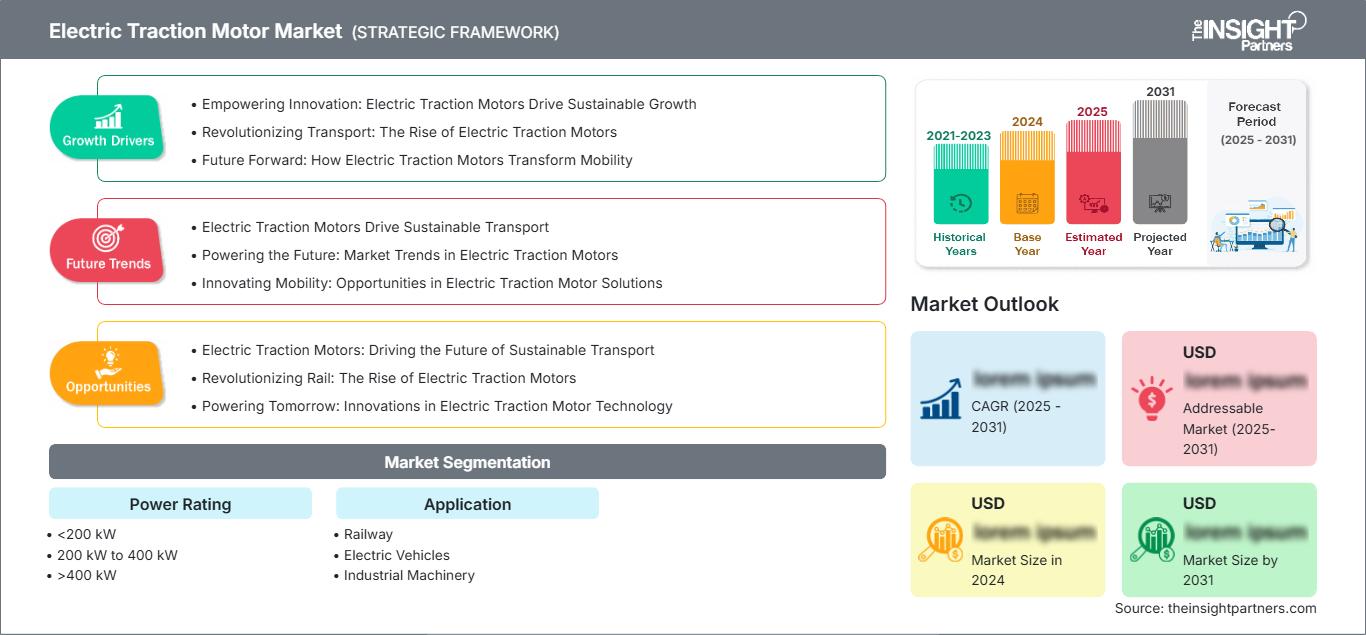
Electric Traction Motor Market: Strategic Insights
Regional Insights
North America Electric Traction Motor Market
The market share of Electric Traction Motor in North America is projected at 21% - 23% in 2025 with CAGR 29.0% - 31.0% until 2034. Diversified demand is driven by passenger EV assembly, electrified pickups and deliveries, transit bus orders, and commuter rail fleet renewal. Incentives for domestic manufacturing of clean technologies lead to localization of motors, inverters, critical materials, and the development of charging infrastructure.
Durability, cybersecurity, performance in cold climates, and compliance with requirements on content domestication are top considerations for regional consumers. The automotive cluster in Mexico makes the region attractive for near-shoring of assembly operations, while Canada provides mining capabilities and zero-emission vehicles programs. Strategic cooperation agreements on rare earth magnets and electrical steel supplies are critical since localization of final assembly is not enough for avoiding upstream risks.
U.S. Electric Traction Motor Market
The United States has a share of 78–82% in the North American market for 2025 and will have a growth rate of 29.5–31.5% CAGR through 2034. Electric SUVs, pickups, vans, buses, and off-highway machinery drive application specifications. Federal production subsidies, state zero-emissions regulations, and fleet electrification targets drive investments, despite the possibility of change through the variation of policies impacting launch and sourcing decisions.
ABB Ltd., Robert Bosch GmbH, Nidec Corporation, and WEG S.A. have sales, design, or manufacturing capabilities in the market. Domestic vehicle manufacturers are incorporating some electric drive technology in-house. Commercial projects favor service, total cost of ownership, and modularity of e-axles. In the railway industry, the need arises from refurbishment, replacement, and modernization of locomotives and metros, where reliability and availability of spare parts are more valued than frequent product updates.
Europe Electric Traction Motor Market
Europe acquires 24-26% of the total demand in 2025 and grows at a CAGR rate of 28.0-30.0%. Germany is the leader owing to automotive engineering scalability and industrial automation. German suppliers are now focusing on optimizing the use of magnets, 800-volt readiness, and integrated thermal management solutions. UK's focus lies in premium vehicles development and rail fleet upgrades, whereas strict fleet emission standards allow for platform investments in spite of inconsistent consumer incentives.
France is supported by the presence of railway manufacturing and public transport procurement, Italy is benefitted by its presence of industrial equipment production and elevator manufacturing, while Spain sees a combination of vehicle assembly and renewables-based mobility projects. The companies Alstom SA, Škoda Electric a.s., Traktionssysteme Austria GmbH, ABB Ltd., and Robert Bosch GmbH add to engineering capabilities in the region.
APAC Electric Traction Motor Market
APAC represents 46-49% of the 2025 demand and is forecasted to account for 34.0-36.0% CAGR until 2034, with China as the leading country. Economies of scale in electric vehicle manufacture, battery packs, magnets, and power electronics help reduce costs and iterations. High precision in manufacturing, material science, and automotive platforms are strengths of Japan and South Korea.
The combination of India’s rail electrification, electric two-wheelers, commercial vehicles, and investments in industry; and Australia’s mining and heavy equipment make up an integral part of the region’s strengths.
Middle East & Africa Electric Traction Motor Market
MEA is expected to expand at a 24.0–27.0% CAGR through 2034, led by the UAE’s logistics, transit, and smart-city programs. Saudi Arabia’s industrial diversification and rail projects support higher-power applications, while South Africa offers mining, rail, and automotive demand.
Across the rest of MEA, grid reliability, financing, and service availability shape adoption speed. Renewable-energy investment and new transport corridors improve the case for electric fleets, conveyors, elevators, and industrial machinery, particularly where operators can monetize lower maintenance and energy costs.
Segmentation Analysis
Power Rating
The Electric Traction Motor Market scope across power ratings reflects sharply different duty cycles, packaging limits, and cooling requirements. The segment is modeled to expand at 32.0–34.0% CAGR during 2026–2034. Lower ratings serve compact mobility and auxiliaries, mid-range systems support mainstream passenger and commercial platforms, and high-power machines address locomotives, heavy equipment, and demanding industrial drives.
- <200 kW: This category leads unit demand through compact and midsize electric vehicles, light industrial equipment, elevators, and localized material-handling systems requiring efficient, economical, space-conscious propulsion.
- 200 kW to 400 kW: Growing use in premium vehicles, buses, delivery fleets, and medium-duty machinery makes this range strategically important for scalable liquid-cooled platforms and integrated e-axles.
- >400 kW: Rail locomotives, mining equipment, heavy off-highway platforms, and large industrial systems sustain specialized demand where torque continuity, thermal endurance, redundancy, and lifecycle support dominate purchasing.
Application
Application demand is modeled to grow at 33.0–35.0% CAGR during 2026–2034. Electric vehicles deliver the largest expansion, but rail, industrial machinery, conveyors, and elevators provide longer replacement cycles and service revenue. Selection criteria vary from power density and acoustic control in vehicles to overload tolerance, regenerative operation, contamination resistance, and maintainability in industrial or infrastructure environments.
- Railway: Metro expansion, locomotive refurbishment, and intercity fleet renewal sustain demand for rugged motors with high availability, regenerative braking compatibility, long qualification histories, and dependable spares support.
- Electric Vehicles: Passenger cars, buses, vans, trucks, and two-wheelers drive volume, rewarding compact architectures, high efficiency across variable loads, rapid software calibration, and manufacturing scalability.
- Industrial Machinery: Electrified presses, robotics, mobile equipment, and production systems require precise torque control, reduced energy consumption, and condition monitoring that limits unplanned downtime.
- Conveyors: Mining, logistics, airports, and factories adopt controllable motor systems to improve throughput, regenerative operation, load matching, and maintenance visibility across continuous material-handling processes.
- Elevators: Urban construction and modernization support efficient, low-noise traction systems, with machine-room-less designs, regenerative drives, ride quality, and compact packaging shaping supplier differentiation.
Opportunity Snapshot
Electric Traction Motor Market Forecasts support prioritizing applications by revenue quality, procurement maturity, and integration intensity.
| Application | Revenue Contribution | Trend Tag | Adoption Stage |
| Railway | Medium | Fleet Renewal | Scaling |
| Electric Vehicles | High | Integrated Axles | Scaling |
| Industrial Machinery | Medium | Smart Drives | Mature |
| Conveyors | Low | Regenerative Motion | Mature |
| Elevators | Medium | Compact Traction | Mature |
Electric Traction Motor Market Growth Drivers and Impact Analysis
Rapid Electrification of Road Transport
More than 17 million electric vehicles have been sold globally in 2024, representing well over a fifth of all new-car sales, providing a substantial and growing foundation of production for traction systems. Every new platform generates not just motor needs but also a demand for corresponding inverters, thermal systems, controllers, and testing capabilities. Commercial vans, buses, and trucks generate additional demand with higher duty cycles and higher margins per vehicle. This translates back up the chain to electrical steel, copper, bearings, magnets, semiconductor devices, and automatic winding machinery. Suppliers that can serve multiple platforms using modular architectures will generate economies of scale, while automakers will see shortened development timeframes.
Rail Modernization and Urban Transit Investment
Older trains, metros, and locomotives are being replaced by newer models in order to enhance capacity, reliability, and emission performance. The traction motor is important since efficiency influences the consumption of electricity, the cooling process, range, and total cost of ownership. The ordering of new rolling stock results in several-year-long programs for the components, whereas refurbishment leads to a need for replacement, rewinding, diagnostics, and spares. Regenerative braking systems and condition-based monitoring make the business case more compelling through energy recovery and the avoidance of unscheduled down times. The qualifications barriers are in favor of suppliers who have proven references, regional service availability, and spare parts commitment.
Industrial Efficiency and Automation Mandates
Factories, mines, warehouses, airports, and buildings have raised the bar on efficiency, increasing adoption of variable-speed traction systems that are efficient. Conveyor belts and industrial machines will greatly benefit from having motors whose speeds correspond to those of the load as opposed to having constant motor speed. Elevators will greatly benefit from gearless technology, especially in the case of skyscraper construction and modernization. With digital sensors, it is easy to perform predictive maintenance through measuring vibration, temperature, current, and condition of insulation. This makes the value proposition include low power consumption, better process control, low mechanical wear, and higher uptime. Demand will be independent of vehicle cycle.
Electric Traction Motor Market Future Trends
Rare-Earth-Efficient and Magnet-Free Architectures
Electric Traction Motor Market trends are increasingly going to prefer those electric traction motor designs that have external excitation, which are synchronous, induction, and reluctant type motors and limit exposure to concentrated rare earth resources. PM machines will continue to be relevant where there is a need for high torque density and efficiency despite the cost of the materials, but the engineering teams will make efforts to control the amount of material used and ensure recovery at the end of life cycle along with diversity in sourcing. Enhanced rotor design, electrical steel, winding technology, and thermal management can help bridge some historical performance gaps.
Software-Defined Propulsion and Digital Twins
Motor differentiation will transcend the use of electromagnetic equipment to embrace controls, simulations, and ongoing optimization. Digital twins allow for bridging design models with manufacturing and field data in order to achieve fast calibration, prediction of faults, and duty cycle-based optimization of efficiency. Software updates could help in improving torque delivery, thermal parameters, and regenerative performance even after the sale, provided that cybersecurity and validation of safety criteria are maintained. OEMs will be able to incorporate motor, inverter, gearbox, and cooling models at an earlier stage of platform development, which will reduce prototyping efforts. Manufacturers with unique control algorithms and large operational datasets could enhance performance by providing condition-based maintenance contracts.
Electric Traction Motor Market Opportunities
Localized Manufacturing in Emerging Mobility Hubs
India, Southeast Asia, Mexico, and Eastern Europe offer investment opportunities as vehicle and equipment producers seek regional supply, lower logistics risk, and compliance with local-content requirements. Entrants can prioritize modular stator lines, flexible winding equipment, and shared testing facilities that serve automotive, rail, and industrial customers. Partnerships with universities, material processors, and power-electronics suppliers can shorten qualification cycles. Investors should stage capacity against secured programs rather than headline demand, because platform delays can depress utilization. The strongest projects will combine export access, skilled labor, renewable electricity, and proximity to customers, while reserving space for magnet recycling and next-generation rotor production.
Lifecycle Services for High-Utilization Fleets
Fleet operators increasingly need uptime guarantees rather than standalone components, creating room for monitoring, repair, remanufacturing, and performance-based contracts. Rail, mining, logistics, and transit applications are especially attractive because equipment runs intensively and downtime carries measurable cost. Suppliers can bundle sensors, remote diagnostics, spare pools, warranty analytics, and scheduled refurbishment into multi-year agreements. Investment should focus on regional service centers, standardized failure databases, and technician training. Remanufactured rotor, stator, and bearing assemblies can lower lifecycle emissions and protect customers from long lead times. This model broadens margins, deepens installed-base relationships, and moderates exposure to new-equipment cycles.
Recent Developments
- October 2025: Schaeffler is expanding its electric drive technology for agricultural machinery with a modular 800 V heavy-duty electric motor platform designed to deliver high power and efficiency in a compact package. The company presented the technology at Agritechnica 2025, highlighting its potential for a wide range of agricultural vehicles and applications. The motors can be used as fully electric traction drives, generators in hybrid systems, or drives for electric power take-off (PTO) systems.
- December 2025: Tata Motors showcased a broad portfolio of advanced, sustainable and connected commercial vehicle solutions at EXCON 2025 in Bengaluru, highlighting technologies designed to improve productivity, efficiency and profitability across India’s construction and mining sectors. The company’s participation was centred around the theme “Productivity Unleashed.” A major highlight was the launch of the Prima 3540.K AutoShift, Tata Motors’ most powerful tipper, developed specifically for demanding deep-mining applications. Powered by a Cummins 8.5-litre engine producing 375 hp and 1,800 Nm of torque, the vehicle features a 12-speed automated manual transmission and is designed for high-productivity heavy-haulage operations.
- October 2025: Mitsubishi Motors has unveiled the Mitsubishi Elevance Concept, an electrified crossover SUV concept, at the Japan Mobility Show 2025 in Tokyo. Under the theme “Forever Adventure,” the company presented a range of vehicles and technologies aimed at combining electrification, advanced four-wheel-drive control and enhanced comfort for both everyday travel and outdoor exploration.
Frequently Asked Questions

- Comprehensive Market Sizing and Forecast Analysis
- Detailed Segmentation Analysis
- In-Depth Market Dynamics Assessment
- Regional and Country-Level Insights
- Competitive Landscape and Company Benchmarking
- Strategic Business Intelligence
Recent Reports
Testimonials

The Insight Partners' SCADA System Market report is comprehensive, with valuable insights on current trends and future forecasts. The team was highly professional, responsive, and supportive throughout. We are very satisfied and highly recommend their services.
RAN KEDEM Partner, Reali Technologies LTDs
I requested a report on a very specific software market and the team produced the report in a few days. The information was very relevant and well presented. I then requested some changes and additions to the report. The team was again very responsive and I got the final report in less than a week.
JEAN-HERVE JENN Chairman, Future Analytica
We worked with The Insight Partners for an important market study and forecast. They gave us clear insights into opportunities and risks, which helped shape our plans. Their research was easy to use and based on solid data. It helped us make smart, confident decisions. We highly recommend them.
PIYUSH NAGPAL Sr. Vice President, High Beam Global
The Insight Partners delivered insightful, well-structured market research with strong domain expertise. Their team was professional and responsive throughout. The user-friendly website made accessing industry reports seamless. We highly recommend them for reliable, high-quality research services
YUKIHIKO ADACHI CEO, Deep Blue, LLC.
This is the first time I have purchased a market report from The Insight Partners.While I was unsure at first, I visited their web site and felt more comfortable to take the risk and purchase a market report.I am completely satisfied with the quality of the report and customer service. I had several questions and comments with the initial report, but after a couple of dialogs over email with their analyst I believe I have a report that I can use as input to our strategic planning process.Thank you so much for taking the extra time and making this a positive experience.I will definitely recommend your service to others and you will be my first call when we need further market data.
JOHN SUZUKI President and Chief Executive Officer, Board Director, BK Technologies
I wish to appreciate your support and the professionalism you displayed in the course of attending to my request for information regarding to infectious disease IVD market in Nigeria. I appreciate your patience, your guidance, and the fact that you were willing to offer a discount, which eventually made it possible for us to close a deal. I look forward to engaging The Insight Partners in the future, all thanks to the impression you have created in me as a result of this first encounter.
DR CHIJIOKE ONYIA MANAGING DIRECTOR, PineCrest Healthcare Ltd.Reason to Buy
- Informed Decision-Making
- Understanding Market Dynamics
- Competitive Analysis
- Identifying Emerging Markets
- Customer Insights
- Market Forecasts
- Risk Mitigation
- Boosting Operational Efficiency
- Strategic Planning
- Investment Justification
- Tracking Industry Innovations
- Aligning with Regulatory Trends





 Get Free Sample for