
Embedded Subscriber Identity Module Market Size, Share & Forecast by 2034
Coverage: By Type (E-SIM Card, Chip); Application (Automotive, Consumer Electronics, Manufacturing, Telecommunication, Transportation and Logistics, Others) , and Geography (North America, Europe, Asia Pacific, and South and Central America)
- Status : Data Released
- Report Code : TIPRE00020756
- Category : Electronics and Semiconductor
- No. of Pages : 150
- Available Report Formats :


- Last update date : August 12, 2026


2025 Market Size
US$ 1.65 Bn
Base year value
2034 Forecast
US$ 6.89 Bn
Projected by 2034
CAGR 2026-2034
17.24 %
Growth rate
Addressable Market
US$ 35.74 Bn
(2026-2034)
The Embedded Subscriber Identity Module Market size stood at US$ 1.65 Billion in 2025, while a growth of up to US$ 6.89 Billion in 2034 is anticipated, recording a CAGR of 17.24% between 2026 and 2034. Growth is attributed to the evolution from SIM cards that could be easily removed to remote SIM provisioning embedded in connected devices, ensuring easier activation and management and switching of networks.
In North America, the Embedded Subscriber Identity Module Market is set to grow at a forecast CAGR of 15.8% to 17.2% in 2034. Wide availability of eSIMs amongst carriers, a large number of installed connected cars, as well as central fleet management needs of enterprises are the factors driving the adoption of eSIMs. Standardized remote provisioning also reduces the field service needs of the utilities, logistics companies, and manufacturers operating in several states.
Embedded Subscriber Identity Module Market Assessment and Insights
- North America held 31–34% Embedded Subscriber Identity Module Market share in 2025 and is projected to grow at 15.8–17.2% CAGR between 2026–2034, supported by eSIM-ready devices, automotive telematics, and mature operator provisioning infrastructure.
- US represented 78–82% of North America in 2025 and is expected to expand at 16.0–17.4% CAGR between 2026–2034 as digital-first activation scales.
- Europe accounted for 27–30% share in 2025 and is forecast to grow at 15.2–16.8% CAGR between 2026–2034, led by Germany, the UK, and France.
- Asia Pacific captured 29–32% share in 2025 and is projected to rise at 18.8–20.4% CAGR between 2026–2034, with China, Japan, South Korea, and India leading deployment.
- Largest Segment Consumer Electronics held 35–39% market share in 2025 and should grow at 16.2–17.8% CAGR between 2026–2034 as handset and wearable integration broadens.
- High Growth Segment Automotive represented 22–26% market share in 2025 and is expected to expand at 19.1–21.0% CAGR between 2026–2034, driven by connected-car platforms.
- Key companies analyzed in detail: Deutsche Telekom AG, Giesecke+Devrient GmbH, IDEMIA Secure Transactions, Infineon Technologies AG, NXP Semiconductors N.V., NTT DOCOMO, INC., Semtech Corporation, STMicroelectronics N.V., Thales Group, and Vodafone Idea Limited.
Source: The Insight Partners' analysis based on proprietary research, government publications, company annual reports, investor presentations, industry databases, and expert interviews.
Technology development has transitioned away from the worth in plastic card manufacturing towards secure chip technology, profile orchestration, certification, and subscription management in the cloud. Consumer demands have dictated remote activation, whereas IoT-specific SGP.32 deals with headless and constrained network devices via automated profile delivery. Manufacturing trends are leaning towards miniature soldered module designs, wafer-scale packages, and hybrid secure element designs. This trend ties the Embedded Subscriber Identity Module Market to long product lifespans, reduced stock-keeping units, cheaper logistics, and better credential management across global production facilities.
Future growth will be driven by Asia Pacific, Middle East, and Latin America owing to local profile needs, connected mobility, and industry digitalization driving embedded connections. Investment is moving towards interoperable eSIM IoT managers, sovereign cloud services, and secured hardware certification. A regulatory focus on cybersecurity, data residency, and roaming will favor solutions offering remote localization of products without changing hardware and thus opening up the demand pool beyond premium consumer electronics to utility systems, transportation assets, and industrial machinery.
Embedded Subscriber Identity Module Market Report Scope
| Report Attribute | Details |
|---|---|
| Market size in 2025 | US$ 1.65 Billion |
| Market Size by 2034 | US$ 6.89 Billion |
| Global CAGR (2026 - 2034) | 17.24% |
| Historical Data | 2021-2024 |
| Forecast period | 2026-2034 |
Embedded Subscriber Identity Module Market Analysis
Embedded Subscriber Identity Module (SIM) market growth will be fueled by the increased number of connected devices, multinationals, and cost of physical SIM operations. The device manufacturers have a standard hardware platform, while the operators maintain their services through the use of profiled SIM cards. This will help enterprises to activate, switch off and deactivate their SIMs remotely in situations where the devices cannot be reached physically or are anticipated to stay for ten years.
The ecosystem involves secure controller vendors, eUICC operating system providers, subscription management, mobile operators, module providers, device OEMs and systems integrators. Supply is influenced by qualification of semiconductors, GSMA certification, cryptographic key management, and operator onboarding. Standardization minimizes two-way integration, though implementation is reliant on certified components, network agreements locally and bootstrapping.
According to the Embedded Subscriber Identity Module Market analysis, competition is shifting towards a combined hardware, software, and managed-connectivity offering. The companies such as Thales Group, IDEMIA Secure Transactions, Giesecke+Devrient GmbH, and STMicroelectronics N.V. focus on certified eUICC and provisioning solutions, while Deutsche Telekom AG, NTT DOCOMO, INC., and Vodafone Idea Limited play a role by their operator channel reach and connectivity solutions for enterprises.
Increasingly, positioning requires interoperability, geographical footprint, cybersecurity, and ease of procurement for global OEMs. Infineon Technologies AG and NXP Semiconductors N.V. offer security silicon and integration, while Semtech Corporation integrates its module and managed service capabilities. Investment focuses on SGP.32 orchestration, data sovereignty hosting, post-quantum security, analytics, and application-specific bundles for automobiles, meters, trackers, and smaller consumer devices.
● REPORT CUSTOMIZATION
Tailor This Report To Align With Your Specific Business Requirements
This report can be customized to align precisely with your business objectives, scope, and target markets. Customization options include tailored segmentation, geography, competitive analysis, and strategic insights to support informed decision-making.
Customize This Report →WHAT YOU CAN ADJUST
- ● Segmentations
- ● Geography
- ● Competitive Analysis
- ● Language Preferences
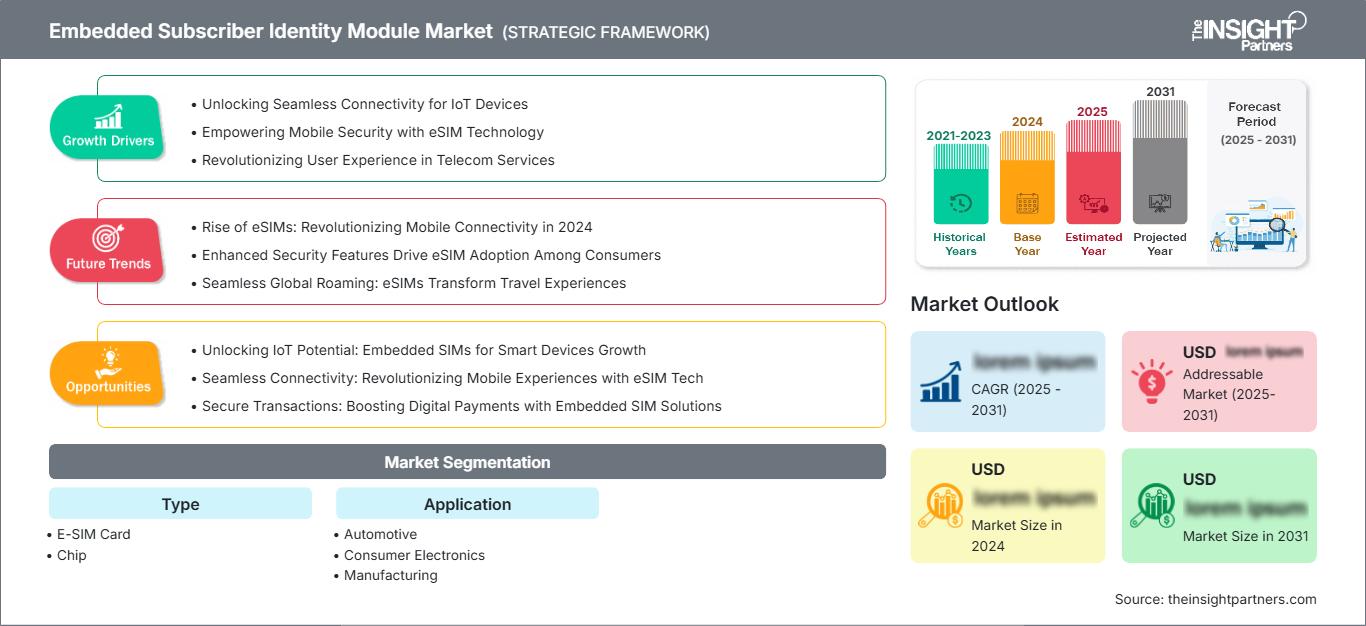
Embedded Subscriber Identity Module Market: Strategic Insights
Regional Insights
North America Embedded Subscriber Identity Module Market
The North American region witnessed an estimated 31–34% Embedded Subscriber Identity Module Market share in 2025 and is likely to witness 15.8–17.2% CAGR during 2034. Smartphones have already adopted the eSIM feature; however, other use cases include the remote management of connectivity by automotive OEMs, logistics fleet, utility sector, and industrial users. Commercialization of the technology would be easy due to 4G/5G network availability, cloud-based services, and wide support from operators.
There will be a transition from individual credentials to managed service platforms including profiles, policy control, analytics, and multi-network coverage. Existing assets of connected cars and cellular M2M devices further drive replacement and growth requirements. There are security requirements, long equipment lifetime cycles, and local subscription deployment requirements, which lead to certification of eUICC solutions. Canada makes its contribution in transportation and resource industry sectors, while Mexico derives growth from the automotive industry.
U.S. Embedded Subscriber Identity Module Market
In 2025, the U.S. accounted for 78–82% of North America's revenue and expected to register 16.0–17.4% CAGR during 2034. The adoption is driven by availability of smartphones equipped with eSIMs, widespread carrier partnerships, connected car manufacturing, and enterprise IoT installations. Digital onboarding becomes more prominent for consumer applications, whereas automotive, metering, and tracking use cases appreciate profile management from a distance, lower field maintenance costs, and reduced inventories.
Thales Group, IDEMIA Secure Transactions, Giesecke+Devrient GmbH, Infineon Technologies AG, NXP Semiconductors N.V., STMicroelectronics N.V., and Semtech Corporation have respective technology or business presence. Smartphones and wearables, telematics control units, industrial gateways, private network devices, and valuable logistics assets represent major applications for eSIM solutions. Certification, secure manufacturing process, service continuity, operator compatibility, and capability to handle subscriptions throughout extended lifecycle constitute competitive factors.
Europe Embedded Subscriber Identity Module Market
Europe held a modelled share of 27-30% in 2025 and will grow at 15.2-16.8% CAGR through 2034. Germany is at the forefront because of its expertise in automotive engineering and industrial automation, as well as having a rich ecosystem of suppliers. The UK offers a combination of excellent digital operator channel and travel, fintech, and enterprise connectivity use cases, thus making a case for consumer activation and managed multi-network services.
France derives an advantage from its connectivity capability and secure-identity expertise, while Italy and Spain have the added benefit of connected mobility, smart metering, and logistics applications. Cybersecurity and product resilience considerations in Europe make it necessary for the use of certified hardware and auditable provisioning and lifecycle management services. Cross-border trade increases the importance of local profiles, especially in terms of vehicles and industrial devices.
APAC Embedded Subscriber Identity Module Market
Asia Pacific was modeled to have a 29-32% market share in 2025 and will achieve a compound annual growth rate (CAGR) of 18.8-20.4% up to 2034. China is leading through its strong presence in devices, connected cars, and operator partnerships. Japan and South Korea provide consumer electronics, and automotive platforms, whereas India brings scale in smartphones, logistics, and industrial digitization.
Australia brings mining, transportation, and remote assets into the picture. The government’s policy in favor of 5G, smart manufacturing, and digital infrastructure leads to embedded connectivity, despite localization regulations and operator challenges. The need for market-specific provisioning becomes more common among regional suppliers.
Middle East & Africa Embedded Subscriber Identity Module Market
MEA is forecast to grow at 16.6-18.4% CAGR from 2023 to 2034, driven by projects in Saudi Arabia related to smart city initiatives, mobility and industrial applications. The UAE will benefit from connected vehicle, air transport logistics and globally deployed enterprise asset management solutions, whereas South Africa will focus on telecommunication and fleet applications.
In other parts of MEA, the adoption will be associated with energy infrastructure, metering, mining and remote monitoring applications. Restrictions related to permanent roaming will increase the popularity of over-the-air localization, although fragmented legislation and network coverage will prevent its deployment. Network operators that can provide both local partnerships and secure global orchestration are likely to succeed in cross-border programs.
Segmentation Analysis
Type
The Type segment is projected to grow at 16.7–18.2% CAGR during 2026–2034. Embedded Subscriber Identity Module Market scope spans removable programmable cards and soldered secure chips, allowing suppliers to address legacy compatibility and deeply integrated device designs. Selection depends on board space, environmental durability, certification, production volume, serviceability, and whether OEMs require flexible migration before committing to fully embedded architectures.
- E-SIM Card supports programmable connectivity in a removable format, appealing to device makers and users seeking easier migration, multi-profile flexibility, and compatibility with equipment designed around established SIM slots.
- Chip occupies the stronger long-term strategic position because soldered integration improves durability, saves device space, reduces tampering exposure, and supports automated provisioning for high-volume consumer, vehicle, and industrial production.
Application
The Application segment is forecast to record 17.1–18.6% CAGR during 2026–2034. Adoption reflects different lifecycle priorities: consumer products emphasize simple activation and compact design, vehicles require cross-border continuity, factories prioritize resilient unattended operation, telecommunications providers monetize digital onboarding, and logistics operators need persistent asset visibility. This breadth reduces dependence on any single device category and supports recurring platform revenue.
- Automotive is the high-growth application as software-defined vehicles, telematics, emergency services, infotainment, and over-the-air updates require secure connectivity that can be localized throughout extended vehicle lifecycles.
- Consumer Electronics remains the largest application, supported by smartphones, wearables, tablets, and laptops that use digital activation, multiple profiles, and smaller internal footprints to improve user convenience.
- Manufacturing demand centers on gateways, robots, sensors, and production assets requiring resilient remote provisioning, global shipment flexibility, and lower maintenance costs in controlled or difficult-to-access industrial environments.
- Telecommunication applications include digital onboarding, travel connectivity, secondary plans, and enterprise orchestration, enabling operators to reduce physical distribution while improving service launch speed and subscriber flexibility.
- Transportation and Logistics uses embedded credentials for fleet telematics, containers, cold-chain monitoring, and asset tracking, where multi-country coverage and remote operator changes protect continuity and shipment visibility.
Opportunity Snapshot
| Application | Revenue Contribution | Trend Tag | Adoption Stage |
| Automotive | High | Connected Vehicles | Scaling |
| Consumer Electronics | High | Digital Activation | Mature |
| Manufacturing | Medium | Industrial IoT | Scaling |
| Telecommunication | High | Profile Orchestration | Mature |
| Transportation and Logistics | Medium | Asset Tracking | Scaling |
Embedded Subscriber Identity Module Market Growth Drivers and Impact Analysis
Remote Provisioning Reduces Global Device-Management Friction
Remote provisioning enables OEMs to design a standard configuration for the device and to assign the local network profiles post-shipping. As a result, country-specific stocks of inventory, physical handling of cards, truck rolls, and recalls due to changes in the connectivity contracts become less frequent. The greatest effect is achieved for automobiles, meters, trackers, and industrial machines that are placed in unreachable places or need to function for more than ten years. For companies, remote provisioning will help to coordinate the activation, suspension, switching, and deactivation processes. The business model will move the revenue towards profile management, orchestration, analytics, and managed connectivity, which adds another layer of the service.
Connected Vehicles Create Long-Lifecycle Connectivity Demand
Today's cars rely on cellular connections to make emergency calls, perform diagnostic tests, provide infotainment and navigation functions, offer fleet management solutions, and provide software updates. Pre-loaded credentials will allow car manufacturers to activate connectivity in the final destination point, comply with national roaming policies, and switch carriers without swapping equipment. A single platform of a car can be manufactured in one place and sold in many different regions governed by their regulations and carrier agreements, which makes subscription localization an important feature to consider. Given that cars have much longer lifetime than consumer devices, suppliers should offer profile management, certificate renewal, and network migration over time periods.
SGP.32 Standardization Unlocks Scalable IoT Deployment
SGP.32 addresses limitations of earlier machine-to-machine and consumer architectures by supporting remotely managed profiles for devices with constrained networks or no user interface. Its eSIM IoT Manager approach reduces dependence on bespoke operator integrations and enables automated fleet-level provisioning. This matters for smart meters, healthcare devices, industrial sensors, cameras, and trackers that cannot rely on manual QR-code activation. Certification improves confidence that chips, profiles, and management platforms will interoperate across suppliers. As commercial implementations mature, enterprises can separate connectivity decisions from initial hardware production and negotiate providers by geography or performance. The resulting flexibility should accelerate procurement while shifting competitive advantage toward certified, portable, and policy-driven orchestration platforms.
Embedded Subscriber Identity Module Market Future Trends
Integrated SIM Architectures Move Connectivity into the System Chip
Embedded Subscriber Identity Module Market trends increasingly point toward integrated SIM architectures that place credential functions within a trusted system-on-chip environment. Consolidating components can reduce board space, bill-of-material complexity, power consumption, and manufacturing steps, which is valuable for compact wearables, trackers, meters, and mass-market connected products. Adoption will depend on certification, ecosystem confidence, and clear separation of roles among semiconductor vendors, operators, and provisioning providers. Over time, integrated implementations should complement rather than immediately displace discrete eUICC chips, with device category, risk profile, serviceability, and production economics determining the preferred architecture for each program.
Cryptographic Agility Becomes a Lifecycle Requirement
Long-lived connected assets will require credentials that can adapt as security standards and threat models evolve. Suppliers are therefore developing remotely updatable cryptographic libraries, secure applets, and post-quantum-ready workflows within eUICC environments. The commercial significance extends beyond headline cybersecurity: utilities, automakers, healthcare providers, and industrial operators need to avoid replacing deployed hardware when algorithms change. Buyers will increasingly evaluate update governance, key custody, auditability, vulnerability response, and regulatory alignment alongside basic profile provisioning. Vendors that combine certified silicon with controlled remote updates can convert compliance obligations into recurring lifecycle-management revenue and strengthen trust in unattended deployments.
Embedded Subscriber Identity Module Market Opportunities
Build Managed SGP.32 Platforms for Mid-Market Enterprises
Embedded Subscriber Identity Module Market Forecasts support investment in turnkey SGP.32 services for enterprises lacking specialist telecom teams. A managed package can combine certified eUICC hardware, bootstrap connectivity, profile hosting, operator selection, policy automation, diagnostics, and compliance reporting. Mid-sized manufacturers and logistics providers often require global coverage but cannot justify separate integrations in every country. Providers should prioritize transparent pricing, open interfaces, portable eSIM IoT Manager functions, and pre-integrated modules for meters, gateways, trackers, and industrial controllers. Channel partnerships with module distributors and systems integrators can shorten deployment cycles. The opportunity is to make multi-network orchestration consumable as an operational service rather than a complex telecom engineering project.
Localize Connected Assets in Regulated Growth Markets
Automotive, energy, and logistics programs in the Gulf, India, Southeast Asia, Africa, and Latin America create demand for remote migration from a global bootstrap profile to a compliant local subscription. Investors can target platforms that package operator agreements, regulatory intelligence, data-residency options, and automated localization by destination. Success requires more than nominal coverage: providers need tested roaming behavior, resilient fallback, local support, and contractual clarity around profile ownership. Partnerships with national operators and regional cloud providers can establish defensible market access. This approach converts regulatory fragmentation from a deployment obstacle into a managed-service opportunity for multinational OEMs.
Recent Developments
- February 2026: IDEMIA Secure Transactions partnered with Hyundai Motor Group to deploy its eSIM and Connectivity Manager across Hyundai, Kia, and Genesis vehicles in strategic markets. Deployment began in the Middle East, enabling destination-specific connectivity, operator switching, and simplified global vehicle configuration while supporting telematics, infotainment, and software-defined vehicle services.
- July 2025: Thales Group announced GSMA eSIM Security Assurance certification for its IoT eSIM solution. The certification covers hardware, firmware, operating system, and cryptographic libraries, strengthening suitability for SGP.32 deployments in smart metering, healthcare, automotive, and tracking applications where mass remote activation, credential protection, and regulatory compliance are critical.
- May 2025: STMicroelectronics N.V. completed GSMA SGP.32 certification for the ST4SIM-300 eSIM. The product supports bulk profile provisioning, provider switching, constrained networks, and multiple form factors for smart meters, asset trackers, and healthcare devices, extending certified interoperability and secure IoT deployment options for equipment developers.
Frequently Asked Questions

- Comprehensive Market Sizing and Forecast Analysis
- Detailed Segmentation Analysis
- In-Depth Market Dynamics Assessment
- Regional and Country-Level Insights
- Competitive Landscape and Company Benchmarking
- Strategic Business Intelligence
Recent Reports
Testimonials

The Insight Partners provided valuable market intelligence that supported our global go-to-market strategy. Their team was professional, responsive, and attentive to our feedback, providing thoughtful analysis and helpful methodological clarifications throughout the project.
Junmo Kim Chief Financial Officer (CFO), Enertech Co., Ltd.
The Insight Partners' SCADA System Market report is comprehensive, with valuable insights on current trends and future forecasts. The team was highly professional, responsive, and supportive throughout. We are very satisfied and highly recommend their services.
RAN KEDEM Partner, Reali Technologies LTDs
I requested a report on a very specific software market and the team produced the report in a few days. The information was very relevant and well presented. I then requested some changes and additions to the report. The team was again very responsive and I got the final report in less than a week.
JEAN-HERVE JENN Chairman, Future Analytica
We worked with The Insight Partners for an important market study and forecast. They gave us clear insights into opportunities and risks, which helped shape our plans. Their research was easy to use and based on solid data. It helped us make smart, confident decisions. We highly recommend them.
PIYUSH NAGPAL Sr. Vice President, High Beam Global
The Insight Partners delivered insightful, well-structured market research with strong domain expertise. Their team was professional and responsive throughout. The user-friendly website made accessing industry reports seamless. We highly recommend them for reliable, high-quality research services
YUKIHIKO ADACHI CEO, Deep Blue, LLC.
This is the first time I have purchased a market report from The Insight Partners.While I was unsure at first, I visited their web site and felt more comfortable to take the risk and purchase a market report.I am completely satisfied with the quality of the report and customer service. I had several questions and comments with the initial report, but after a couple of dialogs over email with their analyst I believe I have a report that I can use as input to our strategic planning process.Thank you so much for taking the extra time and making this a positive experience.I will definitely recommend your service to others and you will be my first call when we need further market data.
JOHN SUZUKI President and Chief Executive Officer, Board Director, BK Technologies
I wish to appreciate your support and the professionalism you displayed in the course of attending to my request for information regarding to infectious disease IVD market in Nigeria. I appreciate your patience, your guidance, and the fact that you were willing to offer a discount, which eventually made it possible for us to close a deal. I look forward to engaging The Insight Partners in the future, all thanks to the impression you have created in me as a result of this first encounter.
DR CHIJIOKE ONYIA MANAGING DIRECTOR, PineCrest Healthcare Ltd.Reason to Buy
- Informed Decision-Making
- Understanding Market Dynamics
- Competitive Analysis
- Identifying Emerging Markets
- Customer Insights
- Market Forecasts
- Risk Mitigation
- Boosting Operational Efficiency
- Strategic Planning
- Investment Justification
- Tracking Industry Innovations
- Aligning with Regulatory Trends





 Get Free Sample for