
Fiber Optic Beam Expander Market Growth, Share & Trends by 2034
Fiber Optic Beam Expander Market Size and Forecasts (2021–2034), Global and Regional Share, Trends, and Growth Opportunity Analysis Report Coverage : By Design Type (Galilean and Keplerian), Device Type (Optical Communication, Measurement, Laser Systems, Remote Sensing, Lidar and Others), Application (Instrumentation, Mining, Lighting, Petroleum Exploration, Scientific Research and Others), End-use Industry (Military, Oil and Gas, Medical, Robotics, Energy and Power, Manufacturing, Industrial and Others)
- Status : Data Released
- Report Code : TIPRE00039430
- Category : Electronics and Semiconductor
- No. of Pages : 150
- Available Report Formats :


- Last update date : August 18, 2026


2025 Market Size
US$ 2.4 Bn
Base year value
2034 Forecast
US$ 4.67 Bn
Projected by 2034
CAGR 2026-2034
7.70 %
Growth rate
Addressable Market
US$ 31.88 Bn
(2026-2034)
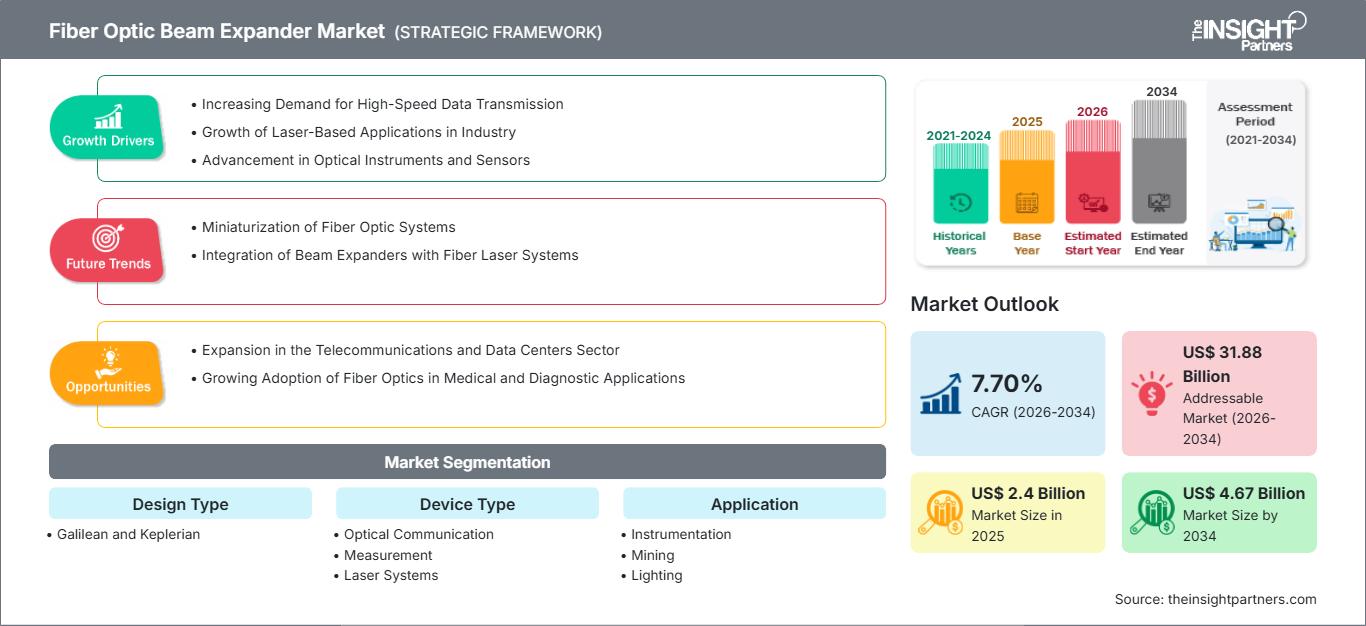
The Fiber Optic Beam Expander Market is valued at US$ 2.4 Billion in 2025 and is projected to reach US$ 4.67 Billion by 2034, expanding at a CAGR of 7.70% during the forecast period from 2026 to 2034. This growth trajectory reflects increasing adoption across optical communication, lidar systems, laser processing, and scientific instrumentation where precise beam manipulation is critical.
North America maintains a commanding position in the Fiber Optic Beam Expander Market, with the region expected to grow at a CAGR range of 7–9% through 2034. Structural drivers include widespread deployment of fiber-optic telecommunications infrastructure, military directed-energy programs, and industrial laser processing adoption across the United States and Canada.
Fiber Optic Beam Expander Market Assessment and Insights
- North America – The region holds approximately 34–37% share in 2025 and is growing at a CAGR range of 7–9% between 2026–2034, driven by strong defense spending and telecommunications infrastructure investments.
- US – Accounts for nearly 76–79% of North America share in 2025, advancing at a CAGR range of 6–8% between 2026–2034, supported by leading photonics companies and 5G network deployments.
- Europe – Represents approximately 23–26% share in 2025 and is expanding at a CAGR range of 7–9% between 2026–2034, with Germany, the UK, and France leading adoption in automotive lidar and industrial laser applications.
- Asia Pacific – Holds roughly 30–33% share in 2025 and is projected to grow at the fastest CAGR range of 8–10% between 2026–2034, propelled by China, Japan, South Korea, and India's electronics and telecommunications manufacturing.
- Largest Segment – Laser Systems commands the largest device type share at 26–29% in 2025, growing at a CAGR range of 7–9% between 2026–2034, as industrial material processing and medical laser applications expand globally.
- High Growth Segment – Lidar represents the fastest-growing segment with a CAGR range of 10–12% between 2026–2034, holding 16–19% share in 2025, fueled by autonomous vehicle development and geospatial mapping deployments.
- Key companies analyzed in detail: Diamond SA, Thor Labs, Qioptiq, Edmund Optics, Micro Laser Systems, Lumetrics, Sill Optics GmbH, Optical Surfaces Ltd., NEUTRIK, and Coherent Corp.
Source: The Insight Partners' analysis based on proprietary research, government publications, company annual reports, investor presentations, industry databases, and expert interviews.
The development of market for Fiber Optic Beam Expanders has been defined by improvements in the area of optical coatings, precision lenses and miniaturization of the beam steering components. The switch from the bulk optics to fiber-coupled beam expanders made the use of such equipment in the telecommunications and sensor systems that demand stable beam expanding over long distances possible. Manufacturing process became more oriented towards modular constructions that support different beam expansion ratio and wavelength range for various lasers.
In the future the Fiber Optic Beam Expander market size will be driven by the wider use of the technology in new geographical regions like Southeast Asia, Latin America, and Eastern Europe. Investments in quantum communication network, self-driving vehicle lidars and high-power laser installations will boost the market even further.
Fiber Optic Beam Expander Market Report Scope
| Report Attribute | Details |
|---|---|
| Market size in 2025 | US$ 2.4 Billion |
| Market Size by 2034 | US$ 4.67 Billion |
| Global CAGR (2026 - 2034) | 7.70% |
| Historical Data | 2021-2024 |
| Forecast period | 2026-2034 |
Fiber Optic Beam Expander Market Analysis
The increasing requirement of high accuracy beam shaping technology in telecommunication, lidar sensors and laser-based material processing is expected to drive the global Fiber Optic Beam Expander market. In the value chain, suppliers include optical glass makers, coating specialists, precise grinding of lenses and solution providers. Suppliers like Schott AG and Corning Inc have increased the manufacturing of optical low-thermal-expansion glass substrates whereas Edmund Optics and Thorlabs have come up with broadband antireflective coating techniques suitable for UV to infrared wavelength ranges.
In the supply chain, there is an evident trend towards vertical platform where lens manufacturing, coating and assembly take place under one quality assurance system. Some of the leading players like Sill Optics GmbH and Coherent Corp provide complete line of beam expanders including fiber coupling and thermal stability capabilities for difficult industrial and research applications. Such solutions simplify the OEMs’ integration process and at the same time improves the performance and stability of beam under temperature changes and mechanical vibrations.
Competitors in the Fiber Optic Beam Expander Market Report include photonics companies, optical component companies, and lidar technology suppliers. Thor Labs has about 18–20% market share thanks to its vast array of beam expanders, including both Galilean and Keplerian types available in all wavelengths from ultraviolet to mid-infrared with fixed and variable magnification. Edmund Optics has 15–17% market share because of its TECHSPEC line of high-precision beam expanders designed for industrial lasers and scientific instruments, whereas Coherent Corp holds 12–14% share due to high-power laser systems integration and customized optics development.
Investment opportunities in the beam expander market center around lidar for self-driving cars and quantum communications. Qioptiq has decided to build extra capacity in order to produce high-precision beam expanders for lidar manufacturers in 2025. Optical Surfaces Ltd. has further consolidated its position with academic partners to develop low-wavefront-error expanders suitable for high-energy lasers. These decisions reflect the industry's understanding that beam expanders will be an essential part of laser systems used in manufacturing, sensing, and communications because of the necessity to precisely control the beam diameter.
● REPORT CUSTOMIZATION
Tailor This Report To Align With Your Specific Business Requirements
This report can be customized to align precisely with your business objectives, scope, and target markets. Customization options include tailored segmentation, geography, competitive analysis, and strategic insights to support informed decision-making.
Customize This Report →WHAT YOU CAN ADJUST
- ● Segmentations
- ● Geography
- ● Competitive Analysis
- ● Language Preferences
Fiber Optic Beam Expander Market: Strategic Insights
Regional Insights
North America Fiber Optic Beam Expander Market
North America captures about 34-37% of the worldwide Fiber Optic Beam Expander Market share of Fiber Optic Beam Expanders in 2025, where the region is anticipated to witness a CAGR rate of 7-9% during 2034. The region is dominated by the United States on account of dominant players of photonics, high investment in telecommunications infrastructure, and military directed energy program. Canada adds its share due to industrial laser processing and instrumentation research of scientific instruments in academic institutions and government agencies.
The Fiber Optic Beam Expander Market Drivers are the use of 5G and fiber-to-the-home networks that need beam expansion in order to amplify signals, Department of Defense spent US$ 1.1 billion on directed-energy R&D projects for fiscal year 2025, and increasing number of autonomous vehicles testing programs using lidar sensors. Having optical component manufacturers in New York, California, and Massachusetts drives innovation in design of beam expanders in telecommunications, defense, and industry.
U.S. Fiber Optic Beam Expander Market
The USA holds around 76–79% market share of North America Fiber Optic Beam Expander in 2025, growing at a CAGR of 6–8% between 2025 and 2034. The domestic market demand is fueled by investment in telecom infrastructures of over USD 40 billion every year, lidar application in over 30% of new automobiles, and industrial laser machining for aerospace, automobile, and electronics industries.
Company presence is seen primarily in Thor Labs from New Jersey, Edmund Optics from California, and Coherent Corp with operations in several US states. Growth in terms of application is seen in optical communication systems integration, where telecom equipment companies are using fiber-optic beam expanders in their amplifiers, switches, and transceivers for long haul and metro networks. Scientific research and defense are the other two areas that are seeing growth in spectroscopy, metrology, and directed energy systems.
Europe Fiber Optic Beam Expander Market
Europe accounts for roughly 23% to 26% of Fiber Optic Beam Expander share in the globe in 2025, growing at a CAGR of 7% to 9% up to 2034. Germany is the leading market for this technology in Europe, accounting for 34% to 37% of Europe share, owing to the automotive OEMs' deployment of lidar technology in ADAS systems and laser suppliers in industrial laser applications for aerospace and precision engineering industries.
The United Kingdom accounts for 19% to 22% of Europe share, where growth is fueled by telecommunication infrastructure improvements and scientific instrumentation in university and government labs. France, Italy, and Spain contribute to 21% to 24% of Europe share owing to increased demand in aerospace lidar, medical laser technology, and industrial material processing applications.
APAC Fiber Optic Beam Expander Market
In Asia Pacific, the Fiber Optic Beam Expander is expected to constitute roughly 30–33% of the global market in 2025 and is anticipated to have the highest CAGR ranging from 8–10% through 2034. Leading the region with 40–43% share of the APAC market is China due to the installation of telecommunications infrastructure, the development of autonomous vehicles, and self-sufficiency campaigns for semiconductors/photonics manufacturing by the country’s government.
Other countries that make up the APAC demand for beam expanders are Japan, South Korea, India, and Australia. The share made by Japan and South Korea in the region is due to their consumer electronics and automobiles lidar systems, whereas in India the quick growth in telecommunications infrastructure and scientific instrument industry.
Middle East & Africa Fiber Optic Beam Expander Market
The Middle East & Africa segment accounts for an estimated 5-7% share of the worldwide Fiber Optic Beam Expander market share in 2025 and is predicted to grow at a CAGR of 7-9% from 2025 to 2034. Saudi Arabia and UAE dominate MEA’s market share with an estimated 52-55% due to factors like smart cities, telecommunication upgrades, and fiber optic sensing technology in oil and gas exploration.
The South African segment contributes about 18-21% of MEA’s market share, fueled by mining operations that use fiber optics for instrumentation and telecommunication upgrades. The other MEA countries have upcoming demand for petroleum exploration and scientific research applications. Contextual information for energy and infrastructure involves the building of fiber optic networks, remote sensing, and growing industrialization in the region that makes way for the use of beam expanders.
Segmentation Analysis
Design Type
The Design Type segment is projected to grow at a CAGR range of 7–9% between 2026–2034. This segment encompasses Galilean and Keplerian beam expander architectures that determine optical performance, physical footprint, and suitability for different wavelength ranges and power levels in diverse applications.
- Galilean – Galilean beam expanders command 54–57% share in 2025, offering compact design with minimal internal optical surfaces, particularly suited for high-power industrial laser systems where internal reflections and losses must be minimized.
- Keplerian – Keplerian beam expanders represent 43–46% share in 2025, providing superior optical quality and flexibility in magnification ratios for precision industrial, medical, and scientific research applications requiring diffraction-limited performance.
Device Type
The Device Type segment is expected to expand at a CAGR range of 7–9% between 2026–2034. This segment includes optical communication, measurement, laser systems, remote sensing, lidar, and others where beam expanders enable precise control of beam diameter and divergence for specific operational requirements.
- Optical Communication – Optical Communication hold 18–21% share in 2025, with 5G deployment and hyperscale data center interconnects driving adoption in optical amplifiers, switches, and transceivers requiring beam conditioning for low-loss signal transmission.
- Measurement – Measurement represents 14–17% share in 2025, integrating beam expanders in interferometers, profilometers, and coordinate measuring machines for non-contact dimensional metrology and surface characterization applications.
- Laser Systems – Laser Systems account for 26–29% share in 2025, serving industrial material processing, medical laser surgery, and scientific research platforms requiring precise beam diameter control and divergence adjustment for optimal performance.
- Remote Sensing – Remote Sensing comprise 13–16% share in 2025, leveraging beam expanders in satellite-based earth observation, atmospheric monitoring, and environmental sensing systems requiring collimated beam propagation over extended distances.
- Lidar – Lidar represents 16–19% share in 2025, enabling autonomous vehicle navigation, geospatial mapping, and industrial safety systems with expanded beam profiles for improved detection range and spatial resolution in diverse operating conditions.
Application
The Application segment in the Fiber Optic Beam Expander Market will advance at a CAGR range of 7–9% between 2026–2034. This segment categorizes end-use scenarios including instrumentation, mining, lighting, petroleum exploration, scientific research, and others where beam expanders serve critical roles in optical system performance and measurement accuracy.
- Instrumentation – Instrumentation hold 24–27% share in 2025, serving laboratory and industrial measurement equipment with beam expanders enabling precise optical alignment and signal conditioning for analytical instruments and process monitoring systems.
- Mining – Mining represents 12–15% share in 2025, integrating beam expanders in fiber-optic sensing systems for geological surveying, structural health monitoring, and underground communication networks in harsh mining environments.
- Lighting – Lighting account for 11–14% share in 2025, utilizing beam expanders in laser-based illumination systems for automotive headlamps, projection displays, and architectural lighting requiring controlled beam shaping and uniformity.
- Petroleum Exploration – Petroleum Exploration comprise 15–18% share in 2025, deploying beam expanders in downhole sensing, seismic survey equipment, and remote monitoring systems for oil and gas exploration and production operations.
- Scientific Research – Scientific Research represents 18–21% share in 2025, serving academic and government laboratories with beam expanders for spectroscopy, metrology, quantum optics, and high-energy laser research applications requiring diffraction-limited performance.
End-use Industry
The End-use Industry segment in the Fiber Optic Beam Expander Market is projected to grow at a CAGR range of 7–9% between 2026–2034. This segment encompasses military, oil and gas, medical, robotics, energy and power, manufacturing, industrial, and others where beam expanders enable critical optical system functionality across diverse operational environments.
- Military – Military command 22–25% share in 2025, integrating beam expanders in targeting systems, rangefinders, directed-energy weapons, and secure communication platforms requiring ruggedized designs meeting MIL-STD-810 specifications.
- Oil and Gas – Oil and Gas represent 16–19% share in 2025, deploying beam expanders in downhole sensing, pipeline monitoring, and offshore communication systems for harsh environment operations with corrosion-resistant and pressure-tolerant designs.
- Medical – Medical account for 14–17% share in 2025, serving ophthalmic surgery, dermatology, and minimally invasive surgical platforms with beam expanders enabling precise laser delivery and tissue interaction control for improved patient outcomes.
- Robotics – Robotics comprise 11–14% share in 2025, integrating beam expanders in industrial automation, collaborative robots, and autonomous mobile platforms for lidar-based navigation, inspection, and quality control applications.
- Energy and Power – Energy and Power represents 13–16% share in 2025, utilizing beam expanders in fiber-optic sensing for wind turbine monitoring, solar panel inspection, and power grid condition assessment requiring reliable long-term operation.
- Manufacturing – Manufacturing hold 12–15% share in 2025, serving laser cutting, welding, marking, and additive manufacturing systems with beam expanders enabling optimal beam diameter and focus for consistent processing quality across diverse materials.
Opportunity Snapshot
| End-use Industry | Revenue Contribution | Trend Tag | Adoption Stage |
|---|---|---|---|
| Military | High | Directed-Energy | Scaling |
| Oil and Gas | Medium | Downhole Sensing | Mature |
| Medical | Medium | Ophthalmic Surgery | Scaling |
| Robotics | Low | Autonomous Navigation | Emerging |
| Energy and Power | Low | Wind Turbine Monitoring | Emerging |
| Manufacturing | High | Laser Material Processing | Mature |
| Industrial | Medium | Process Monitoring | Scaling |
Fiber Optic Beam Expander Market Growth Drivers and Impact Analysis
Telecommunications Infrastructure and 5G Deployment
Global deployment of 5G networks and fiber-to-the-home infrastructure creates substantial demand for Fiber Optic Beam Expander technology in optical amplification and signal conditioning applications. Telecommunications equipment manufacturers require beam expanders for erbium-doped fiber amplifiers, optical switches, and coherent transceivers that maintain signal integrity over extended transmission distances. Industry estimates suggest over USD 40 billion invested annually in global telecommunications infrastructure as of 2025, with beam expanders specified in long-haul, metro, and data center interconnect applications requiring precise beam diameter control and low insertion loss. This infrastructure expansion generates recurring revenue opportunities for optical component suppliers throughout the network upgrade and expansion cycles.
Autonomous Vehicle and Lidar System Integration
Rapid advancement in autonomous vehicle development and geospatial mapping applications accelerates beam expander adoption in lidar systems requiring expanded beam profiles for improved detection range and spatial resolution. Automotive manufacturers and lidar suppliers prioritize optical components that enable reliable object detection in diverse weather conditions and operating environments. Beam expanders play critical roles in adjusting laser beam divergence to optimize point cloud density and maximize sensor field of view for safe navigation. This trend creates opportunities for companies offering automotive-grade beam expanders with extended temperature ranges, vibration resistance, and integration into compact lidar modules for production vehicle deployment.
Industrial Laser Processing and Manufacturing Automation
Growing adoption of laser-based material processing in automotive, aerospace, and electronics manufacturing drives beam expander demand in applications requiring precise beam diameter control for cutting, welding, marking, and additive manufacturing. Industrial laser system integrators prioritize beam expanders that maintain optical performance under high-power operation and thermal cycling conditions typical of production environments. Fiber-coupled beam expanders enable flexible integration with industrial laser sources while reducing alignment complexity and maintenance requirements. This trend generates multi-year design win pipelines for optical component companies offering industrial-grade beam expanders with integrated thermal management and modular magnification options for diverse material processing applications.
Fiber Optic Beam Expander Market Future Trends
Quantum Communication and Photon-Level Beam Control
Fiber Optic Beam Expander Market Trends will increasingly leverage quantum communication protocols requiring photon-level beam control and ultra-low loss transmission for secure information transfer. Quantum key distribution networks and quantum computing interconnects demand beam expanders with exceptional wavefront quality and minimal scattering to preserve quantum state coherence over extended distances. Companies like Optical Surfaces Ltd. and Qioptiq are developing specialized designs with surface roughness below 1 Angstrom and coatings optimized for single-photon wavelengths. This trend will reshape product specifications across telecommunications, defense, and scientific research segments as quantum technologies transition from laboratory demonstrations to commercial deployments requiring ruggedized, field-deployable optical components.
Miniaturization and Integration with MEMS Platforms
As autonomous systems and portable sensing platforms proliferate, miniaturizing beam expanders and integrating them with micro-electro-mechanical systems becomes critical for reducing system footprint and enabling mobile deployment. Integrated beam expanders eliminate discrete optical mounts, reduce alignment complexity, and enable mass production through semiconductor fabrication techniques. Thor Labs and Edmund Optics have expanded MEMS-compatible beam expander offerings integrated with scanning mirrors and photodetectors for compact lidar and sensing modules. This integration will accelerate beam expander adoption in cost-sensitive segments where discrete optical solutions face competition from alternative beam shaping technologies.
Fiber Optic Beam Expander Market Opportunities
Defense Directed-Energy and Laser Weapon Systems
Defense applications present significant opportunities for Fiber Optic Beam Expander Market Forecast in directed-energy weapons, laser designation, and counter-unmanned systems requiring high-power beam delivery with precise divergence control. Military system integrators prioritize beam expanders that maintain optical performance under high-energy laser fluence and harsh operational environments including shock, vibration, and temperature extremes. Ruggedized beam expanders designed for megawatt-class laser systems can enable reliable operation in naval, ground-based, and airborne defense platforms. Companies offering military-specification beam expanders with integration to beam control and tracking systems can capture value in this high-margin segment as defense budgets allocate increasing resources to directed-energy capabilities.
Medical Laser Surgery and Ophthalmic Applications
Medical laser platforms for ophthalmic surgery, dermatology, and minimally invasive procedures offer compelling opportunities for beam expander integration in applications requiring precise beam delivery and tissue interaction control. Ophthalmic laser systems for LASIK, cataract surgery, and retinal treatment benefit from beam expanders that enable uniform energy distribution and controlled spot sizes for improved surgical outcomes. Coherent Corp and Lumetrics have demonstrated beam expander integration in medical laser platforms with integrated safety interlocks and sterile packaging for clinical environments. Regulatory pathways for medical device certification and reimbursement models for laser-based procedures will shape commercialization timelines, but long-term market potential remains substantial as aging populations drive demand for minimally invasive surgical solutions.
Recent Developments
- March 2026: 3M announced a major planned expansion of U.S. manufacturing capacity for its 3M Expanded Beam Optical (EBO) interconnect technology, a high-performance optical connectivity solution engineered to improve deployment speed, reliability, and operational efficiency within next-generation AI data centers. The expansion will include adding new advanced manufacturing equipment and additional production space to support increasing global demand for high-speed interconnects in AI data centers.
- January 2026: Edmund Optics announced the launch of TECHSPEC Gemma Variable Beam Expanders, uniting industrial-grade performance with simplified laser beam expansion for UV to near-infrared wavelengths, offering continuously adjustable magnification from 1X to 8X with motorized control options for automated laser processing systems.
- February 24, 2025: Sintec Optronics announced the launch of two new standard zinc selenide (ZnSe) zoom beam expanders from Sill Optics, designed for high-power CO₂ laser applications. The new models, S6EXZ9313-684 and S6EXZ9313-681, support the industry's most common CO₂ laser wavelengths of 9.3 μm and 10.6 μm, respectively.
Frequently Asked Questions

- Comprehensive Market Sizing and Forecast Analysis
- Detailed Segmentation Analysis
- In-Depth Market Dynamics Assessment
- Regional and Country-Level Insights
- Competitive Landscape and Company Benchmarking
- Strategic Business Intelligence
Recent Reports
Testimonials

The Insight Partners' SCADA System Market report is comprehensive, with valuable insights on current trends and future forecasts. The team was highly professional, responsive, and supportive throughout. We are very satisfied and highly recommend their services.
RAN KEDEM Partner, Reali Technologies LTDs
I requested a report on a very specific software market and the team produced the report in a few days. The information was very relevant and well presented. I then requested some changes and additions to the report. The team was again very responsive and I got the final report in less than a week.
JEAN-HERVE JENN Chairman, Future Analytica
We worked with The Insight Partners for an important market study and forecast. They gave us clear insights into opportunities and risks, which helped shape our plans. Their research was easy to use and based on solid data. It helped us make smart, confident decisions. We highly recommend them.
PIYUSH NAGPAL Sr. Vice President, High Beam Global
The Insight Partners delivered insightful, well-structured market research with strong domain expertise. Their team was professional and responsive throughout. The user-friendly website made accessing industry reports seamless. We highly recommend them for reliable, high-quality research services
YUKIHIKO ADACHI CEO, Deep Blue, LLC.
This is the first time I have purchased a market report from The Insight Partners.While I was unsure at first, I visited their web site and felt more comfortable to take the risk and purchase a market report.I am completely satisfied with the quality of the report and customer service. I had several questions and comments with the initial report, but after a couple of dialogs over email with their analyst I believe I have a report that I can use as input to our strategic planning process.Thank you so much for taking the extra time and making this a positive experience.I will definitely recommend your service to others and you will be my first call when we need further market data.
JOHN SUZUKI President and Chief Executive Officer, Board Director, BK Technologies
I wish to appreciate your support and the professionalism you displayed in the course of attending to my request for information regarding to infectious disease IVD market in Nigeria. I appreciate your patience, your guidance, and the fact that you were willing to offer a discount, which eventually made it possible for us to close a deal. I look forward to engaging The Insight Partners in the future, all thanks to the impression you have created in me as a result of this first encounter.
DR CHIJIOKE ONYIA MANAGING DIRECTOR, PineCrest Healthcare Ltd.Reason to Buy
- Informed Decision-Making
- Understanding Market Dynamics
- Competitive Analysis
- Identifying Emerging Markets
- Customer Insights
- Market Forecasts
- Risk Mitigation
- Boosting Operational Efficiency
- Strategic Planning
- Investment Justification
- Tracking Industry Innovations
- Aligning with Regulatory Trends





 Get Free Sample for