
Fire Alarm Control Panel (FACP) Market Size, Share & Demand by 2034
Coverage: By Type (Conventional, Addressable, Others); Application (Commercial Buildings, Residential Buildings, Public Buildings, Others), and Geography (North America, Europe, Asia Pacific, and South and Central America)
- Status : Data Released
- Report Code : TIPRE00014693
- Category : Electronics and Semiconductor
- No. of Pages : 150
- Available Report Formats :


- Last update date : September 09, 2026


2025 Market Size
US$ 3.98 Bn
Base year value
2034 Forecast
US$ 6.36 Bn
Projected by 2034
CAGR 2026-2034
5.35 %
Growth rate
Addressable Market
US$ 46.91 Bn
(2026-2034)
The Fire Alarm Control Panel Market size was valued at US$ 3.98 Billion in 2025 and is projected to reach US$ 6.36 Billion by 2034, expanding at a CAGR of 5.35% during 2026–2034. The market encompasses conventional and addressable control panels deployed across commercial buildings, residential buildings, and public buildings, with demand shaped by safety requirements, modernization programs, building digitization, and increasing integration of fire protection with broader building-management infrastructure.
Across North America, Fire Alarm Control Panel Market is supported by replacement demand, stringent life-safety requirements, and continued modernization of commercial facilities. The region is expected to record an estimated 4.8–5.4% CAGR through 2034, supported by addressable-system upgrades, connected monitoring, data-center construction, healthcare investment, and the replacement of aging fire protection infrastructure.
Fire Alarm Control Panel (FACP) Market Assessment and Insights
- North America: North America is expected to represent 37–41% Fire Alarm Control Panel Market share in 2025 and grow at a 4.8–5.4% CAGR between 2026–2034, supported by retrofit activity, regulatory compliance, connected buildings, and modernization of aging commercial infrastructure.
- US: The US is estimated to account for 80–84% of North American revenue in 2025 and expand at a 4.9–5.5% CAGR during 2026–2034, led by commercial retrofits and advanced building systems.
- Europe: Europe is projected to hold 24–28% share in 2025 and grow at a 4.6–5.2% CAGR through 2034, with Germany, the UK, France, Italy, and Spain supported by renovation, safety compliance, and intelligent-building investment.
- Asia Pacific: Asia Pacific is estimated at 25–29% share in 2025 and is projected to grow at a 6.0–6.7% CAGR between 2026–2034, led by China, Japan, South Korea, India, and Australia as construction and infrastructure spending expands.
- Largest Segment: Addressable systems represent an estimated 62–66% market share in 2025 and are expected to grow at a 6.0–6.5% CAGR during 2026–2034, supported by precise device identification and integration.
- High Growth Segment: Public Buildings represent an estimated 19–23% market share in 2025 and are projected to grow at a 6.0–6.6% CAGR during 2026–2034, supported by modernization and safety mandates.
- Key companies analyzed in detail: Asenware Ltd., Bosch Sicherheitssysteme GmbH, Carrier Global Corporation, DSW Electronics Ltd., Honeywell International Inc., Johnson Controls International plc, MIRCOM, SHIELD Fire, Safety and Security Ltd., Siemens AG, Texas Instruments Incorporated.
Source: The Insight Partners' analysis based on proprietary research, government publications, company annual reports, investor presentations, industry databases, and expert interviews.
Market developments within the Fire Alarm Control Panel segment are driven by movement away from zoning toward addressable and networking solutions and growing reliance on software. The industry leaders are incorporating control panels with intelligent sensors, incident logging capabilities, remote monitoring, and interfaces with building management systems. Production methods have also been getting regionalized in terms of production, certification, engineering and distribution.
During the forecast period, growth will be seen not only in traditional North American and European replacement markets but also in Asia-Pacific and selected Middle-Eastern infrastructure projects. There will be a tendency to invest in scalable solutions, digital monitoring technologies, cybersecurity solutions, and systems capable of integration with other building automation systems.
Fire Alarm Control Panel (FACP) Market Report Scope
| Report Attribute | Details |
|---|---|
| Market size in 2025 | US$ 3.98 Billion |
| Market Size by 2034 | US$ 6.36 Billion |
| Global CAGR (2026 - 2034) | 5.35% |
| Historical Data | 2021-2024 |
| Forecast period | 2026-2034 |
Fire Alarm Control Panel (FACP) Market Analysis
Growth of the Fire Alarm Control Panel market is driven by demands for reliable detection, event management, emergency notification, and integration with other safety equipment. The value chain includes semiconductor companies, manufacturers of control panels, detectors, and notification devices, system integrators, installation firms, distributors, testers, and users. Addressable systems are becoming more relevant as customers look to benefit from greater detail in data collection and easier diagnostics.
Supply-side conditions include the availability of electronics components, certifications, software development, installer capability, and geographical factors. Component suppliers like Texas Instruments Incorporated deliver semiconductor technology that enables the sensing, communication, computing, and power management functions of fire alarm control panels. Manufacturers use panel scalability, interoperability, commissioning, serviceability, and compatibility with existing installed base to differentiate, while integrators have an impact on specifications through their designs and installations.
Competition in the Fire Alarm Control Panel market involves diversified building technology players as well as specialist companies. Honeywell International Inc., Siemens AG, Bosch Sicherheitssysteme GmbH, Johnson Controls International plc, and Carrier Global Corporation compete by means of wide-ranging portfolios and contacts with facility owners, contractors, and integrators. Specialists such as Asenware Ltd., DSW Electronics Ltd., MIRCOM, and SHIELD Fire, Safety and Security Ltd. enhance competition with specialized products and regional presence.
The Fire Alarm Control Panel Market report shows that funding flows towards connectivity, software, diagnostic features, and lifecycle services rather than mere hardware products. Strategic positioning requires a balance between installed base compatibility and digital innovation. Bosch Sicherheitssysteme GmbH focuses on integrated building technology, while Siemens AG seeks to expand its connected fire safety capabilities. Johnson Controls International plc improves its predictive service offerings, whereas specialist players may compete by customizing their solutions, offering wide certification, fast lead times, and responsiveness in channels.
● REPORT CUSTOMIZATION
Tailor This Report To Align With Your Specific Business Requirements
This report can be customized to align precisely with your business objectives, scope, and target markets. Customization options include tailored segmentation, geography, competitive analysis, and strategic insights to support informed decision-making.
Customize This Report →WHAT YOU CAN ADJUST
- ● Segmentations
- ● Geography
- ● Competitive Analysis
- ● Language Preferences
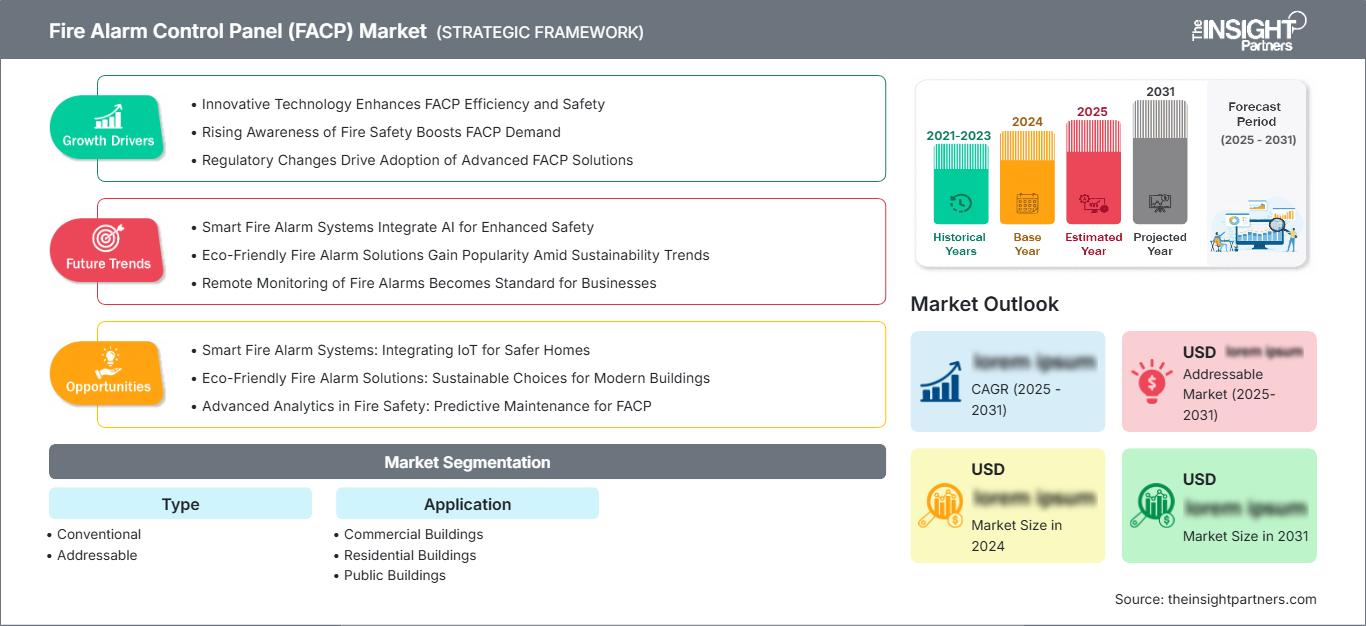
Fire Alarm Control Panel (FACP) Market: Strategic Insights
Regional Insights
North America Fire Alarm Control Panel Market
North America is estimated to command 37–41% of global Fire Alarm Control Panel Market in 2025 and is projected to expand at a 4.8–5.4% CAGR through 2034. Strengths include mature fire safety regulations, an abundance of commercial building stock, periodic inspection, and the removal of legacy panels. Resilience in demand is notable in instances where there is need for system upgrade that does not involve major rewiring or disruption to operations. There is increased adoption of addressable panels in large buildings due to the ability of device level addressing to help in troubleshooting and more elaborate event management. Important application sectors include data centers, healthcare facilities, educational institutions, hospitality establishments, and high-rise buildings.
Other factors driving structural growth in the Fire Alarm Control Panel Market include connectivity in building systems and modernization of existing facilities with old electrical and life-safety infrastructure. Customers in North America are increasingly considering panels in combination with remote monitoring and cybersecurity features. Canada provides the contribution of commercial and institutional construction whereas the US is the key regional demand driver. The presence of a relatively stable market dynamic due to replacement activity and technology-driven retrofits in comparison with other regions where installations rely mostly on new constructions.
U.S. Fire Alarm Control Panel Market Market
The US is estimated to represent 80–84% of North American revenue in 2025 and is expected to grow at a 4.9–5.5% CAGR through 2034. The commercial sector makes up a considerable amount of demand for these systems, while healthcare, education, hospitality, warehousing, and data centers generate the need for scalable systems. The involvement of big players such as Honeywell International Inc., Johnson Controls International plc, Siemens AG, and Bosch Sicherheitssysteme GmbH creates a well-established base for installation and service provision.
In terms of the application trend, there is a shift towards addressable panels, remote diagnostics capabilities, networkability, and interfacing with the larger life safety systems. The replacement cycle is also essential in this industry since property owners require upgrades without changing all the field devices to ensure better information management. The adoption of the Fire Alarm Control Panel Market is also dependent on inspections, insurance, renovation, and operation continuity concerns.
Europe Fire Alarm Control Panel Market
Europe is estimated at 24–28% share in 2025 and is projected to grow at a 4.6–5.2% CAGR through 2034. Germany will continue to be an important country due to its industrial plants, commercial advancements, and engineering skills. UK is another country that can be termed as developed as demand here will be dependent on building renovation, institutions, hospitality, and replacement of devices due to compliance requirements. Europeans usually give importance to reliability, documentation, interoperability, and lifecycle of products.
Germany will still have good industrial and commercial demands especially in areas that require fire safety products to interact with building services. Opportunities in countries such as France, Italy, and Spain can also be found through renovations, hospitality, infrastructure projects, residential projects, and renovations of old buildings. There is increased energy efficiency improvement within building renovation, hence chances for fire safety system improvement along with automation and electricity system improvement in the same buildings.
APAC Fire Alarm Control Panel Market
APAC is estimated to hold 25–29% share in 2025 and is projected to grow at a 6.0–6.7% CAGR through 2034. China is still an important market, while Japan, South Korea, India, and Australia contribute considerable demand. Industrial development, commercial construction, transportation infrastructure, health care investment, and urban development drive the install base. Policy focus on safety and modernization contributes to increasing demand.
India and Southeast Asia have high potential for growth due to increased construction of new commercial and institutional buildings. China integrates infrastructure, manufacturing, and technology investments, while Japan and South Korea focus on systems sophistication and upgrades. Australia makes contributions in terms of commercial construction and safety standards. The regional market trend will increasingly favor addressable architectures, where the project needs scalability and integration with other building systems.
Middle East & Africa Fire Alarm Control Panel Market Market
Middle East and Africa demand is supported by large infrastructure projects, commercial developments, hospitality facilities, airports, healthcare assets, and industrial investments. Saudi Arabia and the UAE remain leading markets, while South Africa provides a significant established base. The region is projected to expand at a 5.5–6.2% CAGR through 2034, with project specifications increasingly favoring sophisticated detection and control capabilities.
Saudi Arabia benefits from major construction and tourism programs, while the UAE combines hospitality, commercial real estate, aviation, and smart-building projects. South Africa contributes through commercial and institutional modernization. The rest of MEA presents more uneven demand, with energy infrastructure, industrial facilities, and public projects creating opportunities. High-temperature environments and remote sites also encourage buyers to prioritize robust equipment, dependable communications, service access, and lifecycle support.

Segmentation Analysis
Type
Fire Alarm Control Panel Market adoption by type is increasingly influenced by building complexity, required information granularity, installation economics, and integration needs. Conventional panels remain relevant for smaller and less complex premises, while addressable systems dominate larger projects requiring precise device identification. The conventional segment is projected to grow at a 4.0–4.5% CAGR during 2026–2034, compared with 6.0–6.5% for addressable systems.
- Conventional: Conventional panels retain a practical position in smaller buildings and cost-sensitive installations where zone-level identification is adequate and straightforward architecture limits commissioning complexity.
- Addressable: Addressable panels remain the leading type because individual device identification, scalable loops, detailed diagnostics, and integration capabilities suit complex commercial and institutional environments.
Application
Application demand reflects differences in occupancy, regulatory exposure, building complexity, and investment cycles. Commercial buildings remain the largest application area because offices, retail properties, hospitality venues, and mixed-use developments require comprehensive detection and notification coverage. Commercial Buildings are projected to grow at a 5.2–5.7% CAGR, Residential Buildings at 4.6–5.1%, and Public Buildings at 6.0–6.6% during 2026–2034.
- Commercial Buildings: Commercial properties require scalable systems capable of supporting varied occupancy profiles, multiple zones, integration with building services, and planned modernization without excessive disruption.
- Residential Buildings: Residential demand centers on dependable protection, simplified installation, cost control, and increasing interest in connected safety technologies across multifamily and higher-density housing.
- Public Buildings: Public facilities require dependable notification, clear emergency response interfaces, and modernization of aging systems across schools, government buildings, transport facilities, and civic infrastructure.
Opportunity Snapshot
| Application | Revenue Contribution | Trend Tag | Adoption Stage |
| Commercial Buildings | High | Smart Integration | Mature |
| Residential Buildings | Medium | Connected Safety | Scaling |
| Public Buildings | Medium | Code Modernization | Scaling |
Fire Alarm Control Panel (FACP) Market Growth Drivers and Impact Analysis
Stricter Life-Safety Compliance and Inspection Requirements
Regulatory enforcement will continue to be one of the primary demand drivers as fire alarm installations need to comply with local regulations and codes, as well as requirements regarding inspection, documentation, and maintenance. NFPA 72 in its 2025 edition has an entire chapter on cybersecurity that underlines the importance of secure architecture for connected fire alarm systems. Such developments increase the technological level of the industry and make it necessary for owners to think about upgrading existing systems if those cannot meet the modern demands. The commercial effect is not limited to selling hardware only since certification, engineering, commissioning, testing, and maintenance become increasingly essential components of the purchasing process. Companies that offer products with wide compliance options can meet more project specifications.
Expansion of Connected and Intelligent Buildings
Property owners are now requiring that life safety systems be able to communicate with other systems in the buildings, particularly when continuity, energy efficiency, and central monitoring become important aspects of operations. This creates a broader scope of operation for the control panel, from being an alarm coordination box to being an operational node that communicates and interacts with other building systems. Connectivity may include remote status, event history, diagnostic, and maintenance capabilities – thus providing added value beyond simply triggering alarms. In a commercial sense, this means that buyers will increasingly require integration, security, and analytics from their fire detection and alarm systems. The vendors will thus be able to leverage not only the hardware of the panel but also its software and the services provided by such software.
Growth of Complex Commercial and Critical Infrastructure
Expansion of data centers, healthcare facilities, logistics campuses, transportation infrastructure, and high-density commercial properties increases the need for fire alarm systems capable of handling large device counts and complex emergency scenarios. These facilities often require detailed location information, resilient communications, integration with suppression equipment, and coordinated emergency response. Data-center development is particularly relevant because power-intensive digital infrastructure creates stringent continuity requirements. As facilities become larger and more interconnected, fire alarm control panels must support rapid fault identification and minimize disruption during testing or maintenance. The market impact is favorable for addressable systems, networked panels, intelligent notification, and advanced diagnostics. It also increases the importance of engineering and service expertise because system configuration can become highly customized. Vendors able to combine hardware, software, commissioning, and lifecycle support are better positioned for complex projects.
Fire Alarm Control Panel (FACP) Market Future Trends
Intelligent Panels with Predictive Diagnostics
Fire alarm control panels are expected to evolve toward continuous system-health monitoring rather than event-only operation. Future architectures will increasingly combine device diagnostics, automated testing, cloud connectivity, and analytics to identify degradation before it becomes a critical failure. Predictive functions could prioritize maintenance based on device behavior, communication quality, battery condition, or recurring fault patterns. This approach should reduce unnecessary site visits while improving confidence in system availability. Artificial intelligence is also likely to support anomaly recognition and nuisance-alarm analysis, although life-safety applications will require controlled validation and clear human oversight. Suppliers that build analytics into panels and associated service platforms can create recurring revenue through monitoring and maintenance. The result will be a broader competitive focus on software, data quality, cybersecurity, and interoperability alongside traditional hardware performance.
Distributed and Software-Defined Fire Safety Architectures
The Fire Alarm Control Panel Market trends show that the next phase of development is likely to emphasize distributed intelligence, modular expansion, and software-defined configuration across larger facilities. Instead of relying exclusively on a central controller, future systems can distribute processing and monitoring capabilities across networked panels, field devices, gateways, and supervisory applications. Such architectures can improve resilience by reducing dependence on individual control points while allowing facilities to expand protection incrementally. Software-based configuration will also simplify updates, diagnostics, reporting, and integration with building-management platforms. Cybersecurity will become a design consideration from commissioning through lifecycle support as more fire systems communicate over connected networks. This trend creates opportunities for suppliers to provide secure architectures with clear segmentation, controlled access, and dependable fallback operation. Procurement teams will increasingly evaluate system architecture and software lifecycle policies alongside panel specifications.
Fire Alarm Control Panel (FACP) Market Opportunities
Localization of Manufacturing and Regional Supply Chains
According to the Fire Alarm Control Panel Market forecast, regional localization presents an opportunity for manufacturers seeking shorter lead times, improved service responsiveness, and stronger alignment with national certification requirements. Local assembly can also help suppliers adapt product configurations to regional installation practices while reducing exposure to logistics disruptions and currency volatility. India, Southeast Asia, the Middle East, and selected European markets offer opportunities where construction activity and infrastructure modernization coincide with increasing demand for certified fire-safety equipment. Manufacturers can strengthen their position by combining local technical teams with centralized research and product development. Partnerships with distributors, system integrators, and engineering firms can further improve market access without requiring fully independent commercial networks. The opportunity is especially relevant for companies able to localize selected production stages while preserving standardized electronics, software platforms, quality controls, and certification processes across multiple markets.
Lifecycle Services and Retrofit-Based Revenue Expansion
The installed base provides an opportunity to increase recurring revenue through inspection, testing, remote monitoring, modernization, replacement planning, and software-enabled maintenance. Many building owners prefer phased upgrades because complete system replacement can interrupt operations and require significant capital expenditure. Suppliers can respond with modular panels, backward-compatible interfaces, migration tools, and service contracts that extend the useful life of existing infrastructure while introducing modern functionality. This strategy can deepen customer relationships and make revenue less dependent on new construction cycles. Retrofit programs are particularly attractive in mature markets where large numbers of commercial, institutional, and industrial buildings already contain fire alarm infrastructure. Companies that combine engineering expertise with digital monitoring can also identify replacement opportunities from recurring faults and obsolete equipment. Lifecycle strategies therefore provide a practical route to sustained account development.
Recent Developments
- June 2026: DelCam Capital expanded its Space Age Electronics fire & life safety platform through the acquisition of SprinkGuard, strengthening its capabilities in commercial and industrial fire sprinkler protection.
- July 2026: Alarm.com expanded into commercial fire safety with the launch of its Fire Communicator, providing connected fire alarm communications and integration with its existing security platform.
- July 2026: Global Fire Equipment launched the FALCON and FALCON Ex fire detection and extinguishing control panels, targeting commercial, industrial, and critical-infrastructure applications.
- July 2026: APi Group completed the acquisition of WTech Fire Group, expanding its fire protection capabilities and European presence while updating its 2026 financial guidance..
Frequently Asked Questions

- Comprehensive Market Sizing and Forecast Analysis
- Detailed Segmentation Analysis
- In-Depth Market Dynamics Assessment
- Regional and Country-Level Insights
- Competitive Landscape and Company Benchmarking
- Strategic Business Intelligence
Recent Reports
Testimonials

The Insight Partners provided valuable market intelligence that supported our global go-to-market strategy. Their team was professional, responsive, and attentive to our feedback, providing thoughtful analysis and helpful methodological clarifications throughout the project.
Junmo Kim Chief Financial Officer (CFO), Enertech Co., Ltd.
The Insight Partners' SCADA System Market report is comprehensive, with valuable insights on current trends and future forecasts. The team was highly professional, responsive, and supportive throughout. We are very satisfied and highly recommend their services.
RAN KEDEM Partner, Reali Technologies LTDs
I requested a report on a very specific software market and the team produced the report in a few days. The information was very relevant and well presented. I then requested some changes and additions to the report. The team was again very responsive and I got the final report in less than a week.
JEAN-HERVE JENN Chairman, Future Analytica
We worked with The Insight Partners for an important market study and forecast. They gave us clear insights into opportunities and risks, which helped shape our plans. Their research was easy to use and based on solid data. It helped us make smart, confident decisions. We highly recommend them.
PIYUSH NAGPAL Sr. Vice President, High Beam Global
The Insight Partners delivered insightful, well-structured market research with strong domain expertise. Their team was professional and responsive throughout. The user-friendly website made accessing industry reports seamless. We highly recommend them for reliable, high-quality research services
YUKIHIKO ADACHI CEO, Deep Blue, LLC.
This is the first time I have purchased a market report from The Insight Partners.While I was unsure at first, I visited their web site and felt more comfortable to take the risk and purchase a market report.I am completely satisfied with the quality of the report and customer service. I had several questions and comments with the initial report, but after a couple of dialogs over email with their analyst I believe I have a report that I can use as input to our strategic planning process.Thank you so much for taking the extra time and making this a positive experience.I will definitely recommend your service to others and you will be my first call when we need further market data.
JOHN SUZUKI President and Chief Executive Officer, Board Director, BK Technologies
I wish to appreciate your support and the professionalism you displayed in the course of attending to my request for information regarding to infectious disease IVD market in Nigeria. I appreciate your patience, your guidance, and the fact that you were willing to offer a discount, which eventually made it possible for us to close a deal. I look forward to engaging The Insight Partners in the future, all thanks to the impression you have created in me as a result of this first encounter.
DR CHIJIOKE ONYIA MANAGING DIRECTOR, PineCrest Healthcare Ltd.Reason to Buy
- Informed Decision-Making
- Understanding Market Dynamics
- Competitive Analysis
- Identifying Emerging Markets
- Customer Insights
- Market Forecasts
- Risk Mitigation
- Boosting Operational Efficiency
- Strategic Planning
- Investment Justification
- Tracking Industry Innovations
- Aligning with Regulatory Trends





 Get Free Sample for