
Flexible Epoxy Resin Market Size, Demand & Growth by 2034
Coverage: by Type (Urethane, Modified, Rubber Modified, Dimer Acid); Application (Paints and Coatings, Composites, Adhesives, Others) , and Geography (North America, Europe, Asia Pacific, and South and Central America)
- Status : Data Released
- Report Code : TIPRE00005090
- Category : Chemicals and Materials
- No. of Pages : 150
- Available Report Formats :


- Last update date : September 17, 2026


2025 Market Size
US$ 802.00 Mn
Base year value
2034 Forecast
US$ 1,331.00 Mn
Projected by 2034
CAGR 2026-2034
5.79 %
Growth rate
Addressable Market
US$ 9,665.32 Mn
(2026-2034)
The Flexible Epoxy Resin Market size was valued at US$ 802.00 Million in 2025 and is projected to reach US$ 1,331.00 Million by 2034, expanding at a CAGR of 5.79% during 2026–2034. The market is supported by rising demand for epoxy systems that combine adhesion, toughness, impact resistance, chemical durability, and controlled flexibility across coatings, composites, and adhesive formulations. Flexible chemistries increasingly address applications where conventional rigid epoxy systems face cracking, vibration, or thermal-expansion limitations.
North America is expected to record a CAGR of approximately 5.2–5.8% during 2026–2034, supported by demand for lightweight composite structures and durable industrial coatings. Expansion in automotive electrification, aerospace manufacturing, infrastructure refurbishment, and advanced adhesive applications is strengthening demand for modified resin systems that provide toughness without sacrificing epoxy-based adhesion and chemical resistance. Flexible formulations are also gaining relevance in applications requiring vibration tolerance and thermal-cycle durability.
Flexible Epoxy Resin Market Assessment and Insights
- North America: The region is estimated to hold a 29–33% Flexible Epoxy Resin Market share in 2025 and expand at a CAGR of 5.2–5.8% between 2026–2034, supported by aerospace, automotive, electronics, industrial coatings, and composite manufacturing.
- US: The US represents approximately 24–27% of the global market in 2025 and is expected to grow at a CAGR of 5.3–5.9% through 2034, led by advanced manufacturing and infrastructure applications.
- Europe: Europe accounts for an estimated 24–28% share in 2025 and is projected to grow at 4.8–5.4% CAGR between 2026–2034, with Germany, France, Italy, and the UK supporting demand through automotive, aerospace, industrial coating, and composite applications.
- Asia Pacific: Asia Pacific represents approximately 25–29% share in 2025 and is expected to register the strongest regional CAGR of 6.2–6.9% during 2026–2034, led by China, Japan, South Korea, and India.
- Largest Segment: Urethane holds an estimated 54–58% market share in 2025 and is projected to grow at a CAGR of 5.6–6.1% during 2026–2034, reflecting broad formulation versatility.
- High Growth Segment: Rubber Modified represents approximately 29–34% share in 2025 and is expected to expand at 6.0–6.6% CAGR between 2026–2034, supported by toughness and impact-resistance requirements.
- Key companies analyzed in detail: Aditya Birla Chemicals, Atul Limited, DIC Corporation, EPOXONIC GmbH Reaktionsharzsysteme, Hexion Inc., Huntsman Corporation, KUKDO CHEMICAL CO., LTD., Olin Corporation, Resoltech S.A.R.L., Spolchemie, a.s.
Source: The Insight Partners' analysis based on proprietary research, government publications, company annual reports, investor presentations, industry databases, and expert interviews.
The Flexible Epoxy Resin Market has progressed from traditional flexibilized epoxy resins to sophisticated formulations offering a balance between elongation, toughness, adhesion, chemical resistance, and processability. Modification with urethanes, rubbers, and dimer acids influences cross-link density and phases, allowing for tuning of the properties of the cured material. Modern manufacturing processes have become increasingly concerned with control of viscosity, reactive functionality, emissions reduction, and automation.
Further development in the Flexible Epoxy Resin Market will be more focused on regional manufacturing localization, investment in electronics, light weighting for transportation, renewable energy facilities, and industrial upgrading. Manufacturers are also working on emission reduction, biobased, and specialized formulations that do not compromise on durability as customers look for improved sustainability. Environmental legislation relating to chemical exposure and safety, as well as volatility of organic compounds, is pushing for reformulation, as investments in production in Asia are making supplies more readily available.
Flexible Epoxy Resin Market Report Scope
| Report Attribute | Details |
|---|---|
| Market size in 2025 | US$ 802.00 Million |
| Market Size by 2034 | US$ 1,331.00 Million |
| Global CAGR (2026 - 2034) | 5.79% |
| Historical Data | 2021-2024 |
| Forecast period | 2026-2034 |
Flexible Epoxy Resin Market Analysis
The Flexible Epoxy Resin Market demand is driven by applications in which standard, rigid epoxy systems fail to sufficiently dampen any impact, vibration, thermal, or deformations. There are now rising demands for flexibility along with all of the features of traditional epoxies in automotive parts, composites, industrial coatings, electronic assemblies, and structural adhesives.
There is a chain of activities beginning from epichlorohydrin, bisphenol derivatives, additives, modifiers, diluents, curing agents, and fillers. The resins are compounded into modified forms by resin manufacturers, who sell the products to compounders, adhesives makers, coatings producers, and composite fabricators. The economics of supply are always affected by petrochemical feedstock prices, energy prices, logistics, and regional production capacity.
Application engineering in the Flexible Epoxy Resin Market is becoming more crucial than just high volumes in competitive positioning. Aditya Birla Chemicals and Atul Limited provide comprehensive epoxy resins, whereas DIC Corporation integrates epoxy chemistry with electronics and coatings. EPOXONIC GmbH Reaktionsharzsysteme specializes in custom reactive resin systems, and Huntsman Corporation possesses a wide range of adhesives and composite formulations. Hexion Inc., Olin Corporation, KUKDO CHEMICAL CO., LTD., Resoltech S.A.R.L., and Spolchemie, a.s. engage in competition through formulation specialization, regional production, technical service, and application engineering.
The areas of priority investments are moving towards advanced formulations, sustainable chemistry, regional manufacturing, and customized resin systems. The investment in increased epoxy manufacturing capacity in semiconductor-related applications by DIC Corporation demonstrates the strategic importance of security of supply and specialty resin production. Specialty suppliers can enhance their competitive position by reducing qualification time, formulating application-specific resins, and offering technical service at all stages of formulation, curing, and processing.
● REPORT CUSTOMIZATION
Tailor This Report To Align With Your Specific Business Requirements
This report can be customized to align precisely with your business objectives, scope, and target markets. Customization options include tailored segmentation, geography, competitive analysis, and strategic insights to support informed decision-making.
Customize This Report →WHAT YOU CAN ADJUST
- ● Segmentations
- ● Geography
- ● Competitive Analysis
- ● Language Preferences
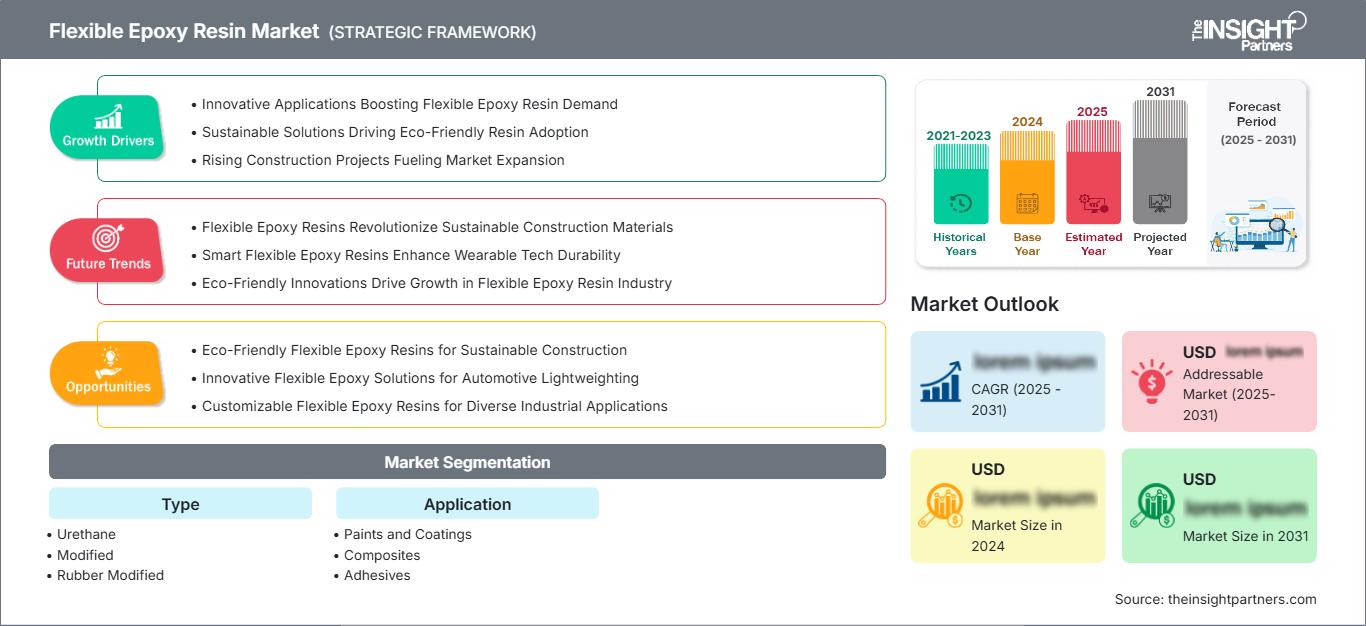
Flexible Epoxy Resin Market: Strategic Insights
Regional Insights
North America Flexible Epoxy Resin Market
North America is estimated to represent 29–33% of the global Flexible Epoxy Resin Market in 2025, with a projected CAGR of 5.2–5.8% through 2034. Demands are driven by aerospace and aircraft parts, automotive, electronics, industrial maintenance, building refurbishment, and composites production. There is a well-developed ecosystem of resin suppliers, formulators, distributors, and specialty adhesives, which enables fast implementation of the specific application-oriented chemistries. Increasing demands for automotive lightweighting and electric vehicles are demanding materials, which can cope with vibrations, thermal cycling, and bonding of diverse materials.
The United States consumes the major share of the regional demand due to aerospace structures, automotive parts, industrial coatings, electrical applications, and high-performance adhesives. The Canadian demand is driven by transport, construction, energy, and industrial maintenance, whereas Mexico takes advantage of its automotive production and electronics-oriented supply chain. Decisions on the material procurement more and more focus on the total performance of the application, processing speed, warranty requirements, and regulatory issues instead of the resin cost alone.
U.S. Flexible Epoxy Resin Market
The US is estimated to account for approximately 74–82% of North American consumption in 2025, equivalent to about 24–27% globally, with a CAGR of 5.3–5.9% through 2034. The demand centers on aerospace, automobiles, electronics, industrial paints, construction, and advanced composites. There are well-developed technical service facilities provided by both local producers and foreign suppliers to qualify new resin systems for harsh environments.
Key application areas in the Flexible Epoxy Resin Market include the growth in automotive electric vehicles, aerospace manufacture, defense-related industries, infrastructure rebuilding, and electronics assembly. Flexibility of formulations is especially important in cases when substrates are exposed to vibration, shock, thermal cycling, and repeated mechanical stress. Companies such as Huntsman Corporation, Hexion Inc., Olin Corporation, and Aditya Birla Chemicals compete along with specialized suppliers using product differentiation and quality services.
Europe Flexible Epoxy Resin Market
Europe is estimated to hold a 24–28% global Flexible Epoxy Resin Market in 2025 and grow at 4.8–5.4% CAGR through 2034. Germany is the main consumer, followed by the UK, France, Italy, and Spain. Germany is aided by its automobile industry, industrial machinery, and electronics and manufacturing industries, while France gains from its aerospace and transportation and industrial applications. The UK retains its demand for aerospace, construction, marine, and specialty adhesives applications.
According to the Flexible Epoxy Resin Market forecast, Germany continues to be the largest European country due to its auto industry, industrial equipment manufacturing sector, and chemical sector. France gains from aerospace and transportation applications, while Italy and Spain help in driving demand due to auto components, construction, coatings, marine and industrial manufacturing. Europe formulators are under immense pressure to cut emissions and enhance worker safety and sustainability, which drives formulators to invest in low emission and bio-based resins technology.
APAC Flexible Epoxy Resin Market
APAC is estimated to represent 25–29% of global demand in 2025 and is projected to expand at 6.2–6.9% CAGR through 2034. The major countries for consumption are China, followed by Japan, South Korea, India, and Australia. The electronics manufacturing industry, automotive manufacturing, investment in infrastructure development, the use of composites, and industrial coatings drives the consumption demand, while increased local production capacity of chemicals boosts supply security.
While China still takes the lead, India emerges as one of the fast-growing markets for chemicals due to the industrialization and manufacturing localization. Japan and South Korea still show high demand driven by their industries related to electronics and automobile sectors, while Australia makes its contribution with the development of infrastructure, mining, and maintenance activities.
Middle East & Africa Flexible Epoxy Resin Market
Middle East and Africa demand remains smaller than major regions but is supported by construction, energy infrastructure, transportation, marine applications, and industrial maintenance. Saudi Arabia and the UAE lead regional consumption, while South Africa provides an important industrial base. The region is estimated to expand at approximately 5.0–5.7% CAGR through 2034.
Saudi Arabia benefits from large infrastructure and industrial diversification programs, while the UAE supports demand through construction, logistics, marine activities, and industrial development. South Africa contributes through mining, infrastructure, transportation, and protective coatings. Rest of MEA demand remains fragmented but can increase as industrial facilities, pipelines, utilities, and construction assets require durable coating and adhesive systems capable of handling demanding environmental conditions.
Segmentation Analysis
Type
The Type segment is projected to expand at approximately 5.5–6.0% CAGR during 2026–2034. Formulation selection depends on the required balance between flexibility, toughness, adhesion, chemical resistance, processing viscosity, and thermal performance. Urethane remains the dominant chemistry, while rubber-modified systems are gaining importance for impact absorption and crack resistance. Dimer-acid systems retain relevance where controlled flexibility and chemical durability are prioritized.
- Urethane: Urethane-modified formulations maintain the strongest market position because they combine epoxy adhesion with enhanced flexibility, toughness, and impact resistance across coatings, adhesives, and composite applications.
- Modified: Modified formulations provide formulators with flexibility to tune viscosity, curing response, adhesion, and mechanical performance, making them strategically important for specialized industrial requirements and customized resin systems.
- Rubber Modified: Rubber-modified systems improve toughness, elongation, crack resistance, and vibration absorption, supporting structural adhesives, automotive components, industrial coatings, and composite applications exposed to repeated mechanical stresses.
- Dimer Acid: Dimer-acid formulations provide controlled flexibility, adhesion, and resistance to mechanical deformation, supporting selected coatings, adhesives, laminates, and applications requiring improved toughness without excessive loss of strength.
Application
The Application segment is projected to grow at approximately 5.7–6.2% CAGR during 2026–2034. Paints and coatings remain important because flexible epoxy formulations help resist cracking and substrate movement. Composites benefit from improved toughness, while adhesives increasingly require flexibility to accommodate differential thermal expansion and vibration. Application development is therefore moving toward multifunctional systems with easier processing and stronger durability.
- Paints and Coatings: Demand remains substantial in protective, industrial, marine, flooring, and infrastructure coatings where flexibility helps reduce cracking and improves coating durability under mechanical or thermal movement.
- Composites: Composite applications require resin systems combining lightweight construction with impact resistance and controlled flexibility, supporting automotive, aerospace, wind-energy, sports, and industrial component manufacturing.
- Adhesives: Flexible epoxy adhesives support durable bonding between dissimilar substrates, offering toughness, chemical resistance, and dimensional stability for automotive, electronics, construction, industrial, and specialty assembly applications.
Opportunity Snapshot
| Applications | Revenue Contribution | Trend Tag | Adoption Stage |
|---|---|---|---|
| Paints and Coatings | High | Corrosion Protection | Mature |
| Composites | High | Lightweight Structures | Scaling |
| Adhesives | High | Mixed-Material Bonding | Scaling |
Flexible Epoxy Resin Market Growth Drivers and Impact Analysis
Lightweighting and Tougher Composite Structures
According to the Flexible Epoxy Resin Market report, automotive, aerospace, transportation, and renewable energy manufacturers are looking for ways of making their components lighter but retaining the strength of these parts. Flexible epoxies may be used by manufacturers to increase the strength of materials used for composites as well as to decrease the brittleness of these materials. Material performance will provide possibilities of creating thinner products, durable bonded assemblies, and more frequent servicing periods. For producers of resins, it means that it is possible to go further than usual formulations by creating application-specific formulations that may be used for infusion, bonding, or lamination. Flexible chemistry is very useful for composite processors because of the reduction of cracking or early failure of materials. This driver becomes more relevant when there are material substitutions that will result in lighter products.
Expansion of High-Performance Industrial Coatings
Coatings for industrial structures will become more important to resist corrosion, chemicals, wear, temperature fluctuations, and mechanical motion. The flexible epoxy coatings offer good protection and crack resistance especially when there is expansion, contraction, or vibrations of substrates. This will mean higher demand of coatings in areas such as infrastructures, industrial machinery, marine products, pipelines, flooring, and power generation facilities. In the coating formulation business, flexible epoxy coatings allow differentiation in terms of adhesion, durability, curing, and environmental aspects. Manufacturers who have managed to produce low emission or waterborne coatings will be able to meet the stringent workplace and environmental regulations while still offering performance. There is more than resin volume from a business perspective since better performing coatings may cost more per unit of resin.
Growth of Advanced Adhesive Assembly
More and more manufacturers rely on adhesive bonding techniques to connect materials such as metals, composites, plastics and many others which are hard to attach by means of traditional mechanical fasteners. Epoxy systems which have good flexibility allow compensating thermal expansion and mechanical loads while ensuring high adhesion levels. It is especially important for automotive, electronics, transportation, industrial equipment and building industries. The trend towards adhesive assembling makes it necessary for suppliers to provide materials which have proper viscosity, easy to cure resins, good peel strength and the right degree of flexibility. This approach will be strategically valuable as adhesives usually generate stronger ties with customers and bigger switching costs compared to resins themselves.
Flexible Epoxy Resin Market Future Trends
Bio-Based and Lower-Impact Flexible Epoxy Systems
Future product development will increasingly focus on reducing fossil-derived content, hazardous components, and lifecycle impacts while retaining epoxy performance. Bio-based modifiers, renewable feedstocks, recyclable curing concepts, and lower-emission formulations are likely to receive greater development attention. Customers will increasingly evaluate resins using both technical specifications and environmental attributes, especially in Europe and advanced manufacturing supply chains. Flexible systems may benefit because formulation architecture can be redesigned around renewable modifiers without completely changing downstream processing equipment. Producers that demonstrate measurable environmental improvements while maintaining adhesion, toughness, and durability will have stronger opportunities for specification. The trend will also encourage greater transparency regarding feedstock origin, product carbon footprint, regulatory status, and manufacturing practices. Qualification will remain important because customers will prioritize validated performance over sustainability claims alone.
Application-Specific Smart Formulation Platforms
The Flexible Epoxy Resin Market trends show that future formulation development is expected to become increasingly application-specific rather than centered on standardized resin grades. Digital formulation tools, simulation, automated testing, and customer process data can help suppliers optimize viscosity, cure kinetics, toughness, flexibility, and thermal performance for particular manufacturing environments. This approach can reduce formulation iterations and improve consistency during scale-up. Producers may increasingly offer modular resin systems in which modifiers, curing agents, and additives are selected according to the customer's processing method and performance target. Such platforms can support rapid adaptation for automotive, electronics, aerospace, coatings, and composite applications. Over time, this model could shift competition from resin specifications alone toward integrated formulation engineering, technical support, and process optimization. Suppliers with strong R&D capabilities and application laboratories are likely to benefit most from this transition.
Flexible Epoxy Resin Market Opportunities
Localized Specialty Resin Manufacturing in Asia
Expanding electronics, automotive, composite, and industrial manufacturing in Asia creates opportunities for localized specialty resin production. China, India, Japan, and South Korea offer established chemical ecosystems and growing downstream demand, allowing producers to shorten supply chains and respond faster to customer specifications. Investment should prioritize flexible resin grades for electronics, composites, adhesives, and protective coatings rather than relying solely on standard commodity epoxy products. Local technical centers can further reduce qualification time and support formulation adaptation to regional processing conditions. Partnerships with compounders, adhesive formulators, and composite manufacturers can provide early visibility into emerging requirements. Capacity additions should also incorporate feedstock flexibility and environmental controls to manage future regulatory expectations. Such investments can improve delivery reliability while creating higher-value revenue streams.
Premium Formulations for Electric Mobility and Electronics
Electric mobility and advanced electronics create opportunities for flexible epoxy systems that tolerate vibration, thermal cycling, miniaturization, and mixed-material interfaces. Battery-related assemblies, electronic modules, sensors, power-management components, and lightweight vehicle structures increasingly require materials combining mechanical durability with electrical or thermal performance. Producers can target this opportunity through specialized grades offering controlled cure, low shrinkage, appropriate dielectric behavior, and strong adhesion. Close collaboration with component manufacturers can accelerate qualification and enable customized systems. Investment in application laboratories and small-batch development capacity can be particularly valuable because electronics and mobility customers often require precise formulation control. Suppliers that secure early design-in positions may benefit from recurring demand as platforms move from prototype to serial production and replacement cycles expand.
Recent Developments
- February 2026: Toray Industries, Inc. — Toray developed a PFAS-free flexible polyphenylene sulfide (PPS) resin designed to combine heat resistance, chemical resistance, and flexibility while addressing tightening PFAS regulations. The company plans to establish a mass-production structure within fiscal 2026. The development highlights the broader industry shift toward high-performance, regulatory-compliant flexible resin systems for demanding applications.
- November 2025: European Coatings — Research highlighted two newly developed epoxy curing agents, DETA-Si and NBOn, that improve flexibility and performance under cryogenic conditions. DETA-Si/epoxy achieved 125% elongation at break with low dielectric loss, while NBOn-based systems retained more than 50% of their ductility after exposure to liquid nitrogen at 77 K. The findings expand potential applications in sensors, electronics, and extreme-temperature environments.
Frequently Asked Questions

- Comprehensive Market Sizing and Forecast Analysis
- Detailed Segmentation Analysis
- In-Depth Market Dynamics Assessment
- Regional and Country-Level Insights
- Competitive Landscape and Company Benchmarking
- Strategic Business Intelligence
Recent Reports
Testimonials

The Insight Partners' SCADA System Market report is comprehensive, with valuable insights on current trends and future forecasts. The team was highly professional, responsive, and supportive throughout. We are very satisfied and highly recommend their services.
RAN KEDEM Partner, Reali Technologies LTDs
I requested a report on a very specific software market and the team produced the report in a few days. The information was very relevant and well presented. I then requested some changes and additions to the report. The team was again very responsive and I got the final report in less than a week.
JEAN-HERVE JENN Chairman, Future Analytica
We worked with The Insight Partners for an important market study and forecast. They gave us clear insights into opportunities and risks, which helped shape our plans. Their research was easy to use and based on solid data. It helped us make smart, confident decisions. We highly recommend them.
PIYUSH NAGPAL Sr. Vice President, High Beam Global
The Insight Partners delivered insightful, well-structured market research with strong domain expertise. Their team was professional and responsive throughout. The user-friendly website made accessing industry reports seamless. We highly recommend them for reliable, high-quality research services
YUKIHIKO ADACHI CEO, Deep Blue, LLC.
This is the first time I have purchased a market report from The Insight Partners.While I was unsure at first, I visited their web site and felt more comfortable to take the risk and purchase a market report.I am completely satisfied with the quality of the report and customer service. I had several questions and comments with the initial report, but after a couple of dialogs over email with their analyst I believe I have a report that I can use as input to our strategic planning process.Thank you so much for taking the extra time and making this a positive experience.I will definitely recommend your service to others and you will be my first call when we need further market data.
JOHN SUZUKI President and Chief Executive Officer, Board Director, BK Technologies
I wish to appreciate your support and the professionalism you displayed in the course of attending to my request for information regarding to infectious disease IVD market in Nigeria. I appreciate your patience, your guidance, and the fact that you were willing to offer a discount, which eventually made it possible for us to close a deal. I look forward to engaging The Insight Partners in the future, all thanks to the impression you have created in me as a result of this first encounter.
DR CHIJIOKE ONYIA MANAGING DIRECTOR, PineCrest Healthcare Ltd.Reason to Buy
- Informed Decision-Making
- Understanding Market Dynamics
- Competitive Analysis
- Identifying Emerging Markets
- Customer Insights
- Market Forecasts
- Risk Mitigation
- Boosting Operational Efficiency
- Strategic Planning
- Investment Justification
- Tracking Industry Innovations
- Aligning with Regulatory Trends





 Get Free Sample for