
Floor-mounted Electric Enclosure Market Growth, Trends & Demand by 2034
Coverage: By Product Type (Small Enclosure, Compact Enclosure, Free-size Enclosure); Applications (Power generation and distribution, Oil and Gas, Metals and Mining, Medical Pulp and Paper, Food and Beverages, Others) , and Geography (North America, Europe, Asia Pacific, and South and Central America)
- Status : Data Released
- Report Code : TIPRE00020268
- Category : Electronics and Semiconductor
- No. of Pages : 150
- Available Report Formats :


- Last update date : September 10, 2026


2025 Market Size
US$ 1.24 Bn
Base year value
2034 Forecast
US$ 2.06 Bn
Projected by 2034
CAGR 2026-2034
5.83 %
Growth rate
Addressable Market
US$ 14.97 Bn
(2026-2034)
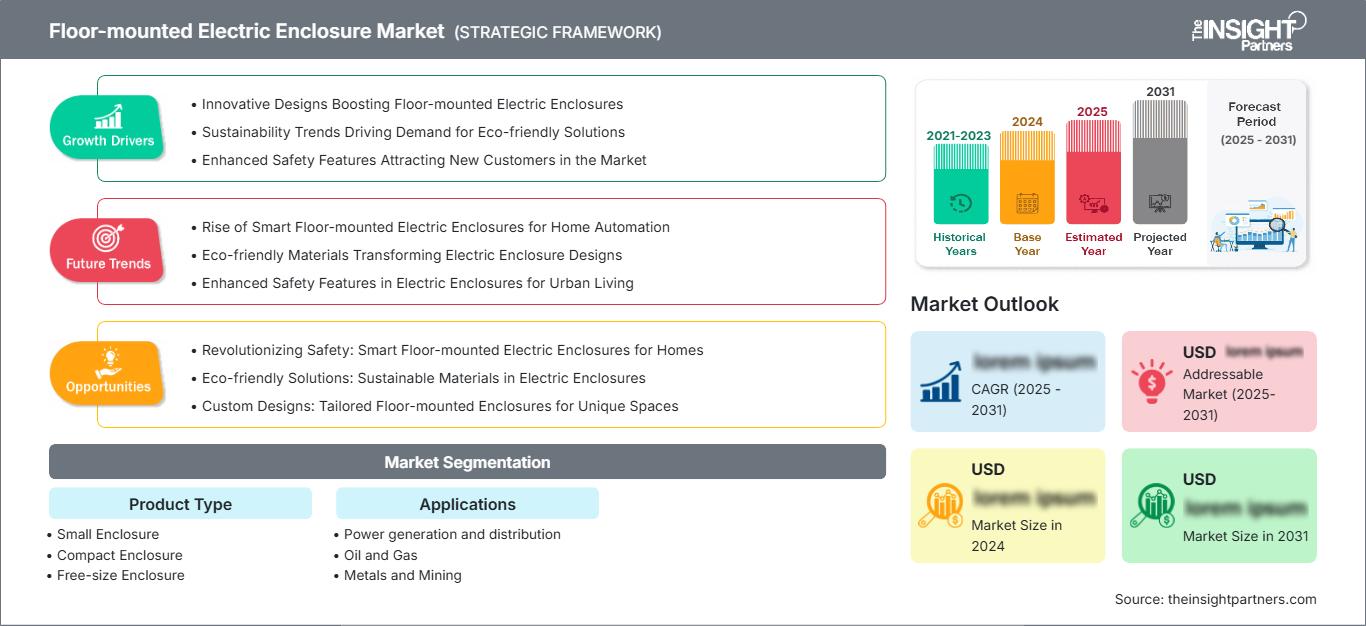
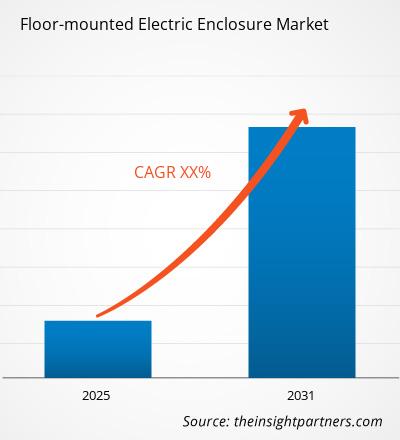
The Floor-mounted Electric Enclosure Market is positioned for sustained expansion as industrial electrification, power infrastructure modernization, and automated manufacturing increase demand for protected electrical equipment. The market is valued at US$ 1.24 Billion in 2025 and is projected to reach US$ 2.06 Billion by 2034, advancing at a CAGR of 5.83% during 2026–2034. Demand is increasingly shaped by enclosure modularity, thermal management, corrosion resistance, and compliance with electrical safety requirements.
North America represents a structurally attractive market, supported by replacement of aging distribution assets and continuing investment in data centers, utilities, and manufacturing capacity. The Floor-mounted Electric Enclosure Market size in the region is expected to expand at an estimated 5.3–5.9% CAGR through 2034, with demand benefiting from standardized NEMA-rated systems, domestic manufacturing, and infrastructure resilience programs.
Floor-mounted Electric Enclosure Market Assessment and Insights
- North America: The region is estimated to hold a 29–33% Floor-mounted Electric Enclosure Market share in 2025 and expand at a 5.3–5.9% CAGR between 2026–2034, supported by grid modernization, industrial reshoring, data-center construction, and replacement of aging electrical infrastructure.
- US: The US accounts for an estimated 68–73% of North America's 2025 market share and is expected to grow at a 5.4–6.0% CAGR between 2026–2034, led by utilities, manufacturing, and digital infrastructure.
- Europe: Europe is estimated to represent a 25–29% share in 2025, with a 4.6–5.2% CAGR between 2026–2034. Germany, the UK, France, Italy, and Spain support demand through industrial automation, energy transition projects, and equipment modernization.
- Asia Pacific: Asia Pacific is estimated to command a 30–34% share in 2025 and grow at a 6.4–7.0% CAGR between 2026–2034, led by China, Japan, South Korea, and India as manufacturing and power investment deepen.
- Largest Segment: Free-size Enclosure is estimated at a 42–46% market share in 2025, expanding at a 5.9–6.4% CAGR during 2026–2034 as complex installations require configurable floor-standing protection.
- High Growth Segment: Power generation and distribution is estimated at a 31–35% market share in 2025, growing at a 6.4–6.9% CAGR during 2026–2034 as grid investment accelerates.
- Key companies analyzed in detail: NEMA Enclosures, EPI Electrical Enclosures and Engineering, KDM Steel, Rittal GmbH & Co. KG, Schneider Electric SE, nVent Electric plc, Emerson Electric Co., Eaton Corporation plc, Hammond Manufacturing Ltd., Fibox Oy Ab.
Source: The Insight Partners' analysis based on proprietary research, government publications, company annual reports, investor presentations, industry databases, and expert interviews.
Enclosures for industrial use are shifting from mere equipment protection to flexible systems that incorporate thermal management, cable management, isolation of safety devices, and quick assembly. The economics of manufacture will tend more towards standard platform architecture, consistent mounting dimensions, and flexible accessories. Metal fabrication is still very key, but the choice of stainless steel, coated steel, aluminum, and non-metallics will be made based on corrosion, hygiene, weight, and environmental considerations.
During the forecast period, investment is expected to shift more towards infrastructure-intensive applications and local manufacturing. The emerging economies of Asia provide large-scale manufacturing, while the markets in North America and Europe require continuity of supply. Sustainability considerations are also influencing choice of materials, recycle content, coating methods, and lifecycle data on products. Regulatory alignment with IEC, NEMA, UL, and regional environmental standards will strengthen demand for enclosure systems.
Floor-mounted Electric Enclosure Market Report Scope
| Report Attribute | Details |
|---|---|
| Market size in 2025 | US$ 1.24 Billion |
| Market Size by 2034 | US$ 2.06 Billion |
| Global CAGR (2026 - 2034) | 5.83% |
| Historical Data | 2021-2024 |
| Forecast period | 2026-2034 |
Floor-mounted Electric Enclosure Market Analysis
Increased deployment of switchgear, motor controls, variable frequency drives, programmable controllers, and distribution systems, which need housing, is driving Floor-mounted Electric Enclosure Market demand in utilities, manufacturing, mining, food processing, and oil and gas industries. The ecosystem comprises raw material suppliers such as steel and polymer providers, enclosure fabricators, enclosure manufacturers, panel builders, system integrators, distributors, EPC contractors, and end users. Increasing factors driving supply include sheet steel prices, components availability, fabrication capabilities, and regional certifications.
Increasing demand is also characterized by configurable products to reduce time taken to build panels and account for different equipment configurations. Competition among suppliers includes enclosure sizes, ingress protection, thermal management, mounting options, customization, and timely delivery. Larger players enjoy wider catalog of products and distribution capabilities, while smaller fabricators compete through engineering capabilities and limited batch productions. Local sourcing continues to be significant wherever the project requires quick modifications, field services, and local certifications.
In terms of the Floor-mounted Electric Enclosure Market competitive analysis, the market is composed of a blend of diversified electrical equipment players and specialized enclosure manufacturers. Companies like Schneider Electric SE, nVent Electric plc, Eaton Corporation plc, and Rittal GmbH & Co. KG have wide system lineups, while Hammond Manufacturing Ltd., Fibox Oy Ab, KDM Steel, NEMA Enclosures, and EPI Electrical Enclosures and Engineering focus on specialized enclosures lineup. Emerson Electric Co. competes in the market through industrial automation and electrical infrastructure solutions.
Investments in floor-mounted electric enclosures continue to favor system level protection compared to independent cabinets. Investment activities by nVent in acquisition of companies illustrate consolidation towards infrastructure protection while portfolio development of Schneider Electric is based on configurability and reduced impact of enclosures.
● REPORT CUSTOMIZATION
Tailor This Report To Align With Your Specific Business Requirements
This report can be customized to align precisely with your business objectives, scope, and target markets. Customization options include tailored segmentation, geography, competitive analysis, and strategic insights to support informed decision-making.
Customize This Report →WHAT YOU CAN ADJUST
- ● Segmentations
- ● Geography
- ● Competitive Analysis
- ● Language Preferences
Floor-mounted Electric Enclosure Market: Strategic Insights
Regional Insights
North America Floor-mounted Electric Enclosure Market
North America is estimated to hold a 29–33% share in 2025 and record a 5.3–5.9% CAGR through 2034. The region benefits from utility modernization, manufacturing expansion, data-center construction, and replacement of aging control infrastructure. Demand is concentrated in the US, with Canada providing additional opportunities through mining, energy, utilities, and industrial projects.
The regional market tends to prefer NEMA-rated steel and stainless-steel enclosures when environmental and physical protection is an issue. The utilities are demanding configurable enclosures for use in substations, distribution equipment, and controls, while the manufacturers value fast assembly of the panels. Shorter lead-time exposure results from local manufacturing and reliable distributor networks. Investments made by the IEA in electric power networks also support enclosure needs over the long term.
U.S. Floor-mounted Electric Enclosure Market
The US represents an estimated 68–73% of North America's 2025 market and is projected to grow at a 5.4–6.0% CAGR through 2034. Strong application demand comes from utilities, industrial automation, oil and gas, semiconductor manufacturing, and data-center electrical infrastructure. NEMA certification and UL compliance remain important purchasing criteria.
Examples of companies that have presence in the market include Schneider Electric SE, nVent Electric plc, Eaton Corporation plc, Emerson Electric Co., and NEMA Enclosures. Growing demands call for large stand-alone models in areas like power distribution, motor control, and automation systems. Custom fabrication is still applicable in situations where installations need unique sizes or protection systems.
Europe Floor-mounted Electric Enclosure Market
Europe is estimated to account for a 25–29% share in 2025 and expand at a 4.6–5.2% CAGR through 2034. Germany continues to be the major market in the region, which is driven by industrial automation, machinery production, renewable energy and electricity equipment production. The UK sustains its demand for the utilities sector, infrastructure, data centers and process industries, taking lifecycle efficiency and the documentation of material properties into account.
France, Italy and Spain represent diversified demand, covering manufacturing, food processing, energy, infrastructure and building services. France receives its advantages through investments in power system and industrial development, Italy due to machinery and manufacturing clusters and Spain due to renewable energy deployment and grid enhancement. European buyers pay a lot of attention to IEC compliance, corrosion protection, heat dissipation, recycling and standardization of modular design.
APAC Floor-mounted Electric Enclosure Market
APAC is estimated to represent a 30–34% share in 2025 and grow at a 6.4–7.0% CAGR through 2034, making it the fastest-growing major region. China leads regional demand, followed by Japan, South Korea, India, and Australia. Manufacturing expansion and electrical infrastructure investment remain central drivers.
Policy-supported industrialization, renewable deployment, semiconductor investment, and automation are increasing requirements for protected distribution and control equipment. China provides production scale, Japan emphasizes precision manufacturing, South Korea supports advanced industrial facilities, India benefits from infrastructure expansion, and Australia adds mining and utility applications.
Middle East & Africa Floor-mounted Electric Enclosure Market
The Middle East and Africa market is expected to grow at a 5.0–5.6% CAGR through 2034, led by Saudi Arabia. The UAE provides strong demand from infrastructure and data-center projects, while South Africa contributes through mining, utilities, and industrial applications. Rest-of-MEA demand remains connected to oil and gas and electricity development.
Energy diversification and infrastructure expansion are increasing the need for durable enclosures capable of handling heat, dust, humidity, and corrosive conditions. Hazardous-area applications favor certified systems, while utility projects require scalable configurations. Suppliers with local distribution, engineering support, and environmental protection capabilities are better positioned for projects where climatic conditions and installation complexity raise enclosure specifications.
Segmentation Analysis
Offering
Offering remains divided between Flexographic Printing Machine? No, the specified segmentation for this market is different: Floor-mounted Electric Enclosure Market offerings are not separately provided in the input. Therefore, the analysis follows the exact provided product structure under Product Type and Applications without introducing an unprovided offering category.
- Small Enclosure: Small enclosures serve compact electrical assemblies, localized controls, and auxiliary equipment. Their strategic value comes from standardized dimensions, installation flexibility, and suitability for distributed industrial systems.
- Compact Enclosure: Compact enclosures address applications where equipment density and footprint are constrained. Demand is supported by automation panels, control equipment, and installations requiring efficient use of plant space.
- Free-size Enclosure: Free-size enclosures support larger and customized electrical assemblies. Their configurable dimensions make them important for switchgear, motor control, distribution systems, and complex industrial automation installations.
Applications
Applications is expected to expand at a 6.0–6.6% CAGR during 2026–2034. Power infrastructure represents the strongest structural opportunity, while oil and gas, mining, process industries, food production, and pulp and paper require enclosure systems adapted to environmental and operational conditions. The Floor-mounted Electric Enclosure Market scope therefore extends across both standardized and engineered installations.
- Power generation and distribution: This application benefits from utility modernization, renewable integration, substations, and distribution upgrades requiring durable protection for switchgear, control systems, and auxiliary electrical equipment.
- Oil and Gas: Harsh environments and hazardous-area requirements support demand for corrosion-resistant and certified enclosures. Product selection emphasizes sealing, material durability, ingress protection, and compatibility with hazardous-location equipment.
- Metals and Mining: Mining and metals facilities require rugged systems capable of operating amid dust, vibration, moisture, and temperature variation. Large configurable enclosures support motor controls, distribution, and automation infrastructure.
- Medical Pulp and Paper: These facilities require enclosure protection across processing, control, and utility systems. Material selection and hygiene or moisture considerations influence cabinet design, particularly around demanding production environments.
- Food and Beverages: Food-processing installations emphasize cleanability, corrosion resistance, ingress protection, and hygienic materials. Stainless-steel and sealed configurations are strategically relevant for washdown areas and production lines.
Automation Type
Automation Type is projected to grow at a 5.4–6.0% CAGR during 2026–2034. Automatic systems benefit from industrial automation and standardized production processes, while semi-automatic configurations remain relevant where panel complexity, customization, or lower production volumes make manual intervention economically appropriate.
- Automatic: Automatic configurations support standardized production environments where repeatability, throughput, and integration with automated manufacturing processes are priorities. They are strategically relevant for high-volume industrial installations.
- Semi-automatic: Semi-automatic systems balance production efficiency with engineering flexibility. They remain important for customized panels, varied product configurations, and projects requiring technician-led assembly or modification.
Opportunity Snapshot
| Applications | Revenue Contribution (High/Medium/Low) | Trend Tag | Adoption Stage |
|---|---|---|---|
| Power generation and distribution | High | Grid Modernization | Scaling |
| Oil and Gas | High | Hazard Protection | Mature |
| Metals and Mining | Medium | Mine Automation | Scaling |
| Medical Pulp and Paper | Medium | Process Control | Mature |
| Food and Beverages | Medium | Hygienic Design | Scaling |
Floor-mounted Electric Enclosure Market Growth Drivers and Impact Analysis
Grid modernization is increasing protected electrical equipment requirements
Electricity grids are becoming upgraded to suit distributed generation, increased peak loads, energy storage, and smart metering. Electricity networks remain on the list as one of the key areas where energy investments should be made by the IEA, which creates a lasting demand for equipment apart from generating facilities. Equipment enclosures are needed for switchgears, protection systems, control electronics, communication devices, and auxiliary distribution devices. There is increased demand for floor-mounted enclosures for thermal protection and environmental resistance. Utilities prefer standard enclosures that are easier to maintain and replace in their substations. The largest effect will be on companies that produce tested assemblies, customization services, and integration with known electrical systems. Such companies will benefit from repeat orders due to gradual upgrading of electricity grids.
Industrial automation raises enclosure density and configuration requirements
Factory owners are incorporating features like programmable controls, variable frequency drives, robots, machine vision systems, and networking devices, which means there will be an increase in both the number and sophistication of electrical components included in the control systems. Increased component density means that factors such as heat dissipation, cabling management, accessibility, and segregation will become more critical when selecting enclosures. This goes beyond the volume of units, as more customers are asking for value-added items like cooling equipment, accessories, installation methods, and customizable internal layout solutions. Reshoring and automation initiatives in North America, Asia, and Europe drive this need. For the enclosure providers, the challenge moves to value-added systems which minimize labor for panel building and commissioning.
Harsh-process industries require higher protection and material performance
The oil and gas industry, mining, food processing, pulp and paper manufacturing, and metal fabrication all provide challenges with respect to humidity, dirt, corrosives, vibration, cleaning, and temperature changes. For this reason, the requirement for ingress protection, corrosion protection, mechanical integrity, and certified manufacture becomes increasingly important. Consequently, demand will tend toward stainless steel, coated steel, specialized polymers, seals, and hazardous locations configurations where applicable. This is reflected in the growing demand for enclosure functionality as opposed to simple cabinet size requirements. Customers assess the overall reliability of their system since a malfunctioning enclosure can result in downtime, risk of electric shock, and increased rate of deterioration of components.
Floor-mounted Electric Enclosure Market Future Trends
Connected enclosure architectures will strengthen digital asset management
Condition monitoring is bound to be added in the future, which includes temperature, humidity, doors, power and thermals. Future enclosure systems would not replace the current ones but rather add more value through data collection related to predictive maintenance and diagnostics. In terms of the Floor-mounted Electric Enclosure Market trends, there is no doubt that the future belongs to enclosure systems that integrate with industrial networks and facility management systems. Digital designing tools should gain more traction, enabling engineers to confirm the dimensions, accessories, cable entries, thermals and the installation of the enclosure system equipment before its manufacturing. Eventually, the business case will evolve from a cabinet into a configurable infrastructure component. The most obvious application is where downtime comes with a cost, such as utilities, data centers, continuous process factories, and automated manufacturing facilities.
Low-carbon materials and lifecycle design will influence procurement
Sustainability requirements are expected to affect enclosure specifications more directly as industrial buyers incorporate embodied carbon, recycled content, recyclability, and product lifecycle documentation into procurement decisions. Steel remains important because of its strength and established recycling pathways, but manufacturers are increasingly evaluating lower-impact processing, recycled materials, optimized coatings, and longer service life. Environmental documentation can become a differentiator when customers compare technically equivalent products. Designers may also favor modular components that can be replaced individually instead of discarding complete assemblies. This approach reduces material consumption and can simplify maintenance. Adoption will vary by geography because regulatory requirements and customer sustainability policies differ, but multinational manufacturers are likely to standardize environmental data across product families to support procurement across several jurisdictions.
Floor-mounted Electric Enclosure Market Opportunities
Localized manufacturing can improve project responsiveness
Regional manufacturing and final configuration facilities represent an attractive investment opportunity because enclosure projects frequently require dimensional changes, accessory selection, drilling, painting, and application-specific assembly. Establishing local fabrication capability can reduce transport costs and lead times while improving responsiveness to EPC contractors and panel builders. Floor-mounted Electric Enclosure Market Forecasts should therefore consider the strategic value of proximity to industrial clusters rather than relying only on aggregate equipment demand. The strongest opportunities are likely in North American manufacturing corridors, Indian industrial regions, Southeast Asian production hubs, and Middle Eastern infrastructure centers. Investors can prioritize flexible fabrication cells, standardized component inventories, and digital quotation systems that allow manufacturers to serve both catalog orders and engineered requirements without creating excessive production complexity.
Engineered solutions for infrastructure-intensive projects offer premium potential
Large power, utility, mining, renewable-energy, and data-center projects can support higher-value enclosure solutions because specifications often extend beyond cabinet dimensions to include thermal management, environmental protection, cable management, segregation, and field-service requirements. Suppliers can pursue these opportunities through partnerships with EPC contractors, switchgear manufacturers, system integrators, and electrical distributors. The strategy should emphasize application engineering and certification coverage rather than simple capacity expansion. Modular platforms can help standardize recurring project designs while preserving configurable options for individual sites. Manufacturers that combine enclosure hardware with engineering documentation, accessories, and lifecycle support can increase customer switching costs. This opportunity is particularly relevant where infrastructure projects have long development cycles and procurement teams prioritize proven technical performance, delivery reliability, and post-installation service.
Recent Developments
- August 2026: Netrack India, part of the Legrand Group, expanded its outdoor cabinet portfolio with the FMOD Series floor-mount electrical enclosures, designed for demanding field deployments such as telecom networks, edge computing nodes, utility control panels and outdoor IT installations. The galvanized-steel enclosures feature fully welded construction and a dual-coat powder finish for enhanced corrosion resistance, with protection ratings of IP56 with fan cooling and IP66 without fans.
- July 2026: Lider Electric launched its LSFB Series Soft Pop-Up Floor Boxes, combining concealed power access with premium finishes for high-end residential and commercial spaces. The series features a smooth, adjustable soft pop-up mechanism, galvanized-steel construction and an IP44 rating for protection against dust and splashing water. Two configurations are available: a 20A self-testing GFCI version designed for enhanced electrical safety near water or heavy equipment, and a USB version with dual USB-A and USB-C ports delivering up to 20W of combined charging power.
- June 2025: ABB Electrification Canada completed the acquisition of Bel Products Inc., a Canadian manufacturer of commercial, industrial and custom-made electrical enclosures, to expand ABB’s enclosures portfolio and strengthen its presence across Canada and the U.S. Bel Products’ offerings include custom-built enclosures, housings, panels and accessories serving commercial, industrial, data center and utility applications.
Frequently Asked Questions

- Comprehensive Market Sizing and Forecast Analysis
- Detailed Segmentation Analysis
- In-Depth Market Dynamics Assessment
- Regional and Country-Level Insights
- Competitive Landscape and Company Benchmarking
- Strategic Business Intelligence
Recent Reports
Testimonials

The Insight Partners provided valuable market intelligence that supported our global go-to-market strategy. Their team was professional, responsive, and attentive to our feedback, providing thoughtful analysis and helpful methodological clarifications throughout the project.
Junmo Kim Chief Financial Officer (CFO), Enertech Co., Ltd.
The Insight Partners' SCADA System Market report is comprehensive, with valuable insights on current trends and future forecasts. The team was highly professional, responsive, and supportive throughout. We are very satisfied and highly recommend their services.
RAN KEDEM Partner, Reali Technologies LTDs
I requested a report on a very specific software market and the team produced the report in a few days. The information was very relevant and well presented. I then requested some changes and additions to the report. The team was again very responsive and I got the final report in less than a week.
JEAN-HERVE JENN Chairman, Future Analytica
We worked with The Insight Partners for an important market study and forecast. They gave us clear insights into opportunities and risks, which helped shape our plans. Their research was easy to use and based on solid data. It helped us make smart, confident decisions. We highly recommend them.
PIYUSH NAGPAL Sr. Vice President, High Beam Global
The Insight Partners delivered insightful, well-structured market research with strong domain expertise. Their team was professional and responsive throughout. The user-friendly website made accessing industry reports seamless. We highly recommend them for reliable, high-quality research services
YUKIHIKO ADACHI CEO, Deep Blue, LLC.
This is the first time I have purchased a market report from The Insight Partners.While I was unsure at first, I visited their web site and felt more comfortable to take the risk and purchase a market report.I am completely satisfied with the quality of the report and customer service. I had several questions and comments with the initial report, but after a couple of dialogs over email with their analyst I believe I have a report that I can use as input to our strategic planning process.Thank you so much for taking the extra time and making this a positive experience.I will definitely recommend your service to others and you will be my first call when we need further market data.
JOHN SUZUKI President and Chief Executive Officer, Board Director, BK Technologies
I wish to appreciate your support and the professionalism you displayed in the course of attending to my request for information regarding to infectious disease IVD market in Nigeria. I appreciate your patience, your guidance, and the fact that you were willing to offer a discount, which eventually made it possible for us to close a deal. I look forward to engaging The Insight Partners in the future, all thanks to the impression you have created in me as a result of this first encounter.
DR CHIJIOKE ONYIA MANAGING DIRECTOR, PineCrest Healthcare Ltd.Reason to Buy
- Informed Decision-Making
- Understanding Market Dynamics
- Competitive Analysis
- Identifying Emerging Markets
- Customer Insights
- Market Forecasts
- Risk Mitigation
- Boosting Operational Efficiency
- Strategic Planning
- Investment Justification
- Tracking Industry Innovations
- Aligning with Regulatory Trends





 Get Free Sample for