
Heat Shield Market Size, Trends & Growth by 2034
Coverage: by Type (Metallic Heat Shield and Non-Metallic Heat Shield); Product (Exhaust Heat Shield Insulation, Turbo Heat Shield, Spark Plug Boot Heat Shield, Thermal and Heat Shield Sleeving, Fire Arm Heat Shield, Others);End-Use Industry (Automotive, Aircraft, Firearm, Others) , and Geography (North America, Europe, Asia Pacific, and South and Central America)
- Status : Data Released
- Report Code : TIPRE00004138
- Category : Electronics and Semiconductor
- No. of Pages : 150
- Available Report Formats :


- Last update date : September 03, 2026


2025 Market Size
US$ 13.76 Bn
Base year value
2034 Forecast
US$ 15.59 Bn
Projected by 2034
CAGR 2026-2034
1.57 %
Growth rate
Addressable Market
US$ 133.98 Bn
(2026-2034)
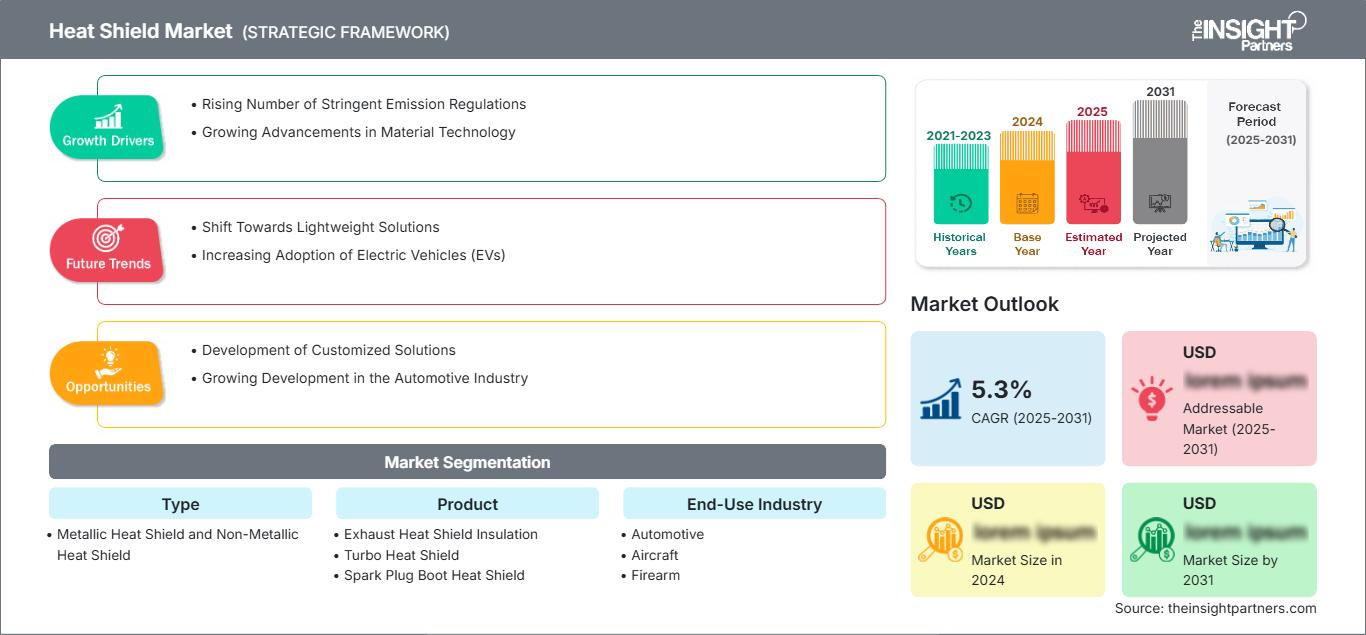
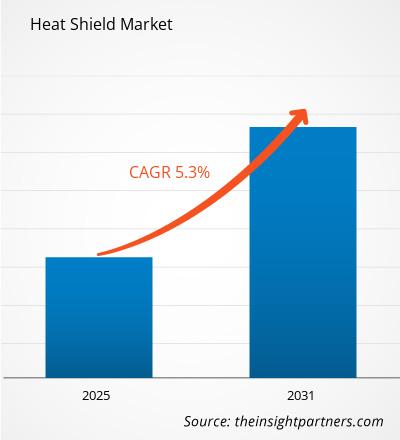
Heat Shield Market stands at US$ 13.76 Billion in 2025 and is projected to reach US$ 15.59 Billion by 2034, expanding at a CAGR of 1.57% during 2026–2034. Market includes metallic as well as non-metallic materials that help in controlling radiant and conducted heat in various automotive, aerospace, and firearm applications. Market growth will be driven by the need for thermal protection, component longevity, weight reduction, emissions regulations, and new demands for battery safety.
North America Heat Shield Market Size is one of the technically advanced regions that has an estimated growth rate of 1.8-2.3% between 2021-2034. North America has a presence of vehicle production, aerospace manufacturing, and aftermarket sales. Federal and state efficiency regulations, along with growing electrification, are pushing manufacturers to design light-weight barriers and thermal insulation materials.
Heat Shield Market Assessment and Insights
- North America: North America is expected to hold a 2025 share of 30–34%, with a CAGR of 1.8–2.3% between 2026–2034. Automotive thermal management, aerospace production, and replacement demand provide structural support for suppliers.
- US: The US is estimated to represent 68–72% of North America's 2025 market, expanding at a CAGR of 1.8–2.3% through 2034, supported by automotive, aerospace, and aftermarket applications.
- Europe: Europe is estimated at a 2025 share of 24–28% and a 2026–2034 CAGR of 1.5–2.0%, led by Germany, the UK, France, Italy, and Spain, where emissions, lightweighting, and advanced vehicle engineering sustain demand.
- Asia Pacific: Asia Pacific is estimated at a 2025 share of 31–35%, expanding at a CAGR of 1.9–2.5% through 2034. China, Japan, South Korea, and India anchor automotive manufacturing, component localization, and thermal engineering demand.
- Largest Segment: Metallic heat shields represent the largest segment, with a 2025 market share of 58–62% and a CAGR of 1.3–1.8% through 2034, reflecting broad exhaust and engine-bay use.
- High Growth Segment: Aircraft represents the high-growth end-use segment, with a 2025 market share of 10–14% and a CAGR of 2.6–3.2%, supported by aerospace thermal protection requirements.
- Key companies analyzed in detail: Autoneum, Cool It Thermo-Tec, Dana Limited, ElringKlinger AG, Lydall, Inc., Morgan Advanced Materials plc, Progress-Werk Oberkirch AG, Tenneco Inc., UGN, Inc., and Zircotec Ltd.
Source: The Insight Partners' analysis based on proprietary research, government publications, company annual reports, investor presentations, industry databases, and expert interviews.
The Heat Shield Market has been evolving from traditional stamped metal shields into advanced designs that incorporate thermal insulation, sound absorption, anti-corrosion properties, and light weight. The use of aluminum, stainless steel, multi-layer designs, fibers, ceramics, and composites has increased among manufacturers that require protection against heat in areas such as exhaust systems, turbochargers, batteries, and electronics.
In terms of future trends, the market will start reflecting the diversity of powertrains. Traditional internal combustion and hybrid cars will continue needing heat shields for exhaust and turbo components; meanwhile, electric cars will require designs that address thermal propagation, electrical insulation, and underbody protection. This way, companies are investing in multifunctional materials, advanced forming technologies, recycling materials, and local manufacturing facilities.
Heat Shield Market Report Scope
| Report Attribute | Details |
|---|---|
| Market size in 2025 | US$ 13.76 Billion |
| Market Size by 2034 | US$ 15.59 Billion |
| Global CAGR (2026 - 2034) | 1.57% |
| Historical Data | 2021-2024 |
| Forecast period | 2026-2034 |
Heat Shield Market Analysis
The demand for Heat Shields correlates with vehicle manufacturing, aircraft deliveries, fabrication operations, and cycle of replacements. Value Chain is represented by metal and fiber manufacturers, ceramic and insulation experts, stampers and formers, coatings, parts manufacturers, Tier, OEM and aftermarket vendors. Growth will be moderate as a result of decline in demand for several exhaust-related applications due to electrification, but thermal management needs become a part of the new architecture of the vehicle.
There are certain trends in supply, and these are related to material efficiency and design integration. Aluminum and stainless steel continue to play an important role because of their properties of heat resistance and manufacturing capability, whereas fiber-based or ceramic solutions are needed for applications where lightness and high-temperature performance are required. Companies which have the ability of prototype, simulation, forming, coating and testing will have a competitive advantage.
Competitive positioning in Heat Shield Market Report requires engineering capabilities, material knowledge, manufacturing capability, customer qualifications, and proximity to OEM plant. Competitors like Autoneum, Dana Limited, ElringKlinger AG, Lydall, Inc., and Tenneco Inc. compete through thermal-acoustic solutions, heat shield solutions, exhaust solutions, and engineered solutions. Speciality players like Zircotec Ltd. focus on ceramic coating and high temperature material technology whereas UGN, Inc. has a strong automotive north America focus.
Investments are increasingly made in lightweight materials, electric vehicle battery solutions, recyclable materials, and localization of manufacturing. Morgan Advanced Materials plc has the capability of high temperature material technology whereas Progress-Werk Oberkirch AG and Cool It Thermo-Tec provide engineered shielding solutions. Competitive companies are those who have the capability to provide thermal performance with control on thickness, weight, tooling, recyclability, and total installed cost.
● REPORT CUSTOMIZATION
Tailor This Report To Align With Your Specific Business Requirements
This report can be customized to align precisely with your business objectives, scope, and target markets. Customization options include tailored segmentation, geography, competitive analysis, and strategic insights to support informed decision-making.
Customize This Report →WHAT YOU CAN ADJUST
- ● Segmentations
- ● Geography
- ● Competitive Analysis
- ● Language Preferences
Heat Shield Market: Strategic Insights
Regional Insights
North America Heat Shield Market
North America is estimated to account for 30–34% of the Heat Shield Market Share in 2025 market and is projected to expand at a CAGR of 1.8–2.3% during 2026–2034. The region combines substantial automotive production with established aircraft manufacturing, commercial vehicle activity, and a sizeable replacement market. Heat management remains important around exhaust systems, turbochargers, catalytic converters, and underbody components.
The US is the key demand market, with help from OEM engineering centers, aerospace applications, the aftermarket channel, and thermal materials providers. The presence of Canada and Mexico enhances the regional network by offering vehicle production capabilities and cross-border logistics networks. Electrification trends have impacted the design of the products but not their need for thermal protection, especially on batteries, power electronics, and surrounding assemblies.
U.S. Heat Shield Market
The United States is believed to account for 68–72% of the market in North America in 2025, growing at a rate of 1.8–2.3% during 2034. The demand will come from passenger cars, commercial trucks, aerospace applications, industrial machinery, and replacement parts. Existing expertise ensures that high-quality customized thermal shields and shielding assemblies can be manufactured.
Companies operating in the sector include Autoneum, Dana Limited, Lydall, Inc., Tenneco Inc., UGN, Inc., and Cool It Thermo-Tec, forming a comprehensive supplier network. There is a shift towards using lighter assemblies, improved thermal management for exhausts, and battery protection, as well as thermal insulation. Aerospace projects add diversity to the portfolio since shielding assemblies have to endure extreme thermal, vibrational, environmental, and mechanical loads.
Europe Heat Shield Market
Europe is estimated to hold 24–28% of the 2025 market and is projected to expand at a CAGR of 1.5–2.0%, with Germany serving as the leading country. The regional industry is shaped by sophisticated vehicle engineering, emissions regulation, lightweight construction, and a mature supplier ecosystem. Electrification is creating new requirements for battery and power-electronics thermal protection.
The UK sustains its demand through aerospace, motorsport, premium automotive and specialized thermal engineering. Germany leverages itself on its strong presence of OEMs and tier suppliers and its strong presence in the automotive components industry. France, Italy, and Spain make their contributions in vehicle assembly, commercial vehicles, aerospace, and components. Regulations concerning vehicle efficiency and emission lead to increased demand for thin and lightweight barrier material.
APAC Heat Shield Market
APAC is estimated to account for 31–35% of the 2025 market and is expected to grow at a CAGR of 1.9–2.5% through 2034. China is the leading country, followed by Japan, South Korea, India, and Australia. High vehicle production, localization, and expanding EV manufacturing create a broad engineering base for thermal protection.
The areas of industrial policy, battery manufacture, and automotive value chain localization provide a basis for sustained investment. China utilizes scale of manufacturing along with rapid electrification, while Japan and South Korea continue to be strong in high-tech parts. India continues to build up its capacity in vehicles and suppliers, but Australia, while small, is important for mining, industrial, and specialty vehicles.
Middle East & Africa Heat Shield Market
MEA consists of a smaller consumer base but provides focused opportunities with Saudi Arabia as a dominant regional market, while MEA CAGR is estimated to be 2.3–2.8% until 2034. Saudi Arabia and the UAE drive demand through construction of transportation, industrial infrastructure, and other infrastructure investments, whereas South Africa adds demand from automotive manufacture and components.
The markets of RoMEA remain fragmented, and the drivers of demand are commercial vehicles, industrial machinery, energy projects, and replacement of components in the after-market. The ambient temperature conditions have a significant influence on the importance of insulation and component protection. Assembly and production localization may influence purchase behavior regionally; nevertheless, imports of components and low specialized manufacturing capacity in RoMEA will continue influencing competition.
Segmentation Analysis
Type
Type remains a fundamental purchasing criterion because material selection determines temperature resistance, weight, acoustic performance, durability, and manufacturing cost. The Type segment is projected to grow at a CAGR of 1.4–1.8% from 2026–2034. Metallic solutions remain broadly established, while non-metallic materials gain attention where lower mass, insulation, flexibility, or extreme-temperature resistance is prioritized.
- Metallic Heat Shield: Metallic Heat Shield maintains broad adoption across exhaust, engine-bay, and underbody applications because aluminum and stainless steel provide predictable forming, thermal reflectivity, durability, and scalable manufacturing.
- Non-Metallic Heat Shield: Non-Metallic Heat Shield demand is supported by ceramic, fiber, and composite solutions requiring low weight, electrical insulation, flexibility, or higher thermal resistance in specialized applications.
Product
Product segmentation is projected to expand at a CAGR of 1.7–2.1% during 2026–2034. Product requirements increasingly depend on component-specific temperature profiles, packaging constraints, installation methods, and regulatory expectations. Suppliers are developing integrated barriers that combine thermal insulation, acoustic control, flame resistance, and mechanical protection within fewer components.
- Exhaust Heat Shield Insulation: Exhaust Heat Shield Insulation remains strategically important for controlling radiant heat around exhaust paths, protecting nearby components, improving thermal efficiency, and supporting emissions-control system performance.
- Turbo Heat Shield: Turbo Heat Shield demand reflects increasingly compact engine layouts and elevated turbocharger temperatures, requiring durable protection that preserves component reliability while limiting heat transfer into adjacent systems.
- Spark Plug Boot Heat Shield: Spark Plug Boot Heat Shield products protect ignition components from radiant and conducted engine heat, supporting reliable ignition performance in high-temperature engine compartments.
- Thermal and Heat Shield Sleeving: Thermal and Heat Shield Sleeving provides flexible protection for wiring, hoses, and mechanical assemblies where routing constraints make rigid barriers impractical, particularly in compact and electrified platforms.
- Fire Arm Heat Shield: Fire Arm Heat Shield applications prioritize operator protection, heat dissipation, and handling safety, with demand concentrated in specialized firearm designs and aftermarket equipment requiring controlled surface temperatures.
End-Use Industry
End-Use Industry demand is projected to grow at a CAGR of 1.5–1.9% during 2026–2034. Automotive remains the dominant application base, but aircraft and firearm uses provide differentiated requirements. The Market scope is broadening as thermal protection moves from conventional exhaust shielding toward battery, aerospace, and advanced material applications.
- Automotive: Automotive applications represent the principal demand center, covering exhaust systems, turbochargers, engine compartments, underbodies, batteries, and power electronics across internal combustion, hybrid, and electric platforms.
- Aircraft: Aircraft applications require lightweight, durable, and high-temperature shielding around engines, exhaust systems, wiring, and structural areas, making advanced fibers, ceramics, and multilayer constructions strategically relevant.
- Firearm: Firearm applications focus on thermal isolation and operator safety, with specialized shields and sleeves used to reduce heat transfer from barrels, suppressors, and other high-temperature components.
Opportunity Snapshot
| End-Use Industry | Revenue Contribution | Trend Tag | Adoption Stage |
| Automotive | High | EV Shielding | Mature |
| Aircraft | Medium | Engine Protection | Scaling |
| Firearm | Low | Barrel Cooling | Mature |
Heat Shield Market Growth Drivers and Impact Analysis
Vehicle Packaging Constraints Increase Thermal Protection Requirements
Modern automotive architectures keep on adding more parts in limited spaces, which results in increased thermal interactions of exhaust systems, turbochargers, batteries, wires, sensors, and passenger cabin sections. Downsized engines are capable of running under high thermal loads, and the addition of electric vehicles results in the concentration of heat sources near batteries and power electronics. This creates the need for thin barriers that offer improved insulation efficiency than large barriers. The commercial relevance here is quite big since the supplier has to offer thermal protection without affecting packaging, weight, serviceability, or time taken in assembling the part. Purchasing by OEMs considers thermal efficiency along with forming efficiency and material efficiency.
Stricter Emissions and Efficiency Requirements Support Thermal Engineering
Efficiency regulations still dictate the development of exhaust systems and aftertreatment units, especially in cases where catalysts are concerned with their operating temperature. Regulation implementation for the EU, such as Euro 7, emphasizes the focus on thermal aspects during actual vehicle use. Heat shields help ensure proper heat insulation and protection of adjacent components from excessive heat. The market implications are not restricted to higher volume of shields. On the contrary, the market requires the use of assemblies that enhance heat concentration and minimize unnecessary heat loss along with durability at temperature fluctuations. Suppliers of global OEM platforms must also adapt to varying regulatory and validation requirements. This makes material platforms all the more important due to the need for adaptation to multiple vehicle designs.
Battery Safety Creates New Demand for High-Temperature Barriers
Battery thermal runaway has created a new protection category extending beyond traditional engine and exhaust applications. Electric vehicles require barriers that can resist high temperatures, hot particles, pressure, and electrical conduction while preserving lightweight construction. These requirements are influencing material development toward fiber composites, ceramics, flame-resistant layers, and multifunctional battery enclosure components. The commercial impact is potentially broader than conventional shielding because thermal protection can become integrated into battery lids, underbody structures, module barriers, and adjacent passenger-compartment interfaces. Suppliers with experience in high-temperature insulation and fire protection can therefore transfer existing material capabilities into vehicle electrification programs. Design validation is increasingly important because battery architecture varies substantially by OEM, cell chemistry, module configuration, and enclosure construction.
Heat Shield Market Future Trends
Multifunctional Composite Barriers Become Platform Technologies
Future product development is likely to favor multifunctional barriers that combine thermal insulation, acoustic attenuation, flame resistance, structural support, and electromagnetic protection within a single engineered component. This approach can reduce part count and simplify assembly while improving packaging efficiency. Composite molding, fiber reinforcement, and hybrid material constructions will support greater geometric flexibility than conventional stamped shields. The Market trends will increasingly reflect platform-level design rather than isolated component protection, particularly in electric vehicles where battery housings must manage several safety functions simultaneously. Suppliers that standardize material platforms while retaining geometry customization can address multiple vehicle programs without rebuilding their complete manufacturing architecture. This approach may also reduce waste and improve end-of-life recyclability where mono-material or compatible composite systems are commercially feasible.
Thermal Protection Expands Across Electrified and Alternative Powertrains
Electrification will not remove the need for thermal protection; it will redistribute demand toward batteries, power electronics, charging systems, and specialized high-temperature interfaces. Hybrid vehicles will retain conventional exhaust-related requirements while adding battery and electronic thermal zones, creating transitional demand for suppliers with cross-platform capabilities. Hydrogen and alternative-fuel powertrains could introduce additional thermal challenges around combustion systems, storage interfaces, and high-temperature components. The Heat Shield Market trends will therefore increasingly involve materials selected for specific thermal events rather than simply operating temperature. Suppliers are likely to develop modular protection systems that can be adapted across propulsion architectures, helping OEMs manage engineering costs while accommodating changing vehicle technologies and evolving safety requirements.
Heat Shield Market Opportunities
Battery Enclosure and Thermal Runaway Protection
Battery enclosure protection offers an attractive avenue for suppliers seeking to diversify beyond declining portions of conventional exhaust shielding. Investment priorities should focus on lightweight flame barriers, thermal insulation layers, impact-resistant shields, and multifunctional battery lids capable of integrating several protection functions. The Heat Shield Market Forecasts indicate that suppliers with established automotive qualification processes can leverage existing relationships to introduce these technologies into EV platforms. Partnerships with battery manufacturers, enclosure specialists, and OEM engineering teams can shorten validation cycles and align material specifications with evolving cell architectures. Opportunities are strongest where products can reduce assembly complexity while meeting thermal, electrical, mechanical, and sustainability requirements. Scalable manufacturing methods will remain important because battery platforms require cost discipline alongside advanced safety performance.
Aerospace and High-Temperature Specialist Applications
Aerospace offers a complementary growth path because aircraft systems require high-temperature protection while placing strict limits on component mass and reliability risk. Investment can target ceramic coatings, advanced fibers, multilayer insulation, flexible sleeving, and shielding for engines, wiring, ducts, and structural interfaces. The Market Forecasts can support strategic prioritization of programs where qualification barriers create longer customer relationships and higher technical differentiation. Suppliers should prioritize materials with traceable performance, stable supply, and repeatable manufacturing because aerospace customers place greater emphasis on validation and lifecycle reliability than on low initial cost alone. Partnerships with aircraft manufacturers and tier suppliers can provide access to recurring production programs while strengthening technical capabilities that can later transfer to automotive and industrial applications.
Recent Developments
- March 2026: Redwire and Los Alamos National Laboratory, with support from NASA Ames Research Center, successfully demonstrated a new deployable heat shield designed to protect spacecraft and payloads from extreme re-entry heating. The system uses a compact, stowed aeroshell that deploys after separation from the launch vehicle, with Redwire providing the deployment mechanism and structural aeroshell. The successful demonstration is expected to support the development of larger, more capable deployable heat shields for spacecraft re-entry, payload recovery, and expanded access to space.
- September 2025: Teconnex India launched a new Heatshield Manufacturing Line at its Chakan, Pune facility, expanding its product portfolio to meet growing demand for heatshield solutions across the Indian and international automotive, industrial, and off-highway sectors. The new line uses multilayer insulation technology to provide thermal protection, reduce noise, and protect wiring, sensors, fuel and brake lines from extreme exhaust heat, while supporting compliance with BS6/Euro 6 and future BS7/Euro 7 emission standards. The expansion strengthens Teconnex India’s capabilities in locally manufactured heatshield and integrated exhaust thermal-management solutions.
- June 2025: UC Berkeley MEng students partnered with NASA to develop advanced heat-shield coatings for future space missions, focusing on materials capable of protecting spacecraft from extreme thermal conditions. The project supports the development of next-generation thermal-protection technologies for spacecraft operating during atmospheric entry and other high-temperature mission environments, highlighting continued research into advanced coatings and materials for aerospace heat shields.
Frequently Asked Questions

- Comprehensive Market Sizing and Forecast Analysis
- Detailed Segmentation Analysis
- In-Depth Market Dynamics Assessment
- Regional and Country-Level Insights
- Competitive Landscape and Company Benchmarking
- Strategic Business Intelligence
Recent Reports
Testimonials

The Insight Partners' SCADA System Market report is comprehensive, with valuable insights on current trends and future forecasts. The team was highly professional, responsive, and supportive throughout. We are very satisfied and highly recommend their services.
RAN KEDEM Partner, Reali Technologies LTDs
I requested a report on a very specific software market and the team produced the report in a few days. The information was very relevant and well presented. I then requested some changes and additions to the report. The team was again very responsive and I got the final report in less than a week.
JEAN-HERVE JENN Chairman, Future Analytica
We worked with The Insight Partners for an important market study and forecast. They gave us clear insights into opportunities and risks, which helped shape our plans. Their research was easy to use and based on solid data. It helped us make smart, confident decisions. We highly recommend them.
PIYUSH NAGPAL Sr. Vice President, High Beam Global
The Insight Partners delivered insightful, well-structured market research with strong domain expertise. Their team was professional and responsive throughout. The user-friendly website made accessing industry reports seamless. We highly recommend them for reliable, high-quality research services
YUKIHIKO ADACHI CEO, Deep Blue, LLC.
This is the first time I have purchased a market report from The Insight Partners.While I was unsure at first, I visited their web site and felt more comfortable to take the risk and purchase a market report.I am completely satisfied with the quality of the report and customer service. I had several questions and comments with the initial report, but after a couple of dialogs over email with their analyst I believe I have a report that I can use as input to our strategic planning process.Thank you so much for taking the extra time and making this a positive experience.I will definitely recommend your service to others and you will be my first call when we need further market data.
JOHN SUZUKI President and Chief Executive Officer, Board Director, BK Technologies
I wish to appreciate your support and the professionalism you displayed in the course of attending to my request for information regarding to infectious disease IVD market in Nigeria. I appreciate your patience, your guidance, and the fact that you were willing to offer a discount, which eventually made it possible for us to close a deal. I look forward to engaging The Insight Partners in the future, all thanks to the impression you have created in me as a result of this first encounter.
DR CHIJIOKE ONYIA MANAGING DIRECTOR, PineCrest Healthcare Ltd.Reason to Buy
- Informed Decision-Making
- Understanding Market Dynamics
- Competitive Analysis
- Identifying Emerging Markets
- Customer Insights
- Market Forecasts
- Risk Mitigation
- Boosting Operational Efficiency
- Strategic Planning
- Investment Justification
- Tracking Industry Innovations
- Aligning with Regulatory Trends





 Get Free Sample for