
Heating Equipment Market Size, Share & Trends by 2034
Coverage: by Product (Heat Pumps, Furnaces, Boilers, Unitary Heaters, Others); End-user (Residential, Commercial, Industrial), and Geography (North America, Europe, Asia Pacific, and South and Central America)
- Status : Data Released
- Report Code : TIPRE00013538
- Category : Electronics and Semiconductor
- No. of Pages : 150
- Available Report Formats :


- Last update date : September 10, 2026


2025 Market Size
US$ 151.54 Bn
Base year value
2034 Forecast
US$ 297.8 Bn
Projected by 2034
CAGR 2026-2034
7.80 %
Growth rate
Addressable Market
US$ 2,023.01 Bn
(2026-2034)
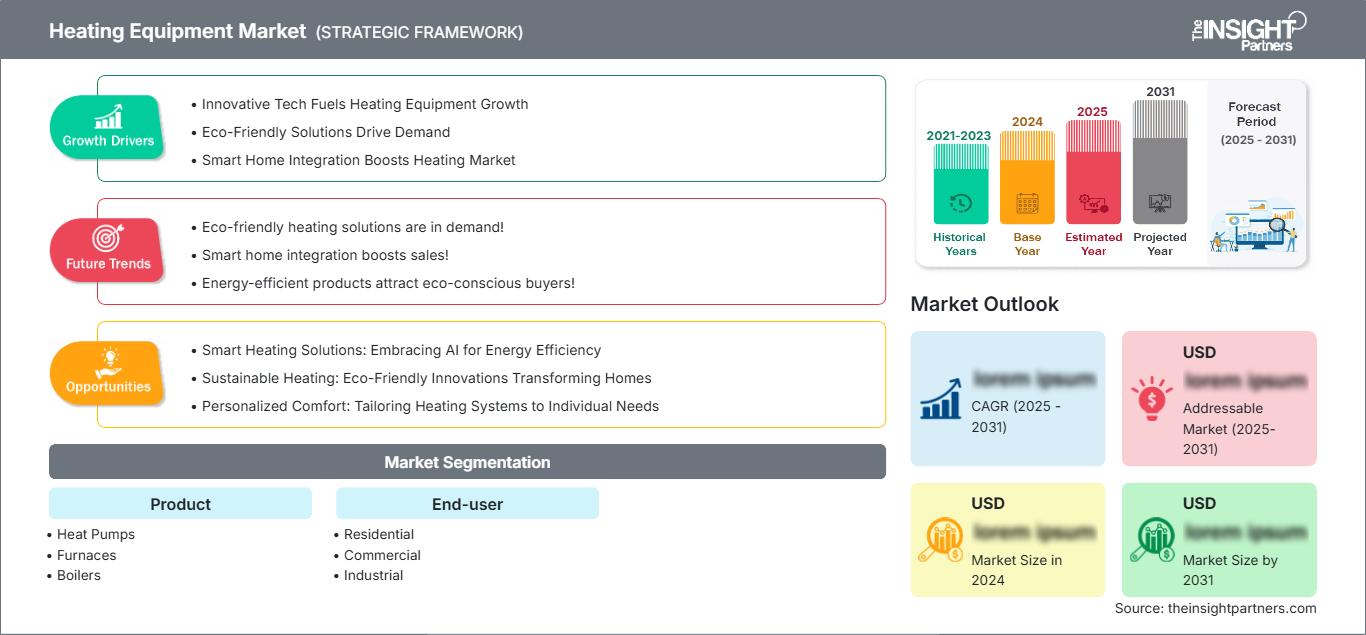
The Heating Equipment Market was valued at US$ 151.54 Billion in 2025 and is projected to reach US$ 297.8 Billion by 2034, expanding at a CAGR of 7.80% during 2026–2034. The market includes products such as heat pumps, furnaces, boilers, and unitary heaters from both residential, commercial, and industrial perspectives. Increasing electrification, aging infrastructure replacement, efficiency standards, and decarbonization policies are affecting equipment choice and investment decisions worldwide.
North America has a stable growth outlook, driven by the demand for replacement, heat pump adoption in cold regions, and tightening efficiency standards. The size of the Heating Equipment Market Size is affected by building renovations and the demand for smart heating equipment. Regional CAGR of 6.1–6.6%, calculated using a model, shows that there is a balance between the mature market base and technology transition.
Heating Equipment Market Assessment and Insights
- North America: North America is expected to hold a 28–32% share in 2025 and grow at a 6.1–6.6% CAGR between 2026–2034, supported by equipment replacement, electrification, commercial retrofits, and cold-climate heating technology adoption.
- US: The US is estimated to represent 78–82% of North America’s 2025 value, with a 5.9–6.4% CAGR between 2026–2034, driven by replacement cycles and efficiency standards.
- Europe: Europe is projected to account for 24–28% share in 2025 and expand at a 7.2–7.8% CAGR between 2026–2034, with Germany, France, Italy, the UK, and Spain supporting demand through electrification and building efficiency programs.
- Asia Pacific: Asia Pacific is estimated at a 34–38% share in 2025 and is expected to register an 8.7–9.3% CAGR between 2026–2034, led by China, Japan, India, and South Korea amid industrialization and energy-transition investment.
- Largest Segment: Heat Pumps hold an estimated 38–42% market share in 2025 and are projected to expand at a 10.2–10.8% CAGR during 2026–2034, reflecting electrification-led substitution.
- High Growth Segment: Industrial end users account for an estimated 25–29% market share in 2025 and are projected to grow at an 8.8–9.4% CAGR during 2026–2034.
- Key companies analyzed in detail: Carrier Global Corporation, Daikin Industries, Ltd., Danfoss, Emerson Electric Co., Haier Group Corporation, Johnson Controls, Inc., Lennox International, Inc., Panasonic Corporation, Robert Bosch GmbH, Trane Technologies.
Source: The Insight Partners' analysis based on proprietary research, government publications, company annual reports, investor presentations, industry databases, and expert interviews.
The technology evolution is transforming heating solutions from independent thermal devices to comprehensive, electrically-controlled systems. Variable-speed compressors, inverters, improved refrigerants, heat recovery systems, connectivity, and hybrid technologies are affecting the product cost dynamics. Also, manufacturers are changing their production platform due to the different refrigerant regulations and efficiency standards in different regions. Such technological evolution is advantageous for suppliers having extensive integration capabilities, engineering, installation network, and manufacturing flexibility.
Investment flow is likely to be directed on low-carbon heat generation, industrial heat recovery, and digital management of the thermal resources. The emerging countries have room for greenfield investment while developed ones have options for replacements and retrofits. Government support for energy efficiency and electrification of buildings is going to affect the economics of projects positively; however, such factors as electricity costs, financing terms, availability of installers, and electricity grid capacity will still matter.
Heating Equipment Market Report Scope
| Report Attribute | Details |
|---|---|
| Market size in 2025 | US$ 151.54 Billion |
| Market Size by 2034 | US$ 297.8 Billion |
| Global CAGR (2026 - 2034) | 7.80% |
| Historical Data | 2021-2024 |
| Forecast period | 2026-2034 |
Heating Equipment Market Analysis
The demand for equipment is becoming more linked with building renovations, needs for processes within industries, changes in climate and replacement of less efficient existing equipment. This means that Heating Equipment Market growth is determined by not only construction but also by replacement investments. The ecosystem involves equipment manufacturers, component manufacturers (compressors, heat exchangers), controllers, distributors, installation companies, utilities, building owners, and service firms. The supply situation is becoming dependent on availability of components, shifts in refrigerants, electronics capabilities, and localized manufacturing.
Heat Pumps change the purchase consideration because the equipment addresses not only the heating requirement but also cooling and water heating requirement in many cases. The relevance of boilers and furnaces will exist within the installed base where there exists existing gas pipeline infrastructure or high temperature requirement. In contrast, unitary heaters remain relevant in certain commercial and industrial settings. The analysis of Heating Equipment Market Report indicates that prominent players are offering bundled products including controls, software services, maintenance contract, and financing in order to increase retention. For instance, Carrier Global Corporation, Daikin Industries, Ltd., and Trane Technologies emphasize their diversified HVAC equipment offerings, while Johnson Controls, Inc. emphasizes their solution offering related to buildings and industrial applications. Robert Bosch GmbH and Panasonic Corporation are positioned in electrified residential technology space.
Other areas of investments are regional manufacturing capabilities, refrigerant capability, connectivity/diagnostics capabilities, and installer ecosystem. Danfoss and Emerson Electric Co. offer enabling technologies for compressors, control, electronics, and industrial applications, while Lennox International, Inc. offers North America-centric solutions. The scale is offered by Haier Group Corporation based on its appliance and HVAC distribution. Differentiating factors of competition include lifecycle economics, serviceability, regulation, and climate-based system customization.
● REPORT CUSTOMIZATION
Tailor This Report To Align With Your Specific Business Requirements
This report can be customized to align precisely with your business objectives, scope, and target markets. Customization options include tailored segmentation, geography, competitive analysis, and strategic insights to support informed decision-making.
Customize This Report →WHAT YOU CAN ADJUST
- ● Segmentations
- ● Geography
- ● Competitive Analysis
- ● Language Preferences
Heating Equipment Market: Strategic Insights
Regional Insights
North America Heating Equipment Market
North America is represented in the forecast at a 28 to 32% Heating Equipment Market share in 2025, and the CAGR in the region is estimated at 6.1 to 6.6% for the 2025-2034 timeframe. North America enjoys the advantage of having a sizable inventory of furnaces, boilers, and heat pumps that need replacement.
The United States leads in terms of demand in the region, followed by Canada and Mexico. There is emphasis on developing variable speed systems, connected thermostats, less environmentally harmful refrigerants, and hybrid heating setups. Total lifecycle cost assessment of the equipment, along with resiliency, is being considered increasingly in commercial facilities.
U.S. Heating Equipment Market
The United States accounts for around 78-82% of North America’s 2025 market, growing at a rate of 5.9-6.4% during the forecast period of 2034. The factors driving demand include the need for new furnaces and air-source heat pump replacements, along with renovations and the continued focus on energy efficiency in HVAC equipment.
Major players in the industry are Carrier Global Corporation, Lennox International, Inc., Trane Technologies, and Johnson Controls, Inc. The importance of heat pumps in strategy cannot be overlooked while gas furnaces retain their importance in traditional heating markets. High-temperature process heaters are being explored by industrial facilities where electrification can limit operational risk without affecting production needs.
Europe Heating Equipment Market
Europe is modeled on a 24-28% share in 2025 and 7.2-7.8% CAGR to 2034. Germany is the most developed country in terms of heat pump deployment and building decarbonization. The UK and France are the major markets in terms of building retrofits, while Italy and Spain offer their contribution via building renovation, commercial development and energy-efficient investments. The regional policy tends to be oriented towards efficient electric solutions.
The UK market focuses on the replacement efficiency, readiness for heat pumps installation and buildings renovation. Germany is especially advanced in its transition to electrified heating systems, with renewed momentum in heat pump deployment observed there. France is still the major market in Europe in terms of heating, while Italy is favored by the renovation activity, and Spain – by the growing HVAC efficiency deployment.
APAC Heating Equipment Market
APAC has a forecasted 34–38% share in 2025 and 8.7–9.3% CAGR till 2034, with China being the regional market leader. Japan, South Korea, India, and Australia can be seen as additional sources of demand due to residential upgrades, industry, and changes in energy use trends.
China provides a combination of manufacturing and supportive policies towards cleaner heating systems, while Japan has an advantage in already established heat pump installations. India and Australia have more long-term potential due to electrification and development. Industry applications are especially important when it comes to process heat and energy efficiency.
Middle East & Africa Heating Equipment Market
The MEA region is forecasted to achieve a 6.0–6.5% CAGR over 2025-2034. Saudi Arabia and the UAE drive investments in the region, whereas South Africa participates via replacement demand in commercial and industrial settings. The rest of MEA region is characterized by fragmentation but provides selective opportunities associated with infrastructure development.
Building construction that consumes much energy, hospitality developments, healthcare facilities, and industrial operations are major drivers of demand. In the Gulf, heating demand exists side-by-side with cooling demand, which stimulates HVAC purchasing. However, the development of infrastructure and measures related to energy efficiency will facilitate adoption, while finance for projects, reliance on imported products, and availability of services are essential limiting factors.
Segmentation Analysis
Product
The Product segment is projected to grow at a 7.9–8.4% CAGR during 2026–2034. Product selection increasingly reflects efficiency, installation flexibility, refrigerant compliance, lifecycle cost, and compatibility with connected controls. The Heating Equipment Market scope within this segment extends from established combustion technologies to rapidly expanding electrified systems, creating different replacement and investment profiles across climates and end users.
- Heat Pumps: Heat pumps are increasingly selected for electrification, dual heating and cooling capability, and lower operational energy use. Demand is strongest where policy, electricity economics, and building suitability support replacement of conventional systems.
- Furnaces: Furnaces retain strategic importance across mature gas-heating markets because of existing distribution infrastructure, familiar installation practices, and replacement demand. Higher-efficiency models remain relevant where full electrification is not economical.
- Boilers: Boilers continue serving hydronic residential, commercial, and industrial applications requiring dependable water-based heat distribution. Modernization focuses on efficiency, controls, lower-emission operation, and compatibility with hybrid or alternative energy configurations.
- Unitary Heaters: Unitary heaters address decentralized heating requirements in warehouses, workshops, retail premises, and other large spaces. Their compact installation profile supports targeted replacement and flexible zoning where centralized systems are impractical.
End-user
The End-user segment is expected to expand at a 7.5–8.0% CAGR during 2026–2034. Residential applications provide broad replacement volume, while commercial facilities increasingly prioritize lifecycle efficiency and automation. Industrial users create additional value through process heating, waste-heat recovery, and electrification projects, making this segmentation important for assessing purchasing priorities and investment intensity.
- Residential: Residential demand is shaped by replacement cycles, household energy costs, building insulation, incentive structures, and consumer awareness. Heat-pump adoption is particularly dependent on installation conditions and contractor capability.
- Commercial: Commercial facilities prioritize reliability, operating cost, zoning, and centralized controls. Offices, hotels, hospitals, schools, and retail properties increasingly evaluate heating equipment alongside broader building-management and energy-efficiency programs.
- Industrial: Industrial buyers require higher temperature ranges, dependable uptime, process integration, and measurable energy savings. Opportunities increasingly center on electrification, heat recovery, and systems capable of serving variable production conditions.
Opportunity Snapshot
| Application | Revenue Contribution | Trend Tag | Adoption Stage |
|---|---|---|---|
| Residential | High | Heat Pumps | Scaling |
| Commercial | High | Smart HVAC | Scaling |
| Industrial | Medium | Process Heat | Emerging |
Heating Equipment Market Growth Drivers and Impact Analysis
Electrification of Building Heat
The effect of electrification on procurement processes is that there will be an increase in the incorporation of heat pumps and other electric-based technology in residential and commercial applications. Buyers will be able to integrate heating, cooling, hot water generation and control in one architecture. This will lower equipment complexity and costs where electrical pricing is good and buildings have good characteristics. There will be chances for utilities to control flexible loads using connected controls. The effect of electrification in the market for manufacturers is that they will compete on compressor efficiency, low temperature operation, refrigerants, controls, and services instead of combustion. The effects will be felt mainly in areas where building regulations and utility incentives coincide. Companies that can offer electrification package will benefit because of the replacement spend.
Building Renovation and Equipment Replacement Cycles
Aging heating assets create dependable replacement demand even when new construction fluctuates. Residential furnaces, boilers, and commercial heating systems have finite operating lives, creating recurring procurement windows for manufacturers and distributors. Renovation projects can also trigger equipment replacement because insulation improvements, building-envelope changes, and control upgrades alter heating loads. This encourages right-sizing rather than one-for-one replacement and creates demand for modular, variable-capacity, and digitally monitored systems. The commercial impact extends to service providers because maintenance contracts and retrofit engineering become integral to equipment decisions. Manufacturers can strengthen positions by offering diagnostic tools, financing options, replacement compatibility, and installer support. As building owners seek predictable operating expenditure, suppliers able to quantify lifecycle performance gain greater influence over capital planning and procurement specifications.
Industrial Energy Efficiency and Process Heat Modernization
Industrial facilities are creating a distinct growth pathway because thermal energy can represent a significant operating expense and process reliability is critical. Heat recovery, high-temperature heat pumps, efficient boilers, and electronically controlled heating systems can address selected process requirements while reducing energy waste. Adoption is strongest where facilities have stable heat loads, recoverable waste heat, and access to suitable electricity infrastructure. Equipment suppliers therefore increasingly engage directly with engineering teams rather than relying solely on conventional HVAC distribution channels. Projects can involve longer qualification cycles but larger system values, making industrial customers strategically important. The resulting impact is a gradual expansion of the addressable opportunity beyond space heating into manufacturing, food processing, chemicals, district energy, and other applications where thermal integration can produce measurable operational benefits.
Heating Equipment Market Future Trends
Intelligent Thermal Management and Connected Heating
Heating Equipment Market trends are moving toward systems that continuously optimize performance using sensors, cloud analytics, predictive controls, and building-management integration. Future platforms will increasingly coordinate heating assets with occupancy, weather, electricity tariffs, storage, and distributed generation. Manufacturers are likely to make commissioning, remote diagnostics, software updates, and performance verification standard parts of equipment offerings. Artificial intelligence can improve fault detection and load forecasting without requiring complete system replacement. For commercial and industrial users, this creates a pathway toward performance-based service contracts and measurable energy management. Residential systems will increasingly use interoperable controls that coordinate heating with cooling, hot water, and household electricity consumption. The competitive advantage will shift toward software-enabled equipment ecosystems that improve performance after installation rather than relying only on higher nameplate efficiency.
Low-Carbon Refrigerants and Higher-Temperature Electrification
Future product development will increasingly combine lower-global-warming-potential refrigerants with equipment capable of operating efficiently at higher supply temperatures. This combination matters because retrofit buildings and industrial facilities may not be able to redesign distribution networks before replacing heating assets. Manufacturers are therefore developing systems that deliver greater thermal output while maintaining safety and efficiency under varied operating conditions. Natural refrigerants, advanced compressors, improved heat exchangers, and cascade configurations are expected to become more prominent in appropriate applications. Higher-temperature heat pumps can also expand electrification into selected industrial and district-heating uses previously dominated by boilers. Over time, regulatory refrigerant requirements will influence component sourcing, technician training, product certification, and installed-base replacement strategies, creating both compliance costs and opportunities for technology differentiation.
Heating Equipment Market Opportunities
Integrated Retrofit Platforms for Existing Buildings
A major opportunity lies in packaged retrofit platforms that combine heating equipment, controls, heat distribution upgrades, commissioning, and financing. Such solutions can address a central barrier to adoption by reducing the coordination burden for building owners. Suppliers can target hospitals, hotels, schools, offices, multifamily properties, and retail facilities where equipment replacement is already planned. Heating Equipment Market Forecasts indicate that value creation will increasingly come from complete project delivery rather than equipment sales alone. Partnerships with energy-service companies, utilities, installers, and property managers can widen customer access. Investors should prioritize suppliers with strong service networks, modular product architectures, digital monitoring capabilities, and proven retrofit performance. Standardized packages can also shorten project development cycles while improving cost visibility for customers evaluating multiple technologies.
Industrial Heat Recovery and Electrification Projects
Industrial decarbonization creates an opportunity for suppliers that can integrate heat pumps with waste-heat sources, process loops, thermal storage, and existing boilers. The most attractive projects are facilities with predictable low- or medium-temperature waste heat and continuous demand for usable thermal energy. Developers can improve project economics through staged deployment, beginning with recoverable heat streams before expanding into broader process electrification. Equipment manufacturers can partner with engineering firms to provide site-specific feasibility studies, system design, controls, and long-term service. This approach creates recurring revenue through monitoring and maintenance while reducing dependence on single equipment transactions. Capital should favor applications where thermal loads are stable, energy costs are material, and operational data can demonstrate measurable savings over the project life.
Recent Developments
- June 2026: Lennox signed a definitive agreement to acquire Heat Controller, an HVAC equipment supplier serving distributors across North America through its Comfort-Aire and Century brands. The acquisition will expand Lennox’s equipment portfolio and strengthen its ability to serve small and mid-size HVAC distributors, with the deal expected to close later in 2026 subject to customary conditions and regulatory approvals.
- June 2026: Vertiv completed its acquisition of ThermoKey, a provider of heat-rejection and heat-exchange technologies, expanding Vertiv’s thermal management portfolio and manufacturing capabilities across Europe, the Middle East and Africa. The acquisition adds heat exchangers, dry coolers and related technologies to support integrated thermal solutions for AI factories and high-density data centers, while ThermoKey’s Rivarotta, Italy facility will remain a key manufacturing and engineering hub.
- August 2026: Coway launched the S Induction cooktop in South Korea, featuring a smart hybrid burner that automatically detects cookware and switches between induction and radiant heating. The 3,400W cooktop also includes a flexible Plus Zone for larger cookware, a touch-slider interface, a cookware compatibility test and 21 safety features, including overheating control, residual-heat indication and automatic shutoff for liquid overflow.
Frequently Asked Questions

- Comprehensive Market Sizing and Forecast Analysis
- Detailed Segmentation Analysis
- In-Depth Market Dynamics Assessment
- Regional and Country-Level Insights
- Competitive Landscape and Company Benchmarking
- Strategic Business Intelligence
Recent Reports
Testimonials

The Insight Partners provided valuable market intelligence that supported our global go-to-market strategy. Their team was professional, responsive, and attentive to our feedback, providing thoughtful analysis and helpful methodological clarifications throughout the project.
Junmo Kim Chief Financial Officer (CFO), Enertech Co., Ltd.
The Insight Partners' SCADA System Market report is comprehensive, with valuable insights on current trends and future forecasts. The team was highly professional, responsive, and supportive throughout. We are very satisfied and highly recommend their services.
RAN KEDEM Partner, Reali Technologies LTDs
I requested a report on a very specific software market and the team produced the report in a few days. The information was very relevant and well presented. I then requested some changes and additions to the report. The team was again very responsive and I got the final report in less than a week.
JEAN-HERVE JENN Chairman, Future Analytica
We worked with The Insight Partners for an important market study and forecast. They gave us clear insights into opportunities and risks, which helped shape our plans. Their research was easy to use and based on solid data. It helped us make smart, confident decisions. We highly recommend them.
PIYUSH NAGPAL Sr. Vice President, High Beam Global
The Insight Partners delivered insightful, well-structured market research with strong domain expertise. Their team was professional and responsive throughout. The user-friendly website made accessing industry reports seamless. We highly recommend them for reliable, high-quality research services
YUKIHIKO ADACHI CEO, Deep Blue, LLC.
This is the first time I have purchased a market report from The Insight Partners.While I was unsure at first, I visited their web site and felt more comfortable to take the risk and purchase a market report.I am completely satisfied with the quality of the report and customer service. I had several questions and comments with the initial report, but after a couple of dialogs over email with their analyst I believe I have a report that I can use as input to our strategic planning process.Thank you so much for taking the extra time and making this a positive experience.I will definitely recommend your service to others and you will be my first call when we need further market data.
JOHN SUZUKI President and Chief Executive Officer, Board Director, BK Technologies
I wish to appreciate your support and the professionalism you displayed in the course of attending to my request for information regarding to infectious disease IVD market in Nigeria. I appreciate your patience, your guidance, and the fact that you were willing to offer a discount, which eventually made it possible for us to close a deal. I look forward to engaging The Insight Partners in the future, all thanks to the impression you have created in me as a result of this first encounter.
DR CHIJIOKE ONYIA MANAGING DIRECTOR, PineCrest Healthcare Ltd.Reason to Buy
- Informed Decision-Making
- Understanding Market Dynamics
- Competitive Analysis
- Identifying Emerging Markets
- Customer Insights
- Market Forecasts
- Risk Mitigation
- Boosting Operational Efficiency
- Strategic Planning
- Investment Justification
- Tracking Industry Innovations
- Aligning with Regulatory Trends





 Get Free Sample for