
Image Based Barcode Reader Market Share, Size & Demand by 2034
Coverage: By Imaging Type (1D Image, 2D Image); Type (Stationary/Fixed Scanners, Portable/Handheld Scanners); End-user (Retail, Manufacturing, Logistics and Warehouse, Healthcare, Automotive, Others) , and Geography (North America, Europe, Asia Pacific, and South and Central America)
- Status : Data Released
- Report Code : TIPRE00018560
- Category : Electronics and Semiconductor
- No. of Pages : 150
- Available Report Formats :


- Last update date : September 17, 2026


2025 Market Size
US$ 2,316.07 Mn
Base year value
2034 Forecast
US$ 3,644.33 Mn
Projected by 2034
CAGR 2026-2034
5.17 %
Growth rate
Addressable Market
US$ 27,047.41 Mn
(2026-2034)
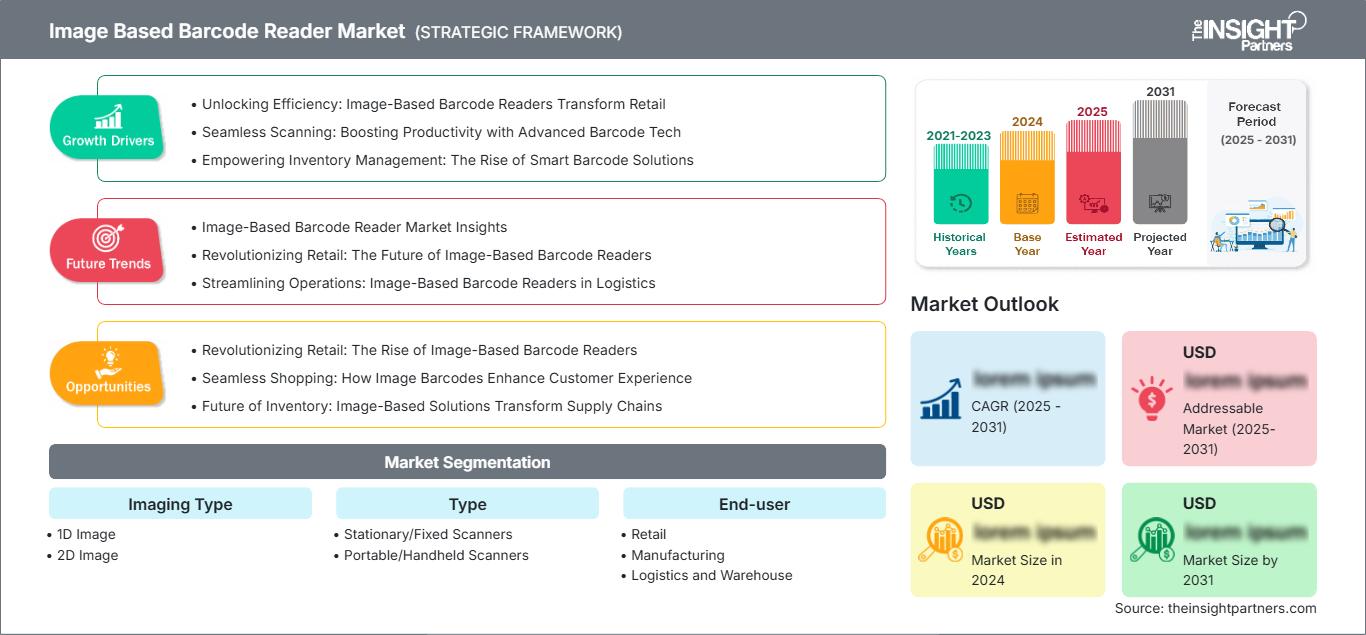
The image based barcode reader market size was valued at US$ 2,316.07 Million in 2025 and is projected to reach US$ 3,644.33 Million by 2034, registering a CAGR of 5.17% during 2026–2034. Expansion is supported by wider deployment of automated identification, machine vision, traceability, and real-time inventory systems across retail, manufacturing, logistics, healthcare, and automotive environments.
North America remains a technology-intensive image based barcode reader market, supported by warehouse automation, advanced manufacturing, and modernization of retail scanning infrastructure. The regional outlook indicates a CAGR of 5.3–5.8% during 2026–2034. Investment in automated fulfillment, machine vision, and connected operational systems is strengthening demand for higher-speed, software-integrated readers.
Image Based Barcode Reader Market Assessment and Insights
- North America: The region represented a 31–35% image based barcode reader market share in 2025 and is expected to expand at a 5.3–5.8% CAGR between 2026–2034, supported by automation and high-volume distribution.
- US: The US accounted for 78–82% of North America in 2025 and is projected to grow at a 5.2–5.7% CAGR during 2026–2034, led by logistics automation.
- Europe: Europe held a 24–28% share in 2025 and is forecast to grow at a 4.8–5.3% CAGR, with Germany, the UK, France, Italy, and Spain supporting industrial and retail modernization.
- Asia Pacific: Asia Pacific represented 27–31% in 2025 and is expected to register a 5.7–6.2% CAGR through 2034, led by China, Japan, South Korea, and India.
- Largest Segment: 2D Image held a 58–62% market share in 2025 and is anticipated to expand at a 5.5–6.0% CAGR during 2026–2034.
- High Growth Segment: Portable/Handheld Scanners represented 36–40% in 2025 and are expected to grow at a 5.8–6.3% CAGR, reflecting flexible mobile workflows.
- Key companies analyzed in detail: AirTrack, Cognex Corporation, Datalogic S.p.A., Honeywell International Inc., Keyence Corporation, Pepperl+Fuchs, Shenzhen MinDe Electronics Technology Ltd., SICK AG, ZEBEX Industries Inc., Zebra Technologies Corporation.
Source: The Insight Partners' analysis based on proprietary research, government publications, company annual reports, investor presentations, industry databases, and expert interviews.
This Image Based Barcode Reader Market has shifted from laser readers for identification purposes to camera-based decoding, better resolution of sensor equipment, processing, and assistance from software. The readers in the production environment have the need to cope with the issues such as damaged barcodes, direct part marking, multi-orientation scanning, and different symbologies. Fixed readers are increasingly being used together with conveyors and machine vision, while hand-held devices are combining imaging, wireless capabilities, rugged design, and software.
The investments in the Image Based Barcode Reader Market will be oriented on such readers that will combine decoding with inspection, optical character recognition, and edge intelligence. New manufacturing hubs in Asia and expansion of automated distribution chains will add new areas of usage. Another trend will be implementation of retail industry of 2D codes with the help of GS1 standards. Traceability needs of industries are promoting interoperability of readers that connect to MES/WMS.
Image Based Barcode Reader Market Report Scope
| Report Attribute | Details |
|---|---|
| Market size in 2025 | US$ 2,316.07 Million |
| Market Size by 2034 | US$ 3,644.33 Million |
| Global CAGR (2026 - 2034) | 5.17% |
| Historical Data | 2021-2024 |
| Forecast period | 2026-2034 |
Image Based Barcode Reader Market Analysis
Demand in the Image Based Barcode Reader Market is increasingly driven by throughput, reliability of read rate, traceability and integration capabilities over simple barcode reading. Ecosystem consists of image sensors, optics, illumination, processors, decoding software, communication components, reader units, system integrators, and enterprise software. The buyer considers workflow effectiveness from installation through to calibration, maintenance, data formatting and integration with warehouse management systems and manufacturing systems.
Supply conditions in the Image Based Barcode Reader Market are affected by semiconductors supply, optical components' supply, embedded processors and software. Proprietary decoding algorithms make vendors distinctive when the labels are damaged or low quality printed. The system integrators also affect purchasing decisions as readers need to work properly inside conveyors, robots, sorting devices, POS terminals, and production cells. Increased demand for standard interface contributes to preference for vendors offering broad connectivity and flexible software platforms.
Competitive positioning within the Image Based Barcode Reader Market relies more and more on decoding intelligence, application efficiency, ruggedness, and ease of installation. Cognex Corporation focuses on artificial intelligence-driven industrial decoding, Datalogic S.p.A. focuses on traceability and direct part marking applications, and Zebra Technologies Corporation on fixed scan, machine vision, and logistics automation. Honeywell International Inc. covers both handheld scan, mobile computing, and warehousing, providing cross-selling opportunities for interrelated operations.
Keyence Corporation, SICK AG, and Pepperl+Fuchs cover the industrial automation side with machine vision and identification technology. AirTrack, ZEBEX Industries Inc., and Shenzhen MinDe Electronics Technology Ltd. cater to more comprehensive needs for data capture from commercial and industrial applications. Investments are becoming concentrated in edge computing, AI-driven decoding, application software, and modular design to enable customers to improve scanning performance without replacement of the whole automation system.
● REPORT CUSTOMIZATION
Tailor This Report To Align With Your Specific Business Requirements
This report can be customized to align precisely with your business objectives, scope, and target markets. Customization options include tailored segmentation, geography, competitive analysis, and strategic insights to support informed decision-making.
Customize This Report →WHAT YOU CAN ADJUST
- ● Segmentations
- ● Geography
- ● Competitive Analysis
- ● Language Preferences
Image Based Barcode Reader Market: Strategic Insights
Regional Insights
North America Image Based Barcode Reader Market
North America held a 31–35% share in 2025 and is projected to expand at a 5.3–5.8% CAGR through 2034. The US continues to be the key market for demands, due to automated fulfillment systems, package sorting, self-checkout, and manufacturing. Canada offers solutions for use in food, logistics, and manufacturing traceability.
Fixed readers are becoming more widely used on conveyors and sorting stations, whereas handheld readers are useful in receiving, picking, cycle counting, and returns. Direct part marking, validation, and manufacturing genealogy are among the requirements of manufacturing users. The advanced automation environment in the region requires devices capable of industrial Ethernet, edge processing, vision integration, and device management.
U.S. Image Based Barcode Reader Market
The US represented 78–82% of North America in 2025 and is forecast to grow at a 5.2–5.7% CAGR. Demand is focused on retail, 3PL, parcels, automotive assembly and automated warehousing applications where throughput volumes make reliable read an operational necessity.
The Cognex Corporation, Zebra Technologies Corporation, Honeywell International Inc., along with other well-established vendors, are all active participants in the applications market. Deployment trends have shifted towards the usage of fixed readers in conveyor applications and portable scanners in hand-held scanning applications. Self-service scanning is growing in the retail segment as well as scan-as-you-shop models, while traceability and part marking are driving manufacturing applications.
Europe Image Based Barcode Reader Market
Europe accounted for a 24–28% share in 2025 and is expected to grow at a 4.8–5.3% CAGR. The largest market is Germany, which is driven by automobile manufacturing, industrial automation, and logistics. The UK will drive demand from the perspective of retail modernization, parcel deliveries, and warehouse automation, while France will maintain demand in manufacturing and healthcare markets. Italy and Spain have additional opportunities in automotive, food processing, retail, and logistics modernization markets.
Machine-readable identification is vital in Germany due to the high level of development of the industrial sector in such industries as automobile manufacturing, electronics, machinery, and packaging. The UK will be driven by fulfillment automation and digitization of retail. Aerospace, healthcare, and logistics markets in France will be the drivers of demand, while manufacturing and food supply chain in Italy and Spain will be among the demand sources.
APAC Image Based Barcode Reader Market
According to the image based barcode reader market report, APAC represented 27–31% of 2025 demand and is expected to grow at a 5.7–6.2% CAGR. China leads regional consumption, followed by Japan, South Korea, India, and Australia. Industrial automation, electronics manufacturing, automotive production, e-commerce fulfillment, and retail modernization support adoption.
China benefits from manufacturing scale and automation investment, while Japan and South Korea emphasize precision production. India is expanding warehouse, retail, and manufacturing automation, and Australia supports logistics and distribution applications. Policy-led industrial upgrading and investment in smart factories should increase demand for connected readers.
Middle East & Africa Image Based Barcode Reader Market
Middle East and Africa demand is projected to expand at a 5.0–5.6% CAGR. Saudi Arabia leads regional momentum, with the UAE supporting logistics and retail modernization and South Africa providing a significant manufacturing and distribution base. Infrastructure investment supports automated identification across warehouses and transport operations.
Saudi Arabia and the UAE benefit from logistics, retail, and diversification programs, while South Africa contributes through mining-related supply chains, manufacturing, and distribution. Rest of MEA demand remains smaller but can expand as organized retail, healthcare digitization, and industrial infrastructure develop. Energy-sector logistics also create traceability requirements for equipment and components.
Segmentation Analysis
Imaging Type
Imaging Type is projected to grow at a 5.4–5.9% CAGR during 2026–2034. Camera-based readers increasingly support diverse code formats, damaged labels, mobile displays, and traceability requirements. The transition toward 2D identification improves the relevance of higher-resolution imaging, while embedded processing enables faster decoding and application-specific functionality.
- 1D Image: 1D Image remains important for established retail and logistics workflows where linear codes dominate. Demand is sustained by installed infrastructure, compatibility requirements, and cost-conscious replacement programs.
- 2D Image: 2D Image benefits from QR, Data Matrix, and other information-dense codes. Its strategic importance rises as retailers and manufacturers prepare systems for broader 2D identification and richer product data.
Type
Type is expected to register a 4.8–5.3% CAGR from 2026 to 2034. Stationary systems benefit from automated high-throughput applications, while portable systems remain essential where scanning points vary. Purchasing decisions increasingly balance throughput, ergonomics, connectivity, durability, and integration complexity.
- Stationary/Fixed Scanners: Stationary/Fixed Scanners occupy critical positions in conveyors, production cells, and automated sortation. Their strategic value comes from continuous hands-free capture, consistent positioning, and integration with machine-vision workflows.
- Portable/Handheld Scanners: Portable/Handheld Scanners support receiving, picking, inventory, checkout, and field workflows. Their flexibility and wireless connectivity make them important where operators move between products, locations, or workstations.
End-user
End-user demand is forecast to grow at a 5.2–5.7% CAGR during 2026–2034. Adoption reflects the need for accurate identification across physical workflows, with different sectors prioritizing throughput, traceability, compliance, patient safety, or mobile productivity according to operational requirements.
- Retail: Retail users deploy readers across point-of-sale, self-checkout, inventory, replenishment, and scan-as-you-shop workflows, with 2D readiness becoming increasingly important.
- Manufacturing: Manufacturing applications emphasize production traceability, direct-part marking, work-in-process identification, quality verification, and integration with automated production equipment.
- Logistics and Warehouse: Logistics and Warehouse operations use readers for receiving, picking, sorting, shipping, inventory audits, and automated conveyor processes where throughput and read reliability are central.
- Healthcare: Healthcare applications include patient identification, medication workflows, laboratory samples, inventory, and asset tracking, making accurate capture and workflow integration key purchasing criteria.
- Automotive: Automotive users require robust identification for components, assemblies, direct-part marks, production genealogy, and quality control across highly automated manufacturing environments.
Opportunity Snapshot
| End Users | Revenue Contribution | Trend Tag | Adoption Stage |
|---|---|---|---|
| Retail | High | 2D Checkout | Scaling |
| Manufacturing | High | Smart Traceability | Mature |
| Logistics and Warehouse | High | Automated Sortation | Scaling |
| Healthcare | Medium | Patient Safety | Scaling |
| Automotive | Medium | Part Traceability | Mature |
Image Based Barcode Reader Market Growth Drivers and Impact Analysis
Retail transition toward 2D identification and richer product data
Retail scanning infrastructure is entering a capability transition as GS1’s Sunrise 2027 program encourages retailers to support both linear and 2D codes. GS1 has reported pilots in 48 countries representing 88.5% of global GDP, while more than 80% of retail point-of-sale systems were already described as capable of reading 2D codes. This creates a replacement and upgrade pathway for imaging hardware, software, and connected checkout systems. The impact extends beyond scanning speed because 2D codes can carry richer product information and support traceability, authentication, expiration management, and digital links. Vendors capable of supporting mixed 1D and 2D environments can therefore address transitional installations while positioning customers for broader 2D adoption.
Automation of warehouses and production environments
The image based barcode reader market forecast shows that automation is increasing the number of scanning events that occur without direct operator intervention. Sortation by conveyors, automatic storage, robotic pickers, pallet handling, and production line tracking need readers that can read codes quickly and send the information directly to the control systems. Fixed readers are very effective when there is repetitive, high-volume work, and handheld scanners continue to be useful for exception handling, stocking, receiving, and inventory tasks. From a business perspective, it means moving from scanners being peripheral devices to being identification points in automation systems. Companies providing scanners together with imaging, illumination, processing, industrial communication, and software become part of automation efforts. It also increases the significance of simple installation and device management.
AI-assisted decoding and edge processing
AI is becoming a practical differentiator where conventional decoding struggles with damaged, low-contrast, distorted, or directly marked codes. Cognex reported in 2025 that 90% of surveyed users expected AI to improve barcode-reading performance, including accuracy and decode rates. Embedded processors and neural acceleration allow more image analysis to occur at the device, reducing latency and supporting additional inspection functions. The impact is strongest in manufacturing and logistics, where a failed read can interrupt production or create downstream handling costs. As AI capabilities become embedded in readers, suppliers can expand from barcode capture toward combined identification, optical character recognition, anomaly detection, and machine-vision functions, increasing the strategic value of software and firmware.
Image Based Barcode Reader Market Future Trends
Convergence of barcode reading and machine vision
The image based barcode reader market trends show that future systems are likely to combine barcode decoding, optical character recognition, image capture, and inspection within increasingly compact hardware. This convergence will reduce the number of separate cameras and processing components required at production or logistics stations. Edge AI can enable readers to classify packages, identify defects, interpret text, and validate codes within a single workflow. For buyers, the resulting value proposition will increasingly depend on total application capability rather than decoding performance alone. Software-defined functionality should also make it easier to add new symbologies or inspection tasks after deployment. This trend will favor vendors with broad machine-vision portfolios, strong algorithms, and application software capable of integrating identification data into enterprise systems.
2D ecosystems becoming standard infrastructure
The expansion of 2D codes will increasingly change reader specifications across retail and supply-chain environments. Instead of treating QR and Data Matrix capability as an optional feature, buyers are likely to make multi-format imaging a baseline requirement. During the transition, scanners will need to handle conventional linear codes and 2D symbols simultaneously, creating demand for flexible decoding engines and software configuration. Product serialization, expiration information, authentication, and digital-link functionality can further expand the value of each scan. Hardware suppliers will therefore compete on read reliability across varied surfaces, displays, print quality, and orientations. As standards mature, procurement decisions should increasingly incorporate interoperability, firmware support, upgradeability, and lifecycle compatibility with evolving data-carrier requirements.
Image Based Barcode Reader Market Opportunities
Expansion of automated fulfillment and distribution networks
Investment in automated fulfillment creates an opportunity for suppliers that can provide scalable scanning architectures across receiving, storage, picking, packing, sortation, and shipping. Customers increasingly require consistent identification across multiple automation stages rather than isolated scanning points. Suppliers can capture this opportunity by offering configurable fixed readers, scan tunnels, handheld devices, software, and integration services as coordinated portfolios. Modular designs can lower deployment risk by allowing customers to expand capacity progressively. There is also scope for application-specific solutions optimized for parcels, pallets, high-speed conveyors, and difficult labels. Vendors with strong partnerships among warehouse automation integrators can improve access to larger projects while increasing recurring software and support opportunities.
AI-enabled retrofit solutions for installed equipment
A substantial opportunity exists in upgrading existing scanning infrastructure without replacing complete production or warehouse systems. AI-enabled decoding, improved sensors, modern communications, and software-defined features can extend the useful life of installed equipment while addressing higher throughput or difficult-code requirements. Retrofit strategies are particularly relevant for manufacturers and logistics operators seeking incremental automation investment under uncertain capital budgets. Suppliers can develop migration paths that preserve existing mounting arrangements, interfaces, and enterprise connections while adding improved decoding or inspection capabilities. Commercial models may increasingly combine hardware with software licenses, analytics, remote monitoring, and service agreements. This approach can create differentiated revenue streams while reducing customer disruption during technology modernization.
Recent Developments
- January 2025: Cognex strengthened its leadership in industrial barcode reading with the launch of its AI-powered DataMan 290 and 390 barcode readers, designed to improve decoding reliability, simplify setup and reduce downtime across manufacturing applications. The new readers use advanced AI to reliably read challenging, damaged or low-quality codes with a single click, while an integrated all-in-one light and guided web interface enable rapid deployment even by non-technical users.
- April 2025: Anyline launched Barcode:AI, an AI-powered mobile barcode scanning solution that combines artificial intelligence, real-time augmented reality and high-performance scanning for retail, logistics, manufacturing, automotive, pharmaceutical and other industries. The technology can scan up to 33 times per second and capture up to 25 codes simultaneously, while improving recognition of damaged or low-quality barcodes and enabling reliable scanning in low-light, glare and cluttered environments.
- April 2026: Honeywell agreed to sell its Productivity Solutions and Services (PSS) business, which provides mobile computers, barcode scanners and printing solutions for warehouse and logistics applications, to Brady Corp. for $1.4 billion in an all-cash transaction. The divestiture, part of Honeywell’s broader portfolio-simplification strategy ahead of its planned Aerospace spin-off, follows the company’s earlier divestiture of its PPE business and spin-off of Advanced Materials.
Frequently Asked Questions

- Comprehensive Market Sizing and Forecast Analysis
- Detailed Segmentation Analysis
- In-Depth Market Dynamics Assessment
- Regional and Country-Level Insights
- Competitive Landscape and Company Benchmarking
- Strategic Business Intelligence
Recent Reports
Testimonials

The Insight Partners provided valuable market intelligence that supported our global go-to-market strategy. Their team was professional, responsive, and attentive to our feedback, providing thoughtful analysis and helpful methodological clarifications throughout the project.
Junmo Kim Chief Financial Officer (CFO), Enertech Co., Ltd.
The Insight Partners' SCADA System Market report is comprehensive, with valuable insights on current trends and future forecasts. The team was highly professional, responsive, and supportive throughout. We are very satisfied and highly recommend their services.
RAN KEDEM Partner, Reali Technologies LTDs
I requested a report on a very specific software market and the team produced the report in a few days. The information was very relevant and well presented. I then requested some changes and additions to the report. The team was again very responsive and I got the final report in less than a week.
JEAN-HERVE JENN Chairman, Future Analytica
We worked with The Insight Partners for an important market study and forecast. They gave us clear insights into opportunities and risks, which helped shape our plans. Their research was easy to use and based on solid data. It helped us make smart, confident decisions. We highly recommend them.
PIYUSH NAGPAL Sr. Vice President, High Beam Global
The Insight Partners delivered insightful, well-structured market research with strong domain expertise. Their team was professional and responsive throughout. The user-friendly website made accessing industry reports seamless. We highly recommend them for reliable, high-quality research services
YUKIHIKO ADACHI CEO, Deep Blue, LLC.
This is the first time I have purchased a market report from The Insight Partners.While I was unsure at first, I visited their web site and felt more comfortable to take the risk and purchase a market report.I am completely satisfied with the quality of the report and customer service. I had several questions and comments with the initial report, but after a couple of dialogs over email with their analyst I believe I have a report that I can use as input to our strategic planning process.Thank you so much for taking the extra time and making this a positive experience.I will definitely recommend your service to others and you will be my first call when we need further market data.
JOHN SUZUKI President and Chief Executive Officer, Board Director, BK Technologies
I wish to appreciate your support and the professionalism you displayed in the course of attending to my request for information regarding to infectious disease IVD market in Nigeria. I appreciate your patience, your guidance, and the fact that you were willing to offer a discount, which eventually made it possible for us to close a deal. I look forward to engaging The Insight Partners in the future, all thanks to the impression you have created in me as a result of this first encounter.
DR CHIJIOKE ONYIA MANAGING DIRECTOR, PineCrest Healthcare Ltd.Reason to Buy
- Informed Decision-Making
- Understanding Market Dynamics
- Competitive Analysis
- Identifying Emerging Markets
- Customer Insights
- Market Forecasts
- Risk Mitigation
- Boosting Operational Efficiency
- Strategic Planning
- Investment Justification
- Tracking Industry Innovations
- Aligning with Regulatory Trends





 Get Free Sample for