
Industrial and Commercial LED Lighting Market Growth, Demand & Size by 2034
Coverage: by Installation Type (Indoor and Outdoor); End-user (Retail, Manufacturing, Hospitality, Healthcare, Warehouses & Storage, and Office Buildings), and Geography (North America, Europe, Asia Pacific, and South and Central America)
- Status : Data Released
- Report Code : TIPTE100001333
- Category : Electronics and Semiconductor
- No. of Pages : 150
- Available Report Formats :


- Last update date : September 21, 2026


2025 Market Size
US$ 62.73 Bn
Base year value
2034 Forecast
US$ 151.38 Bn
Projected by 2034
CAGR 2026-2034
10.28 %
Growth rate
Addressable Market
US$ 950.55 Bn
(2026-2034)
The Industrial And Commercial LED Lighting Market is expanding as industrial facilities, commercial buildings, and infrastructure owners prioritize efficient illumination, lower maintenance requirements, and connected controls. The market is valued at US$ 62.73 Billion in 2025 and is projected to reach US$ 151.38 Billion by 2034, registering a CAGR of 10.28% during 2026–2034. Adoption is increasingly linked to energy management, retrofit cycles, digital building infrastructure, and demand for higher-performing luminaires across diverse operating environments.
North American demand is supported by aging commercial and industrial lighting stock, building-efficiency requirements, and investment in connected facility systems. The Industrial And Commercial LED Lighting Market size outlook in the region reflects a mature replacement cycle supplemented by smart controls, occupancy sensing, and energy-performance programs. These factors support an estimated regional CAGR of 6.5–7.5% through 2034, with retrofit economics remaining central to purchasing decisions.
Industrial and Commercial LED Lighting Market Assessment and Insights
- North America: North America is estimated to hold a 25–28% Industrial And Commercial LED Lighting Market share in 2025 and expand at a 6.5–7.5% CAGR between 2026–2034. Retrofit programs, connected controls, aging facilities, and energy codes support steady replacement-led demand.
- US: The US represents 78–82% of North American revenue in 2025 and is expected to grow at a 6.4–7.4% CAGR through 2034, supported by commercial retrofits and efficiency requirements.
- Europe: Europe accounts for a 21–24% share in 2025 and is projected to grow at a 7.0–8.0% CAGR through 2034. Germany, the UK, France, Italy, and Spain are key markets, supported by building renovation and energy-efficiency policies.
- Asia Pacific: Asia Pacific commands a 35–38% share in 2025 and is expected to grow at a 9.5–10.5% CAGR. China, India, Japan, and South Korea lead demand through industrial expansion, logistics development, and smart-city investment.
- Largest Segment: Indoor installation holds a 64–68% market share in 2025 and is projected to grow at a 9.8–10.6% CAGR during 2026–2034, reflecting broad commercial applicability.
- High Growth Segment: Warehouses & Storage represents a 10–13% market share in 2025 and is expected to expand at an 11.8–12.8% CAGR, driven by logistics automation.
- Key companies analyzed in detail: Koninklijke Philips N.V., Cree Lighting, ams OSRAM AG, DECO Enterprises, Inc., General Electric Company, Toshiba Corporation, Dialight plc, Cooper Industries plc, Eaton Corporation plc, Zumtobel Group AG.
Source: The Insight Partners' analysis based on proprietary research, government publications, company annual reports, investor presentations, industry databases, and expert interviews.
Product development has moved the purchase decision from just simple lamp substitution to the full spectrum of luminaire performance, optics, controls, and integration capabilities. Digital driver and sensor technologies have become more common in high-bay, troffer, linear, floodlight, and area light designs. The IEA estimates that lighting in buildings and outdoor settings accounted for roughly 8% of electricity consumption worldwide in 2024, which equals about 2,200 TWh.
Further steps in the market development process will focus on renovation-friendly systems, circular parts, and software-based operations. Europe is enhancing building efficiency adoption, while Asia Pacific keeps adding new factories, warehouses, offices, and other commercial properties. Additionally, efficiency procurement is gaining momentum in the US as well due to federal standards and building codes. According to the DOE, the compatibility of LEDs with occupancy sensing, dimming, task tuning, and demand response measures is an additional source of savings.
Industrial and Commercial LED Lighting Market Report Scope
| Report Attribute | Details |
|---|---|
| Market size in 2025 | US$ 62.73 Billion |
| Market Size by 2034 | US$ 151.38 Billion |
| Global CAGR (2026 - 2034) | 10.28% |
| Historical Data | 2021-2024 |
| Forecast period | 2026-2034 |
Industrial and Commercial LED Lighting Market Analysis
Factors affecting the Industrial And Commercial LED Lighting Market growth include the gradual shift from fluorescent lighting, high intensity discharge lighting, metal halide lighting, and other traditional lighting solutions to more efficient luminaries. There is a value chain including LED chips, LED packages, LED drivers, LED optics, thermal management elements, LED luminaires, control systems, distribution channels, electrical contractors, lighting design experts, and facilities management personnel.
There is a continued dependency on the supply side on semiconductors, LED drivers, aluminum material, optical components, and manufacturing capacity in the regions. Major suppliers of LED products rely on standard hardware and application specific optics and control systems to simplify their product portfolios. On the demand side, the contractors and distributors have a significant say since retrofits typically require the use of existing wiring, ceiling systems, emergency lighting, and building management systems.
Competitive Structure of Industrial And Commercial LED Lighting Market includes diversified electrical companies, specialized providers of industrial lighting products, component suppliers, and professional lighting organizations. Companies such as Koninklijke Philips N.V., Eaton Corporation plc, and General Electric Company have commercial networks whereas Dialight plc specializes in industrial and hazardous applications. In turn, Zumtobel Group AG relies on architectural specifications and professional lighting equipment, controls, and applications in office, retail, healthcare, and industrial sectors.
Strategic focus areas include connected lighting, enhanced efficacy of optics, modularity, digital commissioning, and circular products architecture. In addition, Cree Lighting will increase manufacturing resiliency, while ams OSRAM AG continues focusing on LEDs, drivers, sensors, and innovative light technologies. Toshiba Corporation, Murata Manufacturing Co. Ltd. and other component players can capitalize on increased electronic content. Hence, competitive advantage will be determined not only by illumination, but also by system integration, application engineering, cost efficiency, and product lifetime performance.
● REPORT CUSTOMIZATION
Tailor This Report To Align With Your Specific Business Requirements
This report can be customized to align precisely with your business objectives, scope, and target markets. Customization options include tailored segmentation, geography, competitive analysis, and strategic insights to support informed decision-making.
Customize This Report →WHAT YOU CAN ADJUST
- ● Segmentations
- ● Geography
- ● Competitive Analysis
- ● Language Preferences
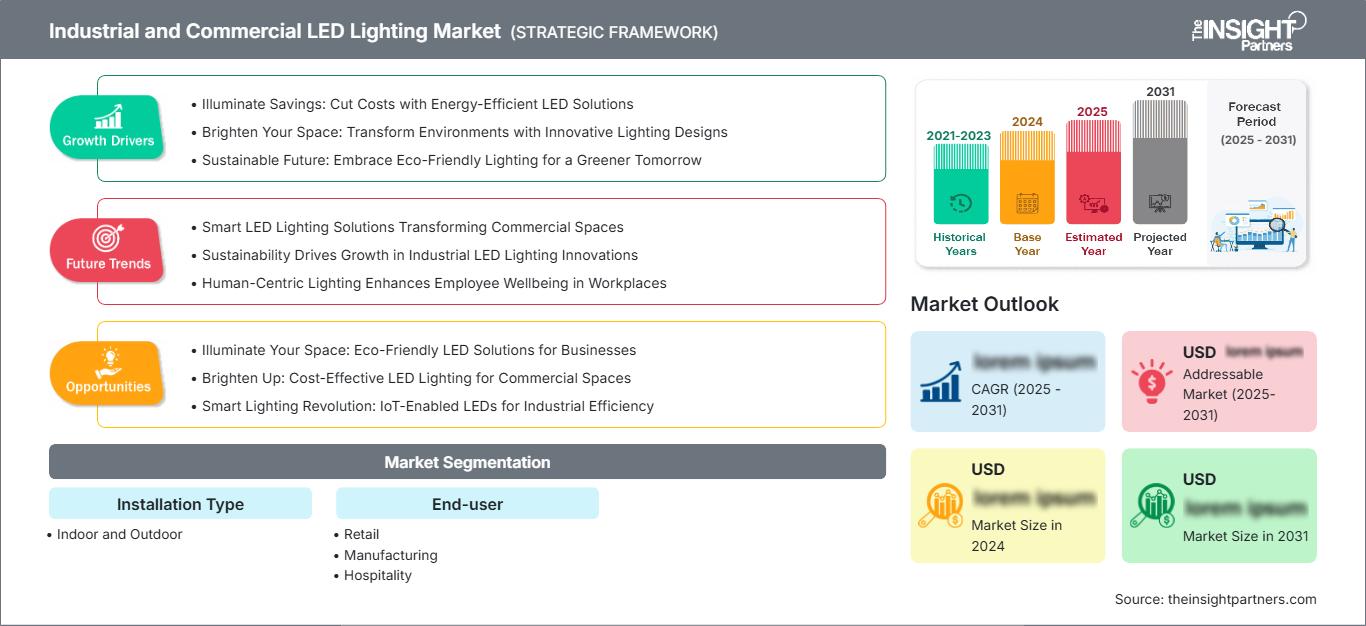
Industrial and Commercial LED Lighting Market: Strategic Insights
Regional Insights
North America Industrial And Commercial LED Lighting Market
North America represents a 25–28% share of the 2025 market and is projected to grow at a 6.5–7.5% CAGR through 2034. Demand is supported by replacement of aging fixtures, commercial renovation, industrial modernization, and growing deployment of occupancy sensing and networked controls. The US remains the principal regional market, while Canada contributes through energy-efficiency programs and infrastructure renewal.
Procurement increasingly evaluates payback, maintenance avoidance, and compatibility with building automation. US federal procurement guidance specifies minimum efficacy requirements for commercial and industrial luminaires, including 175 lm/W for high-bay products under applicable criteria.
U.S. Industrial And Commercial LED Lighting Market
The US accounts for 78–82% of North American revenue in 2025 and is expected to expand at a 6.4–7.4% CAGR through 2034. Industrial facilities, warehouses, offices, healthcare facilities, and retail facilities represent some of the largest applications. Companies like Eaton Corporation plc, General Electric Company, Dialight plc, Cree Lighting, and Koninklijke Philips N.V. operate in the commercial and industrial lighting market space.
This shift involves the transition from individual fixture replacement to connected retrofits using LEDs, along with sensors, dimming, and energy monitoring capabilities. Federal procurement policies and state efficiency programs help enforce specifications, whereas building owners are increasingly benchmarking their projects in terms of lifecycle cost. According to the Department of Energy, efficient commercial and industrial luminaires have the potential to deliver significant energy savings over time.
Europe Industrial And Commercial LED Lighting Market
Europe holds a 21–24% share in 2025 and is projected to grow at a 7.0–8.0% CAGR through 2034, with Germany serving as the leading market. Demand in the UK is affected by commercial estate renovations and net-zero goals, whereas Germany involves industrial modernization and the uptake of smart buildings. In France, Italy, and Spain, demand comes from renovations in building structures, hospitality investments, public infrastructure renewals, and energy efficiency campaigns.
In the UK, there is emphasis on energy-efficient commercial estates, building retrofitting, and performance improvements. In Germany, there is already a good industrial specification base, as well as demand for digitally integrated lighting. In France, there is a combination of public building renovations and efficiency goals. In Italy, there is hospitality, retail, and manufacturing renovation demand. In Spain, there is commercial modernization and infrastructure investments. In these countries, the use of connected controls and building automation in addition to LED lighting upgrades is becoming common practice.
APAC Industrial And Commercial LED Lighting Market
APAC holds a 35–38% share in 2025 and is forecast to grow at a 9.5–10.5% CAGR, making it the leading regional market. China remains the largest demand center, while Japan, South Korea, India, and Australia provide important industrial and commercial applications.
Factory expansion, logistics construction, urban development, and efficiency policies support deployment. India is particularly attractive because new commercial and industrial floor space creates incremental lighting points alongside replacement demand. Manufacturing concentration also supports localized component sourcing and competitive fixture production, strengthening the regional ecosystem.
Middle East & Africa Industrial And Commercial LED Lighting Market
Middle East and Africa demand is supported by infrastructure construction, industrial diversification, logistics development, and energy-management priorities. Saudi Arabia leads regional opportunities, followed by the UAE and South Africa. The broader MEA market is projected to grow at an 8.0–9.0% CAGR through 2034, with project-based procurement remaining important.
Saudi Arabia and the UAE are investing in commercial districts, transport facilities, industrial zones, and large development programs. South Africa emphasizes industrial and municipal efficiency, while the rest of MEA presents selective opportunities around infrastructure upgrades. High ambient temperatures and extended operating periods make thermal management, reliability, and maintenance access important product-selection criteria.
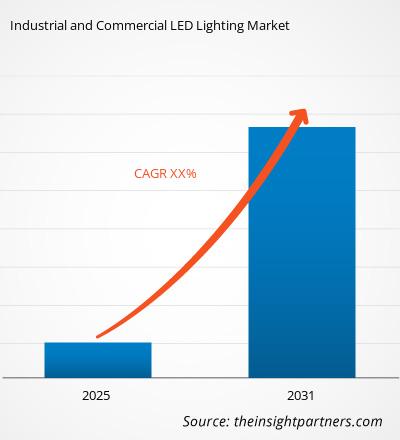
Segmentation Analysis
Installation Type
Installation Type is projected to grow at a 9.4–10.4% CAGR during 2026–2034. Indoor systems retain the broadest addressable base because offices, retail stores, hospitals, factories, and warehouses require controlled illumination across large occupied areas. Outdoor systems benefit from infrastructure modernization and industrial-site requirements. The Industrial And Commercial LED Lighting Market scope increasingly includes fixtures designed for connected controls, retrofit compatibility, and application-specific optical performance.
- Indoor: Indoor installations maintain the leading position because commercial and industrial buildings require continuous, controllable illumination. Demand increasingly favors high-efficacy fixtures, occupancy sensing, tunable output, low-glare optics, and simplified maintenance.
- Outdoor: Outdoor installations serve yards, roads, campuses, parking areas, loading zones, and industrial perimeters. Buyers prioritize weather resistance, optical reach, safety, controls, and reduced maintenance for widely distributed fixtures.
End-user
End-user is expected to expand at a 10.0–11.0% CAGR during 2026–2034. Procurement patterns differ substantially by operating schedule, ceiling height, safety requirements, and lighting quality expectations. Warehouses and storage facilities represent a particularly attractive growth area because automated logistics increases the value of reliable illumination, occupancy-responsive controls, and high-bay efficiency. The segment also illustrates the Industrial And Commercial LED Lighting Market scope across diverse facility types.
- Retail: Retail buyers prioritize visual presentation, color quality, flexible layouts, and controllability. LED systems increasingly support merchandising changes, accent lighting, energy optimization, and faster store renovation cycles.
- Manufacturing: Manufacturing facilities require durable illumination, high output, glare management, and dependable operation. Industrial buyers emphasize maintenance access, hazardous-area compliance where applicable, and integration with facility automation.
- Hospitality: Hotels, restaurants, and leisure properties use LEDs to balance ambience, energy performance, and architectural appearance. Flexible scenes and controls are increasingly important across guest rooms, lobbies, restaurants, and exterior spaces.
- Healthcare: Healthcare facilities require glare control, visual comfort, color rendering, hygiene-compatible products, and reliable operation. Lighting procurement increasingly considers patient environments, staff work areas, circulation zones, and energy management.
- Warehouses & Storage: Warehouses and storage facilities favor high-bay efficiency, motion-responsive controls, uniform illumination, and rapid installation. Automation and extended operating hours strengthen the economic case for connected LED systems.
- Office Buildings: Offices increasingly specify LEDs with low glare, daylight response, occupancy sensing, and flexible controls. Renovation projects often combine lighting upgrades with broader building-automation and workplace modernization programs.
Opportunity Snapshot
| End-user | Revenue Contribution | Trend Tag | Adoption Stage |
|---|---|---|---|
| Retail | High | Store Retrofit | Mature |
| Manufacturing | High | Smart Factory | Mature |
| Hospitality | Medium | Scene Control | Scaling |
| Healthcare | Medium | Visual Comfort | Scaling |
| Warehouses & Storage | High | Motion Control | Scaling |
| Office Buildings | High | Smart Workplace | Mature |
Industrial and Commercial LED Lighting Market Growth Drivers and Impact Analysis
Energy-cost reduction and lifecycle economics
Costs related to electricity use continues to be a crucial factor when purchasing electricity, which means LED replacement will continue to be an appealing option even if LED penetration is high in such facilities. According to the IEA, lighting in both residential and outdoor applications used some 2,200 TWh in 2024.
LED technology decreases lamp and ballast replacement needs, whereas control measures help reduce the hours in operation. For industrial purchasers, this is most relevant in cases of high bay areas running over several shifts. For commercial property managers, the argument becomes more compelling when lighting is part of renovation or energy performance improvements. In this case, the motive is to move from simple unit price comparison to lifecycle cost analysis including electricity, maintenance, disruption, control, and durability.
Connected controls increase the value of LED infrastructure
LED luminaires allow for a digital platform for occupancy sensing, dimming, daylight harvesting, task tuning, and energy monitoring. This increases the potential value for each system because the lighting system may be able to be used for a building-management system. The DOE recommendations have specified that occupancy sensors, task tuning, dimming, and demand response capability can all be used to provide extra savings.
Commercial building owners can invest in both lighting and operations benefits, while industrial buildings can use control to react to production shifts, occupancy, and safety needs. As interoperability is increased, the vendor with the open interface and the ability to be commissioned becomes increasingly important in specification-driven projects.
Regulatory pressure accelerates replacement of inefficient systems
Energy Performance Regulation is leading to a reduction in the lifetimes of inefficient lighting systems in various markets. Europe Union’s ecodesign regulations stipulate that covered light sources and their control gears must be ecodesign-compliant, and the EU building policy increasingly links energy performance with renovation. Procurement regulations and changes in building codes in North America add further requirements for lighting specifications. These types of specifications remove the uncertainties in the performance expectations of facility managers. Manufacturers will be encouraged to develop efficient lighting systems, control methods, heat handling, and documentation capabilities. The impact goes beyond just the construction industry as offices, manufacturing facilities, warehouses, and retail establishments become suitable targets for planned replacements.
Industrial and Commercial LED Lighting Market Future Trends
Lighting will evolve toward adaptive, data-enabled infrastructure
Industrial And Commercial LED Lighting Market trends are likely to see increased integration of light sources into building intelligence rather than treating them as individual devices for electrical installations. Future lighting installations may involve sensors, wireless connectivity, analytics, and control of the luminance level based on occupancy, daylight, task requirements, and scheduling of operations. Digital commissioning will be gaining significance because of the diversification of portfolios across multiple locations. Building managers will also look at having lighting information fed to energy dashboards and facility management systems. This can lead to the development of service business in terms of lighting monitoring, optimization, firmware updates, and performance certification. Technological focus is expected to shift toward interoperable solutions which can co-exist with HVAC, security, access, and automation systems.
Circular design and LED-to-LED renovation will gain importance
The next replacement cycle will increasingly involve existing LED systems rather than conventional lamps alone. First-generation LED installations are reaching points where improved efficacy, optics, controls, and maintainability can justify another renovation. In turn, vendors will react to this demand with modular luminaires, exchangeable parts, recyclable materials, and easy-to-replace mounting systems. Circular design will help reduce the use of materials and make upgrading easier when the families of products change. The business aspect is crucial since facility managers may choose to renovate their lighting system gradually rather than replace it entirely. This is especially important for retail spaces, offices, healthcare facilities, and hotels that can use lighting solutions maintaining their mounting system while improving its visual performance.
Industrial and Commercial LED Lighting Market Opportunities
Warehouse modernization and intelligent logistics facilities
Warehouses provide an attractive investment opportunity because lighting operates for long periods and must accommodate changing occupancy patterns, high ceilings, automated equipment, and safety requirements. Both investors and solution providers have an opportunity to apply high bay LED solutions that are equipped with motion detection to distribution centers. Industrial and e-commerce development are creating a constant flow of new buildings where the technology of connected lights can be applied right from the beginning. At the same time, warehouses that already exist give vendors another source of retrofit installations, especially those that have fluorescent or HID lighting systems. The Industrial And Commercial LED Lighting Market forecast has to include logistics districts, automated fulfillment centers, cold storage facilities, and warehouse portfolio buildings.
Integrated lighting solutions for smart commercial buildings
Commercial building owners increasingly need lighting systems that support broader energy, occupancy, and workplace objectives. This creates opportunities for vendors to package luminaires, controls, sensors, software, commissioning, and maintenance into scalable solutions. Offices, healthcare campuses, retail chains, and hospitality groups can deploy standardized architectures across multiple properties while tailoring scenes and operating schedules locally. Providers can strengthen differentiation through open protocols, cybersecurity, data integration, and analytics rather than relying exclusively on luminaire specifications. Partnerships with electrical contractors, building-automation integrators, and property-management firms can accelerate specification access. The opportunity is especially relevant where owners are pursuing energy-performance improvements without major structural renovation. Retrofit-ready architectures can shorten deployment timelines and support phased investment across geographically distributed portfolios.
Recent Developments
- April 2026: Panasonic Eco Systems North America launched the EcoVent fan with integrated LED lighting, an ENERGY STAR certified ventilation solution designed to improve indoor air quality in high-performance new homes by reducing humidity, mold and pollutants. The compact fan offers selectable 70 and 90 CFM airflow, quiet operation, more than 800 lumens of 3000K warm-white LED lighting, and flexible ceiling or wall installation, providing builders and homeowners with an energy-efficient solution for bathrooms, laundry rooms, basements and other moisture-prone spaces.
- April 2026: Cree LED introduced its compact XLamp XE-B LED series, targeting advanced lighting applications that require high performance in a small package. The new LEDs support a broad range of color options, including white, blue, cyan, green, lime, amber, red and royal blue, giving lighting designers greater flexibility for architectural, specialty and general illumination applications. The series is designed to combine compact form factor, high intensity and multiple color configurations, enabling manufacturers to develop smaller and more versatile lighting systems.
- March 2025: Super Bright LEDs launched Industrial Commercial Lighting (ICL), a dedicated online platform providing commercial-grade LED lighting solutions for facility managers, business owners, contractors and electricians. The platform offers high-efficiency fixtures for warehouses, factories and commercial buildings, advanced lighting controls.
Frequently Asked Questions

- Comprehensive Market Sizing and Forecast Analysis
- Detailed Segmentation Analysis
- In-Depth Market Dynamics Assessment
- Regional and Country-Level Insights
- Competitive Landscape and Company Benchmarking
- Strategic Business Intelligence
Recent Reports
Testimonials

The Insight Partners' SCADA System Market report is comprehensive, with valuable insights on current trends and future forecasts. The team was highly professional, responsive, and supportive throughout. We are very satisfied and highly recommend their services.
RAN KEDEM Partner, Reali Technologies LTDs
I requested a report on a very specific software market and the team produced the report in a few days. The information was very relevant and well presented. I then requested some changes and additions to the report. The team was again very responsive and I got the final report in less than a week.
JEAN-HERVE JENN Chairman, Future Analytica
We worked with The Insight Partners for an important market study and forecast. They gave us clear insights into opportunities and risks, which helped shape our plans. Their research was easy to use and based on solid data. It helped us make smart, confident decisions. We highly recommend them.
PIYUSH NAGPAL Sr. Vice President, High Beam Global
The Insight Partners delivered insightful, well-structured market research with strong domain expertise. Their team was professional and responsive throughout. The user-friendly website made accessing industry reports seamless. We highly recommend them for reliable, high-quality research services
YUKIHIKO ADACHI CEO, Deep Blue, LLC.
This is the first time I have purchased a market report from The Insight Partners.While I was unsure at first, I visited their web site and felt more comfortable to take the risk and purchase a market report.I am completely satisfied with the quality of the report and customer service. I had several questions and comments with the initial report, but after a couple of dialogs over email with their analyst I believe I have a report that I can use as input to our strategic planning process.Thank you so much for taking the extra time and making this a positive experience.I will definitely recommend your service to others and you will be my first call when we need further market data.
JOHN SUZUKI President and Chief Executive Officer, Board Director, BK Technologies
I wish to appreciate your support and the professionalism you displayed in the course of attending to my request for information regarding to infectious disease IVD market in Nigeria. I appreciate your patience, your guidance, and the fact that you were willing to offer a discount, which eventually made it possible for us to close a deal. I look forward to engaging The Insight Partners in the future, all thanks to the impression you have created in me as a result of this first encounter.
DR CHIJIOKE ONYIA MANAGING DIRECTOR, PineCrest Healthcare Ltd.Reason to Buy
- Informed Decision-Making
- Understanding Market Dynamics
- Competitive Analysis
- Identifying Emerging Markets
- Customer Insights
- Market Forecasts
- Risk Mitigation
- Boosting Operational Efficiency
- Strategic Planning
- Investment Justification
- Tracking Industry Innovations
- Aligning with Regulatory Trends





 Get Free Sample for