
Industrial Fasteners Market Share, Growth & Forecast by 2034
Coverage: by Type (Bolts, Screws, Nuts, Washers, Rivets), Product (Externally Threaded, Internally Threaded, Non-Threaded), Raw Material(Metal, Alloy Steel, Carbon Steel, Specialty Alloys, Plastic), End-Use Industry (Aerospace, Automotive, Building and Construction, Industrial Machinery, Consumer Goods, Energy and Power), and Geography (North America, Europe, Asia Pacific, and South and Central America)
- Status : Data Released
- Report Code : TIPTE100000335
- Category : Manufacturing and Construction
- No. of Pages : 150
- Available Report Formats :


- Last update date : August 28, 2026


2025 Market Size
US$ 101.84 Bn
Base year value
2034 Forecast
US$ 164.78 Bn
Projected by 2034
CAGR 2026-2034
5.49 %
Growth rate
Addressable Market
US$ 1,208.77 Bn
(2026-2034)
The industrial fasteners market was valued at US$ 101.84 Billion in 2025 and is projected to reach US$ 164.78 Billion by 2034, expanding at a CAGR of 5.49% during 2026–2034. Demand is supported by recurring assembly requirements across automotive, aerospace, construction, machinery, consumer goods, and energy systems, while product qualification, joint reliability, corrosion resistance, and manufacturing consistency remain decisive purchasing criteria across high-volume and safety-critical applications.
Within North America, the industrial fasteners market size is expected to advance at a 4.8–5.4% CAGR through 2034. Vehicle platform renewal, aerospace production recovery, infrastructure rehabilitation, and reshoring of precision manufacturing underpin demand. Regional buyers increasingly favour documented material traceability, automated vendor-managed inventory, and application-specific coatings that reduce installation time and improve lifecycle performance in harsh industrial environments.
Industrial Fasteners Market Assessment and Insights
- North America: North America represented 24–27% of Industrial Fasteners Market share in 2025 and is forecast to grow at a 4.8–5.4% CAGR during 2026–2034, supported by aerospace, vehicles, machinery, and infrastructure renewal.
- US: The US contributed 76–79% of North American revenue in 2025 and should expand at a 4.9–5.5% CAGR through 2034 on advanced manufacturing and construction activity.
- Europe: Europe accounted for 22–25% in 2025 and is projected to record a 4.3–4.9% CAGR during 2026–2034, led by Germany, the UK, France, Italy, and Spain.
- Asia Pacific: Asia Pacific held 43–46% in 2025 and is expected to achieve a 6.1–6.7% CAGR during 2026–2034, with China, Japan, India, and South Korea leading production and consumption.
- Largest Segment: Externally Threaded products held 47–50% market share in 2025 and are projected to expand at a 5.2–5.8% CAGR during 2026–2034.
- High Growth Segment: Plastic raw material held 7–10% market share in 2025 and is forecast to rise at a 6.8–7.4% CAGR during 2026–2034.
- Key companies analyzed in detail: Illinois Tool Works Inc., Howmet Aerospace Inc., LISI S.A., Nifco Inc., Hilti Aktiengesellschaft, Stanley Black & Decker, Inc., Würth Group, Bossard Holding AG, Bulten AB, and KAMAX Holding GmbH & Co. KG.
Source: The Insight Partners' analysis based on proprietary research, government publications, company annual reports, investor presentations, industry databases, and expert interviews.
Production is no longer catalog-driven commodity production but rather joining system engineering based on cold forming, machining, inspection, and application simulation. High-strength steels, aluminum, titanium, polymers, coatings, and digital quality history have become the norm for many suppliers. This leads to better reliability and weight reductions as well as regional manufacturing and vendor-controlled inventories limiting vulnerability to ports, alloy markets, and line stops.
Industrial Fasteners Market trends indicate that going forward, investments will be made in India, Southeast Asia, Mexico, Eastern Europe, and Gulf manufacturing belts with growing industrial capacity and pipeline. Transport, energy, and building certification trends will support suppliers documenting metallurgy, torque properties, recycling, and carbon footprint. Electric mobility, renewable generation, semiconductors, and manufacturing incentives can increase demand for unique fastener products and local technical services.
Industrial Fasteners Market Report Scope
| Report Attribute | Details |
|---|---|
| Market size in 2025 | US$ 101.84 Billion |
| Market Size by 2034 | US$ 164.78 Billion |
| Global CAGR (2026 - 2034) | 5.49% |
| Historical Data | 2021-2024 |
| Forecast period | 2026-2034 |
Industrial Fasteners Market Analysis
Fasteners industrial market growth is associated with increasing assembly activity in the manufacturing of vehicles, buildings, aircraft, machines, and power equipment. Joint geometry impacts weight, serviceability, vibration, and liability issues during the process, hence OEMs select fasteners early on during the design phase of products. There is interdependency among steel mills, alloy producers, wire drawing facilities, cold former firms, coating facilities, and distributors.
The Industrial Fasteners Market forecast indicates that suppliers are dependent on raw materials such as steel, nickel, chromium, aluminium, and energy. Suppliers are likely to diversify qualified supply base, make blanket orders, and keep inventories close to their plants. Automated optical inspection and statistical process controls have helped increase lot-to-lot consistency. Vendors manage replenishment of low-cost items through availability, packing, and traceability.
Industrial Fasteners Market Analysis is characterized by a fragmented industry structure with global portfolios being able to compete alongside application-specific companies. In their approach, Illinois Tool Works Inc., Würth Group, Stanley Black & Decker, Inc., and Hilti Aktiengesellschaft rely on distribution coverage and branding, whereas Howmet Aerospace Inc. and LISI S.A. capitalize on aerospace approvals. On their part, KAMAX Holding GmbH & Co. KG, Bulten AB, Nifco Inc., and Bossard Holding AG leverage their engineering expertise and logistics know-how.
Allocations of capital in the Industrial Fasteners Market are increasingly focusing on automation, heat treatment, digital warehousing, coatings, and regional factories. Positioning has become more dependent on design-in access, multi-regional qualifications, and the ability to combine standard products with engineered specialties. Scale helps with procurement and service density, although specialists still have pricing power in the event of fatigue life, weight, dimensional tolerance, or audit issues.
● REPORT CUSTOMIZATION
Tailor This Report To Align With Your Specific Business Requirements
This report can be customized to align precisely with your business objectives, scope, and target markets. Customization options include tailored segmentation, geography, competitive analysis, and strategic insights to support informed decision-making.
Customize This Report →WHAT YOU CAN ADJUST
- ● Segmentations
- ● Geography
- ● Competitive Analysis
- ● Language Preferences
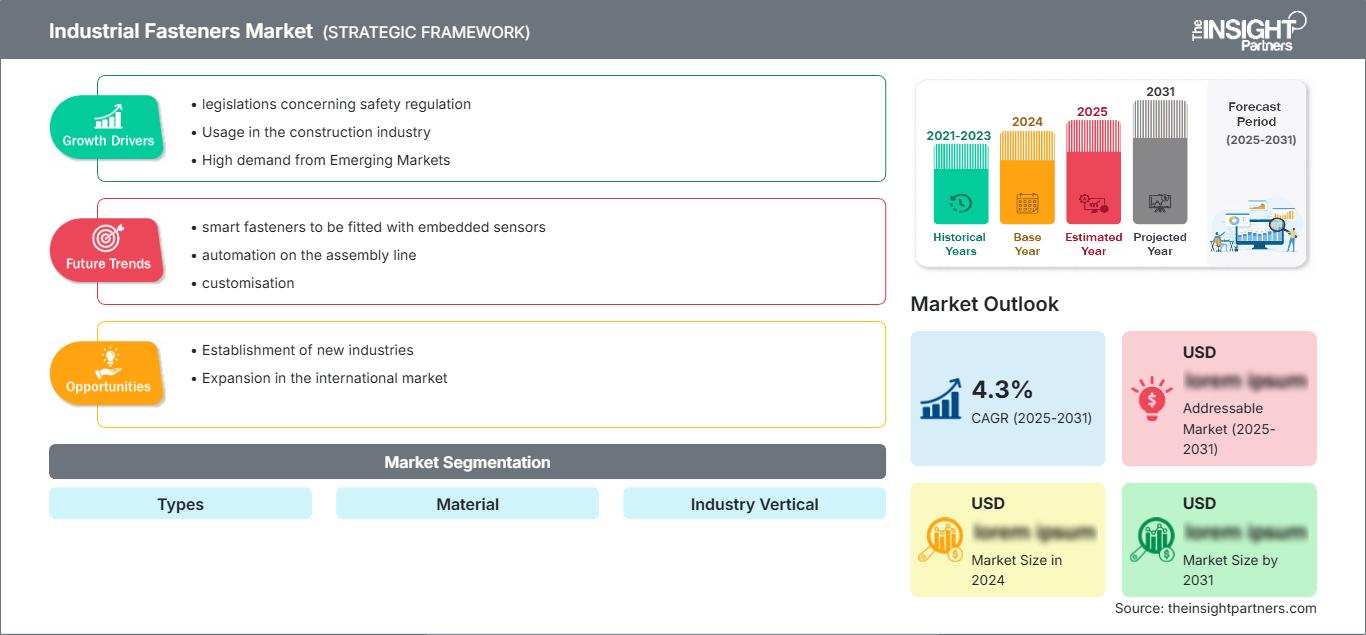
Industrial Fasteners Market: Strategic Insights
Regional Insights
North America industrial fasteners market
North America held 24–27% of global revenue in 2025 and is projected to expand at a 4.8–5.4% CAGR during 2026–2034. Market share for industrial fasteners is a function of a wide-ranging demand base that includes light vehicles, commercial aircrafts, defense systems, data centers, energy systems, industrial machinery, and non-residential construction. Reshoring of component manufacturing drives local sourcing, quick qualification times, and automation investments in cold forming and inspection processes.
Mexico adds value to the supply chain through manufacturing of vehicles and appliances, whereas Canada adds value through aerospace, mining, energy and infrastructure applications. Demand for fasteners continues to increase with emphasis on corrosion resistance, lot tracking, and on-hand availability at plant sites. Suppliers that can provide domestic engineering support, a distribution network, and certification compliance are well-placed to win business where logistics and productivity outweigh small price differentials per piece.
U.S. Industrial Fasteners Market
The US generated 76–79% of the Industrial Fasteners Market in 2025 and is forecast to grow at a 4.9–5.5% CAGR through 2034. The processes of vehicle retooling, commercial production of aircrafts, spending on infrastructure by the government, construction of semiconductor plants, warehousing operations, and power grid expansion contribute to strong fastener sales volumes. The need for fasteners is increasingly becoming one for high strength bolts, structural anchor bolts, self-drilling screws, aerospace fasteners, and polymer clips.
The companies such as Illinois Tool Works Inc., Stanley Black & Decker, Inc., Howmet Aerospace Inc., Hilti Aktiengesellschaft, and Würth Group have considerable operations within the market. Inbound shipments from domestic sources enhance the chances for local manufacturers to get into the market despite price advantages offered by imported fasteners. Growth will be driven by those suppliers who can provide engineering support, automated replenishment, certification history, and speedy deliveries.
Europe Industrial Fasteners Market
Europe represented 22–25% of the Industrial Fasteners Market in 2025 and is expected to post a 4.3–4.9% CAGR during 2026–2034. Germany dominates via cars, machinery, railways, and industrial engineering. The UK contributes through aerospace and construction consumption, whereas France contributes via aircrafts, cars, energy, and infrastructure for transportation. Stringent quality control of goods drives premium coatings, alloy strengths, and documented manufacturing processes.
Italy and Spain participate through vehicle parts, home appliances, fabrication, renewable energy, and construction. High energy prices and lengthy industrial cycles hinder the movement of bulk alloys; however, electrification, offshore wind energy, railway improvement, and automation help in the development of specialized alloys. European manufacturers focus on localization of alloy production, enhanced heat treatment process efficiency, and documentation.
APAC Industrial Fasteners Market
Asia Pacific accounted for 43–46% in 2025 and should grow at a 6.1–6.7% CAGR during 2026–2034. China leads through manufacturing scale, automotive output, machinery, electronics, and construction, while Japan and South Korea sustain demand for precision, quality-controlled products.
India offers the strongest incremental opportunity through infrastructure, vehicles, rail, electronics, and production-linked investment. Australia adds mining, energy, and construction demand. Regional policy support for localization, electric mobility, renewable equipment, and advanced manufacturing encourages capacity expansion and higher-specification fastening systems.
Middle East & Africa Industrial Fasteners Market
Middle East and Africa is forecast to expand at a 5.5–6.1% CAGR during 2026–2034. Saudi Arabia leads through industrial diversification, transport, utilities, and large construction programmes, while the UAE supports logistics, aviation, energy, and commercial projects.
South Africa anchors mining, automotive, power, and general industry demand. The rest of MEA remains project-led and distributor-dependent. Opportunities concentrate in corrosion-resistant, structural, and energy-grade fasteners backed by reliable stocking, technical documentation, and contractor support.
Segmentation Analysis
Type
Type demand is projected to expand at a 5.2–5.8% CAGR during 2026–2034. Selection depends on load path, removability, installation speed, joint accessibility, vibration, and corrosion exposure. Standardization supports volume economics, whereas safety-critical assemblies require engineered geometry, controlled preload, specialized coatings, and documented process capability. Automation favours products that feed consistently and deliver repeatable torque.
- Bolts: Bolts retain a central position in structural, machinery, vehicle, and energy assemblies because they support high clamp loads, disassembly, standardized installation, and auditable torque procedures.
- Screws: Screws benefit from automated assembly, self-drilling capability, and wide use in sheet metal, electronics, construction, appliances, and interiors where installation speed and accessibility matter.
- Nuts: Nuts remain strategically important in bolted joints, with prevailing-torque, flange, lock, and weld designs addressing vibration, space constraints, load distribution, and repeatable maintenance requirements.
- Washers: Washers distribute load, protect mating surfaces, control friction, and improve locking performance, making them essential complements in construction, machinery, transport, and maintenance-intensive assemblies.
- Rivets: Rivets serve permanent and blind-side joining applications in aerospace, transport, sheet-metal fabrication, and construction, particularly where welding heat or rear access is undesirable.
Product
Product demand should grow at a 5.1–5.7% CAGR during 2026–2034. The industrial fasteners market scope spans removable threaded joints and permanent non-threaded connections, with engineering choices balancing clamp force, assembly access, fatigue resistance, weight, inspection, and serviceability. Externally threaded products lead because bolts and screws fit repeatable, automated workflows across nearly every major end-use industry.
- Externally Threaded: This category holds the leading position through extensive use of bolts, screws, and studs in vehicles, equipment, structures, and energy assets requiring strong, serviceable joints.
- Internally Threaded: Internally threaded products support secure mating and modular assembly through nuts and inserts, with demand tied to lightweight substrates, repairability, vibration resistance, and space-efficient design.
- Non-Threaded: Non-threaded products address rapid or permanent joining through rivets, pins, clips, and retaining devices, supporting sheet-metal, aerospace, electronics, interiors, and high-throughput assembly.
Raw Material
Raw material demand is expected to advance at a 5.4–6.0% CAGR during 2026–2034. Engineers select materials using tensile strength, fatigue, temperature, corrosion, weight, electrical behaviour, manufacturability, and total installed cost. Metals dominate critical load-bearing applications, while engineering plastics gain where insulation, low mass, snap-fit assembly, colour coding, and chemical resistance create meaningful system benefits.
- Metal: Metal remains the dominant material family because it combines strength, formability, heat-treatment response, coating compatibility, and established standards across structural and mechanical applications.
- Alloy Steel: Alloy steel serves high-load and fatigue-sensitive joints in automotive, machinery, aerospace support equipment, and energy systems where controlled hardenability and strength are essential.
- Carbon Steel: Carbon steel supports high-volume standardized fasteners through cost efficiency, cold-forming performance, broad availability, and diverse surface treatments for construction, appliances, vehicles, and machinery.
- Specialty Alloys: Specialty alloys address demanding temperature, corrosion, fatigue, and weight requirements in aircraft, turbines, chemical processing, offshore assets, and premium mobility applications.
- Plastic: Plastic fasteners gain strategic relevance in electronics, interiors, appliances, and electric systems by providing electrical insulation, corrosion resistance, low mass, quiet operation, and rapid assembly.
End-Use Industry
End-use demand is projected to expand at a 5.5–6.1% CAGR during 2026–2034. Automotive and construction create high volumes, while aerospace and energy generate higher qualification intensity. Machinery and consumer goods broaden the recurring replacement base. Across industries, suppliers win by aligning product design, certification, packaging, and replenishment with customer assembly economics rather than competing solely on component price.
- Aerospace: Aerospace prioritizes lightweight, fatigue-resistant, traceable fasteners with strict qualification, creating durable supplier relationships and attractive value density despite long approval cycles and demanding audits.
- Automotive: Automotive remains a major volume engine, requiring high-speed feeding, controlled torque, lightweight designs, and platform-specific engineering across powertrain, body, battery, chassis, and interiors.
- Building and Construction: Construction demand spans structural bolts, anchors, screws, washers, and roofing systems, with purchasing influenced by codes, installer productivity, corrosion exposure, and infrastructure pipelines.
- Industrial Machinery: Machinery applications require durable, serviceable joints across equipment production and maintenance, supporting demand for standardized hardware, locking solutions, and vendor-managed inventory programmes.
- Consumer Goods: Consumer goods use cost-efficient screws, clips, inserts, and nuts in appliances, furniture, tools, and devices, emphasizing appearance, assembly speed, noise control, and recyclability.
- Energy and Power: Energy applications require high-strength and corrosion-resistant fastening for wind, solar, grid, conventional power, and storage systems, with reliability shaped by remote locations and long service lives.
Opportunity Snapshot
| End-Use Industry | Revenue Contribution | Trend Tag | Adoption Stage |
| Aerospace | Medium | Fleet Renewal | Scaling |
| Automotive | High | EV Platforms | Mature |
| Building and Construction | High | Structural Anchors | Mature |
| Industrial Machinery | High | Factory Automation | Mature |
| Consumer Goods | Medium | Snap Fits | Scaling |
| Energy and Power | Medium | Wind Repowering | Scaling |
| Others | Low | Niche Assembly | Emerging |
Industrial Fasteners Market Growth Drivers and Impact Analysis
Vehicle Electrification and Platform Redesign
Electric vehicles have a big impact on fastening needs in batteries, thermals, bodies, electronics, and lightweight interiors. Car manufacturers require anti-corrosion features, electrical insulation, load retention, and joints suitable for mixed materials. With increased automation, there is an opportunity for fasteners designed for robotic feeding and online verification. The effect goes well beyond the number of vehicles because the introduction of new platforms will give chances to sell special screws, bolts, inserts, and plastic clips. Those suppliers who take part in this process will be able to affect joint design and earn money during the whole programme cycle. Multi-regional manufacturing is especially beneficial since vehicles’ platforms usually start production in several factories.
Infrastructure Modernization and Urban Construction
Transport infrastructure, utility companies, data centers, manufacturing facilities, warehousing and housing need a significant number of anchor bolts, structural bolts, screws, washers, and custom joints. Aging infrastructure in developed countries will create the market for the renovation, whereas urbanization and industrial belts will provide the market for the new constructions in emerging economies. The fasteners make up a small percentage of the project cost, but they directly influence time and quality of installation, which is why there is an opportunity for differentiation on this niche by creating a product that saves labor and provides performance certification.
Automation, Traceability, and Quality Assurance
With process control becoming tighter due to faster assembly lines that make it more expensive for manufacturers when a fastener is not correct, manufacturers use automated optical inspection, torque control, serialized batches, and digital certificates for better uniformity and quicker troubleshooting. The ability to do that helps to raise the entry barriers in aerospace, automotive, energy, and machine industries where failure of a joint may mean safety risks, warranties, and downtime. The commercial side of the matter means that it will help the companies to enter into longer-term contracts for supplies instead of purchasing on a spot market.
Industrial Fasteners Market Future Trends
Smart Fastening and Connected Assembly
Developments in the industrial fastener market trends will increasingly incorporate joints with sensors, RFID tags, digital torque data, and smart tools capable of validating joint installation parameters. The initial use cases would involve premium applications, such as those in aerospace, mobility, wind energy, and machinery sectors, in which the costs of inspections are higher and the consequences of failure are significant. In the long run, standardized data connectors are expected to tie the fastener identity to the production process and maintenance history. Such developments may allow value transfer from hardware to monitoring of joints, generating new service income for vendors.
Low-Carbon Materials and Circular Design
The emphasis will be on recycled steel, low carbon metal technologies, coating technology, weight saving and design for dismantling. The carbon footprint of the product is expected to become an important factor when purchasing products as automakers assess their carbon footprint from their supply chain, and regulatory authorities impose stricter requirements for reporting. Manufacturers will react by qualifying alternate alloys, optimizing heat treatments, minimizing coating waste, and recording lifecycle performance. Removable fasteners are expected to take precedence over permanently joined fasteners where remanufacturing or disassembly has value.
Industrial Fasteners Market Opportunities
Localized Precision Capacity in Emerging Manufacturing Hubs
Industrial fastener market forecast data favors investments in India, Mexico, Southeast Asia, and specific countries in the Gulf Region where there is an increased capacity for vehicles, electronics, renewable energy, and machinery manufacturing. The opportunity does not only exist in increasing the capacity of generic products but to establish competence in cold-forming, heat-treating, coating, testing, and application engineering services close to customers. Investors may choose high specification products that are currently being imported, reduce delivery time, and provide two sources of supply. Investments in partnership with local distributors or original equipment manufacturers will speed up qualifications, and modular manufacturing facilities keep capital expenditure low.
Advanced Polymer and Lightweight Fastening Systems
Design of polymers, aluminium, titanium, and composite fastening systems emerges as a promising area of growth in the Industrial Fasteners Market as design teams seek to decrease weight and work with mixed material assemblies. Potential areas for application are electric vehicle interiors and battery packs, electronic components, appliances, airliner interiors, medical devices, and other environments exposed to corrosion. The business case is based on expertise in design, tooling, materials, and testing, not just basic capabilities. Value can be extracted through replacement of complicated metal assemblies with clips, inserts, or other attachment technologies which shorten assembly operations. Defensibility comes from co-development agreements and proprietary designs, but good qualification practices are critical in certain applications.
Recent Developments
- June 2025: Bulten AB – the company initiated a strategic review covering make-or-buy choices, manufacturing footprint, and organization. Management stated that future investment would focus on areas with stronger long-term profitable growth, including complex fasteners, C-parts services, and diversification beyond automotive. The review signalled a move toward a more focused, asset-efficient operating model
- August 2026: Teks, a brand of Illinois Tool Works (ITW), launched its new Elite Metal-to-Metal Screws, a premium range of self-drilling fasteners designed for professional electrical, HVAC, metal-framing, and general construction applications. The screws feature a Lightning Point tip designed to start 20% faster in metal, a T-20 StikFit star drive for improved driving stability, and a low-profile washer head for stronger metal-to-metal connections
Frequently Asked Questions

- Comprehensive Market Sizing and Forecast Analysis
- Detailed Segmentation Analysis
- In-Depth Market Dynamics Assessment
- Regional and Country-Level Insights
- Competitive Landscape and Company Benchmarking
- Strategic Business Intelligence
Recent Reports
Testimonials

The Insight Partners provided valuable market intelligence that supported our global go-to-market strategy. Their team was professional, responsive, and attentive to our feedback, providing thoughtful analysis and helpful methodological clarifications throughout the project.
Junmo Kim Chief Financial Officer (CFO), Enertech Co., Ltd.
The Insight Partners' SCADA System Market report is comprehensive, with valuable insights on current trends and future forecasts. The team was highly professional, responsive, and supportive throughout. We are very satisfied and highly recommend their services.
RAN KEDEM Partner, Reali Technologies LTDs
I requested a report on a very specific software market and the team produced the report in a few days. The information was very relevant and well presented. I then requested some changes and additions to the report. The team was again very responsive and I got the final report in less than a week.
JEAN-HERVE JENN Chairman, Future Analytica
We worked with The Insight Partners for an important market study and forecast. They gave us clear insights into opportunities and risks, which helped shape our plans. Their research was easy to use and based on solid data. It helped us make smart, confident decisions. We highly recommend them.
PIYUSH NAGPAL Sr. Vice President, High Beam Global
The Insight Partners delivered insightful, well-structured market research with strong domain expertise. Their team was professional and responsive throughout. The user-friendly website made accessing industry reports seamless. We highly recommend them for reliable, high-quality research services
YUKIHIKO ADACHI CEO, Deep Blue, LLC.
This is the first time I have purchased a market report from The Insight Partners.While I was unsure at first, I visited their web site and felt more comfortable to take the risk and purchase a market report.I am completely satisfied with the quality of the report and customer service. I had several questions and comments with the initial report, but after a couple of dialogs over email with their analyst I believe I have a report that I can use as input to our strategic planning process.Thank you so much for taking the extra time and making this a positive experience.I will definitely recommend your service to others and you will be my first call when we need further market data.
JOHN SUZUKI President and Chief Executive Officer, Board Director, BK Technologies
I wish to appreciate your support and the professionalism you displayed in the course of attending to my request for information regarding to infectious disease IVD market in Nigeria. I appreciate your patience, your guidance, and the fact that you were willing to offer a discount, which eventually made it possible for us to close a deal. I look forward to engaging The Insight Partners in the future, all thanks to the impression you have created in me as a result of this first encounter.
DR CHIJIOKE ONYIA MANAGING DIRECTOR, PineCrest Healthcare Ltd.Reason to Buy
- Informed Decision-Making
- Understanding Market Dynamics
- Competitive Analysis
- Identifying Emerging Markets
- Customer Insights
- Market Forecasts
- Risk Mitigation
- Boosting Operational Efficiency
- Strategic Planning
- Investment Justification
- Tracking Industry Innovations
- Aligning with Regulatory Trends





 Get Free Sample for