
Industrial Smart Motors Market Size, Share & Demand by 2034
Coverage: by Offerings (Products, Services); Application (Pumps, Fans, Compressors, Others); Industry Vertical (Energy and Power, Manufacturing, Automotive, Others) , and Geography (North America, Europe, Asia Pacific, and South and Central America)
- Status : Data Released
- Report Code : TIPRE00007790
- Category : Electronics and Semiconductor
- No. of Pages : 150
- Available Report Formats :


- Last update date : September 18, 2026


2025 Market Size
US$ 8.84 Bn
Base year value
2034 Forecast
US$ 15.28 Bn
Projected by 2034
CAGR 2026-2034
6.27 %
Growth rate
Addressable Market
US$ 109.17 Bn
(2026-2034)
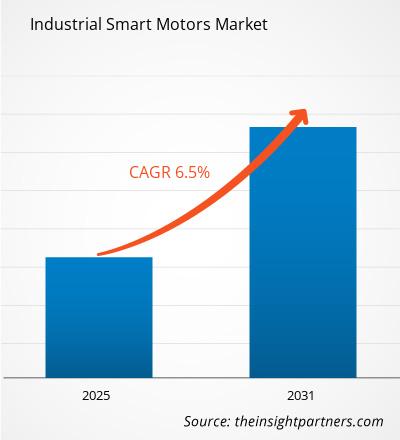
The Industrial Smart Motors Market is valued at US$ 8.84 Billion in 2025 and is projected to reach US$ 15.28 Billion by 2034, expanding at a CAGR of 6.27% during 2026–2034. These trends are manifested through greater integration of intelligence in motor controls, sensors, communication, and energy savings in industrial equipment. The deployment of these systems will be driven by investments in automation, asset monitoring, and the need to increase efficiency in the motor-based industrial application space.
North America Industrial Smart Motors Market Size can be viewed as a structurally significant market, growing at an expected CAGR of 5.9–6.5% between 2026 and 2034. Industrial automation modernizations and replacements of existing old motor systems will drive adoption, and investments in manufacturing, data infrastructure, water infrastructure, and energy security will add to the market opportunity.
Industrial Smart Motors Market Assessment and Insights
- North America is expected to command a 29–33% share in 2025 and grow at a 5.9–6.5% CAGR between 2026–2034, supported by automation modernization, replacement demand, and industrial digitalization.
- US is expected to account for 72–76% of North America's 2025 market and expand at a 6.0–6.6% CAGR during 2026–2034, driven by manufacturing investment and connected asset management.
- Europe is projected to hold a 24–28% share in 2025 and advance at a 5.7–6.3% CAGR during 2026–2034, with Germany, the UK, France, Italy, and Spain supporting industrial efficiency investment.
- Asia Pacific is estimated at 34–38% Industrial Smart Motors Market share in 2025 and is projected to grow at a 6.7–7.3% CAGR during 2026–2034, led by China, Japan, South Korea, and India.
- Largest Segment is Products within Offerings, representing a 69–73% market share in 2025 and growing at a 5.8–6.2% CAGR during 2026–2034.
- High Growth Segment is Services within Offerings, holding a 27–31% market share in 2025 and advancing at a 7.1–7.6% CAGR during 2026–2034.
- Key companies analyzed in detail: CG Power and Industrial Solutions Limited, Dunkermotoren GmbH, HSD SpA, Nidec Corporation, Reliance Precision Limited, Rockwell Automation, Inc., Schneider Electric SE, Somfy Systems, Inc., Technosoft SA, USAutomation.
Source: The Insight Partners' analysis based on proprietary research, government publications, company annual reports, investor presentations, industry databases, and expert interviews.
The Industrial Smart Motors Market has moved from electromechanical devices into motion assets comprising of motors, drives, sensors, communication and software control elements. Economics of production are increasingly driving modular solutions that make installation and troubleshooting easier. Efficiency is another consideration in design, considering that motor systems contribute to more than 40% of total global energy usage, as reported by the International Energy Agency. In the future, deployment will expand to new centers of manufacturing activity and industrial economies that rely heavily on infrastructure investments. Minimum energy performance regulations, digital monitoring and industrial efficiency are expected to drive change in inefficient equipment.
Industrial Smart Motors Market Report Scope
| Report Attribute | Details |
|---|---|
| Market size in 2025 | US$ 8.84 Billion |
| Market Size by 2034 | US$ 15.28 Billion |
| Global CAGR (2026 - 2034) | 6.27% |
| Historical Data | 2021-2024 |
| Forecast period | 2026-2034 |
Industrial Smart Motors Market Analysis
Industrial Smart Motors market dynamics are driven by the intersection of factory automation, energy management, predictive maintenance, and machine connectivity. Significant opportunity exists for pumps, fans, and compressors since operating conditions are likely to be constantly changing, and variable-speed drives and condition monitoring become commercially viable solutions. Consumers increasingly look at motors not as standalone products, but as components of an overall drive and control solution.
The industrial smart motors value chain stretches from motor and component makers, drive producers, automation platforms, distribution, system integration, machine construction, and industrial end users. Availability of semiconductors, magnets, bearings, copper, and power electronics affects the economics of supply, whereas the local presence of manufacturing facilities minimizes lead time risks. Interface standards are becoming more prevalent since plant managers are looking for interoperability of motor assets and control systems.
The Competitive Landscape for the Global Industrial Smart Motors Market Report comprises automation firms along with motor and motion control vendors. The rivalry of Nidec Corporation, Schneider Electric SE, and Rockwell Automation Inc. involves motor control ecosystems, while CG Power and Industrial Solutions Limited, Dunkermotoren GmbH, HSD Spa, Reliance Precision Limited, Technosoft SA, Somfy Systems Inc., and USAutomation focuses on specialization of application, technology of motion or geographical presence.
Competitiveness has been increasingly associated with software integration, service network, application engineering, and retrofitting rather than hardware for the motors. Investments are being made in product connectivity, digital commissioning, monitoring of condition, and production capability. Partnership may help in quickening the process of integration, while localized manufacturing helps in being responsive to the customers' demands. In effect, what exists in the market is rivalry between firms with automation portfolio and specialists.
● REPORT CUSTOMIZATION
Tailor This Report To Align With Your Specific Business Requirements
This report can be customized to align precisely with your business objectives, scope, and target markets. Customization options include tailored segmentation, geography, competitive analysis, and strategic insights to support informed decision-making.
Customize This Report →WHAT YOU CAN ADJUST
- ● Segmentations
- ● Geography
- ● Competitive Analysis
- ● Language Preferences
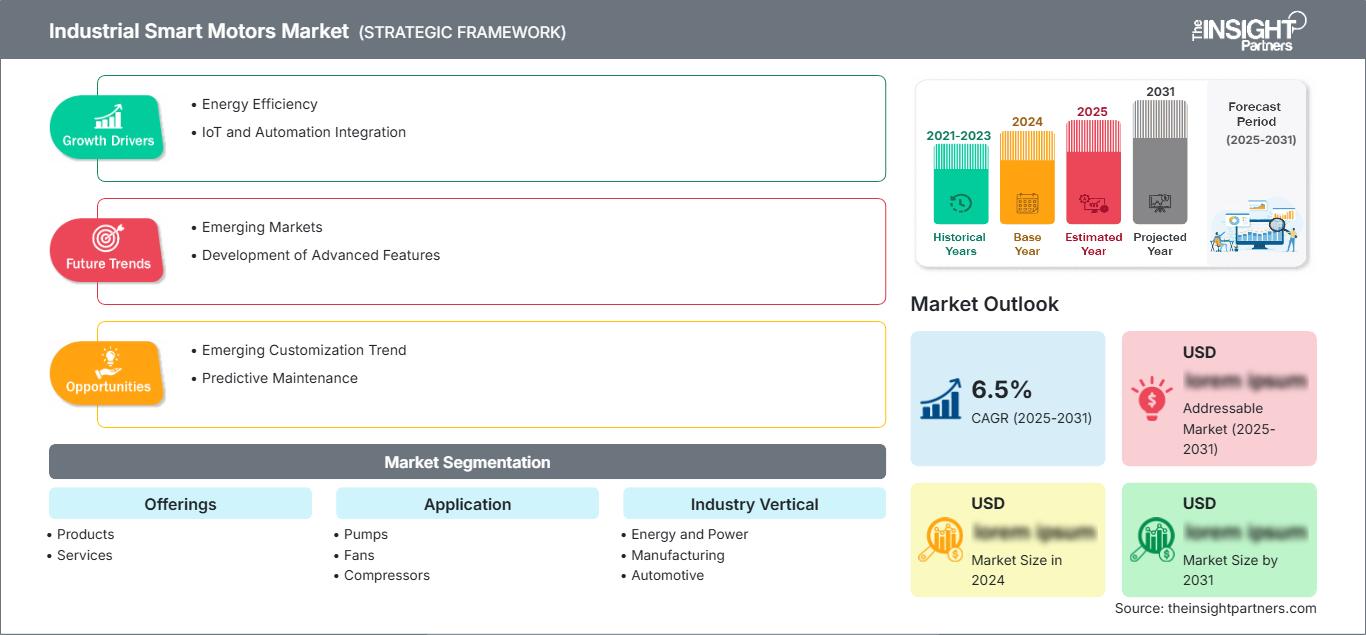
Industrial Smart Motors Market: Strategic Insights
Regional Insights
North America Industrial Smart Motors Market
North America is expected to comprise 29-33% of the 2025 Industrial Smart Motors Market Share and to grow at a 5.9-6.5% CAGR through 2034. The region capitalizes on established automation technology, large installed value of equipment, and replacement options in manufacturing, utilities, logistics, and process segments. Energy management initiatives will further augment the business case for smart motor systems.
The US market constitutes 72-76% of the regional demand, while Canada participates via energy applications, mining, food processing, and infrastructure use cases. Industrial reshoring and investment in smart manufacturing will fuel automation spending, thus providing opportunities for connected motor systems. The modernization of water/wastewater facilities is another factor driving demand for digital pump and variable speed motor solutions. Providers with a strong controls/drives/service offering are well-placed to address retrofits.
U.S. Industrial Smart Motors Market
America is about 72–76% of the market share of North America in 2025 and forecasted to achieve a CAGR of 6.0–6.6% during 2026–2034. This will be driven by investments in factory automation, process improvement, and automation in production capacity. Smart motors play a key role in overall plant control processes.
Some of the applications include pumps, fans, compressors, conveyor belts, machine tools, and automated manufacturing equipment. Some of the firms having expertise in motor controls, drives, automation, or motion control include Rockwell Automation, Inc., Schneider Electric SE, Nidec Corporation, and USAutomation. Investment in local manufacturing and energy-intensive facilities are promoting the use of smart motors, along with remote diagnostics and predictive maintenance.
Europe Industrial Smart Motors Market
Europe is estimated to hold 24–28% of the 2025 market and is projected to advance at a 5.7–6.3% CAGR through 2034. Germany is the leading country, supported by its machinery, automotive, process manufacturing, and industrial automation base. Energy-efficiency policy and decarbonization priorities reinforce demand for efficient motor systems.
The UK is experiencing advantages due to manufacturing and infrastructure modernization, where integrated systems enable effective maintenance planning and energy management. Germany still plays the main role as the source of industry, where the needs of automated machinery and cars production are high. France, Italy, and Spain also play their role due to manufacturing, water and food processing equipment, HVAC-related devices, and infrastructure applications. European customers take into account lifecycle efficiency and digital control along with price when choosing motors.
APAC Industrial Smart Motors Market
APAC will hold a 34%-38% share and is expected to register growth at a rate of 6.7%-7.3% CAGR. China dominates the region’s market, followed by Japan, South Korea, India, and Australia. Increasing manufacturing and investments in automation technologies drive usage.
The scale of industrial automation in China leads to the highest demand generation, while precision manufacturing drives the market of Japan and South Korea. India has benefited from manufacturing digitalization and energy efficiency, while Australia has contributed through its mining industry, utilities, and infrastructure. The policy-driven focus on the efficiency and industrialization of processes has improved the market prospects. IEA has cited strong motor standards and efficiency as important measures for energy performance in industries.
Middle East & Africa Industrial Smart Motors Market
The Middle East and Africa demand is driven by energy infrastructure, water supply, process industries, and industrial diversification. Saudi Arabia dominates the adoption rate in the region, followed by the UAE, whereas South Africa acts as a key country in Africa. This region is expected to grow at 5.4-6.1% CAGR up to 2034.
Industrial diversification and infrastructure development efforts in Saudi Arabia result in demand for connected pumps, compressors, and fans. In UAE, utilities, buildings, logistics, and industrial construction are major drivers, whereas mining, water, and manufacturing sectors in South Africa drive the demand for connected pumps, compressors, and fans. Other MEA demand depends on infrastructure development, energy management, and replacement of aged units.
Segmentation Analysis
Offerings
Offerings is projected to grow at a 6.0–6.5% CAGR during 2026–2034. Products remain the core revenue base because motors, drives, controllers, sensors, and associated hardware are required for new installations and replacements. Services are gaining strategic importance as customers seek commissioning, diagnostics, predictive maintenance, retrofits, and lifecycle optimization, supporting recurring revenue models and deeper supplier relationships.
- Products: Products maintain the dominant market position because industrial users require integrated motor hardware for new equipment and replacement projects. Demand increasingly favors systems with embedded sensing, communication, efficient control, and compatibility with plant automation architectures.
- Services: Services are becoming strategically important as connected equipment generates maintenance data requiring interpretation, commissioning, remote support, optimization, and lifecycle management. Industrial customers increasingly value reduced downtime and predictable maintenance outcomes.
Application
Application is expected to expand at a 6.2–6.8% CAGR during 2026–2034. Demand is concentrated in equipment where motors operate frequently or under changing loads. Pumps, fans, and compressors benefit particularly from variable-speed operation and monitoring, while other applications encompass conveyors, machine tools, material handling, and specialized industrial machinery requiring precise control.
- Pumps: Pumps represent a major application because flow requirements frequently vary across industrial and utility processes. Intelligent control can coordinate motor speed with operating conditions, supporting energy management, process stability, equipment protection, and maintenance planning.
- Fans: Fans benefit from intelligent speed control in ventilation, cooling, process air, and industrial HVAC systems. Connected monitoring helps operators identify abnormal vibration, temperature, or loading conditions before performance deterioration affects production.
- Compressors: Compressors require reliable, energy-conscious operation because inefficient loading can increase operating costs. Smart motor systems support monitoring, control optimization, and maintenance coordination across compressed-air and process-gas installations.
- Others: Other applications include conveyors, machine tools, mixers, packaging equipment, and specialized machinery. Their strategic importance stems from requirements for accurate motion, repeatability, variable speed, and integration with automated production lines.
Industry Vertical
Industry Vertical is forecast to grow at a 6.3–6.9% CAGR during 2026–2034. Manufacturing remains a principal demand center because automation and production continuity directly influence investment decisions. Energy and power applications require reliable rotating equipment, while automotive and other industries increasingly integrate intelligent motion into automated production, material handling, and process-control environments.
- Energy and Power: Energy and power facilities use intelligent motors across pumps, cooling systems, auxiliary equipment, and process applications. Monitoring capabilities support reliability and efficiency where equipment availability directly affects generation and distribution performance.
- Manufacturing: Manufacturing represents a major demand center because motors underpin automated machinery, conveyors, pumps, fans, and process equipment. Digital monitoring can connect motor performance with production data, maintenance schedules, and plant-level energy management.
- Automotive: Automotive production increasingly relies on automated assembly, machining, material handling, and testing systems. Intelligent motor technologies support repeatable motion, equipment diagnostics, and flexible production architectures needed for increasingly automated vehicle manufacturing.
- Others: Other industries include food processing, chemicals, mining, water, logistics, and commercial infrastructure. Adoption is influenced by motor runtime, maintenance requirements, energy costs, and the need to integrate equipment into centralized monitoring environments.
Opportunity Snapshot
| Industry Vertical | Revenue Contribution (High/Medium/Low) | Trend Tag (MAX 2 words) | Adoption Stage (Emerging/Scaling/Mature) |
|---|---|---|---|
| Energy and Power | High | Grid Modernization | Scaling |
| Manufacturing | High | Factory Automation | Mature |
| Automotive | Medium | Flexible Assembly | Scaling |
| Others | Medium | Asset Digitization | Scaling |
Industrial Smart Motors Market Growth Drivers and Impact Analysis
Rising Industrial Energy Efficiency Requirements
Energy efficiency requirements are increasing the commercial attractiveness of intelligent motor systems because motors operate for long periods and directly influence industrial electricity consumption. The IEA notes that motor-driven systems account for more than 40% of global electricity consumption, establishing a substantial efficiency opportunity. For industrial buyers, the impact extends beyond motor efficiency ratings to variable-speed operation, load matching, condition monitoring, and system-level optimization. More stringent performance requirements can accelerate replacement of inefficient installed assets and increase demand for motors integrated with drives and controls. Suppliers able to document energy savings, operating profiles, and lifecycle benefits can strengthen investment cases. This driver also encourages standardization of monitoring functions, making intelligent features increasingly relevant to procurement specifications rather than optional enhancements.
Expansion of Industrial Automation and Connected Production
Industrial automation is expanding the role of motors from isolated power components to connected assets within production architectures. Modern factories increasingly require coordinated motion, real-time equipment status, remote diagnostics, and data exchange with supervisory systems. Smart motors can provide operating information that supports production optimization and maintenance decisions without requiring extensive standalone instrumentation. The market impact is particularly strong in machine building, automotive production, packaging, material handling, and process manufacturing, where unplanned stoppages can interrupt multiple downstream operations. Integration with programmable controllers, industrial networks, and analytics platforms also raises the value of compatibility. Suppliers that combine motor hardware with communication capabilities, engineering tools, and application support can address a larger portion of the automation value chain, while system integrators gain opportunities for retrofit and modernization projects.
Growing Need for Predictive Maintenance and Asset Reliability
Predictive maintenance is creating demand for motor systems capable of generating actionable condition information. Temperature, vibration, load, speed, and operating-history data can help maintenance teams identify abnormal conditions before failures disrupt production. The commercial effect is strongest in facilities where motors support continuous processes or expensive production assets. Instead of relying exclusively on calendar-based maintenance, operators can increasingly prioritize interventions according to equipment condition and operational criticality. This approach can improve spare-parts planning, technician utilization, and maintenance scheduling while reducing unnecessary component replacement. Connected motors also provide a pathway toward centralized asset monitoring across geographically distributed facilities. As industrial organizations standardize digital maintenance practices, intelligent motor functionality becomes increasingly relevant to asset-management strategies, creating demand for sensors, communications, software, analytics, and associated lifecycle services.
Industrial Smart Motors Market Future Trends
Embedded Edge Intelligence in Motor Systems
Industrial Smart Motors Market trends are likely to shift toward greater intelligence at the motor and drive level, reducing dependence on centralized processing for routine diagnostics and control decisions. Embedded processors can interpret vibration, temperature, load, and electrical measurements close to the equipment, enabling faster responses and reducing communication burdens. Edge intelligence can also support standardized health indicators that maintenance platforms can consume without requiring every plant to develop bespoke analytics. During the forecast period, suppliers are likely to integrate more diagnostic algorithms directly into motor-control products, while cloud platforms remain responsible for fleet-level comparisons and long-term analysis. This architecture should improve scalability across factories containing hundreds or thousands of connected assets. Greater cybersecurity requirements will accompany the trend, increasing demand for authenticated communications, secure firmware, access controls, and lifecycle software management.
Interoperable Motor Ecosystems and Digital Service Models
Future competition is likely to center increasingly on interoperability rather than proprietary motor hardware. Industrial customers want motor assets to exchange information with controllers, energy-management platforms, maintenance applications, and enterprise systems without extensive engineering effort. Open communication standards and software-defined automation can reduce integration barriers and extend the useful life of installed equipment. Industrial Smart Motors Market participants are therefore likely to expand digital service models covering remote diagnostics, performance optimization, commissioning support, and predictive maintenance. Subscription-based monitoring could become more common where customers prefer operating expenditure over large upfront software investments. At the same time, machine builders may demand compact, preconfigured motor packages that simplify engineering and shorten commissioning. The combination of interoperable hardware and recurring services can increase customer retention while creating more predictable revenue opportunities for suppliers.
Industrial Smart Motors Market Opportunities
Retrofit Programs for Aging Industrial Motor Fleets
Industrial facilities with aging motor fleets present an opportunity for suppliers that can combine replacement hardware with drives, sensors, controls, and engineering services. Many plants cannot justify full production-line replacement, making modular retrofit packages more practical. Suppliers can target applications where motors operate continuously, loads vary significantly, or failures create high production losses. Opportunity development should focus on standardized assessment tools that quantify energy consumption, operating hours, equipment condition, and expected payback. Local engineering partnerships can further reduce installation disruption and address application-specific requirements. Service providers can build recurring revenue by monitoring upgraded equipment after commissioning and recommending optimization actions. Such programs also create cross-selling opportunities for control hardware, connectivity, maintenance contracts, and analytics. The strongest propositions will balance technical performance with installation simplicity and measurable lifecycle economics.
Smart Motor Platforms for Emerging Manufacturing Hubs
Emerging manufacturing hubs provide an opportunity to deploy intelligent motor architectures directly into new facilities rather than retrofit legacy systems. Industrial expansion in Asia Pacific and selected Middle Eastern economies is increasing demand for automated production, utilities, logistics, and process equipment. Suppliers can address these projects through modular platforms combining motors, drives, control components, sensors, and digital commissioning tools. Industrial Smart Motors Market Forecasts should therefore consider the increasing importance of greenfield factories where automation standards can be embedded from the design stage. Partnerships with machine builders and engineering contractors can improve access to projects and standardize equipment specifications across multiple facilities. Localization of manufacturing and service capabilities can reduce lead times while supporting regional customization. The opportunity is strongest where industrial customers prioritize energy management, remote support, and scalable automation from the beginning of asset deployment.
Recent Developments
- September 2025: XYZ Corporation launched a new range of smart motor technologies designed to improve energy management, operational efficiency and sustainability across manufacturing operations. The motors integrate IoT capabilities for real-time monitoring and control of electrical systems, enabling operators to track energy consumption and identify opportunities for savings, while machine-learning algorithms dynamically optimize performance based on changing operating conditions.
- March 2025: ITT launched VIDAR, a compact industrial smart motor with embedded variable-speed intelligence designed to lower energy consumption, operating costs and CO₂ emissions while extending equipment life in industrial pumps and fans. The motor is 60% smaller than current market offerings and can serve as a drop-in replacement for conventional fixed-speed motors, eliminating the need for special wiring, costly variable frequency drives (VFDs) or additional enclosures.
- April 2026: JSW Motors and Tata Elxsi formed a strategic partnership to develop next-generation connected and software-defined mobility solutions in India, including the establishment of the JNEXT – JSW NextGen Technology Centre in Pune. The R&D hub will focus on AI-powered vehicle platforms for electric, hybrid and plug-in hybrid vehicles, while Tata Elxsi will lead the development of a connected vehicle platform and unified customer experience application across the vehicle lifecycle.
Frequently Asked Questions

- Comprehensive Market Sizing and Forecast Analysis
- Detailed Segmentation Analysis
- In-Depth Market Dynamics Assessment
- Regional and Country-Level Insights
- Competitive Landscape and Company Benchmarking
- Strategic Business Intelligence
Recent Reports
Testimonials

The Insight Partners' SCADA System Market report is comprehensive, with valuable insights on current trends and future forecasts. The team was highly professional, responsive, and supportive throughout. We are very satisfied and highly recommend their services.
RAN KEDEM Partner, Reali Technologies LTDs
I requested a report on a very specific software market and the team produced the report in a few days. The information was very relevant and well presented. I then requested some changes and additions to the report. The team was again very responsive and I got the final report in less than a week.
JEAN-HERVE JENN Chairman, Future Analytica
We worked with The Insight Partners for an important market study and forecast. They gave us clear insights into opportunities and risks, which helped shape our plans. Their research was easy to use and based on solid data. It helped us make smart, confident decisions. We highly recommend them.
PIYUSH NAGPAL Sr. Vice President, High Beam Global
The Insight Partners delivered insightful, well-structured market research with strong domain expertise. Their team was professional and responsive throughout. The user-friendly website made accessing industry reports seamless. We highly recommend them for reliable, high-quality research services
YUKIHIKO ADACHI CEO, Deep Blue, LLC.
This is the first time I have purchased a market report from The Insight Partners.While I was unsure at first, I visited their web site and felt more comfortable to take the risk and purchase a market report.I am completely satisfied with the quality of the report and customer service. I had several questions and comments with the initial report, but after a couple of dialogs over email with their analyst I believe I have a report that I can use as input to our strategic planning process.Thank you so much for taking the extra time and making this a positive experience.I will definitely recommend your service to others and you will be my first call when we need further market data.
JOHN SUZUKI President and Chief Executive Officer, Board Director, BK Technologies
I wish to appreciate your support and the professionalism you displayed in the course of attending to my request for information regarding to infectious disease IVD market in Nigeria. I appreciate your patience, your guidance, and the fact that you were willing to offer a discount, which eventually made it possible for us to close a deal. I look forward to engaging The Insight Partners in the future, all thanks to the impression you have created in me as a result of this first encounter.
DR CHIJIOKE ONYIA MANAGING DIRECTOR, PineCrest Healthcare Ltd.Reason to Buy
- Informed Decision-Making
- Understanding Market Dynamics
- Competitive Analysis
- Identifying Emerging Markets
- Customer Insights
- Market Forecasts
- Risk Mitigation
- Boosting Operational Efficiency
- Strategic Planning
- Investment Justification
- Tracking Industry Innovations
- Aligning with Regulatory Trends





 Get Free Sample for