
Infrared Thermography Testing Market Share, Demand & Growth by 2034
Coverage: by Offerings (Hardware, Software); Application (Equipment and System Monitoring, Building Performance and Analysis, Energy Audits and Inspection, Others); Industry Vertical (Healthcare and Pharmaceutical, Manufacturing, Metals and Mining, Heavy Equipment and Machinery, Others) , and Geography (North America, Europe, Asia Pacific, and South and Central America)
- Status : Data Released
- Report Code : TIPRE00005944
- Category : Electronics and Semiconductor
- No. of Pages : 150
- Available Report Formats :


- Last update date : September 21, 2026


2025 Market Size
US$ 484.16 Mn
Base year value
2034 Forecast
US$ 725.45 Mn
Projected by 2034
CAGR 2026-2034
4.6 %
Growth rate
Addressable Market
US$ 5,493.05 Mn
(2026-2034)
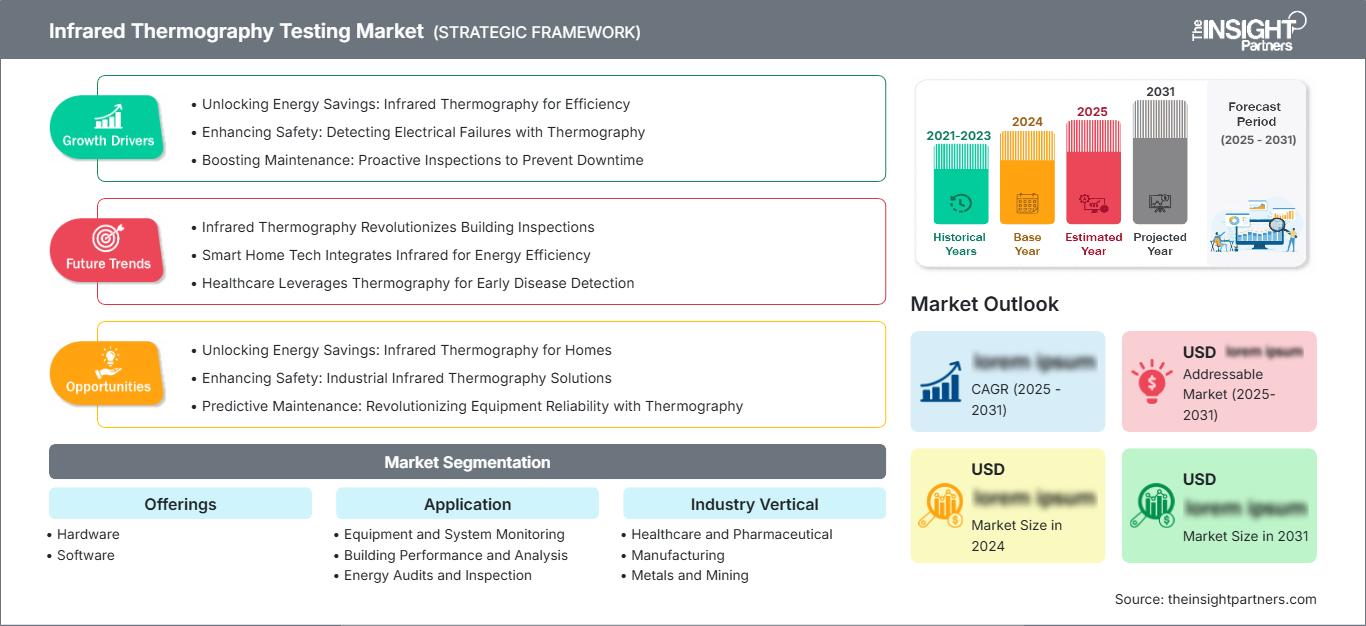
The global Infrared Thermography Testing market was valued at US$ 484.16 million in 2025 and is expected to reach US$ 725.45 million by 2034; it is estimated to record a CAGR of 4.6% during 2026-2034.
Infrared Thermography Testing Market Assessment and Insights
- North America: North America is expected to retain a substantial position, with a 27–30% Infrared Thermography Testing Market share in 2025 and a 4.7–5.3% CAGR between 2026–2034, supported by industrial maintenance, utilities, building diagnostics, and mature inspection practices.
- US: The US represents the principal North American market, with an 82–86% share of North America in 2025 and a 4.6–5.2% CAGR between 2026–2034, led by industrial and electrical inspection.
- Europe: Europe is estimated at a 24–27% share in 2025, growing at a 4.8–5.4% CAGR between 2026–2034. Germany, the UK, France, Italy, and Spain contribute through industrial automation, energy-efficiency programs, and building diagnostics.
- Asia Pacific: Asia Pacific is estimated at a 35–38% share in 2025, expanding at a 6.1–6.7% CAGR between 2026–2034. China, Japan, India, and South Korea are major demand centers across manufacturing and infrastructure.
- Largest Segment: Hardware holds the leading position, with a 70–75% market share in 2025 and a 4.4–5.0% CAGR between 2026–2034, reflecting continued equipment-intensive inspection workflows.
- High Growth Segment: Software represents a 25–30% market share in 2025 and is projected at a 9.0–10.0% CAGR between 2026–2034, supported by analytics and connected reporting.
- Key companies analyzed in detail: Future Electronics, Honeywell International Inc., LITE-ON Technology Corporation, Murata Manufacturing Co., Ltd., ams-OSRAM AG, Infratec GmbH, JENOPTIK AG, Keysight Technologies, Inc., Optris GmbH, Raytek Corporation, SKF AB, and Testo SE & Co. KGaA.
Source: The Insight Partners' analysis based on proprietary research, government publications, company annual reports, investor presentations, industry databases, and expert interviews.
From a technological perspective, the current Infrared Thermography Testing Market scenario has seen a change from individual temperature imaging to integrated inspection systems that include high-resolution imagers, radiometry, automated reports, and workflow integration. Manufacturing plants today make use of both fixed and portable imagers to detect electrical resistance, mechanical friction, poor insulation, and deviation from processes without the need for any physical contact.
During the forecast period, it is predicted that investments in the Infrared Thermography Testing Market will be made in smaller-sized sensors, inspection via software, and application development that can assist in performing regular inspections of assets. New manufacturing hubs in Asia Pacific will see an improvement due to industrialization, while energy efficiency policies will drive the need for building inspections in Europe and North America.
Infrared Thermography Testing Market Report Scope
| Report Attribute | Details |
|---|---|
| Market size in 2025 | US$ 484.16 Million |
| Market Size by 2034 | US$ 725.45 Million |
| Global CAGR (2026 - 2034) | 4.6% |
| Historical Data | 2021-2024 |
| Forecast period | 2026-2034 |
Infrared Thermography Testing Market Analysis
The demand for the Infrared Thermography Testing Market is correlated with the transition from repair-based maintenance towards condition-based maintenance. With the help of thermal imaging, the maintenance personnel can detect abnormal heating conditions before a complete breakdown and inspect electrical connections, motors, bearings, switchgear, furnaces, and building enclosures. This market value chain comprises detector and optics suppliers, camera manufacturers, software providers, calibration companies, distributors, and inspection service providers. Hardware is the key revenue generator since accurate detection and imaging are the foundation of all tests conducted within the industry.
On the supply side, vendors are more differentiated by detectors sensitivity, optics, portability, software capabilities, and analytics for particular applications instead of hardware alone. Semiconductor supply, infrared materials, calibration needs, and optical components quality affect production costs. Imagers are increasingly being connected to mobile applications and databases, creating additional recurring revenues. Such trends benefit vendors that provide both high measurement accuracy and efficient workflows.
The Infrared Thermography Testing Market report describes a moderately fragmented market with competition among traditional instrument manufacturers based on product range, expertise in application areas, distribution, and software. Teledyne FLIR through FLIR competes heavily in thermal imaging, Fluke Corporation focuses on industrial trouble shooting and inspection processes. Testo SE & Co. KGaA is distinct with its application-oriented instruments while Optris GmbH specializes in industrial process thermography and optical designs.
Future Electronics, Honeywell International Inc., LITE-ON Technology Corporation, Murata Manufacturing Co., Ltd., ams-OSRAM AG, Infratec GmbH, JENOPTIK AG, Keysight Technologies, Inc., Raytek Corporation, and SKF AB play a complementary role in components, measurement, sensing, industrial diagnostics, and distribution. Future investments are increasingly being made in miniaturization, software-based interpretations, wireless capability, and integration with larger condition monitoring systems instead of only improving detector resolution.
● REPORT CUSTOMIZATION
Tailor This Report To Align With Your Specific Business Requirements
This report can be customized to align precisely with your business objectives, scope, and target markets. Customization options include tailored segmentation, geography, competitive analysis, and strategic insights to support informed decision-making.
Customize This Report →WHAT YOU CAN ADJUST
- ● Segmentations
- ● Geography
- ● Competitive Analysis
- ● Language Preferences
Infrared Thermography Testing Market: Strategic Insights
Regional Insights
North America Infrared Thermography Testing Market
North America is estimated to account for a 27–30% share in 2025, with regional growth projected at a 4.7–5.3% CAGR through 2034. The demand is driven by existing predictive maintenance systems, well-established electrical infrastructure, industrial facilities, and commercial buildings needing periodic inspection. Utilities and manufacturers are making more use of thermography for prioritizing maintenance without disrupting operations.
The U.S. emerges as the leading regional demand center with the help of industrial facilities, power infrastructures, aerospace activities, and energy assessments of buildings. Canada contributes through mining activities, utilities, manufacturing, and infrastructure maintenance, while Mexico derives benefits from industrial manufacturing and auto supply chain investments. Increasingly, the regional procurements are inclined toward equipment offering radiometric measurement capabilities, wireless communications, asset identification, and automated reporting features.
U.S. Infrared Thermography Testing Market
The U.S. represents an estimated 82–86% share of North America in 2025, expanding at a 4.6–5.2% CAGR through 2034. The demand is linked to electrical inspection, manufacturing maintenance, building diagnostics, utilities, and industrial equipment. The companies of Fluke Corporation, Honeywell International Inc., Keysight Technologies, Inc., and FLIR have created their presence in the market through complementary measurement applications.
Current application developments in the Infrared Thermography Testing Market include repetitive inspection paths, digitalization of reports, and integration with maintenance management software. The thermal imaging cameras are applied to switchgears, motors, mechanical assemblies, HVAC systems, and building shells where excessive temperature can signal faults. The industrial customers also consider connected platforms that allow for remote analysis and standard report creation. It facilitates smooth transition from purchasing separate cameras to inspection processes and services.
Europe Infrared Thermography Testing Market
Europe is estimated to hold a 24–27% share in 2025, with a 4.8–5.4% CAGR through 2034. Germany is leading the regional demand for the product because of manufacturing, industrial automation, machinery manufacturing, and energy efficiency. UK, France, Italy, and Spain are adding demand to the region via infrastructural projects, facilities management, manufacturing and building inspections.
UK benefits from building performance assessment and electrical maintenance within commercial facilities, whereas Germany has industrial process application and machine condition monitoring applications. France is benefiting from the combination of energy efficiency requirements and aerospace and industrial inspection needs. Italy and Spain have manufacturing and infrastructure, utilities and building diagnostics adding demand to the region. Traceable measurement, calibrated instrumentation, software reporting and maintenance are becoming crucial for regional buyers.
APAC Infrared Thermography Testing Market
Asia Pacific is estimated to represent a 35–38% share in 2025, expanding at a 6.1–6.7% CAGR. China leads regional demand, followed by Japan, South Korea, India, and Australia. Manufacturing scale, semiconductor production, energy infrastructure, and industrial modernization are major adoption factors.
China's industrial inspection requirements and smart-manufacturing programs support deployment, while Japan and South Korea emphasize precision manufacturing and electronics. India is expanding applications across utilities, manufacturing, buildings, and infrastructure, with Australia supported by mining and energy operations. Policy emphasis on industrial modernization and energy efficiency should sustain investment, making APAC the leading regional growth center.
Middle East & Africa Infrared Thermography Testing Market
Middle East and Africa demand is supported by energy infrastructure, industrial facilities, utilities, and large construction programs. Saudi Arabia is the leading regional market, followed by the UAE and South Africa. The region is estimated to expand at a 5.0–5.8% CAGR through 2034 as inspection becomes more important across critical assets.
Saudi Arabia and the UAE are increasing technology deployment within energy, infrastructure, and industrial diversification programs, while South Africa contributes through mining, utilities, and heavy equipment. The Rest of MEA remains application-specific, with adoption concentrated around power generation, oil and gas, industrial maintenance, and large facilities. Thermal inspection offers remote assessment capabilities suited to high-temperature and safety-sensitive environments.
Segmentation Analysis
Offerings
Hardware remains the core purchasing category because detectors, cameras, optics, calibration components, and measurement interfaces are necessary for thermal testing. The segment is projected to grow at a 4.4–5.0% CAGR during 2026–2034. Software is becoming increasingly important as users seek automated analysis, reporting, asset tracking, and historical comparison.
- Hardware: Hardware maintains the leading market position because thermal cameras and sensing assemblies directly enable inspection. Demand is concentrated in industrial maintenance, electrical testing, building diagnostics, and process monitoring.
- Software: Software adoption is strengthening as organizations seek automated thermogram analysis, reporting, asset histories, and integration with maintenance platforms. Its strategic value increases as inspection volumes and data complexity rise.
Application
Application demand is diversified across asset monitoring, building diagnostics, and energy inspections. The segment is expected to advance at a 5.0–6.0% CAGR during 2026–2034, with purchasing decisions increasingly determined by inspection frequency, safety requirements, and the economic cost of undetected faults.
- Equipment and System Monitoring: This remains a principal industrial use, supporting early identification of abnormal temperatures in electrical, mechanical, and process equipment. It strengthens predictive-maintenance decisions without requiring equipment shutdown.
- Building Performance and Analysis: Building applications use thermal patterns to identify insulation deficiencies, moisture-related anomalies, HVAC problems, and envelope weaknesses. Demand is reinforced by efficiency assessments and facility-management requirements.
- Energy Audits and Inspection: Energy-focused testing helps locate thermal losses and abnormal operating conditions across facilities. Its strategic importance rises as organizations seek measurable efficiency improvements and more systematic building and equipment assessments.
Industry Vertical
Industry vertical demand is projected to expand at a 5.5–6.5% CAGR during 2026–2034, reflecting broader use of non-contact diagnostics in asset-intensive operations. Manufacturing remains strategically important, while healthcare, metals and mining, and heavy machinery create specialized inspection requirements.
- Healthcare and Pharmaceutical: Thermal inspection supports facility maintenance, electrical checks, HVAC assessment, and equipment monitoring. Controlled environments make reliable temperature visualization valuable for maintenance teams managing sensitive operational infrastructure.
- Manufacturing: Manufacturing plants use thermography for electrical systems, motors, production equipment, process monitoring, and quality checks. High asset density and continuous operations create strong recurring inspection requirements.
- Metals and Mining: High-temperature processes, conveyors, electrical infrastructure, and heavy machinery create multiple thermography use cases. Remote temperature assessment can improve maintenance planning in demanding operating environments.
- Heavy Equipment and Machinery: Heavy machinery operators apply thermal diagnostics to bearings, hydraulic systems, engines, electrical assemblies, and mechanical components. Non-contact testing helps identify abnormal heat before failures become operationally disruptive.
Opportunity Snapshot
| Industry Vertical | Revenue Contribution (High/Medium/Low) | Trend Tag (MAX 2 words) | Adoption Stage (Emerging/Scaling/Mature) |
|---|---|---|---|
| Healthcare and Pharmaceutical | Medium | Facility Safety | Scaling |
| Manufacturing | High | Predictive Maintenance | Mature |
| Metals and Mining | Medium | Asset Monitoring | Scaling |
| Heavy Equipment and Machinery | High | Fleet Diagnostics | Scaling |
Infrared Thermography Testing Market Growth Drivers and Impact Analysis
Expansion of predictive maintenance across asset-intensive operations
Predictive maintenance is changing the procurement criteria by connecting inspection spending to asset availability, maintenance planning, and failure prevention. Infrared technology is especially helpful when temperature irregularities indicate electrical, mechanical, or process failures. Inspection can be done on energized assets without physical contact, which allows maintenance staff to conduct inspections of huge numbers of assets quickly. For mining and heavy machines, thermal images could be used in conjunction with vibration analysis, lubrication, and sound testing to improve condition-based decision-making. The economic implications of using cameras are greater than just selling the cameras, as organizations need calibration, software, training, reporting, and repeated inspection services. With the standardization of maintenance inspection rounds, there is increasing demand for robust inspection units and measurement processes.
Growing emphasis on energy efficiency and building diagnostics
Cost of energy and energy-efficiency targets are raising the interest in thermal losses in buildings, industries, and equipment. The use of infrared technology allows discovering insulation defects, unusual heat transfer processes, overheating of electrical equipment, and other HVAC-related issues without any damaging interventions. Facility managers gain an additional diagnostic tool which allows them to plan necessary actions before starting any engineering works. Consequently, commercial buildings, industries, warehouses, and other institutional facilities are considered important recurring environments for the product. Moreover, the growing need comes from the wider spread of documented energy management systems, which require storing and comparing inspection results. Vendors can meet the need by selling cameras with special software, environmental measurements equipment, and specific applications for different environments.
Integration of thermal data with digital maintenance ecosystems
Integration of inspection processes increases the utility of thermography technology by converting unstructured image data into maintenance information. Through wireless communication, mobile applications, cloud storage, tagging of assets, and automation of report generation, thermal inspections can become more efficient in moving from field workers to engineering and maintenance personnel. This saves transcription time and maintains uniformity when the same machinery is being repeatedly inspected. Integration allows the analysis of thermal inspections along with electrical, vibrational, process or environmental inspections. For manufacturers of thermography systems, integration becomes a factor of competitiveness since industrial buyers maintain more than one system for maintenance. Consequently, the effect of the integration trend on the market will be seen through software capability, interface, integration of workflow along with the imaging technology. In future, buyers may start evaluating thermography solutions with respect to inspection process management capabilities.
Infrared Thermography Testing Market Future Trends
AI-assisted interpretation and automated thermal anomaly classification
The next phase in Infrared Thermography Testing Market trends will revolve around the software which analyzes the thermal images without relying heavily on manual interpretation. The machine learning algorithm is able to match the current thermal images against past inspection data and identify repeated abnormal patterns for focusing on specific assets. The future systems would probably include specific applications models which are meant for electrical systems, rotating equipment, structures and process lines. Edge computing technology would make it possible to perform selected classifications directly at cameras and mobile devices without being always connected. The vendors would probably provide a combination of the thermal data, visual images and non-thermal data. The business implication will be that more focus will be placed on software, training data, cybersecurity and validation of the technology.
Compact multisensor platforms for continuous and remote inspection
Future systems are likely to combine infrared sensing with visible cameras, environmental sensors, wireless communications, and fixed monitoring hardware. Compact multisensor platforms can provide continuous observation of equipment that is difficult or unsafe to inspect manually, including high-temperature processes and remote infrastructure. Developments in optics and detector packaging should support smaller devices without eliminating required measurement performance. Fixed installations may increasingly complement handheld instruments, allowing operators to switch between broad surveillance and targeted diagnostic inspection. Remote access can further reduce travel and improve inspection frequency across geographically dispersed assets. For industrial buyers, the strategic value will come from combining persistent monitoring with targeted human intervention. Suppliers that deliver modular platforms, application-specific optics, and dependable data transmission can address emerging requirements without forcing customers to replace their existing inspection infrastructure.
Infrared Thermography Testing Market Opportunities
Expansion of software-led inspection and recurring service models
Software-led offerings create an attractive investment opportunity because they can extend the value of installed thermal hardware beyond the initial equipment purchase. Suppliers can develop subscription-based analytics, centralized reporting, asset-history management, inspection scheduling, and remote expert review. Service providers can use standardized workflows to deliver recurring surveys for factories, commercial buildings, utilities, and heavy-equipment operators. The opportunity is particularly relevant where organizations lack specialist thermographers but still require documented inspection results. Vendors should prioritize interoperability with maintenance-management systems and support for established reporting practices. The Infrared Thermography Testing Market Forecasts indicate room for value migration toward software and services as users accumulate larger image libraries and demand automated interpretation. Partnerships between hardware manufacturers, software developers, calibration providers, and inspection specialists could accelerate this transition.
Industrial expansion in Asia Pacific and specialized applications
Asia Pacific offers a strategic opportunity because manufacturing expansion, infrastructure development, and energy-intensive industries create large populations of inspectable assets. Suppliers can target semiconductor facilities, electronics manufacturing, automotive plants, mining operations, utilities, and commercial infrastructure with application-specific thermal solutions. Local distribution partnerships and technical training can reduce adoption barriers where thermography expertise remains uneven. Product localization should address environmental conditions, language requirements, calibration practices, and procurement preferences. Specialized solutions for high-temperature processes, electrical inspection, and machinery monitoring can provide stronger differentiation than generic imaging devices. Investment should therefore focus on regional service capabilities as well as equipment sales. The opportunity is strengthened by the ability to build recurring maintenance relationships around installed systems, creating a pathway from initial inspection equipment to software, calibration, training, and managed diagnostic services.
Recent Developments
- August 2026: Guide launched MobIR 3.0, a new-generation smartphone-compatible thermal imaging camera series designed to bring professional-grade infrared inspection capabilities to iOS and Android devices. Powered by ApexVision Ultra-Clarity Imaging Technology with NETD of ≤15mK, the system can detect subtle temperature differences and thermal anomalies, while its Real Time Super Resolution technology enhances image clarity across three models.
- August 2026: The American Society for Nondestructive Testing (ASNT) announced a strategic collaboration with IRISS Inc. to deliver comprehensive infrared thermography training through ASNT’s eLearning platform. The program offers Level I, II and III courses covering infrared physics, thermal imaging, equipment and measurement techniques, diagnostics, predictive maintenance and professional reporting, with training aligned to key industry standards including ASNT SNT-TC-1A, ANSI/ASNT CP-105 and ANSI/ASNT CP-189.
- August 2026: ASTEC Industries launched a new Thermal Imaging Electrical Inspection Service to help asphalt producers improve plant safety, reduce unplanned downtime and extend the service life of critical electrical equipment. The preventive-maintenance service uses infrared imaging to scan energized systems and identify abnormal heat patterns associated with loose connections, corrosion, overloaded circuits and failing components before they cause fires, equipment failures or production stoppages.
Frequently Asked Questions

- Comprehensive Market Sizing and Forecast Analysis
- Detailed Segmentation Analysis
- In-Depth Market Dynamics Assessment
- Regional and Country-Level Insights
- Competitive Landscape and Company Benchmarking
- Strategic Business Intelligence
Recent Reports
Testimonials

The Insight Partners provided valuable market intelligence that supported our global go-to-market strategy. Their team was professional, responsive, and attentive to our feedback, providing thoughtful analysis and helpful methodological clarifications throughout the project.
Junmo Kim Chief Financial Officer (CFO), Enertech Co., Ltd.
The Insight Partners' SCADA System Market report is comprehensive, with valuable insights on current trends and future forecasts. The team was highly professional, responsive, and supportive throughout. We are very satisfied and highly recommend their services.
RAN KEDEM Partner, Reali Technologies LTDs
I requested a report on a very specific software market and the team produced the report in a few days. The information was very relevant and well presented. I then requested some changes and additions to the report. The team was again very responsive and I got the final report in less than a week.
JEAN-HERVE JENN Chairman, Future Analytica
We worked with The Insight Partners for an important market study and forecast. They gave us clear insights into opportunities and risks, which helped shape our plans. Their research was easy to use and based on solid data. It helped us make smart, confident decisions. We highly recommend them.
PIYUSH NAGPAL Sr. Vice President, High Beam Global
The Insight Partners delivered insightful, well-structured market research with strong domain expertise. Their team was professional and responsive throughout. The user-friendly website made accessing industry reports seamless. We highly recommend them for reliable, high-quality research services
YUKIHIKO ADACHI CEO, Deep Blue, LLC.
This is the first time I have purchased a market report from The Insight Partners.While I was unsure at first, I visited their web site and felt more comfortable to take the risk and purchase a market report.I am completely satisfied with the quality of the report and customer service. I had several questions and comments with the initial report, but after a couple of dialogs over email with their analyst I believe I have a report that I can use as input to our strategic planning process.Thank you so much for taking the extra time and making this a positive experience.I will definitely recommend your service to others and you will be my first call when we need further market data.
JOHN SUZUKI President and Chief Executive Officer, Board Director, BK Technologies
I wish to appreciate your support and the professionalism you displayed in the course of attending to my request for information regarding to infectious disease IVD market in Nigeria. I appreciate your patience, your guidance, and the fact that you were willing to offer a discount, which eventually made it possible for us to close a deal. I look forward to engaging The Insight Partners in the future, all thanks to the impression you have created in me as a result of this first encounter.
DR CHIJIOKE ONYIA MANAGING DIRECTOR, PineCrest Healthcare Ltd.Reason to Buy
- Informed Decision-Making
- Understanding Market Dynamics
- Competitive Analysis
- Identifying Emerging Markets
- Customer Insights
- Market Forecasts
- Risk Mitigation
- Boosting Operational Efficiency
- Strategic Planning
- Investment Justification
- Tracking Industry Innovations
- Aligning with Regulatory Trends





 Get Free Sample for