
Installation Relays Market Growth, Size & Forecast by 2034
Coverage: By Type (AC Installation Relays, DC Installation Relays); Application (Industrial, Commercial, Residential), and Geography (North America, Europe, Asia Pacific, and South and Central America)
- Status : Data Released
- Report Code : TIPRE00018384
- Category : Electronics and Semiconductor
- No. of Pages : 150
- Available Report Formats :


- Last update date : October 16, 2026


2025 Market Size
US$ 1.59 Bn
Base year value
2034 Forecast
US$ 3.26 Bn
Projected by 2034
CAGR 2026-2034
8.30 %
Growth rate
Addressable Market
US$ 21.77 Bn
(2026-2034)
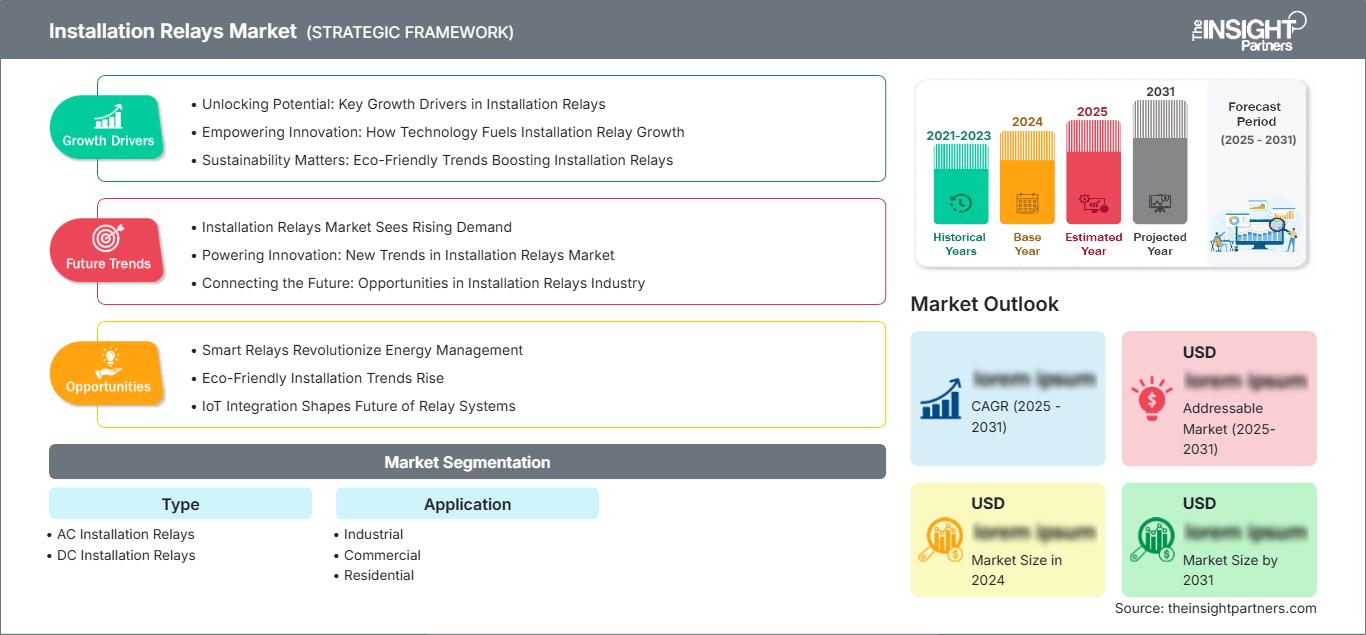
The Installation Relays Market size is valued at US$ 1.59 Billion in 2025 and is projected to reach US$ 3.26 Billion by 2034, registering a CAGR of 8.30% during 2026–2034. Expansion is supported by rising electrical automation, wider deployment of controlled switching in buildings and industrial facilities, and increasing integration of distributed energy assets requiring dependable AC and DC switching architectures.
North America is positioned for steady expansion, with an estimated 7.8–8.4% CAGR through 2034. Industrial reshoring is increasing electrical equipment investment, while commercial building modernization is strengthening demand for compact DIN-rail switching devices. Grid reinforcement, data-center construction, electrification projects, and upgrades to energy-management systems are also creating replacement and new-installation opportunities across the region.
Installation Relays Market Assessment and Insights
- North America: The region represented a 25–29% Installation Relays Market share in 2025 and is projected to grow at an 7.8–8.4% CAGR between 2026–2034, supported by industrial modernization and commercial electrification.
- US: The US accounted for 72–76% of North American demand in 2025 and is expected to grow at a 7.9–8.4% CAGR during 2026–2034, led by manufacturing and infrastructure investment.
- Europe: Europe held a 23–26% share in 2025 and is forecast to expand at a 7.6–8.1% CAGR through 2034. Germany, the UK, France, Italy, and Spain remain important markets because of renovation, automation, and electrical-efficiency requirements.
- Asia Pacific: Asia Pacific captured a 28–31% share in 2025 and is expected to register a 9.1–9.6% CAGR during 2026–2034. China, Japan, South Korea, and India benefit from industrial automation, urban construction, and electrification investment.
- Largest Segment: Industrial Application represented a 46–50% market share in 2025 and is projected to grow at an 8.7–9.2% CAGR during 2026–2034, supported by automated production and process control.
- High Growth Segment: DC Installation Relays held a 32–36% market share in 2025 and is expected to expand at a 9.4–9.9% CAGR during 2026–2034, supported by electrification.
- Key companies analyzed in detail: Doepke Schaltgeräte GmbH, OEZ s.r.o., RELPOL S.A., Bürklin GmbH & Co. KG, Kühn Controls AG, Oc3an, Eaton Corporation plc, Relmatic AG, SKF, and KSM Ltd.
Source: The Insight Partners' analysis based on proprietary research, government publications, company annual reports, investor presentations, industry databases, and expert interviews.
The Installation Relays Market has shifted from traditional electromechanical switches to more compact and modular products that enable greater installation density as well as tougher loading requirements. Product developers are stressing the importance of DIN-rail mounting, voltage versatility of coils, superior contact materials, manual overrides, visual indication, and quieter operation. Manufacturing operations are also being standardized such that manufacturers can provide products not only for industrial panel applications but also for building control panels, heating equipment, ventilation equipment, and lighting fixtures using one single mechanical platform.
In the future, the Installation Relays Market will enjoy benefits arising from investments in new manufacturing bases, especially in South and Southeast Asia. Regulations concerning electrical safety, efficiency, automation, and power generation have resulted in the replacement of obsolete switching units. Digital monitoring and remote diagnostics, as well as integration with automation controllers, will become important design criteria, while local sourcing will help avoid shortages and logistical problems.
Installation Relays Market Report Scope
| Report Attribute | Details |
|---|---|
| Market size in 2025 | US$ 1.59 Billion |
| Market Size by 2034 | US$ 3.26 Billion |
| Global CAGR (2026 - 2034) | 8.30% |
| Historical Data | 2021-2024 |
| Forecast period | 2026-2034 |
Installation Relays Market Analysis
The demand aspect in the Installation Relays Market is grounded on the necessity of reliable switching of lighting, heating, ventilation, motors, control circuitry, and other electrical loads under limited space conditions. There is an industry ecosystem of relay suppliers, contact material vendors, coil and housing manufacturers, panel makers, electricians and their wholesalers, system integrators, contractors, and end users of the facility equipment. Product selection depends more on the switching capacity, electrical durability, mounting footprint, control voltage, and panel compatibility.
Suppliers in the Installation Relays Market operate under the dynamics of standardization, but are still impacted by such commodity prices as copper, engineered plastic, magnets, contacts, and electronics components. Suppliers that have wide range of voltage and contact configurations can service multiple applications without additional customization. At the same time, distribution networks continue to be essential due to the fact that installers often need fast availability, and OEM relationships tend to rely on qualification stability and technical documents.
The Competitive Positioning in the Installation Relays Market is influenced by factors such as product range, technological know-how, distribution networks, and applications focus. The company Doepke Schaltgeräte GmbH focuses on installation switchgear and electrical protection, OEZ s.r.o. and RELPOL S.A. manufacture modular products for building and control applications. Kühn Controls AG covers all relay solutions and industrial automation components to meet special procurement needs.
Whereas larger and diversified suppliers like Eaton Corporation plc focus on their electrical product ranges and system level relationships, the companies such as Bürklin GmbH & Co. KG and Relmatic AG focus more on enhancing access via their distribution and special component networks. Key investments are directed to designing compact products, energy-saving switching functions, interface digitalization, enhanced supply chain, and specific applications certification.
● REPORT CUSTOMIZATION
Tailor This Report To Align With Your Specific Business Requirements
This report can be customized to align precisely with your business objectives, scope, and target markets. Customization options include tailored segmentation, geography, competitive analysis, and strategic insights to support informed decision-making.
Customize This Report →WHAT YOU CAN ADJUST
- ● Segmentations
- ● Geography
- ● Competitive Analysis
- ● Language Preferences
Installation Relays Market: Strategic Insights
Regional Insights
North America Installation Relays Market
North America accounted for 25–29% of global Installation Relays Market in 2025 and is modeled at an 7.8–8.4% CAGR through 2034. The USA holds the position of dominant consumer in the region, whereas Canada and Mexico participate through their industries, utility providers, commercial construction, and manufacturing. The reshoring of industries, semiconductor factories, batteries, pharmaceuticals, and logistics centers is aiding to establish a need for electrical control installments.
Moreover, commercial building renovations and electrification projects are further adding to the demand for relays. Lighting, HVAC, heating, ventilation, and centralized control panels require reliable relay switches to be installed. Manufacturers of such relays that enjoy a widespread distribution network can capitalize on replacements. Meanwhile, panel manufacturers are increasingly adopting modular relays owing to maintenance considerations and saving of cabinet space.
U.S. Installation Relays Market
The US represented 72–76% of North American demand in 2025 and is projected to grow at a 7.9–8.4% CAGR through 2034. Industrial automation, data centers, advanced manufacturing, logistics centers, and commercial buildings are key drivers of demand. Eaton Corporation plc has a large portfolio of electrical products, while companies like Doepke Schaltgeräte GmbH, RELPOL S.A., among others, enter the market through specialization and distribution.
The application trend is increasingly tending towards the use of small switching for HVAC, lighting, machinery, building management systems, and energy management systems. The combination of investments in factories and renovations drives both new panels and replacements demand. Purchase decisions increasingly depend on product availability, certifications, reliability over its lifetime, and compatibility with existing installations.
Europe Installation Relays Market
Europe held a 23–26% Installation Relays Market in 2025 and is forecast to expand at a 7.6–8.1% CAGR through 2034. Germany is the most dominant market, driven by automation in industry, engineering efforts, and system renovation. Other important markets include the UK and France, Italy, and Spain owing to commercial constructions and renovations in industries.
Germany offers a combination of manufacturing intensity and availability of electrical component supply chain along with strong demand for modular switchgear. The UK derives support from buildings' renovations, electrification and commercial controls whereas France, Italy and Spain derive support from industrial renovations. There is an edge enjoyed by European suppliers in terms of application engineering and distribution whereas price competition from Asian suppliers exists.
APAC Installation Relays Market
APAC held a 28–31% share in 2025 and is expected to grow at a 9.1–9.6% CAGR through 2034, making it the leading growth region. Demand is led by China, followed by Japan, South Korea, India, and Australia. Applications include automation, industrial building, commercial buildings, and electrification, which are expanding the addressable installation base.
China enjoys the benefit of economies of scale for manufacturing, while Japan and South Korea focus on automation and high-reliability equipment. India is benefiting from investments in industries and infrastructure, while Australia is benefiting from commercial, mining, and energy applications. Government encouragement of electrification and manufacturing localization also encourages the adoption, especially where there is installation of new control panels and distributed electrical systems.
Middle East & Africa Installation Relays Market
Middle East and Africa demand is projected at an 8.2–8.8% CAGR through 2034, led by Saudi Arabia. UAE is a key market for business and infrastructure, while South Africa’s contribution is via mining, industrial, utility and construction applications. Procurement is focusing on dependable equipment that can perform in harsh conditions.
Saudi Arabia’s infrastructures and energy projects create a significant number of opportunities for installations, while UAE’s construction and smart building investments are driving commercial installations. South Africa and other parts of MEA continue to rely on replacement, although infrastructure expansion and industrialization will result in new installations. Companies with regional presence, technical capabilities and dependable product specifications will capitalize on such projects.
Segmentation Analysis
Spectral Range
The Spectral Range classification comprises Near Infrared, Short Wavelength Infrared, Medium Wavelength Infrared, and Long Wavelength. Within the supplied taxonomy, the segment reflects differentiated product positioning rather than the conventional relay classification used for electrical switching. The segment is modeled at a 7.6–8.1% CAGR during 2026–2034, with demand influenced by specialized system requirements and technology compatibility.
- Near Infrared: Near Infrared occupies applications where compact sensing-related architectures intersect with switching requirements. Its strategic position is supported by equipment designers seeking component compatibility, controlled installation footprints, and reliable integration within increasingly automated systems.
- Short Wavelength Infrared: Short Wavelength Infrared serves specialized equipment configurations requiring defined operating characteristics. Demand is comparatively application-specific, making engineering support, component availability, and compatibility with established control architectures important purchasing considerations.
- Medium Wavelength Infrared: Medium Wavelength Infrared addresses specialized installations where performance consistency and integration requirements influence component selection. Suppliers can differentiate through product documentation, configuration flexibility, and dependable supply for repeat industrial deployments.
- Long Wavelength: Long Wavelength applications emphasize specialized operating environments and system integration. Its strategic importance is linked to equipment architectures requiring consistent switching behavior, controlled installation, and compatibility with application-specific instrumentation.
Type
The Type segment consists of AC Installation Relays and DC Installation Relays. The segment is projected to register an 8.4–8.9% CAGR during 2026–2034. AC products retain broad installed-base demand, while DC products gain momentum as solar, storage, charging infrastructure, and electronically controlled equipment increase the number of direct-current circuits requiring reliable switching.
- AC Installation Relays: AC products remain central to building and industrial electrical systems because of extensive installed infrastructure. Demand is reinforced by lighting, heating, ventilation, motor-control, and refurbishment projects requiring familiar switching architectures.
- DC Installation Relays: DC products are strategically important in electrification applications, including energy storage, photovoltaic systems, charging equipment, and control electronics. Their adoption benefits from the expansion of direct-current power architectures.
Application
Application demand is led by Industrial, Commercial, and Residential installations, with the segment projected to grow at an 8.7–9.2% CAGR during 2026–2034. Industrial installations provide the largest revenue base, while commercial and residential adoption increasingly reflects automation, energy management, and modernization of electrical systems.
- Industrial: Industrial applications hold the strongest position because factories require dependable switching for machinery, ventilation, heating, process equipment, and control panels. Demand benefits from automation investment and ongoing plant modernization.
- Commercial: Commercial installations use relays for lighting, HVAC, access systems, energy management, and centralized controls. Renovation projects and increasingly sophisticated building-management systems sustain demand for modular switching components.
- Residential: Residential demand is supported by heating, ventilation, lighting, smart-home controls, and distributed energy equipment. Compact installation formats and simple manual override capabilities remain important for electricians and maintenance providers.
Opportunity Snapshot
| Application | Revenue Contribution | Trend Tag | Adoption Stage |
|---|---|---|---|
| Industrial | High | Factory Automation | Mature |
| Commercial | Medium | Building Controls | Scaling |
| Residential | Medium | Home Energy | Scaling |
Installation Relays Market Growth Drivers and Impact Analysis
Industrial automation expands the installed base of switching components
Automation in industry increases the amount of controlled electrical loads within factories, warehouses, processing plants, and specialized production facilities. Increased relay requirements follow from the increase in the use of motors, ventilators, safety devices, heaters, conveyors, lights, and auxiliary devices. Market effects are seen most prominently when brownfield sites are upgraded but no change made to existing control structures because relays are modular and can be incorporated into existing panel structures. Additional requirements for relays result from increases in production capabilities because each production line needs its own control system. Manufacturers offering relays in different coil voltages, contact arrangements, mounting styles, and auxiliary features cater to wider requirements. This factor also makes distribution networks valuable since industrial maintenance emphasizes availability and standardization to avoid equipment failure.
Building electrification increases demand for modular load control
Electrification for commercial and residential use is leading to an increase in the amount of loads which have to be controlled, sequenced, or isolated in building distribution systems. Loads may include heat pumps, ventilating systems, lighting systems, energy management systems, water heating and distributed generation that will require the addition of more switching points. The consequence of this is that the demand extends itself beyond the scope of new buildings since retrofitting of buildings requires components that are able to fit into existing distribution boards. Installation relays are relatively simple means of interfacing control signals and electrical loads without full panel replacement during modernization. Demand is highly persistent when building managers aim for low energy usage and at the same time keep comfort levels high for the occupants of the buildings.
Distributed energy resources broaden DC switching requirements
Solar generation, batteries, charging stations, and other forms of distributed energy resource deployments are driving up the number of direct current (DC) circuits found in buildings of all kinds. These changes drive up the demand for switching products that can handle DC loads, but still achieve proper insulation and switching functionality. The effects are multiplied as energy systems become more distributed and need additional controls between power generation, storage, conversion, and equipment use. The specifications for DC switching devices will often vary significantly from AC switching, as the arc characteristics, contact longevity, and circuit interruption capabilities need to be taken into consideration. This allows for differentiation by suppliers in terms of contact systems, thermal capability, size, and application specific engineering.
Installation Relays Market Future Trends
Intelligent switching becomes increasingly integrated with digital building systems
The Installation Relays Market trends show that future products are likely to combine conventional switching with status feedback, diagnostics, and communication capabilities. Instead of functioning only as isolated switching elements, relays can increasingly become components within connected building and industrial control architectures. This transition should encourage suppliers to develop auxiliary interfaces, indicator functions, communication-ready modules, and products capable of supporting remote monitoring. The commercial opportunity lies in reducing troubleshooting time and providing operators with clearer visibility into circuit status. Integration with building-management platforms may also allow load scheduling and maintenance alerts to become more systematic. As cabinet space becomes more valuable, manufacturers are expected to combine multiple functions within compact modular formats. This trend could gradually shift purchasing criteria from simple electrical ratings toward interoperability, diagnostics, installation efficiency, and lifecycle serviceability.
Miniaturization and application-specific designs reshape product specifications
Relay development is expected to emphasize smaller footprints, higher installation density, improved heat management, and more precise application matching. Panel builders increasingly need components that conserve space while retaining sufficient switching capability and electrical endurance. Manufacturers can respond through optimized contact geometry, improved materials, narrower housings, and modular accessories. Application-specific designs should also become more important as solar, charging, HVAC, industrial automation, and building-control systems develop different electrical profiles. Rather than relying exclusively on broad product families, suppliers may provide targeted configurations for defined load classes and installation environments. This approach can reduce engineering time for integrators while strengthening supplier differentiation. Over time, product selection is likely to incorporate thermal behavior, service intervals, compatibility, and installation labor alongside traditional voltage and current specifications.
Installation Relays Market Opportunities
Localized manufacturing and distribution in high-growth Asian economies
Investment in India, Southeast Asia, and other manufacturing centers creates opportunities for relay suppliers to establish localized production, assembly, technical support, and distribution. Local availability can shorten lead times and improve responsiveness to panel builders serving factories, commercial projects, and infrastructure programs. Suppliers can target applications where global specifications coexist with regional procurement requirements, particularly industrial automation, building electrification, and distributed energy. Strategic partnerships with electrical distributors and system integrators can provide market access without requiring immediate large-scale manufacturing investment. Product localization should focus on voltage configurations, mounting standards, documentation, and certification requirements relevant to each market. Companies that combine competitive pricing with dependable quality and engineering assistance may gain share as manufacturers seek diversified component sources and reduce exposure to long international supply chains.
Advanced DC architectures create opportunities across electrification projects
The Installation Relays Market forecast shows that expansion of batteries, photovoltaic systems, charging infrastructure, and electronically controlled equipment creates a growing opportunity for specialized DC switching solutions. Suppliers can prioritize products optimized for the electrical and thermal characteristics of direct-current loads rather than simply adapting conventional AC designs. Target applications include energy storage cabinets, charging equipment, inverter systems, industrial DC controls, and building energy-management installations. Partnerships with equipment manufacturers can help relay suppliers secure design wins before large projects enter procurement phases. Product development should emphasize contact durability, switching safety, compact construction, and compatibility with standardized control architectures. Companies capable of providing application engineering alongside components can strengthen their position because system designers increasingly evaluate switching devices as part of a complete electrical architecture rather than as interchangeable catalog items.
Recent Developments
- April 2026: FCL Components America launched the FTR-MYWA, a socket-type compatible slim power relay designed for PLC applications such as factory automation equipment. The relay enables quick installation and replacement without board mounting, simplifying maintenance and helping end users optimize costs. Its pre-soldered terminals also allow it to be used as a PCB relay. The compact 5.0 × 20.9 × 12.0 mm, 2.5 g relay supports up to 5A switching current, offers electrical isolation and protection for PLC outputs, and features a -40°C to +90°C operating temperature range and long electrical life. FCL Components is also developing the sealed, reflow-compatible FTR-MY-RW, targeted for release in April 2027.
- July 2026: PowerNex, a MEAN WELL group company, introduced the MRL01D24-2Z08A compact medium-power relay along with the MRLS01-2Z relay socket, expanding its power-system accessory portfolio for industrial control applications. The relay features a 2 Form C (DPDT) configuration with switching current up to 8A and 5,000VAC dielectric strength between the coil and contacts for enhanced electrical isolation, safety and EMI immunity. When paired with the socket, it supports DIN TH35-7.5 rail mounting and screw-terminal connections for quick wiring, installation and maintenance.
- January 2026: OMRON Electronic Components launched its P6K relay sockets, surface-mount sockets designed for the G6K PCB terminal-type relay series, including G6K-2P and G6K(U)-2P-Y models. The sockets simplify PCB assembly and enable quick, solder-free relay replacement, helping reduce maintenance time, labor costs and system downtime. Designed to match the G6K series terminal arrangement, the P6K sockets maintain reliable electrical performance with no increase in contact resistance after 50 insertions. The solution is targeted at applications including test and measurement equipment, telecommunications, office and building automation, security systems and industrial equipment.
Frequently Asked Questions

- Comprehensive Market Sizing and Forecast Analysis
- Detailed Segmentation Analysis
- In-Depth Market Dynamics Assessment
- Regional and Country-Level Insights
- Competitive Landscape and Company Benchmarking
- Strategic Business Intelligence
Recent Reports
Testimonials

The Insight Partners provided valuable market intelligence that supported our global go-to-market strategy. Their team was professional, responsive, and attentive to our feedback, providing thoughtful analysis and helpful methodological clarifications throughout the project.
Junmo Kim Chief Financial Officer (CFO), Enertech Co., Ltd.
The Insight Partners' SCADA System Market report is comprehensive, with valuable insights on current trends and future forecasts. The team was highly professional, responsive, and supportive throughout. We are very satisfied and highly recommend their services.
RAN KEDEM Partner, Reali Technologies LTDs
I requested a report on a very specific software market and the team produced the report in a few days. The information was very relevant and well presented. I then requested some changes and additions to the report. The team was again very responsive and I got the final report in less than a week.
JEAN-HERVE JENN Chairman, Future Analytica
We worked with The Insight Partners for an important market study and forecast. They gave us clear insights into opportunities and risks, which helped shape our plans. Their research was easy to use and based on solid data. It helped us make smart, confident decisions. We highly recommend them.
PIYUSH NAGPAL Sr. Vice President, High Beam Global
The Insight Partners delivered insightful, well-structured market research with strong domain expertise. Their team was professional and responsive throughout. The user-friendly website made accessing industry reports seamless. We highly recommend them for reliable, high-quality research services
YUKIHIKO ADACHI CEO, Deep Blue, LLC.
This is the first time I have purchased a market report from The Insight Partners.While I was unsure at first, I visited their web site and felt more comfortable to take the risk and purchase a market report.I am completely satisfied with the quality of the report and customer service. I had several questions and comments with the initial report, but after a couple of dialogs over email with their analyst I believe I have a report that I can use as input to our strategic planning process.Thank you so much for taking the extra time and making this a positive experience.I will definitely recommend your service to others and you will be my first call when we need further market data.
JOHN SUZUKI President and Chief Executive Officer, Board Director, BK Technologies
I wish to appreciate your support and the professionalism you displayed in the course of attending to my request for information regarding to infectious disease IVD market in Nigeria. I appreciate your patience, your guidance, and the fact that you were willing to offer a discount, which eventually made it possible for us to close a deal. I look forward to engaging The Insight Partners in the future, all thanks to the impression you have created in me as a result of this first encounter.
DR CHIJIOKE ONYIA MANAGING DIRECTOR, PineCrest Healthcare Ltd.Reason to Buy
- Informed Decision-Making
- Understanding Market Dynamics
- Competitive Analysis
- Identifying Emerging Markets
- Customer Insights
- Market Forecasts
- Risk Mitigation
- Boosting Operational Efficiency
- Strategic Planning
- Investment Justification
- Tracking Industry Innovations
- Aligning with Regulatory Trends





 Get Free Sample for