
Instrumentation Amplifier Market Size, Growth & Demand by 2034
Coverage: by Type (Two-op-amp Instrumentation Amplifier, Three-op-amp Instrumentation Amplifier); End-user (Cement, Food, Pharmaceutical, Chemical, Steel, Others) , and Geography (North America, Europe, Asia Pacific, and South and Central America)
- Status : Data Released
- Report Code : TIPRE00012728
- Category : Electronics and Semiconductor
- No. of Pages : 150
- Available Report Formats :


- Last update date : October 16, 2026


2025 Market Size
US$ 637.00 Mn
Base year value
2034 Forecast
US$ 1,326.00 Mn
Projected by 2034
CAGR 2026-2034
8.49 %
Growth rate
Addressable Market
US$ 8,808.46 Mn
(2026-2034)
The Instrumentation Amplifier Market is positioned for sustained expansion as precision signal conditioning becomes increasingly important across industrial measurement, process control, and specialized instrumentation. The market is valued at US$ 637.00 Million in 2025 and is projected to reach US$ 1,326.00 Million by 2034, registering a CAGR of 8.49% from 2026 to 2034. Demand is supported by higher measurement accuracy requirements, sensor integration, and modernization of industrial control architectures.
North America remains a structurally important market, with an estimated 8.0–8.8% CAGR from 2026–2034, supported by semiconductor innovation, advanced manufacturing, and expanding test-and-measurement infrastructure. The regional Instrumentation Amplifier Market size is also influenced by investments in medical equipment, aerospace electronics, industrial automation, and precision data acquisition, where low noise, high common-mode rejection, and stable gain are critical design requirements.
Instrumentation Amplifier Market Assessment and Insights
- North America: North America is expected to account for a 32–36% share in 2025, expanding at a CAGR of 8.0–8.8% between 2026–2034, supported by advanced electronics manufacturing, aerospace programs, industrial automation, and medical instrumentation.
- US: The US represents approximately 68–72% of North America's 2025 share, with a CAGR of 8.1–8.9% from 2026–2034, driven by precision electronics and defense-related instrumentation.
- Europe: Europe is estimated at a 24–28% share in 2025, growing at a CAGR of 7.4–8.2% during 2026–2034, with Germany, the UK, France, and Italy benefiting from industrial automation and process instrumentation.
- Asia Pacific: Asia Pacific represents approximately 30–34% share in 2025 and is projected to grow at a CAGR of 9.2–10.1% during 2026–2034, led by China, Japan, South Korea, and India.
- Largest Segment: The Three-op-amp Instrumentation Amplifier segment holds a 54–58% market share in 2025, with a CAGR of 8.8–9.4% from 2026–2034, reflecting precision and flexibility advantages.
- High Growth Segment: Pharmaceutical end users represent a 13–17% share in 2025, with a CAGR of 10.5–11.5% from 2026–2034, supported by automated quality-control systems.
- Key companies analyzed in detail: Analog Devices, Inc.; Kyowa Electronic Instruments Co., Ltd.; Maxim Integrated Products, Inc.; MaxLinear, Inc.; Microchip Technology Incorporated; QuinStar Technology, Inc.; Renesas Electronics Corporation; STMicroelectronics N.V.; Texas Instruments Incorporated; TMD Technologies Ltd.
Source: The Insight Partners' analysis based on proprietary research, government publications, company annual reports, investor presentations, industry databases, and expert interviews.
Signal conditioners have moved from simple amplifiers to sophisticated, integrated, and precision systems that are able to amplify low-signal sensor inputs in noisy environments. The instrumentation amplifier of today is characterized by low offset, low drift, common mode rejection, over-voltage protection, and low power consumption. The need for such sophisticated instruments is especially true where strain gauges, pressure transducers, load cells, and other types of sensors are used to feed digital data acquisition systems.
Future needs may well shift focus from laboratory instrumentation to the use of such instruments in connected factories, medical devices, electrified manufacturing, and advanced aerospace electronic systems. The availability of smaller packaging and improved analog front ends may enable system level integration, while investment in semiconductors within regions may enhance supply chain security.
Instrumentation Amplifier Market Report Scope
| Report Attribute | Details |
|---|---|
| Market size in 2025 | US$ 637.00 Million |
| Market Size by 2034 | US$ 1,326.00 Million |
| Global CAGR (2026 - 2034) | 8.49% |
| Historical Data | 2021-2024 |
| Forecast period | 2026-2034 |
Instrumentation Amplifier Market Analysis
Growth of the Market in the Instrumentation Amplifier Market is highly contingent upon the requirement for accurate differential measurements in the event that the output of the sensor is very small when compared to the common mode noise. Stable amplification of signals before digital conversion is essential in industrial controls, weigh scales, medical instrumentation, test automation, and process instruments. The market’s value chain consists of semiconductor companies, sensors, integration firms, distribution, and OEMs.
Supply dynamics are determined by analog semiconductors manufacturing capabilities, resistor matching, package technology, and qualification. Three op-amp topology continues to be versatile due to the ability of the designer to have a high input impedance and strong common mode rejection, while the integrated solution simplifies board design. Automotive qualification, extended temperature range, and product life cycle are gaining importance in purchasing decisions.
In this competitive environment, diversified semiconductor vendors are competing with dedicated instrumentation vendors. Competitors of Analog Devices, Inc., Texas Instruments Incorporated, Renesas Electronics Corporation, STMicroelectronics N.V., Microchip Technology Incorporated, and MaxLinear, Inc. include precision specifications, packaging, power efficiency, and application capability. The company Kyowa Electronic Instruments Co., Ltd. concentrates on measurement instrumentation while the company QuinStar Technology, Inc. is involved with specialized test and high frequency application.
According to the Instrumentation Amplifier Market report, positioning is becoming increasingly dependent upon signal chain capability, and not just amplifier specification. Companies are developing their offerings with reference design, evaluation board, simulation software and full analog front end in order to reduce development time for customers. In the same way TMD Technologies Ltd. continues to be relevant with specialized instrumentation, Maxim Integrated Products, Inc. continues to be associated with precision analog capabilities due to its acquisition by Analog Devices.
● REPORT CUSTOMIZATION
Tailor This Report To Align With Your Specific Business Requirements
This report can be customized to align precisely with your business objectives, scope, and target markets. Customization options include tailored segmentation, geography, competitive analysis, and strategic insights to support informed decision-making.
Customize This Report →WHAT YOU CAN ADJUST
- ● Segmentations
- ● Geography
- ● Competitive Analysis
- ● Language Preferences
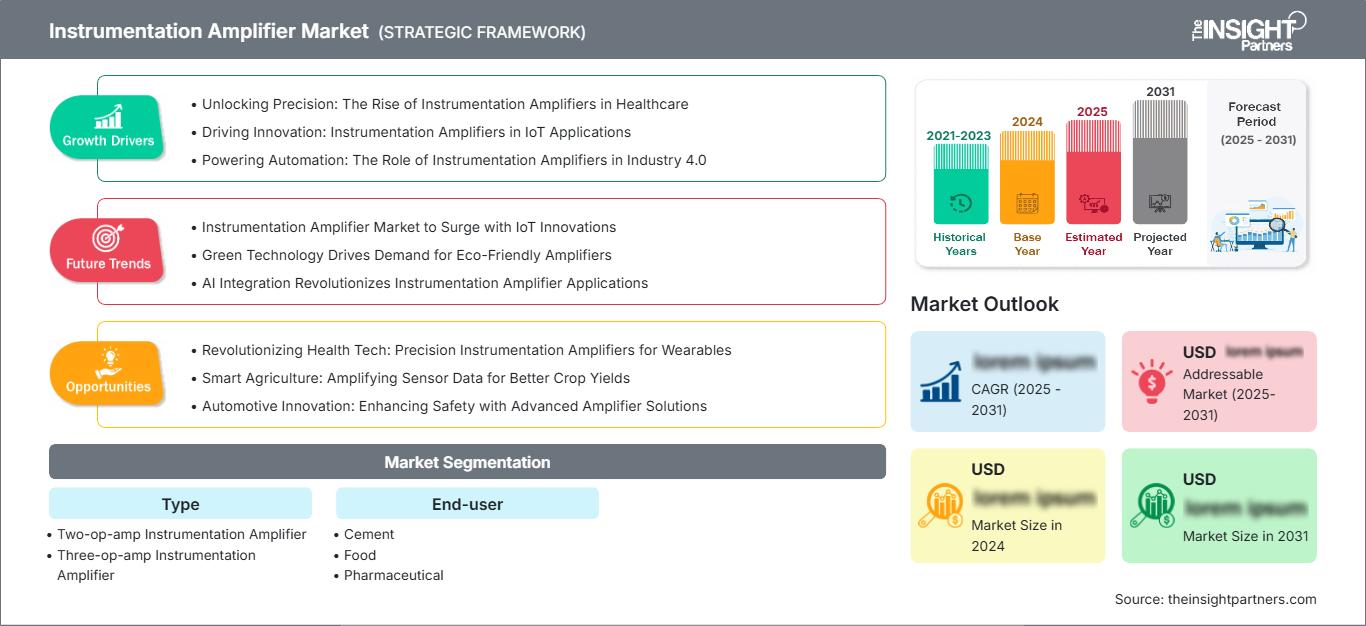
Instrumentation Amplifier Market: Strategic Insights
Regional Insights
North America Instrumentation Amplifier Market
North America is estimated to represent 32–36% of the Instrumentation Amplifier Market Share in 2025, with an 8.0–8.8% CAGR through 2034. The US accounts for 68–72% of the regional market, reflecting its concentration of semiconductor design, aerospace, defense, medical-device, and advanced manufacturing activities. Precision measurement requirements are particularly strong in test equipment and industrial automation.
The areas which Canada can contribute in are mining, energy, aerospace, and industrial measurement technologies, whereas the demand in the USA will be fueled by their investments in semiconductor production as well as their own electronics industry. Some companies which have diverse technological offerings for precision signal conditioning include Analog Devices, Inc., Texas Instruments Incorporated, Microchip Technology Incorporated, and Renesas Electronics Corporation.
U.S. Instrumentation Amplifier Market
The US holds 68-72% of the North American 2025 market share and has an 8.1-8.9% CAGR between 2026-2034. Demand is seen in sectors such as industrial measurement, aerospace electronics, medical equipment, semiconductors testing, and automated manufacturing. Selection criteria are shifting toward lower offset, lower drift, lower noise, higher common-mode rejection, and small packaging.
Texas Instruments Incorporated provides instrumentation amplifiers that cater to applications needing low power, precision, wide supply range, and high common-mode rejection capability. TI portfolio includes products which offer small packaging and precision features for use in industrial and measurement applications. Analog Devices, Inc. and Microchip Technology Incorporated are other participants in this segment of precision analogs.
Europe Instrumentation Amplifier Market
The Europe region is expected to capture a market share of 24% to 28% in 2025, exhibiting a CAGR of 7.4% to 8.2% until 2034, wherein Germany accounts for the largest country. The United Kingdom, Germany, France, Italy, and Spain offer significant demands for automation, laboratory systems, energy equipment, aerospace, and process industries.
The United Kingdom has the advantage of aerospace, defense, scientific instruments, and advanced manufacturing. The relevance of Germany lies in its strength of industrial automation, machinery, factory measurement, and automotive electronics. France makes its contribution through aerospace and defense, whereas Italy and Spain contribute with their demands for manufacturing, food processing, energy, and industrial equipment sectors.
APAC Instrumentation Amplifier Market
APAC is expected to account for 30%-34% share in 2025, having an impressive 9.2%-10.1% CAGR up to 2034. China is the leader of APAC, driven by electronics production, industrial automation, and internal semiconductor manufacturing. Precision manufacturing capacity in Japan and South Korea further increases market potential.
India is growing its presence in industrial electronics and process automation, while Australia offers mining, energy, and infrastructure measurement applications. APAC policies encouraging semiconductor localization and advanced manufacturing will help to increase demand for precision analog ICs. A diversified APAC electronics manufacturing base will also allow instrumentation amplifiers to penetrate equipment manufactured for export destinations.
Middle East & Africa Instrumentation Amplifier Market
Middle East & Africa is estimated to achieve 6.6% to 7.5% CAGR from 2019 to 2034, with Saudi Arabia driving demand in the region. Investments made by UAE in industrial infrastructure drive the usage of measurement instruments, whereas South Africa contributes owing to applications in mining, manufacturing, and energy sector.
Opportunities exist in energy diversification, water infrastructure, mining automation, and process control where precision signal conditioning parts have applications. Developmental activities in Saudi Arabia will drive the need for instrumentation in the projects of energy and manufacturing, whereas UAE's industrial facilities will increasingly need automated monitoring and control.
Segmentation Analysis
Type
The Type segment in the Instrumentation Amplifier Market is characterized by continued use of established precision architectures alongside demand for compact integrated solutions. Three-op-amp configurations remain dominant where designers require high input impedance and strong common-mode rejection, while two-op-amp designs can reduce component count. The segment is expected to expand at a CAGR of 8.5–9.3% from 2026–2034, with application-specific design determining architecture selection.
- Two-op-amp Instrumentation Amplifier: Two-op-amp architectures offer lower component complexity and can support compact designs where input characteristics and gain requirements permit. They remain relevant for cost-sensitive industrial measurement and embedded signal-conditioning applications.
- Three-op-amp Instrumentation Amplifier: Three-op-amp configurations maintain a strong position because separate input stages provide high impedance, flexible gain setting, and strong common-mode rejection across precision measurement applications.
End-user
The End-user segment reflects differing measurement priorities across process industries. Pharmaceutical and food production require repeatable measurement and controlled processing, while cement, chemical, and steel operations demand robust instrumentation in harsh environments. The segment is forecast to grow at a CAGR of 8.7–9.6% during 2026–2034, supported by automation and digital process monitoring. This establishes the Instrumentation Amplifier Market scope across both continuous-process and discrete production environments.
- Cement: Cement plants use precision measurement for weighing, pressure, temperature, vibration, and material-handling systems, making reliable signal conditioning important for process consistency and equipment monitoring.
- Food: Food-processing facilities increasingly integrate automated weighing, filling, batching, and quality systems, creating demand for stable amplification of low-level signals from measurement devices.
- Pharmaceutical: Pharmaceutical manufacturing requires precise process monitoring, validated instrumentation, and repeatable measurements, strengthening demand for low-drift amplification in automated production and quality-control systems.
- Chemical: Chemical plants require accurate signal acquisition across pressure, flow, temperature, and analytical equipment, particularly where electrically noisy industrial environments can affect low-level sensor measurements.
- Steel: Steel production uses instrumentation across furnaces, rolling lines, material handling, and structural monitoring, creating demand for rugged signal-conditioning electronics capable of supporting continuous industrial operation.
Opportunity Snapshot
| End-user | Revenue Contribution | Trend Tag | Adoption Stage |
|---|---|---|---|
| Cement | Medium | Kiln Control | Mature |
| Food | Medium | Process Weighing | Scaling |
| Pharmaceutical | High | Validated Control | Scaling |
| Chemical | High | Process Analytics | Mature |
| Steel | High | Furnace Monitoring | Mature |
Instrumentation Amplifier Market Growth Drivers and Impact Analysis
Increasing Precision Requirements in Industrial Measurement
Modern production equipment increasingly depends on accurate measurement of low-level differential signals from load cells, strain gauges, pressure sensors, and other transducers. Instrumentation amplifiers provide high common-mode rejection and controlled gain, helping measurement systems maintain accuracy when deployed near motors, switching equipment, and other interference sources. The practical impact is strongest in automated process-control systems where measurement errors can cause material waste, quality deviations, or equipment downtime. As manufacturers upgrade legacy instrumentation, integrated precision amplifiers can replace discrete signal-conditioning circuits while reducing board space. This transition also encourages suppliers to offer higher-performance products with lower offset and drift. The resulting design requirements support sustained component replacement demand across cement, chemical, pharmaceutical, food, and steel production environments.
Expansion of Automated Process-Control Architectures
Industrial automation is increasing the number of measurement points connected to controllers, data-acquisition modules, and supervisory systems. Each additional measurement channel creates requirements for dependable signal conditioning before analog-to-digital conversion. Instrumentation amplifiers are therefore benefiting from broader deployment in weighing, pressure monitoring, force measurement, and equipment diagnostics. The impact is especially visible in production facilities where centralized control systems must process multiple sensor types under changing environmental conditions. Suppliers that combine amplifiers with reference designs, evaluation platforms, and compatible converters can reduce integration complexity for equipment manufacturers. Greater adoption of digital factory architectures also increases the value of low-power components, compact packages, and high reliability. These characteristics support replacement of older circuits and enable new measurement points in automated production lines.
Growth of High-Reliability Electronics in Critical Applications
Aerospace, defense, medical equipment, and specialized industrial systems impose demanding requirements on analog signal chains. Measurement electronics in these environments must tolerate temperature variation, electrical interference, long operating cycles, and stringent reliability expectations. Instrumentation amplifiers support these requirements by providing precise differential amplification while minimizing common-mode interference. The commercial impact extends beyond individual component sales because qualification can create longer product lifecycles and stronger customer retention. Specialized suppliers can differentiate through extended temperature operation, rugged packaging, radiation tolerance, or application-specific configurations. At the same time, mainstream semiconductor vendors can address high-volume industrial applications with standardized precision products. This separation creates multiple competitive tiers and allows the market to serve both high-volume manufacturing and lower-volume, high-value instrumentation applications.
Instrumentation Amplifier Market Future Trends
Higher Integration of Analog Front-End Functions
Future designs are likely to combine instrumentation amplification with programmable gain, filtering, references, conversion, diagnostics, and digital interfaces. Such integration can reduce external components and simplify calibration while improving system-level consistency. Programmable analog front ends are particularly relevant when equipment must accommodate different sensor ranges or operating conditions without redesigning the circuit. Renesas Electronics Corporation already positions programmable analog front ends for multiple sensor types and instrumentation applications. This direction should encourage suppliers to compete on complete signal-chain performance rather than isolated amplifier specifications. Over time, integrated architectures may gain traction in compact medical devices, industrial sensors, portable test equipment, and factory automation modules where board space and development time are constrained.
Greater Emphasis on Low-Power Precision Architectures
The next phase of product development is expected to emphasize precision at substantially lower power levels. Battery-operated measurement devices, distributed industrial sensors, portable diagnostic equipment, and remote monitoring nodes require long operating periods without compromising measurement stability. Semiconductor suppliers are responding through low-quiescent-current architectures, improved trimming, and smaller packages. Texas Instruments Incorporated, for example, offers instrumentation amplifiers spanning low-power and high-precision requirements, including devices designed for small packages and low current consumption. The Instrumentation Amplifier Market trend should broaden the addressable application base because designers can integrate precision analog conditioning into equipment previously constrained by energy budgets. Greater emphasis on thermal stability will also support consistent performance in compact electronics where self-heating can affect measurement accuracy.
Instrumentation Amplifier Market Opportunities
Precision Signal Conditioning for Pharmaceutical Automation
Pharmaceutical manufacturing provides an attractive opportunity because automated production requires repeatable measurement, documented process control, and reliable sensor interfaces. Equipment suppliers can target instrumentation amplifier designs for weighing, pressure monitoring, flow measurement, filling systems, and laboratory process equipment. The strongest opportunity lies in systems where accuracy and repeatability influence batch consistency or quality verification. Suppliers can increase value by providing application-specific reference circuits, calibration guidance, and long-lifecycle components rather than competing solely on unit price. The Instrumentation Amplifier Market Forecasts therefore point toward increasing relevance in equipment modernization as pharmaceutical producers expand automation and monitoring. Partnerships with automation integrators and instrumentation OEMs can provide access to recurring design opportunities while reducing dependence on individual component transactions.
Localized Analog Supply Chains in Emerging Manufacturing Hubs
Growing electronics manufacturing capabilities in India, Southeast Asia, and other emerging production centers create opportunities for suppliers to establish regional distribution, technical support, and application-engineering capabilities. Localized availability can reduce procurement delays and help equipment manufacturers qualify alternative components. The opportunity is particularly relevant for industrial measurement equipment, factory automation modules, and process-control systems that require long-term component availability. Suppliers can strengthen their position by combining regional stocking with design support and qualification documentation. Partnerships with contract manufacturers can also create scalable routes into multiple equipment categories. For investors and component vendors, the opportunity is less about commodity volume alone and more about securing recurring design wins in industrial platforms with long operating lifecycles and demanding reliability specifications.
Recent Developments
- July 2026: Analog Devices, Inc. (NASDAQ: ADI) announced the completion of its acquisition of Empower Semiconductor. The combination further strengthens ADI’s position as a leading strategic, system-level grid-to-core power partner across the entire AI ecosystem, expanding ADI’s total addressable market and capabilities in AI compute power delivery.
- May 2025: Nisshinbo Micro Devices Inc. released the NL9620 series, the first precision instrumentation amplifier from a Japanese manufacturer for industrial applications with ±2.3 V to ±18 V operation.
- October 2023: AMETEK, Inc. (NYSE: AME) announced the acquisition of Amplifier Research Corp., a leading manufacturer of radio frequency (RF) and microwave amplifiers and electromagnetic compatibility (EMC) testing equipment. Amplifier Research is a leading provider of amplifiers and EMC testing equipment for the defense, medical, communications and automotive markets. The company has a diverse product portfolio including RF and microwave instrumentation amplifiers, hybrid power amplifier modules, antennas, and control software used to provide high-end, EMC solutions.
Frequently Asked Questions

- Comprehensive Market Sizing and Forecast Analysis
- Detailed Segmentation Analysis
- In-Depth Market Dynamics Assessment
- Regional and Country-Level Insights
- Competitive Landscape and Company Benchmarking
- Strategic Business Intelligence
Recent Reports
Testimonials

The Insight Partners provided valuable market intelligence that supported our global go-to-market strategy. Their team was professional, responsive, and attentive to our feedback, providing thoughtful analysis and helpful methodological clarifications throughout the project.
Junmo Kim Chief Financial Officer (CFO), Enertech Co., Ltd.
The Insight Partners' SCADA System Market report is comprehensive, with valuable insights on current trends and future forecasts. The team was highly professional, responsive, and supportive throughout. We are very satisfied and highly recommend their services.
RAN KEDEM Partner, Reali Technologies LTDs
I requested a report on a very specific software market and the team produced the report in a few days. The information was very relevant and well presented. I then requested some changes and additions to the report. The team was again very responsive and I got the final report in less than a week.
JEAN-HERVE JENN Chairman, Future Analytica
We worked with The Insight Partners for an important market study and forecast. They gave us clear insights into opportunities and risks, which helped shape our plans. Their research was easy to use and based on solid data. It helped us make smart, confident decisions. We highly recommend them.
PIYUSH NAGPAL Sr. Vice President, High Beam Global
The Insight Partners delivered insightful, well-structured market research with strong domain expertise. Their team was professional and responsive throughout. The user-friendly website made accessing industry reports seamless. We highly recommend them for reliable, high-quality research services
YUKIHIKO ADACHI CEO, Deep Blue, LLC.
This is the first time I have purchased a market report from The Insight Partners.While I was unsure at first, I visited their web site and felt more comfortable to take the risk and purchase a market report.I am completely satisfied with the quality of the report and customer service. I had several questions and comments with the initial report, but after a couple of dialogs over email with their analyst I believe I have a report that I can use as input to our strategic planning process.Thank you so much for taking the extra time and making this a positive experience.I will definitely recommend your service to others and you will be my first call when we need further market data.
JOHN SUZUKI President and Chief Executive Officer, Board Director, BK Technologies
I wish to appreciate your support and the professionalism you displayed in the course of attending to my request for information regarding to infectious disease IVD market in Nigeria. I appreciate your patience, your guidance, and the fact that you were willing to offer a discount, which eventually made it possible for us to close a deal. I look forward to engaging The Insight Partners in the future, all thanks to the impression you have created in me as a result of this first encounter.
DR CHIJIOKE ONYIA MANAGING DIRECTOR, PineCrest Healthcare Ltd.Reason to Buy
- Informed Decision-Making
- Understanding Market Dynamics
- Competitive Analysis
- Identifying Emerging Markets
- Customer Insights
- Market Forecasts
- Risk Mitigation
- Boosting Operational Efficiency
- Strategic Planning
- Investment Justification
- Tracking Industry Innovations
- Aligning with Regulatory Trends





 Get Free Sample for