
Ionisers Market Size, Share & Forecast by 2034
Coverage: by Types (Generate Negative Ions, Balanced Ion Generator); Application (Household Office, Buildings, Others) , and Geography (North America, Europe, Asia Pacific, and South and Central America)
- Status : Data Released
- Report Code : TIPRE00011815
- Category : Electronics and Semiconductor
- No. of Pages : 150
- Available Report Formats :


- Last update date : September 21, 2026


2025 Market Size
US$ 8.98 Bn
Base year value
2034 Forecast
US$ 18.69 Bn
Projected by 2034
CAGR 2026-2034
8.49 %
Growth rate
Addressable Market
US$ 124.18 Bn
(2026-2034)
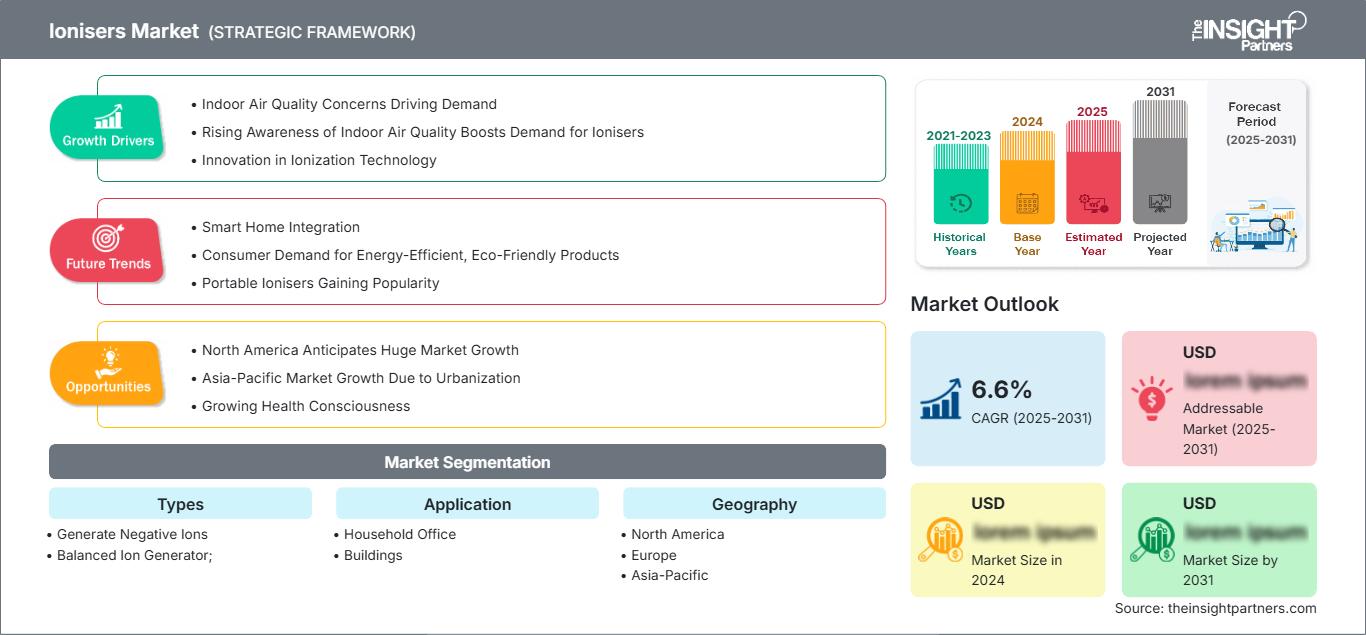
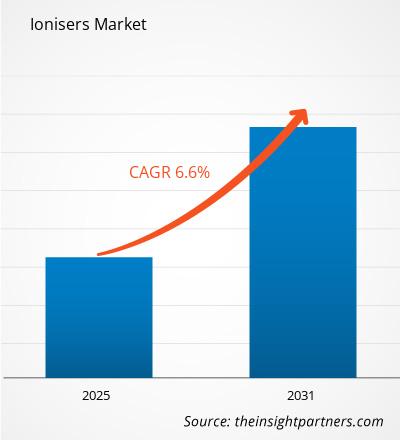
The global Ionisers market was valued at US$ 8.98 billion in 2025 and is expected to reach US$ 18.69 billion by 2034; it is estimated to record a CAGR of 8.49% during 2026-2034.
Ionisers Market Assessment and Insights
- North America: North America is expected to account for a 28–32% Ionisers Market share in 2025, with the market growing at a CAGR of 8.7–9.4% between 2026–2034. Demand is supported by established purifier adoption and commercial indoor-air-quality requirements.
- US: The US represents approximately 82–86% of North America's 2025 share, with a CAGR of 8.5–9.2% between 2026–2034. Residential purification, smart monitoring, and commercial air-quality applications remain important.
- Europe: Europe is projected to hold a 24–28% share in 2025 and expand at a CAGR of 8.8–9.5% during 2026–2034, led by Germany, the UK, France, Italy, and Spain, where energy-conscious and low-emission purification technologies are gaining attention.
- Asia Pacific: Asia Pacific is expected to represent a 30–34% share in 2025 and record a CAGR of 11.0–11.8% through 2034. China, Japan, South Korea, and India provide strong demand through urbanization, manufacturing activity, and rising indoor-air-quality awareness.
- Largest Segment: Household Office is the largest application, representing a 65–70% market share in 2025 and expanding at a CAGR of 9.2–10.0%, supported by broad residential and small-office deployment.
- High Growth Segment: Buildings is the high-growth application, with a 30–35% share in 2025 and a CAGR of 10.5–11.5%, reflecting institutional and commercial investment in integrated air-quality management.
- Key companies analyzed in detail: Airocide, Alen Corporation, Amstat Industries Inc., Fresher Air, Honeywell International Inc., IQAir, Lasko, O-Ion, Rabbit Air, and Sunbeam Products.
Source: The Insight Partners' analysis based on proprietary research, government publications, company annual reports, investor presentations, industry databases, and expert interviews.
There has been an evolution in technology development from single standalone particle charging devices towards integrated air treatment systems. The manufacturers now integrate the process of ion generation together with mechanical filters, activated carbon, sensors, variable speed fans, and digital controls. Production processes have also been geared towards smaller sizes, reduced power consumption, reduced noise, and increased electrical safety. This would make these devices more applicable in different environments including residential rooms, offices, classroom, health care facilities, and commercial establishments.
In terms of future developments in the Ionisers Market, there will be more growth in regions where there are urban air quality problems along with modern appliances and buildings efficiency campaigns. The manufacturers will be working on controls connectivity, particulate sensing, remote monitoring, and adaptable operating modes. Regulatory pressure for ozone emissions and air quality performance will make the manufacturers produce designs with controlled ion generation and safety features. There will also be new opportunities arising in the Asia Pacific region and some Middle Eastern countries.
Ionisers Market Report Scope
| Report Attribute | Details |
|---|---|
| Market size in 2025 | US$ 8.98 Billion |
| Market Size by 2034 | US$ 18.69 Billion |
| Global CAGR (2026 - 2034) | 8.49% |
| Historical Data | 2021-2024 |
| Forecast period | 2026-2034 |
Ionisers Market Analysis
The growth of the Ionisers market is being driven by the requirement for dealing with airborne particles in controlled indoor environments, especially when ventilation is not always adequate for handling local pollutant loads. The development of the market will hinge on an ecosystem including ion-generating units, power electronics, fans, filtering mediums, sensors, control software, appliance companies, distribution channels, and replacement parts suppliers. Suppliers with consistent high-voltage parts and manufacturing reliability may affect product performance and running costs.
In terms of product development, the ioniser makers are adopting modular designs that enable the use of ion generation capabilities in overall purification solutions. Such design enables the differentiation of products for household, office, and building uses without the need for creating a separate development platform. The availability of parts, electrical safety, ozone-control engineering, and certification become key procurement issues. The trend towards the integration with HEPA and activated-carbon purification systems creates more supplier opportunities.
The Ionisers Market competition study shows a fragmented industry with diversified air treatment products and companies dedicated to specific air purification techniques. Honeywell International Inc. represents both consumer and building air quality solutions, whereas Alen Corporation and Rabbit Air represent consumer air purification products that may combine ionization and filtration. IQAir stands out with its premium air quality technology and monitoring, while Airocide provides alternative air purification technologies for niche applications.
The Ionisers Market report shows that product architecture, as opposed to ionizing, is becoming an essential criterion of competitive positioning. Lasko and Sunbeam Products offer products through consumer appliances channels, while O-Ion, Fresher Air, and Amstat Industries Inc. cater to more specialized needs. The key investment areas include sensors, digital interfaces, compactness, and energy-efficient air flow. Companies that demonstrate the ability to manage their emissions, particles, and adaptability to indoor air quality standards will be in better positions to win both institutional and household orders.
● REPORT CUSTOMIZATION
Tailor This Report To Align With Your Specific Business Requirements
This report can be customized to align precisely with your business objectives, scope, and target markets. Customization options include tailored segmentation, geography, competitive analysis, and strategic insights to support informed decision-making.
Customize This Report →WHAT YOU CAN ADJUST
- ● Segmentations
- ● Geography
- ● Competitive Analysis
- ● Language Preferences
Ionisers Market: Strategic Insights
Regional Insights
North America Ionisers Market
North America is projected to retain a 28–32% Ionisers Market in 2025 and expand at a CAGR of 8.7–9.4% through 2034. The US market provides the largest regional source of demand due to well-developed consumer awareness regarding air purification, extensive use of portable devices, and growing focus on indoor environmental quality. The contribution from Canada includes residential and commercial applications wherein the need to seal buildings due to seasonal climate creates a need for air purification indoors.
There is also a growing importance of commercial demand owing to office, educational, healthcare, and hospitality establishments looking at particle removal in addition to ventilation. The regional competitive dynamics call for products with combination of ionisation and filtration, indoor air quality sensors, automatic mode operation, and low noise operation. Scrutiny of ozone emissions by regulatory authorities helps manufacturers differentiate through proper electrical design and operational characteristics of their equipment.
U.S. Ionisers Market
The US is estimated to represent 82–86% of North America's 2025 Ionisers Market value and is expected to grow at a CAGR of 8.5–9.2% during 2026–2034. Demand includes household appliances, office spaces, institutions, and commercial buildings, where buying decisions are made on the basis of filtration efficacy, area coverage, noise produced, energy use, and intelligent controls.
Manufacturers in the Ionisers Market, like Honeywell International Inc., Alen Corporation, IQAir, Lasko, Rabbit Air, and Sunbeam Products form part of the competitive landscape in the industry. Consumer devices rely on ionization along with HEPA filters and particle sensors, while commercial devices integrate with the ventilation and building management systems. The US market has begun to give more importance to certification and emissions performance of the product. Manufacturers with the ability to design ionization devices with air quality results will benefit from this trend.
Europe Ionisers Market
Europe is projected to hold a 24–28% share in 2025 and grow at a CAGR of 8.8–9.5% through 2034. Germany is an important market due to the presence of engineering competencies, appliance manufacturing, and high concern about energy efficiency. The UK sustains the demand in households, offices, and institutional settings, while France and Italy create chances in domestic and commercial air treatment.
Germany and the UK are especially relevant for technologically integrated purification systems where such factors as energy consumption, noise, maintenance, and indoor environmental performance have an impact on the purchase decision. France, Italy, and Spain offer chances in household appliances, hospitality sector, offices, and other enclosed spaces. European buyers become increasingly concerned about safety and emissions performance of products, which prompts the suppliers to develop better control over the process of ions generation and combine it with filtration.
APAC Ionisers Market
APAC is expected to command a 30–34% share in 2025 and expand at a CAGR of 11.0–11.8%, making it the leading high-growth region. China leads regional demand, followed by Japan, South Korea, India, and Australia. Industrialization, urban density, appliance adoption, and indoor-air-quality awareness support expansion across household and commercial applications.
Government concern over pollution mitigation, modern construction, and energy-efficient appliances is another factor that reinforces this trend. China represents the biggest manufacturer and consumer base; Japan and South Korea focus on small, efficient, and sensor-equipped appliances; India has a large untapped market in urban housing and offices; and Australia represents a well-established high-end appliance market.
Middle East & Africa Ionisers Market
Middle East and Africa demand is expected to expand at a CAGR of 8.0–8.8% during 2026–2034. Saudi Arabia and UAE take the forefront in terms of market penetration, thanks to the emergence of commercial facilities, hospitality sector, health care facilities, and high dependency on artificial indoor environments. South Africa becomes the primary opportunity among the sub-Saharan countries.
A combination of energy-consuming buildings and high outdoor particulate matter creates a need for indoor air treatment solutions. In the UAE and Saudi Arabia, the potential exists in terms of premium housing projects, hotels, offices, and health care facilities; in South Africa, the potential exists in housing and commercial facilities. Demand among RoMEA countries will continue to be more fragmented depending on the capabilities of the distributors and product costs.
Segmentation Analysis
Types
The Types segment is expected to expand at a CAGR of 9.0–9.8% between 2026–2034. Product selection depends on desired ion polarity, particle-charging performance, electrical architecture, and compatibility with filtration systems. Manufacturers increasingly emphasize stable output, controlled emissions, compact electronics, and integration with sensors and automated operating modes.
- Generate Negative Ions: Negative-ion generation remains widely used in consumer purification designs because it can be incorporated into compact electrical architectures. Demand is strongest where manufacturers combine ion generation with filtration, airflow control, and user-adjustable operating modes.
- Balanced Ion Generator: Balanced ion generators support applications requiring more controlled ion production and polarity management. Their strategic importance increases where system designers prioritize predictable electrical performance, environmental control, and integration within sophisticated purification equipment.
Application
The Application segment is projected to grow at a CAGR of 9.4–10.2% during 2026–2034. Household Office applications provide the largest installed base, while Buildings are gaining importance as property operators evaluate integrated indoor-air-quality systems. Application growth depends on room size, operating hours, ventilation configuration, and the required level of monitoring and control.
- Household Office: Household Office applications represent the broadest addressable base, supported by residential rooms, home offices, and small workplaces. Compact dimensions, low noise, simple controls, and compatibility with filtration remain key purchasing considerations.
- Buildings: Buildings demand higher-capacity and continuously operated solutions for offices, education, healthcare, hospitality, and public facilities. Integration with HVAC systems, sensors, building controls, and maintenance programs increases strategic relevance for commercial deployments.
Opportunity Snapshot
| Application | Revenue Contribution | Trend Tag | Adoption Stage |
| Household Office | High | Smart Purification | Mature |
| Buildings | Medium | HVAC Integration | Scaling |
Ionisers Market Growth Drivers and Impact Analysis
Rising Indoor-Air-Quality Awareness
Increasing interest in the problem of indoor pollution stimulates households and businesses to consider solutions that could help handle particle pollutants in enclosed spaces. Ionization can be seen as one component of a larger purifier architecture that can involve filtration and ventilation alongside other elements. This driver influences product design as consumers tend to demand some performance data from manufacturers. As a result, it becomes more attractive for producers to incorporate sensors, operating signals, filter configurations, and automation into their products. The same applies to corporate customers who consider maintenance costs and system compatibility when purchasing such equipment. In turn, this situation leads to preference towards integrated devices with known operating characteristics. Such tendencies may eventually result in a rise in the average level of product complexity and competition between companies through performance and engineering features.
Integration of Ionisation With Smart Air Treatment
Integration with connected purification systems is changing how ionisation functions are deployed and controlled. Sensors can monitor particulate concentration, volatile compounds, temperature, humidity, or other environmental variables, allowing operating modes to respond to changing conditions. This architecture creates additional value because ion generation can become one controllable component within a larger air-treatment sequence rather than operating continuously at a fixed output. Digital connectivity also enables usage monitoring, maintenance alerts, and remote configuration. For manufacturers, integrated platforms provide opportunities to differentiate across multiple room sizes and customer groups using shared hardware and software architectures. The impact extends to commercial buildings, where air-quality equipment can increasingly exchange information with broader facility-management systems and support more coordinated operating strategies.
Expansion of Commercial Indoor Environmental Management
Commercial buildings are increasingly evaluated according to occupant comfort, energy performance, ventilation quality, and indoor environmental conditions. This broader perspective creates opportunities for air-treatment technologies in offices, schools, healthcare facilities, hospitality properties, and other continuously occupied spaces. Ionisation functions can be incorporated into systems that already include mechanical filtration, air circulation, and monitoring. The commercial opportunity is therefore influenced by building refurbishment cycles and the modernization of HVAC infrastructure. Suppliers that provide modular installation options can address different capacities without redesigning complete systems. Procurement decisions also increasingly consider operating costs, serviceability, safety, and integration requirements. As building owners seek measurable environmental performance, technologies capable of producing consistent and controllable treatment outcomes can gain relevance within larger indoor-air-quality programs.
Ionisers Market Future Trends
Sensor-Guided Ionisation and Adaptive Operation
The Ionisers Market trends are likely to increasingly center on adaptive ion-generation systems that adjust operation according to real-time air-quality conditions. Instead of maintaining fixed output, future appliances can use particulate and environmental sensors to determine when ionisation should operate, reduce output, or coordinate with mechanical filtration. This approach can improve energy management and provide users with clearer information about equipment behavior. Connected applications may also introduce remote diagnostics, usage histories, filter-life notifications, and automated maintenance recommendations. In commercial settings, sensor data could feed building-management platforms and support coordinated ventilation strategies. Product developers are consequently likely to focus on algorithms, sensor reliability, and interoperability alongside the electrical ion-generation module itself. Such development could make ionisation increasingly invisible as a standalone feature while preserving it as an embedded air-treatment function.
Low-Emission and Hybrid Purification Architectures
Future product development is expected to emphasize hybrid architectures that combine controlled ionisation with mechanical filtration, activated carbon, ultraviolet technologies, or other purification layers. The objective is to distribute pollutant-management functions across several technologies rather than relying on ion generation alone. This can help manufacturers address different particle and contaminant profiles while giving customers greater control over operating modes. Low-emission electrical designs will become increasingly important as customers and regulators examine unintended byproducts. Product engineering is therefore likely to emphasize optimized voltage control, insulation, airflow paths, and monitoring. Hybrid systems can also support modular product families, enabling manufacturers to adapt common platforms for household, office, and building applications. This trend should increase the technical differentiation of products and raise the importance of validation, testing, and lifecycle performance.
Ionisers Market Opportunities
Commercial Retrofit and Building Integration
The Ionisers Market Forecasts point toward an expanding opportunity in retrofit projects where existing buildings require improved air-treatment performance without complete HVAC replacement. Suppliers can develop modular ion-generation units that fit within air-handling systems, return-air pathways, ceiling equipment, or localized purification zones. Such solutions can address offices, schools, hospitality facilities, healthcare sites, and public buildings with different capacity requirements. Investment opportunities exist in equipment design, installation services, monitoring software, and recurring maintenance. Companies that simplify commissioning and demonstrate compatibility with existing controls can reduce adoption barriers. The opportunity is particularly relevant in regions with large installed building stocks, where incremental upgrades may be more practical than full system replacement. Partnerships with facility-management providers and HVAC integrators can also expand distribution and improve access to institutional customers.
Connected Premium Residential Systems
Premium residential applications offer an opportunity to combine ionisation with connected purification, air-quality sensing, automated controls, and multi-device management. Consumers increasingly expect appliances to provide information rather than operate as isolated hardware, creating room for subscription-based monitoring, filter replenishment programs, and mobile applications. Manufacturers can target larger homes, home offices, allergy-sensitive environments, and connected-home ecosystems with differentiated product platforms. Investment should focus on sensor accuracy, quiet operation, compact design, energy efficiency, and simple maintenance. Product developers can also create tiered systems using common electronics and software while varying room coverage and filtration configurations. This strategy can improve manufacturing efficiency and support broader channel coverage. The opportunity is strongest for brands able to combine credible air-treatment performance with convenient digital experiences and transparent operating information.
Recent Developments
- June 2026: Alen Corporation introduced the BreatheSmart 35i as a new addition to its smart air-purifier lineup. The model combines real-time contaminant sensing, connected functionality, compact dimensions, and quiet operation for smaller residential spaces, demonstrating the company’s continued movement toward sensor-enabled purification products.
- May 2026: IQAir North America launched a US trade-in program allowing eligible customers to return qualifying used air purifiers and air-quality monitors for credit toward new products. The initiative supports product upgrades while encouraging customers to move toward newer systems with enhanced performance, connectivity, and monitoring capabilities.
- February 2025: Honeywell International Inc. announced its intention to separate its Automation and Aerospace businesses, with the planned transaction expected to create three independently focused companies. The portfolio change is strategically relevant to its broader building and indoor-air-quality activities by sharpening the organizational focus of its automation business.
Frequently Asked Questions

- Comprehensive Market Sizing and Forecast Analysis
- Detailed Segmentation Analysis
- In-Depth Market Dynamics Assessment
- Regional and Country-Level Insights
- Competitive Landscape and Company Benchmarking
- Strategic Business Intelligence
Recent Reports
Testimonials

The Insight Partners provided valuable market intelligence that supported our global go-to-market strategy. Their team was professional, responsive, and attentive to our feedback, providing thoughtful analysis and helpful methodological clarifications throughout the project.
Junmo Kim Chief Financial Officer (CFO), Enertech Co., Ltd.
The Insight Partners' SCADA System Market report is comprehensive, with valuable insights on current trends and future forecasts. The team was highly professional, responsive, and supportive throughout. We are very satisfied and highly recommend their services.
RAN KEDEM Partner, Reali Technologies LTDs
I requested a report on a very specific software market and the team produced the report in a few days. The information was very relevant and well presented. I then requested some changes and additions to the report. The team was again very responsive and I got the final report in less than a week.
JEAN-HERVE JENN Chairman, Future Analytica
We worked with The Insight Partners for an important market study and forecast. They gave us clear insights into opportunities and risks, which helped shape our plans. Their research was easy to use and based on solid data. It helped us make smart, confident decisions. We highly recommend them.
PIYUSH NAGPAL Sr. Vice President, High Beam Global
The Insight Partners delivered insightful, well-structured market research with strong domain expertise. Their team was professional and responsive throughout. The user-friendly website made accessing industry reports seamless. We highly recommend them for reliable, high-quality research services
YUKIHIKO ADACHI CEO, Deep Blue, LLC.
This is the first time I have purchased a market report from The Insight Partners.While I was unsure at first, I visited their web site and felt more comfortable to take the risk and purchase a market report.I am completely satisfied with the quality of the report and customer service. I had several questions and comments with the initial report, but after a couple of dialogs over email with their analyst I believe I have a report that I can use as input to our strategic planning process.Thank you so much for taking the extra time and making this a positive experience.I will definitely recommend your service to others and you will be my first call when we need further market data.
JOHN SUZUKI President and Chief Executive Officer, Board Director, BK Technologies
I wish to appreciate your support and the professionalism you displayed in the course of attending to my request for information regarding to infectious disease IVD market in Nigeria. I appreciate your patience, your guidance, and the fact that you were willing to offer a discount, which eventually made it possible for us to close a deal. I look forward to engaging The Insight Partners in the future, all thanks to the impression you have created in me as a result of this first encounter.
DR CHIJIOKE ONYIA MANAGING DIRECTOR, PineCrest Healthcare Ltd.Reason to Buy
- Informed Decision-Making
- Understanding Market Dynamics
- Competitive Analysis
- Identifying Emerging Markets
- Customer Insights
- Market Forecasts
- Risk Mitigation
- Boosting Operational Efficiency
- Strategic Planning
- Investment Justification
- Tracking Industry Innovations
- Aligning with Regulatory Trends





 Get Free Sample for