
Laser Dust Monitoring Market Size, Trends & Growth by 2034
Coverage: by Measuring Range (0.3-2.5 µm, 0.3-5.0 µm, 0.3-10 µm, Others); End User (Power Generation, Oil and Gas, Medical, Construction, Chemical, Others) , and Geography (North America, Europe, Asia Pacific, and South and Central America)
- Status : Data Released
- Report Code : TIPRE00006352
- Category : Electronics and Semiconductor
- No. of Pages : 150
- Available Report Formats :


- Last update date : September 28, 2026


2025 Market Size
US$ 556.79 Mn
Base year value
2034 Forecast
US$ 1,194. Mn
Projected by 2034
CAGR 2026-2034
8.85 %
Growth rate
Addressable Market
US$ 7,842.16 Mn
(2026-2034)
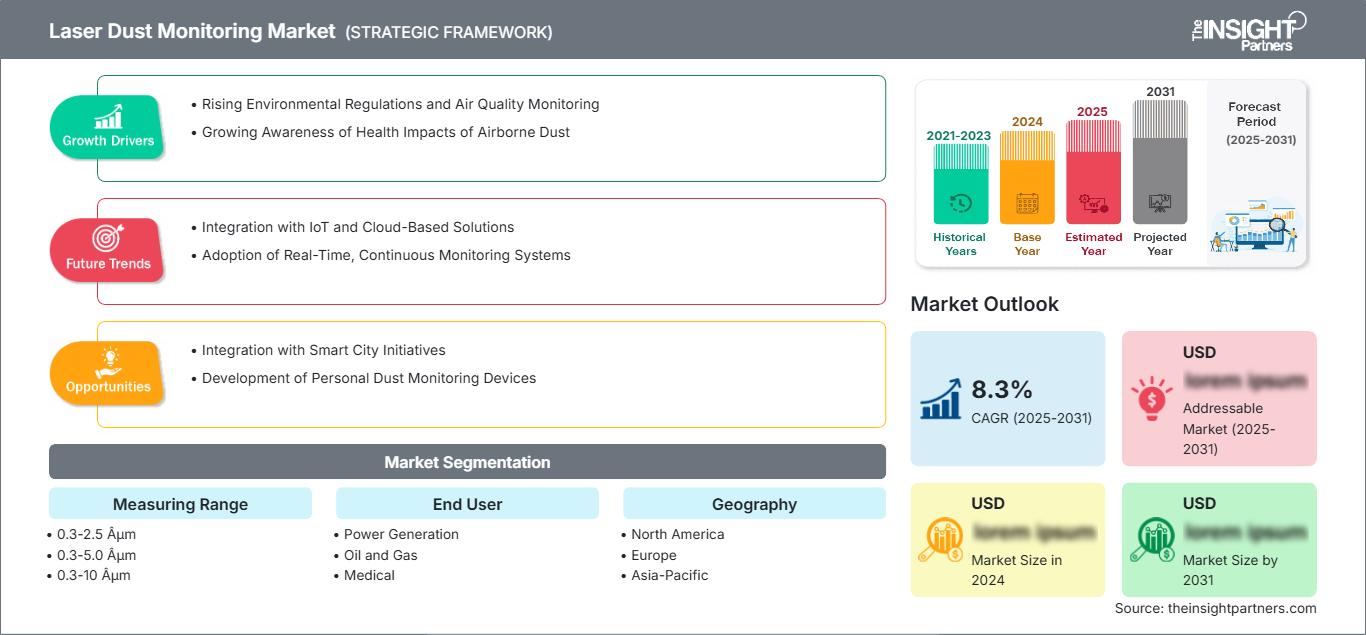
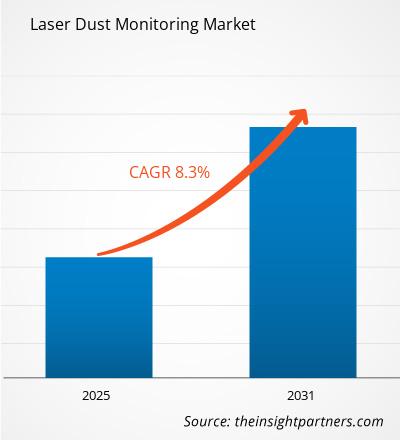
The global Laser Dust Monitoring market was valued at US$ 556.79 million in 2025 and is expected to reach US$ 1194 million by 2034; it is estimated to record a CAGR of 8.85% during 2026-2034.
Laser Dust Monitoring Market Assessment and Insights
- North America: North America is estimated to hold a 29–33% share in 2025 and expand at a 9.4–10.3% CAGR during 2026–2034, supported by industrial hygiene, construction monitoring, energy facilities, and connected environmental instrumentation.
- US: The US represents 84–88% of North American demand in 2025 and is projected to grow at a 9.6–10.5% CAGR during 2026–2034, led by workplace safety and industrial monitoring.
- Europe: Europe accounts for a 25–29% share in 2025 and is projected to grow at a 9.1–10.0% CAGR through 2034, with Germany, the UK, France, Italy, and Spain supporting demand across manufacturing, construction, energy, and controlled environments.
- Asia Pacific: Asia Pacific holds a 28–32% share in 2025 and is expected to register a 10.7–11.7% CAGR, led by China, Japan, South Korea, India, and Australia, where industrialization and cleanroom investment support adoption.
- Largest Segment: The 0.3-10 µm measuring range holds a 42–47% market share in 2025 and is expected to expand at a 10.2–11.1% CAGR through 2034.
- High Growth Segment: Construction is the high-growth end-user segment, representing a 16–20% market share in 2025 and expanding at a 11.4–12.4% CAGR through 2034.
- Key companies analyzed in detail: AMETEK, Inc., FORBIX SEMICON India Pvt. Ltd., Hangzhou Zetian Technology Co., Ltd., Honeywell International Inc., Kaiterra, Kanomax, KANSAI Automation Co., Ltd., Particles Plus, Inc., PCE Instruments, Swan Environmental Pvt. Ltd., and TSI Incorporated.
Source: The Insight Partners' analysis based on proprietary research, government publications, company annual reports, investor presentations, industry databases, and expert interviews.
Laser Dust Monitoring Market has evolved from manual gravimetric testing to compact optical monitoring devices which can provide instant dust particle readings. Laser light scattering technologies are now capable of multi-channel particle detection, data logging and alarms, and connectivity. In terms of product innovation, there is an emerging trend towards integration of temperature, humidity, gas, and particulates monitoring systems.
Future demand for Laser Dust Monitoring Systems will be increasingly focused on connectivity, portability and systems that can integrate particulate analysis with facility management systems. There are ample growth prospects in the Asia Pacific region owing to semiconductor investments, pharmaceutical investments, manufacturing investments, and infrastructure developments, while the Gulf economies present growth potential with respect to construction and industrial diversification. Growth will be supported by regulation on worker exposure, indoor environment quality and process contamination.
Laser Dust Monitoring Market Report Scope
| Report Attribute | Details |
|---|---|
| Market size in 2025 | US$ 556.79 Million |
| Market Size by 2034 | US$ 1,194. Million |
| Global CAGR (2026 - 2034) | 8.85% |
| Historical Data | 2021-2024 |
| Forecast period | 2026-2034 |
Laser Dust Monitoring Market Analysis
Demand is being determined by occupational exposure management, industrial process control, construction-site dust measurement, and cleanroom contamination prevention. Laser Dust Monitoring Market is growing thanks to the capability of optical instruments to provide instantaneous results without laboratory analysis. Ecosystem comprises laser sources, optical chambers, photodetectors, pumps, calibration companies, software developers, distributors, and industrial safety systems integrators. Choice of instrument is determined by the number of particle-size channels, accuracy, flow control, environmental resistance, need in calibration and connectivity.
Supply is increasingly determined by the emergence of compact devices that combine portability with larger data storage capabilities and digital communications. Kanomax, PCE Instruments, Honeywell International Inc., and Kaiterra products illustrate this trend of moving towards real-time particulate detection, multiple channels of measurements and facility integration. Users' attention is increasingly paid to such parameters as sensor stability, calibration traceability, battery life, protection against ingress and compatibility with the existing environmental monitoring systems, instead of simply nominal measurement range.
Laser Dust Monitoring Market Report demonstrates fragmentation among foreign multinationals involved in manufacturing of instrumentation equipment, specialized particle monitoring companies, and regional manufacturers. The market includes AMETEK, Inc. through its expertise in precision measurement and industrial instrumentation, and Honeywell International Inc. with its offering of particulate sensors along with its automation solutions for buildings and industries. Kaiterra focuses on environmental monitoring, and Kanomax offers its specialty products in the domain of dust monitors, particle counters, and clean rooms.
Investment is being made into miniaturization of sensors, remote data access, automated calibration, and environmental measurements. Competitors include Particle Plus, Inc., PCE Instruments, KANSAI Automation Co., Ltd., and TSI Incorporated that specialize in their offerings, whereas FORBIX SEMICON India Pvt. Ltd., Hangzhou Zetian Technology Co., Ltd., and Swan Environmental Pvt. Ltd. help expand regional presence. Increasingly, the competitive strategy involves application oriented configuration, calibration, and compatibility with industrial control systems.
● REPORT CUSTOMIZATION
Tailor This Report To Align With Your Specific Business Requirements
This report can be customized to align precisely with your business objectives, scope, and target markets. Customization options include tailored segmentation, geography, competitive analysis, and strategic insights to support informed decision-making.
Customize This Report →WHAT YOU CAN ADJUST
- ● Segmentations
- ● Geography
- ● Competitive Analysis
- ● Language Preferences
Laser Dust Monitoring Market: Strategic Insights
Regional Insights
North America Laser Dust Monitoring Market
The North American region is expected to hold around 29%-33% share in 2025 and is expected to grow at a 9.4%-10.3% CAGR till 2034. US leads the regional market and Canada & Mexico present further market potential by virtue of construction, manufacturing, energy and environmental monitoring. Management of workplace exposures remains the key purchasing driver.
Industrial establishments need devices that offer real-time readings along with logging capability, alarm functions and portability. Increasing number of construction projects too are raising the requirement for fast on-site assessments. The regional market sees the advantage of presence of calibration services, well-developed occupational safety programs and widespread availability of suppliers of specialized instruments.
U.S. Laser Dust Monitoring Market
The US accounts for 84–88% of North American demand and is forecast to grow at a CAGR of 9.6–10.5% until 2034. The demand drivers include workplace exposure assessment, construction safety, manufacturing sector, utilities, and environment investigation. Customers are moving toward direct reading instruments due to quick decision making requirements.
The key vendors for product and distribution are Honeywell International Inc., AMETEK, Inc., Kanomax, Particles Plus, Inc., PCE Instruments, and TSI Incorporated. The applications include industrial hygiene, clean room, construction, indoor environment assessment, etc. Connected instruments are becoming important as the facility manager can correlate particulate data along with temperature, humidity, alarms, and other environmental parameters.
Europe Laser Dust Monitoring Market
The region accounted for about 25-29% of the global market in 2025 and is forecasted to exhibit a CAGR of 9.1-10.0% up to 2034. The biggest driver of demand in the region is Germany, due to its manufacturing base, industrial safety needs, engineering, and environmental monitoring needs.
The other significant country for the market is the UK, with construction, occupational hygiene, labs, and facilities management applications. Other countries of interest include France, Italy, and Spain, with their additional applications in manufacturing, construction, energy, and environmental monitoring. France gets advantages from industrial and infrastructure projects; Italy from manufacturing and process industries applications; Spain from construction, energy, and urban environmental assessments.
APAC Laser Dust Monitoring Market
APAC comprised about 28%-32% share in 2025 and is expected to grow with a 10.7%-11.7% CAGR until 2034. China will be the key region driven by manufacturing and infrastructural needs. Japan and South Korea will see growth owing to the demand for semiconductors and high-end manufacturing. India will be witnessing growth owing to construction and industrialization.
Australia will be contributing on account of mining, construction, environmental monitoring, and workplace safety applications. The growth in industrialization and investments in controlled manufacturing plants is likely to drive the usage of real-time particulate instruments.
Middle East & Africa Laser Dust Monitoring Market
MEA and Africa demand is growing on the back of a relatively small demand base with Saudi Arabia and UAE driving regional adoption. Construction, oil & gas, utilities, and industrial diversification drive demand, while South Africa serves as an important player in mining and manufacturing. MEA market is expected to grow at 10.0%–11.0% CAGR.
Saudi Arabia has benefited from infrastructure developments, while the UAE is a mix of construction, property development, and industrial investments. Mining applications in South Africa drive demand, whereas the remaining part of MEA market relies on localized industrial and environmental applications. Heat, dust loading, servicing availability, and equipment durability are key procurement factors.
Segmentation Analysis
Measuring Range
Measuring Range is projected to grow at a 9.8–10.8% CAGR during 2026–2034. The Laser Dust Monitoring Market scope increasingly favors instruments covering multiple particulate sizes because industrial users need flexible monitoring across workplace exposure, process control, cleanroom, and environmental applications. Broader ranges also support fewer instruments across mixed facilities.
- 0.3-2.5 µm: This range is important for fine-particle monitoring and controlled environments, supporting applications where smaller airborne particles influence contamination control, indoor air assessment, and sensitive manufacturing processes.
- 0.3-5.0 µm: This configuration provides an intermediate measurement window suited to facilities requiring fine and moderately sized particle detection without the broader coverage of larger-particle systems.
- 0.3-10 µm: This range offers broad practical coverage for industrial hygiene, construction, environmental assessment, and facility monitoring, making it attractive where one instrument must support multiple applications.
- Others: Other ranges address specialized measurement requirements, including applications requiring narrower or extended particle-size coverage, giving suppliers opportunities to differentiate instruments for particular industrial and research environments.
End User
End User demand is forecast to expand at a 10.4–11.5% CAGR through 2034. Adoption varies according to exposure risks, process sensitivity, regulatory expectations, and monitoring frequency. Energy, construction, chemical production, healthcare, and manufacturing facilities increasingly value direct-reading instruments that support immediate corrective action and documented environmental control.
- Power Generation: Power-generation facilities use particulate monitoring to investigate combustion-related emissions, workplace exposure, equipment areas, and environmental conditions where airborne dust can affect safety and operational performance.
- Oil and Gas: Oil and gas facilities require rugged monitoring equipment for maintenance areas, processing environments, storage locations, and worker exposure assessments where dust and aerosols can accompany industrial activity.
- Medical: Medical and controlled healthcare environments require particulate monitoring to support cleanliness assessment, contamination control, and facility verification, particularly where airborne particles can affect sensitive procedures or products.
- Construction: Construction sites generate variable dust levels from cutting, drilling, demolition, and material handling, creating strong demand for portable instruments that enable rapid assessment and immediate mitigation.
- Chemical: Chemical facilities use particulate measurement alongside broader process and workplace controls, helping identify airborne contamination and support operational decisions in production, handling, and maintenance areas.
- Others: Other users include laboratories, educational facilities, environmental agencies, commercial buildings, and specialized manufacturers requiring portable or fixed particulate monitoring for localized air-quality assessment.
Opportunity Snapshot
| End User | Revenue Contribution (High/Medium/Low) | Trend Tag | Adoption Stage |
|---|---|---|---|
| Power Generation | High | Stack Dust | Scaling |
| Oil and Gas | High | Site Exposure | Scaling |
| Medical | Medium | Cleanroom Control | Mature |
| Construction | High | Site Dust | Scaling |
| Chemical | High | Process Safety | Scaling |
| Others | Medium | Indoor Monitoring | Emerging |
Laser Dust Monitoring Market Growth Drivers and Impact Analysis
Stricter Workplace Exposure and Environmental Monitoring
Increased focus on particulates in the air is prompting firms to complement regular testing with direct-reading equipment. Real-time readings enable the safety team to detect changes taking place while the firm is conducting cutting operations, moving materials, combustion processes, or maintenance work. The market implication of this trend is increased demand for such equipment outside the laboratory setting to include construction projects, manufacturing facilities, utilities companies, and chemical processing plants. Equipment that has alarm capabilities and data storage could improve the ability of the organization to document and investigate incidents. Demand is especially robust where the facility needs regular testing of different areas. Firms that supply such equipment could diversify by providing services in calibration, training, software for reporting, and replacement sensors in addition to the equipment itself.
Growth of Connected Environmental Monitoring Systems
The demand is growing among industrial customers for having an integrated overview of the environmental parameters as opposed to individual readings from various instruments. With digitalization, particulate information could be sent via Ethernet, wireless connectivity, Modbus, or even cloud service so that one could analyze the historical trends and set automatic alarms. It could save time for manual documentation and provide safety managers with a means to correlate the particulate events with the working conditions. There would be an opportunity for manufacturers to offer dust monitoring in tandem with temperature, humidity, gas, pressure, or airflow monitoring. The commercial effect reaches well beyond the sensor devices themselves, since software, gateways, calibration services, and analysis come into the scope of purchases.
Industrial and Infrastructure Expansion in Emerging Economies
Industrialization, urban construction, energy generation, and industrial growth are leading to an expansion in the geographic range for particulate measurement. The fast-paced and sometimes unpredictable nature of projects in developing markets creates the need for a quick-deployment instrument in the presence of variable dust environments. India, China, Southeast Asia, the Middle East, and selected African countries represent regions of opportunity with the emergence of new facilities that embrace proper monitoring processes in the workplace and environment. The commercial potential is greatest where instruments are able to function reliably in hot environments, under heavy dust loading, and with calibration consistency. Instrumentation vendors that build distribution and support networks within the region will make adoption easier.
Laser Dust Monitoring Market Future Trends
Sensor Fusion and Intelligent Particulate Monitoring
Future Laser Dust Monitoring Market trends are likely to center on sensor fusion, combining particulate measurements with temperature, humidity, gases, pressure, airflow, and operational data. Intelligent systems could automatically compensate readings for environmental conditions, flag unusual particle events, and distinguish recurring process signatures from isolated incidents. Advances in embedded processing should allow more analysis at the instrument level, reducing dependence on continuous cloud connectivity. This development may create a new tier of equipment positioned between basic handheld meters and fully integrated facility-monitoring platforms. Manufacturers that combine robust optics with configurable software can address multiple use cases through one hardware architecture. Over time, predictive alerts could help organizations identify ventilation problems, process deviations, or recurring exposure events before they become persistent operational concerns.
Portable-to-Networked Monitoring Convergence
Portable instruments are expected to become increasingly compatible with fixed monitoring architectures, allowing organizations to move devices between investigation points while retaining centralized data management. Future systems may support automatic device identification, wireless synchronization, cloud dashboards, and standardized reporting without requiring complex setup by field technicians. This convergence can reduce the distinction between spot measurement and continuous monitoring. Construction companies, industrial hygienists, facility managers, and environmental consultants could deploy portable instruments during investigations and subsequently incorporate selected units into longer-term programs. Suppliers may therefore develop modular products with interchangeable communication and sensor components. Such flexibility can extend equipment lifecycles, simplify fleet management, and allow customers to increase monitoring density without replacing their entire instrumentation infrastructure.
Laser Dust Monitoring Market Opportunities
Construction and Infrastructure Monitoring Services
Construction provides an attractive investment opportunity because particulate generation changes rapidly with demolition, excavation, drilling, cutting, and material handling. Service providers can deploy portable instruments across projects and combine measurement with worker-safety assessments, environmental reporting, and mitigation recommendations. Laser Dust Monitoring Market Forecasts should therefore consider recurring service demand alongside direct equipment sales. Contractors and infrastructure owners increasingly need documented evidence that dust-control measures are functioning effectively. Investors can target regional monitoring providers that bundle instruments with field technicians, data reporting, calibration, and compliance support. The opportunity is especially relevant in fast-growing urban markets where construction activity is high and environmental expectations are becoming more formal. Subscription-based monitoring can further lower adoption barriers for smaller contractors.
Integrated Monitoring for Energy and Process Facilities
Power-generation, oil and gas, and chemical facilities offer opportunities for integrated particulate-monitoring systems that connect local instruments with broader plant-control infrastructure. Investment can focus on rugged fixed monitors, portable verification devices, data gateways, and maintenance services rather than standalone meters. Facilities can use these systems to investigate abnormal dust conditions, improve worker protection, and support environmental documentation. The strongest opportunities are likely where multiple operating areas require different measurement configurations but centralized reporting is desirable. Suppliers can develop application packages combining hardware, calibration, software integration, and technical support. Such solutions may produce recurring revenue through service agreements and periodic calibration while improving customer retention. Regional industrial expansion should support demand for these integrated monitoring models.
Recent Developments
- September 2025: SES partnered with France-based Cailabs to test next-generation optical ground stations for laser-based space-to-ground communications, aiming to deliver faster, more secure data while reducing reliance on increasingly congested radio-frequency spectrum. The TILBA-OGS L10 stations support two-way transmissions of up to 10 Gbps and use Cailabs’ Multi-Plane Light Conversion technology to mitigate atmospheric turbulence, with SES planning to evaluate the technology ahead of potential integration into commercial services.
- July 2026: Delhi Chief Minister Rekha Gupta launched AI-powered Dust Portal 2.0 to strengthen monitoring and control of dust pollution from construction and demolition sites across the capital. The upgraded platform enables live monitoring of construction sites, using technology to improve compliance with dust-control measures and help authorities identify and address violations more effectively. The initiative is aimed at strengthening Delhi’s pollution-control framework through greater transparency, real-time oversight and technology-driven enforcement.
Frequently Asked Questions

- Comprehensive Market Sizing and Forecast Analysis
- Detailed Segmentation Analysis
- In-Depth Market Dynamics Assessment
- Regional and Country-Level Insights
- Competitive Landscape and Company Benchmarking
- Strategic Business Intelligence
Recent Reports
Testimonials

The Insight Partners' SCADA System Market report is comprehensive, with valuable insights on current trends and future forecasts. The team was highly professional, responsive, and supportive throughout. We are very satisfied and highly recommend their services.
RAN KEDEM Partner, Reali Technologies LTDs
I requested a report on a very specific software market and the team produced the report in a few days. The information was very relevant and well presented. I then requested some changes and additions to the report. The team was again very responsive and I got the final report in less than a week.
JEAN-HERVE JENN Chairman, Future Analytica
We worked with The Insight Partners for an important market study and forecast. They gave us clear insights into opportunities and risks, which helped shape our plans. Their research was easy to use and based on solid data. It helped us make smart, confident decisions. We highly recommend them.
PIYUSH NAGPAL Sr. Vice President, High Beam Global
The Insight Partners delivered insightful, well-structured market research with strong domain expertise. Their team was professional and responsive throughout. The user-friendly website made accessing industry reports seamless. We highly recommend them for reliable, high-quality research services
YUKIHIKO ADACHI CEO, Deep Blue, LLC.
This is the first time I have purchased a market report from The Insight Partners.While I was unsure at first, I visited their web site and felt more comfortable to take the risk and purchase a market report.I am completely satisfied with the quality of the report and customer service. I had several questions and comments with the initial report, but after a couple of dialogs over email with their analyst I believe I have a report that I can use as input to our strategic planning process.Thank you so much for taking the extra time and making this a positive experience.I will definitely recommend your service to others and you will be my first call when we need further market data.
JOHN SUZUKI President and Chief Executive Officer, Board Director, BK Technologies
I wish to appreciate your support and the professionalism you displayed in the course of attending to my request for information regarding to infectious disease IVD market in Nigeria. I appreciate your patience, your guidance, and the fact that you were willing to offer a discount, which eventually made it possible for us to close a deal. I look forward to engaging The Insight Partners in the future, all thanks to the impression you have created in me as a result of this first encounter.
DR CHIJIOKE ONYIA MANAGING DIRECTOR, PineCrest Healthcare Ltd.Reason to Buy
- Informed Decision-Making
- Understanding Market Dynamics
- Competitive Analysis
- Identifying Emerging Markets
- Customer Insights
- Market Forecasts
- Risk Mitigation
- Boosting Operational Efficiency
- Strategic Planning
- Investment Justification
- Tracking Industry Innovations
- Aligning with Regulatory Trends





 Get Free Sample for