
Low Voltage Multilayer Chip Ceramic Capacitors Market Share, Growth & Forecast by 2034
Coverage: By Type (Chip Type, Lead Type); Application (Consumer Electronics, Automotive, Industrial Machinery, Defence, Others) , and Geography (North America, Europe, Asia Pacific, and South and Central America)
- Status : Data Released
- Report Code : TIPRE00024434
- Category : Electronics and Semiconductor
- No. of Pages : 150
- Available Report Formats :


- Last update date : October 07, 2026


2025 Market Size
US$ 2.53 Bn
Base year value
2034 Forecast
US$ 4.57 Bn
Projected by 2034
CAGR 2026-2034
7.67 %
Growth rate
Addressable Market
US$ 33.55 Bn
(2026-2034)
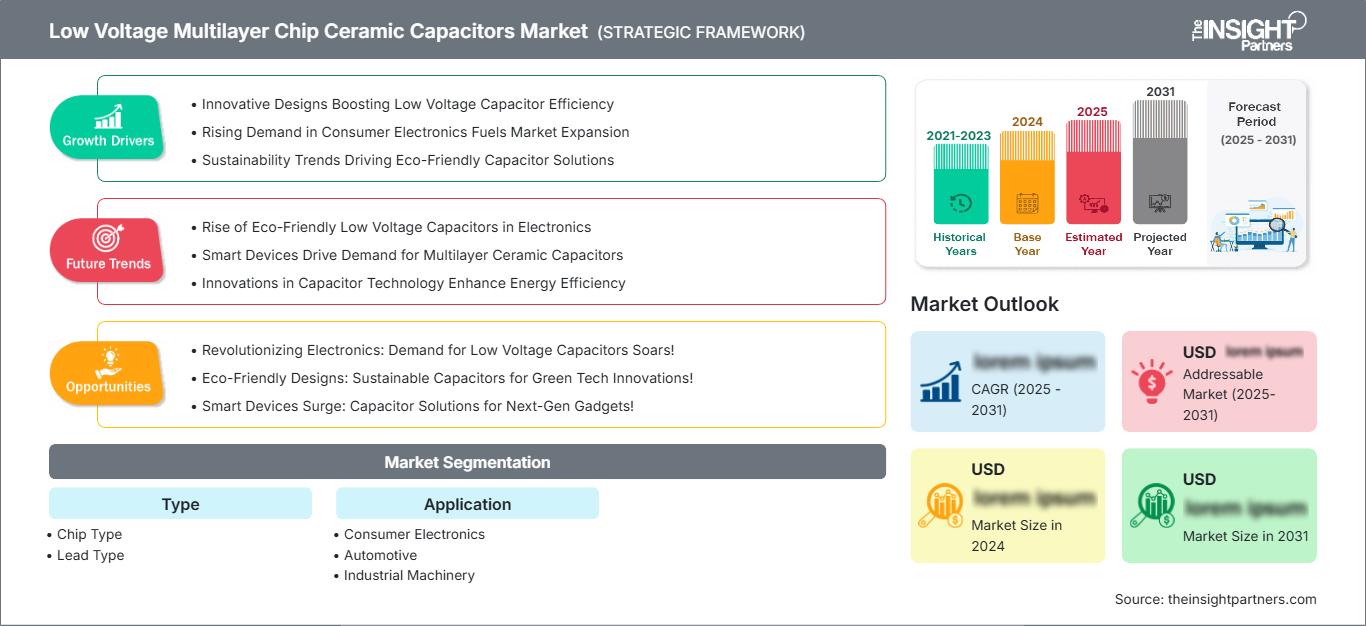
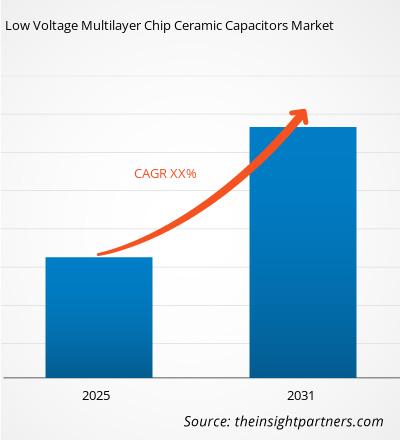
The Low Voltage Multilayer Chip Ceramic Capacitors Market is expanding from a US$ 2.53 Billion valuation in 2025 to US$ 4.57 Billion by 2034, registering a CAGR of 7.67% during 2026–2034. Demand is supported by electronic miniaturization, increasing component density, automotive electrification, and wider deployment of compact power-management architectures requiring reliable capacitance, stable electrical performance, and efficient board utilization across consumer, automotive, industrial, and defense applications.
North America presents a structurally attractive environment for the Low Voltage Multilayer Chip Ceramic Capacitors Market size, supported by advanced automotive electronics, semiconductor manufacturing, aerospace and defense programs, and continued investment in data-center infrastructure. The regional outlook is shaped by rising demand for compact passive components, higher reliability requirements, and domestic supply-chain resilience. Automotive electronics, industrial automation, and high-performance computing are expected to sustain component adoption as designers prioritize lower board area, improved thermal behavior, and dependable electrical characteristics.
Low Voltage Multilayer Chip Ceramic Capacitors Market Assessment and Insights
- North America: North America is projected to hold a 22–26% share in 2025 and grow at a CAGR of 6.8–7.8% between 2026–2034, supported by automotive electronics, industrial automation, aerospace, defence, and data-center investments.
- US: The US is expected to represent 72–76% of North America's 2025 market and expand at a CAGR of 6.9–7.9% during 2026–2034, led by advanced electronics and manufacturing.
- Europe: Europe is estimated at a 19–23% share in 2025 and a CAGR of 6.4–7.4% through 2034, with Germany, France, Italy, and the UK supporting automotive and industrial electronics demand.
- Asia Pacific: Asia Pacific is expected to command a 48–52% share in 2025 and register a CAGR of 8.0–9.0%, led by China, Japan, South Korea, and India through electronics manufacturing and automotive expansion.
- Largest Segment: Chip Type is estimated to account for 86–91% market share in 2025 and expand at a CAGR of 7.6–8.5%, reflecting surface-mount adoption.
- High Growth Segment: Automotive is estimated at a 19–23% market share in 2025 and a CAGR of 8.4–9.4%, driven by electrification and electronic content.
- Key companies analyzed in detail: Murata Manufacturing Co., Ltd.; Samsung Electro-Mechanics Co., Ltd.; TDK Corporation; KYOCERA AVX Components Corporation; Taiyo Yuden Co., Ltd.; Yageo Corporation; Vishay Intertechnology, Inc.; Holy Stone Enterprise Co., Ltd.; Fenghua Advanced Technology; EYANG Technology Co., Ltd.
Source: The Insight Partners' analysis based on proprietary research, government publications, company annual reports, investor presentations, industry databases, and expert interviews.
The market has transitioned from traditional methods of making ceramic capacitors to fully automated multi-layer technology that includes thinner dielectric films, higher capacitance density, reduced case sizes, and advanced termination technologies. The qualification process in the automotive industry has also brought higher requirements for thermal resistance and mechanical durability. The economy of production is now more than ever dependent on the quality of ceramic powder, electrodes, printing, lamination, sintering and automated inspection.
Over the next decade, the Low Voltage Multilayer Chip Ceramic Capacitors Market report indicates that manufacturing capacity is likely to broaden across Asia Pacific while North American and European buyers emphasize resilient sourcing and qualified alternatives. Investments in electric mobility, AI infrastructure, industrial automation, and connected devices should encourage higher-value component specifications. Regulatory requirements concerning vehicle safety, electromagnetic performance, reliability, and environmental compliance are also likely to reinforce qualification barriers, favoring suppliers capable of consistent process control and documented product performance.
Low Voltage Multilayer Chip Ceramic Capacitors Market Report Scope
| Report Attribute | Details |
|---|---|
| Market size in 2025 | US$ 2.53 Billion |
| Market Size by 2034 | US$ 4.57 Billion |
| Global CAGR (2026 - 2034) | 7.67% |
| Historical Data | 2021-2024 |
| Forecast period | 2026-2034 |
Low Voltage Multilayer Chip Ceramic Capacitors Market Analysis
The Low Voltage Multilayer Chip Ceramic Capacitors Market growth is closely linked to rising electronic content per device. Cell phones, computers, automobile control modules, industrial controllers, power management devices, and communication devices need decoupling, filtering, smoothing, and voltage regulation. The market environment is made up of ceramic powder makers, electrode material suppliers, capacitor manufacturers, distributors, original equipment manufacturers, and electronic manufacturing services. Growing needs are more inclined to favor small capacitors with a combination of thermal stability and capacitance.
The supply situation continues to be dominated by technologically advanced suppliers based in Asia, though local buyers are becoming increasingly interested in second sources. Capacity utilization and high yield, consistent quality of raw materials and high precision of the production process are essential in controlling costs due to the need for capital discipline in manufacturing processes. Automobile applications make product development longer, and consumer electronics need fast scale-up and miniaturization.
The Low Voltage Multilayer Chip Ceramic Capacitors Market analysis indicates competition is centered on capacitance density, reliability, miniaturization, qualification breadth, production yield, and customer-specific engineering. Murata Manufacturing Co., Ltd., TDK Corporation, and Samsung Electro-Mechanics Co., Ltd. remain in dominant positions thanks to comprehensive MLCC ranges and involvement in high-performance applications. KYOCERA AVX Components Corporation, Taiyo Yuden Co., Ltd., Yageo Corporation, and Vishay Intertechnology, Inc. participate in competition thanks to specialization in their products, application focus, and global presence.
Holy Stone Enterprise Co., Ltd., Fenghua Advanced Technology, and EYANG Technology Co., Ltd. increase the number of players in the market by means of manufacturing capacity, cost positioning, and growing product ranges. Strategic investments in recent times focus on high-capacitance miniature products, automotive parts, high voltage capabilities, and data centers. Companies that possess the capacity and ability to quickly qualify support designs and minimize customer concerns regarding continuity.
● REPORT CUSTOMIZATION
Tailor This Report To Align With Your Specific Business Requirements
This report can be customized to align precisely with your business objectives, scope, and target markets. Customization options include tailored segmentation, geography, competitive analysis, and strategic insights to support informed decision-making.
Customize This Report →WHAT YOU CAN ADJUST
- ● Segmentations
- ● Geography
- ● Competitive Analysis
- ● Language Preferences
Low Voltage Multilayer Chip Ceramic Capacitors Market: Strategic Insights
Regional Insights
North America Low Voltage Multilayer Chip Ceramic Capacitors Market
North America is estimated to represent 22–26% of the global Low Voltage Multilayer Chip Ceramic Capacitors Market in 2025 and is projected to expand at a CAGR of 6.8–7.8% through 2034. The region benefits from established semiconductor, aerospace, defense, automotive, and industrial electronics ecosystems. Demand is driven by the need for compact decoupling and filter parts in building data centers, artificial intelligence computer infrastructure, manufacturing automation and automotive electronics. US-based manufacturers and integrators are placing greater emphasis on securing adequate supply and sourcing alternative components.
The buying landscape of the region favors those who can fulfill the requirements of reliability and quality in production. The various avenues of demand come from automotive electronics, industrial controls, telecoms, and defense electronics. The increased use of sophisticated driver assistance features and electric vehicles has led to a higher number of passives being incorporated into electronic control systems.
U.S. Low Voltage Multilayer Chip Ceramic Capacitors Market
The US accounts for approximately 72–76% of North America's 2025 Low Voltage Multilayer Chip Ceramic Capacitors Market and is projected to grow at a CAGR of 6.9–7.9% through 2034. The demand is facilitated by investments in semiconductors, AI servers, aerospace systems, defense electronics, automotive platforms, and industrial automation. The industry enjoys robust engineering skills and electronics design work, but does have a considerable part of its component manufacturing outsourced to foreign markets.
Some of the leading companies that are commercially active in US electronics supply chains include Murata Manufacturing Co., Ltd., TDK Corporation, Samsung Electro-Mechanics Co., Ltd., KYOCERA AVX Components Corporation, Taiyo Yuden Co., Ltd., Yageo Corporation, and Vishay Intertechnology, Inc. The importance of the automotive sector is growing due to the increasing sophistication of electronics used in vehicles. There is also the rising need for high-capacitance components in high-performance computing and data center equipment.
Europe Low Voltage Multilayer Chip Ceramic Capacitors Market
Europe is projected to account for 19–23% of the 2025 Low Voltage Multilayer Chip Ceramic Capacitors Market and register a CAGR of 6.4–7.4% through 2034. Germany remains the leading country, supported by automotive manufacturing and industrial automation, while the UK, France, Italy, and Spain contribute through electronics, mobility, aerospace, industrial equipment, and infrastructure applications.
The factors influencing the demand for electronic components in the UK include aerospace, defense, telecommunication, and advanced electronics. Germany is the dominant country in the region for automotive and industrial electronics, with more demand for miniaturized passive electronic components being created. For France, the main influences include aerospace, defense, transportation, and industrial electronics. The other European countries that influence include Italy and Spain in terms of automotive, industrial equipment, renewable energy, and consumer electronics.
APAC Low Voltage Multilayer Chip Ceramic Capacitors Market
APAC is estimated to command 48–52% of the 2025 Low Voltage Multilayer Chip Ceramic Capacitors Market and is projected to grow at a CAGR of 8.0–9.0% through 2034. China is the leading customer, with Japan and South Korea being the next most important ones; India and Australia offer marginal contributions to the market. The strength of China lies in its electronics manufacturing capability and electric vehicle production. Japan continues to be significant in advanced components development, while South Korea relies on its strength in smartphones, semiconductor devices, display panels, and automobile electronics. On the other hand, India’s importance increases due to its electronics manufacturing and automobile localization, while Australia's role lies in industry, energy, and infrastructure applications.
Middle East & Africa Low Voltage Multilayer Chip Ceramic Capacitors Market
The Middle East and Africa Low Voltage Multilayer Chip Ceramic Capacitors Market is projected to grow at a CAGR of 6.0–7.0% through 2034. Saudi Arabia is positioned as a leading regional market, supported by industrial diversification and infrastructure programs. The UAE benefits from electronics, communications, data centers, and smart infrastructure, while South Africa supports industrial and automotive demand.
Energy infrastructure, telecommunications modernization, industrial automation, and transportation projects provide application opportunities across the region. Saudi Arabia and the UAE are particularly relevant for data centers, smart infrastructure, and industrial digitization. South Africa contributes through automotive manufacturing and industrial equipment, while the Rest of MEA remains comparatively fragmented. Procurement is often distributor-led, increasing the importance of established global suppliers, dependable logistics, and product availability.
Segmentation Analysis
Type
The Low Voltage Multilayer Chip Ceramic Capacitors Market forecast by type distinguishes Chip Type and Lead Type, with chip-based architectures benefiting from automated surface-mount assembly, compact footprints, and high component density. The type segment is projected to grow at a CAGR of 7.5–8.4% during 2026–2034 as electronics designers favor smaller packages and efficient automated manufacturing.
- Chip Type: Chip Type remains the dominant configuration because surface mounting supports compact PCB layouts, automated placement, high-volume electronics manufacturing, and increasing capacitance density across consumer, automotive, and industrial equipment.
- Lead Type: Lead Type retains relevance where mechanical mounting, connection geometry, or legacy design requirements influence component selection, particularly in selected industrial and specialized electronic assemblies.
Application
Low Voltage Multilayer Chip Ceramic Capacitors Market trends by application cover Consumer Electronics, Automotive, Industrial Machinery, and Defense. The application segment is expected to register a CAGR of 7.8–8.7% during 2026–2034, reflecting increasing electronic content and reliability requirements across equipment categories.
- Consumer Electronics: Consumer Electronics provides substantial volume demand through smartphones, computers, wearables, networking equipment, and household electronics requiring compact decoupling and filtering components.
- Automotive: Automotive is strategically important as electrification, ADAS, connected systems, and higher electronic content increase requirements for reliable low-voltage capacitors near control and power-management circuits.
- Industrial Machinery: Industrial Machinery supports demand through automation controllers, robotics, drives, sensors, power supplies, and factory equipment requiring stable operation and compact electronic assemblies.
- Defence: Defence emphasizes dependable components for communications, radar, avionics, control systems, and rugged electronics, where qualification, reliability, and long operating life influence procurement decisions.
Opportunity Snapshot
| Application | Revenue Contribution | Trend Tag | Adoption Stage |
| Consumer Electronics | High | Device Miniaturization | Mature |
| Automotive | High | EV Electronics | Scaling |
| Industrial Machinery | Medium | Factory Automation | Scaling |
| Defence | Low | Rugged Electronics | Emerging |
Low Voltage Multilayer Chip Ceramic Capacitors Market Growth Drivers and Impact Analysis
Automotive electrification raises component density
Electric vehicles are raising the number of control functions contained in contemporary systems and thereby generating a steady requirement for small passive components. Management of batteries, power converters, infotainment systems, ADAS (advanced driver assistance systems), communication systems, and electronic control units all require isolation and filtering near the ICs. More electronics imply more components and packaging limitations favor miniaturization and increased capacitance density. Meanwhile, automotive qualification moves buying from vendors who can ensure stability of electrical parameters through wide temperature and vibration ranges. In turn, from the viewpoint of manufacturers, automotive demand helps develop higher value-added product lines and longer-lasting relationships with customers, since qualification processes and design validation build real switching barriers.
AI infrastructure strengthens demand for compact power-management components
There is a need for dense power delivery systems in AI servers and data center systems, making voltage regulation and transient management an important issue for boards. Advanced processors consume significant current and function in confined printed circuit board settings, resulting in a preference for smaller capacitors with more capacitance and thermal characteristics. This trend may lead to greater demand for parts that offer improved electrical performance without requiring increased board area. Companies that have expertise in dielectric development and multilayer manufacturing, as well as automated testing, are best suited to meet this demand. Investments in computing facilities also allow for a greater customer pool than traditional consumer electronics.
Industrial automation expands electronics content across machinery
Industrial machinery is becoming increasingly dependent on sensors, controllers, motor drives, communications modules, and embedded computing, increasing the need for passive components that support stable electrical operation. Factory automation programs encourage equipment manufacturers to improve precision, connectivity, energy efficiency, and predictive maintenance capabilities. Each added electronic function can create incremental requirements for decoupling, filtering, and power stabilization. Industrial buyers also prioritize reliability because component failure can create production downtime and maintenance costs. This favors suppliers offering consistent specifications, traceability, and long-term availability. As automation expands across manufacturing, logistics, energy, and process industries, demand becomes less dependent on a single equipment category. The driver, therefore, supports broader application diversification and encourages manufacturers to develop products tailored to industrial temperature, reliability, and assembly requirements.
Low Voltage Multilayer Chip Ceramic Capacitors Market Future Trends
Higher capacitance density in progressively smaller packages
Future product development is likely to emphasize simultaneous improvements in capacitance, package miniaturization, and reliability. Designers increasingly need to place more electronic functionality within constrained PCB areas, particularly in computing, automotive, and portable devices. This creates pressure on manufacturers to develop thinner dielectric layers, improved electrode structures, and more precise multilayer stacking. Advanced material engineering can allow higher capacitance without proportionally increasing component dimensions. Over time, qualification standards and customer specifications are likely to become more demanding as products move into safety-critical and high-density applications. The competitive advantage will increasingly depend on manufacturing yield and process consistency rather than capacitance alone. Suppliers capable of scaling miniature high-performance products economically should be better positioned to capture future design opportunities.
Application-specific reliability engineering becomes more important
The next phase of development is expected to involve greater customization around application-specific reliability requirements. Automotive, defense, industrial, and computing customers operate under different thermal, mechanical, electrical, and lifecycle conditions, creating demand for differentiated component architectures. Manufacturers are likely to expand soft-termination, high-temperature, high-voltage, and specialized dielectric options while maintaining compact dimensions. Qualification data and application engineering will become increasingly important in purchasing decisions because customers seek predictable behavior across extended operating conditions. This evolution could reduce the relative importance of undifferentiated commodity pricing in technically demanding applications. Suppliers with broad qualification capabilities, strong reliability testing, and application-level engineering support may therefore strengthen their strategic position as electronics become more mission-critical.
Low Voltage Multilayer Chip Ceramic Capacitors Market Opportunities
Localized supply and diversified sourcing programs
Supply-chain diversification creates opportunities for manufacturers and distributors to establish stronger regional capacity, qualified second sources, and localized technical support. Electronics customers increasingly seek continuity for components that can affect production schedules and product qualification. Regional warehousing, application engineering, and supplier qualification programs can therefore complement manufacturing investments. Companies expanding into North America, Europe, and India can target customers seeking shorter lead times and reduced sourcing concentration while maintaining established Asian production advantages. Investment opportunities are strongest where local electronics manufacturing is expanding alongside automotive, industrial, and computing applications. A balanced strategy should combine production economics with geographic resilience, documented quality systems, and customer-specific qualification support rather than relying solely on lower component pricing.
Advanced automotive and computing component portfolios
Product portfolios designed around automotive electrification and high-performance computing offer attractive opportunities for value expansion. Customers in these applications increasingly require compact components capable of supporting higher capacitance, stable electrical behavior, and demanding operating environments. Suppliers can prioritize application-specific engineering, qualification packages, and integrated technical support to improve design adoption. New products can target power-management circuits, processor-adjacent decoupling, ADAS electronics, battery systems, and high-density server boards. Strategic investment in dielectric technology, automated production, and reliability testing can create differentiation while supporting scalable output. Companies that align research and development with customer platform roadmaps may capture longer-term design wins and reduce exposure to lower-margin standardized components.
Frequently Asked Questions

- Comprehensive Market Sizing and Forecast Analysis
- Detailed Segmentation Analysis
- In-Depth Market Dynamics Assessment
- Regional and Country-Level Insights
- Competitive Landscape and Company Benchmarking
- Strategic Business Intelligence
Recent Reports
Testimonials

The Insight Partners provided valuable market intelligence that supported our global go-to-market strategy. Their team was professional, responsive, and attentive to our feedback, providing thoughtful analysis and helpful methodological clarifications throughout the project.
Junmo Kim Chief Financial Officer (CFO), Enertech Co., Ltd.
The Insight Partners' SCADA System Market report is comprehensive, with valuable insights on current trends and future forecasts. The team was highly professional, responsive, and supportive throughout. We are very satisfied and highly recommend their services.
RAN KEDEM Partner, Reali Technologies LTDs
I requested a report on a very specific software market and the team produced the report in a few days. The information was very relevant and well presented. I then requested some changes and additions to the report. The team was again very responsive and I got the final report in less than a week.
JEAN-HERVE JENN Chairman, Future Analytica
We worked with The Insight Partners for an important market study and forecast. They gave us clear insights into opportunities and risks, which helped shape our plans. Their research was easy to use and based on solid data. It helped us make smart, confident decisions. We highly recommend them.
PIYUSH NAGPAL Sr. Vice President, High Beam Global
The Insight Partners delivered insightful, well-structured market research with strong domain expertise. Their team was professional and responsive throughout. The user-friendly website made accessing industry reports seamless. We highly recommend them for reliable, high-quality research services
YUKIHIKO ADACHI CEO, Deep Blue, LLC.
This is the first time I have purchased a market report from The Insight Partners.While I was unsure at first, I visited their web site and felt more comfortable to take the risk and purchase a market report.I am completely satisfied with the quality of the report and customer service. I had several questions and comments with the initial report, but after a couple of dialogs over email with their analyst I believe I have a report that I can use as input to our strategic planning process.Thank you so much for taking the extra time and making this a positive experience.I will definitely recommend your service to others and you will be my first call when we need further market data.
JOHN SUZUKI President and Chief Executive Officer, Board Director, BK Technologies
I wish to appreciate your support and the professionalism you displayed in the course of attending to my request for information regarding to infectious disease IVD market in Nigeria. I appreciate your patience, your guidance, and the fact that you were willing to offer a discount, which eventually made it possible for us to close a deal. I look forward to engaging The Insight Partners in the future, all thanks to the impression you have created in me as a result of this first encounter.
DR CHIJIOKE ONYIA MANAGING DIRECTOR, PineCrest Healthcare Ltd.Reason to Buy
- Informed Decision-Making
- Understanding Market Dynamics
- Competitive Analysis
- Identifying Emerging Markets
- Customer Insights
- Market Forecasts
- Risk Mitigation
- Boosting Operational Efficiency
- Strategic Planning
- Investment Justification
- Tracking Industry Innovations
- Aligning with Regulatory Trends





 Get Free Sample for