
Marine Autopilot Market Growth, Trends & Forecast by 2034
Coverage: by Component (Hardware, Software, Services); Application (Container Ships, Recreational Boats, Fishing Vessels, Passenger Ships, Others) , and Geography (North America, Europe, Asia Pacific, and South and Central America)
- Status : Data Released
- Report Code : TIPRE00006042
- Category : Electronics and Semiconductor
- No. of Pages : 150
- Available Report Formats :


- Last update date : September 30, 2026


2025 Market Size
US$ 410.08 Mn
Base year value
2034 Forecast
US$ 497.5 Mn
Projected by 2034
CAGR 2026-2034
2.45 %
Growth rate
Addressable Market
US$ 4,173.68 Mn
(2026-2034)
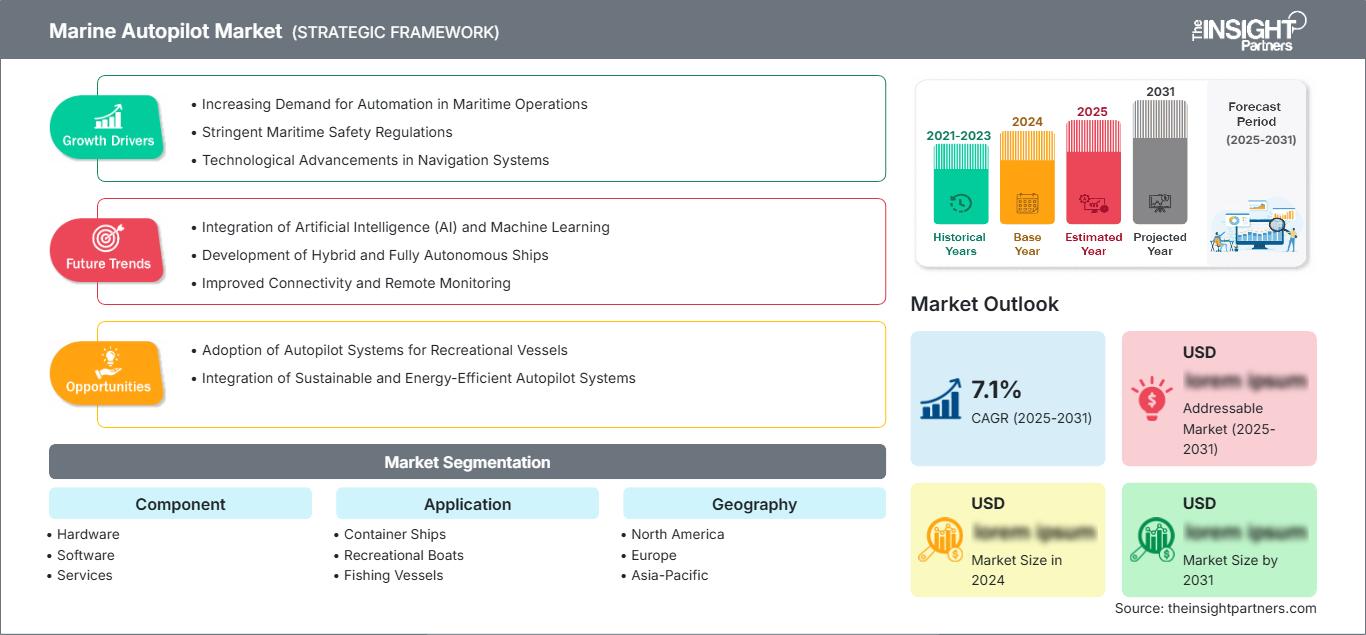
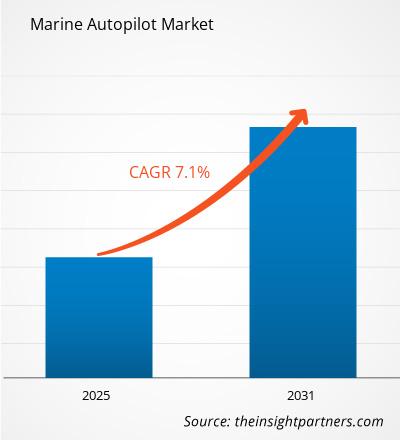
The Marine autopilot market was valued at US$ 410.08 Million in 2025 and is projected to reach US$ 497.5 Million by 2034, registering a CAGR of 2.45% during 2026–2034. Demand continues to be supported by increasing vessel automation, greater emphasis on navigational accuracy, and modernization across commercial and recreational fleets. Integration of advanced navigation electronics and digital bridge systems is strengthening adoption across established maritime economies and emerging marine transport markets.
Across North America, maritime digitalization initiatives, vessel modernization programs, and expanding recreational boating activity continue to reinforce long-term demand. The marine autopilot market size is supported by investments in navigation safety technologies, electronic chart integration, and autonomous vessel research. The regional market is anticipated to expand at a CAGR between 2.6% and 3.0% through 2034, with the United States remaining the primary contributor due to strong marine electronics manufacturing capabilities and sustained fleet replacement activities.
Marine Autopilot Market Assessment and Insights
- North America: Accounted for 34–38% marine autopilot market Share in 2025 and is projected to grow at a CAGR between 2.6–3.0% during 2026–2034. Fleet modernization, advanced navigation regulations, and widespread adoption of integrated bridge systems continue supporting regional expansion.
- US: Represented 74–78% of the North American market in 2025 and is expected to register a CAGR between 2.7–3.1% during 2026–2034, supported by recreational boating demand, naval technology investments, and domestic marine electronics innovation.
- Europe: Held 28–32% Share in 2025 and is forecast to expand at a CAGR between 2.2–2.6% during 2026–2034. Norway, Germany, the United Kingdom, Italy, and the Netherlands remain key contributors through commercial shipping and marine equipment manufacturing.
- Asia Pacific: Captured 22–26% Share in 2025 and is anticipated to grow at a CAGR between 2.8–3.3% during 2026–2034. China, Japan, South Korea, Australia, and India continue investing in commercial shipbuilding and advanced navigation technologies.
- Largest Segment: Hardware represented 56–60% market share in 2025 and is projected to record a CAGR between 2.2–2.6% during 2026–2034, driven by continual upgrades of sensors, control units, steering interfaces, and navigation processors.
- High Growth Segment: Recreational Boats accounted for 22–26% market share in 2025 and is expected to witness a CAGR between 3.2–3.6% during 2026–2034, supported by premium boating experiences, safety enhancements, and user-friendly digital helm technologies.
- Key companies analyzed in detail: AL MARAKEB, ComNav Marine Ltd., Commercial and Marine Comms Ltd., Furuno Electric Co., Ltd., Garmin Ltd., Honeywell International Inc., Micropilot Inc., Navico Group, Raymarine (FLIR Systems, Inc.), Rice Electronics.
Source: The Insight Partners' analysis based on proprietary research, government publications, company annual reports, investor presentations, industry databases, and expert interviews.
The marine navigation ecosystem has experienced a significant transition from standalone steering controllers toward integrated digital bridge solutions capable of processing data from GNSS receivers, inertial sensors, radar, sonar, electronic charts, and satellite communication platforms. Manufacturers increasingly emphasize modular autopilot architectures that simplify installation while improving compatibility with multifunction displays and vessel management systems. These developments have enhanced operational precision, minimized steering deviations, reduced crew workload, and improved fuel efficiency for commercial operators and recreational vessel owners alike. The marine autopilot market growth remains closely associated with ongoing maritime digitalization and stricter navigation safety expectations across international shipping operations.
Looking ahead, expansion opportunities are expected to emerge from Asia-Pacific shipbuilding investments, offshore support vessel modernization, and autonomous navigation research programs supported by public and private funding. Regulatory emphasis on safer maritime operations, combined with growing digital transformation initiatives across ports and shipping companies, is likely to stimulate technology upgrades. The marine autopilot market analysis indicates that suppliers investing in software interoperability, cybersecurity, predictive diagnostics, and artificial intelligence-assisted navigation capabilities are expected to strengthen their competitive positioning throughout the forecast period.
Marine Autopilot Market Report Scope
| Report Attribute | Details |
|---|---|
| Market size in 2025 | US$ 410.08 Million |
| Market Size by 2034 | US$ 497.5 Million |
| Global CAGR (2026 - 2034) | 2.45% |
| Historical Data | 2021-2024 |
| Forecast period | 2026-2034 |
Marine Autopilot Market Analysis
Increasing seaborne trade, increased offshore activities, and the need for enhanced navigational accuracy have led to investments in automation technologies. There is increasing importance placed on advanced navigation systems that can increase efficiency while saving on fuel and energy costs. This has been facilitated by the rising adoption of electronic navigation equipment that conform to safety standards of the International Maritime Organization.
In the entire supply chain from semiconductors to software, marine communication technology manufacturers, system integrators, ship builders and aftersales services work together to provide more intelligent steering technology. Advances in GPS and digital sensors, as well as marine communication technology, have led to increased system reliability.
The sector still operates under the model of constant innovations, strategic product launches, integration of software and creation of international distribution channels. Companies like Garmin Ltd., Furuno Electric Co., Ltd., Honeywell International Inc., Navico Group and Raymarine (FLIR Systems, Inc.) continue developing ecosystems of multifunctional navigation systems. Specialists like ComNav Marine Ltd., Micropilot Inc., AL MARAKEB, Commercial and Marine Comms Ltd., Rice Electronics are busy developing bespoke solutions for automation of vessels.
Current investments are directed at the development of autonomous vessels, assistance of navigation with the use of artificial intelligence, cybersecurity, monitoring of fleets through the cloud, and development of unified marine electronics systems. Companies establish cooperation with shipyards and marine equipment distributors to enhance their aftermarket services along with software compatibility in various navigation systems.
● REPORT CUSTOMIZATION
Tailor This Report To Align With Your Specific Business Requirements
This report can be customized to align precisely with your business objectives, scope, and target markets. Customization options include tailored segmentation, geography, competitive analysis, and strategic insights to support informed decision-making.
Customize This Report →WHAT YOU CAN ADJUST
- ● Segmentations
- ● Geography
- ● Competitive Analysis
- ● Language Preferences
Marine Autopilot Market: Strategic Insights
Regional Insights
North America Marine Autopilot Market
North America accounted for 34–38% of the global marine autopilot market share in 2025 and is projected to expand at a CAGR between 2.6–3.0% during 2026–2034. It will gain due advantage from its presence of marine electronics industry, recreational boat owners and naval modernization. Navigational safety, use of digital bridge systems and fuel efficiency will drive the regulatory focus, thereby making the operators switch from traditional steaming systems to integrated auto-pilot systems, thus increasing reliability and decreasing fuel costs.
Both US and Canada will be engaged in the development and installation of advanced navigational systems in commercial ships, offshore vessels, research vessels, and yachts. Increased integration of radar, electronic chart displays, satellite navigation and intelligent steering systems is helping in increasing adoption rates in various segments of ships. The vendors are further benefiting from developed distribution networks, marine specific service providers, and after-market upgrades that help the region to retain its dominance throughout the forecast period.
U.S. Marine Autopilot Market
The United States represented 74–78% of the North American market in 2025 and is anticipated to register a CAGR between 2.7–3.1% during 2026–2034. With robust recreational boating industry, substantial commercial coast-based operations, and regular investments in the military sector, there is a high potential demand for the most advanced autopilot technology innovations. Local and foreign manufacturers present innovative navigation system kits designed to be compatible with multifunction displays, electronic chart display systems, sonar, radar, and satellite communication devices.
Innovation focus lies in easy installation, touch screens, smart steering functions, and cybersecurity protection of the connected boats. Recreational boaters look for intelligent navigation technologies that would alleviate the stress from long-haul voyages and offshore fishing. Commercial operators still prefer to have digital solutions for vessel management, which would ensure route optimization and improved fuel consumption rate.
Europe Marine Autopilot Market
Europe held 28–32% of the global market in 2025 and is forecast to grow at a CAGR between 2.2–2.6% during 2026–2034. United Kingdom has high demand due to modernization of naval fleet, support vessels in oil production at sea, merchant ships and luxury yacht boats. Constant upgrading of navigation system in maritime transportation ensures implementation of advanced autonomous autopilot technology for safety and voyage efficiency improvement.
Germany is the top European producer of marine electronics with its highly developed engineering, commercial shipbuilding and automation industry. France, Italy and Spain create the demand regionally with their growing fishing fleet, passenger ferries, tourist recreational yachts and coastal maritime transportation. Increasing priority is put on intelligent navigation system, electronic bridge system and maritime digital infrastructure.
APAC Marine Autopilot Market
Asia Pacific accounted for 22–26% of the global market in 2025 and is projected to record a CAGR between 2.8–3.3% during 2026–2034. China leads regional demand through large-scale commercial shipbuilding, while Japan and South Korea continue advancing high-value marine electronics manufacturing and intelligent vessel technologies.
India and Australia are steadily increasing investments in port modernization, coastal surveillance, offshore resource development, and recreational marine infrastructure. Government initiatives supporting maritime digitalization, combined with expanding commercial fleets and increasing navigation safety requirements, continue strengthening adoption of integrated autopilot systems across the region.
Middle East & Africa Marine Autopilot Market
The Middle East & Africa market is expected to expand at a CAGR between 2.3–2.8% during 2026–2034. Saudi Arabia and the United Arab Emirates continue investing in maritime logistics, commercial ports, offshore energy infrastructure, and advanced vessel technologies that encourage installation of modern navigation automation systems.
South Africa serves as an important maritime gateway supporting commercial shipping and fishing activities, while the Rest of MEA experiences gradual adoption through port expansion and marine infrastructure development. Increasing offshore exploration projects and investments in shipping efficiency are expected to create steady demand for marine autopilot technologies across regional commercial fleets.
Segmentation Analysis
Component
The Component segment represents the technological foundation of the industry and is projected to register a CAGR between 2.4–2.8% during 2026–2034. Continuous innovation in navigation electronics, software integration, and lifecycle maintenance services is improving steering precision and operational efficiency across commercial and recreational vessels. The marine autopilot market scope continues expanding as vessel owners increasingly adopt integrated solutions that combine hardware reliability with intelligent software capabilities and comprehensive technical support.
- Hardware: Hardware remains the dominant sub-segment owing to sustained demand for control heads, course computers, heading sensors, rudder reference units, hydraulic pumps, and steering actuators that enable reliable vessel navigation under varying sea conditions.
- Software: Software solutions are gaining strategic importance through advanced steering algorithms, adaptive route optimization, electronic chart integration, remote diagnostics, and compatibility with multifunction bridge displays supporting safer maritime operations.
- Services: Professional services include installation, calibration, commissioning, preventive maintenance, software upgrades, technical inspections, and aftermarket support, ensuring long-term equipment reliability while reducing operational downtime for vessel operators.
Application
The Application segment is anticipated to record a CAGR between 2.7–3.1% during 2026–2034 as automation requirements continue expanding across diverse vessel categories. Increasing emphasis on navigation safety, reduced crew workload, operational consistency, and fuel optimization encourages wider deployment of autopilot systems in both commercial and leisure marine operations.
- Container Ships: Container shipping operators increasingly integrate advanced autopilot technologies with bridge management systems to improve voyage consistency, optimize fuel consumption, reduce steering corrections, and support long-distance international maritime transportation.
- Recreational Boats: Recreational boats continue demonstrating strong adoption as boat owners seek simplified navigation, hands-free cruising, waypoint tracking, and seamless connectivity with sonar, radar, and multifunction marine displays for enhanced user experience.
- Fishing Vessels: Fishing operators utilize autopilot systems to maintain precise headings during trawling, improve operational efficiency, reduce crew fatigue, and support safe navigation under changing offshore environmental conditions.
- Passenger Ships: Passenger vessels adopt integrated autopilot technologies to improve navigational accuracy, passenger safety, fuel efficiency, and operational reliability while supporting increasingly sophisticated bridge management environments.
Opportunity Snapshot
| Application | Revenue Contribution | Trend Tag | Adoption Stage |
|---|---|---|---|
| Container Ships | High | Smart Bridge | Mature |
| Recreational Boats | High | Connected Helm | Scaling |
| Fishing Vessels | Medium | Precision Trawling | Scaling |
| Passenger Ships | Medium | Voyage Safety | Mature |
| Others | Low | Fleet Upgrade | Emerging |
Marine Autopilot Market Growth Drivers and Impact Analysis
Expansion of Integrated Navigation and Digital Bridge Technologies
Increasing usage of integrated bridge systems has greatly boosted the market for innovative marine autopilots. Current generation ships feature radar, GNSS, inertial navigation systems, sonar, electronic chart display and information systems, and satellite communication in one system of navigation. The autopilot systems able to work with information coming in real time from various ship's sensors increase the accuracy of maneuvers and help to decrease operator's efforts. Additionally, fuel consumption on board can be saved owing to better control of the course. As far as maritime operators continuously modernize their fleets in order to increase efficiency and to meet the increasing navigation requirements, it becomes crucial to use advanced autopilot systems on board.
Increasing Global Commercial Shipping and Fleet Modernization
International seaborne trade keeps providing a conducive environment for making investments in commercial ship modernization, which provides growth opportunities to autopilot systems manufacturers. Many shipping firms are now replacing old navigational instruments with internet-enabled steering devices that will help them in efficient voyage planning and automated heading. The other measures being taken for ship fleet modernization are installation of predictive diagnostics, remote monitoring features, and better cybersecurity of navigational instruments. It is known that advanced autopilot systems make the process more consistent and at the same time prevent crew from getting tired during long oceanic journeys. Investments in container ships, offshore service vessels, ferries, and specialty commercial fleets keep increasing.
Growth in Recreational Boating and Marine Electronics Adoption
The recreational boating industry continues creating attractive opportunities for advanced navigation technologies as consumers increasingly prioritize safety, convenience, and connected onboard experiences. Premium recreational vessels now incorporate multifunction displays, fish finders, sonar systems, and intelligent autopilot solutions within integrated digital helm environments. Manufacturers are introducing user-friendly interfaces, wireless connectivity, mobile application compatibility, and adaptive steering capabilities designed for both experienced captains and first-time boat owners. Growing participation in offshore cruising, sport fishing, and leisure boating encourages wider investment in reliable navigation equipment that simplifies vessel handling while enhancing operational confidence under diverse marine conditions.
Marine Autopilot Market Future Trends
Artificial Intelligence Supporting Next-Generation Vessel Navigation
Artificial intelligence is expected to reshape vessel navigation by enabling autopilot systems to process weather forecasts, vessel motion, traffic density, and route optimization simultaneously. Future solutions will combine machine learning with sensor fusion to deliver adaptive steering decisions under changing marine environments. The marine autopilot market trends indicate increasing investment in intelligent navigation platforms capable of predictive course correction, anomaly detection, and integration with autonomous vessel technologies. Manufacturers are also developing software architectures that support remote diagnostics, cybersecurity updates, and cloud connectivity, allowing fleet operators to improve operational efficiency while reducing maintenance costs and enhancing navigational safety across commercial and recreational applications.
Greater Integration with Connected Marine Electronics Ecosystems
The next generation of marine autopilot solutions will increasingly function as part of fully connected onboard ecosystems rather than standalone steering devices. Integration with multifunction displays, radar, sonar, satellite communication, engine monitoring, and electronic chart systems will become standard across new vessels. Open software architectures and standardized communication protocols are expected to improve interoperability between equipment supplied by different manufacturers. This evolution will encourage shipowners to upgrade legacy navigation systems while supporting predictive maintenance, remote software management, and improved operational visibility. Continued investment in digital maritime infrastructure is expected to strengthen long-term demand for integrated navigation technologies.
Marine Autopilot Market Opportunities
Autonomous and Smart Commercial Vessel Development
Commercial shipping companies, technology developers, and shipbuilders are increasing investments in autonomous navigation capabilities that require sophisticated autopilot systems as core operational components. The marine autopilot market Forecasts suggest that future growth opportunities will increasingly depend on intelligent navigation platforms supporting remote vessel monitoring, collision avoidance, predictive route optimization, and integrated bridge automation. Suppliers capable of delivering scalable hardware and software platforms compatible with autonomous vessel technologies are expected to strengthen long-term competitiveness. Strategic collaboration between marine electronics manufacturers, shipyards, software developers, and regulatory organizations will further accelerate commercialization of advanced navigation automation across global shipping operations.
Expansion Across Emerging Maritime Economies
Emerging maritime economies continue investing in commercial ports, coastal transportation, fishing modernization, offshore energy infrastructure, and marine tourism. These investments create favorable conditions for wider deployment of advanced autopilot technologies across both new vessel construction and retrofit projects. Manufacturers expanding regional distribution networks, localized technical support, and certified installation services are expected to improve market penetration. Demand is also expected to benefit from government initiatives promoting maritime safety, digital navigation infrastructure, and efficient fleet operations. Long-term opportunities remain particularly attractive across Asia-Pacific, the Middle East, Latin America, and selected African coastal economies where marine transportation capacity continues expanding.
Frequently Asked Questions

- Comprehensive Market Sizing and Forecast Analysis
- Detailed Segmentation Analysis
- In-Depth Market Dynamics Assessment
- Regional and Country-Level Insights
- Competitive Landscape and Company Benchmarking
- Strategic Business Intelligence
Recent Reports
Testimonials

The Insight Partners' SCADA System Market report is comprehensive, with valuable insights on current trends and future forecasts. The team was highly professional, responsive, and supportive throughout. We are very satisfied and highly recommend their services.
RAN KEDEM Partner, Reali Technologies LTDs
I requested a report on a very specific software market and the team produced the report in a few days. The information was very relevant and well presented. I then requested some changes and additions to the report. The team was again very responsive and I got the final report in less than a week.
JEAN-HERVE JENN Chairman, Future Analytica
We worked with The Insight Partners for an important market study and forecast. They gave us clear insights into opportunities and risks, which helped shape our plans. Their research was easy to use and based on solid data. It helped us make smart, confident decisions. We highly recommend them.
PIYUSH NAGPAL Sr. Vice President, High Beam Global
The Insight Partners delivered insightful, well-structured market research with strong domain expertise. Their team was professional and responsive throughout. The user-friendly website made accessing industry reports seamless. We highly recommend them for reliable, high-quality research services
YUKIHIKO ADACHI CEO, Deep Blue, LLC.
This is the first time I have purchased a market report from The Insight Partners.While I was unsure at first, I visited their web site and felt more comfortable to take the risk and purchase a market report.I am completely satisfied with the quality of the report and customer service. I had several questions and comments with the initial report, but after a couple of dialogs over email with their analyst I believe I have a report that I can use as input to our strategic planning process.Thank you so much for taking the extra time and making this a positive experience.I will definitely recommend your service to others and you will be my first call when we need further market data.
JOHN SUZUKI President and Chief Executive Officer, Board Director, BK Technologies
I wish to appreciate your support and the professionalism you displayed in the course of attending to my request for information regarding to infectious disease IVD market in Nigeria. I appreciate your patience, your guidance, and the fact that you were willing to offer a discount, which eventually made it possible for us to close a deal. I look forward to engaging The Insight Partners in the future, all thanks to the impression you have created in me as a result of this first encounter.
DR CHIJIOKE ONYIA MANAGING DIRECTOR, PineCrest Healthcare Ltd.Reason to Buy
- Informed Decision-Making
- Understanding Market Dynamics
- Competitive Analysis
- Identifying Emerging Markets
- Customer Insights
- Market Forecasts
- Risk Mitigation
- Boosting Operational Efficiency
- Strategic Planning
- Investment Justification
- Tracking Industry Innovations
- Aligning with Regulatory Trends





 Get Free Sample for