
Paraxylene Market Share, Growth & Demand by 2034
Coverage: by Product Type (Pure Terephthalic Acid (PTA, Di Methyl Terephthalate (DMT), Di-Paraxylene (DI-PX)); Application (Solvents, Pesticides, Coatings And Others); End User (Plastic Industry, Cosmetics, Textile Industry, Construction, Others) , and Geography (North America, Europe, Asia Pacific, and South and Central America)
- Status : Data Released
- Report Code : TIPRE00011885
- Category : Chemicals and Materials
- No. of Pages : 150
- Available Report Formats :


- Last update date : September 22, 2026


2025 Market Size
US$ 58.87 Bn
Base year value
2034 Forecast
US$ 88.11 Bn
Projected by 2034
CAGR 2026-2034
4.58 %
Growth rate
Addressable Market
US$ 667.24 Bn
(2026-2034)
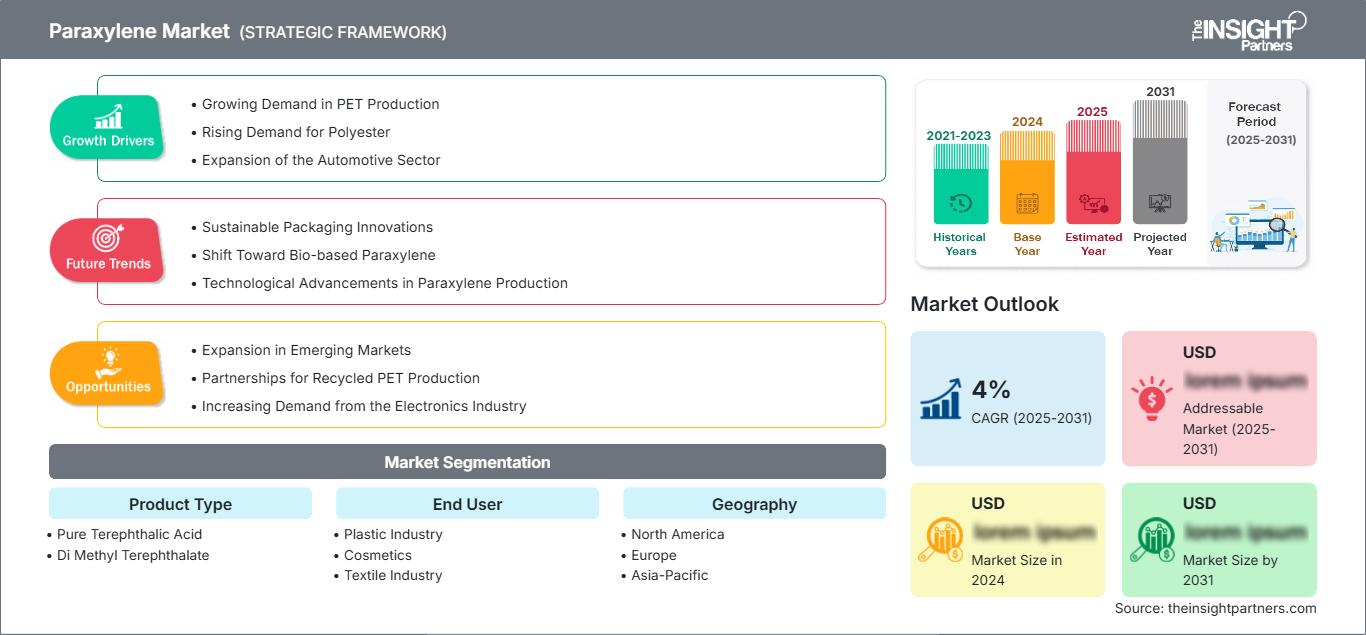
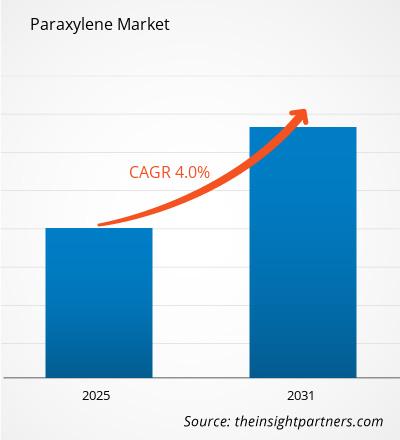
The global Paraxylene market was valued at US$ 58.87 billion in 2025 and is expected to reach US$ 88.11 billion by 2034; it is estimated to record a CAGR of 4.58% during 2026-2034.
Paraxylene Market Assessment and Insights
- North America: North America is expected to account for a 16–19% Paraxylene Market share in 2025, supported by integrated refining assets and downstream polymer demand, with a growth of 3.8–4.5% CAGR between 2026–2034 as packaging and textile applications remain resilient.
- U.S.: The U.S. is estimated to represent 72–78% of North America's 2025 share, supported by large refining complexes and PET-related consumption, with a 3.7–4.4% CAGR between 2026–2034.
- Europe: Europe is projected to hold a 10–13% share in 2025, with Germany, Italy, France, Spain, and the UK forming important downstream markets, and is expected to expand at a 3.5–4.2% CAGR between 2026 and 2034 amid efficiency-led investment.
- Asia Pacific: Asia Pacific is expected to command a 62–66% share in 2025, led by China, South Korea, Japan, and India, and grow at a 5.6–6.2% CAGR between 2026 and 2034, supported by polyester integration and packaging demand.
- Largest Segment: Pure Terephthalic Acid is estimated to hold an 82–86% market share in 2025, reflecting its dominant downstream route, with 5.1–5.5% CAGR during 2026–2034.
- High Growth Segment: Textile Industry is estimated at 25–29% market share in 2025, supported by polyester fiber consumption, with 5.7–6.1% CAGR during 2026–2034.
- Key companies analyzed in detail: Chevron Phillips Chemical Company LLC, Reliance Industries Limited, Mitsubishi Corporation, GS Caltex Corporation, BP p.l.c., ENEOS Corporation, Teijin Limited, China National Petroleum Corporation, S-OIL Corporation, and LOTTE Chemical Corporation.
Source: The Insight Partners' analysis based on proprietary research, government publications, company annual reports, investor presentations, industry databases, and expert interviews.
Today, production economics in the Paraxylene Market are largely dictated by refinery integration, size, and aromatics separation efficiency. Large complexes are able to optimize mixed xylene, hydrogen, energy usage, and conversion downstream operations, giving competitive cost advantage. China built more PTA capacity but still had major PX import needs, indicating that the imbalance between feedstock and derivatives capacity persists. In 2025, Chinese PX imports amounted to 9.61 million metric tons, which was 2.41% higher than 2024 levels.
In future, investments in the Paraxylene Market would be directed toward bottlenecking, energy efficiency, flexibility, and chain of PTA and polyester. India and Southeast Asia appear to have a promising demand base, given the growing demand for textiles and PET packaging industry. Gulf producers are able to use refinery integration advantages. Emissions, circularity, and chemical traceability regulations will increasingly dictate investment priorities without substituting traditional PX as main polyester feedstock.
Paraxylene Market Report Scope
| Report Attribute | Details |
|---|---|
| Market size in 2025 | US$ 58.87 Billion |
| Market Size by 2034 | US$ 88.11 Billion |
| Global CAGR (2026 - 2034) | 4.58% |
| Historical Data | 2021-2024 |
| Forecast period | 2026-2034 |
Paraxylene Market Analysis
The demand of PX is highly connected with the polyester chain economy as it is mostly utilized in producing PTA and partly used in DMT. Thus, Paraxylene Market will grow due to PET bottles, polyester fibers, films, and textiles in industry, where packaging will serve as stable source of demand and apparel will be driven by population, incomes, and production cycles. The supply chain starts from crude oil and naphtha, continues reforming and xylene separation and finishes with PTA, DMT, PET, and polyester goods.
The Paraxylene Market report shows that supply situation still remains the same with major integrated producers who are able to regulate their aromatics production in accordance with refinery performance. China has become a major market and started to increase own production; however, the volume of PX import into China was very high in 2025. This gives competitive pressure on exporting companies in South Korea, Japan, Southeast Asia, and Middle East regions.
Competitive landscape comprises of refineries, petrochemicals, traders, and vertically-integrated polyester companies. The Paraxylene market Analysis reveals that integration is a very important competitive strategy as the producers can generate value from PX, PTA, PET and polyester and not rely solely on trading. Reliance Industries Limited has 4.6 million metric tons of annual PX production capacity that caters captive PTA plants and customers in Asia.
According to GS Caltex Corporation, the annual production capacity for PX is 1.35 million tons. On the other hand, S-OIL Corporation has sizable aromatic units located in South Korea. The company that is emerging as a strong competitor among Asian players is ENEOS Corporation with an annual external PX production capacity of 3.01 million tons by March 2026.
● REPORT CUSTOMIZATION
Tailor This Report To Align With Your Specific Business Requirements
This report can be customized to align precisely with your business objectives, scope, and target markets. Customization options include tailored segmentation, geography, competitive analysis, and strategic insights to support informed decision-making.
Customize This Report →WHAT YOU CAN ADJUST
- ● Segmentations
- ● Geography
- ● Competitive Analysis
- ● Language Preferences
Paraxylene Market: Strategic Insights
Regional Insights
North America Paraxylene Market
North America is expected to represent a 16–19% share in 2025 and expand at a 3.8–4.5% CAGR through 2034. It is dominant in the regional market due to its refining infrastructure, PET production, and packaging chain. The additional downstream market for Mexico includes textile and plastic manufacturing.
The regional market favors companies that have refinery integration, feedstock security, and transportation channels. The demand from beverage containers, food packaging, films, and polyester products serves as a stable demand source, whereas the investment in replacements focuses on energy saving and reliability. Additional trade links are provided by Canada and Mexico, although the regional markets are price-sensitive to crude oil prices, refinery run rates, and PX arbitrages worldwide. In addition, the North American producers examine the options for a more environmentally friendly process.
U.S. Paraxylene Market
The U.S. accounts for approximately 72–78% of North America's 2025 share and is expected to grow at a 3.7–4.4% CAGR through 2034. Demand is supported by PET packaging, polyester materials, and durable polymer applications.
Domestic producers take advantage of well-developed refining facilities as well as close proximity to large centers of chemical production in the Gulf Coast area. Trends in the use of PET include the application of packaging and the supply of recycled polyester. Textile consumption represents a smaller yet steady source of demand. The role of Chevron Phillips Chemical Company LLC is that of an aromatics producer, while BP p.l.c. stays relevant through the technology it possesses and its integration in the PTA-PX process.
Europe Paraxylene Market
Europe is projected to hold a 10–13% share in 2025 and grow at a 3.5–4.2% CAGR through 2034. Germany is among the most prominent markets for the industry, fueled by demand in chemicals, packaging, automotive materials, and technical textiles. The UK has demand fueled by packaging and consumption of consumer products, though its local economics depend heavily on importation and regional refinery factors.
France and Italy are both key downstream markets that contribute through packaging and textiles and specialty polymer manufacturing. Italy has a strong textile and converting network, while France has good packaging and chemical processing capabilities. Spain is another that contributes demand through PET packaging and polyester-based manufacturing. Regional manufacturers have relatively high energy costs, spurring them to invest in process efficiencies and recycling and logistics. Carbon footprints have become key criteria in European purchaser decisions along with traditional metrics like price and supply.
APAC Paraxylene Market
Asia Pacific represents approximately 62–66% share in 2025 and is projected to expand at 5.6–6.2% CAGR through 2034. China is still the largest consumer of PX, followed by Japan, South Korea, India, and Australia. China's imports of PX amounted to 9.61 million metric tons in 2025 amid significant domestic production.
This region is favored by numerous large integrated refining and petrochemical plants, the development of PET packing materials, and widespread polyester fabrics production. India is becoming more prominent with the help of integrated refining and polyester projects, whereas South Korea continues to be an export-oriented supplier of products. Japan provides experience in technology and customer base.
Middle East & Africa Paraxylene Market
The Middle East & Africa regions are served by refinery integration and petrochemical investments in the downstream sector, with Saudi Arabia being the main market. In the case of Saudi producers, the key advantages include competitive feedstocks and integrated facilities. Meanwhile, the United Arab Emirates is actively consolidating its position in the petrochemical and logistical sectors.
The Paraxylene Market trends show that South Africa represents the downstream packaging and textiles market demand, whereas the Rest of MEA region has a smaller scale and greater dependency on imports. The drivers behind growth in this region include infrastructure development, diversification of industries, and the development of value-added chemicals from refinery streams. The integrated petrochemical strategy of Saudi Arabia is especially relevant as it enables producers to process their refinery streams into aromatics and intermediates and serve Asian export markets.
Segmentation Analysis
Product Type
Product Type is expected to expand at a 5.0–5.4% CAGR during 2026–2034, with demand dominated by PTA production. The Paraxylene Market scope is therefore closely associated with polyester-chain investment, PET packaging requirements, and textile manufacturing. PTA remains structurally dominant because of its established conversion economics and extensive global production infrastructure.
- Pure Terephthalic Acid: Pure Terephthalic Acid represents the principal downstream route, supported by polyester fiber, PET resin, film, and industrial polymer manufacturing. Its broad application base creates recurring feedstock requirements across packaging and textile value chains.
- Di Methyl Terephthalate: Di Methyl Terephthalate serves specialized polyester and polymer applications where established esterification routes remain relevant. Demand is more selective, but its processing characteristics support niche applications requiring controlled material properties and formulation flexibility.
End User
End User is forecast to grow at 5.1–5.5% CAGR during 2026–2034, reflecting continued demand from packaging, textiles, plastics, and construction-related materials. The segment structure varies by regional manufacturing base, with the Asia Pacific benefiting from strong polyester integration and consumer-product manufacturing.
- Plastic Industry: The plastic industry remains strategically important because PET bottles, films, containers, and engineered polymer products depend on the polyester chain. Packaging demand provides a relatively stable consumption base across developed and emerging economies.
- Cosmetics: Cosmetics contribute indirectly through PET packaging, films, containers, and specialty plastic components. Demand is influenced by premium packaging, personal-care consumption, lightweighting, and increasing preference for recyclable packaging formats.
- Textile Industry: The textile industry is a major downstream consumer of polyester fiber and yarn production. Its importance is reinforced by apparel manufacturing, technical textiles, home furnishings, and expanding synthetic-fiber penetration in emerging economies.
- Construction: Construction uses polyester-derived materials in films, coatings, insulation-related products, and selected polymer applications. Infrastructure development and durable-material requirements support demand, particularly in rapidly urbanizing markets.
Opportunity Snapshot
| End User | Revenue Contribution | Trend Tag | Adoption Stage |
|---|---|---|---|
| Plastic Industry | High | PET Packaging | Mature |
| Cosmetics | Low | Premium Packaging | Scaling |
| Textile Industry | High | Polyester Fiber | Mature |
| Construction | Medium | Polymer Materials | Scaling |
Paraxylene Market Growth Drivers and Impact Analysis
Expansion of PET Packaging and Polyester Consumption
Demand for PET packages is still an important driver due to the fact that beverage bottles, food packages, films, and household packaging need resins made out of polyester obtained using PX-PTA feedstock chain. Growth in population, urbanization, convenience consumption, and increased penetration of bottled beverages expand the potential client base in developing countries. Textile uses strengthen the same feedstock chain, especially in those cases when polyester has better characteristics than natural fiber material. In case of manufacturers, strong demand makes it easier to utilize the capacity and invest in aromatics and PTA production. However, the effect is reduced through increased recycling, alternative resins, and reduction of virgin plastic use. The greatest effect on structure should be seen in those regions where PET consumption and polyester production grow at the same time.
Integrated Refinery and Petrochemical Production Economics
An integration of refining, aromatics separation, PX manufacture, PTA conversion, and polyester manufacture will go a long way towards increasing operational reliability. Producers who have captive feedstock supply can tailor crude oil choice, reformer use, mixed-xylene production, hydrogen production, and conversion based on market demand conditions. This business model lessens dependency on merchant feedstock supplies and allows companies to balance their margins at multiple levels within the value chain. Big plants also enjoy economies of scale, common utilities, logistic economies, and ability to weather any temporary volatility in prices. The rapid expansion of China highlights the significance of scale, whereas the South Korean and Japanese producers will keep competing through operational reliability and customer relationships. In the face of high capital intensity, integrated facilities will have an edge over small independent ones.
Industrialization and Polyester Manufacturing in Emerging Economies
Industrialization in India, Southeast Asia, and a chosen few Middle Eastern countries is driving up the demand for intermediates due to their use in textiles, packaging, and consumer goods manufacturing. Growing urban population and manufacturing clusters provide further needs for PET bottles, films, fibers, and polymer materials. Governments desirous of increasing domestic chemical independence are also driving integrated production and value-added petrochemical processing infrastructure development. For suppliers of PX, this means that there are opportunities to develop long-term customer relations in emerging consumption areas. India, due to its integrated refinery and polyester industry, and Southeast Asia, due to manufacturing growth and exports of textiles, are especially important in this context.
Paraxylene Market Future Trends
Bio-Based and Mass-Balance Paraxylene Pathways
Trends within the Paraxylene Market are becoming increasingly driven by the advent of pathways based on lower-fossil feedstock, such as bio-naphtha and mass-balance. This is because these types of pathways enable manufacturers to integrate renewable feedstocks within the current refineries and chemical plants without having to change their existing conversion facilities. The movement of the industry was seen by ENEOS Corporation in February 2026 when the corporation supplied PX produced from bio-naphtha to Sony Corporation using the mass-balance method, in collaboration with Mitsubishi Corporation. This kind of process will enable brand owners to become less reliant on fossil fuel feedstocks without having to completely change PET production. In the long run, there could be more need for renewable content from packaging, electronics, textiles, and consumer goods companies.
Digital Optimization of Integrated Aromatics Complexes
The role of digitalization in the manufacturing of PX is projected to increase, as operators try to achieve increased productivity, reduce energy consumption, and enhance equipment reliability. Advanced process control, predictive maintenance, digital twinning, and real-time optimization may allow operators to address the complexities associated with interdependencies between reformers, aromatics units, separators, and conversion units. The use of data for optimization is especially important when operating conditions are challenging, since margin is tight and companies need to make the best use of their assets, instead of building new capacities. Digital technologies may also enhance product consistency and help adjust to feedstock fluctuations more effectively. During the forecast period, investments will shift from automation projects to integrated operating platforms, connecting production planning, maintenance, energy efficiency, and scheduling.
Paraxylene Market Opportunities
Integrated Capacity Expansion in India and Southeast Asia
Paraxylene Market forecast suggests that investment options are not limited to well-established sources of production in Northeast Asia because of increased strength of textile, packaging, and polymer manufacturing industries in India and Southeast Asia. It is possible to add value for the producers by combining PX with PTA, PET, polyester fiber, and other conversion facilities in proximity to clusters of the increasing customers. In this case, there will be less risk due to transportation, and there will be more flexibility regarding the allocation of materials between merchant and captive markets. India represents special attractiveness for such an investment due to the fact that refining and petrochemical facilities of the country are well-integrated into local textile and packaging industries.
Low-Carbon and Circular Polyester Value Chains
A second opportunity lies in linking PX production with circular and lower-carbon polyester systems. Chemical and mechanical recycling can reduce dependence on virgin feedstocks, while mass-balance renewable inputs provide another pathway for lowering fossil-resource intensity. Producers that can document feedstock origin, carbon attributes, and chain-of-custody performance may secure stronger relationships with global packaging, apparel, electronics, and consumer-goods companies. The opportunity is not limited to new production capacity. Existing aromatics complexes can be upgraded through energy-efficiency projects, renewable power procurement, process optimization, and certified alternative feedstocks. Companies that combine conventional cost competitiveness with measurable environmental performance can improve resilience as customers introduce recycled-content requirements and corporate emissions targets across international supply chains.
Recent Developments
- July 2026: Indian Oil Corporation Limited — IndianOil reported a cumulative investment of ₹43,359 crore at its Paradip complex, strengthening the site as an integrated energy and petrochemical hub. Its ongoing PX-PTA project includes 0.8 million tonnes per annum of paraxylene and 1.2 million tonnes per annum of PTA, reinforcing domestic polyester-chain integration and downstream petrochemical capacity in India.
- August 2026: GAIL (India) Limited — GAIL is progressing with the revival of its 1.25 million tonnes per annum PTA plant in Mangalore, Karnataka, operated through GAIL Mangalore Petrochemicals Limited. The facility received its first paraxylene feedstock cargo in January 2026 and is being positioned to supply domestic textile and polyester manufacturers, supporting India's downstream integration and reducing reliance on imported PTA.
Frequently Asked Questions

- Comprehensive Market Sizing and Forecast Analysis
- Detailed Segmentation Analysis
- In-Depth Market Dynamics Assessment
- Regional and Country-Level Insights
- Competitive Landscape and Company Benchmarking
- Strategic Business Intelligence
Recent Reports
Testimonials

The Insight Partners' SCADA System Market report is comprehensive, with valuable insights on current trends and future forecasts. The team was highly professional, responsive, and supportive throughout. We are very satisfied and highly recommend their services.
RAN KEDEM Partner, Reali Technologies LTDs
I requested a report on a very specific software market and the team produced the report in a few days. The information was very relevant and well presented. I then requested some changes and additions to the report. The team was again very responsive and I got the final report in less than a week.
JEAN-HERVE JENN Chairman, Future Analytica
We worked with The Insight Partners for an important market study and forecast. They gave us clear insights into opportunities and risks, which helped shape our plans. Their research was easy to use and based on solid data. It helped us make smart, confident decisions. We highly recommend them.
PIYUSH NAGPAL Sr. Vice President, High Beam Global
The Insight Partners delivered insightful, well-structured market research with strong domain expertise. Their team was professional and responsive throughout. The user-friendly website made accessing industry reports seamless. We highly recommend them for reliable, high-quality research services
YUKIHIKO ADACHI CEO, Deep Blue, LLC.
This is the first time I have purchased a market report from The Insight Partners.While I was unsure at first, I visited their web site and felt more comfortable to take the risk and purchase a market report.I am completely satisfied with the quality of the report and customer service. I had several questions and comments with the initial report, but after a couple of dialogs over email with their analyst I believe I have a report that I can use as input to our strategic planning process.Thank you so much for taking the extra time and making this a positive experience.I will definitely recommend your service to others and you will be my first call when we need further market data.
JOHN SUZUKI President and Chief Executive Officer, Board Director, BK Technologies
I wish to appreciate your support and the professionalism you displayed in the course of attending to my request for information regarding to infectious disease IVD market in Nigeria. I appreciate your patience, your guidance, and the fact that you were willing to offer a discount, which eventually made it possible for us to close a deal. I look forward to engaging The Insight Partners in the future, all thanks to the impression you have created in me as a result of this first encounter.
DR CHIJIOKE ONYIA MANAGING DIRECTOR, PineCrest Healthcare Ltd.Reason to Buy
- Informed Decision-Making
- Understanding Market Dynamics
- Competitive Analysis
- Identifying Emerging Markets
- Customer Insights
- Market Forecasts
- Risk Mitigation
- Boosting Operational Efficiency
- Strategic Planning
- Investment Justification
- Tracking Industry Innovations
- Aligning with Regulatory Trends





 Get Free Sample for