
PVD Coaters Market Share, Demand & Growth by 2034
Coverage: By Substrate (Metals, Plastics, Glass); Material Type (Metals, Ceramics, Others); End-User (Aerospace and Defense, Automotive, Electronics and Semiconductors, Power Generation, Others) , and Geography (North America, Europe, Asia Pacific, and South and Central America)
- Status : Data Released
- Report Code : TIPRE00018403
- Category : Manufacturing and Construction
- No. of Pages : 150
- Available Report Formats :


- Last update date : September 02, 2026


2025 Market Size
US$ 9.12 Bn
Base year value
2034 Forecast
US$ 14.24 Bn
Projected by 2034
CAGR 2026-2034
5.08 %
Growth rate
Addressable Market
US$ 106.02 Bn
(2026-2034)
The PVD coaters market is valued at US$ 9.12 Billion in 2025 and is projected to reach US$ 14.24 Billion by 2034, registering a CAGR of 5.08% during 2026–2034. Growth reflects sustained investment in precision surface engineering, tool life extension, semiconductor manufacturing, automotive components, and lower-impact alternatives to conventional plating. Equipment capabilities are increasingly shaped by automation, process monitoring, multilayer deposition, and application-specific coating architectures.
North America remains an important technology and application center, supported by aerospace manufacturing, medical-device production, semiconductor investment, and advanced machining, contributing significantly to PVD Coaters Market Size. The regional market is expected to expand at an estimated 4.6–5.2% CAGR between 2026–2034. Demand is reinforced by stringent performance requirements for components exposed to friction, heat, corrosion, and repeated mechanical loading.
PVD Coaters Market Assessment and Insights
- North America: North America accounted for an estimated 16–19% share in 2025 and is expected to grow at a 4.6–5.2% CAGR between 2026–2034, supported by aerospace, medical devices, advanced manufacturing, and semiconductor applications.
- US: The US represented approximately 72–76% of the North American market share in 2025, with growth of 4.7–5.3% CAGR between 2026–2034, led by aerospace, defense, tooling, and electronics.
- Europe: Europe held an estimated 20–23% share in 2025 and is projected to expand at a 4.3–4.9% CAGR between 2026–2034. Germany, Italy, France, and the UK remain important centers for precision engineering, automotive manufacturing, and industrial coating services.
- Asia Pacific: Asia Pacific represented approximately 47–50% share in 2025 and is expected to record a 5.4–6.1% CAGR between 2026–2034. China, Japan, South Korea, Taiwan, and India benefit from semiconductor, electronics, automotive, and machinery production.
- Largest Segment: Substrate represented an estimated 55–59% market share in 2025, with a 4.7–5.1% CAGR between 2026–2034, reflecting broad metal-component coating requirements.
- High Growth Segment: Material Type is projected to expand at a 5.3–5.8% CAGR between 2026–2034, with an estimated 41–45% share in 2025 as ceramic-based architectures gain industrial relevance.
- Key companies analyzed in detail: Crystallume PVD; HEF; IHI Ionbond AG; Impact Coatings AB; Inoxcolorz Private Limited; MITSUBISHI MATERIALS Corporation; OC Oerlikon Management AG; Sputtek Coatings; TEKNIKER; voestalpine eifeler group; CemeCon AG; PLATIT AG.
Source: The Insight Partners' analysis based on proprietary research, government publications, company annual reports, investor presentations, industry databases, and expert interviews.
The development of production technology has moved from fairly standardized single layer deposition to multilayer, nanometer, and high power impulse magnetron sputter designs. There is an increasing incorporation of automation, programmable biasing, cathode versatility, and process control on the part of equipment manufacturers to improve coating uniformity in order to meet the challenging needs of hardness, adhesion, friction, and thermal stability.
Over the forecast period, investment is expected to broaden beyond established coating centers into India, Southeast Asia, the Middle East, and selected Latin American manufacturing clusters, as highlighted in the PVD Coaters Market Report. Regulatory pressure on wet plating chemistry, resource-efficiency objectives, and localization of strategic manufacturing capacity should support adoption. Suppliers with modular systems, application laboratories, remote diagnostics, and flexible batch configurations are positioned to capture increasingly specialized demand.
PVD Coaters Market Report Scope
| Report Attribute | Details |
|---|---|
| Market size in 2025 | US$ 9.12 Billion |
| Market Size by 2034 | US$ 14.24 Billion |
| Global CAGR (2026 - 2034) | 5.08% |
| Historical Data | 2021-2024 |
| Forecast period | 2026-2034 |
PVD Coaters Market Analysis
The pvd coaters growth outlook is closely linked to the expansion of high-value manufacturing where surface performance directly influences productivity, maintenance, and component life. The ecosystem includes vacuum-system manufacturers, target-material suppliers, coating equipment producers, service providers, tooling companies, OEMs, and component manufacturers. Demand is strongest where thin films can reduce wear, friction, oxidation, or material transfer without substantially changing component dimensions.
The supply structure remains technically specialized because deposition chambers, cathodes, plasma sources, vacuum pumps, substrate fixtures, and process-control systems must operate as an integrated platform, a characteristic highlighted in the PVD Coaters Market Report. Equipment availability is thus affected by capital expenditure cycles in the automotive, aerospace, electronic, and precision machining industries. Competing regional coating centers are now competing on faster delivery times, application engineering, and custom process recipes rather than the cost of equipment.
Process engineering, rather than simple chamber volume, is thus becoming the key to competitive advantage. IHI Ionbond AG, OC Oerlikon Management AG, HEF, and voestalpine eifeler group integrate coating equipment with application knowledge and services. Impact Coatings AB specializes in modular PVD equipment, while CemeCon AG and PLATIT AG specialize in tooling applications. Competitors thus range from coating-service networks to equipment manufacturers to application-oriented companies.
Investment priorities are shifting toward high-throughput systems, automation, and coating platforms capable of handling multiple substrates and materials, according to the PVD Coaters Market Report. Companies are also strengthening positions in electronics, hydrogen-related applications, automotive components, and decorative coatings. MITSUBISHI MATERIALS Corporation brings strong tooling exposure, while Crystallume PVD and Sputtek Coatings serve specialized coating requirements. Strategic positioning increasingly depends on technology qualification, local technical support, repeatability, and the ability to scale validated recipes across production sites.
● REPORT CUSTOMIZATION
Tailor This Report To Align With Your Specific Business Requirements
This report can be customized to align precisely with your business objectives, scope, and target markets. Customization options include tailored segmentation, geography, competitive analysis, and strategic insights to support informed decision-making.
Customize This Report →WHAT YOU CAN ADJUST
- ● Segmentations
- ● Geography
- ● Competitive Analysis
- ● Language Preferences
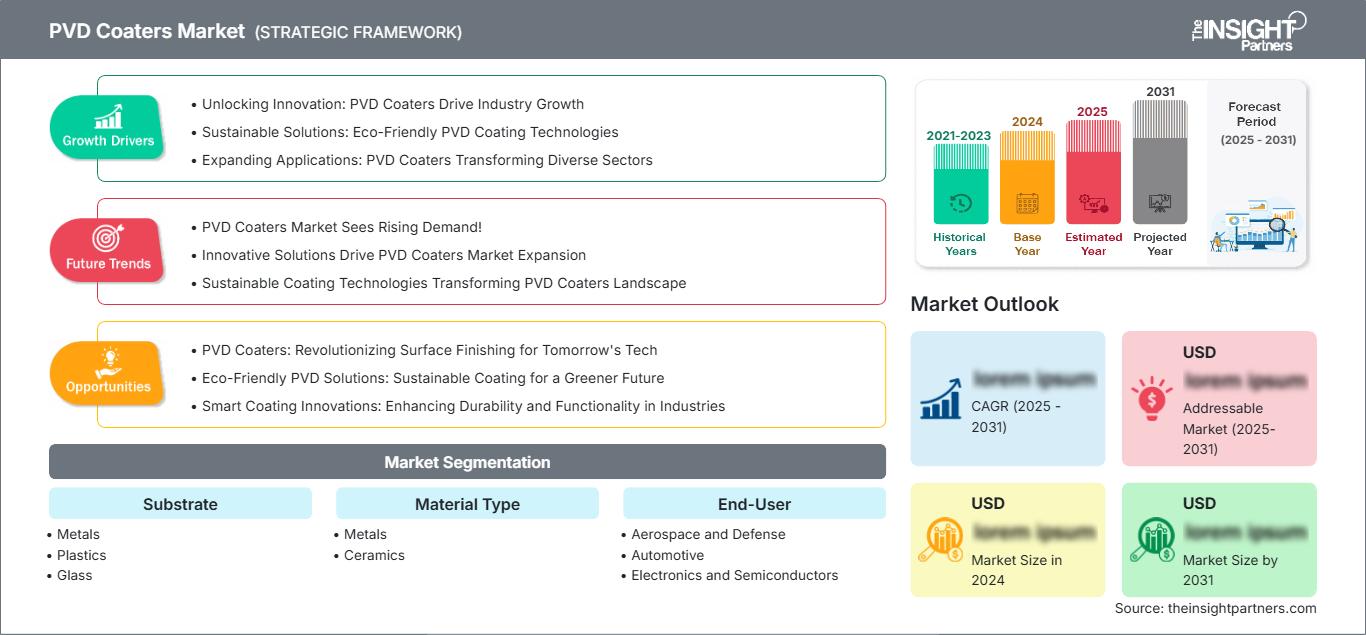
PVD Coaters Market: Strategic Insights
Regional Insights
North America pvd coaters market
North America held an estimated 16–19% of the PVD Coaters Market share in 2025 and is projected to grow at a 4.6–5.2% CAGR through 2034. The United States dominates regional demand, supported by aerospace, defense, medical equipment, semiconductor manufacturing, and precision machining. Canada contributes through energy, industrial equipment, and specialized manufacturing, while Mexico benefits from automotive and electronics production. The regional purchasing model increasingly favors coating systems that integrate automation, quality monitoring, and repeatable production recipes.
Aerospace and defense applications require coatings capable of maintaining dimensional stability and wear resistance under demanding thermal and mechanical conditions. Semiconductor and medical-device manufacturers add requirements for contamination control, process consistency, and specialized materials. Regional suppliers also benefit from reshoring and domestic manufacturing investments because localized coating capacity can shorten production cycles and reduce dependence on overseas finishing operations. These structural factors support steady investment despite a relatively mature industrial infrastructure.
U.S. pvd coaters Market
The US accounted for approximately 72–76% of North America's 2025 PVD Coaters Market and is expected to grow at a 4.7–5.3% CAGR through 2034.Aerospace, Defense, Medical Devices, Semiconductor Equipment, and Advanced Machining are the primary application sectors. The demand is centered on high-cost parts, where surface technology would enhance reliability, tool performance, and maintenance cycles without making significant changes in dimensions.
Facility presence is assured through global coating facilities and dedicated local suppliers. Increasingly, applications include cutting tools, turbine components, surgical equipment, semiconductor equipment, and decorative hardware. Manufacturing investment is also geared towards automated coating systems that are capable of handling loading, depositing, inspection, and traceability processes. The combination of demanding OEM needs and domestic manufacturing development will keep the US as a strategic regional market.
Europe pvd coaters Market
Europe represented an estimated 20–23% share of the PVD Coaters Market in 2025 and is forecast to expand at a 4.3–4.9% CAGR through 2034, with Germany remaining the leading country. The UK is driven by aerospace and defense, medical technology and advanced engineering. - Germany includes automotive, machinery, tooling and industrial equipment demand, whereas France includes aerospace and engineering applications. - Italy and Spain include automotive, machinery, tooling and industrial manufacturing.
European demand is also affected by environmental demands concerning surface treatment and by companies searching for solutions to move away from traditional plating technologies. - German precision machining environment drives very strict demands in wear-resistant tool coatings, while France and UK drive aerospace applications. - Italy and Spain provide increasing demand for industrial components and automotive applications. The region remains relevant for application development and coating qualification.
APAC pvd coaters Market
APAC represented approximately 47–50% share of the PVD Coaters Market in 2025 and is projected to expand at a 5.4–6.1% CAGR through 2034, making it the leading regional market. China leads regional demand, followed by Japan, South Korea, Taiwan, India, and Australia. Semiconductor investment, electronics production, automotive manufacturing, and machine-tool capacity provide a broad application base for advanced surface engineering.
Industrial policy and localization programs are encouraging domestic manufacturing of electronics, components, machinery, and strategic technologies. China benefits from its extensive manufacturing ecosystem, while Japan and South Korea emphasize precision and semiconductor applications. India is developing rapidly through automotive, tooling, electronics, and industrial investments. Australia remains smaller but contributes through mining and specialized industrial equipment requirements.
Middle East & Africa pvd coaters Market
The Middle East and Africa PVD Coaters Market is expected to expand at approximately 5.1–5.8% CAGR through 2034. SA and the UAE spearhead regional adoption through industrial diversification, energy infrastructure, machinery, and advanced manufacturing initiatives. South Africa continues to be the leading market in Africa, with the remainder of MEA offering selective prospects in the mining industry, oil and gas, power generation, and industrial equipment.
These industries rely on coating technology due to its need for resistance against erosion, corrosion, friction, and heat. The development of infrastructure and diversification of manufacturing should slowly but surely drive up the demand for coating capabilities. Adoption is relatively lower compared to other regions, although investments in industrial production and maintenance should provide a good basis for coating technology.
Segmentation Analysis
Substrate
Substrate is expected to expand at a 4.7–5.1% CAGR between 2026–2034. Metal substrates remain central because PVD processes can enhance wear resistance, hardness, friction behavior, and corrosion performance without materially altering component geometry. Plastic and glass applications broaden the addressable base through electronics, decorative products, optical components, and specialized industrial parts. The pvd coaters scope, therefore, varies substantially by substrate preparation, thermal sensitivity, adhesion requirements, and intended service environment.
- Metals: Metal substrates represent the principal demand base because cutting tools, automotive components, aerospace parts, molds, dies, and industrial components frequently require improved wear and friction performance.
- Plastics: Plastic substrates support specialized decorative, optical, electronics, and lightweight-component applications where controlled deposition temperatures and adhesion engineering are critical.
- Glass: Glass applications emphasize decorative appearance, optical functionality, durability, and controlled surface properties, particularly in electronics, architectural products, and premium consumer applications.
Material Type
Material Type is projected to record a 5.3–5.8% CAGR between 2026–2034, according to the PVD Coaters Market Forecast. Material selection increasingly depends on the targeted combination of hardness, toughness, thermal stability, conductivity, friction, and chemical resistance. Metal and ceramic targets can be engineered into multilayer or graded structures, allowing manufacturers to tailor performance for specific operating environments. Greater emphasis on application-specific formulations should sustain investment in flexible deposition platforms.
- Metals: Metallic coating materials remain important for conductive, decorative, wear-resistant, and corrosion-control applications, with demand linked to components requiring controlled surface chemistry.
- Ceramics: Ceramic materials are strategically important for high-hardness, thermal, and chemically resistant coatings used in demanding machining, electronics, and industrial environments.
End-User
End-User demand is expected to grow at a 5.0–5.5% CAGR between 2026–2034, reflecting key PVD Coaters Market Trends. Automotive and aerospace remain significant consumers because surface performance can influence component durability and production efficiency. Electronics and semiconductors represent an important growth area as manufacturing requires increasingly controlled surfaces and contamination-sensitive processes. Power generation applications add demand for coatings exposed to elevated temperature, erosion, friction, and corrosive environments.
- Aerospace and Defense: Demand centers on high-performance components, tooling, actuating systems, and parts requiring controlled wear, friction, and thermal behavior under demanding operating conditions.
- Automotive: Automotive applications include powertrain components, tooling, decorative parts, and precision components where improved wear resistance and surface durability support longer operating life.
- Electronics and Semiconductors: Electronics applications emphasize process cleanliness, dimensional control, electrical functionality, and specialized thin films for increasingly sophisticated manufacturing environments.
- Power Generation: Power-generation applications require surface protection for components exposed to heat, erosion, corrosion, friction, and repeated mechanical loading.
Opportunity Snapshot
| End-User | Revenue Contribution | Trend Tag | Adoption Stage |
| Aerospace and Defense | Medium | Wear Protection | Scaling |
| Automotive | High | Tool Life | Mature |
| Electronics and Semiconductors | High | Thin Films | Scaling |
| Power Generation | Medium | Thermal Protection | Scaling |
PVD Coaters Market Growth Drivers and Impact Analysis
Expansion of precision machining and tool-life requirements
Manufacturers increasingly evaluate surface treatment according to measurable productivity outcomes rather than coating cost alone, a trend shaping PVD Coaters Market Trends. In cutting and forming operations, improved hardness, lower friction, and resistance to adhesive or abrasive wear can reduce tool replacement frequency and stabilize production quality. This encourages investment in PVD equipment among tool manufacturers and coating service providers seeking repeatable production performance. The impact is particularly strong where downtime carries high opportunity costs, such as aerospace machining and high-volume automotive production. Equipment suppliers consequently prioritize uniform deposition, automated handling, and recipe repeatability. Greater use of difficult-to-machine materials, including hardened steels, titanium alloys, and advanced lightweight materials, further raises the value of specialized coating architectures and supports demand for increasingly sophisticated PVD platforms.
Semiconductor and electronics manufacturing localization
The growing need for semiconductor and electronics fabrication will result in increasing demands for controlled surface technologies that can be applied to equipment, parts, fixturing, and tooling in production lines. Thin-film deposition has high requirements concerning cleanliness, reproducibility, adhesion, and dimensionality. Thus, new capacities for fabrication and packaging in Asia, North America, and Europe will not only affect semiconductor producers but also those producing equipment that is employed in these capacities. Thereby, the market influence also concerns coating machines that can process various substrates and materials under tight vacuum control. Companies that have application labs and process development expertise can reduce the qualification time needed for the new application. With the growing geographical distribution of semiconductor fabrication, local coating capacity becomes increasingly important.
Regulatory preference for lower-impact surface treatment
The growing need for semiconductor and electronics fabrication will result in increasing demands for controlled surface technologies that can be applied to equipment, parts, fixturing, and tooling in production lines. Thin-film deposition has high requirements concerning cleanliness, reproducibility, adhesion, and dimensionality. Thus, new capacities for fabrication and packaging in Asia, North America, and Europe will not only affect semiconductor producers but also those producing equipment that is employed in these capacities. Thereby, the market influence also concerns coating machines that can process various substrates and materials under tight vacuum control. Companies that have application labs and process development expertise can reduce qualification time needed for the new application. With growing geographical distribution of semiconductor fabrication, local coating capacity becomes increasingly important.
PVD Coaters Market Future Trends
Expansion of intelligent and autonomous coating cells
The pvd coaters trends landscape is moving toward increasingly autonomous production environments in which loading, vacuum management, deposition, monitoring, and quality verification are coordinated digitally. Future systems are likely to combine sensor data with recipe management, predictive maintenance, and automated parameter adjustment. This development can reduce operator dependence and improve repeatability across multiple production sites. Digital records will also become more important for industries requiring traceability, particularly aerospace, medical, and semiconductor manufacturing. Equipment suppliers that integrate analytics into existing vacuum architectures can create value without requiring complete replacement of installed systems. The result should be a gradual transition from standalone coating equipment toward connected manufacturing cells capable of reporting process conditions, identifying deviations, and supporting centralized production management.
Advanced multilayer and high-power impulse deposition architectures
The growing need for semiconductor and electronics fabrication will result in increasing demands for controlled surface technologies that can be applied to equipment, parts, fixturing, and tooling in production lines. Thin-film deposition has high requirements concerning cleanliness, reproducibility, adhesion, and dimensionality. Thus, new capacities for fabrication and packaging in Asia, North America, and Europe will not only affect semiconductor producers but also those producing equipment that is employed in these capacities. Thereby, the market influence also concerns coating machines that can process various substrates and materials under tight vacuum control. Companies that have application labs and process development expertise can reduce the qualification time needed for the new application. With the growing geographical distribution of semiconductor fabrication, local coating capacity becomes increasingly important.
PVD Coaters Market Opportunities
Localized coating capacity in emerging manufacturing hubs
The pvd coaters Forecasts indicate attractive investment potential in manufacturing regions where industrial production is expanding faster than local surface-treatment capacity. India, Southeast Asia, selected Middle Eastern economies, and parts of Eastern Europe offer opportunities for service centers positioned near automotive, electronics, tooling, aerospace, and industrial-component clusters. Investors can reduce market-entry risk by establishing application-specific capacity rather than generic coating operations. Partnerships with equipment manufacturers, toolmakers, and OEM suppliers can provide an initial customer base while supporting technical qualification. Local technical teams, rapid turnaround, and recipe localization can differentiate new facilities from distant suppliers. The strongest opportunities are likely to emerge where imported components and long finishing lead times create a measurable operational disadvantage for manufacturers.
Integrated systems for energy-transition applications
The pvd coaters Report opportunity landscape is also expanding into hydrogen, fuel-cell, electrolyzer, power-electronics, and related energy-transition applications. These applications require conductive, corrosion-resistant, durable surfaces and can create demand for highly controlled thin films on metallic components. Suppliers can pursue this opportunity through dedicated development programs with component manufacturers rather than relying exclusively on established tooling applications. Qualification requirements may be stringent, but successful commercialization can create recurring demand because coating performance directly influences component efficiency and service life. Modular systems are particularly relevant because emerging applications may initially require smaller production volumes before reaching industrial scale. Investment in flexible chambers, specialized cathodes, process monitoring, and application engineering can therefore position suppliers to capture new coating requirements as energy technologies move from pilot production toward broader commercialization.
Frequently Asked Questions

- Comprehensive Market Sizing and Forecast Analysis
- Detailed Segmentation Analysis
- In-Depth Market Dynamics Assessment
- Regional and Country-Level Insights
- Competitive Landscape and Company Benchmarking
- Strategic Business Intelligence
Recent Reports
Testimonials

The Insight Partners provided valuable market intelligence that supported our global go-to-market strategy. Their team was professional, responsive, and attentive to our feedback, providing thoughtful analysis and helpful methodological clarifications throughout the project.
Junmo Kim Chief Financial Officer (CFO), Enertech Co., Ltd.
The Insight Partners' SCADA System Market report is comprehensive, with valuable insights on current trends and future forecasts. The team was highly professional, responsive, and supportive throughout. We are very satisfied and highly recommend their services.
RAN KEDEM Partner, Reali Technologies LTDs
I requested a report on a very specific software market and the team produced the report in a few days. The information was very relevant and well presented. I then requested some changes and additions to the report. The team was again very responsive and I got the final report in less than a week.
JEAN-HERVE JENN Chairman, Future Analytica
We worked with The Insight Partners for an important market study and forecast. They gave us clear insights into opportunities and risks, which helped shape our plans. Their research was easy to use and based on solid data. It helped us make smart, confident decisions. We highly recommend them.
PIYUSH NAGPAL Sr. Vice President, High Beam Global
The Insight Partners delivered insightful, well-structured market research with strong domain expertise. Their team was professional and responsive throughout. The user-friendly website made accessing industry reports seamless. We highly recommend them for reliable, high-quality research services
YUKIHIKO ADACHI CEO, Deep Blue, LLC.
This is the first time I have purchased a market report from The Insight Partners.While I was unsure at first, I visited their web site and felt more comfortable to take the risk and purchase a market report.I am completely satisfied with the quality of the report and customer service. I had several questions and comments with the initial report, but after a couple of dialogs over email with their analyst I believe I have a report that I can use as input to our strategic planning process.Thank you so much for taking the extra time and making this a positive experience.I will definitely recommend your service to others and you will be my first call when we need further market data.
JOHN SUZUKI President and Chief Executive Officer, Board Director, BK Technologies
I wish to appreciate your support and the professionalism you displayed in the course of attending to my request for information regarding to infectious disease IVD market in Nigeria. I appreciate your patience, your guidance, and the fact that you were willing to offer a discount, which eventually made it possible for us to close a deal. I look forward to engaging The Insight Partners in the future, all thanks to the impression you have created in me as a result of this first encounter.
DR CHIJIOKE ONYIA MANAGING DIRECTOR, PineCrest Healthcare Ltd.Reason to Buy
- Informed Decision-Making
- Understanding Market Dynamics
- Competitive Analysis
- Identifying Emerging Markets
- Customer Insights
- Market Forecasts
- Risk Mitigation
- Boosting Operational Efficiency
- Strategic Planning
- Investment Justification
- Tracking Industry Innovations
- Aligning with Regulatory Trends





 Get Free Sample for