
Refrigerator Thermometer Market Share, Demand & Growth by 2034
Coverage: by Type (Digital, Analog); Distribution Channel (Direct Sales, Indirect Sales); End-user (Industrial, Commercial, Residential) , and Geography (North America, Europe, Asia Pacific, and South and Central America)
- Status : Data Released
- Report Code : TIPRE00010563
- Category : Electronics and Semiconductor
- No. of Pages : 150
- Available Report Formats :


- Last update date : September 16, 2026


2025 Market Size
US$ 536.12 Mn
Base year value
2034 Forecast
US$ 772.79 Mn
Projected by 2034
CAGR 2026-2034
4.15 %
Growth rate
Addressable Market
US$ 5,945.55 Mn
(2026-2034)
The refrigerator thermometer market is positioned around temperature measurement devices used to monitor refrigerator conditions across household, commercial, and industrial environments. The market is valued at US$ 536.12 Million in 2025 and is projected to reach US$ 772.79 Million by 2034, expanding at a CAGR of 4.15% from 2026 to 2034. Product development increasingly emphasizes accuracy, readability, alarm functions, calibration capability, and compatibility with connected monitoring systems.
North American demand is supported by food-safety practices, commercial kitchen compliance, pharmaceutical storage requirements, and replacement of basic gauges with digital monitoring equipment in the Refrigerator Thermometer Market Size. The opportunity is expected to expand at an estimated 3.8–4.4% CAGR between 2026 and 2034, supported by stronger temperature-control documentation, wider adoption of connected devices, and increasing consumer awareness of cold-storage safety.
Refrigerator Thermometer Market Assessment and Insights
- North America: North America is expected to account for a 29–33% share in 2025 and expand at a 3.8–4.4% CAGR between 2026–2034, supported by food-service compliance, household food-safety awareness, pharmaceutical storage, and replacement demand.
- US: The US represents approximately 75–79% of North America's 2025 share and is expected to grow at 3.7–4.3% CAGR between 2026–2034, driven by food-safety monitoring and commercial refrigeration applications.
- Europe: Europe is estimated at a 24–28% share in 2025, growing at 3.4–4.0% CAGR between 2026–2034, with Germany, the UK, France, Italy, and Spain supported by food hygiene requirements and professional temperature documentation.
- Asia Pacific: Asia Pacific is estimated at a 28–32% share in 2025 and is projected to grow at 4.6–5.2% CAGR between 2026–2034, led by China, Japan, India, and South Korea through expanding food retail and cold-chain infrastructure.
- Largest Segment: Digital products represent an estimated 62–66% market share in 2025, supported by easier reading, higher measurement precision, and alarm functionality, with 4.6–5.0% CAGR between 2026–2034.
- High Growth Segment: Industrial end users represent approximately 18–22% market share in 2025 and are projected to grow at 5.2–5.7% CAGR between 2026–2034, supported by controlled-storage requirements.
- Key companies analyzed in detail: Comark Instruments, Component Design Northwest, Inc. (CDN), Cooper-Atkins Corporation, DeltaTrak, Ningbo Instruments Factory (T and W Industry Co.,Ltd), ORIA Innovations Limited, Philipp Kirsch GmbH, S. Brannan and Sons Limited, Taylor (Lifetime Brands, Inc.), Wrenwane.
Source: The Insight Partners' analysis based on proprietary research, government publications, company annual reports, investor presentations, industry databases, and expert interviews.
Temperature measuring has moved from mechanical devices to electronic devices that have the capability of measuring both maximum and minimum temperatures, alarm capabilities, remote access capabilities, and even calibration capabilities. The emphasis in manufacturing nowadays has moved towards building stability into the device, low power consumption, small size of housing, and the capability to prevent moisture.
Over the forecast period, investment is likely to favor connected monitoring, wireless data transmission, and software-supported documentation rather than standalone displays alone in the Refrigerator Thermometer Market Share. Regulatory attention to food safety and pharmaceutical storage should strengthen professional demand, while emerging economies offer volume opportunities as modern grocery formats and organized food distribution expand. Replacement cycles will remain important because basic analog products retain a cost advantage.
Refrigerator Thermometer Market Report Scope
| Report Attribute | Details |
|---|---|
| Market size in 2025 | US$ 536.12 Million |
| Market Size by 2034 | US$ 772.79 Million |
| Global CAGR (2026 - 2034) | 4.15% |
| Historical Data | 2021-2024 |
| Forecast period | 2026-2034 |
Refrigerator Thermometer Market Analysis
Temperature control requirements across food handling, retail refrigeration, hospitality, healthcare, and domestic storage create a diversified demand base. The refrigerator thermometer growth outlook is supported by the need to verify actual compartment temperatures rather than relying solely on appliance settings. Manufacturers, distributors, food-service operators, and maintenance technicians form an ecosystem in which product selection depends on accuracy, durability, calibration, display visibility, installation method, and operating range.
The value chain includes sensor and electronic component suppliers, thermometer assemblers, calibration providers, distributors, appliance-equipment channels, and end users in the Refrigerator Thermometer Market Report. Digital products require greater integration of displays, batteries, probes, and electronic components, while analog instruments depend more heavily on mechanical sensing elements and housing quality. The supply situation will be affected by the availability of semiconductors for advanced versions, the prices of metals and plastics for conventional devices, and the efficiency of distribution for consumer goods that have lower value.
Competitive position is based on the distinction between traditional measurement specialists and companies focusing on comprehensive temperature measuring products. Comark Instruments and Cooper-Atkins Corporation focus on professional food service measuring instruments, whereas CDN, Taylor (Lifetime Brands, Inc.), and Wrenwane cater to household and commercial needs. DeltaTrak broadens the scope of temperature measurements to include cold chain measurements, while Philipp Kirsch GmbH specializes in controlled temperature measurements.
The refrigerator thermometer analysis indicates that differentiation increasingly depends on measurement reliability, calibration support, connectivity, and application-specific design rather than basic temperature display alone. INFICON, through its broader measurement portfolio, illustrates the movement toward specialized monitoring technologies, while Testo-style connected monitoring approaches demonstrate the value of cloud-based documentation. Companies are likely to pursue channel expansion, sensor integration, private-label manufacturing, and digital monitoring partnerships to improve recurring commercial demand.
● REPORT CUSTOMIZATION
Tailor This Report To Align With Your Specific Business Requirements
This report can be customized to align precisely with your business objectives, scope, and target markets. Customization options include tailored segmentation, geography, competitive analysis, and strategic insights to support informed decision-making.
Customize This Report →WHAT YOU CAN ADJUST
- ● Segmentations
- ● Geography
- ● Competitive Analysis
- ● Language Preferences
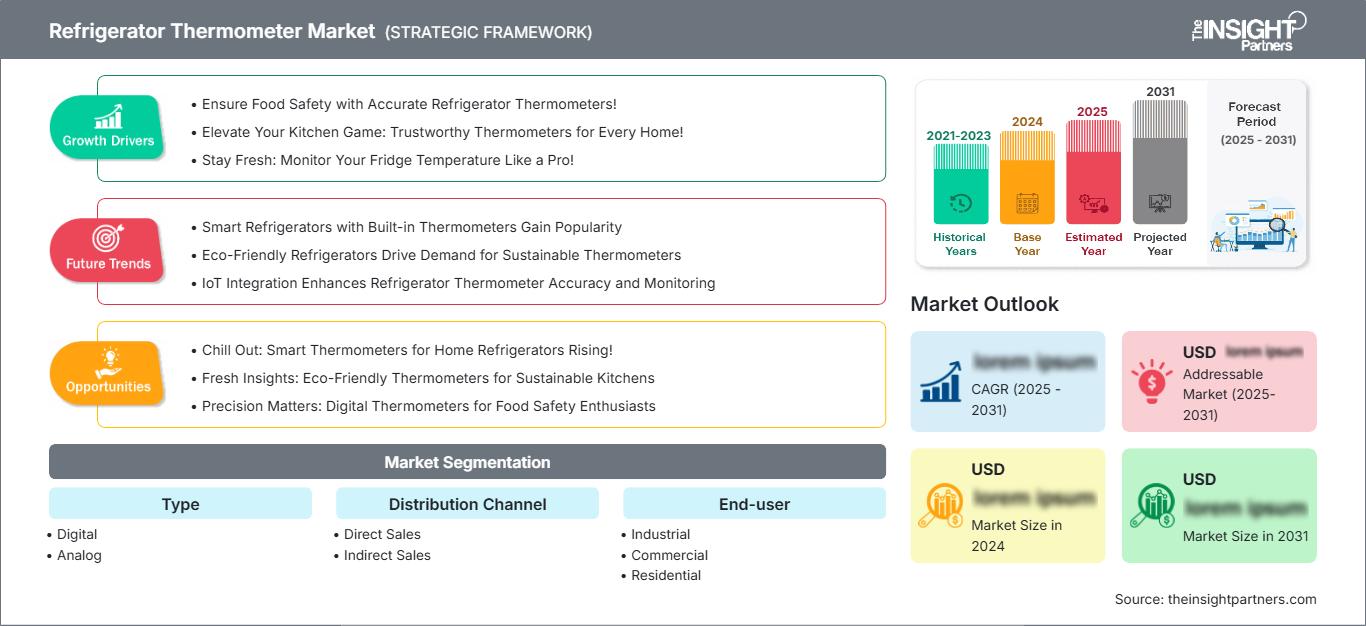
Refrigerator Thermometer Market: Strategic Insights
Regional Insights
North America refrigerator thermometer market
North America is estimated to hold a 29–33% share in 2025 and is expected to register a 3.8–4.4% CAGR through 2034. The region benefits from mature food-service infrastructure, extensive supermarket networks, healthcare facilities, and established cold-storage practices. Temperature verification remains relevant because refrigerator controls do not always provide a direct measurement of internal conditions. Commercial buyers increasingly favor devices capable of recording excursions.
The US dominates regional demand, while Canada contributes through food distribution, hospitality, healthcare, and household applications in the Refrigerator Thermometer Market Forecast. Digital models are increasingly selected where readable displays, alarms, and minimum or maximum recording improve operational control. Regional demand also benefits from the replacement of aging analog instruments and the broader adoption of preventive maintenance programs. Industrial users place greater emphasis on calibration documentation and repeatability, whereas residential buyers remain highly price-sensitive.
U.S. refrigeration thermometer Market
The US represents approximately 75–79% of North America's 2025 share and is projected to grow at 3.7–4.3% CAGR through 2034. Demand comes from food safety policies, commercial kitchens, grocery stores, pharmacies, laboratories, and home storage units. According to FDA guidelines, temperatures should be 40° F or less, and specifically mention the use of appliance thermometers to check actual conditions. It supports the demand for the independent measurement of temperature.
Digital thermometers that come with an alarm, probe, and memory features are favored in commercial settings where people have to take temperatures. Cooper-Atkins Corporation, Comark Instruments, DeltaTrak, and Taylor (Lifetime Brands, Inc.) serve different segments of the American market. The residential market needs affordable individual units, whereas the industrial market demands calibration features, durability, and monitoring protocols.
Europe refrigerator thermometer market
Europe is projected to represent a 24–28% share of the refrigerator thermometer market in 2025 and expand at 3.4–4.0% CAGR, with Germany serving as a leading market. EU purchasers stress accuracy in measurement, hygiene, calibration, and documentation, favoring professional digital instruments in addition to their traditional analog instruments.
The United Kingdom has a significant demand for the hospitality sector, food retailing, catering, and institutional kitchens. Germany is advanced in food processing and quality control procedures, along with engineering. Food processing, tourism, hospitality, and supermarkets in France, Italy, and Spain make contributions. In the region, there is a growing trend among professional purchasers for readings that are traceable, probes that are tough, and proper calibration, while consumers continue to prefer inexpensive individual instruments.
APAC refrigerator thermometer market
APAC is estimated to account for a 28–32% share of the refrigerator thermometer market in 2025 and is projected to grow at 4.6–5.2% CAGR, making it the leading high-growth region. Regional demand starts with China and is followed by Japan, India, South Korea, and Australia, whose retail industry, hospitality, healthcare, and cold chain logistics continue to grow.
There is an increasing need for reliable temperature sensing due to industrialization and organized food logistics. While in Japan and South Korea emphasis is on precision and instrumentation, in India and China volume prospects are provided through increasing retail and processing of food products. The food safety traditions in Australia provide an advantage to the country.
Middle East & Africa refrigeration thermometer Market
The Middle East and Africa refrigerator thermometer market demand is expected to expand at a 3.2–3.8% CAGR, with Saudi Arabia and the UAE leading Gulf adoption and South Africa representing an important African market. Growth is linked to modern retail, hospitality, healthcare storage, food imports, and expanding temperature-controlled logistics.
High ambient temperatures increase the operational importance of refrigeration monitoring, particularly in distribution centers and food-service facilities. Saudi Arabia and the UAE are investing in modern logistics and retail infrastructure, while South Africa supports regional food-processing and distribution networks. The Rest of MEA remains fragmented, with demand concentrated around urban commercial centers. Digital products should gain gradually as operators seek better visibility, although low-cost analog devices remain important in price-sensitive markets.

Segmentation Analysis
Type
Type segmentation is led by digital instruments, which provide clearer readings and support functions unavailable in basic mechanical devices. The refrigeration thermometer scope is expected to expand as buyers increasingly value precision, alarms, memory, and easier inspection. The Type segment is projected to grow at 4.2–4.8% CAGR between 2026–2034, with digital products gaining share while analog devices retain cost-sensitive applications.
- Digital: Digital products provide high readability and can incorporate alarms, minimum and maximum recording, probes, and electronic calibration features. They are strategically important for commercial kitchens, laboratories, healthcare storage, and connected monitoring applications.
- Analog: Analog instruments remain relevant where low purchase cost, battery-free operation, simple installation, and basic visual verification are priorities. They retain strong positions in household refrigerators and price-sensitive commercial environments.
Distribution Channel
Distribution-channel dynamics are shaped by product complexity, purchase frequency, and buyer requirements in the Refrigerator Thermometer Market Trends. The segment is expected to expand at 3.8–4.4% CAGR between 2026–2034, with direct channels becoming more important for professional instruments requiring technical specifications, calibration services, or application guidance.
- Direct Sales: Direct sales support institutional and professional purchases where buyers require product specifications, calibration documentation, technical consultation, and repeat procurement arrangements.
- Indirect Sales: Indirect channels provide broad geographic reach through distributors, retailers, e-commerce platforms, appliance stores, and food-service suppliers, supporting higher-volume consumer and small-business purchases.
End-user
End-user demand varies considerably by temperature-control requirements and documentation intensity in the Refrigerator Thermometer Market. This segment is projected to grow at 4.4–5.0% CAGR between 2026–2034, with industrial and commercial users adopting more sophisticated monitoring while residential demand remains anchored in affordability and simplicity.
- Industrial: Industrial users require durable instruments, repeatable measurements, calibration, and reliable performance across food processing, cold storage, pharmaceutical handling, and manufacturing environments.
- Commercial: Commercial buyers include restaurants, supermarkets, hotels, catering operations, pharmacies, and laboratories where routine temperature verification supports product quality and operating procedures.
- Residential: Residential demand centers on affordable, easy-to-read products used to independently verify refrigerator and freezer temperatures, especially where appliance controls do not show actual internal conditions.
Opportunity Snapshot
| End-user | Revenue Contribution (High/Medium/Low) | Trend Tag | Adoption Stage |
| Industrial | Medium | Audit Logging | Scaling |
| Commercial | High | HACCP Monitoring | Mature |
| Residential | Medium | Food Safety | Scaling |
Refrigerator Thermometer Market Growth Drivers and Impact Analysis
Food-safety compliance and temperature verification
Food-safety requirements create a recurring need for independent temperature verification across households and professional facilities in the Refrigerator Thermometer Market. It is recommended that the temperature be maintained at or below 40 degrees Fahrenheit inside refrigerators by the FDA. This translates to the demand for simple, affordable devices, especially in the food-service industry, where changes in temperature could influence both the quality of the product and the compliance requirements. Food service industry players are more interested in devices that make the process of checking easy and allow one to save records. This means that there is always a constant demand for such devices, even if refrigerators are not being installed anymore. The use of digital devices allows for saving on time spent on the control process.
Expansion of cold-chain infrastructure and controlled storage
Growth in the range of heat-sensitive foods, pharmaceuticals, biological substances, and specialty items leads to an increase in the number of locations that require temperature measurement. The growth in the cold chain means that there is increased demand beyond the conventional household refrigeration, mainly in pharmacies, laboratories, food processing places, distribution centers, and institutions. The users require proof that the equipment is maintained within the prescribed ranges during normal operations, servicing, and in the event of a power outage. These conditions favor equipment that can measure continuously, record history, or generate alarms. From a business point of view, the significance is even higher when considering the emerging markets in which the grocery and health care facilities are developing very fast. Buyers consider measurement equipment in the context of quality control practices as opposed to mere accessories.
Increasing preference for connected temperature monitoring
Connectivity will affect how temperature data are collected, analyzed, and responded to. The use of wireless data loggers and cloud solutions will automate data recording, trigger alerts, and create documentation without having to manually monitor the results. While the basic temperature reader for refrigerators is a very inexpensive device, the professional user will be interested in systems combining the sensor hardware with software and mobile applications. The impact of the technology commercially is most pronounced when there is an event that may lead to product losses, legal exposures, and operational disruptions. Connectivity allows for remote monitoring of multiple refrigerators in pharmacies, grocery stores, laboratories, and catering establishments. As sensors become cheaper and wireless connectivity gets simpler, advanced monitoring will slowly trickle down to small businesses.
Refrigerator Thermometer Market Future Trends
Connected sensors will move from standalone monitoring toward integrated platforms
The refrigeration thermometer trends outlook increasingly points toward integration between temperature sensors, wireless gateways, cloud dashboards, and mobile applications. Future professional products are likely to combine compact probes with automated alerts, historical data storage, threshold configuration, and reporting functions. Integration with building-management and food-safety systems could allow temperature information to trigger maintenance workflows rather than merely display a reading. Artificial intelligence may eventually assist by identifying recurring excursions associated with door openings, compressor cycling, or equipment deterioration. Such capabilities would shift value from the physical thermometer toward data services and analytics. However, adoption will remain segmented because residential buyers generally prioritize simplicity and price. Manufacturers, therefore, face a dual-market requirement: maintain low-cost standalone products while developing scalable connected solutions for professional users.
Calibration intelligence will become a stronger differentiator
It is anticipated that future sensors will place more importance on calibration status, consistency of measurements, and traceability. Professional users need assurance that readings not only work but are also verifiable during audits, quality investigations, or service procedures. Digital thermometers have the ability to perform calibration alerts, store correction data, maintain test reports, and report. Manufacturers may integrate these capabilities with mobile apps for simplified management of certificates and devices. In an industrial environment, sensor diagnostics may flag abnormal drifts before readings become faulty and affect stored items. This is especially applicable in pharmaceutical, laboratory, food processing, and institutional industries where temperature data forms an integral part of the quality system.
Refrigerator Thermometer Market Opportunities
Private-label expansion through retail and e-commerce channels
The refrigeration thermometer Forecasts opportunity is significant for manufacturers capable of balancing low production costs with consistent accuracy and recognizable product features. Retailers and e-commerce platforms can expand private-label offerings by combining analog entry products with digital models, freezer combinations, magnetic mounts, and alarm-enabled devices. The strategy can increase shelf presence while allowing manufacturers to serve distinct price tiers without redesigning the underlying sensing architecture. Packaging, multilingual instructions, clear temperature ranges, and food-safety positioning can improve conversion among household buyers. Suppliers should prioritize reliable component sourcing and quality-control processes because inexpensive devices compete aggressively on consumer reviews and perceived accuracy. Partnerships with appliance retailers and kitchen-equipment distributors could also create recurring replacement demand as older thermometers are lost, damaged, or upgraded.
Professional monitoring bundles for multi-site operators
For suppliers who can provide standardized monitoring programs by bundling sensors, probes, calibration assistance, gateways, and reporting software, there is a great opportunity with commercial operators. Commercial operators such as restaurant organizations, supermarket chains, pharmacies, laboratories, and institutional kitchens typically have several refrigerated units and hence have a greater need for central monitoring as compared to buying individual instruments. This can help reduce installation problems and generate continuous revenue from software, maintenance, calibration, and replacement services. Systems must be developed that would facilitate both independent use and scaling up so that the customer can start with a few monitored units. Interoperability with existing quality management systems can increase retention. Suppliers providing quality measurement tools with easy installation and audit documentation stand a chance to capture the professional market rather than those competing on pricing alone.
Frequently Asked Questions

- Comprehensive Market Sizing and Forecast Analysis
- Detailed Segmentation Analysis
- In-Depth Market Dynamics Assessment
- Regional and Country-Level Insights
- Competitive Landscape and Company Benchmarking
- Strategic Business Intelligence
Recent Reports
Testimonials

The Insight Partners provided valuable market intelligence that supported our global go-to-market strategy. Their team was professional, responsive, and attentive to our feedback, providing thoughtful analysis and helpful methodological clarifications throughout the project.
Junmo Kim Chief Financial Officer (CFO), Enertech Co., Ltd.
The Insight Partners' SCADA System Market report is comprehensive, with valuable insights on current trends and future forecasts. The team was highly professional, responsive, and supportive throughout. We are very satisfied and highly recommend their services.
RAN KEDEM Partner, Reali Technologies LTDs
I requested a report on a very specific software market and the team produced the report in a few days. The information was very relevant and well presented. I then requested some changes and additions to the report. The team was again very responsive and I got the final report in less than a week.
JEAN-HERVE JENN Chairman, Future Analytica
We worked with The Insight Partners for an important market study and forecast. They gave us clear insights into opportunities and risks, which helped shape our plans. Their research was easy to use and based on solid data. It helped us make smart, confident decisions. We highly recommend them.
PIYUSH NAGPAL Sr. Vice President, High Beam Global
The Insight Partners delivered insightful, well-structured market research with strong domain expertise. Their team was professional and responsive throughout. The user-friendly website made accessing industry reports seamless. We highly recommend them for reliable, high-quality research services
YUKIHIKO ADACHI CEO, Deep Blue, LLC.
This is the first time I have purchased a market report from The Insight Partners.While I was unsure at first, I visited their web site and felt more comfortable to take the risk and purchase a market report.I am completely satisfied with the quality of the report and customer service. I had several questions and comments with the initial report, but after a couple of dialogs over email with their analyst I believe I have a report that I can use as input to our strategic planning process.Thank you so much for taking the extra time and making this a positive experience.I will definitely recommend your service to others and you will be my first call when we need further market data.
JOHN SUZUKI President and Chief Executive Officer, Board Director, BK Technologies
I wish to appreciate your support and the professionalism you displayed in the course of attending to my request for information regarding to infectious disease IVD market in Nigeria. I appreciate your patience, your guidance, and the fact that you were willing to offer a discount, which eventually made it possible for us to close a deal. I look forward to engaging The Insight Partners in the future, all thanks to the impression you have created in me as a result of this first encounter.
DR CHIJIOKE ONYIA MANAGING DIRECTOR, PineCrest Healthcare Ltd.Reason to Buy
- Informed Decision-Making
- Understanding Market Dynamics
- Competitive Analysis
- Identifying Emerging Markets
- Customer Insights
- Market Forecasts
- Risk Mitigation
- Boosting Operational Efficiency
- Strategic Planning
- Investment Justification
- Tracking Industry Innovations
- Aligning with Regulatory Trends





 Get Free Sample for