
Residential Booster Pump Market Growth, Trends & Forecast by 2034
Coverage: by Product (Single Stage, Multiple Stage); Application (Residential Homes/Flats, Farm Houses/Cottages/Guest House) , and Geography (North America, Europe, Asia Pacific, and South and Central America)
- Status : Data Released
- Report Code : TIPRE00004811
- Category : Electronics and Semiconductor
- No. of Pages : 150
- Available Report Formats :


- Last update date : September 21, 2026


2025 Market Size
US$ 3.79 Bn
Base year value
2034 Forecast
US$ 6.89 Bn
Projected by 2034
CAGR 2026-2034
6.87 %
Growth rate
Addressable Market
US$ 48.25 Bn
(2026-2034)
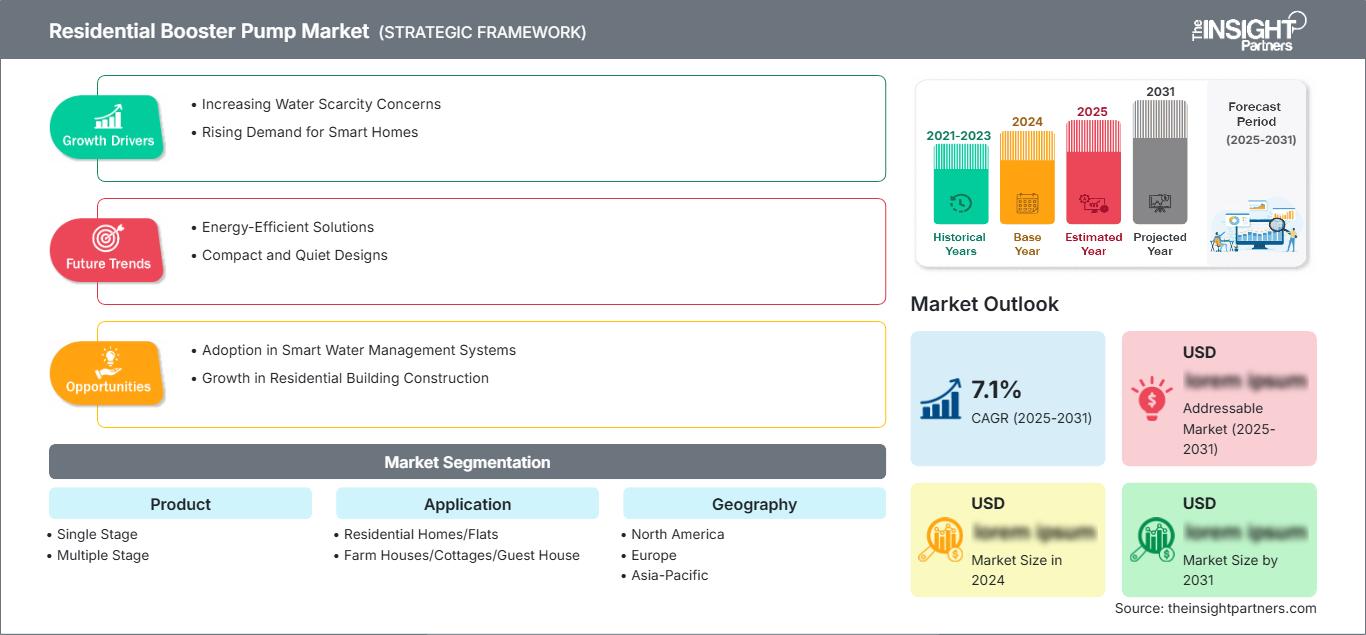
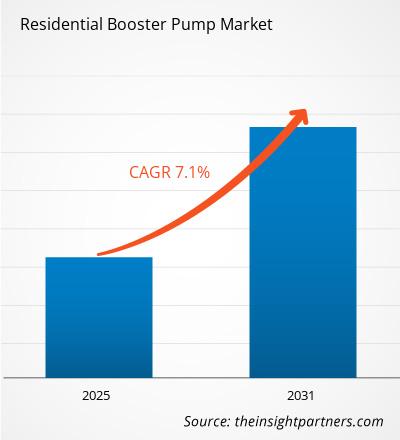
The global Residential Booster Pump market was valued at US$ 3.79 billion in 2025 and is expected to reach US$ 6.89 billion by 2034; it is estimated to record a CAGR of 6.87% during 2026-2034.
Residential Booster Pump Market Assessment and Insights
- North America: North America is expected to represent a 25–29% share in 2025, growing at a 6.8–7.3% CAGR between 2026–2034, supported by residential renovation, pressure inconsistencies, multi-story housing, and increasing preference for variable-speed boosting equipment.
- US: The US is estimated to account for 54–58% of North America's 2025 share, expanding at a 6.7–7.2% CAGR between 2026–2034, driven by retrofit demand, suburban housing, and multi-family construction.
- Europe: Europe is projected to hold a 28–32% share in 2025 and grow at a 6.3–6.8% CAGR between 2026–2034. Germany, the UK, France, Italy, and Spain are key markets, supported by efficiency requirements and the modernization of residential water systems.
- Asia Pacific: Asia Pacific is estimated at a 38–42% share in 2025, with a 8.2–8.7% CAGR between 2026–2034. China, Japan, India, South Korea, and Australia lead demand through urban housing, water-pressure challenges, and residential infrastructure investment.
- Largest Segment: Single Stage systems are estimated at a 56–61% market share in 2025, with a 7.1–7.6% CAGR between 2026–2034, reflecting affordability and straightforward installation.
- High Growth Segment: Multiple Stage systems are estimated at a 39–44% market share in 2025, with a 8.3–8.8% CAGR between 2026–2034, benefiting from higher pressure requirements in larger and multi-level residences.
- Key companies analyzed in detail: Alfred Kärcher SE & Co. KG, Aquatec International, Inc., DAB Pumps S.p.A., Franklin Electric Co., Inc., Grundfos Holding A/S, KSB SE & Co. KGaA, SyncroFlo Inc., Wilo SE, Xylem Inc., Zodiac Pool Solutions.
Source: The Insight Partners' analysis based on proprietary research, government publications, company annual reports, investor presentations, industry databases, and expert interviews.
Residential water-pressure systems have evolved from basic fixed-speed pumps toward integrated packages combining motors, pressure sensors, controllers, tanks, and variable-speed drives. Compact form factors reduce installation constraints, while electronic controls regulate output according to demand. Production strategies increasingly emphasize modular hydraulics, standardized components, digital monitoring, and lower acoustic performance. These changes support residential installations where space, noise, and operating efficiency influence purchasing decisions.
Over the forecast period, emerging urban centers in the Asia Pacific and Latin America are expected to attract equipment investment as apartment density increases and water infrastructure remains uneven. European efficiency requirements and North American retrofit activity should support premium systems. Manufacturers are also likely to prioritize installer-friendly designs, remote diagnostics, corrosion-resistant materials, and integrated protection features as residential owners become more attentive to lifecycle operating costs.
Residential Booster Pump Market Report Scope
| Report Attribute | Details |
|---|---|
| Market size in 2025 | US$ 3.79 Billion |
| Market Size by 2034 | US$ 6.89 Billion |
| Global CAGR (2026 - 2034) | 6.87% |
| Historical Data | 2021-2024 |
| Forecast period | 2026-2034 |
Residential Booster Pump Market Analysis
Demand for residential booster systems is closely connected to water-pressure deficiencies created by elevation, long pipe runs, peak household consumption, storage tanks, and inconsistent municipal distribution. The residential booster pump market growth, therefore, depends on both new construction and replacement activity. Its ecosystem includes pump manufacturers, motor and drive suppliers, plumbing contractors, distributors, developers, utilities, and homeowners. Supply chains increasingly favor compact assemblies that reduce installation labor.
Pumps must be efficient, reliable, quiet, compact, easy to control, and quick to commission. Increasingly, stainless-steel wetted parts, permanent-magnet motors, electronic pressure measurement, and frequency conversion are found in high-end products. The distribution network is fragmented among specialist plumbing networks, electrical distributors, building services equipment suppliers, and e-commerce. The availability of trained installers is important because incorrect sizing results in increased cycling, energy use, and wear of the pump components.
Competitive strategy covers standard residential pumps, premium smart boosters, multi-pump packages, and application-specific offerings. Grundfos stresses integration for residential boosting systems, whereas Wilo, Xylem Inc., Franklin Electric Co., Inc., and KSB SE & Co. KGaA serve more diverse water management needs. DAB Pumps S.p.A., Alfred Kärcher SE & Co. KG, Aquatec International, Inc., SyncroFlo Inc., and Zodiac Pool Solutions offer further specialist/channel competition in residential and related applications.
Investment is being made into electronic control components rather than traditional mechanical components. Product differentiation is moving towards factors such as installation time, pressure stability, energy efficiency, connectivity and ease of service. Manufacturers with a network of contractors can influence specification at an early stage within the residential market, while those manufacturers with a wide distributor network will capture the replacement market.
● REPORT CUSTOMIZATION
Tailor This Report To Align With Your Specific Business Requirements
This report can be customized to align precisely with your business objectives, scope, and target markets. Customization options include tailored segmentation, geography, competitive analysis, and strategic insights to support informed decision-making.
Customize This Report →WHAT YOU CAN ADJUST
- ● Segmentations
- ● Geography
- ● Competitive Analysis
- ● Language Preferences
Residential Booster Pump Market: Strategic Insights
Regional Insights
North America residential booster pump market
North America is estimated to account for 25–29% of the 2025 residential booster pump market and is projected to grow at a 6.8–7.3% CAGR through 2034. Demand is supported by suburban housing, multi-family developments, pressure losses across large properties, and renovation of aging residential plumbing. Variable-speed systems are increasingly relevant where households require stable pressure during simultaneous shower, appliance, and irrigation use.
The US represents the dominant regional market, while Canada provides additional demand through detached housing and water-system upgrades. Residential installations increasingly favor compact integrated units that simplify contractor work and reduce equipment-room requirements. Local water conditions, building configuration, and inlet pressure remain important sizing variables. Replacement demand should remain resilient because homeowners often upgrade pumps when existing systems become noisy, inefficient, or unable to maintain pressure during peak consumption.
U.S. residential booster pump Market
The U.S. is estimated to represent 54–58% of North America's 2025 residential booster pump market, with a growth of 6.7–7.2% CAGR through 2034. Demand is concentrated in suburban houses, townhomes, multi-family properties, and homes using wells or storage systems. Pressure instability, elevation changes, and simultaneous water use support replacement and new installations.
Grundfos, Xylem Inc., Franklin Electric Co., Inc., and other established suppliers provide domestic boosting solutions through plumbing and water-equipment channels. Applications increasingly include whole-house pressure stabilization, irrigation support, and properties where municipal pressure is insufficient. Product selection is influenced by horsepower, flow, pressure setpoint, noise, installation footprint, and compatibility with existing plumbing. Smart controls are becoming more relevant as homeowners place greater emphasis on energy consumption and maintenance visibility.
Europe residential booster pump Market
Europe is projected to hold 28–32% of the 2025 residential booster pump market, advancing at a 6.3–6.8% CAGR through 2034, with Germany representing a leading market. Efficiency requirements, compact urban housing, water-system modernization, and technical standards support the adoption of electronically controlled equipment across major European economies.
The UK is a market that has good potential for retrofits owing to old housing stock and localized pressure restrictions, making room for boosting systems that are small in size. The case for Germany is a result of an intensive building process, the presence of pump manufacturers, and attention to the efficiency of equipment. Apartment renovations, residential buildings associated with tourism, and the need for proper water management are driving forces for France, Italy, and Spain.
APAC residential booster pump Market
APAC is estimated to command 38–42% residential booster pump market in 2025 and is expected to register an 8.2–8.7% CAGR through 2034. In regional terms, China is the largest user, followed by Japan, India, South Korea, and Australia. Urban apartments, irregular pressures, and water system investments encourage installations.
Opportunities in terms of volume exist in China and India owing to their urban populations and residential construction growth. Reliability, size, and controls are important in Japan and South Korea. In Australia, opportunities exist based on detached houses, conservation of water, and decentralized water management systems. Government investments in infrastructure and consumer expectations for a consistent water supply drive the installation of automated pressure management and pumping.
Middle East & Africa residential booster pump Market
The Middle East and Africa residential booster pump market demand is supported by water scarcity, high-rise development, and decentralized water systems. Saudi Arabia is a leading market, while the UAE and South Africa provide significant opportunities. The regional market is expected to expand at approximately 7.0–7.5% CAGR through 2034.
Saudi Arabia and the UAE need a system that will offer good pressure management of water within their villas, apartments, and large residential areas while considering issues of corrosion resistance due to difficult water. South Africa presents a niche based on its challenges in terms of water supply and residential systems that rely on water storage. The remainder of the MEA is still fragmented, and investments are made only in urban projects, hospitality-related housing, and water infrastructure.
Segmentation Analysis
Product
The Product segment is divided into Single Stage and Multiple Stage systems. Single Stage remains the leading configuration because many residential installations require moderate pressure enhancement without complex hydraulic arrangements. Multiple-stage systems gain relevance where homes have greater elevation, longer pipe runs, or simultaneous demand. The segment is expected to expand at approximately 7.2–7.7% CAGR between 2026–2034, with electronic controls increasingly integrated across both configurations.
- Single Stage: Single-stage pumps remain widely selected for straightforward domestic pressure boosting because of their compact construction, lower initial complexity, and suitability for moderate pressure requirements in detached houses and smaller residential properties.
- Multiple Stage: Multiple Stage pumps serve applications requiring higher pressure and greater hydraulic head, making them strategically important for larger homes, multi-level properties, storage-based systems, and installations involving several simultaneous water outlets.
Application
The Application segment covers Residential Homes/Flats and Farm Houses/Cottages/Guest Houses. Residential homes and flats represent the principal demand pool because apartment density, household appliance use, and variable inlet pressure create recurring pressure-management requirements. The segment is projected to grow at approximately 7.7–8.2% CAGR between 2026–2034, supported by new housing and retrofit installations.
- Residential Homes/Flats: Residential Homes/Flats account for the broadest addressable application base, particularly where multiple bathrooms, elevated floors, water tanks, and inconsistent municipal pressure require automated pressure stabilization.
- Farm Houses/Cottages/Guest House: Farm Houses/Cottages/Guest House applications often require flexible systems capable of supporting wells, storage tanks, irrigation interfaces, and variable occupancy, making dependable pressure control important across dispersed or seasonal properties.
Opportunity Snapshot
| Application | Revenue Contribution | Trend Tag | Adoption Stage |
| Residential Homes/Flats | High | Multi-Tap Pressure | Mature |
| Farm Houses/Cottages/Guest House | Medium | Well Integration | Scaling |
Residential Booster Pump Market Growth Drivers and Impact Analysis
Urban vertical housing increases pressure-management requirements
Changing residential densities will create new hydraulic needs in water systems in households. High-rises, row houses, and multilevel houses will encounter pressure differential between floors or along long pipe routes internally. This will create a need for systems that will maintain a set point even when several outlets are operating simultaneously. The change will not only affect the newly constructed buildings, as retrofit projects can now incorporate small boosters without changes in the mechanical room. There is increasing consideration of pressure systems among plumbing specifications by developers rather than the former consideration of pressure systems as replacements. This will create a need for manufacturers of pressure systems to produce standardized systems for repeated building types.
Variable-speed control improves lifecycle economics
Variable speed drives are revolutionizing the economics of residential boosting by enabling the output of the motor to vary according to the water demand. As opposed to continuous running at the same rate, electronically-controlled systems are able to vary output depending on the level of demand and increase output in situations when several fixtures are opened. There is potential to conserve energy that is not necessary to be used while ensuring that pressure remains consistent. The commercial significance is mainly felt in large houses and apartment complexes where demand varies greatly during the course of a day. The ability of manufacturers to integrate sensors, pressure tanks, fault protection and automated controls in their systems will enable differentiation of products.
Water infrastructure variability expands decentralized solutions
The differences in residential water networks across nations and even across communities have made it necessary to have decentralized pressure control devices. Residences could be supplied with water either from main lines in the city, storage tanks, shallow boreholes, or a combination of all of these. The booster pump could help in overcoming the pressures without necessitating the rebuilding of the whole upstream network. This effect on commerce is especially critical in cases where urban development has exceeded the pace of network development. Suppliers could help to cater for the variance through self-priming, adaptability of the inlet, protection against dry run, and suitability for storage use. In developed markets, the same reason has come about due to old plumbing and renovations. Therefore, it is clear that the addressable market is not confined only to new constructions.
Residential Booster Pump Market Future Trends
Integrated digital pressure management
Digital pressure management is set to be a more pronounced differentiating feature, especially when residential boosters begin to be equipped with sensors, variable speed motors, connectivity, and fault detection. Future products will integrate pressure management with the operating status of the product to allow for early detection of abnormal operation, including dry running, inefficient operation, and cycling. Connectability will help with the commissioning and servicing processes, reducing unnecessary site visits. Instead of developing the standalone smart home features, the manufacturers will develop the features right inside the control unit of the pump. This development should enhance usability without increasing the complexity of the system. In the future, the digital features will become more useful in the maintenance of several properties, where the maintenance team needs to keep track of all installations.
Compact high-efficiency booster architectures
Future innovations in product design would focus on the miniaturization of hydraulic systems in which the pumps, motors, controls, pressure sensors, tanks, and protection components would all fit into more space-saving packages. This is especially important in apartment buildings, utility rooms, garages, and retrofits where standard booster units may not be easily installed due to a lack of space. Permanent magnet motors and hydraulic system innovation would enable better efficiency levels at acceptable pressure levels. Simplification of the installation process by having pre-assembled connections, built-in non-return valves, and automatic commissioning systems would also help in simplifying the installation process. This would reduce the technicality involved in installing and selecting the right products, even though hydraulic sizing would still be necessary.
Residential Booster Pump Market Opportunities
Installer-focused packaged systems
Manufacturers can capture additional value by developing packaged systems specifically around installer workflows. Products that combine pump, controller, pressure management, protection, and connection components can reduce the number of separate items required during installation. Clear sizing tools, guided commissioning, diagnostic indicators, and standardized connection dimensions can further reduce labor requirements. The opportunity is particularly relevant in retrofit markets where installers encounter varied plumbing configurations and limited equipment space, reflecting key residential booster pump market trends. Suppliers with established plumbing distribution networks can strengthen their position by providing training, digital selection tools, technical documentation, and rapid replacement support alongside hardware. A service-oriented approach can also improve brand retention because installers influence repeated household purchases. Investment should therefore prioritize the complete installation experience rather than focusing solely on hydraulic performance.
Smart water-system integration
Smart water-system integration offers manufacturers an opportunity to move beyond standalone pressure boosting toward coordinated residential water management. Booster systems could exchange information with storage tanks, leak-detection devices, water meters, filtration equipment, and building-management platforms. Such integration would allow pressure settings and operating schedules to respond to household demand patterns or system conditions. The residential booster pump market forecasts indicate that suppliers able to connect equipment without creating excessive installation complexity can address both premium new-build and retrofit opportunities. Commercial strategies should focus on interoperable communication, dependable sensors, and straightforward user interfaces rather than proprietary ecosystems alone. Partnerships with plumbing technology providers, home automation companies, and water-management specialists could accelerate adoption. The strongest opportunity lies in making digital functionality useful to homeowners while preserving simple operation for installers.
Frequently Asked Questions

- Comprehensive Market Sizing and Forecast Analysis
- Detailed Segmentation Analysis
- In-Depth Market Dynamics Assessment
- Regional and Country-Level Insights
- Competitive Landscape and Company Benchmarking
- Strategic Business Intelligence
Recent Reports
Testimonials

The Insight Partners' SCADA System Market report is comprehensive, with valuable insights on current trends and future forecasts. The team was highly professional, responsive, and supportive throughout. We are very satisfied and highly recommend their services.
RAN KEDEM Partner, Reali Technologies LTDs
I requested a report on a very specific software market and the team produced the report in a few days. The information was very relevant and well presented. I then requested some changes and additions to the report. The team was again very responsive and I got the final report in less than a week.
JEAN-HERVE JENN Chairman, Future Analytica
We worked with The Insight Partners for an important market study and forecast. They gave us clear insights into opportunities and risks, which helped shape our plans. Their research was easy to use and based on solid data. It helped us make smart, confident decisions. We highly recommend them.
PIYUSH NAGPAL Sr. Vice President, High Beam Global
The Insight Partners delivered insightful, well-structured market research with strong domain expertise. Their team was professional and responsive throughout. The user-friendly website made accessing industry reports seamless. We highly recommend them for reliable, high-quality research services
YUKIHIKO ADACHI CEO, Deep Blue, LLC.
This is the first time I have purchased a market report from The Insight Partners.While I was unsure at first, I visited their web site and felt more comfortable to take the risk and purchase a market report.I am completely satisfied with the quality of the report and customer service. I had several questions and comments with the initial report, but after a couple of dialogs over email with their analyst I believe I have a report that I can use as input to our strategic planning process.Thank you so much for taking the extra time and making this a positive experience.I will definitely recommend your service to others and you will be my first call when we need further market data.
JOHN SUZUKI President and Chief Executive Officer, Board Director, BK Technologies
I wish to appreciate your support and the professionalism you displayed in the course of attending to my request for information regarding to infectious disease IVD market in Nigeria. I appreciate your patience, your guidance, and the fact that you were willing to offer a discount, which eventually made it possible for us to close a deal. I look forward to engaging The Insight Partners in the future, all thanks to the impression you have created in me as a result of this first encounter.
DR CHIJIOKE ONYIA MANAGING DIRECTOR, PineCrest Healthcare Ltd.Reason to Buy
- Informed Decision-Making
- Understanding Market Dynamics
- Competitive Analysis
- Identifying Emerging Markets
- Customer Insights
- Market Forecasts
- Risk Mitigation
- Boosting Operational Efficiency
- Strategic Planning
- Investment Justification
- Tracking Industry Innovations
- Aligning with Regulatory Trends





 Get Free Sample for