
Rugged Devices Market Size, Share & Trends by 2034
Coverage: by Product Type (Industrial Computing, Tracking Devices, Handheld Devices, and Others) and End User (Chemical, Transportation, Power, Aerospace, Healthcare, Defense, Metal & Mining, and Others), and Geography (North America, Europe, Asia Pacific, and South and Central America)
- Status : Data Released
- Report Code : TIPTE00002544
- Category : Electronics and Semiconductor
- No. of Pages : 150
- Available Report Formats :


- Last update date : September 21, 2026


2025 Market Size
US$ 7.7 Bn
Base year value
2034 Forecast
US$ 13.16 Bn
Projected by 2034
CAGR 2026-2034
6.14 %
Growth rate
Addressable Market
US$ 94.46 Bn
(2026-2034)
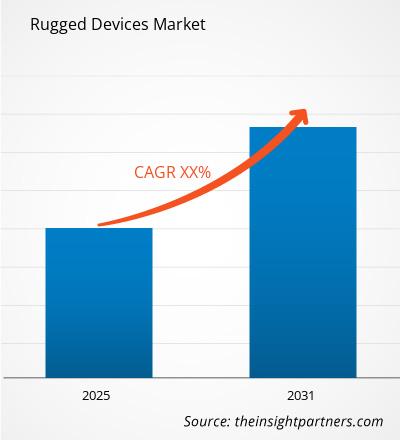
The rugged devices market is valued at US$ 7.7 Billion in 2025 and is projected to reach US$ 13.16 Billion by 2034, expanding at a CAGR of 6.14% during 2026–2034. The market reflects sustained investment in field mobility, industrial computing, asset tracking, and connected workforce technologies, with demand concentrated in applications requiring durability, secure connectivity, extended operating life, and dependable performance under demanding environmental conditions.
North America remains a structurally attractive market, supported by fleet modernization, industrial automation, defense digitization, and replacement of aging mobile hardware. The regional CAGR is modelled at 6.0–6.6% between 2026–2034. The rugged devices market size is further supported by increasing deployment of connected field-work platforms, private wireless networks, edge computing, and mobile applications across utilities, logistics, public safety, and industrial operations.
Rugged Devices Market Assessment and Insights
- North America: North America is estimated to account for a 31–35% share in 2025 and grow at a CAGR of 6.0–6.6% between 2026–2034, supported by industrial digitization, fleet modernization, defense procurement, and connected field-service requirements.
- US: The US represents 74–78% of North American demand in 2025 and is expected to expand at a CAGR of 6.1–6.7% through 2034, led by logistics, utilities, defense, and public safety deployments.
- Europe: Europe is estimated at a 23–27% share in 2025, with a CAGR of 5.6–6.2% through 2034. Germany, the UK, France, and Italy lead demand through manufacturing automation, transportation modernization, industrial safety requirements, and field-service digitization.
- Asia Pacific: Asia Pacific is estimated to hold a 27–31% share in 2025 and grow at a CAGR of 6.8–7.5% during 2026–2034, led by China, Japan, South Korea, and India as manufacturing, logistics, energy, and infrastructure digitization accelerates.
- Largest Segment: Handheld Devices is modelled at a 43–47% market share in 2025, with a CAGR of 6.0–6.5%, reflecting broad adoption across frontline mobility, logistics, service operations, and asset-intensive workplaces.
- High Growth Segment: Tracking Devices is modelled at a 20–24% market share in 2025 and a CAGR of 7.0–7.6%, benefiting from connected assets, fleet visibility, location intelligence, and industrial monitoring.
- Key companies analyzed in detail: Honeywell International Inc.; Zebra Technologies Corporation; Panasonic Corporation; Datalogic S.p.A.; BARTEC GmbH; Bluebird Inc.; Caterpillar Inc.; CipherLab Co., Ltd.; Getac Technology Corporation; Handheld Group AB.
Source: The Insight Partners' analysis based on proprietary research, government publications, company annual reports, investor presentations, industry databases, and expert interviews.
The rugged devices market has evolved from basic hardened computing toward connected, application-aware endpoints incorporating advanced processors, cellular connectivity, Wi-Fi 6E or newer standards, RFID, scanning, biometric security, and edge intelligence. Product differentiation will rely more on lifecycle reliability, modularity, battery design, device management, and interoperability, in addition to enclosure toughness. Computing and software, therefore, are being combined with communication features by manufacturers.
In the future, the market will expand into new regions like manufacturing facilities, infrastructure development, utilities, transportation, and military systems modernization. Focus of investments is anticipated to move towards AI-enabled processors, private wireless networks, cybersecurity, device-as-a-service business model, and extended lifecycle. Regulations that focus on employee safety and data security will drive organizations to update their consumer-grade endpoints, which have the potential to cause disruption in workflows.
Rugged Devices Market Report Scope
| Report Attribute | Details |
|---|---|
| Market size in 2025 | US$ 7.7 Billion |
| Market Size by 2034 | US$ 13.16 Billion |
| Global CAGR (2026 - 2034) | 6.14% |
| Historical Data | 2021-2024 |
| Forecast period | 2026-2034 |
Rugged Devices Market Analysis
Demand is increasingly shaped by the need to digitize workers operating outside controlled office environments. The rugged devices market growth is supported by barcode capture, mobile work orders, remote diagnostics, asset identification, fleet management, electronic inspections, and real-time operational reporting. This ecological system ranges from semiconductor suppliers to display and battery companies, device manufacturers, software developers, systems integrators, wireless operators, and enterprise customers.
In the value chain, device manufacturers engage in competition on the basis of processing efficiency, housing design, certification, accessories, product life cycle, and integration with the enterprise mobility platform. The supply environment is affected by semiconductors, display elements, batteries, radio modules, and specialized scanning devices. The product life cycle serves to compensate for replacement volatility.
Competition is fragmented between diversified technology companies and specialists focused on highly regulated or hazardous environments. The rugged devices market analysis indicates that Honeywell International Inc. and Zebra Technologies Corporation emphasize enterprise mobility ecosystems, while Panasonic Corporation and Getac Technology Corporation compete through rugged computing, modularity, and lifecycle support. Datalogic S.p.A. maintains a strong position in industrial identification, whereas BARTEC GmbH emphasizes hazardous-area applications.
Positioning strategies are more and more associated with software, management of devices, connectivity, and vertical offerings rather than just hardware attributes. Bluebird Inc., CipherLab Co., Ltd., and Handheld Group AB cater to specific mobility needs, whereas Caterpillar Inc. introduces rugged capabilities into tough industrial and outdoor conditions. Funds thus flow into AI-capable devices, edge computing, cyber security, modular design, and application-oriented customization.
● REPORT CUSTOMIZATION
Tailor This Report To Align With Your Specific Business Requirements
This report can be customized to align precisely with your business objectives, scope, and target markets. Customization options include tailored segmentation, geography, competitive analysis, and strategic insights to support informed decision-making.
Customize This Report →WHAT YOU CAN ADJUST
- ● Segmentations
- ● Geography
- ● Competitive Analysis
- ● Language Preferences
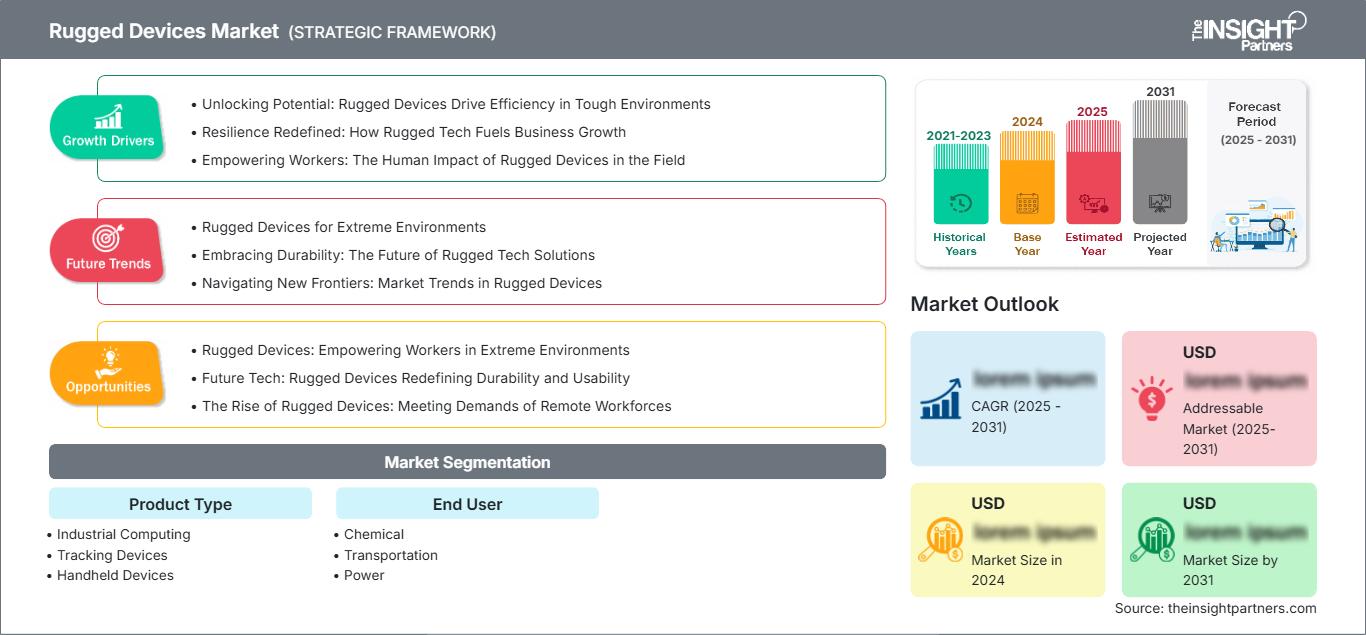
Rugged Devices Market: Strategic Insights
Regional Insights
North America rugged devices market
North America is modelled at a 31–35% share in 2025 and a 6.0–6.6% CAGR through 2034. The United States leads demand in the region, and Canada adds its value in the form of mining, utilities, transportation, public safety, and industrial field work. The adoption process is facilitated by the upgrade of existing mobile terminals and the expansion of connected processes.
Industrial automation, warehouse modernization, fleet management, and military communications represent stable channels of demand. Companies more frequently assess their devices on the basis of total cost of ownership, security, connectivity, and compatibility with enterprise applications. The procurement market in the region is also inclined towards devices that can function under various conditions of temperature, dust, vibrations, and moisture.
U.S. rugged devices Market
The US is estimated to represent 74–78% of the North American Rugged Devices Market demand in 2025 and is modeled to expand at a 6.1–6.7% CAGR through 2034. Major applications include warehouse execution, field service, utilities, public safety, defense, transportation, and industrial inspection. Enterprise buyers increasingly prioritize Android compatibility, 5G, Wi-Fi 6E, scanning, and remote device management.
Honeywell International Inc., Zebra Technologies Corporation, Panasonic Corporation, Getac Technology Corporation, and Caterpillar Inc. maintain market presence across different application categories. Demand is moving toward devices supporting real-time operational data, digital work instructions, video, RFID, and edge analytics. Longer support commitments are also important because large US fleets require consistent hardware, software, accessories, and security policies across multiple deployment cycles.
Europe rugged devices Market
Europe is estimated to have a 23–27% of the Rugged Devices Market share in 2025 and a 5.6–6.2% CAGR through 2034, with Germany leading regional demand. Industrial automation, worker safety, logistics modernization, and increasingly connected manufacturing operations underpin procurement. Environmental durability and cybersecurity are important selection criteria for industrial and public-sector deployments.
The UK maintains demand across transportation, utilities, public safety, defense, and field services, where mobile data capture supports distributed operations. Germany benefits from manufacturing automation, automotive production, logistics, and industrial engineering, making durable computing valuable for shop-floor and maintenance workflows. France, Italy, and Spain contribute through aerospace, manufacturing, energy, transportation, and infrastructure applications. Regional adoption is increasingly linked to industrial digitalization and secure enterprise mobility.
APAC rugged devices Market
APAC is modelled at a 27–31% share of the Rugged Devices Market in 2025 and a 6.8–7.5% CAGR through 2034, with China leading demand. Japan and South Korea contribute through advanced manufacturing, while India and Australia provide opportunities across infrastructure, logistics, mining, utilities, and public-sector operations.
Industrial automation, smart logistics, infrastructure expansion, and digital manufacturing policies support adoption. India is becoming increasingly relevant for rugged field computing as transportation, manufacturing, pharmaceuticals, and infrastructure operations digitize. Australia provides specialized demand from mining and remote operations, while China remains important for manufacturing and supply-chain applications.
Middle East & Africa rugged devices Market
The Middle East and Africa Rugged Devices Market represents a smaller but strategically relevant opportunity, with demand concentrated in Saudi Arabia, the UAE, and South Africa. The region is modelled to grow at a 5.7–6.4% CAGR through 2034, supported by infrastructure development, energy operations, logistics, and public-sector modernization.
Saudi Arabia leads regional investment momentum through large infrastructure and industrial programs, while the UAE emphasizes logistics, aviation, ports, and smart-city operations. South Africa contributes through mining, utilities, transportation, and industrial applications. Remote operating environments, heat, dust, and limited connectivity strengthen the requirement for durable devices with extended battery life and offline functionality.
Segmentation Analysis
Product Type
Product Type remains a central determinant of procurement because organizations select hardware according to mobility, computing intensity, scanning requirements, and operating environment. The segment is modeled to expand at a 5.8–7.2% CAGR during 2026–2034. Demand is shifting toward devices combining ruggedness with higher processing capability, connectivity, and enterprise software compatibility, according to the Rugged Devices Market report.
- Industrial Computing: Industrial Computing serves applications requiring sustained processing, vehicle integration, industrial control support, diagnostics, and field engineering. Demand is reinforced by factory digitization and mobile access to operational software.
- Tracking Devices: Tracking Devices support location visibility, asset identification, fleet monitoring, and condition-aware workflows. Their strategic importance increases as organizations seek real-time visibility across distributed equipment and mobile assets.
- Handheld Devices: Handheld Devices remain central to frontline mobility, combining scanning, communication, inventory functions, work orders, and digital inspections. Their broad compatibility with enterprise applications supports widespread deployment.
End User
End User adoption is modeled to increase at a 6.0–7.3% CAGR during 2026–2034 as rugged mobility moves deeper into asset-intensive operations. Selection depends on exposure to harsh conditions, workforce mobility, operational criticality, compliance requirements, and the cost of device failure.
- Chemical: Chemical facilities require durable computing for inspections, inventory, maintenance, and hazardous-area workflows where device reliability and appropriate certification are operational priorities.
- Transportation: Transportation users deploy rugged devices for fleet management, dispatch, cargo handling, maintenance, navigation, and real-time documentation across demanding mobile environments.
- Power: Power utilities use rugged mobility for inspections, maintenance, outage response, asset identification, and remote field operations where connectivity may be intermittent.
- Aerospace: Aerospace applications require dependable devices for maintenance documentation, diagnostics, logistics, and engineering workflows where accuracy and traceability are critical.
- Healthcare: Healthcare deployments emphasize disinfectability, secure data access, barcode identification, patient workflows, and reliable mobility across hospitals and distributed care environments.
- Defense: Defense users prioritize secure communications, situational awareness, mission computing, navigation, and equipment support under extreme environmental and connectivity conditions.
- Metal & Mining: Mining operations require rugged mobility for equipment monitoring, maintenance, worker communications, asset tracking, and production workflows in dust, vibration, and remote environments.
Opportunity Snapshot
| End User | Revenue Contribution (High/Medium/Low) | Trend Tag (MAX 2 words) | Adoption Stage |
| Chemical | Medium | Hazardous Mobility | Scaling |
| Transportation | High | Fleet Telematics | Mature |
| Power | High | Grid Fieldwork | Scaling |
| Aerospace | Medium | Mission Computing | Scaling |
| Healthcare | Medium | Clinical Mobility | Mature |
| Defense | High | Tactical Edge | Scaling |
| Metal & Mining | Medium | Mine Digitization | Scaling |
Rugged Devices Market Growth Drivers and Impact Analysis
Expansion of connected frontline operations
Interconnected field services are creating increased economic value in durable mobile endpoints since workers need immediate access to records of assets, work orders, location, imaging, and enterprise applications. With a durable endpoint, various tasks that used to be done separately using scanners, radios, cameras, and paperwork are done on one single piece of hardware. This minimization of context switching will lead to increased operational efficiency and decreased response cycles. Therefore, for logistics companies, utilities, maintenance companies, and industrial services, there are more reasons to standardize their mobile fleets. The integration with 5G, Wi-Fi 6E, RFID, and cloud apps increases the workload addressed by these devices. As far as suppliers are concerned, the trend is moving from hardware purchases alone towards mobility programs.
Rising requirement for resilient industrial computing
The environment that exists within an industrial setting includes vibration, impact, temperature changes, moisture, dust, chemicals, and interference from electromagnetic fields. As computerization of tasks replaces the use of paper-based inspections and maintenance, the cost implications of endpoint failure become clearer. This need for equipment designed on the basis of known standards of durability and ingress protection rather than consumer standards emerges. Plants, mines, utilities, transportation companies, and defense organizations are increasingly evaluating the performance throughout the life cycle of the equipment, including battery replacement, repair, accessories, and software support. The procurement need in this case is for providers that can maintain families of products for several years.
Growth of edge intelligence in mission-critical workflows
The evolution of AI-driven edge computing is altering what is demanded of robust devices. Rather than offloading each task to centralized resources, users now have the option to process images, diagnostics, voice control, maps, and operational data at the endpoint itself. This approach is especially applicable in situations of spotty network access, time-sensitive applications, or sensitive data that needs to be kept close to the user. With the availability of edge computing hardware and neural processing units, there is scope for ruggedized equipment to carry out tasks that were earlier only possible on laptops or cloud services. Defense, utilities, manufacturing, transport, and field services can harness local intelligence for anomaly detection, documentation, predictive maintenance, and decision-making support. In terms of the impact on business, it is a rise in the requirement standards for future procurements.
Rugged Devices Market Future Trends
AI-native field computing becomes a standard design objective
The next generation of rugged endpoints is likely to treat AI acceleration as a core hardware requirement rather than an optional software capability. Neural processing units, local inference, and optimized thermal architectures will enable technicians, inspectors, and operators to execute selected workloads without continuous cloud connectivity. Device makers will increasingly differentiate through AI-enabled diagnostics, document processing, computer vision, voice interfaces, and contextual assistance. The rugged devices market trends will consequently move toward combinations of durable hardware, edge software, secure local processing, and application-specific AI models. Organizations will assess these capabilities through measurable productivity outcomes rather than processor specifications alone. Longer battery endurance and efficient inference will remain essential because field workers cannot always depend on fixed power or high-bandwidth connectivity.
Modular and service-oriented device ecosystems expand
The procurement model would shift towards that of a managed ecosystem of devices, which would include hardware, software, accessories, security, maintenance, and lifecycle services, as against the replacement of hardware periodically. A modular design could increase the lifetime of such an ecosystem by enabling certain components to be replaced or upgraded, and this would not entail retiring the whole device. This concept would be very relevant in sectors like defense, utilities, transportation, and industrial fleet, as it would lead to less complexity in the training and maintenance of the devices because of standardization. Subscription-based support, analytics, diagnostics, and configurations could become part of the product offering by vendors, along with the equipment.
Rugged Devices Market Opportunities
Targeted expansion in infrastructure-intensive economies
Infrastructure modernization in India, Southeast Asia, the Middle East, and selected Latin American markets creates opportunities for suppliers that can tailor rugged mobility to local operating conditions. New rail networks, ports, utilities, manufacturing facilities, mining projects, and logistics hubs require field personnel to capture and exchange information outside conventional offices. Vendors can address these opportunities through localized configurations, regional channel partnerships, multilingual software, extended battery options, and connectivity suited to remote areas. The rugged devices market forecasts should therefore be evaluated alongside infrastructure investment cycles rather than solely through replacement demand. Suppliers that establish service capabilities near emerging industrial clusters can improve deployment reliability and reduce downtime. Local systems integrators can also provide an important route into large public-sector and industrial contracts.
Verticalized solutions for hazardous and remote operations
Specialized industries provide an opportunity to move beyond generic rugged hardware toward complete application packages. Chemical processing, mining, power generation, aerospace maintenance, and defense operations have distinct requirements for certification, connectivity, workflow software, accessories, and data security. Suppliers can build higher-value offerings by combining certified devices with scanners, sensors, docking systems, device management, and industry-specific applications. Such verticalization can reduce procurement complexity for customers while strengthening supplier differentiation. Partnerships with software developers and systems integrators may be especially valuable where customers need integration with enterprise resource planning, maintenance platforms, geographic information systems, or industrial control environments. The strongest opportunities are likely to arise where device failure carries measurable operational, safety, or compliance consequences.
Frequently Asked Questions

- Comprehensive Market Sizing and Forecast Analysis
- Detailed Segmentation Analysis
- In-Depth Market Dynamics Assessment
- Regional and Country-Level Insights
- Competitive Landscape and Company Benchmarking
- Strategic Business Intelligence
Recent Reports
Testimonials

The Insight Partners' SCADA System Market report is comprehensive, with valuable insights on current trends and future forecasts. The team was highly professional, responsive, and supportive throughout. We are very satisfied and highly recommend their services.
RAN KEDEM Partner, Reali Technologies LTDs
I requested a report on a very specific software market and the team produced the report in a few days. The information was very relevant and well presented. I then requested some changes and additions to the report. The team was again very responsive and I got the final report in less than a week.
JEAN-HERVE JENN Chairman, Future Analytica
We worked with The Insight Partners for an important market study and forecast. They gave us clear insights into opportunities and risks, which helped shape our plans. Their research was easy to use and based on solid data. It helped us make smart, confident decisions. We highly recommend them.
PIYUSH NAGPAL Sr. Vice President, High Beam Global
The Insight Partners delivered insightful, well-structured market research with strong domain expertise. Their team was professional and responsive throughout. The user-friendly website made accessing industry reports seamless. We highly recommend them for reliable, high-quality research services
YUKIHIKO ADACHI CEO, Deep Blue, LLC.
This is the first time I have purchased a market report from The Insight Partners.While I was unsure at first, I visited their web site and felt more comfortable to take the risk and purchase a market report.I am completely satisfied with the quality of the report and customer service. I had several questions and comments with the initial report, but after a couple of dialogs over email with their analyst I believe I have a report that I can use as input to our strategic planning process.Thank you so much for taking the extra time and making this a positive experience.I will definitely recommend your service to others and you will be my first call when we need further market data.
JOHN SUZUKI President and Chief Executive Officer, Board Director, BK Technologies
I wish to appreciate your support and the professionalism you displayed in the course of attending to my request for information regarding to infectious disease IVD market in Nigeria. I appreciate your patience, your guidance, and the fact that you were willing to offer a discount, which eventually made it possible for us to close a deal. I look forward to engaging The Insight Partners in the future, all thanks to the impression you have created in me as a result of this first encounter.
DR CHIJIOKE ONYIA MANAGING DIRECTOR, PineCrest Healthcare Ltd.Reason to Buy
- Informed Decision-Making
- Understanding Market Dynamics
- Competitive Analysis
- Identifying Emerging Markets
- Customer Insights
- Market Forecasts
- Risk Mitigation
- Boosting Operational Efficiency
- Strategic Planning
- Investment Justification
- Tracking Industry Innovations
- Aligning with Regulatory Trends





 Get Free Sample for