
Satellite Modem Market Share, Size & Demand by 2034
Coverage: by Type (SCPC & MCPC), Data Rate (High-Speed, Mid-Range, Entry-Level), Application (Mobile & Backhaul, IP Trunking, Offshore Communication), Industry Vertical (Telecom, Marine, Oil & Gas), and Geography (North America, Europe, Asia Pacific, and South and Central America)
- Status : Data Released
- Report Code : TIPEL00002192
- Category : Electronics and Semiconductor
- No. of Pages : 150
- Available Report Formats :


- Last update date : September 21, 2026


2025 Market Size
US$ 656. Mn
Base year value
2034 Forecast
US$ 1,563.3 Mn
Projected by 2034
CAGR 2026-2034
10.13 %
Growth rate
Addressable Market
US$ 9,864.34 Mn
(2026-2034)
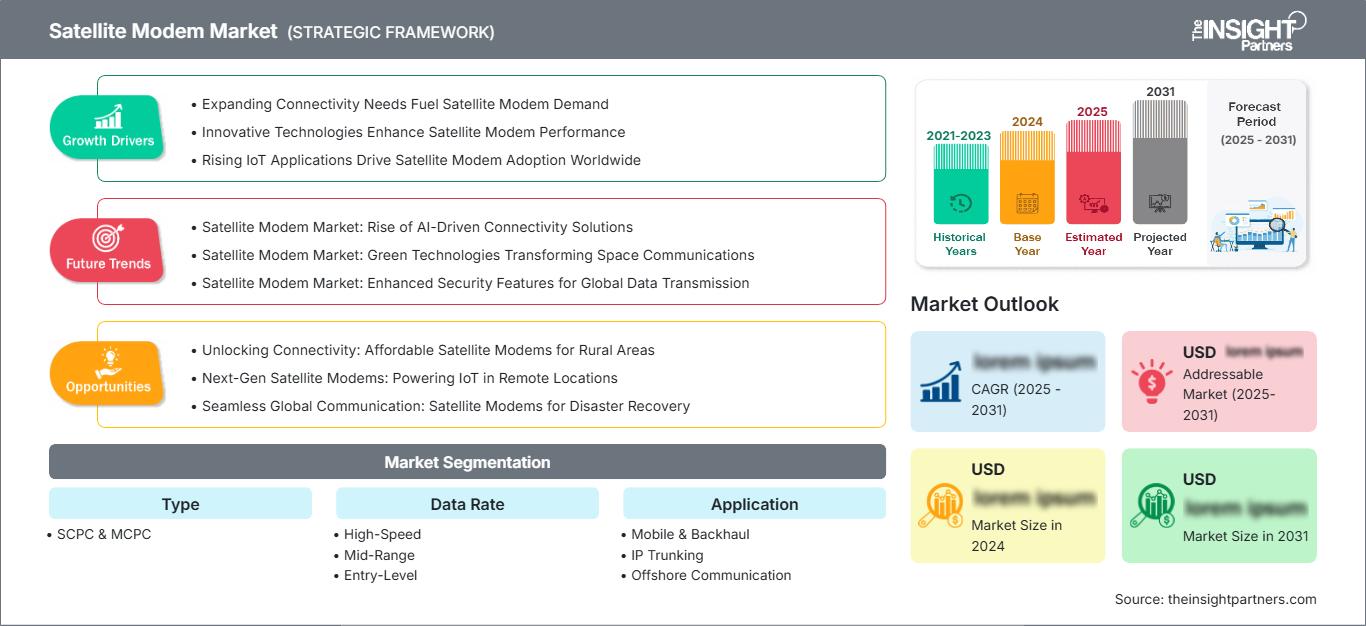
The satellite modem market was valued at US$ 656.00 Million in 2025 and is projected to reach US$ 1563.3 Million by 2034, growing at a CAGR of 10.13% during 2026–2034. Demand is expanding as high-throughput satellites, LEO networks, mobility services, cellular backhaul, offshore platforms, and enterprise links require modems that sustain resilient two-way data transmission.
North America remains a leading contributor to the satellite modem market size because defense communications, oil and gas operations, maritime connectivity, and telecom backhaul depend on reliable satellite access. The region is estimated to hold 36–39% share in 2025 and grow at a CAGR of 9.4–10.1% during 2026–2034, supported by advanced procurement and mature ground segment vendors.
Satellite Modem Market Assessment and Insights
- North America holds 36–39% share in 2025 and is growing at a CAGR of 9.4–10.1% between 2026–2034, supported by defense, offshore energy, enterprise continuity, and cellular backhaul modernization.
- US accounts for 80–84% of North America in 2025 and is growing at a CAGR of 9.6–10.3% during 2026–2034 due to secure SATCOM and telecom demand.
- Europe holds 24–27% share in 2025 and is growing at a CAGR of 8.9–9.6% during 2026–2034, led by the UK, Germany, France, Italy, and Spain.
- Asia Pacific represents 27–30% share in 2025 and is growing at a CAGR of 10.8–11.7% during 2026–2034, with China, India, Japan, South Korea, and Australia supporting demand.
- Largest Segment: high-speed data rate modems hold 45–49% market share in 2025 and are growing at a CAGR of 10.6–11.4% during 2026–2034.
- High Growth Segment: mobile and backhaul applications hold 34–38% share in 2025 and are growing at a CAGR of 11.2–12.3% during 2026–2034.
- Key companies analyzed in detail: Gilat Satellite Networks Ltd., ST Engineering iDirect, ORBCOMM Inc., Datum Systems Inc., Viasat, Inc., NovelSat Ltd., WORK Microwave GmbH, Comtech Telecommunications Corp., Teledyne Paradise Datacom LLC, and Advantech Wireless Technologies Inc.
Source: The Insight Partners' analysis based on proprietary research, government publications, company annual reports, investor presentations, industry databases, and expert interviews.
There have been changes in network architecture, with a a transition from point-to-point links to software-defined networks with multiple orbits and adaptable bandwidth. The modems control the DVB-S2X, SCPC, TDMA, waveform switching, encryption, traffic acceleration, and remote management. There will be demand for greater spectral efficiency due to satellite capacity being expensive, as well as varied traffic on the aviation, maritime, defense, and cellular networks.
The investments will go towards platforms that can offer routing for LEO, MEO, and GEO networks without any complicated replacements in the field. There will also be benefits in the market with the integration of 5G non-terrestrial network, rural broadband policy, and resilient infrastructure planning.
Satellite Modem Market Report Scope
| Report Attribute | Details |
|---|---|
| Market size in 2025 | US$ 656. Million |
| Market Size by 2034 | US$ 1,563.3 Million |
| Global CAGR (2026 - 2034) | 10.13% |
| Historical Data | 2021-2024 |
| Forecast period | 2026-2034 |
Satellite Modem Market Analysis
Market growth drivers include long-range broadband, emergency communication, cell tower backhaul, offshore applications, and military mobility. Modems are devices that transform digital data into RF signals for satellites; hence, they are an important component of all terminals, hubs, gateways, and mobile applications. The highest demands will be seen in those areas where there are no terrestrial systems available, not reliable, or can be compromised.
Value chain participants consist of chipset manufacturers, modem providers, antenna producers, teleport operators, satellite owners, systems integration companies, telecom providers, and vertical application service providers. The supply side is driven by the compatibility of the waveform, encryption, spectrum efficiency, certification time frame, and multi-band capabilities.
Market analysis reveals intense rivalry between integrated ground system providers and specialized modem manufacturers. Gilat Satellite Networks Ltd., ST Engineering iDirect, Viasat Inc., and Comtech Telecommunications Corp. are competing through platform solutions, whereas NovelSat Ltd., Datum Systems Inc., WORK Microwave GmbH, and Advantech Wireless Technologies Inc. provide high-performance modems, RF and broadcast equipment.
Strategic positioning is becoming software-definable. ORBCOMM Inc. is developing capabilities to meet IoT satellite services demands, Teledyne Paradise Datacom LLC provides modem and RF equipment, and ST Engineering iDirect uses Newtec and iDirect portfolios for multiple services. Suppliers capable of showing actual performance and providing remote waveform updates will enjoy a procurement advantage.
● REPORT CUSTOMIZATION
Tailor This Report To Align With Your Specific Business Requirements
This report can be customized to align precisely with your business objectives, scope, and target markets. Customization options include tailored segmentation, geography, competitive analysis, and strategic insights to support informed decision-making.
Customize This Report →WHAT YOU CAN ADJUST
- ● Segmentations
- ● Geography
- ● Competitive Analysis
- ● Language Preferences
Satellite Modem Market: Strategic Insights
Regional Insights
North America satellite modem market
North America accounts for 36–39% satellite modem market share in 2025 and is forecast to grow at a CAGR of 9.4–10.1% during 2026–2034. Growth is tied to defense modernization, offshore communication, emergency response, and telecom backhaul, where resilient links remain operationally critical.
U.S. and Canadian enterprises buy modems for fixed, mobile, and transportable systems serving energy, maritime, aviation, and government users. High-throughput satellite capacity and managed service models support upgrades from legacy equipment to software-defined modems that offer better spectral efficiency and network visibility.
U.S. satellite modem Market
The U.S. represents 80–84% of North America in 2025 and is growing at a CAGR of 9.6–10.3% through 2034. Procurement is shaped by military SATCOM, oil and gas communications, cellular backhaul, disaster recovery, and enterprise continuity programs that demand certified and secure modem performance.
Company presence is strong through Comtech Telecommunications Corp., Gilat Satellite Networks Ltd., Viasat, Inc., Datum Systems Inc., ORBCOMM Inc., and Teledyne Paradise Datacom LLC. Application trends favor multi-network modems, cyber-secure firmware, high-speed IP trunking, and compact hardware for mobile terminals and deployable field systems.
Europe satellite modem Market
Europe holds 24–27% share in 2025 and is projected to grow at a CAGR of 8.9–9.6% during 2026–2034. The UK and Germany lead adoption through defense, maritime, satellite broadcasting, and industrial networks, while France contributes through aerospace programs and institutional connectivity demand.
Italy and Spain add demand from maritime routes, energy sites, and telecom resilience projects. European buyers prioritize waveform flexibility, certified security, and compatibility with sovereign satellite programs. WORK Microwave GmbH and ST Engineering iDirect’s Newtec heritage strengthen the regional ground segment supplier base.
APAC satellite modem Market
APAC represents 27–30% share in 2025 and is expected to grow at a CAGR of 10.8–11.7% during 2026–2034. China and India lead through satellite broadband, telecom backhaul, and government connectivity programs, while Japan, South Korea, and Australia support maritime, defense, disaster recovery, and mining use cases.
The region benefits from rural connectivity gaps, national space ambitions, and industrial digitization. Buyers are shifting from basic VSAT equipment toward higher-speed modems that support adaptive coding, network optimization, and remote management for distributed telecom, energy, transport, and enterprise links.
Middle East & Africa satellite modem Market
The Middle East and Africa are projected to grow at a CAGR of 9.8–10.7% during 2026–2034. Saudi Arabia and the UAE lead demand through energy, defense, smart infrastructure, and national connectivity programs, while South Africa supports mining, enterprise communications, and regional satellite service distribution.
Offshore rigs, desert assets, ports, defense sites, and rural communities rely on satellite links where terrestrial networks are limited. Adoption depends on distributor coverage, technical support, and modem ruggedness. Energy and infrastructure spending make Saudi Arabia the leading demand center in the region.
Segmentation Analysis
Type
Type demand within the satellite modem market scope is growing at a CAGR of 9.7–10.6% during 2026–2034. SCPC remains important for dedicated links requiring predictable bandwidth, while MCPC supports shared carrier economics across broadcast, enterprise, and managed networks. Selection depends on traffic stability, service-level requirements, and capacity cost.
- SCPC modems are preferred for dedicated circuits, offshore platforms, defense links, and high-availability enterprise traffic where constant bandwidth, lower contention, and predictable performance justify capacity commitment.
- MCPC modems support shared network capacity for broadcasters, hub operators, and managed service providers that need statistical multiplexing, bandwidth pooling, and efficient multi-site service delivery.
Data Rate
Data Rate demand is growing at a CAGR of 10.1–11.0% during 2026–2034. High-speed modems lead as HTS capacity, IP trunking, maritime broadband, and mobility services increase throughput requirements. Mid-range and entry-level devices remain relevant for narrowband backup, remote monitoring, and cost-sensitive installations.
- High-Speed modems serve bandwidth-intensive backhaul, aviation, maritime broadband, and enterprise networks where throughput, acceleration, adaptive coding, and spectral efficiency define service quality.
- Mid-Range modems support branches, vessels, offshore sites, and backup links that need reliable IP performance without the cost profile of the highest-throughput equipment.
- Entry-Level modems remain useful for telemetry, small offices, emergency kits, and basic remote connectivity where affordability, low power, and simple installation matter most.
Application
Application demand is growing at a CAGR of 10.5–11.5% during 2026–2034. Mobile and backhaul applications lead because operators require flexible connectivity for moving assets and remote towers. IP trunking and offshore communication remain essential where high-availability links support enterprise continuity and operational safety.
- Mobile and Backhaul applications use satellite modems for cellular tower extension, transportable networks, maritime routes, aircraft connectivity, and disaster recovery when fiber or microwave links are unavailable.
- IP Trunking supports aggregated enterprise, government, and service-provider traffic across international routes, allowing users to maintain resilient connectivity and predictable bandwidth in remote regions.
- Offshore Communication depends on rugged modems for rigs, vessels, and energy assets where data, voice, safety systems, and crew welfare require continuous satellite connectivity.
Industry Vertical
Industry Vertical demand is growing at a CAGR of 10.0–10.9% during 2026–2034. Telecom generates the greatest recurring demand because tower backhaul and rural broadband need scalable capacity. Marine and oil and gas buyers prioritize reliability, ruggedization, and managed support for remote operations.
- Telecom users deploy modems for backhaul, redundancy, rural coverage, and temporary capacity, making waveform efficiency and remote management central to network economics.
- Marine operators use satellite modems for navigation data, crew connectivity, fleet tracking, passenger services, and operational communications across maritime routes beyond terrestrial coverage.
- Oil and Gas operations require secure links for drilling sites, offshore rigs, pipeline monitoring, emergency response, and production data, where downtime can affect safety and revenue.
Opportunity Snapshot
| Industry Vertical | Revenue Contribution | Trend Tag | Adoption Stage |
| Telecom | High | Backhaul | Mature |
| Marine | Medium | Fleet Links | Scaling |
| Oil and Gas | Medium | Remote Assets | Mature |
Satellite Modem Market Growth Drivers and Impact Analysis
Rising Cellular Backhaul in Underserved Areas
Mobile network providers are still extending their reach into areas that have low fiber penetration because the infrastructure takes too long to roll out or the cost is prohibitive. With satellite modems, it is possible to have tower backhaul as they will convert the network flow into a satellite connection while ensuring dynamic bandwidth distribution. This will drive the demand for high- and mid-bandwidth modems that provide speed and cost efficiency. The market effect will be felt most in APAC, Africa, and North America.
Defense and Emergency Communications Modernization
The government needs communications to endure any terrestrial disruption, any cybersecurity breach, and any contested environment. Secure satellite modems provide secure connections, waveform upgrades, multi-orbital routing, and command networks in the field. Purchasing focuses on certification, which enables the system to be compatible with the terminals of military and coalition networks. This driver contributes to increasing average selling prices due to the need for durable equipment and software-defined capabilities.
Offshore and Maritime Connectivity Requirements
Vessels, offshore drilling rigs, and energy facilities need to maintain communication channels for the sake of safety, operations, telemetry, and the welfare of crews. Satellite modems are important parts of vessel communication networks, offshore drilling platforms, and logistics systems since they enable maintenance of IP communications outside the coastal reach of networks. Increased bandwidth requirements for surveillance, diagnostic, and welfare communications are prompting users towards fast modems.
Satellite Modem Market Future Trends
Software-Defined Multi-Orbit Modems
The satellite modem market trends will increasingly center on software-defined modems that move traffic across GEO, MEO, LEO, terrestrial, and cellular paths. Operators want flexible platforms that can add waveforms, improve cybersecurity, and optimize bandwidth without hardware swaps. This trend is important for defense, maritime, telecom, and enterprise networks, where service availability depends on rapid adaptation. Vendors with virtualized gateways and remotely upgradeable modem families will gain stronger lifecycle value.
5G NTN and Hybrid Network Integration
Satellite modems will play an increasing role in the design of 5G non-terrestrial network solutions due to the convergence of satellite connectivity in the main telecom core networks. Roaming, policy control, and end-user experience consistency in coverage areas both on the ground and in space will require hybrid solutions. The change will shift the focus from purchasing separate terminals to the compatibility of modem functions within ecosystems. Satellites will benefit from the modems, which offer IP acceleration, time management, and orchestration features.
Satellite Modem Market Opportunities
Managed Backhaul Packages for Telecom Operators
The satellite modem market forecasts point to a strong opportunity in managed backhaul packages that combine modems, airtime, installation, monitoring, and service-level support. Many providers that serve rural or transient locations favor turnkey solutions to independent hardware acquisition. Vendors have an opportunity to add value through bandwidth optimization, unit backup schemes, and diagnostics. This is especially true in areas where there is a universal service obligation and competition to rapidly deploy without having to build out fiber infrastructure.
Rugged Modem Upgrades for Energy Assets
Oil and Gas, Offshore Rigs, and Remote Utilities present an opportunity for upgrades since the equipment will have to work in harsh environments and with strict safety standards. The legacy modems will not be able to cope with the requirements of a modern OT network when it comes to throughput, encryption, and management remotely. Vendors can address the need for upgrades through robust devices and firmware and support integration efforts. Sites have long lifecycles that lead to recurring revenues.
Frequently Asked Questions

- Comprehensive Market Sizing and Forecast Analysis
- Detailed Segmentation Analysis
- In-Depth Market Dynamics Assessment
- Regional and Country-Level Insights
- Competitive Landscape and Company Benchmarking
- Strategic Business Intelligence
Recent Reports
Testimonials

The Insight Partners provided valuable market intelligence that supported our global go-to-market strategy. Their team was professional, responsive, and attentive to our feedback, providing thoughtful analysis and helpful methodological clarifications throughout the project.
Junmo Kim Chief Financial Officer (CFO), Enertech Co., Ltd.
The Insight Partners' SCADA System Market report is comprehensive, with valuable insights on current trends and future forecasts. The team was highly professional, responsive, and supportive throughout. We are very satisfied and highly recommend their services.
RAN KEDEM Partner, Reali Technologies LTDs
I requested a report on a very specific software market and the team produced the report in a few days. The information was very relevant and well presented. I then requested some changes and additions to the report. The team was again very responsive and I got the final report in less than a week.
JEAN-HERVE JENN Chairman, Future Analytica
We worked with The Insight Partners for an important market study and forecast. They gave us clear insights into opportunities and risks, which helped shape our plans. Their research was easy to use and based on solid data. It helped us make smart, confident decisions. We highly recommend them.
PIYUSH NAGPAL Sr. Vice President, High Beam Global
The Insight Partners delivered insightful, well-structured market research with strong domain expertise. Their team was professional and responsive throughout. The user-friendly website made accessing industry reports seamless. We highly recommend them for reliable, high-quality research services
YUKIHIKO ADACHI CEO, Deep Blue, LLC.
This is the first time I have purchased a market report from The Insight Partners.While I was unsure at first, I visited their web site and felt more comfortable to take the risk and purchase a market report.I am completely satisfied with the quality of the report and customer service. I had several questions and comments with the initial report, but after a couple of dialogs over email with their analyst I believe I have a report that I can use as input to our strategic planning process.Thank you so much for taking the extra time and making this a positive experience.I will definitely recommend your service to others and you will be my first call when we need further market data.
JOHN SUZUKI President and Chief Executive Officer, Board Director, BK Technologies
I wish to appreciate your support and the professionalism you displayed in the course of attending to my request for information regarding to infectious disease IVD market in Nigeria. I appreciate your patience, your guidance, and the fact that you were willing to offer a discount, which eventually made it possible for us to close a deal. I look forward to engaging The Insight Partners in the future, all thanks to the impression you have created in me as a result of this first encounter.
DR CHIJIOKE ONYIA MANAGING DIRECTOR, PineCrest Healthcare Ltd.Reason to Buy
- Informed Decision-Making
- Understanding Market Dynamics
- Competitive Analysis
- Identifying Emerging Markets
- Customer Insights
- Market Forecasts
- Risk Mitigation
- Boosting Operational Efficiency
- Strategic Planning
- Investment Justification
- Tracking Industry Innovations
- Aligning with Regulatory Trends





 Get Free Sample for