
Satellite Phone Market Demand, Share & Growth by 2034
Coverage: by Type (Geosynchronous Satellite Phones, Low-Earth Orbit Satellite Phones); Application (Aerospace and Defense, Maritime, Fishing, Others) , and Geography (North America, Europe, Asia Pacific, and South and Central America)
- Status : Data Released
- Report Code : TIPRE00010565
- Category : Electronics and Semiconductor
- No. of Pages : 150
- Available Report Formats :


- Last update date : September 18, 2026


2025 Market Size
US$ 988.74 Mn
Base year value
2034 Forecast
US$ 1,326.23 Mn
Projected by 2034
CAGR 2026-2034
3.32 %
Growth rate
Addressable Market
US$ 10,514.53 Mn
(2026-2034)
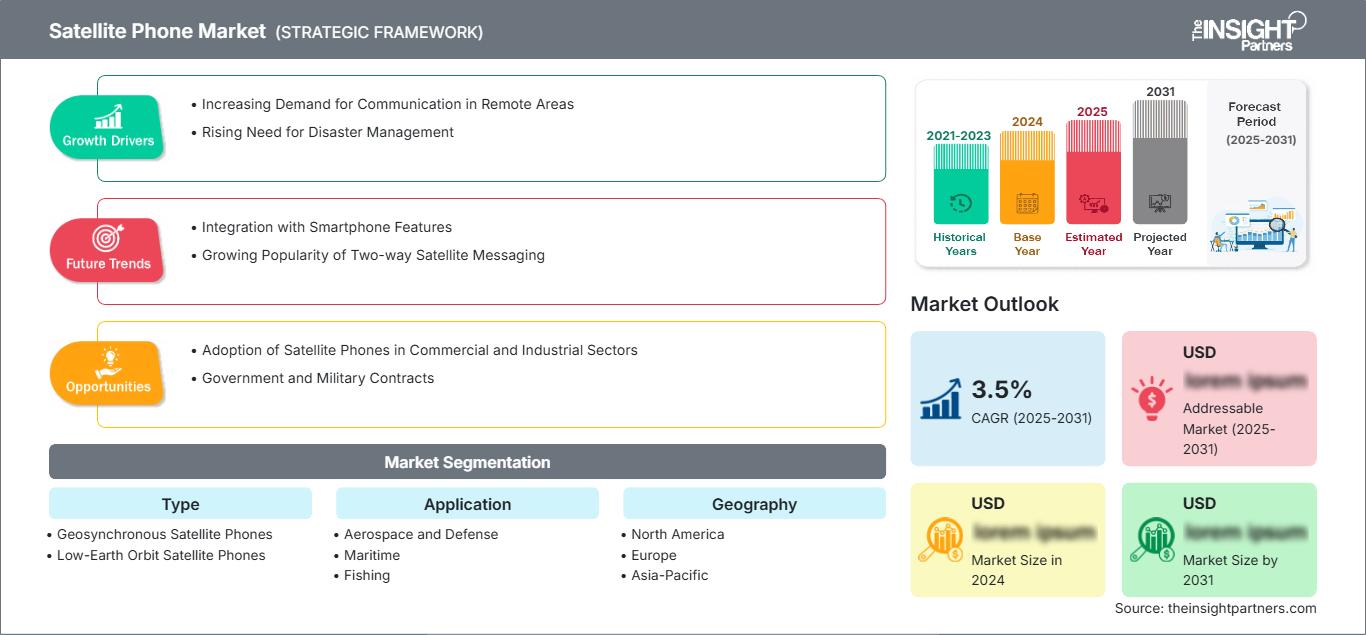
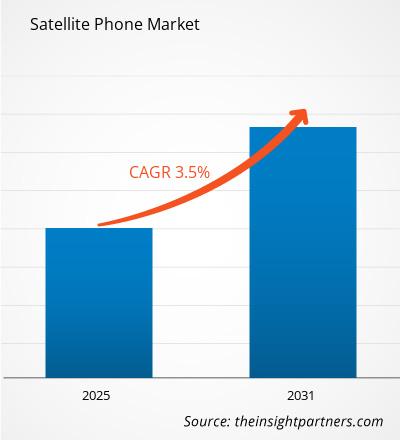
The satellite phone market is valued at US$ 988.74 Million in 2025 and is projected to reach US$ 1326.23 Million by 2034, registering a CAGR of 3.32% during 2026–2034. The market encompasses handset technologies operating through geosynchronous and low-earth-orbit satellite architectures, serving applications where terrestrial communications are unavailable, unreliable, or operationally insufficient.
North America remains a structurally important demand center, supported by government communications, emergency response, remote industrial activity, outdoor recreation, and maritime operations. The satellite phone market size in the region is expected to expand at a modeled CAGR of 3.5–4.0% between 2026–2034, with replacement demand and resilient communications infrastructure supporting sustained equipment adoption.
Satellite Phone Market Assessment and Insights
- North America: North America is estimated to hold a 34–38% share in 2025 and is expected to grow at a CAGR of 3.5–4.0% between 2026–2034, supported by defense, emergency communications, remote operations, and outdoor connectivity requirements.
- US: The US represents approximately 78–82% of North American revenue in 2025, with a modeled CAGR of 3.6–4.1% through 2034, led by government, defense, and remote communications requirements.
- Europe: Europe is estimated at a 22–26% share in 2025 and is projected to grow at 3.0–3.5% CAGR, with Germany, the UK, France, Italy, and Norway supporting maritime, emergency, and industrial applications.
- Asia Pacific: Asia Pacific accounts for an estimated 20–24% share in 2025 and is forecast to expand at 4.0–4.6% CAGR, led by China, Japan, India, South Korea, and Australia.
- Largest Segment: Aerospace and Defense is estimated to represent a 38–42% market share in 2025, with a 3.8–4.3% CAGR through 2034 as secure remote communications remain strategically important.
- High Growth Segment: Maritime is estimated at a 25–29% share in 2025 and is projected to grow at 4.0–4.6% CAGR, supported by safety and operational communications.
- Key companies analyzed in detail: Beam Communications Pty. Ltd., Bharat Sanchar Nigam Limited, Garmin Ltd., Globalstar, Inmarsat, Iridium Communications Inc., K.S.C, KVH Industries, Inc., Thuraya Telecommunications Company, and TS2 Space Sp. z o.o.
Source: The Insight Partners' analysis based on proprietary research, government publications, company annual reports, investor presentations, industry databases, and expert interviews.
The satellite phone market has evolved from specialized voice-only equipment toward multifunctional communication platforms integrating messaging, location tracking, emergency signaling, and increasingly compact hardware. LEO architectures have strengthened the proposition for lower-latency connectivity, while established satellite networks continue serving government, maritime, aviation, and remote industrial users. Device manufacturers increasingly differentiate through battery efficiency, ruggedization, network coverage, interoperability, and service bundles rather than handset functionality alone.
Over the forecast period, procurement is expected to broaden across emerging industrial geographies and applications requiring communications resilience. Regulatory requirements for maritime safety, government communications, and emergency preparedness can support replacement cycles, while lower device costs and subscription flexibility can improve accessibility. Investment in satellite constellations, ground infrastructure, and direct-to-device capabilities should also influence the competitive environment, although conventional satellite phones will continue to occupy specialized communications niches.
Satellite Phone Market Report Scope
| Report Attribute | Details |
|---|---|
| Market size in 2025 | US$ 988.74 Million |
| Market Size by 2034 | US$ 1,326.23 Million |
| Global CAGR (2026 - 2034) | 3.32% |
| Historical Data | 2021-2024 |
| Forecast period | 2026-2034 |
Satellite Phone Market Analysis
Demand is concentrated where terrestrial cellular infrastructure cannot reliably provide coverage. Aerospace and defense organizations prioritize secure voice and data communications, while maritime operators require dependable connectivity during offshore operations. Fishing fleets, expedition teams, emergency agencies, mining operations, and remote infrastructure contractors represent additional addressable demand. The satellite phone market growth trajectory therefore, depends less on mass consumer penetration and more on mission-critical use cases where communication failure carries substantial operational consequences.
The ecosystem includes satellite operators, handset manufacturers, service providers, distributors, government agencies, and enterprise users. Iridium Communications Inc. reported approximately 2.537 million billable subscribers at the end of 2025 and identified remote communications, emergency response, regulatory mandates, and improving mobile satellite services as important industry drivers. Supply dynamics increasingly reflect integration between satellite networks and terrestrial connectivity, with LEO infrastructure creating opportunities for more responsive communications and device ecosystems.
Competition is shaped by network coverage, spectrum access, service availability, handset durability, pricing, and channel reach. Iridium Communications Inc. maintains a strong position in mission-critical communications, while Globalstar is expanding its infrastructure and government-oriented positioning. Globalstar reported 2025 revenue of US$273.0 million, up 9% year over year, while continuing investment in next-generation constellation and ground infrastructure. Garmin Ltd. is extending satellite connectivity into adjacent personal devices, increasing competitive overlap between traditional satellite phones and multifunctional communicators.
Strategic positioning is consequently shifting toward broader communication ecosystems rather than standalone handsets. Garmin's integration of satellite connectivity into watches and compact communicators illustrates this transition, while Globalstar's infrastructure expansion demonstrates the importance of network scale. The Satellite Phone Market report highlights that operators and manufacturers combining reliable coverage, simplified subscription models, rugged hardware, and emergency-response capabilities are better positioned to capture replacement demand and adjacent applications without depending solely on conventional satellite voice services.
● REPORT CUSTOMIZATION
Tailor This Report To Align With Your Specific Business Requirements
This report can be customized to align precisely with your business objectives, scope, and target markets. Customization options include tailored segmentation, geography, competitive analysis, and strategic insights to support informed decision-making.
Customize This Report →WHAT YOU CAN ADJUST
- ● Segmentations
- ● Geography
- ● Competitive Analysis
- ● Language Preferences
Satellite Phone Market: Strategic Insights
Regional Insights
North America satellite phone market
North America is estimated to account for 34–38% of the satellite phone market share in 2025 and is projected to register a 3.5–4.0% CAGR through 2034. The US dominates regional demand because government agencies, defense organizations, emergency responders, outdoor users, and remote industrial operators require communications beyond terrestrial network coverage. Procurement is also supported by the geographic scale of Alaska, northern Canada, offshore operations, and remote infrastructure projects.
Canada contributes through mining, forestry, maritime activity, emergency response, and northern communities, where terrestrial coverage remains uneven. The US market benefits from established distribution channels and extensive government procurement, while Mexico contributes through energy, logistics, maritime, and remote industrial applications. Product demand increasingly favors compact terminals, two-way messaging, tracking, and SOS capabilities. The regional market is therefore expected to remain equipment-intensive while gradually incorporating multifunctional satellite communicators alongside conventional handsets.
U.S. satellite phone Market
The US represents approximately 78–82% of North American market revenue in 2025 and is expected to expand at a 3.6–4.1% CAGR during 2026–2034. Defense and government applications provide a stable foundation because secure, resilient communications remain necessary where terrestrial infrastructure is unavailable or compromised. Commercial demand extends across maritime, energy, emergency response, construction, logistics, and outdoor recreation. The Satellite Phone Market forecast indicates continued growth as organizations prioritize reliable connectivity, disaster preparedness, remote operations support, and communication resilience across critical and infrastructure-challenged environments.
Garmin Ltd., Globalstar, Iridium Communications Inc., and other satellite communications providers have established commercial and institutional channels across the country. Demand is shifting toward integrated devices offering text, location, and SOS functions alongside voice. Government requirements for resilient communications and private-sector investment in remote operations should support replacement demand, while consumer adoption remains more selective because cellular and broadband alternatives cover most populated areas.
Europe satellite phone Market
Europe is estimated to represent 22–26% of the satellite phone market in 2025 and is projected to grow at a 3.0–3.5% CAGR through 2034. The region's demand is supported by maritime safety, offshore energy, emergency communications, defense, and remote travel. Northern European countries maintain particularly strong maritime requirements, while Western European markets support enterprise and government procurement. The Satellite Phone Market trends indicate growing emphasis on integrated satellite connectivity, emergency-response capabilities, resilient communications infrastructure, and expanded coverage solutions for commercial, government, and maritime users.
The UK maintains demand across maritime, defense, emergency response, and offshore energy. Germany provides a substantial industrial and logistics base, with satellite communications supporting specialized remote operations and resilient communications requirements. France benefits from aerospace, defense, maritime, and overseas operational needs. Italy and Spain contribute through shipping, fishing, tourism, emergency services, and offshore activity. Across the region, regulatory compliance and safety requirements support continued demand, with maritime applications providing an important recurring use case.
APAC satellite phone Market
Asia Pacific is estimated to account for 20–24% of the market in 2025 and is forecast to grow at 4.0–4.6% CAGR through 2034. China, Japan, South Korea, India, and Australia represent important demand centers. Australia has particularly strong requirements across mining, emergency response, agriculture, maritime activity, and remote travel, while Japan and South Korea maintain significant maritime and industrial applications.
India's remote geography and expanding industrial infrastructure create opportunities, although regulatory controls influence deployment. China combines maritime, industrial, and government requirements, while Japan and South Korea benefit from sophisticated shipping and technology ecosystems. APAC's leading growth potential reflects expanding remote operations, disaster preparedness, and industrial connectivity requirements, with LEO network expansion potentially broadening addressable applications.
Middle East & Africa satellite phone Market
The Middle East and Africa region is expected to record a 3.0–3.6% CAGR through 2034. Saudi Arabia and the UAE provide demand through energy, infrastructure, defense, logistics, and remote-site operations, while South Africa supports mining, emergency response, and industrial communications. Rest-of-region demand is concentrated in remote environments where cellular coverage is limited.
Energy exploration and infrastructure development create recurring requirements for resilient communications across isolated locations. Maritime activity in the Red Sea, Arabian Gulf, and African coastal markets adds another use case. Regulatory conditions differ significantly between countries, making distribution partnerships and local compliance capabilities important. The region's opportunity is therefore more specialized than mass-market, with government, energy, mining, maritime, and emergency applications providing the strongest commercial foundation.
Segmentation Analysis
Type
The type segment differentiates devices according to satellite-orbit architecture and resulting coverage characteristics. The segment is expected to expand at a modeled 3.4–3.9% CAGR during 2026–2034. Demand increasingly reflects requirements for coverage, latency, reliability, handset size, and network availability rather than orbit classification alone. LEO systems are gaining strategic attention, while geosynchronous systems remain important across established satellite communication networks.
- Geosynchronous Satellite Phones: These devices serve established satellite communication applications requiring broad geographic coverage and dependable voice connectivity. They remain strategically relevant for government, maritime, and remote commercial users with established network relationships.
- Low-Earth Orbit Satellite Phones: LEO devices benefit from shorter signal paths and increasing constellation investment. Their strategic importance is rising as users seek lower latency, compact hardware, and integration with broader satellite communication ecosystems.
Application
The application represents the principal demand structure because purchasing decisions are strongly influenced by operational risk and communications requirements. The segment is projected to grow at a modeled 3.7–4.2% CAGR through 2034. Aerospace and defense remain the largest applications, while maritime and fishing provide recurring specialized demand. The satellite phone market scope increasingly includes emergency communications and remote operational continuity.
- Aerospace and Defense: Mission-critical communications, secure operations, remote deployments, and continuity requirements sustain high-value procurement. Buyers prioritize network availability, security, ruggedness, and compatibility with broader government communication systems.
- Maritime: Vessel safety, offshore operations, fleet coordination, and emergency communications underpin adoption. Regulatory requirements and communications redundancy make satellite connectivity particularly important when vessels operate outside terrestrial coverage.
- Fishing: Commercial fishing fleets use satellite communications for safety, coordination, weather information, and shore connectivity. Demand is strongest where vessels operate far offshore for extended periods.
- Others: Emergency response, expedition travel, mining, energy, construction, and remote infrastructure provide diversified demand. These users generally prioritize portability, battery endurance, tracking, and simple emergency communication capabilities.
Opportunity Snapshot
| Application | Revenue Contribution (High/Medium/Low) | Trend Tag | Adoption Stage |
| Aerospace and Defense | High | Secure Comms | Mature |
| Maritime | High | Fleet Safety | Scaling |
| Fishing | Medium | Offshore Safety | Scaling |
| Others | Low | Remote Response | Emerging |
Satellite Phone Market Growth Drivers and Impact Analysis
Remote and Mission-Critical Communications Requirements
Remote operations will continue to serve as a key demand pull factor as the satellite phones enable communication in locations where there is no cellular network or the network is unreliable or inappropriate for operational use. Defense operations, ships at sea, mining operations, rescue services, explorers, and remote infrastructure construction efforts do not always have the option of using the terrestrial network. Thus, the procurement strategy for such clients is driven by communication availability as opposed to standard consumer communication needs. The consequence is especially pronounced for those clients who risk being unable to carry out their operations when communication fails. This makes the evaluation of equipment focus on its dependability, coverage, power consumption, durability, and emergency functionality.
Government and Defense Communications Resilience
Demand from governments and defense agencies is relatively resilient due to the capability of satellite communication to offer connectivity in challenging or remote areas. According to Iridium Communication Inc., there are needs such as global coverage, mobility, security, voice, and two-way data transmission in addition to being capable of Type I encryption, among other factors, on the part of the government customers in the United States, which is facilitated by its 9575A mobile phone. These demands set high standards within the general commercial market in terms of security, network stability, and durability. Predictable replacement cycles and special product needs may also be created in procurement programs.
Expansion of Satellite Connectivity Infrastructure
Satellite constellation and infrastructure investments have increased the technological base that can be leveraged by satellite communication providers. Globalstar’s activities for 2025 entailed an increase in ground infrastructure as well as constellation development. This involved the creation of more capacity for satellite-enabled connectivity solutions by the provider. Increasing infrastructure can help to achieve improved resilience, network capacity, geographic presence, and allow for the introduction of new configurations of devices and services by providers. The effect on the market will be slow due to long replacement cycles of satellite phones compared to mainstream consumer products. Still, better economics and coverage may promote the adoption of new use cases, facilitate small devices, and lower barriers to organizations considering satellite communication too niche or expensive.
Satellite Phone Market Future Trends
Convergence of Satellite Phones and Multifunctional Communicators
The satellite phone market is moving toward multifunctional communication devices that combine voice, messaging, location tracking, SOS, and increasingly richer media capabilities. Garmin's 2025 introduction of the inReach Mini 3 Plus illustrates this transition by adding voice messages, text, photo sharing, and interactive SOS functionality to a compact satellite communicator. This convergence could gradually reduce the distinction between conventional satellite phones and personal satellite communicators. Buyers are likely to favor devices that provide multiple communication functions without requiring separate equipment. Manufacturers will therefore compete increasingly on software, user interfaces, subscription ecosystems, battery management, emergency services, and integration with smartphones and wearable devices rather than on satellite voice capability alone.
Integration of LEO Connectivity Into Broader Mobile Ecosystems
The architecture of LEO satellites continues to impact the satellite connectivity strategy by providing low latencies, increased network capabilities, and compatibility with ground-based telecommunications. The Globalstar investment in the network infrastructure, along with the implementation of LEO satellites both commercially and by the governments, indicates how the industry is heading towards creating more extensive communication environments. This may eventually lead to hybrid communication ecosystems where satellite-based connectivity works alongside cellular-based connectivity as opposed to working completely independently. The main implication of this trend for satellite phone manufacturers includes interoperability, small antennas, software-defined functions, and multi-mode service plans.
Satellite Phone Market Opportunities
Government and Defense Replacement Programs
Government and military equipment replacement is a great business opportunity for companies able to provide high-security, reliable, and interoperable products. In today’s world, procurement agencies need communications equipment that will operate in case of failure of terrestrial networks due to various reasons. A supplier can exploit this opportunity by offering ruggedized mobile phones, secured communications, lifecycle management, network management, and special service agreements. This business opportunity includes not only selling equipment itself but also providing training, support services, replacement batteries, accessories, software updates, and connectivity. It is also possible for firms already operating in the field of government equipment to leverage such an opportunity to retain clients and boost their contracts. Collaboration with satellite communications providers, systems integrators, and defense contractors can help overcome qualification, certification, and regional regulation barriers.
Maritime Safety and Remote Industrial Connectivity
A third opportunity lies in the maritime and remote industrial segments since this segment requires continuous communications capabilities despite being beyond the reach of terrestrial networks. Vessels, offshore energy companies, mining companies, emergency teams, and remote infrastructure providers may all benefit from small devices that have voice, messaging, tracking, and emergency capability built into them. Vendors can pursue the opportunity by providing fleet bundles, managed connectivity services, ruggedized equipment, and integration with safety systems. Maritime regulation could help to create recurring demand if there is approval for the use of satellite equipment for safety communications. For instance, in India, existing maritime guidance allows for the use of approved Iridium GMDSS terminals for certain distress and safety communications, but not other satellite phones.
Frequently Asked Questions

- Comprehensive Market Sizing and Forecast Analysis
- Detailed Segmentation Analysis
- In-Depth Market Dynamics Assessment
- Regional and Country-Level Insights
- Competitive Landscape and Company Benchmarking
- Strategic Business Intelligence
Recent Reports
Testimonials

The Insight Partners provided valuable market intelligence that supported our global go-to-market strategy. Their team was professional, responsive, and attentive to our feedback, providing thoughtful analysis and helpful methodological clarifications throughout the project.
Junmo Kim Chief Financial Officer (CFO), Enertech Co., Ltd.
The Insight Partners' SCADA System Market report is comprehensive, with valuable insights on current trends and future forecasts. The team was highly professional, responsive, and supportive throughout. We are very satisfied and highly recommend their services.
RAN KEDEM Partner, Reali Technologies LTDs
I requested a report on a very specific software market and the team produced the report in a few days. The information was very relevant and well presented. I then requested some changes and additions to the report. The team was again very responsive and I got the final report in less than a week.
JEAN-HERVE JENN Chairman, Future Analytica
We worked with The Insight Partners for an important market study and forecast. They gave us clear insights into opportunities and risks, which helped shape our plans. Their research was easy to use and based on solid data. It helped us make smart, confident decisions. We highly recommend them.
PIYUSH NAGPAL Sr. Vice President, High Beam Global
The Insight Partners delivered insightful, well-structured market research with strong domain expertise. Their team was professional and responsive throughout. The user-friendly website made accessing industry reports seamless. We highly recommend them for reliable, high-quality research services
YUKIHIKO ADACHI CEO, Deep Blue, LLC.
This is the first time I have purchased a market report from The Insight Partners.While I was unsure at first, I visited their web site and felt more comfortable to take the risk and purchase a market report.I am completely satisfied with the quality of the report and customer service. I had several questions and comments with the initial report, but after a couple of dialogs over email with their analyst I believe I have a report that I can use as input to our strategic planning process.Thank you so much for taking the extra time and making this a positive experience.I will definitely recommend your service to others and you will be my first call when we need further market data.
JOHN SUZUKI President and Chief Executive Officer, Board Director, BK Technologies
I wish to appreciate your support and the professionalism you displayed in the course of attending to my request for information regarding to infectious disease IVD market in Nigeria. I appreciate your patience, your guidance, and the fact that you were willing to offer a discount, which eventually made it possible for us to close a deal. I look forward to engaging The Insight Partners in the future, all thanks to the impression you have created in me as a result of this first encounter.
DR CHIJIOKE ONYIA MANAGING DIRECTOR, PineCrest Healthcare Ltd.Reason to Buy
- Informed Decision-Making
- Understanding Market Dynamics
- Competitive Analysis
- Identifying Emerging Markets
- Customer Insights
- Market Forecasts
- Risk Mitigation
- Boosting Operational Efficiency
- Strategic Planning
- Investment Justification
- Tracking Industry Innovations
- Aligning with Regulatory Trends





 Get Free Sample for