
Service Mesh tools Market Share, Size & Demand by 2034
Coverage: By Type (Kubernetes, Other Environments); Application (Large Enterprises, SMEs) , and Geography (North America, Europe, Asia Pacific, and South and Central America)
- Status : Data Released
- Report Code : TIPRE00026355
- Category : Electronics and Semiconductor
- No. of Pages : 150
- Available Report Formats :


- Last update date : July 17, 2026


2025 Market Size
US$ 356.58 Mn
Base year value
2034 Forecast
US$ 2,150.73 Mn
Projected by 2034
CAGR 2026-2034
22.1 %
Growth rate
Addressable Market
US$ 9,912.81 Mn
(2026-2034)
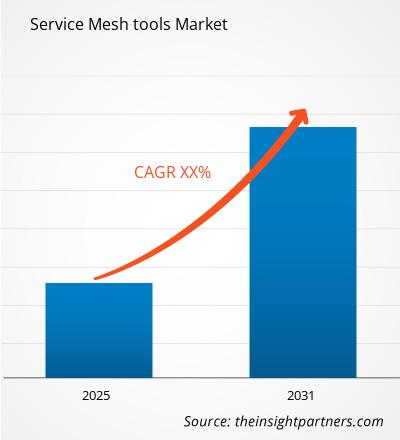
The Service Mesh tools market was valued at US$ 356.58 million in 2025 and is expected to reach US$ 2150.73 million by 2034; it is estimated to record a CAGR of 22.1% during 2026-2034.
Service Mesh tools Market Assessment and Insights
- North America accounted for 39–42% share in 2025 and is growing at a CAGR of 24–26% during 2026–2034, led by Kubernetes consolidation, compliance automation, and large enterprise platform engineering investments.
- US represented 78–82% of North America in 2025 and is growing at a CAGR of 24–26% during 2026–2034, supported by hyperscaler ecosystems and regulated workloads.
- Europe held 24–27% share in 2025 and is growing at a CAGR of 23–25% during 2026–2034, with the UK, Germany, and France leading demand for secure cloud-native operations.
- Asia Pacific captured 22–25% share in 2025 and is growing at a CAGR of 27–30% during 2026–2034, led by China, Japan, India, South Korea, and Australia.
- Largest Segment Kubernetes held 72–76% market share in 2025 and is growing at a CAGR of 25–27% during 2026–2034 as container orchestration becomes the primary mesh deployment environment.
- High Growth Segment SMEs held 30–34% market share in 2025 and are growing at a CAGR of 27–30% during 2026–2034 as managed cloud services reduce adoption complexity.
- Key companies analyzed in detail: Google LLC, Buoyant Inc., Aspen Mesh, F5, Inc., Amazon Web Services, Inc., Grey Matter, Kong Inc., Tetrate.io, Inc., Traefik Labs SAS, Solo.io, Inc.
Source: The Insight Partners' analysis based on proprietary research, government publications, company annual reports, investor presentations, industry databases, and expert interviews.
Enterprise service communication has moved from application-level libraries to infrastructure-level control planes as Kubernetes estates expanded across production environments. Service Mesh Tools now address traffic policy, telemetry, certificate rotation, and workload identity without requiring changes to application code. Production dynamics are also shifting from self-managed open-source deployments toward supported distributions, managed cloud offerings, and lower-overhead architectures that reduce proxy resource consumption while preserving zero-trust controls. These developments continue to shape the Service Mesh Tools Market across enterprise cloud environments.
Over the forecast period, adoption will widen beyond digital-native firms into financial services, telecom, healthcare, government, and industrial software teams. Emerging geographies are expected to increase spending as sovereign cloud programs, cybersecurity rules, and local data residency policies push organizations toward auditable service-to-service encryption. Vendor investment is likely to focus on managed control planes, AI workload governance, and interoperability with gateway, API security, and observability stacks.
Service Mesh tools Market Report Scope
| Report Attribute | Details |
|---|---|
| Market size in 2025 | US$ 356.58 Million |
| Market Size by 2034 | US$ 2,150.73 Million |
| Global CAGR (2026 - 2034) | 22.1% |
| Historical Data | 2021-2024 |
| Forecast period | 2026-2034 |
Service Mesh tools Market Analysis
Service mesh tools market growth is driven by rising microservice density, hybrid cloud deployment, and the operational need to standardize traffic management across clusters. As teams deploy hundreds of services, manual configuration of retries, timeouts, mutual TLS, and access policies becomes unreliable. Platform teams, therefore, use service mesh layers to decouple networking controls from application code and create reusable governance patterns.
The ecosystem includes open-source projects, cloud-native vendors, managed hyperscaler services, API gateway suppliers, and observability providers. Demand is strongest where enterprises operate Kubernetes at scale and require consistent security evidence for audits. Supply dynamics are moving toward lighter data planes, managed upgrades, and integration with policy-as-code pipelines, reducing the operational burden that previously slowed mesh programs within the Service Mesh Tools Market.
Service mesh tools market analysis indicates a competitive landscape split between hyperscaler-native platforms and specialist vendors focused on portability. Google LLC focuses on offering managed cloud mesh features, whereas Amazon Web Services, Inc. is directing customers towards adjacent application network features. The competition among Buoyant Inc., Tetrate.io, Inc., Solo.io, Inc., Traefik Labs SAS, Kong Inc., and F5, Inc. will involve enterprise support, gateway, security policies, and multi-cluster operations.
The focus areas for investments are moving from basic service discovery to governance, automation, and reliable results measurement. Aspen Mesh and Grey Matter cater to regulated and government sectors where policy enforcement and auditability are must-haves. Service mesh vendors that have defined migration plans, simple deployment models, and better observability integrations can get the budget of enterprises once they graduate from engineering experiments to platforms.
● REPORT CUSTOMIZATION
Tailor This Report To Align With Your Specific Business Requirements
This report can be customized to align precisely with your business objectives, scope, and target markets. Customization options include tailored segmentation, geography, competitive analysis, and strategic insights to support informed decision-making.
Customize This Report →WHAT YOU CAN ADJUST
- ● Segmentations
- ● Geography
- ● Competitive Analysis
- ● Language Preferences
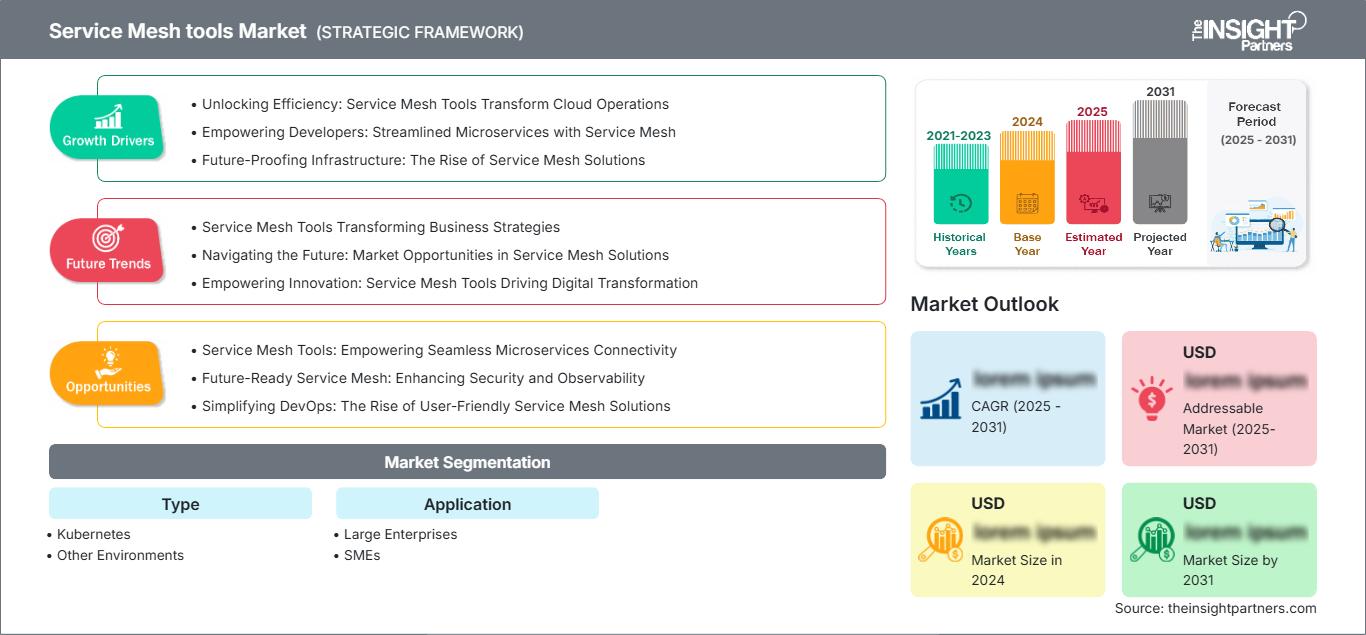
Service Mesh tools Market: Strategic Insights
Regional Insights
North America Service Mesh Tools Market
North America held 39–42% share in 2025 and is expected to grow at a CAGR of 24–26% during 2026–2034. The region benefits from early Kubernetes adoption, high cloud spending, and strict requirements for encrypted internal traffic. Service mesh tools market share is reinforced by financial institutions, healthcare networks, and software companies that need auditable identity controls across distributed platforms.
Structural drivers include multi-cloud resilience programs, SRE maturity, and growing public sector interest in zero-trust architectures. Organizations are using mesh layers to reduce duplicated networking logic and improve incident response with service-level metrics. Managed offerings are gaining attention because they lower upgrade risk, an important issue for large clusters running mission-critical payment, logistics, and digital health applications.
U.S. Service Mesh Tools Market
The U.S. accounted for 78–82% of North America in 2025 and is projected to record a CAGR of 24–26% during 2026–2034. Adoption is concentrated among cloud-first enterprises, federal contractors, large retailers, and technology providers. Service Mesh Tools Market demand is increasingly driven by organizations evaluating service mesh solutions alongside API gateways, workload identity platforms, and observability suites to improve control over internal application traffic.
Company presence is deep, with Google LLC, Amazon Web Services, Inc., Buoyant Inc., Solo.io, Inc., Tetrate.io, Inc., Kong Inc., and F5, Inc. supporting enterprise deployments. Application trends include progressive delivery, policy-based access, and encrypted service communication in regulated workloads. Migration planning around cloud-native networking is also increasing interest in vendor-supported alternatives and portable mesh architectures.
Europe Service Mesh Tools Market
Europe represented 24–27% share in 2025 and is forecast to grow at a CAGR of 23–25% during 2026–2034. The UK is the top-ranking country, driven by the evolution of its financial services, cloud governance, and digital public infrastructure. The demand is highest for countries where regulated organizations have a need for verifiable encryption, service identification, and policy management within their distributed software assets.
Germany ranks second with manufacturers, insurance firms, and software vendors upgrading to containers with a high degree of reliability in mind. France, Italy, and Spain are growing the use of technology through telecom clouds, banking transformation, and public sector digitalization. European customers tend to prioritize sovereignty, auditability, and interoperability, which makes Service Mesh Tools advantageous.
APAC Service Mesh Tools Market
APAC held 22–25% share in 2025 and is expected to grow at a CAGR of 27–30% during 2026–2034, making it the fastest regional growth zone. China leads regional demand, while Japan, South Korea, India, and Australia are expanding Kubernetes operations across finance, telecom, e-commerce, and digital government platforms. These developments are accelerating the growth of the Service Mesh Tools Market across the Asia-Pacific region.
Industrial digitization, 5G core modernization, data localization, and cloud security policies are accelerating adoption. Buyers often prefer managed or supported distributions to reduce skills gaps. Service Mesh Tools are also being adopted by platform teams seeking consistent telemetry and encrypted service communication across mixed public cloud and private infrastructure environments.
Middle East & Africa Service Mesh Tools Market
The Middle East & Africa is projected to grow at a CAGR of 22–24% during 2026–2034, with Saudi Arabia leading regional adoption. The UAE, South Africa, and the rest of MEA are increasing investment in cloud platforms, smart government services, financial technology, and energy-sector digitalization, where secure service communication is increasingly required, supporting the expansion of the Service Mesh Tools Market across the region.
Energy companies and infrastructure operators are modernizing applications that connect field systems, analytics platforms, and customer services. Service mesh adoption remains selective but is rising as regional cloud regions, cybersecurity strategies, and digital sovereignty programs mature. Supported deployments are preferred because in-house Kubernetes and observability skills are still developing unevenly.
Segmentation Analysis
Type
Type is expected to grow at a CAGR of 24–27% during 2026–2034 as deployment environments diversify. The service mesh tools market scope is centered on Kubernetes, but enterprises are also evaluating ways to extend identity, traffic control, and telemetry to virtual machines, hybrid clusters, and serverless workloads. Platform teams increasingly prioritize consistent policy models over environment-specific networking tools.
- Kubernetes remains the dominant deployment environment because it aligns naturally with sidecar injection, service discovery, and container lifecycle automation, making it strategically central to enterprise mesh standardization.
- Other Environments include virtual machines, hybrid infrastructure, and cloud-run services, where buyers seek consistent identity, telemetry, and routing controls without fully refactoring existing applications.
Application
The application is expected to exhibit a compound annual growth rate of 25–28% from 2026 to 2034 due to the deployment of cloud-native services by both large corporations and SMEs. While the former focus on regulatory requirements, governance across multiple clusters, and resilience, the latter favor managed services due to their easy-to-manage service discovery and communication facilities.
- Large Enterprises generate the highest revenue contribution due to complex microservice estates, regulated workflows, and dedicated platform engineering teams managing multi-cluster security, observability, and release controls.
- SMEs are moving from experimentation to adoption as managed Kubernetes services, simplified installers, and bundled observability reduce the operational skills needed to deploy mesh capabilities.
Opportunity Snapshot
| Segment Name | Revenue Contribution | Trend Tag | Adoption Stage |
| Large Enterprises | High | Zero Trust | Mature |
| SMEs | Medium | Managed Mesh | Scaling |
Service Mesh tools Market Growth Drivers and Impact Analysis
Rising Kubernetes Production Complexity
As companies expand their use of Kubernetes from individual projects into shared platforms for production, it becomes increasingly difficult to manage service communications manually. The Service Mesh Tools provide platform engineers with ways to configure consistent retries, timeouts, identities, and encryption in services that have been built by different teams. Its effect is most pronounced in companies operating a hundred services where a single misconfiguration in a dependency may disrupt customer-facing services. This driver benefits from meshing since it helps avoid duplicating networking code, improves troubleshooting incidents, and facilitates progressive delivery methods.
Zero-Trust Security Requirements for Internal Traffic
It is becoming common for security professionals to see the east-west application traffic as a significant risk surface rather than an automatically trusted network environment. The Service Mesh Tools enable mutual TLS authentication, workload identification, and access based on policies at the service level. There is an impact of this market in the financial industry, medical care, government organizations, and the energy sector because the presence of the encryption in the internal communication can affect the purchase decision. Another feature of the mesh is that there is a separation of duties between developers and security teams through the policies.
Need for Unified Observability Across Distributed Services
There will be operational blind spots within distributed applications since the logging, metric collection, and tracing are not consistent among teams and environments. The reason why there are Service Mesh Tools is to provide a unified telemetry layer wherein the success rate of requests, latency, traffic flow, and failures are gathered without having to add network-related code instrumentation by individual development teams. This is important from a commercial perspective since observability is directly related to service level objectives, incident management, and customer experience.
Service Mesh tools Market Future Trends
AI Workload Governance Through Mesh Layers
Service mesh tools market trends are expanding toward governance for AI agents and model-connected services that generate unpredictable, long-lived, and high-volume traffic patterns. Future mesh deployments are expected to monitor prompt-related requests, enforce identity-based access between agents, and apply traffic shaping when inference workloads create resource spikes. This trend moves mesh value beyond conventional microservices into AI operating environments where visibility, authorization, and reliability controls must work continuously. Vendors that support emerging protocols and AI-specific telemetry can address a new class of enterprise risk without forcing separate governance infrastructure.
Lower-Overhead and Sidecar-Reduced Architectures
Future adoption will depend on how well the vendors manage to mitigate the resource costs that have been traditionally seen with sidecar-centric implementations. Companies are looking into ambient, proxyless, and light-weight data plane designs that offer the same policy and telemetry capabilities without increasing memory, CPU, and operations overhead. It is critical in terms of saving money in Kubernetes clusters that operate on tight budgets, as well as at edge locations and in dense clusters, where every additional proxy means additional infrastructure cost.
Service Mesh tools Market Opportunities
Managed Mesh Services for Midmarket Kubernetes Teams
Such mid-market firms often understand the importance of security in service communication, but are not capable of performing the platform engineering necessary for running complicated mesh stacks. The vendors can take advantage of the difference by providing managed control planes, opinionated defaults, automated certificate renewal, and observability guidance. This is particularly true for cloud providers who are able to deliver mesh capabilities as a part of their Kubernetes management, API gateway, and developer portal services.
Regulated Industry Compliance and Audit Automation
Regulated industries offer a high-value opportunity because mesh capabilities map directly to encryption, identity, access control, and operational evidence requirements. Financial institutions, healthcare networks, government agencies, and energy operators need repeatable controls that can be demonstrated during audits without slowing application release cycles. Vendors can differentiate by providing compliance dashboards, policy templates, signed software supply chain artifacts, and integrations with security information platforms. This opportunity favors providers that combine technical mesh functions with documentation, support, and assurance workflows aligned with enterprise risk management processes.
Recent Developments
- June 2026: Buoyant Enterprise for Linkerd 2.20 is now available! This release automates rotation of mTLS trust anchors; adds support for Windows VMs running outside of Kubernetes; and improves circuit breaking and load balancing (including zone-aware HAZL balancing) to be aware of rate-limited services. Linkerd 2.20 also improves memory consumption of the control plane, especially on busy clusters, and promotes native sidecars to the default deployment type for Linkerd’s data plane microproxies.
- November 2025: Buoyant, the company behind the open-source Linkerd service mesh, announced that Linkerd now supports the Model Context Protocol (MCP), making it the first service mesh to natively manage, secure, and observe agentic AI traffic in Kubernetes environments. The move is designed to accelerate enterprise AI adoption by offering a stable, secure, and fully observable runtime for AI-driven workflows, which behave differently from traditional API-based applications.
- September 2024: Amazon Web Services, Inc. — AWS announced that AWS App Mesh will be discontinued on September 30, 2026, and guided customers toward Amazon ECS Service Connect and Amazon VPC Lattice migration paths.
Frequently Asked Questions

- Comprehensive Market Sizing and Forecast Analysis
- Detailed Segmentation Analysis
- In-Depth Market Dynamics Assessment
- Regional and Country-Level Insights
- Competitive Landscape and Company Benchmarking
- Strategic Business Intelligence
Recent Reports
Testimonials

The Insight Partners' SCADA System Market report is comprehensive, with valuable insights on current trends and future forecasts. The team was highly professional, responsive, and supportive throughout. We are very satisfied and highly recommend their services.
RAN KEDEM Partner, Reali Technologies LTDs
I requested a report on a very specific software market and the team produced the report in a few days. The information was very relevant and well presented. I then requested some changes and additions to the report. The team was again very responsive and I got the final report in less than a week.
JEAN-HERVE JENN Chairman, Future Analytica
We worked with The Insight Partners for an important market study and forecast. They gave us clear insights into opportunities and risks, which helped shape our plans. Their research was easy to use and based on solid data. It helped us make smart, confident decisions. We highly recommend them.
PIYUSH NAGPAL Sr. Vice President, High Beam Global
The Insight Partners delivered insightful, well-structured market research with strong domain expertise. Their team was professional and responsive throughout. The user-friendly website made accessing industry reports seamless. We highly recommend them for reliable, high-quality research services
YUKIHIKO ADACHI CEO, Deep Blue, LLC.
This is the first time I have purchased a market report from The Insight Partners.While I was unsure at first, I visited their web site and felt more comfortable to take the risk and purchase a market report.I am completely satisfied with the quality of the report and customer service. I had several questions and comments with the initial report, but after a couple of dialogs over email with their analyst I believe I have a report that I can use as input to our strategic planning process.Thank you so much for taking the extra time and making this a positive experience.I will definitely recommend your service to others and you will be my first call when we need further market data.
JOHN SUZUKI President and Chief Executive Officer, Board Director, BK Technologies
I wish to appreciate your support and the professionalism you displayed in the course of attending to my request for information regarding to infectious disease IVD market in Nigeria. I appreciate your patience, your guidance, and the fact that you were willing to offer a discount, which eventually made it possible for us to close a deal. I look forward to engaging The Insight Partners in the future, all thanks to the impression you have created in me as a result of this first encounter.
DR CHIJIOKE ONYIA MANAGING DIRECTOR, PineCrest Healthcare Ltd.Reason to Buy
- Informed Decision-Making
- Understanding Market Dynamics
- Competitive Analysis
- Identifying Emerging Markets
- Customer Insights
- Market Forecasts
- Risk Mitigation
- Boosting Operational Efficiency
- Strategic Planning
- Investment Justification
- Tracking Industry Innovations
- Aligning with Regulatory Trends





 Get Free Sample for