
Shuttle Blister Packaging Systems Market Growth, Share & Trends by 2034
Coverage: by Station Type (Single station, Two Stations, Multiple Stations); Process Type (Manual, Semiautomatic, Automatic); Sealing Side (Single sided, Double sided); End-Use Industry (Pharmaceuticals, Food and Beverages, Cosmetics and Personal Care, Electronics and Electrical, Industrial Goods, Others) , and Geography (North America, Europe, Asia Pacific, and South and Central America)
- Status : Data Released
- Report Code : TIPRE00009579
- Category : Electronics and Semiconductor
- No. of Pages : 150
- Available Report Formats :


- Last update date : July 17, 2026


2025 Market Size
US$ 1.32 Bn
Base year value
2034 Forecast
US$ 2.53 Bn
Projected by 2034
CAGR 2026-2034
7.48 %
Growth rate
Addressable Market
US$ 17.34 Bn
(2026-2034)
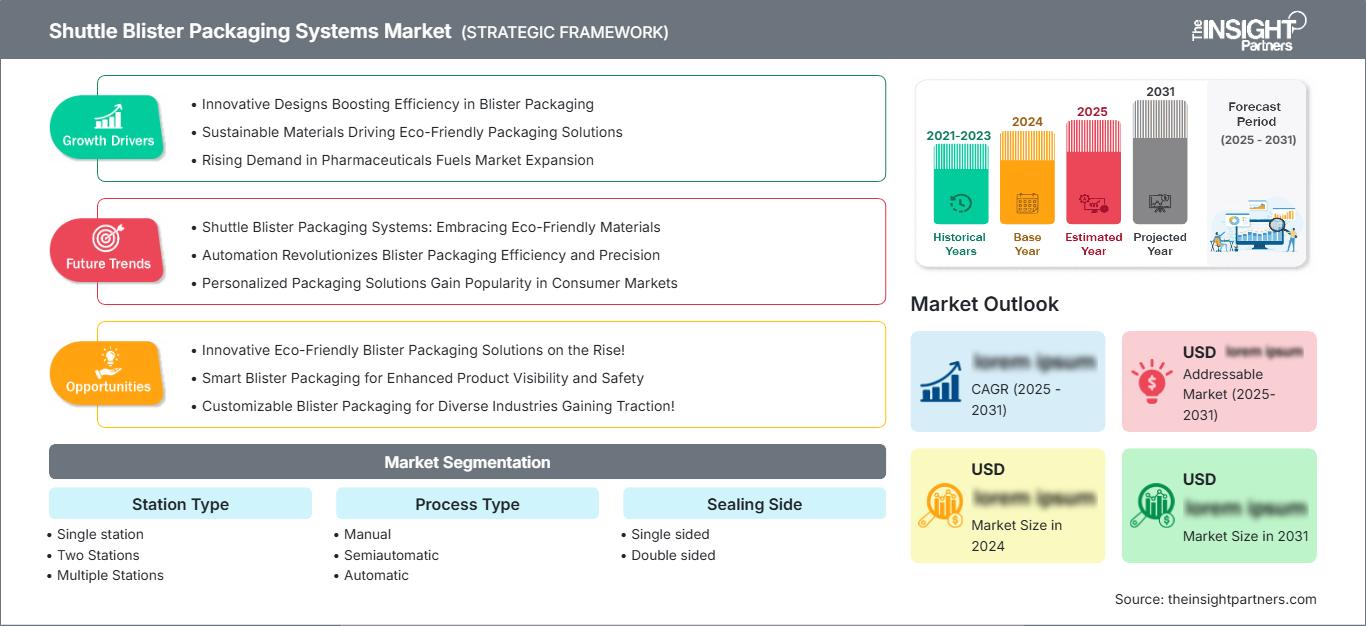
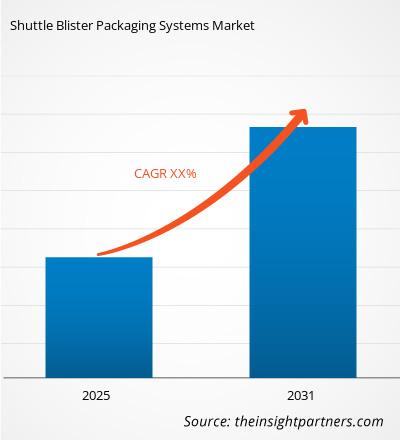
Shuttle Blister Packaging Systems Market was valued at US$ 1.32 Billion in 2025 and is projected to reach US$ 2.53 Billion by 2034, registering a CAGR of 7.48% during 2026–2034. The expansion reflects rising demand for precise, repeatable, and compliant blister sealing platforms across pharmaceuticals, medical products, consumer goods, and electronics packaging applications.
North America remains a leading demand center, with regional equipment purchases supported by pharmaceutical packaging compliance, reshoring of regulated production, and automation upgrades in contract packaging. The Shuttle Blister Packaging Systems Market size in the region is supported by an estimated 34–38% 2025 share and a 6.8–7.4% CAGR outlook through 2034.
Shuttle Blister Packaging Systems Market Assessment and Insights
- North America accounted for 34–38% share in 2025 and is expected to grow at a 6.8–7.4% CAGR between 2026–2034, supported by regulated pharmaceutical packaging, domestic medical production, and automation upgrades.
- US represented 78–82% of North America in 2025 and is projected to expand at a 6.9–7.5% CAGR between 2026–2034.
- Europe held 25–29% share in 2025 and is forecast to grow at a 6.4–7.0% CAGR between 2026–2034, led by Germany, the UK, France, Italy, and Spain.
- Asia Pacific captured 24–28% share in 2025 and is estimated to grow at a 8.2–8.8% CAGR between 2026–2034, led by China, Japan, South Korea, India, and Australia.
- Largest Segment Pharmaceuticals held 46–50% market share in 2025 and is projected to grow at a 7.2–7.8% CAGR between 2026–2034.
- High Growth Segment Automatic systems held 38–42% market share in 2025 and are expected to grow at a 8.6–9.2% CAGR between 2026–2034.
- Key companies analyzed in detail: Algus Packaging, Inc., Aline Heat Seal Corporation, Colimatic USA, CVC Technologies, Inc., Ecobliss Blister Packaging B.V., ILLIG Maschinenbau GmbH and Co. KG, Sonoco Alloyd, Starview Packaging Machinery, Inc., Thwing-Albert Instrument Company, Vollenda-Werk GmbH.
Source: The Insight Partners' analysis based on proprietary research, government publications, company annual reports, investor presentations, industry databases, and expert interviews.
The shift is from operator-controlled shuttle sealers to servo-driven, vision-based, and ready-for-validation systems which cut down on variability in cycle times. The factors that drive the growth of the Shuttle Blister Packaging Systems market include shortened production cycles, rising SKU variety, and the need for consistent sealing performance of thermoformed packages, medical trays, and retail blisters. Tooling flexibility, quick changeover, and material adaptability are being emphasized by the manufacturers to preserve profit margins and satisfy the quality requirements of highly regulated and brand-conscious industries.
Future demand should rise in regions with newly formed industrial clusters, which focus on local drug manufacturing, modernized food safety packaging solutions, and electronic device assembly. Increased spending on small automatic units, recycled blister packages, and data-ready sealers will be expected as the companies adapt their packaging processes to auditability, productivity, and environmental goals.
Shuttle Blister Packaging Systems Market Report Scope
| Report Attribute | Details |
|---|---|
| Market size in 2025 | US$ 1.32 Billion |
| Market Size by 2034 | US$ 2.53 Billion |
| Global CAGR (2026 - 2034) | 7.48% |
| Historical Data | 2021-2024 |
| Forecast period | 2026-2034 |
Shuttle Blister Packaging Systems Market Analysis
Demand is high when packaging needs to incorporate visibility, barriers, tampering resistance, and batch-to-batch consistency. Pharmaceutical companies employ shuttles in their clinical packs, low to moderate solid dosages, and accessories for devices. Consumer companies use shuttles to protect against theft and display products effectively on shelves. Machinery manufacturers are designing machines which take into account quick tool changes, operator safety, and sealing confirmation.
The market consists of machinery manufacturers, heat seal tooling providers, thermoformed material providers, converters, contract packagers, and end users. The analysis of the Shuttle Blister Packaging Systems Market shows that supply chain is dependent upon lead times in precision parts, demand for stainless steel pharmaceutical machinery, and software integration for recipes.
There is competition that is fragmented yet technically specialized. The competitors include Algus Packaging, Inc., Aline Heat Seal Corporation, Starview Packaging Machinery, Inc., and Sonoco Alloyd who compete by having a service network in North America and tooling and semi-automatic to automatic technologies. The competitors are ILLIG Maschinenbau GmbH and Co. KG, Vollenda-Werk GmbH with their European engineering background and Ecobliss Blister Packaging B.V. with their focus on integrated packaging systems.
The areas for investment are becoming increasingly focused on modular automation technology, sustainable materials, and control systems ready for validation and not the basic capability of sealing. Colimatic USA, CVC Technologies, Inc., and Thwing-Albert Instrument Company contribute to the field through adjacent packaging equipment, quality testing, and process measurement technologies.
● REPORT CUSTOMIZATION
Tailor This Report To Align With Your Specific Business Requirements
This report can be customized to align precisely with your business objectives, scope, and target markets. Customization options include tailored segmentation, geography, competitive analysis, and strategic insights to support informed decision-making.
Customize This Report →WHAT YOU CAN ADJUST
- ● Segmentations
- ● Geography
- ● Competitive Analysis
- ● Language Preferences
Shuttle Blister Packaging Systems Market: Strategic Insights
Regional Insights
North America Shuttle Blister Packaging Systems Market
North America accounted for 34–38% share in 2025, with a 6.8–7.4% CAGR expected through 2034. The Shuttle Blister Packaging Systems Market share is supported by pharmaceutical compliance, medical device packaging, and contract packaging capacity. U.S. producers are upgrading semi-automatic lines to reduce labor dependency and improve seal repeatability.
Regional buyers prioritize validation support, stainless-steel construction, operator guarding, and compatibility with recyclable films or paperboard-backed blisters. Demand also benefits from reshoring discussions in healthcare supply chains, where shorter lead times and localized packaging reduce inventory risk for regulated and high-value products.
U.S. Shuttle Blister Packaging Systems Market
The U.S. represented 78–82% of North America in 2025 and is forecast to grow at a 6.9–7.5% CAGR between 2026–2034. The country benefits from dense pharmaceutical manufacturing, medical device assembly, and consumer packaged goods operations requiring flexible blister formats for short runs.
Algus Packaging, Inc., Aline Heat Seal Corporation, Sonoco Alloyd, and Starview Packaging Machinery, Inc. support domestic adoption through equipment supply, heat seal tooling, and service proximity. Application trends include clinical trial packaging, OTC formats, medical kits, batteries, and retail hardware where visibility and tamper evidence remain important.
Europe Shuttle Blister Packaging Systems Market
Share of Europe was 25 – 29% in 2025 with expected CAGR of 6.4 – 7.0%. Germany dominates due to engineering of machines, production of pharmaceuticals, and export of medical technologies. The UK is characterized by steady demand of contract packers and healthcare brands.
France, Italy, and Spain are the main contributors to regional market growth owing to investments in cosmetic, food, and healthcare packaging. Providers of available technology are ILLIG Maschinenbau GmbH & Co. KG, Vollenda-Werk GmbH, and Ecobliss Blister Packaging B.V. European customers put great emphasis on energy saving, safety, and reusable blister packaging.
APAC Shuttle Blister Packaging Systems Market
APAC’s share stands at 24-28% in 2025 and will grow at a CAGR of 8.2-8.8%, which is the highest regional growth rate. China has the highest share and benefits from its production of pharmaceuticals, electronics, and consumer goods. India also sees its share growing on account of generics and contract manufacturing.
In Japan and South Korea, the focus is on accuracy, miniaturized automation, and cleanliness. The market in Australia derives growth from healthcare and nutraceutical packaging products. Policies that favor local manufacturing and industrial automation have made equipment more affordable for regional buyers.
Middle East & Africa Shuttle Blister Packaging Systems Market
MEA & Africa market is forecasted to record a growth rate of 5.8–6.4% CAGR until 2034, owing to increasing investments in healthcare localization, food processing and packaging, and driven by the development in Saudi Arabia and the UAE. South Africa is the most mature subregional production base.
Diversification efforts related to energy, improved logistics, and pharmaceuticals substitution imports are providing better demand visibility. Rest of MEA adoption is more selective, mostly driven by distributor-led installations, investments in food safety and packaging for consumer goods exports.
Segmentation Analysis
Station Type
Station Type is expected to grow at a 7.0–7.6% CAGR between 2026–2034. The Shuttle Blister Packaging Systems Market scope across station configurations reflects production scale, operator availability, and required throughput. Single-station systems suit controlled batches, while multiple-station formats support faster cycles and better division of forming, loading, sealing, and unloading tasks.
- Single station systems remain important for laboratories, clinical packaging, and small brand owners needing compact equipment, lower capital cost, and controlled manual intervention for specialty blister formats.
- Two Stations equipment balances productivity and flexibility, supporting mid-volume production where separation of loading and sealing improves workflow without requiring a fully automated line footprint.
- Multiple Stations platforms serve higher-output operations by enabling parallel process steps, reduced waiting time, improved ergonomics, and better suitability for complex regulated packaging workflows.
Process Type
Process Type is projected to grow at a 7.4–8.0% CAGR between 2026–2034. Manual machines remain relevant for low-volume production, but semiautomatic and automatic systems are gaining preference as labor availability, audit documentation, and repeatable sealing become central procurement criteria in pharmaceuticals, cosmetics, electronics, and consumer goods packaging.
- Manual systems are used for prototyping, specialty packaging, and small batches where capital discipline matters more than speed, particularly among start-ups and laboratories.
- Semiautomatic machines support growing manufacturers that need improved seal consistency, operator safety, and repeatability while retaining flexibility for frequent product changeovers.
- Automatic systems held 38–42% market share in 2025 and are favored for high-throughput, validated production requiring programmable controls, process monitoring, and lower unit labor cost.
Sealing Side
Sealing Side is expected to grow at a 6.9–7.5% CAGR between 2026–2034. Single-sided sealing dominates standard retail and pharmaceutical card formats, while double-sided systems address stronger package integrity, visibility, and premium presentation needs in electronics, medical components, and industrial parts where protection during handling is critical.
- Single sided sealing is preferred for cost-effective cards, tablets, capsules, and small consumer goods where one backing layer provides sufficient protection and shelf communication.
- Double sided sealing supports demanding products needing stronger containment, balanced appearance, and better resistance to handling stress across electronics, devices, and industrial components.
End-Use Industry
End-Use Industry is forecast to grow at a 7.3–7.9% CAGR between 2026–2034. Pharmaceutical demand anchors the segment because compliance, unit-dose integrity, and traceability require controlled packaging. Food, cosmetics, electronics, and industrial goods expand adoption where product visibility, tamper evidence, and protection during distribution influence purchasing decisions.
- Pharmaceuticals held 46–50% market share in 2025, driven by tablets, capsules, clinical trial packs, and medical accessories requiring clean operation, seal consistency, and audit-ready production.
- Food and Beverages demand is linked to portion packs, confectionery, condiments, and freshness-sensitive products where blister formats improve presentation, handling, and controlled dispensing.
- Cosmetics and Personal Care users adopt shuttle systems for sample packs, grooming accessories, and premium retail formats requiring product visibility, compact runs, and attractive shelf presentation.
- Electronics and Electrical applications include batteries, connectors, small devices, and accessories where blister packs provide security, visibility, anti-theft presentation, and distribution protection.
- Industrial Goods users rely on blister packaging for fasteners, tools, replacement parts, and kits where organized presentation and tamper evidence improve retail and service-channel handling.
Opportunity Snapshot
| End-Use Industry | Revenue Contribution | Trend Tag | Adoption Stage |
| Pharmaceuticals | High | Unit Dose | Mature |
| Food and Beverages | Medium | Portion Packs | Scaling |
| Cosmetics and Personal Care | Medium | Sample Kits | Scaling |
| Electronics and Electrical | Medium | Retail Security | Mature |
| Industrial Goods | Low | Parts Kits | Emerging |
Shuttle Blister Packaging Systems Market Growth Drivers and Impact Analysis
Rising Need for Validated Pharmaceutical Packaging
Pharmaceutical packagers have to invest in packaging machinery that will allow for consistent sealing, controllable operating conditions, and audit trails of quality. This requirement is met by shuttle equipment due to its consistency in dwell time, pressure control, and tooling repeatability for tablets, capsules, medical devices, and clinical packages. The true value proposition of such machines is increased demand for replacements of manually operated equipment and increased use of semi-automatic and automatic machinery. As the regulated manufacturers introduce more short-run and customized products, validated equipment becomes an important capital investment.
Automation Upgrades to Offset Labor Constraints
Manufacturers are facing higher labor costs, operator turnover, and training burdens in packaging operations. Shuttle blister systems with programmable controls, guided loading, vision checks, and automated unloading reduce dependence on manual judgment while improving cycle consistency. This driver is especially important for contract packagers that manage multiple SKUs and frequent changeovers. The business impact includes lower scrap rates, improved line utilization, and better responsiveness to customer orders. As equipment buyers measure total cost of ownership, automation becomes a practical route to protect margins and stabilize quality.
Growth in Retail-Ready Protective Packaging
Consumer goods, electronics, and industrial products increasingly require packaging that combines visibility, security, and damage resistance. Shuttle blister equipment enables brands to produce clear retail packs for batteries, accessories, tools, and personal care items while maintaining flexibility for different shapes and batch sizes. The impact extends beyond presentation because blister formats can reduce pilferage, simplify inventory handling, and protect products during e-commerce fulfillment. Equipment demand rises when brand owners seek flexible packaging cells that handle product variation without committing to large continuous lines.
Shuttle Blister Packaging Systems Market Future Trends
Data-Ready Shuttle Packaging Cells
Shuttle Blister Packaging Systems Market trends are moving toward connected equipment that records temperature, pressure, dwell time, cycle count, and operator actions. Future systems will increasingly feed production data into quality systems, maintenance dashboards, and batch records. This shift will benefit regulated manufacturers that need faster deviation investigations and stronger audit readiness. It will also help contract packagers compare line performance across customers and products. Suppliers that provide intuitive software, secure data export, and simple integration with plant systems will gain advantage as packaging becomes part of broader digital manufacturing programs.
Material-Agnostic Sealing Platforms
Future equipment designs will place greater emphasis on handling recyclable films, paperboard-backed structures, rPET, and bio-based thermoformed materials without sacrificing seal reliability. This trend reflects brand commitments to packaging sustainability and regulatory pressure on plastic waste. Machine builders will need wider sealing windows, precise temperature control, and tooling capable of managing new material behavior. Buyers will value systems that allow material trials, quick parameter changes, and validated performance across multiple substrates. Flexibility will become a differentiator as material innovation accelerates across healthcare and consumer applications.
Shuttle Blister Packaging Systems Market Opportunities
Localized Pharmaceutical Packaging Capacity
Manufacturing localization creates a strong investment case for compact, validation-ready shuttle systems in emerging pharmaceutical hubs. Shuttle Blister Packaging Systems Market Forecasts indicate that buyers in India, Southeast Asia, Latin America, and the Middle East will prioritize flexible equipment for generics, OTC products, and clinical supplies. Suppliers can capture this opportunity through regional service partnerships, training packages, and modular platforms that scale from semiautomatic to automatic operation. The most attractive projects will combine compliance support, fast installation, and tooling flexibility for producers adding capacity without building full high-speed blister lines.
Service-Led Lifecycle Revenue
Equipment suppliers can expand revenue by shifting from one-time machine sales toward lifecycle service, tooling refurbishment, validation documentation, spare parts, and operator training. Shuttle blister systems often remain in service for many years, creating recurring needs as customers add products, change materials, or increase throughput. A service-led model improves customer retention and reduces downtime risk for end users. Companies with field technicians, remote diagnostics, and application engineering will be better positioned to support regulated plants and contract packagers that cannot tolerate extended packaging interruptions.
Recent Developments
- April 2024: IMA group announced plans to display 38 new machines at Interpack 2026 across a pavilion spanning 4500-sqm. Among these are several blister packaging and vertical FFS machines designed to streamline pharmaceutical packaging processes. The Tile-X line will be showcased by IMA Life for the first time. It is an innovation in the fill-finish process, designed to handle ready-to-use components using magnetic levitation. Suitable for high-value pharmaceuticals such as biopharmaceuticals and ATMPs with a focus on cell and gene therapies, Tile-X extends the concept of modularity, unprecedented in the aseptic fill-finish process.
- August 2023: Jornen has launched a new generation of high-speed blister packaging machine. Each machine station features an independent servo system, providing convenient production variety switching. This technology is the result of Jornen’s 30+ years of professional experience. The blister packaging machine is divided into two layers to shorten its length. The forming station is located on the lower side of the feeding area, and the forming material is placed inside the device. The packaging material passes through the forming station to form the blisters, through a U-turn and enters the feeding area upwards. This allows more room for feeding and more space for installing an online camera inspection system after feeding.
- July 2022: SEA Vision and Marchesini Group launched a brand-new solution on the market for primary pack serialization and aggregation, including a complete range of technologies to print, inspect and pack serialized blisters and perform aggregation with cartons, all integrated in a 4.0 environment. The two companies decided to invest in this challenging project in order to further enhance product identification, which is a prerequisite in the healthcare industry. While today this prerequisite is respected in the case of cartons and pallets, this does not apply to primary packaging such as blisters. This means that there is still a risk of counterfeiting when it comes to drugs’ primary packaging and, despite all the investments made by pharma companies to ensure that secondary packaging is traceable, there is still a hidden gap that could cause serious damage.
Frequently Asked Questions

- Comprehensive Market Sizing and Forecast Analysis
- Detailed Segmentation Analysis
- In-Depth Market Dynamics Assessment
- Regional and Country-Level Insights
- Competitive Landscape and Company Benchmarking
- Strategic Business Intelligence
Recent Reports
Testimonials

The Insight Partners' SCADA System Market report is comprehensive, with valuable insights on current trends and future forecasts. The team was highly professional, responsive, and supportive throughout. We are very satisfied and highly recommend their services.
RAN KEDEM Partner, Reali Technologies LTDs
I requested a report on a very specific software market and the team produced the report in a few days. The information was very relevant and well presented. I then requested some changes and additions to the report. The team was again very responsive and I got the final report in less than a week.
JEAN-HERVE JENN Chairman, Future Analytica
We worked with The Insight Partners for an important market study and forecast. They gave us clear insights into opportunities and risks, which helped shape our plans. Their research was easy to use and based on solid data. It helped us make smart, confident decisions. We highly recommend them.
PIYUSH NAGPAL Sr. Vice President, High Beam Global
The Insight Partners delivered insightful, well-structured market research with strong domain expertise. Their team was professional and responsive throughout. The user-friendly website made accessing industry reports seamless. We highly recommend them for reliable, high-quality research services
YUKIHIKO ADACHI CEO, Deep Blue, LLC.
This is the first time I have purchased a market report from The Insight Partners.While I was unsure at first, I visited their web site and felt more comfortable to take the risk and purchase a market report.I am completely satisfied with the quality of the report and customer service. I had several questions and comments with the initial report, but after a couple of dialogs over email with their analyst I believe I have a report that I can use as input to our strategic planning process.Thank you so much for taking the extra time and making this a positive experience.I will definitely recommend your service to others and you will be my first call when we need further market data.
JOHN SUZUKI President and Chief Executive Officer, Board Director, BK Technologies
I wish to appreciate your support and the professionalism you displayed in the course of attending to my request for information regarding to infectious disease IVD market in Nigeria. I appreciate your patience, your guidance, and the fact that you were willing to offer a discount, which eventually made it possible for us to close a deal. I look forward to engaging The Insight Partners in the future, all thanks to the impression you have created in me as a result of this first encounter.
DR CHIJIOKE ONYIA MANAGING DIRECTOR, PineCrest Healthcare Ltd.Reason to Buy
- Informed Decision-Making
- Understanding Market Dynamics
- Competitive Analysis
- Identifying Emerging Markets
- Customer Insights
- Market Forecasts
- Risk Mitigation
- Boosting Operational Efficiency
- Strategic Planning
- Investment Justification
- Tracking Industry Innovations
- Aligning with Regulatory Trends





 Get Free Sample for