
Silicon Capacitors Market Size, Growth & Trends by 2034
Coverage: by Structure (Deep-trench Capacitor, MNOS Capacitor, MIS Capacitor); Industry Vertical (Automotive, Aerospace and Defense, Telecommunication, Healthcare, Others) , and Geography (North America, Europe, Asia Pacific, and South and Central America)
- Status : Data Released
- Report Code : TIPRE00006228
- Category : Electronics and Semiconductor
- No. of Pages : 150
- Available Report Formats :


- Last update date : July 21, 2026


2025 Market Size
US$ 1.61 Bn
Base year value
2034 Forecast
US$ 2.79 Bn
Projected by 2034
CAGR 2026-2034
7.14 %
Growth rate
Addressable Market
US$ 20.78 Bn
(2026-2034)
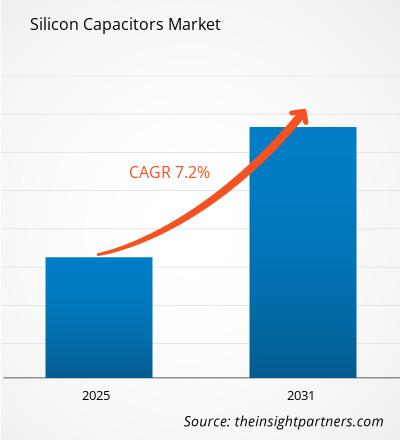
The global Silicon Capacitors Market size is estimated to grow from US$ 1.61 billion in 2025 to US$ 2.79 billion by 2034, exhibiting a CAGR of 7.14% in 2026-2034. The market growth is driven by the demand for compact and high-frequency passive components for semiconductor packaging, RF modules, automotive electronics, medical devices, aerospace electronics, and advanced telecommunication infrastructure.
North America will continue to be strategically important as it has many of the key semiconductor packaging companies as well as aerospace electronics, military electronics and defense modernization projects, and medical device manufacturers located there. The regional market size is anticipated to grow at a 6.8-7.3% CAGR over the forecast period.
Silicon Capacitors Market Assessment and Insights
- North America accounted for 28–31% share in 2025 and is projected to grow at a CAGR of 6.8–7.3% between 2026–2034, led by aerospace, defense, RF, and medical electronics demand.
- US represented 78–82% of North America in 2025 and is expected to grow at 6.9–7.4% CAGR between 2026–2034, supported by semiconductor packaging investment.
- Europe held 20–23% share in 2025 and is forecast to grow at 6.5–7.0% CAGR between 2026–2034, with Germany, France, and the UK leading advanced electronics adoption.
- Asia Pacific captured 38–42% share in 2025 and is projected to grow at 7.4–8.0% CAGR between 2026–2034, driven by China, Japan, South Korea, Taiwan, and India.
- Largest Segment Deep-trench Capacitor held 44–48% market share in 2025 and is expected to grow at 7.1–7.6% CAGR between 2026–2034 due to density advantages.
- High Growth Segment Telecommunication held 27–31% market share in 2025 and is projected to grow at 7.8–8.4% CAGR between 2026–2034 on RF module demand.
- Key companies analyzed in detail: KYOCERA AVX Components Corporation, MACOM Technology Solutions Holdings, Inc., Microchip Technology Incorporated, Murata Manufacturing Co., Ltd., Skyworks Solutions, Inc., TDK Corporation, Taiwan Semiconductor Manufacturing Company Limited, Viking Tech Corporation, Vishay Intertechnology, Inc., ROHM Co., Ltd.
Source: The Insight Partners' analysis based on proprietary research, government publications, company annual reports, investor presentations, industry databases, and expert interviews.
Silicon capacitor technology has evolved from its usage only at high frequencies to become a part of semiconductor packaging due to designers' needs to have low equivalent series resistance, stable capacitance, and compact design. The deep trench approach enables increased capacitance per unit volume, whereas MIS and MNOS configurations help address bias dependence, leakage reduction, and design flexibility. Mass production is getting more compatible with wafer-level fabrication, making it more repeatable but still challenging in terms of qualification for automotive, aerospace, and healthcare sectors.
The market for Silicon Capacitors is expected to profit from the following trends over the forecast period – development of fabrication hubs in Asia, implementation of governmental semiconductor initiatives in North America and Europe, as well as investments in medical and defense electronics. The need for reliable automotive electronics and aviation equipment will drive demand for qualified silicon capacitors.
Silicon Capacitors Market Report Scope
| Report Attribute | Details |
|---|---|
| Market size in 2025 | US$ 1.61 Billion |
| Market Size by 2034 | US$ 2.79 Billion |
| Global CAGR (2026 - 2034) | 7.14% |
| Historical Data | 2021-2024 |
| Forecast period | 2026-2034 |
Silicon Capacitors Market Analysis
Silicon Capacitors Market growth is driven by applications where circuit density, thermal stability, and high-frequency performance become more important than the cost of commodity components. Components for telecommunication equipment, satellite payloads, implantable devices, ADAS modules, and power management circuits have to provide electrical properties under conditions of limited space, vibration, and temperature.
The supply chain comprises silicon wafer suppliers, foundries, thin film experts, component assemblers, distributors, and OEM qualification departments. The supply is technically limited because capacitance density, dielectric reliability, and packaging compatibility must be demonstrated simultaneously. With shrinking RF front-end components, silicon capacitors offer competitive advantages in terms of reliability, integratability, and sourcing capability.
According to the Silicon Capacitors Market analysis, the competition is characterized by fragmentation and technical specialization. Some firms are represented by KYOCERA AVX Components Corporation, Murata Manufacturing Co., Ltd., Vishay Intertechnology, Inc., TDK Corporation, and ROHM Co., Ltd., which provide their products across various passive component market segments. MACOM Technology Solutions Holdings, Inc., and Skyworks Solutions, Inc. are positioned in accordance with the RF and compound semiconductor ecosystem.
The investment focus is shifting from cost leadership to wafer-level integration capabilities, qualification capabilities, and regional supply resilience. Among them is the Taiwan Semiconductor Manufacturing Company Limited which is important in the context of foundries, and Microchip Technology Incorporated, contributing to the aerospace and defense electronics channel segment.
● REPORT CUSTOMIZATION
Tailor This Report To Align With Your Specific Business Requirements
This report can be customized to align precisely with your business objectives, scope, and target markets. Customization options include tailored segmentation, geography, competitive analysis, and strategic insights to support informed decision-making.
Customize This Report →WHAT YOU CAN ADJUST
- ● Segmentations
- ● Geography
- ● Competitive Analysis
- ● Language Preferences
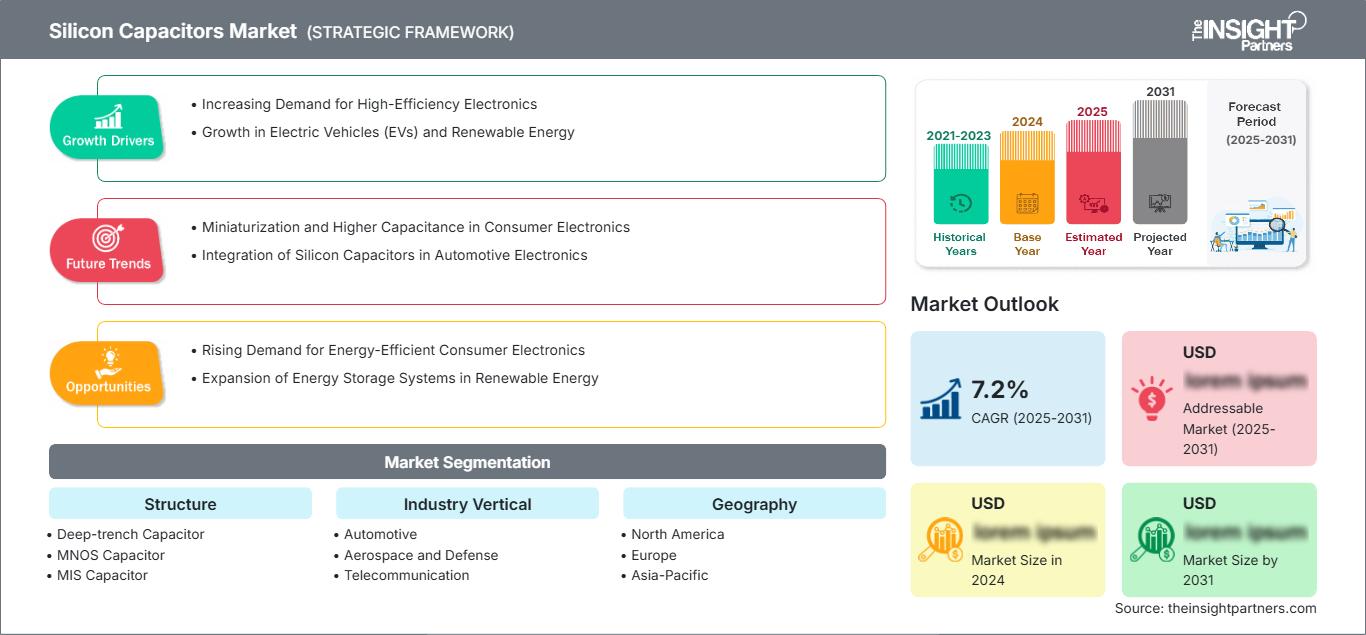
Silicon Capacitors Market: Strategic Insights
Regional Insights
North America Silicon Capacitors Market
North America accounted for 28–31% share in 2025 and is projected to expand at a 6.8–7.3% CAGR through 2034. The Silicon Capacitors Market share is supported by defense electronics, high-reliability aerospace programs, medical device manufacturing, and 5G infrastructure upgrades.
Semiconductor localization and engineering expertise are advantages in this region. Expectations of growth in IATA passenger numbers and ongoing aerospace supply chain development drive demand for avionics systems, which also require miniaturized, reliable parts for portable and implantable medical applications.
U.S. Silicon Capacitors Market
North America had 78% to 82% share by the US in 2025 and is expected to grow at CAGR of 6.9% to 7.4% in 2026 to 2034. The major demand drivers include aerospace electronics, defense communications, RF modules, medical diagnostics, and packaging in semiconductors.
A wide presence is maintained by MACOM Technology Solutions Holdings, Inc., Microchip Technology Incorporated, Skyworks Solutions, Inc., and Vishay Intertechnology, Inc. in support of domestic applications. The US customers value qualification depth, traceability, and long-term product lifetimes.
Europe Silicon Capacitors Market
The Europe region has captured 20–23% of market share in 2025 and is anticipated to grow at a CAGR of 6.5–7.0%. Germany takes the lead due to automotive electronics and industrial automation applications, while the UK aids RF design, aerospace applications, and defense electronics.
France, Italy, and Spain are contributing due to aviation, medical devices, and telecom infrastructure upgrade initiatives. The European suppliers and OEMs focus on safety standards, part tracing ability, and miniaturized design due to electric cars, satellites, and healthcare instruments.
APAC Silicon Capacitors Market
APAC secured a 38-42% share in 2025 and will exhibit a 7.4-8.0% CAGR, which is the highest among regions. China dominates volume consumption, whereas Japan, South Korea, Taiwan, India, and Australia contribute through semiconductor, telecommunication, and defense electronics.
The influence of industrial policies, advanced wafer fabrication, and packaging capabilities positions APAC as a key player in the Silicon Capacitors Market. The surge in 5G devices manufacturing, electric vehicle industry, and local assembling of medical electronics augments the use of miniaturized passive electronic components.
Middle East & Africa Silicon Capacitors Market
Growth of Middle East & Africa segment is estimated at a CAGR of 5.9–6.4% until 2034. Saudi Arabia and UAE dominate the market in terms of electronics demand in energy, defense, satellite communication and data center applications; South Africa leads in the industrial and healthcare sectors.
Adoption in rest of MEA is application-oriented, considering the importation of electronics and regional infrastructure development. High temperature reliability makes the use of silicon capacitors more favorable in challenging conditions and for applications such as energy monitoring, communications backhaul, and defense.
Segmentation Analysis
Structure
Structure is forecast to grow at a 6.9–7.5% CAGR during 2026–2034. Silicon Capacitors Market scope across this segment is shaped by capacitance density, leakage behavior, process compatibility, and packaging constraints. Deep-trench designs dominate where area reduction is essential, while MNOS and MIS structures remain relevant for specialized electrical stability requirements.
- Deep-trench Capacitor holds the strongest market position because vertical structures deliver high capacitance density in limited space, making them strategically important for RF modules, advanced packaging, and miniaturized electronics.
- MNOS Capacitor serves specialized designs requiring controlled dielectric behavior and charge stability, with demand tied to aerospace, defense, and precision electronics where reliability outweighs standard component economics.
- MIS Capacitor supports integration-friendly designs in semiconductor circuits, offering stable electrical characteristics for signal conditioning, filtering, and embedded passive applications across telecom, healthcare, and industrial electronics.
Industry Vertical
Industry Vertical is projected to grow at a 7.2–7.8% CAGR during 2026–2034. Adoption is strongest where electronics must combine reliability, miniaturization, and high-frequency operation. Automotive and telecommunication demand is scaling rapidly, while aerospace and healthcare provide qualification-led opportunities with longer product lifecycles and higher design assurance requirements.
- Automotive demand is rising as EV power electronics, ADAS sensors, infotainment, and connectivity modules require compact passive components with stable performance across heat, vibration, and extended operating cycles.
- Aerospace and Defense applications prioritize radiation tolerance, low loss, and long-term reliability, supporting adoption in satellites, avionics, radar systems, secure communications, and mission-critical electronic assemblies.
- Telecommunication remains the high-growth vertical, driven by RF front-end miniaturization, 5G small cells, high-speed backhaul, and network equipment requiring low-loss, thermally stable capacitance.
- Healthcare adoption is linked to portable diagnostics, implantable devices, monitoring equipment, and imaging electronics where compact size, low leakage, and dependable electrical performance support patient-facing reliability.
Opportunity Snapshot
| Industry Vertical | Revenue Contribution | Trend Tag | Adoption Stage |
| Automotive | High | EV Modules | Scaling |
| Aerospace and Defense | Medium | Space Grade | Scaling |
| Telecommunication | High | RF Frontend | Mature |
| Healthcare | Medium | Portable Care | Scaling |
| Others | Low | Industrial IoT | Emerging |
Silicon Capacitors Market Growth Drivers and Impact Analysis
Miniaturization of RF and Semiconductor Packages
Density of components becomes an important factor in designing systems as the functions of telecommunications boards, wearable devices, medical electronic systems, and automotive control boards increase without having to take up any additional board area. Silicon capacitors offer higher capacitance density and stability at higher frequencies than ceramic capacitors. This is particularly true in radio-frequency front-end systems, systems-in-package, and embedded passives, where parasitics are minimized to enhance signal integrity. Suppliers with the ability to achieve wafer-level tolerances and application engineering support will benefit greatly from design wins early in the process.
Reliability Requirements in Aerospace and Medical Electronics
Requirements in aerospace and defense, as well as in the healthcare industry, include the ability of components to maintain electrical stability under temperature cycling, vibration, sterilization, and radiation. The silicon capacitors satisfy such demands thanks to the predictable behavior of the dielectrics and miniature size of the components. The positive outlook for passenger flow growth provided by IATA stimulates the development of avionics systems, while the growth of diagnostic and monitoring equipment stimulates growth in the medical industry.
Semiconductor Localization and Advanced Packaging Investment
Semiconductor production support schemes are driving local ecosystems of substrates, packaging, and passive components. Silicon capacitors represent such development, as they can be made in compatible with semiconductor technology and be located near active components. Geopolitical risks are reduced by local supply for defense, automotive, and infrastructure end-users. The influence on the market is seen in growing popularity of foundry cooperation, dual sourcing, and capacity booking. Vendors who are able to link their capacitor production capabilities with an advanced packaging strategies will benefit from increased demand.
Silicon Capacitors Market Future Trends
Embedded Passives in Heterogeneous Integration
Silicon Capacitors Market trends would increasingly be defined by the integration of heterogeneity, with passive components located close to processors, RF components, sensors, and power management components. This trend helps reduce interconnect distances, improve signal quality, and enable smaller modules. Future demand would arise from co-designing packages rather than substitution of individual components. Manufacturers would need closer cooperation with foundries, OSATs, and system designers because capacitor selection would affect thermal considerations, impedance management, and packaging performance prior to traditional board design.
Qualification-Led Supply Chains for Critical Electronics
Critical electronics buyers are expected to place greater emphasis on supplier traceability, process control, and multi-year availability rather than lowest unit price. Automotive safety systems, defense communications, satellite payloads, and medical devices cannot absorb frequent component changes after qualification. This trend will encourage longer supplier agreements, regional sourcing strategies, and documentation-heavy procurement. Manufacturers with automotive, aerospace, and medical quality systems will gain preferred status as electronics supply chains become more risk-managed and compliance-oriented.
Silicon Capacitors Market Opportunities
Telecommunication Design Wins in RF Front Ends
Telecommunication equipment offers attractive opportunity because 5G densification, private networks, satellite links, and high-speed backhaul all require compact RF paths. Silicon Capacitors Market Forecasts indicate that suppliers can improve revenue visibility by engaging early with module designers and network equipment vendors. Investment should focus on low-loss products, package compatibility, and engineering support for impedance-sensitive designs. Companies that provide validated libraries, predictable lead times, and regional customer support can convert technical performance into recurring program-level demand.
Medical Electronics Miniaturization Programs
Medical device manufacturers are redesigning diagnostics, monitoring tools, and implantable electronics around smaller, lower-power, and more reliable assemblies. Silicon capacitors can support this transition by reducing footprint while maintaining stable electrical behavior. The opportunity is most actionable for suppliers that offer documentation, biocompatibility-adjacent process discipline, and long lifecycle commitments. Partnerships with device OEMs during prototype development can secure design-in positions that remain stable through regulatory approval, commercial launch, and replacement product generations.
Recent Developments
- February 2026: Empower Semiconductor has announced three new embedded silicon capacitors (ECAPs) aimed at addressing the power integrity requirements of next-generation AI and high-performance computing (HPC) processors. The expanded ECAP lineup includes the EC2005P, delivering 9.34 μF in a 2 mm × 2 mm package; the EC2025P, offering 18.68 μF in a 4 mm × 2 mm package; and the EC2006P, providing 36.8 μF in a 4 mm × 4 mm form factor.
- December 2025: AP Memory, a leading global design company providing customized memory solutions, announced further advancements in its S-SiCap (Stack Silicon Capacitor) product line to address the increasing integration demands of AI servers and high-performance computing (HPC) systems. The S-SiCap portfolio includes two product categories —discrete silicon capacitors and interposers with silicon capacitors — designed to support different system architectures and diverse application requirements.
- November 2024: Murata Manufacturing Ltd, a leading manufacturer of electronic components, modules, and devices, has broadened the scope of its Integrated Passive Solutions offering by opening a new production line at its site in Caen, France. Following the initial announcement in 2023, Murata has fulfilled its commitment to establish a new 200-mm mass production line aimed at bolstering its Silicon Capacitor manufacturing capabilities. The Caen facility, operated by Murata since the acquisition of the start-up IPDiA in 2016, is a beacon of innovation and is home to over 250 dedicated employees working to support the clean room, production line, and all other crucial business functions.
Frequently Asked Questions

- Comprehensive Market Sizing and Forecast Analysis
- Detailed Segmentation Analysis
- In-Depth Market Dynamics Assessment
- Regional and Country-Level Insights
- Competitive Landscape and Company Benchmarking
- Strategic Business Intelligence
Recent Reports
Testimonials

The Insight Partners' SCADA System Market report is comprehensive, with valuable insights on current trends and future forecasts. The team was highly professional, responsive, and supportive throughout. We are very satisfied and highly recommend their services.
RAN KEDEM Partner, Reali Technologies LTDs
I requested a report on a very specific software market and the team produced the report in a few days. The information was very relevant and well presented. I then requested some changes and additions to the report. The team was again very responsive and I got the final report in less than a week.
JEAN-HERVE JENN Chairman, Future Analytica
We worked with The Insight Partners for an important market study and forecast. They gave us clear insights into opportunities and risks, which helped shape our plans. Their research was easy to use and based on solid data. It helped us make smart, confident decisions. We highly recommend them.
PIYUSH NAGPAL Sr. Vice President, High Beam Global
The Insight Partners delivered insightful, well-structured market research with strong domain expertise. Their team was professional and responsive throughout. The user-friendly website made accessing industry reports seamless. We highly recommend them for reliable, high-quality research services
YUKIHIKO ADACHI CEO, Deep Blue, LLC.
This is the first time I have purchased a market report from The Insight Partners.While I was unsure at first, I visited their web site and felt more comfortable to take the risk and purchase a market report.I am completely satisfied with the quality of the report and customer service. I had several questions and comments with the initial report, but after a couple of dialogs over email with their analyst I believe I have a report that I can use as input to our strategic planning process.Thank you so much for taking the extra time and making this a positive experience.I will definitely recommend your service to others and you will be my first call when we need further market data.
JOHN SUZUKI President and Chief Executive Officer, Board Director, BK Technologies
I wish to appreciate your support and the professionalism you displayed in the course of attending to my request for information regarding to infectious disease IVD market in Nigeria. I appreciate your patience, your guidance, and the fact that you were willing to offer a discount, which eventually made it possible for us to close a deal. I look forward to engaging The Insight Partners in the future, all thanks to the impression you have created in me as a result of this first encounter.
DR CHIJIOKE ONYIA MANAGING DIRECTOR, PineCrest Healthcare Ltd.Reason to Buy
- Informed Decision-Making
- Understanding Market Dynamics
- Competitive Analysis
- Identifying Emerging Markets
- Customer Insights
- Market Forecasts
- Risk Mitigation
- Boosting Operational Efficiency
- Strategic Planning
- Investment Justification
- Tracking Industry Innovations
- Aligning with Regulatory Trends





 Get Free Sample for