
Smart Antenna Market Growth, Size & Forecast by 2034
Coverage: By Type (Switched Beam Smart Antenna, Adaptive Array Smart Antenna, SIMO, MISO, MIMO); Application (Military, Satellite Communication, Mobile Communication, Wireless Sensor Networks, Terrestrial Television Reception, Others) , and Geography (North America, Europe, Asia Pacific, and South and Central America)
- Status : Data Released
- Report Code : TIPTE00002100
- Category : Electronics and Semiconductor
- No. of Pages : 150
- Available Report Formats :


- Last update date : July 31, 2026


2025 Market Size
US$ 6,746.58 Mn
Base year value
2034 Forecast
US$ 11,992.69 Mn
Projected by 2034
CAGR 2026-2034
6.60 %
Growth rate
Addressable Market
US$ 84,724.56 Mn
(2026-2034)
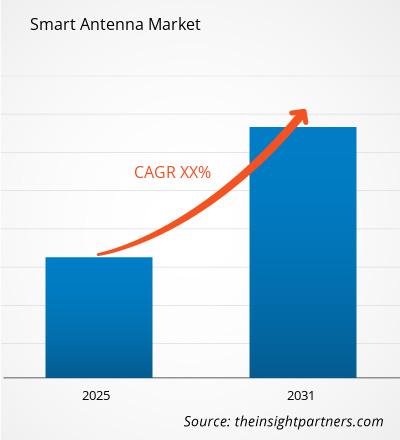
The Smart Antenna Market value is expected to rise from US$ 6,746.58 million in 2025 to US$ 11,992.69 million by 2034, recording a CAGR of 6.60% from 2026 to 2034. The growth drivers include the increasing need for high spectral efficiency, minimum interference and signal control due to adaptive beamforming, MIMO systems, satellite communication and dense mobile communication infrastructure.
In 2025, North America held an approximate share of 33-36%, and this percentage will record a CAGR of 6.2-6.8% till 2034, backed by factors like the increasing density of 5G, development of private wireless networks, military upgrades and satellite broadband services. The Smart Antenna Market size in this region depends on carriers' investments in upgrading, adoption of enterprise Wi-Fi 7 and need for spectral efficiency in networks.
Smart Antenna Market Assessment and Insights
- North America accounted for 33–36% share in 2025 and is growing at a CAGR range of 6.2–6.8% during 2026–2034, supported by 5G, defense radios, and connected infrastructure.
- US represented 78–82% of North America in 2025 and is growing at a CAGR range of 6.1–6.7% during 2026–2034, led by carriers and federal networks.
- Europe held 22–25% share in 2025 and is growing at a CAGR range of 5.8–6.4% during 2026–2034, with Germany, the UK, France, Italy, and Spain leading adoption.
- Asia Pacific captured 27–30% share in 2025 and is growing at a CAGR range of 7.0–7.6% during 2026–2034, driven by China, Japan, South Korea, India, and Australia.
- Largest Segment MIMO held 38–42% market share in 2025 and is growing at a CAGR range of 6.8–7.4% during 2026–2034, due to carrier-grade throughput gains.
- High Growth Segment Adaptive Array Smart Antenna held 18–21% market share in 2025 and is growing at a CAGR range of 7.4–8.0% during 2026–2034.
- Key companies analyzed in detail: Airgain, Inc.; AirNet Communications Corporation; ArrayComm LLC; Intel Corporation; Navini Networks, Inc. (Cisco Systems, Inc.); Ruckus Networks; Sofant Technologies Ltd.; Telstra Group Limited; Texas Instruments Incorporated; Trimble Inc.
Source: The Insight Partners' analysis based on proprietary research, government publications, company annual reports, investor presentations, industry databases, and expert interviews.
Technology migration has shifted the focus of the Smart Antenna Market from fixed sector antennas to software-controllable solutions that integrate RF front ends, digital signal processing, and beam control in real time. Dynamics on the production side are evolving too, as the modules have started to be designed together with chipsets, routers, small cells, and military terminals as opposed to being purchased separately.
During the forecast period, new geographies will likely grow their demand for smart antennas due to the growth of public broadband networks, private 5G networks, low-earth-orbit satellite services, and industrial automation outside the first adopters. Regulation supporting spectrum refarming initiatives, digital inclusion efforts, and secure communications improves the predictability of investments. Companies that can certify the devices for telecoms, aerospace, transport, and mission-critical segments will benefit from this resilient demand.
Smart Antenna Market Report Scope
| Report Attribute | Details |
|---|---|
| Market size in 2025 | US$ 6,746.58 Million |
| Market Size by 2034 | US$ 11,992.69 Million |
| Global CAGR (2026 - 2034) | 6.60% |
| Historical Data | 2021-2024 |
| Forecast period | 2026-2034 |
Smart Antenna Market Analysis
The factors propelling the Smart Antenna Market growth include the requirement to accommodate more devices per unit of spectrum and site. The operators are utilizing beamforming and MIMO technology to enhance the edge performance of their networks, while the enterprises are deploying the intelligent antennas in their warehouse, campus, venue, transport hub, and IIoT nodes where interference management will impact their performance.
The supply chain participants include radio frequency semiconductor manufacturers, antenna developers, module assembly firms, network equipment companies, system integrators, and operators. The supply considerations include smaller size, thermal stability, multiple bands capable of meeting regulatory standards, as well as suitability for outdoor use. Energy efficiency, firmware upgrade capability, and compatibility with the emerging standards like Wi-Fi 7, 5G Advanced, NTN, and defense waveform are becoming increasingly important procurement criteria.
The Smart Antenna Market Report reveals competition among innovators of smart antenna components, providers of wireless connectivity platforms, and infrastructure suppliers. Airgain, Inc. is investing in embedded and automotive connectivity platforms, Ruckus Networks in enterprise wireless capabilities, Intel Corporation and Texas Instruments Incorporated in silicon enablement, and Trimble Inc. and Telstra Group Limited in applications combining antenna performance with positioning, infrastructure and connectivity management.
There is a trend toward investment in complete platforms rather than standalone antennas since the customer demand is for quantifiable improvement in throughput, coverage, and reliability. Companies still active in beamforming and adaptive array technology include ArrayComm LLC, Sofant Technologies Ltd., AirNet Communications Corporation, and Navini Networks, Inc., and the presence of Cisco Systems, Inc. in the ownership history of companies adds credibility in enterprise networking solutions.
● REPORT CUSTOMIZATION
Tailor This Report To Align With Your Specific Business Requirements
This report can be customized to align precisely with your business objectives, scope, and target markets. Customization options include tailored segmentation, geography, competitive analysis, and strategic insights to support informed decision-making.
Customize This Report →WHAT YOU CAN ADJUST
- ● Segmentations
- ● Geography
- ● Competitive Analysis
- ● Language Preferences
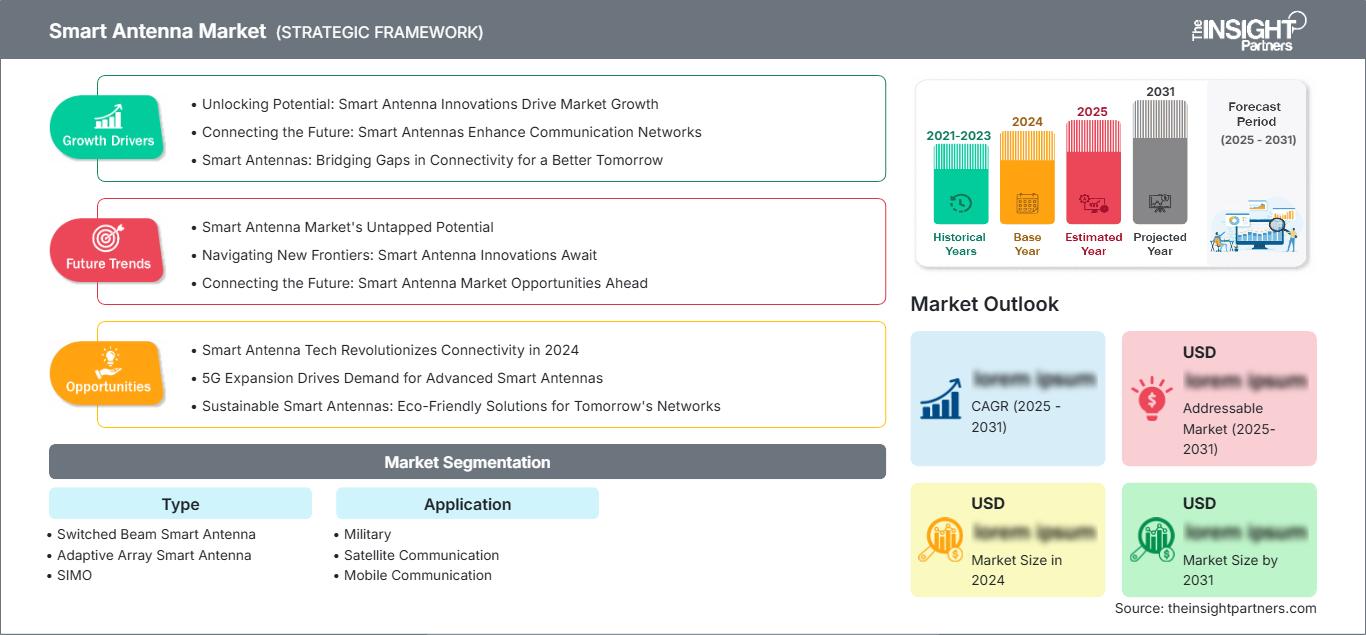
Smart Antenna Market: Strategic Insights
Regional Insights
North America Smart Antenna Market
The North American share in 2025 was 33–36%, which will grow further with a CAGR of 6.2–6.8% between 2026 and 2034. The region enjoys benefits from the extension of 5G networks, advanced military communication systems, Wi-Fi 7 updates, and broadband terminals for satellites. High Smart Antenna Market share is due to the need for spectral efficiency in congested urban areas and rural broadband corridors.
Investments by the Government of the U.S. in broadband services, communication network, and network security result in significant demands for antennas. Canada provides new business areas for the firm in remote connectivity, automation of mines, and transport communications systems. Beam forming, multiple bands, energy usage, and life cycle management via software become key issues in the purchase of antennas in the region.
U.S. Smart Antenna Market
The U.S. accounted for 78–82% of North America in 2025 and expected to grow at a CAGR of 6.1–6.7% during 2026–2034. Customer segments include carrier densification, neutral-host infrastructure, fixed wireless access, and defense projects. Market penetration is good, with Airgain, Inc., Intel Corporation, Texas Instruments Incorporated, Ruckus Networks, and Trimble Inc. enabling antenna, silicon, networking, and positioning segments.
Applications that show the highest growth include mobile communications, military solutions, wireless sensor networks, and enterprise environments. Public safety fleets and utilities networks have increased demand for high power and connectivity, whereas broadband gateways have a requirement of embedded antennas capable of preserving throughput within the premises.
Europe Smart Antenna Market
Share of Europe in 2025 was 22–25%, and is growing with a CAGR of 5.8–6.4% during 2026–2034. Germany is the biggest region of demand because of industrial automation, private networks, testing in automotive, and defense electronics. The UK has telecom upgrades and venue connectivity; and France is focused on aerospace, satellite communications, and secure government networks.
Italy and Spain are growing in their transport infrastructure, telecoms' broadcast upgrades, smart cities, and the need for coastal connectivity. Procurement in Europe is driven by energy efficiency, electromagnetic compliance, and interoperability of equipment. Antennas that have capabilities to lower power consumption of the network while providing 5G, Wi-Fi, and critical communication services are preferred by operators and businesses.
APAC Smart Antenna Market
In 2025, APAC had a 27%-30% market share, while the expected CAGR is estimated at a rate between 7.0%-7.6% between 2026 and 2034. This will be the highest rate compared to all other leading regions. China is at the forefront with 5G deployment, telecommunications equipment manufacture and smart cities initiative, while Japan and South Korea have excelled in densified cellular networks and electronics.
Drivers for growth in India and Australia include digital infrastructure, defense communication system, mining communication, and remote broadband infrastructure. Local electronic equipment and satellite services in addition to automation in industries will determine local sourcing policies. In cost-effective implementations in the region, small antenna systems would be needed.
Middle East & Africa Smart Antenna Market
The Middle East and Africa region is expanding at a CAGR between 5.9-6.5% for 2026-2034 with Saudi Arabia being a leader in terms of smart infrastructure, connectivity within the energy sector, and networking within large venues. UAE follows with its smart city initiatives, airport connectivity, and enterprise transformation.
The demand in South Africa comes from the mining industry, public networks, and wireless network modernization in the industrial environment. For Rest of MEA, demand comes from satellite and fixed wireless access. Harsh environments, long distances covered, and critical infrastructure applications require reliable adaptive antennas.
Segmentation Analysis
Type
Type is projected to grow at a CAGR range of 6.4–7.0% during 2026–2034. The Smart Antenna Market scope across type categories reflects different levels of complexity, from switched beam systems used for targeted coverage to adaptive arrays and MIMO architectures used in high-capacity communication networks. Selection depends on latency tolerance, channel conditions, device density, and integration cost.
- Switched Beam Smart Antenna systems remain relevant where predefined directional coverage improves signal quality without complex continuous adaptation, especially in broadcast, fixed wireless, and cost-sensitive enterprise connectivity deployments.
- Adaptive Array Smart Antenna systems dynamically adjust radiation patterns to suppress interference and improve link reliability, making them strategically important for military, satellite, and dense mobile communication environments.
- SIMO configurations support improved receive diversity where device-side complexity must remain low, helping networks strengthen reception quality in sensor, broadcast, and lower-power wireless applications.
- MISO architectures improve transmission robustness from multiple antennas toward simpler receivers, supporting infrastructure-led upgrades in fixed wireless, terrestrial television reception, and industrial communication networks.
- MIMO remains the largest type category because it increases throughput and spectral efficiency, making it essential for 5G, Wi-Fi 7, satellite broadband, and high-density enterprise networks.
Application
Application is projected to grow at a CAGR range of 6.3–6.9% during 2026–2034. Adoption is strongest where connectivity performance affects mission continuity, capacity, or safety. Mobile communication drives volume, while military and satellite communication support higher-value ruggedized demand. Wireless sensor networks expand with industrial automation, and terrestrial television reception benefits from targeted signal improvement.
- Military applications prioritize resilient links, anti-jamming capability, and directional control, making smart antennas valuable for tactical radios, unmanned systems, mobile command platforms, and secure field communications.
- Satellite Communication uses intelligent beam control to support mobile terminals, broadband access, and non-terrestrial networks, especially where compact form factors and tracking performance improve service continuity.
- Mobile Communication generates the largest deployment volume as carriers use MIMO and beamforming to increase capacity, reduce interference, and support dense urban and indoor network performance.
- Wireless Sensor Networks benefit from improved signal reliability and lower retransmission needs, supporting industrial monitoring, utilities, agriculture, logistics, and smart infrastructure with better battery and network performance.
- Terrestrial Television Reception remains a specialized application where directional reception, interference reduction, and signal stability improve viewing quality in fringe coverage and multipath-prone locations.
Opportunity Snapshot
| Application | Revenue Contribution | Trend Tag | Adoption Stage |
| Military | High | Secure Links | Scaling |
| Satellite Communication | High | NTN Access | Scaling |
| Mobile Communication | High | 5G Capacity | Mature |
| Wireless Sensor Networks | Medium | Industrial IoT | Scaling |
| Terrestrial Television Reception | Low | Signal Quality | Mature |
Smart Antenna Market Growth Drivers and Impact Analysis
5G densification increases demand for beam-controlled capacity
Network operators are adding small cells, indoor systems, and higher-order MIMO to address traffic concentration in venues, transport corridors, campuses, and urban neighborhoods. Smart antennas improve capacity by directing energy toward active users rather than broadcasting uniformly, which raises spectral efficiency and reduces interference. The impact is strongest where site acquisition is costly and spectrum is constrained. As operators prepare for 5G Advanced and early 6G research, antenna intelligence becomes a practical way to extend existing assets while improving user experience, network energy use, and service reliability.
Defense and public-safety networks require resilient connectivity
Military and emergency-response users require communication systems that remain stable under mobility, congestion, interference, and difficult terrain. Adaptive arrays and MIMO systems strengthen link quality by improving directionality, diversity, and interference rejection. This creates procurement opportunities for ruggedized antennas, vehicle gateways, portable terminals, and command-network equipment. The market impact extends beyond hardware sales because defense buyers often require qualification testing, lifecycle support, and secure software integration. Suppliers with proven reliability, certification discipline, and multi-domain communication expertise are therefore better positioned for long-cycle contracts.
Satellite broadband and non-terrestrial networks expand addressable use
Satellite communication is moving from specialized government terminals toward broadband, mobility, maritime, aviation, and remote enterprise applications. Smart antennas are important because terminals must maintain signal quality while managing movement, obstruction, and multiple orbital paths. Electronically steered and adaptive designs reduce mechanical complexity and improve service continuity. The commercial impact is visible in demand for compact terminals, hybrid cellular-satellite equipment, and connectivity platforms for areas without dense terrestrial infrastructure. This driver broadens supplier opportunities across telecom operators, satellite service providers, industrial users, and transport fleets.
Smart Antenna Market Future Trends
AI-assisted beam optimization becomes embedded in network operations
Smart Antenna Market trends are moving toward AI-assisted radio management that continuously adjusts beam direction, power, and interference suppression based on traffic, user movement, and environmental conditions. Future systems will rely less on static planning and more on closed-loop optimization across base stations, routers, gateways, and satellite terminals. This shift can reduce manual tuning, improve outage prediction, and support service-level commitments in dense enterprise and public networks. Vendors able to combine RF design with analytics, firmware updates, and secure telemetry will gain differentiation as antenna performance becomes part of network intelligence.
Smart surfaces and reconfigurable environments reshape coverage planning
Reconfigurable intelligent surfaces are expected to complement antenna arrays by controlling how radio waves reflect through buildings, streets, factories, and transport hubs. Instead of relying only on tower placement, network planners may use programmable surfaces to improve coverage in shadowed zones and reduce power requirements. This could create new partnerships among antenna suppliers, materials companies, infrastructure owners, and system integrators. Adoption will likely start in high-value venues and industrial facilities where reliability benefits justify additional engineering and installation complexity.
Smart Antenna Market Opportunities
Private wireless networks create integrated antenna platform demand
Industrial campuses, ports, mines, hospitals, and logistics hubs are investing in private wireless networks to improve automation, safety, and asset visibility. Smart Antenna Market Forecasts indicate that suppliers can capture value by offering integrated antennas, gateways, software diagnostics, and deployment support rather than commodity hardware. Buyers need predictable coverage in metal-rich, mobile, or obstructed environments, which makes RF planning and adaptive performance critical. Partnerships with system integrators, cloud providers, and industrial automation vendors can help antenna companies convert pilot programs into repeatable site deployments.
Multi-band terminals unlock mobility and remote connectivity
Transport fleets, emergency vehicles, construction sites, rural enterprises, and energy assets increasingly need devices that can switch among cellular, satellite, Wi-Fi, and specialized radio networks. Multi-band smart antennas can improve continuity by selecting better paths and maintaining stronger links during movement or obstruction. This opportunity favors suppliers that can combine compact design, thermal control, rugged certification, and carrier approval. Revenue potential is strongest where connectivity failures create operational cost, safety exposure, or service disruption, making performance assurance more important than lowest initial hardware price.
Recent Developments
- March 2026: Adant Technologies Inc. announced the launch of its latest smart antenna solution for Wi-Fi routers and mesh nodes delivering significantly enhanced wireless performance while maintaining cost parity with traditional passive antenna systems. The new solution is based on Adant’s proprietary smart antenna technology, which dynamically adapts antenna radiation patterns to optimize signal quality and maximize wireless throughput. By intelligently directing signals toward connected devices or mesh nodes, the technology improves link reliability, network coverage, and overall performance.
- March 2025: Quectel Wireless Solutions, a global IoT solutions provider, announces the launch of its 5G transparent antenna, the YFCX001WWAH, an innovative solution designed to improve connectivity while maintaining seamless device design. The YFCX001WWAH transparent antenna combines efficiency, transparency, and adaptability, offering manufacturers greater flexibility in device design while ensuring seamless 5G connectivity.
- January 2024: Septentrio, a leader in high-precision GNSS positioning solutions, announces the launch of a new smart antenna, ideal for machine automation and control in construction, precision agriculture and logistics. The AntaRx smart antenna is robust inside and out. Enclosed in a ruggedized housing, it can handle high levels of shocks and vibrations and is ready for operation in harsh industrial environments. Built on Septentrio’s long standing GNSS experience, this multi-frequency receiver delivers high-accuracy RTK positioning down to the centimeter level. Equipment manufacturers and system integrators can benefit from the versatile offering including INS (Inertial Navigation System) integration, dual antenna mode, and 4G cellular communication.
Frequently Asked Questions

- Comprehensive Market Sizing and Forecast Analysis
- Detailed Segmentation Analysis
- In-Depth Market Dynamics Assessment
- Regional and Country-Level Insights
- Competitive Landscape and Company Benchmarking
- Strategic Business Intelligence
Recent Reports
Testimonials

The Insight Partners' SCADA System Market report is comprehensive, with valuable insights on current trends and future forecasts. The team was highly professional, responsive, and supportive throughout. We are very satisfied and highly recommend their services.
RAN KEDEM Partner, Reali Technologies LTDs
I requested a report on a very specific software market and the team produced the report in a few days. The information was very relevant and well presented. I then requested some changes and additions to the report. The team was again very responsive and I got the final report in less than a week.
JEAN-HERVE JENN Chairman, Future Analytica
We worked with The Insight Partners for an important market study and forecast. They gave us clear insights into opportunities and risks, which helped shape our plans. Their research was easy to use and based on solid data. It helped us make smart, confident decisions. We highly recommend them.
PIYUSH NAGPAL Sr. Vice President, High Beam Global
The Insight Partners delivered insightful, well-structured market research with strong domain expertise. Their team was professional and responsive throughout. The user-friendly website made accessing industry reports seamless. We highly recommend them for reliable, high-quality research services
YUKIHIKO ADACHI CEO, Deep Blue, LLC.
This is the first time I have purchased a market report from The Insight Partners.While I was unsure at first, I visited their web site and felt more comfortable to take the risk and purchase a market report.I am completely satisfied with the quality of the report and customer service. I had several questions and comments with the initial report, but after a couple of dialogs over email with their analyst I believe I have a report that I can use as input to our strategic planning process.Thank you so much for taking the extra time and making this a positive experience.I will definitely recommend your service to others and you will be my first call when we need further market data.
JOHN SUZUKI President and Chief Executive Officer, Board Director, BK Technologies
I wish to appreciate your support and the professionalism you displayed in the course of attending to my request for information regarding to infectious disease IVD market in Nigeria. I appreciate your patience, your guidance, and the fact that you were willing to offer a discount, which eventually made it possible for us to close a deal. I look forward to engaging The Insight Partners in the future, all thanks to the impression you have created in me as a result of this first encounter.
DR CHIJIOKE ONYIA MANAGING DIRECTOR, PineCrest Healthcare Ltd.Reason to Buy
- Informed Decision-Making
- Understanding Market Dynamics
- Competitive Analysis
- Identifying Emerging Markets
- Customer Insights
- Market Forecasts
- Risk Mitigation
- Boosting Operational Efficiency
- Strategic Planning
- Investment Justification
- Tracking Industry Innovations
- Aligning with Regulatory Trends





 Get Free Sample for