
Submarine Power Cable Market Trends, Size & Forecast by 2034
Coverage: By Voltage (Medium Voltage (MV), High Voltage (HV), Extra High Voltage (EHV)), Insulation Type (Cross-Linked Polyethylene (XLPE), Ethylene Propylene Rubber (EPR), Mass Impregnated Paper (MI), Polyethylene (PE), Polypropylene Laminated Paper (PPLP), Others), Conductor Type (Copper, Aluminum, Others), End Users (Telecommunications, Oil and Gas, Power Utilities and Grid Operators, Renewable Energy Developers, Government and Defense, Others), and Geography (North America, Europe, Asia Pacific, Middle East & Africa, and South & Central America)
- Status : Published
- Report Code : TIPRE00008943
- Category : Electronics and Semiconductor
- No. of Pages : 251
- Available Report Formats :


- Last update date : September 28, 2026


2025 Market Size
US$ 20.97 Bn
Base year value
2034 Forecast
US$ 50.58 Bn
Projected by 2034
CAGR 2026-2034
10.3 %
Growth rate
Addressable Market
US$ 318.08 Bn
(2026-2034)
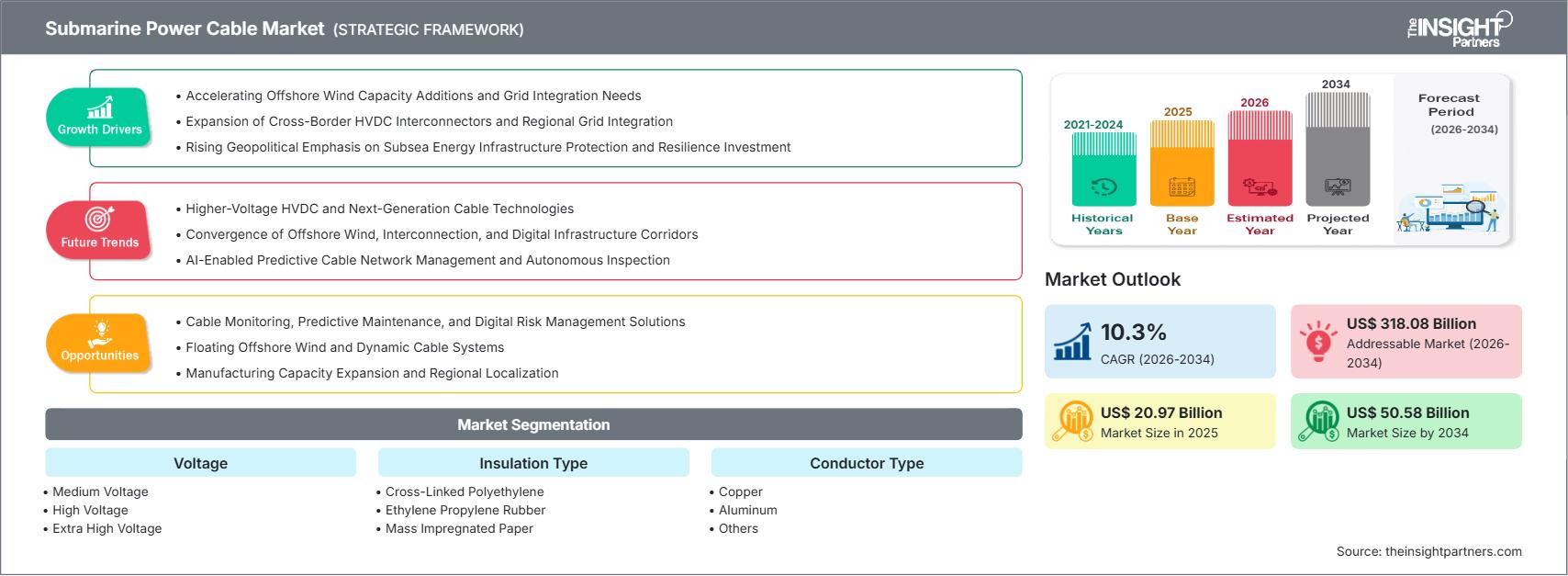
The Subsea Cable Market was valued at US$ 20.74 Billion in 2025 and is projected to reach US$ 50.58 Billion by 2034, expanding at a CAGR of 10.3% over the forecast period. The market encompasses underwater power transmission cables designed for offshore energy, grid interconnection, and island connectivity applications. These cables enable electricity transmission from offshore wind farms, between power grids, and to remote communities through medium voltage, high voltage, and extra high voltage configurations with various insulation and conductor types worldwide.
North America Submarine Power Cable Market size is expected to expand at a CAGR of 8.9% during 2026–2034, supported by offshore wind development, grid interconnection projects, and renewable energy targets across the US and Canada. Demand is reinforced by energy transition policies, infrastructure investment, and procurement preferences for reliable, high-performance subsea cable solutions in offshore energy applications.
Submarine Power Cable Market Assessment and Insights
- North America held 22.39% share in 2025 and is growing at a CAGR of 8.9% during 2026–2034, led by offshore wind projects, grid interconnection, and renewable energy development across the US and Canada.
- US represented 82–85% of North American revenue in 2025 and is growing at a CAGR of 9.0–9.2% during 2026–2034.
- Europe accounted for 28.45% share in 2025 and is growing at a CAGR of 10.4% during 2026–2034, led by Germany, the UK, France, Italy, and Spain.
- Asia Pacific held 39.11% share in 2025 and is growing at a CAGR of 11.5% during 2026–2034, led by China, India, Japan, South Korea, and Australia.
- Fastest Growing Segment Extra High Voltage (EHV) is growing at a CAGR of 11.4% during 2026–2034.
- Highest Share End User Renewable Energy Developers held 53.51% market share in 2025.
- Key companies analyzed in detail: TELE-FONIKA Kable SA; Jiangsu Zhongtian Technology Co Ltd.; Hydro Group; LS Cable & System Ltd.; KEI Industries Limited; Prysmian SpA; Sumitomo Electric Industries Ltd.; Furukawa Electric Co Ltd.; NKT AS; Hengtong Group Co., Ltd.; Nexans SA; Fujikura Ltd.
Source: The Insight Partners' analysis based on proprietary research, government publications, company annual reports, investor presentations, industry databases, and expert interviews.
Submarine power cable technology has evolved from basic designs toward advanced solutions with higher voltage ratings, improved insulation materials, and enhanced durability for demanding offshore environments. Production dynamics now emphasize cable reliability, installation efficiency, and factory-tested performance across varying water depths and operating conditions. Submarine Power Cable Market demand is also shaped by offshore wind developers and grid operators that align cable solutions with project requirements, environmental conditions, and operational priorities in renewable energy applications.
Forward investment is shifting toward Asia Pacific, Europe, and North American regions where offshore wind development, grid interconnections, and renewable energy targets require advanced submarine cable solutions with improved performance and reliability. Regulatory alignment with energy standards and environmental requirements supports cable qualification. Buyers increasingly favor solutions that combine cable performance, reliability, and project support with responsive technical assistance and lifecycle management.
Submarine Power Cable Market Report Scope
| Report Attribute | Details |
|---|---|
| Market size in 2025 | US$ 20.97 Billion |
| Market Size by 2034 | US$ 50.58 Billion |
| Global CAGR (2026 - 2034) | 10.3% |
| Historical Data | 2021-2024 |
| Forecast period | 2026-2034 |
Submarine Power Cable Market Analysis
Submarine Power Cable Market growth is driven by offshore wind energy development, grid interconnection projects, renewable energy targets, and island connectivity requirements. The value chain includes cable manufacturers, installation contractors, project developers, and energy utilities. Supply dynamics are shaped by raw material availability, manufacturing capacity, and energy investment cycles. Submarine Power Cable Market analysis indicates that Extra High Voltage cables represent the fastest-growing segment through longer-distance transmission requirements while renewable energy developers represent the largest end-user segment. Service capability is decisive because project support, installation expertise, and supply chain reliability affect project success and operational performance.
Competition is led by cable manufacturing specialists and energy infrastructure companies. Prysmian SpA, Nexans SA, NKT AS, Sumitomo Electric Industries Ltd., LS Cable & System Ltd., Furukawa Electric Co Ltd., Hengtong Group Co., Ltd., Jiangsu Zhongtian Technology Co Ltd., TELE-FONIKA Kable SA, Hydro Group, KEI Industries Limited, and Fujikura Ltd. compete on cable performance, reliability, project capability, and industry relationships. Investment trends favor higher voltage ratings, advanced insulation, and deeper water capability. Prysmian and Nexans maintain leadership through comprehensive cable portfolios and project experience, while NKT and Sumitomo benefit from technology expertise. Strategic positioning depends on certified performance, reliability, and project execution capability.
The Submarine Power Cable Market is also benefiting from the expansion of cross-border electricity transmission and the increasing integration of renewable power into national grids. Countries are investing in subsea transmission infrastructure to connect offshore generation assets with onshore demand centers and to strengthen electricity exchange between interconnected markets. The development of offshore wind farms located farther from coastlines is creating demand for higher-capacity and longer-length submarine cables capable of transmitting electricity efficiently over extended distances. At the same time, aging transmission infrastructure and the need to improve grid resilience are encouraging utilities to adopt modern submarine cable systems with enhanced monitoring, insulation, and fault-detection capabilities. These developments are increasing the technical and engineering requirements for submarine power cable projects and supporting demand for advanced cable solutions.
Technology advancement and manufacturing expansion are expected to remain important competitive factors in the Submarine Power Cable Market. Manufacturers are increasing investments in high-voltage and extra high-voltage cable systems, larger conductor designs, improved insulation materials, and advanced cable protection technologies to address complex offshore and deep-water applications. The growing scale of offshore wind projects is also encouraging suppliers to expand production capacity and strengthen installation capabilities to manage large-volume projects and reduce delivery bottlenecks. In parallel, digital monitoring technologies are being incorporated into cable systems to support predictive maintenance, condition assessment, and asset management. Companies that combine advanced cable technology with manufacturing scale, installation expertise, engineering services, and reliable project execution are positioned to capture opportunities arising from the long-term expansion of submarine electricity transmission infrastructure.
● REPORT CUSTOMIZATION
Tailor This Report To Align With Your Specific Business Requirements
This report can be customized to align precisely with your business objectives, scope, and target markets. Customization options include tailored segmentation, geography, competitive analysis, and strategic insights to support informed decision-making.
Customize This Report →WHAT YOU CAN ADJUST
- ● Segmentations
- ● Geography
- ● Competitive Analysis
- ● Language Preferences
Submarine Power Cable Market: Strategic Insights
Regional Insights
North America Submarine Power Cable Market
North America accounted for 22.39% of Submarine Power Cable Market share in 2025 and is projected to grow at a CAGR of 8.9% during 2026–2034. Demand is supported by offshore wind development, grid interconnection projects, renewable energy targets, and infrastructure investment across the US and Canada. The region's energy transition and infrastructure development drive consistent cable demand. Prysmian SpA, Nexans SA, NKT AS, Sumitomo Electric Industries Ltd., and LS Cable & System Ltd. support installed bases across offshore wind farms and grid interconnection projects in the US and Canada.
U.S. Submarine Power Cable Market
The U.S. represented 82–85% of North American revenue in 2025 and is forecast to grow at a CAGR of 9.0–9.2% during 2026–2034. Application demand is concentrated in offshore wind projects, grid interconnection, and island connectivity applications. Company presence is reinforced by Prysmian SpA, Nexans SA, NKT AS, Sumitomo Electric Industries Ltd., and LS Cable & System Ltd. Buyers prioritize cable reliability, performance, project support, and quality assurance, plus project management that reduces installation risk and improves confidence in subsea cable performance.
Europe Submarine Power Cable Market
Europe held 28.45% share in 2025 and is expected to grow at a CAGR of 10.4% during 2026–2034. Germany leads through offshore wind development and grid interconnection, while the UK supports demand from renewable energy projects and island connectivity. France, Italy, and Spain add demand through offshore energy and grid infrastructure development. Energy transition and regulatory standards favor suppliers with documented performance and project capability. Prysmian SpA, Nexans SA, NKT AS, and Sumitomo Electric Industries Ltd. remain visible across offshore energy and grid projects.
APAC Submarine Power Cable Market
Asia Pacific accounted for 39.11% share in 2025 and is projected to grow at a CAGR of 11.5% during 2026–2034. China leads through offshore wind development and manufacturing capacity, while India expands through renewable energy and grid interconnection investment. Japan and South Korea prioritize advanced cable technology for offshore energy and island connectivity, while Australia adds renewable energy and grid infrastructure. Policy support for renewable energy and grid modernization strengthen Submarine Power Cable Market adoption where cable performance and supply capacity carry significant value.
Middle East & Africa Submarine Power Cable Market
The Middle East & Africa market is projected to grow at a CAGR of 8.0% during 2026–2034. Saudi Arabia leads through energy and infrastructure development, while the UAE adds offshore energy and grid connectivity projects. South Africa and Rest of MEA rely on energy and infrastructure development. Infrastructure investment and energy transition create demand for subsea cable solutions. Suppliers succeed when they combine product quality, project support, and regional expertise.
Segmentation Analysis
Voltage
Voltage is projected to grow at a CAGR of 10.0–10.6% during 2026–2034. Submarine Power Cable Market scope covers Medium Voltage (MV), High Voltage (HV), and Extra High Voltage (EHV). Selection depends on transmission distance and capacity requirements. Extra High Voltage leads as the fastest-growing segment through long-distance transmission applications.
- Medium Voltage (MV) cables serve lower capacity offshore and inshore applications.
- High Voltage (HV) cables address main power transmission for offshore wind farms and grid interconnection.
- Extra High Voltage (EHV) cables enable long-distance, high-capacity transmission for major infrastructure projects.
Insulation Type
Insulation Type is forecast to grow at a CAGR of 10.0–10.6% during 2026–2034. Cross-Linked Polyethylene, Ethylene Propylene Rubber, Mass Impregnated Paper, Polyethylene, Polypropylene Laminated Paper, and Others address diverse requirements.
- Cross-Linked Polyethylene (XLPE) provides reliable, high-performance insulation for modern cable systems.
- Ethylene Propylene Rubber (EPR) offers flexible, durable insulation for specific applications.
- Mass Impregnated Paper (MI) provides established insulation for traditional applications.
- Polyethylene (PE) offers cost-effective insulation for certain applications.
- Polypropylene Laminated Paper (PPLP) delivers enhanced performance for high-voltage applications.
Conductor Type
Conductor Type is expected to grow at a CAGR of 10.0–10.6% during 2026–2034. Copper, Aluminum, and Others address conductivity and weight requirements.
- Copper conductors provide superior conductivity for power transmission applications.
- Aluminum conductors offer lightweight, cost-effective alternatives for specific requirements.
End Users
End Users is projected to grow at a CAGR of 10.2–10.8% during 2026–2034. Telecommunications, Oil and Gas, Power Utilities and Grid Operators, Renewable Energy Developers, Government and Defense, and Others represent key end-user sectors.
- Renewable Energy Developers represent the largest end-user segment for offshore wind applications.
- Power Utilities and Grid Operators use cables for grid interconnection and transmission.
- Oil and Gas applications require cables for offshore operations and infrastructure.
- Telecommunications applications include specific power requirements.
- Government and Defense applications include secure infrastructure.
Opportunity Snapshot
| End Users | Revenue Contribution | Trend Tag | Adoption Stage |
|---|---|---|---|
| Telecommunications | Medium | Power Supply | Mature |
| Oil and Gas | High | Offshore Power | Mature |
| Power Utilities and Grid Operators | High | Grid Interconnection | Mature |
| Renewable Energy Developers | High | Offshore Wind | Scaling |
| Government and Defense | Medium | Secure Power | Mature |
Submarine Power Cable Market Growth Drivers and Impact Analysis
Offshore Wind Energy Development Drives Cable Demand
Offshore wind energy development across global markets is creating significant demand for submarine power cables used in turbine interconnection, power collection, and grid connection. Each offshore wind farm requires extensive cable infrastructure to efficiently transmit electricity from turbines to offshore substations and onshore grids. As governments and utilities accelerate renewable energy investments and pursue decarbonization targets, the deployment of offshore wind projects is expanding across established and emerging markets. This growth directly increases the need for reliable, durable, and high-performance submarine power cables capable of supporting long-distance electricity transmission, strengthening grid connectivity, improving energy security, and enabling the global transition toward cleaner energy sources.
Grid Interconnection and Island Connectivity Create Cable Requirements
Grid interconnection projects and island connectivity requirements across energy systems are driving demand for submarine power cables used to transmit electricity between regions, countries, and islands. As energy networks expand and become more interconnected, utilities are investing in subsea transmission infrastructure to improve power reliability, balance electricity supply, and integrate renewable energy resources. Island communities increasingly require submarine cables to connect isolated grids with mainland power systems, reducing dependence on local generation. At the same time, grid modernization and cross-border interconnection initiatives are supporting sustained infrastructure investments. This trend benefits submarine power cable suppliers capable of delivering reliable, high-capacity solutions for long-distance interconnection applications.
Renewable Energy Targets and Energy Transition Drive Investment
Renewable energy targets and energy transition policies across global markets are driving investment in submarine power cable infrastructure for offshore wind projects, renewable power transmission, and grid modernization. Governments and utilities are increasingly prioritizing clean energy deployment and strengthening electricity networks to support changing generation patterns. Policy incentives, decarbonization initiatives, and long-term energy transition strategies encourage investment in subsea transmission infrastructure. As renewable energy capacity expands, reliable power transmission becomes increasingly important for connecting offshore generation assets with onshore grids and integrating distributed energy resources. This trend supports sustained demand for high-performance submarine power cables designed for efficient, reliable, and long-distance electricity transmission.
Submarine Power Cable Market Future Trends
Higher Voltage Ratings Enable Longer Distance Transmission
Submarine Power Cable Market trends indicate a shift toward higher voltage ratings to enable longer-distance power transmission and greater capacity for offshore wind, renewable energy, and cross-border interconnection applications. As offshore projects move farther from shore and electricity networks become increasingly interconnected, the need for advanced high-voltage cable systems is growing. The next generation of submarine power cables is expected to combine higher voltage capabilities with enhanced reliability, durability, and transmission efficiency to support demanding applications. This transition is significant as transmission distances and capacity requirements continue to increase. Vendors with strong high-voltage technology expertise are therefore better positioned to capitalize on evolving market requirements.
Enhanced Cable Monitoring and Protection Enable Reliability
Enhanced cable monitoring and protection systems are emerging as important capabilities for improving operational reliability and risk management in submarine power cable infrastructure. Next-generation cable systems are expected to incorporate advanced monitoring technologies that provide real-time visibility into cable condition, performance, temperature, and potential faults. This evolution can support predictive maintenance, reduce unplanned downtime, and improve asset management throughout the cable lifecycle. As submarine power cable networks become more critical to offshore energy and grid interconnection projects, operators are placing greater emphasis on continuous monitoring and early fault detection. Suppliers offering integrated monitoring solutions alongside proven cable performance can strengthen their value proposition and credibility with project developers.
Submarine Power Cable Market Opportunities
Offshore Wind Interconnection Cables for Renewable Energy Projects
Submarine Power Cable Market Forecasts indicate strong opportunities in offshore wind interconnection cables as renewable energy projects increasingly require reliable, high-performance transmission solutions. Offshore wind farm developers depend on submarine power cables to connect turbines, offshore substations, and onshore electricity grids, creating sustained demand as project pipelines expand. Cable manufacturers and infrastructure providers can capitalize on this opportunity by developing specialized solutions tailored to offshore wind requirements, including high-capacity, durable, and reliable cable systems. The opportunity is particularly significant in markets where offshore wind capacity is expanding rapidly and new projects require extensive subsea transmission infrastructure for efficient electricity delivery and grid integration.
High-Voltage Cable Solutions for Long-Distance Transmission
High-voltage cable solutions for long-distance power transmission are creating significant opportunities for EHV cables across major infrastructure and grid interconnection projects. As electricity networks expand and transmission distances increase, grid operators require high-capacity cable systems capable of delivering power efficiently and reliably over long subsea routes. Suppliers with advanced EHV cable technologies, manufacturing capabilities, and project execution expertise are well positioned to address these requirements. This opportunity is particularly relevant for offshore renewable energy connections, cross-border interconnections, and large-scale grid modernization initiatives. Companies that can combine high transmission capacity with reliability, durability, installation expertise, and comprehensive project support can strengthen their competitive position in long-distance transmission markets.
Recent Developments
- March 2026: Prysmian has completed testing and is ready to launch the new global standard for high voltage direct current (HVDC) submarine cable systems qualifying the use of 525kV submarine energy cables at an increased operating temperature of up to 90°C. This breakthrough, which is founded on the higher withstand temperature of the cable plastic insulation while operating, means that the maximum power that can be transmitted through a single 525kV link increases from today's standard of 2GW to 2.5GW – and this power can already be deployed in the existing HVDC network infrastructure, with no impacts on the rest of the system. This is a significant boost for operational efficiency, as higher power transfers can be made without increasing voltage or converter and platform sizes, enabling more efficient power transmission in multi-terminal grids and hybrid interconnectors – combining long-distance energy transmission and offshore wind generation in a single and better utilized asset.
- December 2025: Sumitomo Electric Industries, Ltd. (Sumitomo Electric) has secured a contract with National Grid Electricity Transmission PLC (NGET) for supply and installation of the 140 km HVDC cable project “Sea Link” between Kent and Suffolk in the UK. The submarine cable for the project will be manufactured in Sumitomo Electric’s factory in the UK, maximising the social value of the project. The construction of Sea Link is scheduled to begin in 2027.
- July 2025: Nokia announced that it will power the Medusa Submarine Cable System, a project owned by AFR-IX Telecom. The groundbreaking and new subsea fiber-optic network will connect the Atlantic coast, Mediterranean Sea and the Red Sea, creating a new high-capacity digital corridor in the region, driving connectivity, innovation, and economic growth across the region.
Frequently Asked Questions

- Comprehensive Market Sizing and Forecast Analysis
- Detailed Segmentation Analysis
- In-Depth Market Dynamics Assessment
- Regional and Country-Level Insights
- Competitive Landscape and Company Benchmarking
- Strategic Business Intelligence
Recent Reports
Testimonials

The Insight Partners' SCADA System Market report is comprehensive, with valuable insights on current trends and future forecasts. The team was highly professional, responsive, and supportive throughout. We are very satisfied and highly recommend their services.
RAN KEDEM Partner, Reali Technologies LTDs
I requested a report on a very specific software market and the team produced the report in a few days. The information was very relevant and well presented. I then requested some changes and additions to the report. The team was again very responsive and I got the final report in less than a week.
JEAN-HERVE JENN Chairman, Future Analytica
We worked with The Insight Partners for an important market study and forecast. They gave us clear insights into opportunities and risks, which helped shape our plans. Their research was easy to use and based on solid data. It helped us make smart, confident decisions. We highly recommend them.
PIYUSH NAGPAL Sr. Vice President, High Beam Global
The Insight Partners delivered insightful, well-structured market research with strong domain expertise. Their team was professional and responsive throughout. The user-friendly website made accessing industry reports seamless. We highly recommend them for reliable, high-quality research services
YUKIHIKO ADACHI CEO, Deep Blue, LLC.
This is the first time I have purchased a market report from The Insight Partners.While I was unsure at first, I visited their web site and felt more comfortable to take the risk and purchase a market report.I am completely satisfied with the quality of the report and customer service. I had several questions and comments with the initial report, but after a couple of dialogs over email with their analyst I believe I have a report that I can use as input to our strategic planning process.Thank you so much for taking the extra time and making this a positive experience.I will definitely recommend your service to others and you will be my first call when we need further market data.
JOHN SUZUKI President and Chief Executive Officer, Board Director, BK Technologies
I wish to appreciate your support and the professionalism you displayed in the course of attending to my request for information regarding to infectious disease IVD market in Nigeria. I appreciate your patience, your guidance, and the fact that you were willing to offer a discount, which eventually made it possible for us to close a deal. I look forward to engaging The Insight Partners in the future, all thanks to the impression you have created in me as a result of this first encounter.
DR CHIJIOKE ONYIA MANAGING DIRECTOR, PineCrest Healthcare Ltd.Reason to Buy
- Informed Decision-Making
- Understanding Market Dynamics
- Competitive Analysis
- Identifying Emerging Markets
- Customer Insights
- Market Forecasts
- Risk Mitigation
- Boosting Operational Efficiency
- Strategic Planning
- Investment Justification
- Tracking Industry Innovations
- Aligning with Regulatory Trends





 Get Free Sample for