
Thermal Desorption Instrumentation Market Strategies, Top Players, Growth Opportunities, Analysis and Forecast by 2034
Coverage: by Type (Dual Channel, Secondary, and Automatic); Application (Chemical, Mining, School, and Others)\n, and Geography (North America, Europe, Asia Pacific, and South and Central America)
- Status : Data Released
- Report Code : TIPEL00002076
- Category : Electronics and Semiconductor
- No. of Pages : 150
- Available Report Formats :


- Last update date : July 13, 2026


2025 Market Size
US$ 12.34 Bn
Base year value
2034 Forecast
US$ 24.56 Bn
Projected by 2034
CAGR 2026-2034
7.95 %
Growth rate
Addressable Market
US$ 166.00 Bn
(2026-2034)
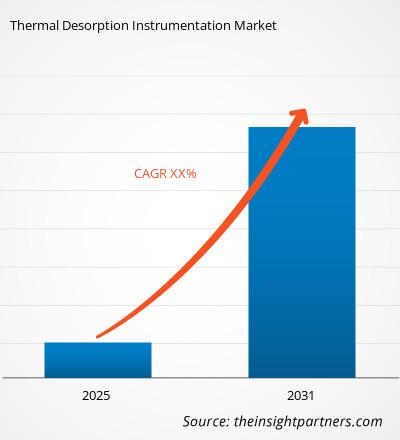
The global Thermal Desorption Instrumentation market was valued at US$ 12.34 billion in 2025 and is expected to reach US$ 24.56 billion by 2034; it is estimated to record a CAGR of 7.95% during 2026-2034.
Thermal Desorption Instrumentation Market Assessment and Insights
- North America: The region accounted for 31–34% of the Thermal Desorption Instrumentation Market share in 2025 and is projected to grow at a 5.6–6.1% CAGR between 2026–2034, led by air quality compliance and laboratory modernization.
- US: The US represented 76–80% of North America in 2025 and is expected to expand at a 5.7–6.2% CAGR between 2026–2034, driven by environmental laboratories and industrial hygiene testing.
- Europe: Europe held 25–28% share in 2025 and the Thermal Desorption Instrumentation Market forecast is expected to register 5.1–5.6% CAGR between 2026–2034, led by Germany, the UK, and France.
- Asia Pacific: Asia Pacific captured 24–27% share in 2025 and is anticipated to post a 6.2–6.8% CAGR between 2026–2034, with China, Japan, South Korea, and India leading demand.
- Largest Segment: Automatic systems held 43–47% of the Thermal Desorption Instrumentation market share in 2025 and are expected to grow at a 6.0–6.5% CAGR between 2026–2034 due to unattended workflows.
- High Growth Segment: Chemical applications held 46–50% market share in 2025 and are projected to grow at a 6.1–6.7% CAGR between 2026–2034 as VOC compliance expands.
- Key companies analyzed in detail: Markes International Limited; GERSTEL GmbH and Co. KG; Agilent Technologies, Inc.; CDS Analytical, LLC; Camsco, Inc.; Tarmac International, Inc.; Scientific Instrument Services, Inc.; Shimadzu Corporation; PerkinElmer, Inc.; Dani Instruments S.p.A.; AIRSENSE Analytics GmbH; Beijing BCHP Analytical Technology Co., Ltd.
Source: The Insight Partners' analysis based on proprietary research, government publications, company annual reports, investor presentations, industry databases, and expert interviews.
The market for Thermal Desorption Instrumentation has transformed from being labor-intensive to becoming automated, solvent-free, and multi-tube, which increases sensitivity and improves productivity. Manufacturers are focusing on sample tube conditioning, water management, air analysis, and compatibility with leading GC-MS brands. The production is still dominated by specialist analytical instrumentation suppliers, but the demand is driven by laboratory needs for increased sensitivity and reduced number of solvent-dependent sample preparation processes.
Investment focus is moving towards the Asia Pacific, the Gulf, and high-regulation regions with growing air monitoring, petrochemical analysis, and material emission initiatives. Growing regulatory interest in VOCs, exposure limits, and indoor air quality expands the scope of applications beyond specialist environmental laboratories. The market growth potential for Thermal Desorption Instrumentation is greatest when investment in automation matches analytical reporting requirements.
Thermal Desorption Instrumentation Market Report Scope
| Report Attribute | Details |
|---|---|
| Market size in 2025 | US$ 12.34 Billion |
| Market Size by 2034 | US$ 24.56 Billion |
| Global CAGR (2026 - 2034) | 7.95% |
| Historical Data | 2021-2024 |
| Forecast period | 2026-2034 |
Thermal Desorption Instrumentation Market Analysis
Demand is based on VOCs and SVOCs recognition, industrial hygiene, emissions measurement, and contamination assessment. Thermal desorption leads to lower solvent consumption and increased transfer efficiencies; therefore, it is beneficial in the context of laboratories dealing with trace level analysis of air, soil vapor, materials, and processes samples. It follows from the Thermal Desorption Instrumentation market trends that automation is becoming critical in terms of throughput, repeatability, and report generation.
The value chain consists of sorbent tube providers, thermal desorber producers, GC/GC-MS suppliers, calibration companies, laboratory services providers, and regulatory test clients. The supply environment benefits companies with application databases, methodologies, service capabilities, and proven compatibility with current GC instrumentation. The Thermal Desorption Instrumentation market trends demonstrate an increasing demand for dual channel and online instruments in continuous monitoring applications.
The Thermal Desorption Instrumentation Market report focuses on key companies including Markes International Limited, GERSTEL GmbH and Co. KG, Agilent Technologies, Inc., CDS Analytical, LLC, Shimadzu Corporation, and PerkinElmer, Inc., who compete on automation, sensitivity, geographical spread, and the integration of GC-MS. Camsco, Inc., Scientific Instrument Services, Inc., Dani Instruments S.p.A., AIRSENSE Analytics GmbH, and Beijing BCHP Analytical Technology Co., Ltd. reinforce the supplier ecosystem through consumables and application-oriented instruments.
Investment priorities are focused on automation, online sample handling, hydrogen gas compatibility, maintenance-free traps, and workflow solutions powered by software. Positioning strategies revolve around application knowledge instead of instrumentation, since clients need techniques for ambient air, workplace exposure, materials emissions, and chemical processes. The market share for Thermal Desorption Instrumentation is likely to move to companies with lower cost of ownership and solid analytical capabilities.
● REPORT CUSTOMIZATION
Tailor This Report To Align With Your Specific Business Requirements
This report can be customized to align precisely with your business objectives, scope, and target markets. Customization options include tailored segmentation, geography, competitive analysis, and strategic insights to support informed decision-making.
Customize This Report →WHAT YOU CAN ADJUST
- ● Segmentations
- ● Geography
- ● Competitive Analysis
- ● Language Preferences
Thermal Desorption Instrumentation Market: Strategic Insights

Regional Insights
North America Thermal Desorption Instrumentation
North America held 31–34% share in 2025 and is forecast to grow at a 5.6–6.1% CAGR through 2034. The region benefits from EPA-oriented air toxics testing, occupational exposure monitoring, and established GC-MS laboratory infrastructure. Demand is strongest in environmental laboratories, petrochemical hubs, and materials testing facilities that require automated trace VOC workflows.
Procurement is shifting from single-purpose desorbers toward automated systems that support sorbent tubes, canisters, and unattended monitoring. The Thermal Desorption Instrumentation size in North America is supported by replacement cycles, service contracts, and method validation requirements.
U.S. Thermal Desorption Instrumentation Market
The US accounted for 76–80% of North America in 2025 and is expected to grow at a 5.7–6.2% CAGR during 2026–2034. The country’s demand is linked to air monitoring networks, industrial hygiene testing, federal method compliance, and growing attention to indoor air and fenceline emissions.
Company presence is strengthened by Agilent Technologies, Inc., CDS Analytical, LLC, Camsco, Inc., Scientific Instrument Services, Inc., and PerkinElmer, Inc. Applications are broadening from environmental compliance to chemical processing, building materials, research teaching laboratories, and mining-related exposure assessment.
Europe Thermal Desorption Instrumentation Market
Europe represented 25–28% share in 2025 and is projected to expand at a 5.1–5.6% CAGR. Germany is the leading country, supported by analytical instrument engineering, automotive emissions research, chemical manufacturing, and strong laboratory accreditation practices.
The UK remains important through Markes International Limited, environmental testing demand, and academic research adoption. Germany benefits from GERSTEL GmbH and Co. KG, while France, Italy, and Spain add demand through air quality, industrial exposure, food aroma, and materials emissions testing.
European buyers emphasize validated methods, service continuity, and lower solvent consumption.
APAC Thermal Desorption Instrumentation Market
APAC held 24–27% share in 2025 and is expected to grow at a 6.2–6.8% CAGR. China is the leading country due to industrial emissions control, petrochemical monitoring, and expanding environmental laboratory capacity.
Japan and South Korea add demand through electronics, automotive interiors, and high-precision materials testing.
India and Australia are scaling adoption through mining, academic research, occupational exposure monitoring, and urban air quality programs, making APAC central to long-term Thermal Desorption Instrumentation Market expansion.
Middle East & Africa Thermal Desorption Instrumentation Market
MEA is forecast to grow at a 4.8–5.4% CAGR during 2026–2034, with Saudi Arabia leading regional demand. Petrochemical expansion, refinery monitoring, and industrial hygiene requirements support instrument purchases.
The UAE is adopting laboratory automation for environmental and infrastructure projects.
South Africa and the Rest of MEA contribute through mining, academic testing, and air quality monitoring, although adoption remains uneven because of budget constraints and limited specialist service coverage.
Segmentation Analysis
Type
The Type segment in the Thermal Desorption Instrumentation Market is expected to grow at a 5.7–6.3% CAGR during 2026–2034. Instrument selection depends on sample throughput, automation needs, and analytical complexity. Automatic systems lead because they reduce labor intensity, while dual-channel platforms support higher productivity. Secondary systems remain relevant where laboratories need targeted desorption capability without full automation.
- Dual Channel systems are selected by laboratories requiring parallel sample handling, shorter batch cycles, and stronger productivity for VOC monitoring across environmental, chemical, and research settings.
- Secondary systems serve users needing focused thermal release, cost control, and compatibility with existing chromatography assets, especially in smaller laboratories and specialized teaching or process applications.
- Automatic instruments dominate high-throughput demand by enabling unattended sequences, consistent tube handling, audit-friendly workflows, and reduced analyst intervention in regulated testing environments.
Application
The Application segment in the Thermal Desorption Instrumentation Market is projected to grow at a 5.8–6.4% CAGR during 2026–2034. Chemical testing remains the strongest revenue contributor because VOC identification, emissions control, and process monitoring require sensitive analytical workflows. Mining and school applications add breadth, with demand linked to exposure assessment, training laboratories, and applied research programs.
- Chemical applications lead adoption as manufacturers and testing laboratories use thermal desorption to quantify residual solvents, process emissions, workplace contaminants, and trace organic impurities.
- Mining applications focus on worker exposure, soil vapor, ventilation assessment, and remediation-related sampling, making reliable VOC and SVOC detection strategically important for compliance.
- School applications support teaching laboratories, environmental science programs, and institutional research, where compact automated systems help demonstrate chromatography workflows and air quality testing.
Opportunity Snapshot
| Segment Name | Revenue Contribution | Trend Tag | Adoption Stage |
| Chemical | High | VOC Control | Mature |
| Mining | Medium | Exposure Testing | Scaling |
| School | Low | Teaching Labs | Emerging |
Thermal Desorption Instrumentation Market Growth Drivers and Impact Analysis
Stricter VOC and SVOC Compliance Requirements
Growth in the regulatory oversight of volatile organics has spurred a need for high-sensitivity and repeatable sampling systems. With thermal desorption providing the means to achieve trace detection via concentration of compounds from tube or canister sampling prior to GC/MS analysis, environmental testing labs, chemical manufacturers, and occupational safety groups are switching from solvent-based sampling procedures to the automated desorption approach. This translates to greater instrument use, increased consumables sales, and additional recurring services revenues for vendors of these validated techniques.
Laboratory Automation and Throughput Pressure
Larger volumes of samples, shorter turnaround times, and fewer analysts are putting pressure on testing labs. These challenges can be solved by the automatic thermal desorption technology by allowing unattended tubing operations, uniform conditioning, and uniform transfer to the analytical instrumentation. The importance of this driver is especially evident in the environmental, chemical, and institution labs because repeatability and audit trail have significant effect on contracts.
Expansion of Industrial Hygiene and Materials Emissions Testing
The need for evidence-based exposure monitoring of industrial workers, indoor air pollution, and emissions from manufactured goods is becoming more essential. Thermal desorption technology offers a solution that links sampling in the field to compound identification of lab grade. This growing need is apparent in petrochemical industries, mining, car interiors, building products, and academia. The resulting impact will be an expanded clientele for thermal desorption technology beyond environmental agencies, making application-oriented approaches and training even more important.
Thermal Desorption Instrumentation Market Future Trends
Continuous Online Monitoring Platforms
Continuous and near real-time monitoring will be necessary when there is a shift from sampling to more informative surveillance by regulators and industrial plants. On-line thermal desorption with automatic stream switching, water handling, and dual trap capability could minimize data gaps in monitoring ambient air, process gas, and fence line samples. This will drive suppliers to develop solutions with high availability, calibration stability, and remote diagnostics. Clients will assess instruments on detection levels but also on reliability and maintenance needs and integration with electronic data processing.
Cryogen-Free and Lower-Emission Laboratory Workflows
Instruments used in the lab are being reassessed for ways to use fewer materials, solvents, have less intense energy usage and be simpler in operation. The Thermal Desorption Instrumentation Market trend towards sustainability and controlling costs is reflected by the adoption of cryogen free thermal desorption systems, reusable sorbent tubes and more efficient focusing traps. In the coming years, there will be an increased consideration by procurement managers of total cost of operation, waste reduction and reliability of technique.
Thermal Desorption Instrumentation Market Opportunities
Application Bundles for Chemical and Mining Laboratories
Instruments could generate more income through bundling themselves with proven methods, sorbent tubes, calibration kits, and application training targeted to the chemical and mining industries. Some laboratories require systems for residual solvents, emission, soil vapor, and employee exposures instead of just an instrument. Such an approach reduces the time to implement the system and assists customers in protecting their data integrity in audits. It is easier for companies combining instrument development with applications support and documentation to capitalize on such an opportunity.
Education and Research Laboratory Modernization
School and university laboratories represent a smaller but strategic opportunity because training programs influence future analytical workflows. Compact automatic or secondary thermal desorption systems can help institutions teach sample preparation, chromatography, VOC analysis, and environmental monitoring using realistic methods. Suppliers can support adoption through teaching kits, simplified software, shared service models, and curriculum-oriented application notes. Over time, exposure in academic settings can strengthen brand familiarity and expand the trained user base for industrial laboratories.
Recent Developments
- May 2026: Agilent Technologies, Inc. — Agilent launched new GC systems with GC Assist to improve laboratory efficiency and data quality, strengthening the chromatography platform ecosystem used with thermal desorption workflows for VOC and SVOC analysis
- January 2026: Markes International Limited — Velaris acquired Markes International, expanding its automated sample preparation and analytical instrumentation portfolio, with expected benefits in regional support, complementary technology coverage, and service reach for GC and GC-MS laboratories
- October 2025: Markes International Limited — Markes International and Agilent Technologies co-hosted a TD-GC-MS workshop in Germany covering trace volatile sampling, sorbent selection, hydrogen carrier gas, and deconvolution, reinforcing applied training for advanced VOC workflows
Frequently Asked Questions

- Comprehensive Market Sizing and Forecast Analysis
- Detailed Segmentation Analysis
- In-Depth Market Dynamics Assessment
- Regional and Country-Level Insights
- Competitive Landscape and Company Benchmarking
- Strategic Business Intelligence
Recent Reports
Testimonials

The Insight Partners' SCADA System Market report is comprehensive, with valuable insights on current trends and future forecasts. The team was highly professional, responsive, and supportive throughout. We are very satisfied and highly recommend their services.
RAN KEDEM Partner, Reali Technologies LTDs
I requested a report on a very specific software market and the team produced the report in a few days. The information was very relevant and well presented. I then requested some changes and additions to the report. The team was again very responsive and I got the final report in less than a week.
JEAN-HERVE JENN Chairman, Future Analytica
We worked with The Insight Partners for an important market study and forecast. They gave us clear insights into opportunities and risks, which helped shape our plans. Their research was easy to use and based on solid data. It helped us make smart, confident decisions. We highly recommend them.
PIYUSH NAGPAL Sr. Vice President, High Beam Global
The Insight Partners delivered insightful, well-structured market research with strong domain expertise. Their team was professional and responsive throughout. The user-friendly website made accessing industry reports seamless. We highly recommend them for reliable, high-quality research services
YUKIHIKO ADACHI CEO, Deep Blue, LLC.
This is the first time I have purchased a market report from The Insight Partners.While I was unsure at first, I visited their web site and felt more comfortable to take the risk and purchase a market report.I am completely satisfied with the quality of the report and customer service. I had several questions and comments with the initial report, but after a couple of dialogs over email with their analyst I believe I have a report that I can use as input to our strategic planning process.Thank you so much for taking the extra time and making this a positive experience.I will definitely recommend your service to others and you will be my first call when we need further market data.
JOHN SUZUKI President and Chief Executive Officer, Board Director, BK Technologies
I wish to appreciate your support and the professionalism you displayed in the course of attending to my request for information regarding to infectious disease IVD market in Nigeria. I appreciate your patience, your guidance, and the fact that you were willing to offer a discount, which eventually made it possible for us to close a deal. I look forward to engaging The Insight Partners in the future, all thanks to the impression you have created in me as a result of this first encounter.
DR CHIJIOKE ONYIA MANAGING DIRECTOR, PineCrest Healthcare Ltd.Reason to Buy
- Informed Decision-Making
- Understanding Market Dynamics
- Competitive Analysis
- Identifying Emerging Markets
- Customer Insights
- Market Forecasts
- Risk Mitigation
- Boosting Operational Efficiency
- Strategic Planning
- Investment Justification
- Tracking Industry Innovations
- Aligning with Regulatory Trends





 Get Free Sample for