
Thick Film Devices Market Growth, Share & Trends by 2034
Coverage: By Type (Capacitor, Resistors, Photovoltaic Cells, Heaters, Others); End-user Industry (Automotive, Consumer Electronics, Healthcare, Infrastructure, Others) , and Geography (North America, Europe, Asia Pacific, and South and Central America)
- Status : Data Released
- Report Code : TIPRE00017182
- Category : Electronics and Semiconductor
- No. of Pages : 150
- Available Report Formats :


- Last update date : July 28, 2026


2025 Market Size
US$ 93.69 Bn
Base year value
2034 Forecast
US$ 192.97 Bn
Projected by 2034
CAGR 2026-2034
8.36 %
Growth rate
Addressable Market
US$ 1,286.98 Bn
(2026-2034)
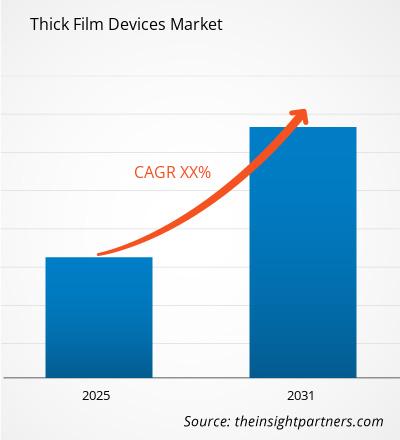
The Thick Film Devices Market is expected to increase from US$ 93.69 Billion in 2025 to US$ 192.97 Billion by 2034 at a CAGR of 8.36%. The Thick Film Devices market will be characterized by the increasing application of printed layers of conductive, resistive, dielectric, and functional materials in electronics, automobiles, healthcare applications, solar panels, and other infrastructure-based controls requiring durability, manufacturing compatibility, and stable electrical performance characteristics.
In North America, the growth forecast of the Thick Film Devices market size is projected to reach 7.2–8.0% CAGR by 2034, backed by semiconductor fabrication re-shoring, EV electronics localization, and rising manufacture of medical devices. The U.S. CHIPS Act, the shift towards EVs, and automation investments in industry will further drive the need for reliable thick film resistors, heaters, capacitors, and solar cells.
Thick Film Devices Market Assessment and Insights
- North America accounted for 29–31% share in 2025 and is growing at a CAGR range of 7.2–8.0% during 2026–2034, supported by EV electronics, defense-grade assemblies, and healthcare device manufacturing.
- US represented 76–79% of North America in 2025 and is growing at a CAGR range of 7.4–8.2% during 2026–2034, led by semiconductor supply-chain incentives.
- Europe held 20–22% share in 2025 and is growing at a CAGR range of 6.9–7.7% during 2026–2034, with Germany, France, the UK, Italy, and Spain leading adoption.
- Asia Pacific captured 37–40% share in 2025 and is growing at a CAGR range of 8.8–9.6% during 2026–2034, led by China, Japan, South Korea, India, and Taiwan-linked electronics supply chains.
- Largest Segment Resistors held 34–37% market share in 2025 and is growing at a CAGR range of 7.8–8.6% during 2026–2034, reflecting strong automotive and electronics demand.
- High Growth Segment Photovoltaic Cells held 18–21% market share in 2025 and is growing at a CAGR range of 9.4–10.2% during 2026–2034, supported by distributed solar and grid modernization.
- Key companies analyzed in detail: Bourns, Inc.; KOA Speer Electronics, Inc.; Murata Manufacturing Co., Ltd.; Panasonic Holdings Corporation; ROHM Co., Ltd.; Samsung Electro-Mechanics Co., Ltd.; TE Connectivity Ltd.; Vishay Intertechnology, Inc.; Walsin Technology Corporation; Würth Elektronik GmbH and Co. KG.
Source: The Insight Partners' analysis based on proprietary research, government publications, company annual reports, investor presentations, industry databases, and expert interviews.
The industry has advanced from conventional screen-printed passive devices to multi-layered, thermally stable and miniaturized devices suited for densely populated printed circuit boards and high temperature applications. The Thick Film Devices Market Report covers surface mount technology production, improved paste formulation of ruthenium and silver-palladium pastes and strict qualification standards such as AEC-Q200 for automobiles. The value chain still depends on the availability of ceramics and paste chemistry from East Asia; however, customers in North America and Europe have started showing more interest in dual sourcing of their critical passive devices.
In the forecast period, the new regions expected to be demand centers would include India, Southeast Asia, Mexico and Central Europe due to manufacture of electronic devices nearer to their end-users namely automotive, healthcare and infrastructure. The regulations supporting the cause of saving energy, installation of solar plants and semiconductor production in local factories would support those suppliers who are skilled at cost effective printing and have a performance guarantee.
Thick Film Devices Market Report Scope
| Report Attribute | Details |
|---|---|
| Market size in 2025 | US$ 93.69 Billion |
| Market Size by 2034 | US$ 192.97 Billion |
| Global CAGR (2026 - 2034) | 8.36% |
| Historical Data | 2021-2024 |
| Forecast period | 2026-2034 |
Thick Film Devices Market Analysis
The demand for Thick Film Devices Market increases due to the increasing density of passive components in EVs, interconnected devices for consumers, medical diagnostics equipment, and smart infrastructure control units. EVs require battery management units, inverters, charging units, LED lighting systems, and medical sensors that would be miniature in size and able to withstand temperatures, vibrations, and prolonged operation. The IEA announced continued demand for electric cars in 2025 that supports the increased use of electronics and procurement of qualified thick film components.
The supply chain includes ceramic substrate makers, paste makers, screen-printing machine makers, firing furnace makers, component makers, distributors, EMS makers, and OEM designers. The market is influenced by the price of noble metals, availability of alumina substrates, and qualification lead time. The Thick Film Devices are preferred if the designer requires moderate cost, high volume manufacturability, and tolerable tolerance levels compared to thin film components.
Positioning within the industry is based on suppliers with automotive-grade offerings, worldwide reach, and process control on a large scale. TFD analysis suggests that Bourns, KOA Speer Electronics, Panasonic Holdings, ROHM, Vishay Intertechnology, and Walsin Technology have competitive advantage by virtue of their resistor offering, while Murata Manufacturing, Samsung Electro-Mechanics, TE Connectivity, and Würth Elektronik enhance neighboring passive, connector, and module product families.
Capital flow is being oriented towards chip products, sulfur tolerant terminations, high voltage offerings, and SMT compatible components. There is also an emerging need for geographic stocking, application engineering, and end of life management because increasingly Original Equipment Manufacturers see passive components as critical reliability parts. Differentiation strategy will be contingent upon quality systems in place, stable material supply, and footprint customization without compromising economics of mass production.
● REPORT CUSTOMIZATION
Tailor This Report To Align With Your Specific Business Requirements
This report can be customized to align precisely with your business objectives, scope, and target markets. Customization options include tailored segmentation, geography, competitive analysis, and strategic insights to support informed decision-making.
Customize This Report →WHAT YOU CAN ADJUST
- ● Segmentations
- ● Geography
- ● Competitive Analysis
- ● Language Preferences
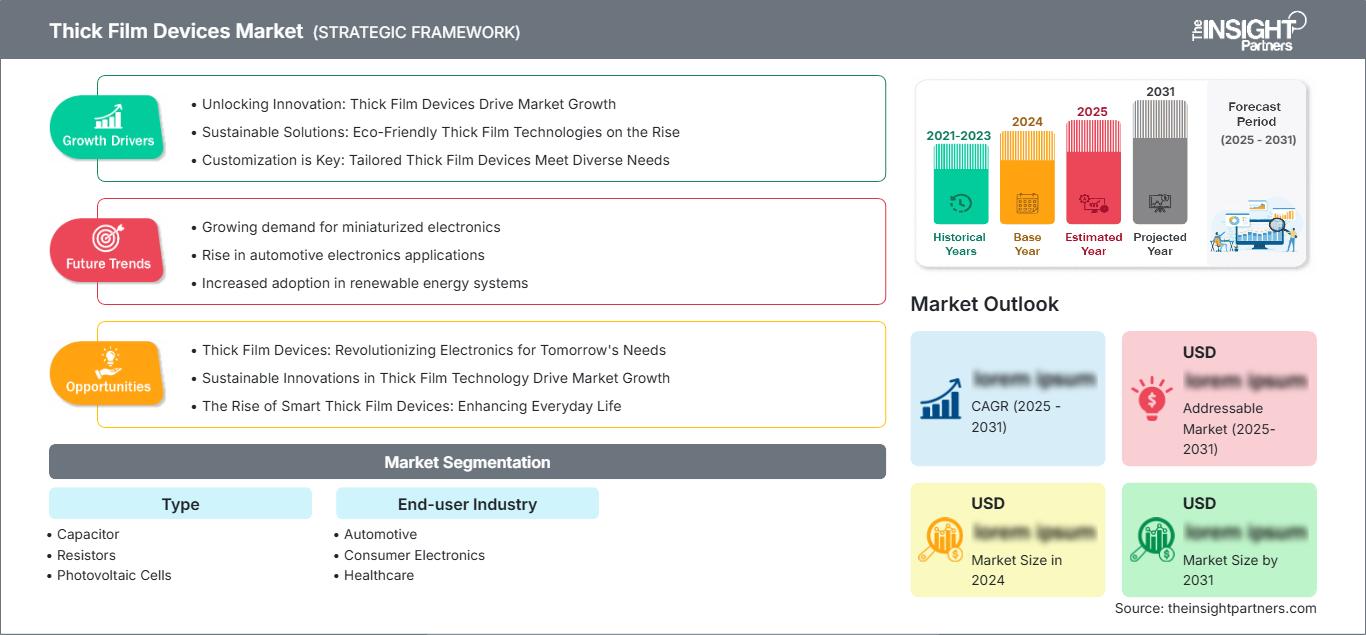
Thick Film Devices Market: Strategic Insights
Regional Insights
North America Thick Film Devices Market
The North American market had 29-31% of the total revenue share in 2025 and was driven by the presence of an electronics industry in the USA, assembly capabilities in Mexico, and industrial automation needs in Canada. It is projected to grow at a CAGR of 7.2-8.0% over 2026-2034 owing to the demand for qualified passive components in EV platforms, aerospace electronics, grid control systems, and portable healthcare equipment.
Key structural factors include localization of semiconductors, increasing use of electronics in vehicles, and the desire for reliable local or nearshoring. Increasing electronics manufacturing service capabilities in the USA and Mexico in the automotive, chargers, and industrial control modules will drive demand for resistors, heaters, capacitors, and printed photovoltaics. Supplier qualification cycles are long, hence qualifying components early is business-critical.
U.S. Thick Film Devices Market
In 2025, the US accounted for 76-79% of North America's revenues and is estimated to grow at a 7.4-8.2% CAGR during 2026-2034. The demand is focused on automotive electronics, medical equipment, defense systems, telecommunications equipment, and industrial power management systems, where qualifying, traceable, and reliable suppliers are more important than cheap ones.
Bourns, Vishay Intertechnology, TE Connectivity, and KOA Speer Electronics have good presence in the US market with sales, engineering, and distribution capabilities. Panasonic Holdings, ROHM, Murata Manufacturing, Samsung Electro-Mechanics, Walsin Technology, and Würth Elektronik have presence in OEMs' global catalogs. There is a trend toward sulfur resistance for chip resistors, small form-factor heaters for sensors, and reliable parts for power conversion systems.
Europe Thick Film Devices Market
Europe was 20–22% in 2025, and expected to have a CAGR of 6.9–7.7% from 2026 to 2034. Europe has demand driven by the automotive electronics, industrial automation, and power conversion manufacturing in Germany, with the help of EU energy efficiency laws and medical technology exportation. The United Kingdom has demand for aerospace electronics, health monitoring equipment, and specialized industrial controls, with purchasing preferences being towards distributors that deal with qualified products and long-life passive components. Germany has the highest demand because of its Tier 1 automotive suppliers, factory automation companies, and power electronics manufacturing need high-temperature operation, small footprints, and proper documentation.
France, Italy, and Spain contribute to demand from rail electronics, renewable energy production, machinery, and manufacturing of medical equipment. In France, there is the aerospace and defense programs’ usage of ruggedized passive components, the Italian industrial machinery needs cost-efficient reliable products, and Spain has renewable energy and automotive manufacturing needing printed heaters, resistors, and photovoltaic assemblies.
APAC Thick Film Devices Market
The APAC region has accounted for 37%-40% market share in 2025 and is forecast to register a CAGR of 8.8%-9.6% during 2026-2034. Leading in terms of market share is China, driven by electronics assembly operations, EV manufacturing, solar energy products, and consumer electronics supply chains.
Advanced materials, ceramics, passive components, and automotive electronics from Japan and South Korea, together with infrastructure digitization programs in India and Australia, will generate strong demand for thick films.
Middle East & Africa Thick Film Devices Market
The Middle East and Africa region will see growth in the range of 6.4%–7.2% CAGR from 2026 to 2034, with the major impetus coming from Saudi Arabia and the UAE in terms of energy systems, smart cities, data centers, and transportation infrastructure using more control electronics.
The South Africa region has an impact through industrial automation, mining machinery, and medical devices, and the other MEA regions through grid modernization and opportunities in solar applications. Difficult environmental conditions make more important the need for dependable resistive and heating elements. Success of manufacturers comes through distribution, maintenance support, and infrastructure procurement.
Segmentation Analysis
Type
The Type segment is expected to grow at a 8.1–8.9% CAGR during 2026–2034 as OEMs select thick film platforms for electrical control, thermal management, energy conversion, and compact circuit protection. The Thick Film Devices Market scope across type categories reflects broad process flexibility, from printed resistive tracks to heater patterns and photovoltaic functional layers.
- Capacitor demand is supported by compact electronics, power conditioning, and module integration where printed dielectric layers help reduce board space while maintaining stable performance across consumer and industrial circuits.
- Resistors remain the largest type, used for current sensing, voltage division, and circuit protection in automotive, consumer electronics, healthcare instruments, and infrastructure controls requiring high-volume reliability.
- Photovoltaic Cells are gaining strategic importance as printed conductive patterns support solar cell efficiency, distributed generation, and manufacturing scalability across utility, rooftop, and building-integrated photovoltaic applications.
- Heaters serve sensors, medical devices, automotive systems, and industrial equipment where localized heating, rapid thermal response, and durable ceramic substrates improve performance in compact assemblies.
End-user Industry
The End-user Industry segment is projected to grow at a 8.3–9.1% CAGR during 2026–2034, reflecting expanding electronic content in mobility, consumer devices, healthcare systems, and infrastructure assets. Adoption is strongest where ruggedness, cost-efficient mass production, and qualification consistency matter more than ultra-high precision alone.
- Automotive uses thick film resistors, heaters, and sensor elements in EV powertrains, ADAS, lighting, battery systems, infotainment, and body electronics requiring compact, temperature-tolerant components.
- Consumer Electronics demand is tied to smartphones, wearables, laptops, appliances, and connected devices where surface-mount compatibility, miniaturization, and high-volume cost discipline guide component selection.
- Healthcare applications include portable diagnostics, patient monitoring, imaging accessories, and therapeutic devices where reliability, thermal control, and stable electrical behavior support regulated device performance.
- Infrastructure adoption is rising in smart meters, grid equipment, transport signaling, renewable energy systems, and building automation where long operating life and environmental resilience are procurement priorities.
Opportunity Snapshot
| End-user Industry | Revenue Contribution | Trend Tag | Adoption Stage |
| Automotive | High | EV Modules | Scaling |
| Consumer Electronics | High | Compact SMT | Mature |
| Healthcare | Medium | Wearable Care | Scaling |
| Infrastructure | Medium | Smart Grid | Emerging |
Thick Film Devices Market Growth Drivers and Impact Analysis
Rising Electronic Content in Electric and Connected Vehicles
Automotive platforms are adding more sensors, power converters, lighting modules, battery management units, and infotainment circuits, creating sustained pull for qualified thick film resistors, heaters, and functional elements. Electric vehicles typically require higher passive component counts than internal-combustion vehicles because voltage monitoring, thermal management, and power conditioning become more complex. The IEA’s continued reporting of expanding EV sales reinforces this demand signal. Market impact is direct: suppliers with AEC-Q200 portfolios, sulfur-resistant parts, and regional application support can secure design-ins that last through multi-year vehicle programs, improving revenue visibility and customer retention.
Miniaturization and High-Volume Surface-Mount Manufacturing
Device makers are reducing circuit board footprints while increasing functionality, which raises demand for small, stable, and manufacturable passive components. Thick film printing supports compact geometries, automated placement, and scalable firing processes, making it attractive for smartphones, wearables, routers, appliances, and industrial controls. The impact is visible in supplier roadmaps focused on smaller chip sizes, tighter process control, and improved terminations. Manufacturers able to deliver consistent electrical values at high volumes gain purchasing preference because OEMs need predictable yields, low rework, and compatibility with fast SMT assembly lines.
Energy Efficiency and Smart Infrastructure Expansion
Utilities, cities, and industrial operators are upgrading metering, grid automation, renewable integration, and transport systems, increasing demand for robust electronic controls. Thick film heaters, resistors, and photovoltaic-related components support measurement accuracy, environmental tolerance, and reliable operation in outdoor or high-duty-cycle installations. Energy-efficiency regulations and infrastructure digitization create procurement momentum for components with long service life and stable performance. Market impact is strongest where suppliers combine technical documentation, extended availability, and distributor coverage, allowing infrastructure buyers to manage lifecycle risk across dispersed assets.
Thick Film Devices Market Future Trends
Application-Specific Thick Film Architectures
Thick Film Devices Market trends will increasingly move toward application-specific geometries, materials, and qualification packages rather than catalog-only component selection. Automotive inverter controls, implant-adjacent healthcare devices, smart meters, and renewable energy converters each require distinct combinations of thermal stability, resistance value, footprint, and failure-mode behavior. Suppliers are expected to expand co-design work with OEMs, using simulation, customized substrates, and process monitoring to improve fit-for-purpose performance. This shift will raise switching costs for customers and make early engineering engagement a stronger competitive lever than price alone.
Regionalized Supply Chains and Materials Resilience
Future procurement strategies will place greater weight on regional inventory, alternative paste chemistries, and diversified substrate sourcing. Noble-metal exposure, geopolitical risk, and transport disruptions have made passive components part of broader supply-chain resilience planning. North American and European customers are likely to qualify secondary sources earlier, while Asian suppliers will retain scale advantages through ceramics and electronics clusters. Over time, traceability, environmental compliance, and continuity planning will become routine selection criteria, especially for automotive, healthcare, defense, and infrastructure programs with long product lifecycles.
Thick Film Devices Market Opportunities
Design-In Partnerships for EV and Power Electronics Platforms
Suppliers can capture value by entering EV, charger, and industrial power programs during architecture definition, not after component sourcing begins. Thick Film Devices Market Forecasts favor vendors that provide thermal modeling, failure-mode data, qualification documentation, and package options aligned with inverter, onboard charger, and battery management needs. The opportunity is investment-oriented because design wins can translate into multi-year revenue streams once vehicles or power systems enter production. Companies should prioritize field application engineering, local sample availability, and automotive-grade capacity planning to improve conversion from specification to recurring orders.
Healthcare and Wearable Electronics Expansion
Portable diagnostics, patient monitoring patches, drug-delivery devices, and connected wellness products create opportunities for compact heaters, stable resistors, and sensor-related thick film structures. Healthcare OEMs value reliability, documented manufacturing controls, and component consistency because device approvals and field performance depend on stable electronics. Suppliers can differentiate through medical-grade traceability, long-term product availability, and collaboration with design houses serving regulated equipment makers. Investment in clean manufacturing practices, extended qualification data, and small-form-factor portfolios will help companies address higher-margin niches beyond commodity consumer electronics.
Recent Developments
- February 2026: Vishay Intertechnology, Inc. (NYSE: VSH) today introduced a new series of AEC-Q200 qualified thick film chip resistors in the ultra compact 0201 case size. Offering a miniature footprint of just 0.6 mm by 0.3 mm by 0.23 mm, the CRCW0201-AT e3 series devices provide designers with a reliable, space-saving solution for automotive, industrial, and telecommunications applications.
- May 2025: Asahi Kasei has developed the TA Series of Sunfort™ dry film photoresist as a new product designed to meet growing demand in the field of advanced semiconductor packages used in applications such as artificial intelligence (AI) servers. This product is positioned as a strategic offering within Asahi Kasei's Material sector, aiming to strengthen its footprint in the rapidly growing market for next-generation chip packaging. The dry film delivers an ultra-high resolution with conventional stepper exposure systems and laser direct imaging (LDI) systems, which transfer circuit patterns onto substrates during packaging, contributing to enhanced performance and precision in back-end processes.
Frequently Asked Questions

- Comprehensive Market Sizing and Forecast Analysis
- Detailed Segmentation Analysis
- In-Depth Market Dynamics Assessment
- Regional and Country-Level Insights
- Competitive Landscape and Company Benchmarking
- Strategic Business Intelligence
Recent Reports
Testimonials

The Insight Partners' SCADA System Market report is comprehensive, with valuable insights on current trends and future forecasts. The team was highly professional, responsive, and supportive throughout. We are very satisfied and highly recommend their services.
RAN KEDEM Partner, Reali Technologies LTDs
I requested a report on a very specific software market and the team produced the report in a few days. The information was very relevant and well presented. I then requested some changes and additions to the report. The team was again very responsive and I got the final report in less than a week.
JEAN-HERVE JENN Chairman, Future Analytica
We worked with The Insight Partners for an important market study and forecast. They gave us clear insights into opportunities and risks, which helped shape our plans. Their research was easy to use and based on solid data. It helped us make smart, confident decisions. We highly recommend them.
PIYUSH NAGPAL Sr. Vice President, High Beam Global
The Insight Partners delivered insightful, well-structured market research with strong domain expertise. Their team was professional and responsive throughout. The user-friendly website made accessing industry reports seamless. We highly recommend them for reliable, high-quality research services
YUKIHIKO ADACHI CEO, Deep Blue, LLC.
This is the first time I have purchased a market report from The Insight Partners.While I was unsure at first, I visited their web site and felt more comfortable to take the risk and purchase a market report.I am completely satisfied with the quality of the report and customer service. I had several questions and comments with the initial report, but after a couple of dialogs over email with their analyst I believe I have a report that I can use as input to our strategic planning process.Thank you so much for taking the extra time and making this a positive experience.I will definitely recommend your service to others and you will be my first call when we need further market data.
JOHN SUZUKI President and Chief Executive Officer, Board Director, BK Technologies
I wish to appreciate your support and the professionalism you displayed in the course of attending to my request for information regarding to infectious disease IVD market in Nigeria. I appreciate your patience, your guidance, and the fact that you were willing to offer a discount, which eventually made it possible for us to close a deal. I look forward to engaging The Insight Partners in the future, all thanks to the impression you have created in me as a result of this first encounter.
DR CHIJIOKE ONYIA MANAGING DIRECTOR, PineCrest Healthcare Ltd.Reason to Buy
- Informed Decision-Making
- Understanding Market Dynamics
- Competitive Analysis
- Identifying Emerging Markets
- Customer Insights
- Market Forecasts
- Risk Mitigation
- Boosting Operational Efficiency
- Strategic Planning
- Investment Justification
- Tracking Industry Innovations
- Aligning with Regulatory Trends





 Get Free Sample for