
Thin Film Photovoltaic Market Size, Trends & Demand by 2034
Coverage: by Type (Inorganic Photovoltic, Organic Photovoltaic); Material (Cadmium Telluride, Copper Indium Gallium Selenide, Amorphous Silicon); End-Use (Commercial, Residential, Industrial) , and Geography (North America, Europe, Asia Pacific, and South and Central America)
- Status : Data Released
- Report Code : TIPRE00010575
- Category : Electronics and Semiconductor
- No. of Pages : 150
- Available Report Formats :


- Last update date : July 21, 2026


2025 Market Size
US$ 7.92 Bn
Base year value
2034 Forecast
US$ 29.26 Bn
Projected by 2034
CAGR 2026-2034
15.63 %
Growth rate
Addressable Market
US$ 157.91 Bn
(2026-2034)
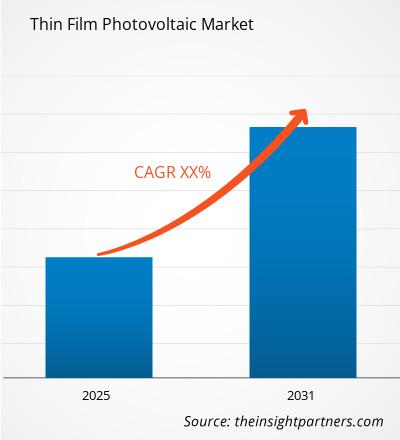
The global Thin Film Photovoltaic Market is expected to grow from US$ 7.92 billion in 2025 to US$ 29.26 billion by 2034 with a Compound Annual Growth Rate (CAGR) of 15.63% during 2026–2034. This is driven by the growing need for thin film technology that can provide lightweight and flexible photovoltaic technology and lesser amount of materials needed.
In North America, the Thin Film Photovoltaic market size continues to be an important region due to manufacturing, utility-scale solar, and demand for modules that perform well in hot climates. The region will witness growth at a CAGR of 14.8-15.6% during 2026–2034 driven by additions of capacity in U.S., localization of supply chain, data center power needs, and preference for traceable technologies.
Thin Film Photovoltaic Market Assessment and Insights
- North America accounted for 29–32% share in 2025 and is growing at a CAGR range of 14.8–15.6% during 2026–2034, led by utility-scale procurement, domestic content incentives, and resilient module supply preferences.
- US represented 78–82% of North America in 2025 and is growing at a CAGR range of 15.0–15.8% during 2026–2034, supported by capacity expansion and tax-credit-linked manufacturing.
- Europe held 20–23% share in 2025 and is growing at a CAGR range of 13.9–14.7% during 2026–2034, with Germany, France, Italy, Spain, and the UK driving rooftop, industrial, and building-integrated installations.
- Asia Pacific captured 34–38% share in 2025 and is growing at a CAGR range of 16.2–17.0% during 2026–2034, led by China, India, Japan, South Korea, and Australia across industrial solar and flexible applications.
- Largest Segment Cadmium Telluride held 48–52% market share in 2025 and is growing at a CAGR range of 15.1–15.9% during 2026–2034, reflecting utility-scale bankability and efficient high-temperature performance.
- High Growth Segment Organic Photovoltaic held 8–11% market share in 2025 and is growing at a CAGR range of 18.0–19.2% during 2026–2034, driven by lightweight electronics, façades, and indoor energy harvesting.
- Key companies analyzed in detail: Armor Group, Ascent Solar Technologies, Inc., AVANCIS GmbH, D2solar, DUNMORE Corporation, First Solar, Inc., Flisom AG, Global Solar Energy, Inc., Zentrum für Sonnenenergie- und Wasserstoff-Forschung Baden-Württemberg, Hanergy Thin Film Power Group Limited
Source: The Insight Partners' analysis based on proprietary research, government publications, company annual reports, investor presentations, industry databases, and expert interviews.
Technology migration is redefining Thin Film Photovoltaic market as an investment-oriented solar technology category, driven by distinct material economics. The commercial-scale production of CdTe has been enabled through integrated manufacturing lines, whereas CIGS and organic technologies have moved towards lighter weight substrates, aerospace applications, building-integrated photovoltaics, and lighter-load roof tops. IEA PVPS estimated 553–601 GW of solar photovoltaic installations globally in 2024, offering greater potential for alternatives to crystalline silicon.
The investment trends would diversify further away from North America due to increasing energy security considerations, lighter weight modules, and decarbonization objectives in industry sectors. New demand drivers in India, Southeast Asia, the Gulf countries, and even Africa would be inclined to use more durable solar energy systems, which simplify the balance of system design.
Thin Film Photovoltaic Market Report Scope
| Report Attribute | Details |
|---|---|
| Market size in 2025 | US$ 7.92 Billion |
| Market Size by 2034 | US$ 29.26 Billion |
| Global CAGR (2026 - 2034) | 15.63% |
| Historical Data | 2021-2024 |
| Forecast period | 2026-2034 |
Thin Film Photovoltaic Market Analysis
The drivers of Thin Film Photovoltaic market growth include increasing solar installations, limited roof space, and reducing the amount of material embedded. There is demand where light-weighted modules help save the cost of strengthening the roof structure or where high temperature, humidity, and partial shade hamper the performance of traditional modules. The value chain includes semiconductor raw materials, deposition equipment, encapsulation films, module manufacturing, system integration and recycling partnerships.
The supply chains rely on cadmium, tellurium, indium, gallium, selenium, barrier films, and coatings. According to the Thin Film Photovoltaic market report, vertically integrated CdTe production provides greater cost transparency, whereas CIGS and organic module manufacturers compete by differentiating through customization. Purchasing departments consider lifecycle carbon, module traceability, recyclability, warranty degradation rate, and ability to withstand high temperatures
Market structure is dominated by a few players but varies across niche applications. First Solar, Inc. is the market leader in utility-scale CdTe modules, whereas Ascent Solar Technologies, Inc., Flisom AG, AVANCIS GmbH, Global Solar Energy, Inc., and Armor Group operate in niche CIGS, building-integration, and other specialty products. DUNMORE Corporation and D2solar cater to module materials, prototype development, and testing markets.
Strategy orientation has changed from international sourcing to localization, military/aerospace approval, and superior module characteristics instead of pure cost-based competition. The companies having secured materials supply, certified manufacturing capability, field-proven track record, and warranties will benefit from lucrative customer demand. Public funding of CdTe/perovskite thin film technologies, including U.S. Department of Energy solar projects, provides additional credibility of the technology roadmap.
● REPORT CUSTOMIZATION
Tailor This Report To Align With Your Specific Business Requirements
This report can be customized to align precisely with your business objectives, scope, and target markets. Customization options include tailored segmentation, geography, competitive analysis, and strategic insights to support informed decision-making.
Customize This Report →WHAT YOU CAN ADJUST
- ● Segmentations
- ● Geography
- ● Competitive Analysis
- ● Language Preferences
Thin Film Photovoltaic Market: Strategic Insights
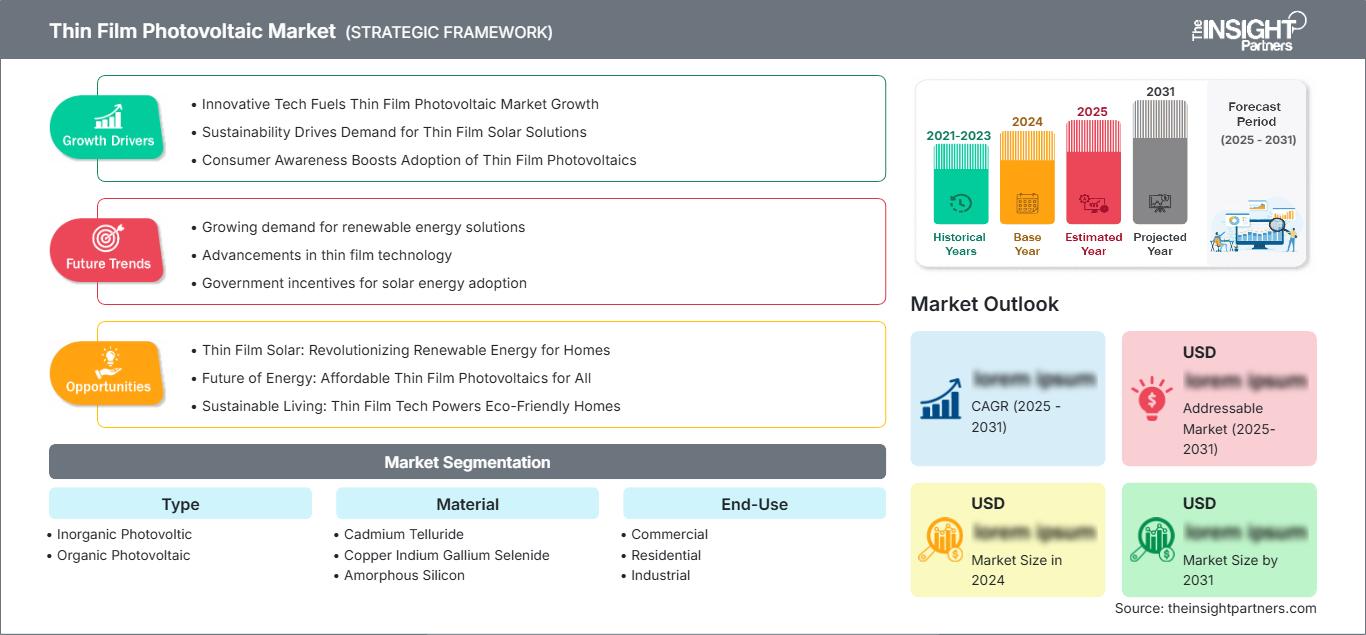
Regional Insights
North America Thin Film Photovoltaic Market
North America had Thin Film Photovoltaic market share of 29–32% in 2025 and is expected to see growth at a CAGR of 14.8–15.6% over 2026-2034. This region stands out due to domestic content policies, utility procurements, and capacity additions connected to data center, manufacturing, and transportation sector electrification.
Policy-driven manufacturing is key since the thin-film supply chain could be local and have lesser dependency on polysilicon. First Solar, Inc. has bolstered U.S. CdTe capacity, and Ascent Solar Technologies, Inc. has supported flexible CIGS applications in the defense and space sectors. Commercial rooftops and brownfield utility sites are key demand segments.
U.S. Thin Film Photovoltaic Market
In 2025, the U.S. accounted for 78-82% of Thin Film Photovoltaic Market in North America, and it is projected to have a CAGR of 15.0-15.8% during 2026-2034. The demand driver will be a combination of clean energy tax credit, federal purchases priority, utility-scale pipelines of solar projects, and preference for source traceability in power purchase agreement.
Presence is highly prevalent, as First Solar, Inc. produces CdTe modules, while Ascent Solar Technologies, Inc. specializes in aerospace and flexible cell applications. Application trends comprise power plants utility, military field power generation, rooftop installations with load capacity limits, and future renewable energy purchases related to data centers.
Europe Thin Film Photovoltaic Market
Europe held the Thin Film Photovoltaic market share of 20-23% in 2025 and is expected to exhibit a CAGR of 13.9-14.7% during the forecast period of 2026-2034. Germany emerges as the largest country with factors such as industrial decarbonization, rooftop solar regulations, and advanced engineering capabilities for BIPV and façade-based energy generation.
The UK leans towards lightweight solar applications on commercial structures with restricted structural loading capacity, whereas Germany has an advantage due to industrial electricity consumption and retrofitting opportunities. In France, Italy, and Spain, public buildings, logistics warehouses, agrivoltaic, and high irradiation projects for utilities due to low-temperature sensitivity contribute to the growth.
APAC Thin Film Photovoltaic Market
Share of APAC stood at 34–38% in 2025 and will expand at CAGR of 16.2–17.0% between 2026–2034. China will be the leader because of its high volume of PVs, equipment, and policies. The electronics-related thin film development and building integration are supported by Japan and South Korea.
India and Australia are driving APAC Thin Film Photovoltaic market through utility solar projects, off-grid applications, and industrial decarbonization. Flexible solar panels can be used for warehouses, transportation equipment, and low load roof surfaces that make rigid panels inappropriate. Renewable capacity expansion and manufacturing localization are important for APAC policies.
Middle East & Africa Thin Film Photovoltaic Market
Middle East & Africa is projected to grow at a CAGR of 15.4–16.2% during 2026–2034. Saudi Arabia is the leading country, followed by the UAE, South Africa, and Rest of MEA markets where utility solar, grid modernization, and industrial energy diversification are strategic priorities.
High solar irradiation, desert operating conditions, and demand for resilient generation favor module formats with strong heat performance and low water needs. Commercial and infrastructure projects in Gulf economies support premium solar procurement, while South Africa’s power reliability challenges create additional demand for distributed systems.
Segmentation Analysis
Type
The Type segment is projected to grow at a CAGR of 15.4–16.2% during 2026–2034 as buyers balance efficiency, flexibility, weight, and application fit. Thin Film Photovoltaic scope across type categories is widening because inorganic technologies dominate bankable utility demand, while organic formats address lower-power, flexible, and design-sensitive use cases.
- Inorganic Photovoltic holds the stronger commercial position because CdTe and CIGS technologies offer proven outdoor durability, established deposition methods, and better suitability for utility, industrial, and building-mounted deployments.
- Organic Photovoltaic is strategically important for lightweight electronics, indoor energy harvesting, façades, and flexible surfaces where transparency, aesthetics, low weight, and roll-to-roll manufacturing potential matter more than peak efficiency.
Material
The Material segment is estimated to grow at a CAGR of 15.0–15.8% during 2026–2034. Material selection determines energy yield, substrate compatibility, deposition economics, supply risk, and recycling pathways. CdTe remains the commercial anchor, CIGS supports flexible specialty formats, and amorphous silicon retains selected low-light and legacy product roles.
- Cadmium Telluride leads scaled deployment because it combines strong absorption, high-throughput production, favorable energy yield in hot climates, and established recycling programs suitable for utility procurement.
- Copper Indium Gallium Selenide serves flexible and lightweight applications, especially aerospace, portable power, and curved surfaces, where high specific power and substrate versatility create differentiation.
- Amorphous Silicon remains relevant in low-light devices, calculators, sensors, and certain building products, although mainstream growth is limited by lower conversion efficiency versus CdTe and CIGS alternatives.
End-Use
The End-Use segment is forecast to grow at a CAGR of 15.6–16.4% during 2026–2034 as solar adoption expands across commercial facilities, homes, and industrial operations. Commercial users prioritize rooftop load limits and electricity cost control, residential applications benefit from flexible design, and industrial buyers value reliability, distributed generation, and carbon reduction.
- Commercial demand is strongest in warehouses, offices, retail assets, and public buildings where lightweight modules can unlock unused roofs and support corporate renewable electricity targets.
- Residential adoption is emerging through flexible, aesthetic, and building-integrated formats, particularly where conventional panels face design restrictions, weight constraints, or limited roof geometry.
- Industrial users apply thin-film systems across factories, mines, remote sites, and process facilities to reduce grid exposure, stabilize energy costs, and meet decarbonization commitments.
Opportunity Snapshot
| End-Use | Revenue Contribution | Trend Tag | Adoption Stage |
| Commercial | High | Light Roofs | Scaling |
| Residential | Medium | Integrated Design | Emerging |
| Industrial | High | Process Power | Scaling |
Thin Film Photovoltaic Market Growth Drivers and Impact Analysis
Domestic Solar Manufacturing Incentives
These manufacturing incentives are making a direct difference to the economics of the Thin Film Photovoltaic producers who have local supply chain facilities. In the U.S., production tax credits and domestic content requirements are making it worthwhile to produce modules out of the reach of imported components, thus enabling long-term offtake arrangements and scale-ups of capacity. It becomes clear that manufacturers receive assurance regarding their supplies, utilities limit their exposure to the policies of trade, and the manufacturers are able to justify investments into deposition lines, glass preparation, encapsulation, and recycling technologies.
Lightweight Modules for Structurally Constrained Roofs
Commercial and industrial structures frequently feature weight restrictions for roofs, which raise installation expenses for standard glass-based systems. Thin film modules lower the requirement for structure strengthening, accelerate permit processes, and allow more efficient utilization of the solar surface area in warehouses, transport terminals, and public buildings. The effect will be felt in places where the electricity prices are high and business customers want to use renewable power generation on-site without carrying out expensive construction projects. Organic and CIGS flexible thin film modules can also be used for façades, curves, and membrane roofs.
Performance Advantages in Heat and Harsh Conditions
Areas experiencing high temperatures, dustiness, humidity, or partial-shadow conditions need modules that deliver consistent performance under less laboratory-like conditions. The strength of temperature dependence is what makes the CdTe technology popular, and the flexibility of CIGS modules make them suitable for applications like mobile, aerospace, and remote uses. Field yields being higher than average may benefit levelized cost despite module cost not necessarily being the lowest among all. This particular driver enables usage in desert areas, mines, logistics centers, off-grid stations, and defense applications.
Thin Film Photovoltaic Market Future Trends
Building-Integrated Solar Surfaces
Thin Film Photovoltaic market trends will increasingly center on solar products that function as building materials rather than add-on equipment. Façade laminates, semi-transparent glazing, roofing membranes, and lightweight cladding can convert more exterior surfaces into power-generating assets. This direction will require closer collaboration between PV manufacturers, architects, insurers, construction firms, and building code authorities. The commercial upside is significant because adoption moves from energy procurement budgets into capital expenditure for renovation and new construction. Products that combine fire ratings, weather resistance, aesthetics, and certified electrical performance will be better positioned than generic flexible panels.
Space, Defense, and Mobile Power Qualification
Specialty demand will expand as satellites, unmanned systems, field equipment, and maritime platforms require low-mass solar generation. Qualification standards will become a competitive filter because buyers need evidence of radiation tolerance, atomic oxygen resilience, vibration survival, and stable output after repeated deployment. CIGS producers with flight heritage, rapid prototyping capacity, and standardized module kits can shorten customer design cycles. Defense and aerospace sales will not match utility-scale volumes, but margins can be attractive and technology learnings may later improve terrestrial products for harsh environments.
Thin Film Photovoltaic Market Opportunities
Localized Supply Chains for Utility Procurement
Thin Film Photovoltaic Market Forecasts indicate a clear opportunity for manufacturers that can offer traceable, regionally produced modules to utilities and independent power producers. Buyers are increasingly exposed to import duties, forced-labor compliance, shipping delays, and grid interconnection timelines. A localized supply chain can reduce procurement uncertainty and support bankability discussions with lenders. Companies should prioritize long-term semiconductor material contracts, recycling agreements, and co-location with glass and encapsulation suppliers. The opportunity is strongest in North America and Europe, where policy incentives and procurement rules reward domestic value creation.
Commercial Retrofit Programs for Low-Load Buildings
Commercial building retrofits offer a scalable route for installers, roofing firms, and energy service providers. Many warehouses, retail assets, and public facilities cannot easily support traditional framed panels without reinforcement, but flexible thin-film modules can broaden feasible project inventory. Companies should package structural assessment, module supply, inverter integration, and performance monitoring into repeatable programs for property portfolios. Financing models tied to power purchase agreements or energy savings can reduce customer friction. This opportunity is particularly relevant for logistics parks, cold storage, schools, airports, and municipal buildings with large roofs.
Recent Developments
- June 2026: Ascent Solar Technologies (“Ascent” or the “Company”) (Nasdaq: ASTI), the leading U.S. innovator in the design and manufacturing of featherweight, flexible thin-film photovoltaic (PV) solutions, today announced the results of its preliminary Atomic Oxygen (AO) exposure testing for its space grade thin-film PV products. Testing has shown significant resilience to Atomic Oxygen in Low-Earth Orbit (LEO).
- December 2025: Ascent Solar Technologies (“Ascent”), the leading U.S. innovator in the design and manufacturing of featherweight, flexible thin-film photovoltaic (PV) solutions, today announced that it recently provided test modules of its thin-film PV technology to a leading space company.
Frequently Asked Questions

- Comprehensive Market Sizing and Forecast Analysis
- Detailed Segmentation Analysis
- In-Depth Market Dynamics Assessment
- Regional and Country-Level Insights
- Competitive Landscape and Company Benchmarking
- Strategic Business Intelligence
Recent Reports
Testimonials

The Insight Partners' SCADA System Market report is comprehensive, with valuable insights on current trends and future forecasts. The team was highly professional, responsive, and supportive throughout. We are very satisfied and highly recommend their services.
RAN KEDEM Partner, Reali Technologies LTDs
I requested a report on a very specific software market and the team produced the report in a few days. The information was very relevant and well presented. I then requested some changes and additions to the report. The team was again very responsive and I got the final report in less than a week.
JEAN-HERVE JENN Chairman, Future Analytica
We worked with The Insight Partners for an important market study and forecast. They gave us clear insights into opportunities and risks, which helped shape our plans. Their research was easy to use and based on solid data. It helped us make smart, confident decisions. We highly recommend them.
PIYUSH NAGPAL Sr. Vice President, High Beam Global
The Insight Partners delivered insightful, well-structured market research with strong domain expertise. Their team was professional and responsive throughout. The user-friendly website made accessing industry reports seamless. We highly recommend them for reliable, high-quality research services
YUKIHIKO ADACHI CEO, Deep Blue, LLC.
This is the first time I have purchased a market report from The Insight Partners.While I was unsure at first, I visited their web site and felt more comfortable to take the risk and purchase a market report.I am completely satisfied with the quality of the report and customer service. I had several questions and comments with the initial report, but after a couple of dialogs over email with their analyst I believe I have a report that I can use as input to our strategic planning process.Thank you so much for taking the extra time and making this a positive experience.I will definitely recommend your service to others and you will be my first call when we need further market data.
JOHN SUZUKI President and Chief Executive Officer, Board Director, BK Technologies
I wish to appreciate your support and the professionalism you displayed in the course of attending to my request for information regarding to infectious disease IVD market in Nigeria. I appreciate your patience, your guidance, and the fact that you were willing to offer a discount, which eventually made it possible for us to close a deal. I look forward to engaging The Insight Partners in the future, all thanks to the impression you have created in me as a result of this first encounter.
DR CHIJIOKE ONYIA MANAGING DIRECTOR, PineCrest Healthcare Ltd.Reason to Buy
- Informed Decision-Making
- Understanding Market Dynamics
- Competitive Analysis
- Identifying Emerging Markets
- Customer Insights
- Market Forecasts
- Risk Mitigation
- Boosting Operational Efficiency
- Strategic Planning
- Investment Justification
- Tracking Industry Innovations
- Aligning with Regulatory Trends





 Get Free Sample for